

Category Archives: Front Page

Caring For All of God’s Creation

Caring For All of God’s Creation

By Shantha Ready Alonso
From NETWORK’s Catholic Social Justice Reflection Guide

I find it profound to worship a God who revels in the knowledge that the diversity of creation is very good. Beginning in the book of Genesis, we learn of a Creator who finds joy in difference – distinguishing land from water, forming a variety of plants and creatures, and calling forth humans of different genders, many colors and various creeds.

In Laudato Si’, Pope Francis introduces to us the concept of integral ecology, which expands our concept of what is included when we think of “God’s creation.” Creation not only encompasses the natural world, but also everything we co-create with God: built environments, economies, political systems, currencies, cuisines, languages, and music. From an integral ecology perspective, care for God’s creation means caring for the whole inhabited earth, and the cosmos beyond.

As people living in the United States, one way to delve into caring for creation is through our vast system of public lands: national parks, forests, monuments, refuges, sanctuaries and wilderness areas. Together, we the people collectively share responsibility for stewardship of these public lands. Through this system, together we can conserve our spiritual, natural, historical, and cultural heritage.

The heritage preserved in our public lands is something we can all treasure. But, our nation’s racist history of forced removal of people from land, confinement to reservations, segregation, discrimination, and unfair or forced labor practices has left a painful legacy – even in our public lands system. Likewise, our nation’s history of low regard for threatened and endangered species needs to be overcome by greater care. We have work to do to ensure our public lands belong to all of God’s creation.

Recently, the values of cultural and bio-diversity have become more prominent in our public lands and waters system. In the past five years, we have seen more and more monument designations that honor social justice leaders of courage, including the Cesar Chavez National Monument in California, the Harriet Tubman Underground Railroad National Monument in Maryland, and the Belmont-Paul Women’s Equality National Monument in Washington DC. For the first time in our history, the public lands system has a national monument with a focus on Native American heritage: Bears Ears National Monument. This 1.35 acres of land in Utah is sacred to multiple tribes, and through this monument, we can all benefit from the wisdom of the tribes that claim Bears Ears as their ancestral land.

Our public lands and waters tell our stories and shape our collective memory. They are places where we learn, play, and pray. We all depend on the integrity of God’s creation, which brings us together. All of us want clean air, water, and land for ourselves and our families. May we treasure the earth and these places of beauty that reveal the wonders of our Creator. In reflecting on the importance and sacredness of the earth, may we understand that it is a lens for us to see our interconnectedness and to celebrate our diversity.

Shantha Ready Alonso is the Executive Director of Creation Justice Ministries, which represents the creation care and environmental justice policies of major Christian denominations throughout the United States. Read more about their work at http://www.creationjustice.org.


View the full Catholic Social Justice Reflection guide here.

View the Lent Calendar to take action on healthcare here.

Called to Defend the Rights of Workers

Called to Defend the Rights of Workers

By Joseph Geevarghese
From NETWORK’s Catholic Social Justice Reflection Guide

Every day, Charles Gladden wakes up and goes to work at the US Capitol. As a cook and cleaner at the Senate, Charles serves some of the wealthiest and most powerful people in our nation. But every night, Charles goes to sleep outside a metro station just a few blocks from the White House. Even though Charles worked full-time, he was homeless.

Charles is just one of millions of low-wage federal contract workers who earn so little that they cannot live in dignity. In fact, the U.S. Government is America’s leading low-wage job creator, using our tax dollars to fund more poverty jobs than Wal-Mart and McDonalds combined.

This means that we the people – as taxpayers and citizens – are complicit in creating an economy that keeps Charles and other workers struggling to survive. But it also means that we have the power to stand-up and transform a broken system.

Charles is already taking action alongside other low-wage federal contract workers. Over the past four years, thousands of these workers – supported by Sr. Simone and other faith leaders – walked off their jobs 20 times to help 20 million contract workers win higher wages, protection against wage theft and other labor abuses, and paid leave benefits through Presidential action.

However, these gains are now at risk of being lost. Like our Latino and Muslim brothers and sisters, the rights of workers are under attack.

Catholic social teaching calls us to stand in solidarity with workers to transform unjust political and economic systems that put people last. We are called to defend the right of workers who are organizing to create a better life for themselves and their families. We are called to safeguard the right of workers to enjoy the fruits of their labor. And, importantly, we are called to unite with workers like Charles to hold our elected officials accountable to end our government-sponsored low-wage economy.

Joseph Geevarghese is the Director of Good Jobs Nation, an organization of low-wage federal contractors organizing for living wages and union rights. Read more at: http://goodjobsnation.org.


View the full Catholic Social Justice Reflection guide here.

View the Lent Calendar to take action on healthcare here.

Is Your Feminism Intersectional?

Is Your Feminism Intersectional?

Catherine G.
March 30, 2017

I am a Black woman. Despite the marriage of these two identities, my Blackness tends to always feel divorced from the latter. Separate and not equal. Not equal because while there are shared struggles specific to the woman experience, not all women are valued or discriminated against equally and liberation for black and brown women is merely an afterthought, if even thought of at all. Separate because being Black in America affords me with a set of unique experiences that can only be comprehended by people who share that identity with me.  And, it is precisely this distinction that creates a tension between my two identities.

In our history, the majority of women showed up almost exclusively for white women’s causes. Not all women could vote in 1920 after the 19th Amendment was passed, yet that year is taught in high school history courses.  Enraged protests against the $0.77 women earn to every $1.00 a white male makes ignore the fact that for a Black woman it’s $0.60.  Thousands of women rushed to Susan B. Anthony’s grave after the 2016 Election with their “I voted” stickers.  While Susan B. Anthony fought tirelessly for women’s right to vote neither my personhood, nor the personhood of my ancestors were included in her fight.  Anthony once said, “I will cut off this right arm of mine before I will ever work or demand the ballot for the Negro and not the woman.”  And still we, as Black women, are expected to learn the history of Susan B. Anthony before Ida B. Wells or Sojourner Truth.

For me, intersectionality means acknowledging that there are varying components that shape our womanhood. I do not support any kind of feminism that functions on the institution of Whiteness or unearned privilege. Instead, I support feminism that is intersectional at every level. This Women’s History Month, I vowed to listen and seek out women’s voices that are not always brought to the forefront or celebrated. Women like Kimberlé Williams Crenshaw, Malala Yousafzai, and Janet Mock who have devoted their lives to effecting change for all.  I vow to continue this effort and hope that all proclaimed feminists will follow suit.  Because as Audre Lorde pointed out, “It is not our differences that divide us. It is our inability to recognize, accept, and celebrate those differences.”

Understanding That We Are All Connected

Understanding That We Are All Connected

By Sister Nancy Sylvester, IHM
From NETWORK’s Catholic Social Justice Reflection Guide

One of the principles of Catholic Social Justice Teaching is needed more than ever today. It is that of the Common Good. We, as a nation, have lost our sense of responsibility as citizens to address the needs of the whole community and seem to only advocate for those policies which affect me and my group. As we move further and further away from each other and self-identify with specific groups, it becomes harder to address what we need as a people, as a nation, to realize our full potential as children of God.

When I was at NETWORK, I heard Congresspersons talk about the common good. Today, it is rare if anyone raises it up. Yet, for me it is growing in importance as we navigate an increasingly complex political terrain that has become mean spirited and divisively partisan. We have forgotten that governments play an important role in our lives. Catholic Social Justice Teaching reminds us of this when in the encyclical Pacem in Terris, Pope John the XXIII wrote that “the attainment of the common good is the sole reason for the existence of civil authorities.”  Every society needs a body who will promote the good of each of us and has the authority and capacity to step back and address the good of the whole.

In Catholic Social Justice Teaching, to promote the common good is to create the conditions for every person to realize their full potential as children of God. To do that is to safeguard and foster the various rights first stated in Pacem in Terris. These rights include: life, the right to bodily integrity and the means necessary for its proper development – food, clothing, shelter, medical care, rest and social services; freedom to worship; to work; to form associations; to immigrate and emigrate; and to take an active role in public life.

This understanding of the common good, safeguarding what we need to flourish as full human beings, reflects the scriptural image that we are all parts of one body and each is needed for the whole to function and be healthy. We are the Body of Christ and we find our fulfillment in relationship with each other.

Our society is far from embracing such a teaching, yet I believe it is critical for our future. It is understanding that we are all connected and all share the same Earth-home that will enable us to relinquish group agendas for the common good so that we can move forward together as a nation.

My work for justice and systemic change has evolved over these past years to address the transformation of consciousness. I believe that contemplation—individually and communally—is transformative. Becoming more attuned to God working within you frees you to see your biases, your assumptions, your world view. You awaken to the fears you have of those who are not like yourself; you begin to stop reacting to people and ideas and begin to respond.

It is with this self-awareness rooted in our deep center where the Divine dwells that will free us to create a space to meet those with whom we differ. We need to talk to each other and to those whom we elect about the values and vision we have as a people, a nation, a planetary community. We need to come to understand that we are all sisters and brothers; we are all connected, sentient and non-sentient beings. If we grasp that and respect each other, then the possibility exists that over time we can imagine a new way forward where the common good is addressed in mutually enhancing ways.

Nancy Sylvester, IHM, is founder and director of the Institute for Communal Contemplation and Dialogue (ICCD) since 2002. She served in leadership of her own religious community, the Sister Servants of the Immaculate Heart of Mary, Monroe, MI. www.ihmsisters.org as well as in the Presidency of the Leadership Conference of Women Religious. Prior to that she was National Coordinator of NETWORK, the National Catholic Social Justice Lobby. A new free resource that is related to this topic can be found at www.iccdinstitute.org  click on “Finding Our Balance Post Election.”

View the full Catholic Social Justice Reflection guide here.

View the Lent Calendar to take action on healthcare here.

NETWORK Joins Moral Rally to Save Healthcare

NETWORK Joins Moral Rally for Healthcare Before House Vote

March 22, 2017

The day before the House of Representatives is scheduled to vote on a repeal of the Affordable Care Act (ACA) and the Republican replacement, the American Health Care Act (AHCA), NETWORK joined with Rev. William Barber, II, Faith in Public Life, and clergy representing many faiths, to speak on the moral call for healthcare for all. Laura Peralta-Schulte, NETWORK Senior Government Relations Advocate, spoke; watch her remarks or read the transcript below:

Healthcare is a matter of life and death.

For Catholics, our Church’s teaching on healthcare is simple: Healthcare is fundamental right, not a privilege for those who can afford it.

It was Pope Benedict who summed it up best when he said, “it is the moral responsible of nations to guarantee access to health care for all of their citizens, regardless of social and economic status or their ability to pay.”

Our long and rich tradition is based on the Gospel’s call to love our neighbor.  We are called to imitate the practices of Christ who ministered to the sick, cared for those in poverty, and went directly to the people who were on the margins.

Our teaching is not a theory or an intellectual exercise.  It is the way we are called to live in this very broken and suffering world.

The Catholic Sisters who founded NETWORK over four decades ago have shown an unwavering commitment to justice for healthcare.  We believed the Affordable Care Act was a huge step in the right direction.

NETWORK’s Executive Director Sister Simone, boldly proclaimed it in 2010 creating the “Nun’s Letter” and we were hopefully, a little bit a part of how that bill got passed.

And you know what? They were right.  The law has made a profound difference as we’re here today and look at these beautiful babies.

So, Speaker Ryan tomorrow your bill is on the floor and you are taking our country in a very different direction. That bill will deny healthcare to millions of people.  That includes almost 50,000 women, children, and men in your own district who stand to lose healthcare.

At the same time, the Speaker’s bill gives the pharmaceutical industry, the insurance industry, and the wealthiest families in America a big, fat tax cut paid for by none other than Medicaid.

Speaker Ryan we say to you today: This bill is shameful and violates the core beliefs of our Catholic faith.  Rather than providing a preferential option for the poor, it provides a preferential option for the wealthy and well connected.

It is not a faithful way forward.  We plead with House Members to reject this bill and the suffering it will produce.

Blessed Pope John Paul II said in his farewell address to America, “The ultimate test of your greatness is the way you treat every human being, but especially the weakest and most defenseless ones.”

Those comments were echoed by Pope Francis in his visit to Washington when he said, “You are called to defend and preserve the dignity of your fellow citizens in the tireless and demanding pursuit of the common good, for this is the chief aim of all politics.

Tomorrow, House Members have a choice.  Whose side will they chose? Will they stand with the 24 million Americans who will lose coverage under this bill, or not?

Speaker Ryan: You are called by faith to do better than this. In this season of Lent, we pray you and House Members will reject this bill for the health and well-being of the people you pledged to represent.

We Are There for Each Other

We Are There for Each Other

By Alice Kitchen
From NETWORK’s Catholic Social Justice Reflection Guide

My inspiration to pursue justice comes from a confluence of family, educational experiences, and exposure to many courageous faith leaders through the years. These remarkable leaders have spoken up when their voices were not welcome, marched in cold winter weather, disobeyed unjust laws, and became shields for those in harm’s way. I learned from them that to be silent is to be complicit in injustice and oppression.

In my community, I have found that working with our local Jobs with Justice (JwJ) organizers, a part of the national Jobs with Justice, as a Co-Member of Loretto has afforded me a deep connection to what Solidarity looks like up close. We, faith leaders, work as a part of the team supporting the priorities decided by the JwJ core committee. This has led us to work with unions in the low wage worker movement, now for the fourth year.

We must work to overturn the prejudice against workers and their right to unionize. Unions are the structural way to provide working people with human dignity. 100 years of Catholic Social Teaching is deeply pro-union and is loudly proclaimed in five major encyclicals.

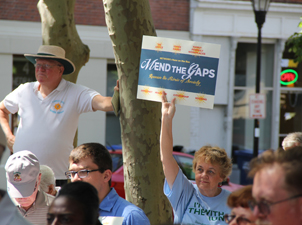
Applying NETWORK’S 2020 Mend the Gaps policy vision locally, I focus on the wage gap for fast food workers, home care workers, child care workers, and adjunct faculty and their employers. As faith leaders and justice-seekers, we are encouraged to accompany them on such action steps as:

  • Going out on strike when the workers exercise their legal right to strike without fear of being fired, connect them to the media ( we are not their voice, we amplify their voice)
  • Securing signatures for referendum ballot initiatives and petitions, writing letters to the Editors, speaking out on talk radio and social media
  • Joining with workers in the exercise of civil disobedience to witness to injustice
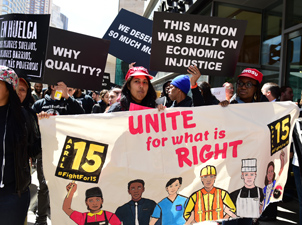
  • Accompanying workers at rallies to demonstrate the need to shrink the wage gap, secure health care coverage, and sick leave and a family-friendly work place. (Remember the acompañamiento model, from the experience of women in Nicaragua working with Canadian social workers. Accompaniment is best characterized by nonintrusive collaboration, mutual trust, agreement on the social ill, egalitarian spirit, commitment to solidarity, and an agreed upon plan of action)
  • Joining with a worker when they go to court, traveling to the state capital to educate elected officials to pass minimum wage laws- $15 and a union

Solidarity means working with organizations across our communities and states in a unified manner to carry out shared goals. That means we meet with them, create implementation plans, and support the identified lead agencies. Cohesion is a challenge as each organization has a unique mission and they often have differing approaches. This requires the hard work of identifying, analyzing and planning strategy. It can mean compromise, lining up behind others, and bringing our members along to support others.

The power of working in unison with others is:  strength in numbers, voices, and the ability to leverage structural change and increase wages. This is not a one way street. Reciprocity is the ingredient needed to make this work. We are there for each other, standing in solidarity, no matter whether the issue is ecological reforms, payday lending regulators, health care coverage or minimum wage increases.

Alice Kitchen is a NETWORK board member, Co-member of the Sisters of Loretto, Adjunct Professor at the University of Missouri-Kansas City, School of Social Work, and retired Licensed Social Worker.

View the full Catholic Social Justice Reflection guide here.

View the Lent Calendar to take action on healthcare here.

Becoming Eagerly Engaged

Becoming Eagerly Engaged

By U.S. Senator Catherine Cortez Masto (D-NV)
From NETWORK’s Catholic Social Justice Reflection Guide

Over 60 years ago, my father and mother met in Las Vegas, Nevada. My father, the son of a Mexican immigrant, got his start parking cars at the Dunes Hotel and eventually rose to become the head of the Las Vegas Convention and Visitors Authority – working to help build Las Vegas into the premier destination it is today. My father, Manny Cortez, lived his life following three principles: work hard, be honest, and respect everyone.

If it were not for my grandparents and parents’ hard work and the opportunities this country afforded them, my sister and I would have not been the first in our family to graduate from college and I would not be serving as the first Latina senator in the U.S. Senate.

For me, the appeal of public office has never been about the spotlight or political influence. It has always been about giving back – an important principle my parents taught me from a young age. I ran for public office because I want to give back to the community that has given so much to my family.

I’ve spent my career working to solve problems. As Nevada’s attorney general, I introduced over 40 bipartisan bills that were signed into law by a republican governor. As Nevada’s newest U.S. Senator, I will work to find common ground with my new colleagues to end the gridlock in Washington and get to work on the issues most important to Nevadans.

I also believe in ensuring the most vulnerable among us have the opportunities they need and deserve to succeed. When I first ran for public office and later for Senate, I promised that I would be a voice for those who have often been neglected. That’s why I have been a tireless advocate for human rights issues, especially domestic violence and sexual assault prevention. When women are given the support and tools they need to succeed, our communities thrive. That is why I am committed to passing equal pay for equal work legislation, raising the minimum wage, and passing comprehensive immigration reform to keep hardworking immigrant families together.

While we have a president who has wasted no time putting the anti-immigrant, misogynist, xenophobic rhetoric he campaigned on into dangerous action, I will continue fighting every day for an America that is inclusive and welcoming, not one that divides us and takes us backwards. But I cannot do it alone. We must all become eagerly engaged in our communities. Together, our voices and our actions can, and will, make a difference.

Senator Catherine Cortez Masto represents the state of Nevada. As a former attorney general, she has championed the rights of the vulnerable and fought for comprehensive foreclosure reform.

View the full Catholic Social Justice Reflection guide here.

View the Lent Calendar to take action on healthcare here.

Is There Reality in Funding the Federal Government?

Blog: Is There Reality in Funding the Federal Government?

Sister Marge Clark
March 13, 2017

Funding for the current fiscal year ends on April 28. Congress needs to complete plans for funding the federal government for this current fiscal year and at the same time begin to create a budget for 2018.   Since Congress is on recess for four weeks before the April 28 deadline, there are only five weeks to get the job done. Decisions on appropriations will impact a number of NETWORK “Mend the Gap” priorities, but three programs are particularly vulnerable:  housing support for those in poverty, healthcare funding and funds to conduct the 2020 Census.

We know that funding for these programs mean so much to the lives of those in poverty.  Pope Francis reminds us that, behind every statistic, there is the face of a person who is suffering, … “Poverty has a face! It has the face of a child; it has the face of a family; it has the face of people, young and old. It has the face of widespread unemployment and lack of opportunity. It has the face of forced migrations, and of empty or destroyed homes.”

Housing vouchers are particularly at risk for this year. The current budget allotted $500 million less than the amount needed to fund currently held vouchers for the rest of the year. CBPP estimates that more than 100,000 vouchers could be lost in the next few months. 100,000 households could become homeless unless we can secure new funding.

The Affordable Care Act continues to be under attack.  One of the key ways opponents may move to cut the program is to defund its operating system.  House appropriators, for several years have denied the Center for Medicare and Medicaid Services and the IRS new funding to cover the administrative costs of ACA implementation.   These funds and more are at serious risk.

Past decennial censuses have tended to undercount communities of color, people experiencing poverty, immigrants, young children, Native Americans and rural residents. The systematic undercounting of these communities decreases their access to federal funding and proportional representation. If the Census Bureau does not receive increased funding to conduct necessary tests and prepare for 2020, we fear that these gaps in the census will persist.

This year, the funding decisions are particularly daunting, as the administration and many House Republicans are determined to increase military spending while adhering to the top level spending caps established in the Budget Control Act, 2011.  Doing this necessitates cuts in non-defense spending – mostly human needs programs – in order to not exceed the caps.

Further, at the Trump Administration request, Congress is considering a 2017 Supplemental Budget.   They propose that it would cover the added cost of the President’s “deportation force,” which we have seen escalate its activities in the last week.  It would include some war costs, but mostly would cover the cost of President Trump’s Border Wall which ranges from estimates $8 billion to $21 billion.  Removing this from the FY 2017 appropriations does not relieve all of us from paying for it. We would still need to fund the Supplemental through our tax dollars.  NETWORK will actively work to stop this bill.

In addition to completing work on the FY 2017 Appropriations, Congress faces passage of a Budget for FY 2018 – which goes into effect October 1, 2017.  They have yet to receive direction from the President, other than broad statements of cutting non-defense spending by a stunning $3.7 trillion over ten years. This equates to a 43 percent drop in meeting the basic support of people with limited income.

Increases in military spending and unwillingness of Congress to increase revenue put the burden of balancing the budget on the backs of people in need by reducing spending on human needs such as housing, healthcare and the census. This is in direct opposition to what NETWORK Lobby and Advocates for Catholic Social Justice continue to work to achieve. It is imperative that all of us engage with our members of Congress frequently to influence their spending decisions. We need to work hard to protect the dignity of all people in our communities.

Something Which Can Never Be Taken Away

Something Which Can Never Be Taken Away

By James Luisi
From NETWORK’s Catholic Social Justice Reflection Guide

Last spring I went to jail for the first time. Not because I had been charged with any crime or because I had been arrested—I was with a group of students from Boston College’s School of Theology and Ministry. We were in jail together that Sunday morning, seeking to pray and break bread with the inmates.

I suppose the jail matched what I could imagine based off a season of Orange is the New Black. The walls were painted cinder block. The doors locked behind us wherever we went. Corrections officers were stationed periodically throughout the hallways, buzzing us through.

I wasn’t even sure why I was there that morning or what I was expected to do. As part of a school-wide week-of-service, some of us had the opportunity to go to the jail to do “prison ministry” but I had no clue what that actually meant. Was I expected to talk to the prisoners? Counsel them? Tell them about God?

I breathed a sigh of relief when I learned I wouldn’t be going alone through the jail that day. Our task would be rather straightforward and simple: my fellow student and I would go with the seasoned chaplain to three locations in the prison; we would celebrate a communion service with a pre-written reflection from the chaplain and offer the prisoners a chance to say a word or two about the readings if they felt so called; and then we would pack up and go to the next location. I took comfort in the simple formula that our day would follow, knowing there was not much I could mess up so long as I didn’t miss getting buzzed through a door.

I don’t really know anything about the men I met in the jail that morning. I quickly learned that I was not being asked to “do” anything for them. There was nothing to do. The simple act of being present, of acknowledging the fundamental human dignity of the men in jail that day by praying with them, by sharing the Eucharist with them—that was all I could do.

Society often values human life only by what it can contribute to its prosperity. Most people might even agree with the reasonable-sounding idea that, for the most part, society should be structured to give to each person that which they have earned. It’s hard to argue with the logic of a meritocracy—if you work hard, you should be able to get ahead in life; if you pursue higher education, you should make more money doing less strenuous work; if you have an innovative idea, you should profit from your ingenuity.

People in jail are severely limited in their ability to contribute to society. In fact, they have been removed from society precisely so that society can extract a debt from them. It is not for me to say whether or not the men I met that day merited their sentences; in fact, many if not all of them may have been duly processed for a law they had broken.

But this is precisely the point. Human dignity is not only something which cannot be earned, it is also something which can never be taken away, even if one has committed a heinous offense. What I learned by praying with those in jail is that human dignity radically transcends both merit and demerit—nothing can add to nor detract from the humanity of any human being, in any circumstance, ever. A person couldn’t even renounce his or her own human dignity, so intrinsically is it linked to their very being!

We should be able to agree that those things which are necessary to uphold the human dignity of our fellow sisters and brothers—things like nutrition, shelter, healthcare, community, the opportunity to participate in society—are things for which no one must prove merit. Then, perhaps, we can begin to have a reasonable debate about how we can go about providing these things to all people. This might sound pretty radical, but then again, that’s human dignity.

James Luisi is a third year student at the Boston College School of Theology and Ministry, and a former NETWORK Government Relations Associate.

View the full Catholic Social Justice Reflection guide here.

View the Lent Calendar to take action on healthcare here.

Blog: NETWORK Evaluates New Healthcare Bill

NETWORK Evaluates New Healthcare Bill

Lucas Allen
March 7, 2017

NETWORK Lobby for Catholic Social Justice released our “10 Commandments of Healthcare,” a set of principles grounded in Christian faith and a concern for the common good. We know that healthcare is a human right that is essential for a dignified life, so each of these commandments seeks to protect that right to healthcare and provide health security for all.  Each of these principles form the fabric of a just healthcare system that cares for people living in or near poverty.

NETWORK’s test for any ACA replacement bill is simple: Does the bill protect access to quality, affordable, equitable healthcare for vulnerable communities? After reviewing the House GOP replacement bill, the answer is a resounding no. Instead of providing greater health security, the bill increases costs for older and sicker patients and drastically cuts the Medicaid program, all while providing huge tax cuts to wealthy corporations and individuals. This is not the faithful way forward and must be rejected.

Two House committees will begin “marking up” the health bill tomorrow. Democratic members of the Committees will offer amendments to expand coverage and protect Medicaid during the process but it is not anticipated they will be successful. The bill would then move to the Budget Committee next week then finally to the House floor likely the week of March 20th.

It is imperative that advocates voice opposition to the current form of the bill because silence will be interpreted as satisfaction.  Action now will impact the direction of the bill in the House and in the Senate, the body advocates believe is our best chance of stopping a bad bill.

How Does the GOP Bill Stack Up Against the 10 Commandments of Healthcare?

The following is a comparison of the House GOP plan – the American Health Care Act (AHCA) – with the principles outlined in the 10 Commandments of Healthcare.

1. Thou shalt provide affordable insurance and the same benefits to all currently covered under the Affordable Care Act.

FAILED: The AHCA would cause millions of people to lose access to health coverage. Policy changes would particularly harm people who are older, sicker, and less wealthy.

2. Thou shalt continue to allow children under the age of 26 to be covered by their parents’ insurance.

PASSED: The bill maintains the ACA provision that allows young adults to stay on their parents’ plan through age 26.

3. Thou shalt ensure that insurance premiums and cost sharing are truly affordable to all.

FAILED: This plan would make premiums and cost sharing far less affordable for millions of Americans. It repeals the ACA tax credits that were used by more than 10 million families in 2016, and offers smaller tax credits that do not adjust by income.

4. Thou shalt expand Medicaid to better serve vulnerable people in our nation.

FAILED: While the AHCA does not end the Medicaid expansion immediately, it would freeze enrollment in the year 2020. At that point, states would no longer be able to sign new enrollees up for the program, reversing the unprecedented coverage gains made since the passage of the ACA.  Not only does the AHCA end Medicaid expansion, but it threatens the entire Medicaid program with massive cuts.

5. Thou shalt not undercut the structure or undermine the purpose of Medicaid, Children’s Health Insurance Program (CHIP), and Medicare funding.

FAILED: The AHCA would end Medicaid as we know it in order to cut and shift Medicaid funding to tax breaks for the wealthy. It converts Medicaid to a per-capita cap, which would cap funds and force states to cut eligibility and benefits for the millions of children and families, seniors, and people with disabilities who rely on Medicaid today.

6. Thou shalt create effective mechanisms of accountability for insurance companies and not allow them to have annual or lifetime caps on expenditures.

HALF-FAILED: While the AHCA keeps the ACA ban on annual and lifetime limits, it removes many mechanism of accountability for insurance companies.

7. Thou shalt not allow insurance companies to discriminate against those with pre-existing conditions.

HALF-FAILED: The AHCA does not repeal the ACA ban on discriminating people with pre-existing conditions, but it makes it more difficult for people who have failed to maintain continuous coverage to get insurance. This will disproportionately impact people with pre-existing conditions and leave many with higher premiums.

8. Thou shalt not allow insurance companies to discriminate against women, the elderly, and people in poverty.

FAILED: The AHCA would allow insurers to charger older enrollees far more, which could leave the elderly with prohibitively expensive premiums on the individual market. It would also impose harsh penalties on people who fail to maintain continuous health care coverage, which would disproportionately affect people in poverty. People who struggle to get affordable coverage should be assisted, not punished and locked out of the insurance market.

9. Thou shalt provide adequate assistance for people enrolling and using their health coverage.

FAILED: The AHCA does not provide assistance for people enrolling, but actually makes it more expensive for people to enroll if they have gone without insurance for 63 days. This could lock out people who have lost coverage and want to enroll.

10. Thou shalt continue to ensure reasonable revenue is in the federal budget to pay for life-sustaining healthcare for all.

FAILED: The House GOP bill gives a massive $525 billion dollar tax breaks to the very wealthiest and corporations with the richest 400 families receiving a 7 million dollar tax break a year.  Meanwhile, there are $200 billion new taxes on working families.  The bill has not been officially scored by the non-partisan Congressional Budget Office although budget experts believe there will be significantly less revenue generated to assist low income individuals and families.