


Category Archives: Mend the Gap

Blog: Income Gap Continues to Widen – Shouldn’t It Be Decreasing?

Blog: Income Gap Continues to Widen – Shouldn’t It Be Decreasing?

Matthew Shuster
Oct 11, 2011

The wealth gap in the United States has grown larger, and the ugly beast is not done growing. According to an article on the Huffington Post’s official website, the median income for the United States is less than $27,000 annually.

Meanwhile, the wealthiest, much-smaller portion of the American population who make over a million dollars has increased to 94,000 people. In comparison, in 2009, 79,000 people made over a million dollars. How can it be that the richest people in America continue to get more and more money while a much larger number of people are struggling to make ends meet with just $30,000 to 40,000 a year (If that!)? Pretty soon, there will be no middle-class, just two teams: The Strugglers who must obsess over grocery shopping coupons and the Exuberantly Wealthy.

People have a right to feel pessimistic about the unemployment rate and salaries in America. Not only are the unemployed unhappy financially, but even people who already have jobs are upset because necessities like food and fuel are becoming more and more expensive while their incomes are not increasing. According to the Huffington Post, nine in ten employees do not expect a raise in the upcoming year. Furthermore, household income has declined more during this “recovery” period than during the initial impact of the economic recession.

Something must be done to mend this income gap and there should be more jobs created for the unemployed. In addition, I hope that there will be more salary rewards given to the already-employed who work hard to care for their families. If you would like to read into this further, check out this article!

Blog: My Reaction to New Poverty Statistics

Blog: My Reaction to New Poverty Statistics

Claire Wheeler
Sep 20, 2011

Last week, the Census Bureau released its data on 2010 poverty statistics.  I found the following numbers particularly disturbing:

  • 1 in 6 Americans lived in poverty in 2010.
  • Incomes fell 4-5% for American households in the bottom 20%, more than 6 times as much as those in the top 20%.
  • More than 1 in 5 children are living in poverty. This issue is compounded by the fact that the racial and ethnic wealth gap also expanded in 2010. This is demonstrated by the fact that approximately 40% of African American children live in poverty, while only 12% of Caucasian children are living in poverty.
  • Over 40% of single-mother families lived below the poverty line, compared to 8.8% of families headed by a married couple. Furthermore, more than half a million single women who worked full-time, year round, lived in poverty.

After these 2010 figures were announced, I attended “Poverty and Income in 2010: A Look at the New Census Data and What the Numbers Mean,” a panel arranged by the Brookings Institution. The panelists represented a wide range of ideologies and advocated differing prescriptions for our country’s poverty dilemma. These prescriptions ranged from blaming personal irresponsibility to fully adopting President Obama’s American Jobs Act. One panelist even insinuated that we should put the needs of the most vulnerable on hold until the nation is financially “able” to address that problem. Essentially, the growing wealth gap was of no concern to this panelist.

These opinions were frustrating, needless to say, because although personal responsibility is relevant, it should not be used as a gross overgeneralization for condemning millions of people in situations beyond their control. People need to be provided with the opportunity and resources before being expected to take responsibility for their reality. We also know that people across socioeconomic stratifications are looking for jobs, but we cannot ignore the most vulnerable in our society in our attempts to stimulate our economy. Drastically uneven income growth is harmful to our nation.

The severity of the poverty numbers is best understood when looking through the lens formed by the majority of the panelists’ testimonies: 1) The 2007 economic recession was much worse than we realized, and will require more drastic steps to repair, 2) Government programs are necessary to diminish the poverty level in our country, and 3) It is feasible to simultaneously lessen the poverty rate while decreasing our nation’s deficit.

Indeed, the new data released by the Census Bureau was altogether grim, to put it lightly. However, there were a couple of positive points that are worth highlighting:

  • The poverty rate did NOT increase significantly among senior citizens. This can be attributed to safety net programs like Social Security; and
  • The American Recovery and Reinvestment Act (ARRA) of 2009 prevented 4.5 million people from entering poverty.

Through government policy, we can make things better or worse. It is with hope that we look to Obama’s jobs proposal, which one of the panelists predicted will bolster the safety net, keeping 1.5 million fewer people in poverty by extending unemployment insurance. She also predicted that it will create/ save jobs for an additional 1.5 million people, to prevent a total of 3 million people from slipping below the poverty line. Ultimately, jobs are the best antipoverty strategy, and we must be active in voicing our concerns to our representatives, which will help ensure that they enact steps to alleviate the weight of our nation’s predicament.

For more information on the poverty statistics, click here.
The Isle of the Dogs

The Isle of the Dogs

Aug 18, 2011
By Page May

Below is a favorite story of mine. It illustrates the logic behind failed poverty alleviation using the metaphor of an island with 100 dogs.

We are immediately limiting the success of anti-hunger and anti-poverty programs when we ask “Why are the poor poor?” instead of “Why is there poverty?”

“There once was an island with a population of one hundred dogs. Every day a plane flew overhead and dropped ninety-five bones onto the island. It was a dog paradise, except for the fact that every day five dogs went hungry. Hearing about the problem, a group of social scientists was sent to assess the situation and recommend remedies. The social scientists ran a series of regressions and determined that bonelessness in the dog population was associated with levels of bone-seeking effort and the boneless dogs also lacked the important skills in fighting for bones. As a remedy for the problem, some of the social scientists proposed that boneless dogs needed a good kick in the side to get them moving, while others proposed that boneless dogs be provided special training in bone-fighting skills. A bitter controversy ensued over which of these two strategies ought to be pursued. Over time, both strategies were tried, and both reported limited success in helping individual dogs overcome their bonelessness- but despite this success, the bonelessness problem on the island never lessened in the aggregate. Every day, there were still five dogs who went hungry.”

Or, as Obama put it in 2005:

“It is time for us to meet the why of today with the why nots we often quote but rarely live- to answer ‘why hunger’ and ‘why homelessness’, ‘why violence’ and ‘why despair’ with ‘why not food jobs and living wages’, ‘why not better health care and world class schools’, ‘why not a country where make possible the potential that exist in every human being?’”

-Barack Obama at the Robert Kennedy Human Rights Award Ceremony in November 2005

Blog: Letters to the Editor

Blog: Letters to the Editor

Mary Georgevich
Aug 11, 2011

Blog: Letters to the Editor

Letters to the Editor

Workers’ Wages Chasing Corporate Profits,” “American Millinoaires: 1,400 Paid No US Income Taxes in 2009,” “Making More, Contributing Less” – in the past few weeks, wealth dispaity has made it into some big headlines. It is headlines like these that open the door for your comments and perspectives to be shared in the media in a letter to the editor. This is a great way to help spread the word about the campaign and educate about the wealth gap. Writing letters to local and diocesan papers (as opposed to national newspapers) will increase your chances of getting it published, and will help you reach people in your community.

We’ve compiled instructions and useful letter-writing tips here and talking points to use in a Mind the Gap! letter to the editor can be found here.

The letter at the top was published by a Mind the Gap! supporter. Thanks, Rose Mary, and all of you who are starting conversations about the wealth gap in your area. Let us know how your conversations are going by leaving a comment here, or sending an email to [email protected].

Blog: The Danger of Losing the Middle Class

Blog: The Danger of Losing the Middle Class

Samuel Fubara, NETWORK Intern
Jul 15, 2011

The American middle class is fast being relegated to the political background by big businesses. The relegation in question is two-fold, economic and political, both of which are inextricable. We know that a middle class is the most essential feature of a functioning democracy because civil society, the part of society that discuses the nation’s direction, exists in the middle class. Hence, the effects of the aforementioned relegation leave our democracy on a very tenuous foundation.

From the political point of view, big businesses are able to push a conservative agenda and finance conservative candidates. The Supreme Court’s 2010 decision in Citizens United v. Federal Election Commission exacerbated this problem. In that decision, the Supreme Court held that corporate funding for political candidates is protected under the first amendment and as such cannot be limited. The day the Supreme Court made its decision in Citizens United, President Obama called it a major victory for health insurance companies and other major corporations that drown out the voices of everyday Americans. At the time, Lainie Rutkow, an assistant professor at Johns Hopkins’s School of Public Health, remarked that with the recent efforts at healthcare reform, insurance companies can now select candidates who support their interests and devote unlimited funds to their campaigns to secure their elections or reelections. This has been deleterious to the interests of people who are poor, most of whom depend on programs like Medicare and Medicaid.

The president’s statement portended the situation we are facing today with a majority of the Republican members of Congress fighting to ensure that the benefits of the rich remain intact while Medicare, Medicaid, TANF and other social safety net programs are cut. These programs provide more than a social safety net, they provide a political safety net because they prevent people from falling out of the middle class, the very essence of democracy. Hence, other than the moral obligation we have to people in poverty, given every human being’s dignity, we have a practical interest in ensuring that their lot is bettered so that the ranks of the middle class are increased.

We face a situation worse than the relegation of the middle class. The United States is at a crossroads where its policies are rapidly leading to the complete erosion of the middle class. With the loss of the middle class, capitalism and democracy, as we know them, are likely to devolve into a modern feudalism where people at the economic margins, a group consisting of most Americans, will be left at the mercy of big businesses, in an arrangement of permanent economic subjugation.

Measure More than GDP!

Measure More than GDP!

By Shannon Hughes
July 11, 2011

What if we cared enough about our wellness as people to run statistics about it on a ticker in Times Square? In the Philippines, governors compete for prestige by reporting on and their economic accomplishments, but also their people’s rank according to  the United Nations’ Human Development Index. Government in the US, however, doesn’t officially use this data, instead focusing on stock prices and the GDP to tell us something about the success of our country.

Sarah Burd-Sharps, co-author of The Measure of America, knows that we can’t stop there. By calculating a single number based on the three basic standards of the Human Development Index – health, education, and income –The Measure of America gives us another look at how America measures up. Not surprisingly, inequalities abound across gender, race, and geography. The good news is, we can visit and understand the places that are doing well, and strategically focus policies to decreases the “entire century of progress [that] separates New Jersey’s Asian Americans and South Dakota’s Native Americans” in terms of life expectancy. Check out this video to hear Burd-Sharps explain her work more fully. Ready for more facts? Check out http://www.measureofamerica.org/ for interactive resources including a Common Good Forecaster and a personal Well-o-Meter.

The Spirit Level

The Spirit Level

Jean Sammon
June 30, 2011

Many of us at NETWORK were intrigued by The Spirit Level – Why Greater Equality Makes Societies Stronger, the book that shows why a less-equal society is bad for everyone.

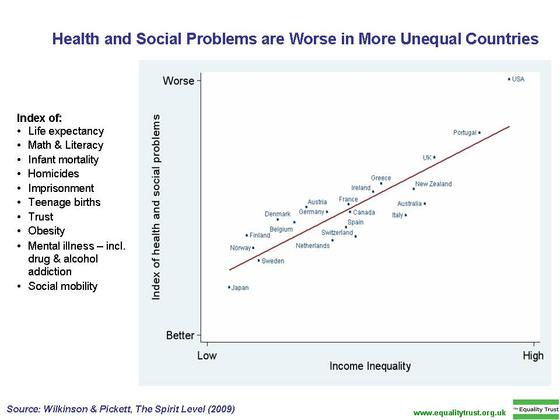
The authors – Professors Richard Wilkinson and Kate Pickett – did extensive research on various social problems in developed nations and found a correlation between a nation’s income inequality and social problems. The chart above shows that correlation.

Note that the U.S. has the highest level of income inequality of all the other developed nations, and also the highest level of social problems.

(The book has charts showing the correlation for each of the social problems listed. You can also find them at: www.equalitytrust.org.uk/resources/other/TSL-slides)


A Matter of Trust

What surprised me the most was that “trust” was included as a social problem. But after reading the chapter on trust I now understand why the level of trust is a problem. Here’s what I found:

“Changes in inequality and trust go together over the years. With greater inequality, people are less caring of one another, there is less mutuality in relationships, people have to fend for themselves and get what they can – so, inevitably there is less trust. Mistrust and inequality reinforce each other. . . . we are less likely to empathize with those not seen as equals; material differences serve to divide us socially.” (p.56)

How is the level of trust measured?

For the U.S. it’s the National Opinion Research Center’s General Social Survey question that asks people whether or not they agree that most people can be trusted. In 1960, 60 percent of respondents agreed. By 2004, this had fallen to 40%.

This isn’t good. Because when people don’t trust each other they don’t cooperate with each other. This erodes ‘social capital’ which is a term used to describe people’s involvement in community life.

Political scientist Robert Putnam says that “. . . citizens in high social capital states [are] likely to do more to reduce inequalities, and inequalities themselves [are] likely to be socially divisive.” (p. 55)

The authors of The Spirit Level believe that “inequality increases the social distance between different groups of people, making us less willing to see them as ‘us’ rather than ‘them’”. (p. 62)

All this sounds believable to me.

The other chapters in the book discuss the other social problems listed above. But I think the heart of the book, and perhaps the reason the book is titled The Spirit Level, is the chapter about trust, which is titled “Community life and social relations.”

What kind of community life and social relations do we envision for our country? Can we achieve it with such a high level of wealth and income inequality, and such a low level of trust?

Click here to return to main Blog page

Click here to check out, learn more, and join the Mind the Gap! campaign

Wealth Gap Featured on Washington Post’s Front Page

Wealth Gap Featured on Washington Post’s Front Page

Stephanie Niedringhaus
June 23, 2011

The front page of Sunday’s Washington Post (6/19/11) included another chilling article about growing disparities in our nation. Under the heading, “Breakaway Wealth; The Pay Bubble,” one article (“Income gap widens as executives prosper”) included information about how executive compensation rose sharply in recent years while the wealth gap also grew dramatically. During the 1950s and 1960s, it noted, executive pay was relative flat. The steep rise began in the 1970s.

The fact that executive pay was flat when companies were growing in the ‘50s and ‘60s shows that current excuses for excessive compensation – i.e., that executive salaries rise naturally when firms grow – are inaccurate.

Many of today’s executives enjoy luxurious lifestyles while millions of people struggle to put food on the table. According to the article, “The evolution of executive grandeur – from very comfortable to jet-setting – reflects one of the primary reasons that the gap between those with the highest incomes and everyone else is widening.”

Do you want to learn more? Check out the Washington Post.

And be sure to sign up for our Mind the Gap! campaign by clicking here. You can be part of the movement to address this injustice!

Blog: Washington Post Highlights Wealth and Income Disparities

Washington Post Highlights Wealth and Income Disparities

By Stephanie Niedringhaus
June 20, 2011

The front page of Sunday’s Washington Post (6/19/11) featured another chilling article about growing disparities in our nation. Under the heading, “Breakaway Wealth; The Pay Bubble,” one article (“Income gap widens as executives prosper”) included information about how executive compensation rose sharply in recent years while the wealth gap also grew dramatically. During the 1950s and 1960s, it noted, executive pay was relative flat. The steep rise began in the 1970s.

The fact that executive pay was flat when companies were growing in the ‘50s and ‘60s shows that current excuses for excessive compensation – i.e., that executive salaries rise naturally when firms grow – are inaccurate.

Many of today’s executives enjoy luxurious lifestyles while millions of people struggle to put food on the table. According to the article, “The evolution of executive grandeur – from very comfortable to jet-setting – reflects one of the primary reasons that the gap between those with the highest incomes and everyone else is widening.”

Do you want to learn more? Check out the Washington Post.

And be sure to sign up for our Mind the Gap! campaign by clicking here. You can be part of the movement to address this injustice!

Blog: Race, Wealth, and Intergenerational Poverty

Blog: Race, Wealth, and Intergenerational Poverty

Page May
Jun 10, 2011

Blog: Race, Wealth, and Intergenerational Poverty

Article: There will never be a post-racial America if the wealth gap persists.

From The American Prospect-

“Since the election of Barack Obama, a growing belief has emerged that race is no longer a defining feature of one’s life chances. But the extraordinary overlap between wealth and race puts a lie to the notion that America is now in a post-racial era. The smallest racial wealth gap exists for families in the third quartile of the income distribution where the typical black family has only 38 percent of the wealth of the typical white family. In the bottom income quartile—the group containing the working poor—a black family has a startlingly low 2 percent of the wealth of the typical white family.

Given the importance of intergenerational transfers of wealth and past and present barriers preventing black wealth accumulation, private action and market forces alone cannot close an unjust racial wealth gap—public-sector intervention is necessary…However, wealth, given the racial disparity of its distribution, can be an effective non-race-based instrument to eliminate racial inequality. We could shift from an income-based to a wealth-based test for transfer programs. Policy eligibility based on net worth below the national median would qualify a large proportion of black households…. These changes in eligibility should be coupled with policies to promote asset building.”

Read more here.