

Category Archives: Front Page

Working Towards Transformation in our Country

Working Towards Transformation in our Country

Sister Emily TeKolste, SP
August 13, 2020

Everyone knows how difficult it can be to have a conversation about politics or current events with someone you disagree with. But avoiding these conversations is contributing to our nation’s increasing polarization, not to mention the harmful effects of this division on family and community ties.

In May, I presented NETWORK’s Transformative Conversations to Bridge Divides training to NETWORK advocates from Philadelphia and Pittsburg. About 20 participants came together online to learn and practice ways to foster productive conversations and create the conditions needed for transformation to occur. Some of the key takeaways and commitments from participants included, “doing more preparation before difficult conversations,” “approach potentially confrontational conversations with a little less arrogance,” and “think more carefully about the other person when I need to have a difficult discussion.”

After the training, Gerri in Philadelphia found “There are constructive, concrete, successful ways we can have meaningful conversations with those we love who have opinions other than ours.” As we approach the November election, NETWORK will provide additional opportunities for all members of our Spirit-filled network to participate in this Transformative Conversations training, as well as other trainings and activities. Together we can transform our policies and our nation!

PHOTO: Participants learn how to build the foundation for transformative conversations.

5 Steps to a Healthy, Transformative Conversation

  1. Be Curious
    Seek to learn about the other person’s perspective
  1. Listen
    Listen fully and attentively, with an open mind
  1. Review
    Repeat back what you heard to make sure you understand correctly
  1. Validate
    Acknowledge what they said, even if you feel differently
  1. Express
    Share your truth, your assessment of the issue, your reasoning

Learn more: networkadvocates.org/transform

This story was originally published in the Third Quarter 2020 issue of Connection magazine. Read the full issue


Voting Under the Sign of the Cross

Voting Under the Sign of the Cross

Putting Our Focus on the Margins
Meghan J. Clark
August 13, 2020

In the wake of the murders of George Floyd, Ahmaud Arbery, and Breonna Taylor, our communities powerfully cry out for racial justice. The global COVID-19 pandemic remains, it has not dissipated, despite growing public fatigue with mitigation measures. Amidst all of this, we struggle to maintain voting rights in primaries and in preparation for November. NETWORK and its partners have tirelessly worked on issues of racial and economic justice for decades. The issues are not new, unknown, or unstudied; and yet, something about 2020 feels different.  The collective albeit deeply unequal experience of COVID-19’s vulnerability, suffering, and death has inescapably interrupted our business as usual attitude.

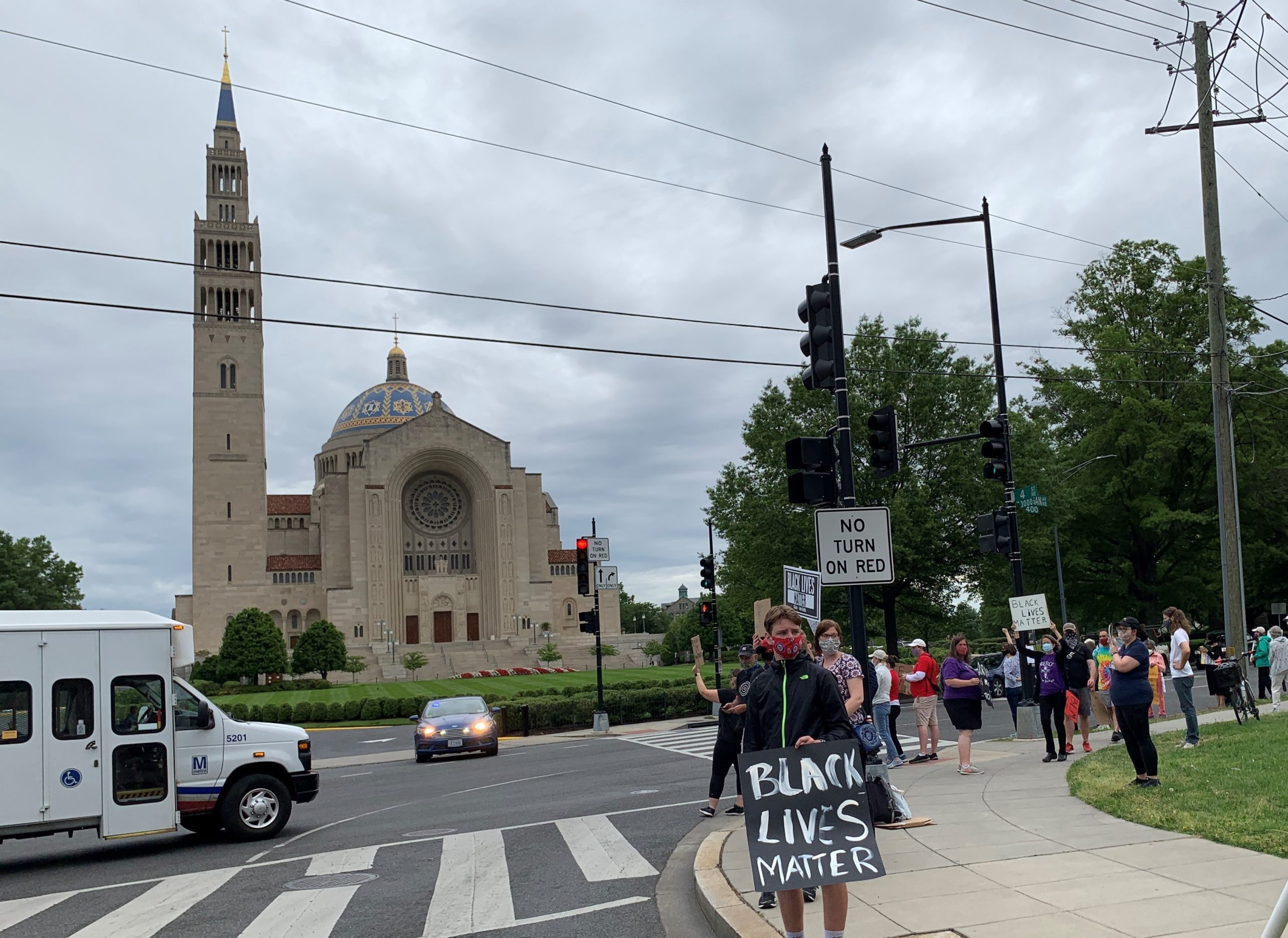
Today there is a growing chorus of people demanding a more just and equitable community. A chorus that rejects returning to a business as usual that benefits only the privileged while excluding millions. At marches in Rockaway, Queens, youth leaders pair a focus on racial justice alongside voter registration and census participation. Alongside chants of “Black lives matter!” you also hear, “Don’t just hope, get out and VOTE!”

Participation in the political, social, and economic life of the community is both our right and our responsibility. While not everyone is called to be an activist, all are called to actively work for the common good. Voting, in Catholic social teaching, is a moral obligation. Yet, as Christians, we are called to vote not motivated by own self-interest but by a commitment to the human dignity of all, an all-inclusive common good, and with a preferential option for the poor and vulnerable. Faithful discipleship, then, becomes a matter of solidarity and kinship in which all are equally sacred. In faithful citizenship, we are called to vote under the sign of the cross.

Beginning with the Crucified

In his first homily as pope, Francis prayed that we, as the people of God, may receive the grace to “to walk, to build, to profess Jesus Christ crucified.” In focusing our journey on Christ crucified, Francis draws individuals out of themselves and towards the margins of society. The task is two-fold: to focus our attention on those excluded from our societies while also recognizing the structures by which they are rendered invisible or expendable. Beginning with the crucified Christ illustrates the ways both individual dignity and structures of sin are inextricably linked.  When Francis labels inequality as the root of all social ills in his apostolic exhortation Evangelii Gaudium (EG), it is in recognition that it is “making it practically impossible to live a human life ruled by moral principles.”

Building on both Catholic social teaching and the prophetic insights of liberation theology, Pope Francis’s decries, “Human beings are themselves considered consumer goods to be used and then discarded. We have created a “throw away” culture which is now spreading.…those excluded are no longer society’s underside or its fringes or its disenfranchised – they are no longer even a part of it.” (EG 53).

Voting under the sign of the cross, then, asks us to begin our discernment from the perspective of the excluded, of those who suffer from institutionalized violence, those whom the martyred El Salvadoran Jesuit Ignacio Ellacuria called the crucified peoples. For Ellacuria, the cross focuses our attention on the “collective reality, grounding and making possible individual sins.”1 Talking about the reality of individual sin is not enough. Seeing the reality of our society’s crucified peoples requires those with privilege to face the uncomfortable and unavoidable complicity in social sin, of which in the United States, racism and white supremacy are paramount.

Nowhere is this clearer than in the call for racial justice in our country today. Professing Christ crucified, in all its historical complexity, has long been central in African American Christian ethics, most notably the work of Protestant theologian James Cone, who famously described the crucifixion as a first-century lynching.2 Reflecting on the current protests, Nigerian-American Sister Anne Arabome laments that God cannot breathe; “As the protests continue, I see people on the streets — breathing in and breathing out. In their voices I hear the God of life screaming and asking for space to breathe again.”3

Living Incarnational Solidarity

“A faith that does not draw us into solidarity is a faith which is dead, it is deceitful…faith without solidarity is a faith without Christ.”4 These provocative words, spoken by Francis on a pastoral visit in Paraguay, challenge us to see that solidarity and work for justice are at the very heart of the Christian faith. For Christians, Jesus is our model of solidarity and it is in practicing solidarity that we encounter Christ in our neighbor.

In the Gospels, both the Beatitudes and Matthew 25’s parable of the last judgement provide clear descriptive illustrations of the connection between solidarity with Jesus and solidarity with those on the margins, culminating in an uncompromising statement that whatsoever one does or does not do for the least, one does or does not do to the Son of Man himself. A radical identification of Jesus not with his followers but with those who are hungry, thirsty, imprisoned, etc.  Visual artists like Kelly Latimore powerfully concretize this for us depicting the Holy Family as migrants crossing a militarized border.5

“Solidarity is a wrenching task,” notes theologian M. Shawn Copeland, “to stand up for justice in the midst of injustice; to take up simplicity in the midst of affluence and comfort; to embrace integrity in the midst of collusion and co-optation; to contest the gravitational pull of domination.”6 Incarnational solidarity is deeply rooted in seeing one’s neighbor as the image and likeness of God, as the face of Christ in our midst. For Francis, “Solidarity must be lived as the decision to restore to the poor what belongs to them” (EG 189), a difficult task because “complacency is seductive” (Gaudete et Exsultate 137). In practice, this solidarity strengthens efforts to practice good politics, in which “everyone can contribute his or her stone to help build the common home.”7

A Community of Kinship and Justice

Both the image of the crucified peoples and the focus of incarnational solidarity ask us to reflect deeply on how we view the work around us and possibly change the position from which we participate in the political community. For Christians, the task of politics is to build a community of kinship, and justice. It is the recognition that we belong to each other and that we are all diminished by the exclusion and oppression of some. In his many books and TedTalks, Fr. Greg Boyle, SJ of Homeboy Industries challenges us to imagine a circle of kinship and then imagine it is big enough where no one is on the others side.8 For Boyle, Jesus does not provide us with easy answers but relentlessly asks, “Where are you standing?” The shift is at once a severe challenge but also freeing.

The fundamental starting point is where do you position yourself? With the marginalized and against marginalization? With the oppressed against their oppression? These seem like easy questions and yet for those like myself, a white woman in the United States, answering them honestly requires facing the ways in which my life has been aided by the white supremacy I recognize as sinful and evil. It requires humility in acknowledging one’s own complicity in systems of injustice, followed by a firm and persevering commitment to be anti-racist.

The Challenge of Radical Kinship and Politics

At this point, you may be thinking voting under the sign of the cross is impossible in U.S. politics. While it is true that Catholics who hold with the Church a consistent ethic of human dignity do not neatly fit into the U.S. political system, I wish to make two caveats before delving into the practical reflections on the type of political engagement envisioned above.

First, voting is always a bounded choice. There are no perfect candidates or political platforms. One advantage of Catholic social tradition’s approach to social ethics is that it recognizes the reality of both individual and structural sin. Our political engagement is aimed at bringing about greater justice and peace but recognizes that the fullness of either relies on God. By letting go of purity and perfection, we are freed to act for justice. This recognition, alongside a realistic appreciation of pluralism, also helps us act with humility, recognizing with Pope Francis that “growth in holiness is a journey in community, side by side with others” (GE 141).

Navigating voting and political participation amidst these complexities is a challenge. It requires practicing: see (learning about candidates’ records), judge (discern), act (vote/advocate). Whenever Catholics explore the meaning of “the preferential option for the poor” the list includes: the unborn, migrants, those living in poverty, the elderly, victims of human trafficking, etc. For many in the United States today, the challenge is most acutely felt in navigating their position on abortion alongside their solidarity with marginalized and minoritized peoples.

Personally, I find Pope Francis’s approach helpful for discernment. Cautioning against ideologies within the church which either avoid talking about God or avoid social justice, he states, “our defense of the unborn, for example, needs to be clear, firm, and passionate…equally sacred, however, are the lives of the poor, those already born, the destitute, the abandoned, and the underprivileged, the vulnerable infirm and elderly exposed to covert euthanasia, the victims of human trafficking. . . we cannot uphold an ideal of holiness that would ignore injustice” (GE 101). There is a unity and integrity to this image of “equally sacred” that is rooted in prioritizing those whose dignity is thrown away.

Equally sacred is not a capitulation or deflection. It does not deny the specific reality of injustice, the way “all lives matter” dismisses the need to specify Black lives matter. Instead it is a desire to be faithful to the Gospel, to standing with the crucified.  “A fundamental tragedy of this broken and sinful world,” notes theologian Cathy Kaveny, “is that the most vulnerable persons – the unborn, the disabled, the needy are often completely dependent upon persons almost as vulnerable as themselves.”9 The first step, according to Kaveny, is to listen and hear their voices. In U.S. politics, concern about abortion is often reduced to the question of criminal law. However, if we follow Jesus to the margins, it is difficult to treat any single issue as the only one of concern. Similarly, if we follow Kaveny alongside Boyle’s vision of kinship, it asks us to consider our policies on abortion from both the perspective of the unborn and the pregnant woman in crisis. In doing so, the nexus of concern expands far beyond mere criminalization of abortion.

Throughout his ministry, Pope Francis has implored us to pray with the Gospel, reject the throwaway culture, and be in kinship with the marginalized. When we do that, our understanding of building a pro-life community of solidarity must be a circle in which no one is left out. We position ourselves with Black Lives Matter,10 with migrants of all ages, and with those experiencing poverty and struggling to meet their basic needs.

As we head into election season, voting is one important way that we participate in the political life of our communities. It is an act of solemn discernment and conscience. In 2020, in the midst of a global pandemic, desperate cries for racial justice, and increasing economic need, it feels as if the stakes are quite high, and they are. Still, as people of faith, we begin by making sure we are standing in the right place as we discern, our focus on promoting the common good and building a community of solidarity in which none are excluded.

_____________________________________________________________________________

Meghan J. Clark, Ph.D., is an associate professor of moral theology at St John’s University (NY). She is a senior fellow of St. John’s Vincentian Center for Church and Society. From 2010-2013, she served as a Consultant to the United States Conference of Catholic Bishops Committee on Domestic Justice and Human Development. She is author of The Vision of Catholic Social Thought: the Virtue of Solidarity and the Praxis of Human Rights (Fortress Press, 2014) and co-editor of Public Theology and the Global Common Good (Orbis, 2106).

Sources:

  1. Ignacio Ellacuria, “The Crucified Peoples,” in Ignacio Ellacuria: Essays on History, Liberation, and Salvation, Edited by Michael E. Lee, (Maryknoll, NY: Orbis, 2013), p. 204.
  2. James H. Cone, The Cross and the Lynching Tree. (Maryknoll, N.Y.: Orbis Books, 2011).
  3. Anne Arabome, “I can’t breathe because God can’t breathe,” National Catholic Reporter, June 10, 2020 https://www.ncronline.org/news/opinion/i-cant-breathe-because-god-cant-breathe
  4. Pope Francis, “Visit to the People of Bañado Norte” (Address, Paraguay, July 12, 2015) https://w2.vatican.va/content/francesco/en/speeches/2015/july/documents/papa-francesco_20150712_paraguay-banado-norte.html
  5. Kelly Latimore, “Refugees: La Sagrada Familia” https://kellylatimoreicons.com/gallery/img_2361/
  6. Shawn Copeland, “Towards a Critical Christian Feminist Theology of Solidarity,” in Women and Theology, ed. Mary Ann Hinsdale and Phyllis H. Kaminski (Maryknoll, NY: Orbis, 1995), 18.
  7. Pope Francis, “Good Politics is at the service of Peace,” World Day of Peace Message 2019.
  8. Gregory Boyle, SJ, “Compassion and Kinship,” TEDxConejo 2012 https://www.youtube.com/watch?v=ipR0kWt1Fkc
  9. Cathleen Kaveny, “Could the Church take a risk?” Commonweal Magazine, August 10, 2018.
  10. Olga Segura, “What Black Lives Matter Can Teach Catholics About Racial Justice” https://www.americamagazine.org/politics-society/2019/02/01/what-black-lives-matter-can-teach-catholics-about-racial-justice
This story was originally published in the Third Quarter 2020 issue of Connection magazine. Read the full issue

Advocacy for Justice Continues… Virtually

Advocacy for Justice Continues… Virtually

Meg Olson
August 13, 2020

In response to the call to action on the April 2020 webinar, “NETWORK’s COVID-19 Response: Updates and Our Work Ahead,” Grassroots Advocates Teams and other NETWORK members and supporters from across the country held 24 meetings with their Senators’ offices in April and May to discuss what needs to be included in the fourth COVID-19 relief bill. As these were the first meetings held during the time of social distancing, NETWORK members and Senate schedulers worked together to coordinate these meetings to take place over the phone or via video conferencing.

Watch the COVID-19 Response webinar: www.networkadvocates.org/webinarrecordings

The specific topics of each of the meetings were chosen either based on the Senator’s position within leadership or key committee, or the NETWORK members’ advocacy interest and expertise. They included each of NETWORK’s seven Mend the Gap public policy priorities, as well as unemployment insurance, nutrition assistance, and caring for those who are incarcerated or in detention centers. Our Government Relations team helped prep advocates for their meetings and participated in calls held with Hill staff.

Read more about NETWORK’s COVID-19 legislative priorities:  www.networklobby.org/covid19.

Overall, NETWORK’s advocates found the virtual in-district and Hill meetings to be as effective as meeting in person. Sister Phyllis Tierny, SSJ of Rochester, New York joined with members of the LCWR Region 2 Justice Promoters Collaborative to discuss ensuring safe and fair elections and protecting all immigrants with Hill staff in Senator Gillibrand and Senator Schumer’s offices. One reason why she helped organize these meetings is because, “In these difficult and uncertain times, the issue of who can vote has become a priority as we look forward to the election in November.  Voting is both a privilege and a responsibility for all citizens and to be deprived of the opportunity because one is housebound or in danger of contracting the virus limits who can vote.” Sister Phyllis adds, “It was a privilege to interact with the legislative assistants of our New York Senators, knowing that they are sympathetic to these issues and will raise their voices in the Senate. One of the take-aways for me is the need for a different approach to work with legislators across the aisle. It is easy to think of politicians as ‘cardboard’ and talk at them. We need to find a way to engage their humanity and begin a different conversation!”

NETWORK is grateful for all of our members’ and supporters’ advocacy efforts around COVID-19, particularly for Black, Native American, and immigrant communities, as well as for those who are incarcerated or detained.

“The COVID-19 pandemic has laid bare the ways our federal government has failed to structure a society that cares for those most in need… The grave challenges facing the United States and the world are unprecedented and require a bold and compassionate response.”
From NETWORK’s COVID-19 Legislative Priorities Leave Behind

This story was originally published in the Third Quarter 2020 issue of Connection magazine. Read the full issue

When You Say

When You Say

Leslye Colvin
August 12, 2020

When you say,
“I’m not racist,”
you deny the complexity
of a system built on the racist ideas
born of white supremacy.

When you say,
“I don’t see color,”
you do not understand that
making judgements based
on color is the problem,
not seeing color.

When you say,
“I was taught to treat everyone the same,”
you deny the limitations of your being kind
when the system denies my dignity.

When you say,
“But, I’m a Christian,”
you deny the whitening of Jesus’ body
and the distortion of his Gospel
for economic gain through
the genocide of indigenous people,
the enslavement of Africans,
and other atrocities against
people of color.

When you say,
“My child is Black,”
you conflate your love for one person
with a love for all.

When you say,
“My family never enslaved people”
you deny how the injustices of slavery
were transformed to perpetuate
your illusion of white supremacy.

When you say,
“My ancestors were wronged for being Irish or Italian,”
you deny that people of Irish and Italian ancestry
now identify as white.

When you say,
“My ancestors arrived after slavery,”
you deny that their white skin
privileges you today.

When you say,
“The Constitution says all men are created equal,”
you deny ongoing legal battles to make it realized.

When you say,
“All lives matter,”
you deny our lived experience.

When you say,
“I want to learn,”
you take a step forward.

When you say,
“I want to be an ally,”
the hard work begins.

Leslye Colvin is the Communications Coordinator for Gathering for Mission, a project of Catholic Committee of the South inspired by Pope Francis that provides practicums in dialogue in dioceses across the country. She is also a member of the editorial team for the Center for Action and Contemplation’s Daily Meditations, and a member of the NETWORK Board. This poem was originally published on Leslye’s blog, Leslye’s Labyrinth, www.leslyeslabyrinth.blogspot.com.

This story was published in the Third Quarter 2020 issue of Connection magazine. Read the full issue.

Grief, Anger, and Sacred Imagination

Grief, Anger, and Sacred Imagination

Confronting Injustices in Our Midst

Protesters outside the White House in the days following the murder of George Floyd.

The litany of horrors in the last few months has at times overwhelmed us. The murder of innocent Black people and police attacks on peaceful protesters. The pandemic and the failure of the Trump administration to engage and lead. The necessary closing of business to protect each other from the disease and the resulting economic crisis. The effort to respond to the needs of our most vulnerable people brought Democrats and Republicans, House and Senate together for a brief moment as they crafted emergency legislation to respond. More action is needed though, to begin the healing in our nation.

As weeks have gone on, we have learned how the Black and Latinx communities have been disproportionately affected by the COVID-19 pandemic. In Wisconsin, Black people represent 6% of the population and nearly 40% of COVID-19 fatalities. In Kansas, 6% of the population is Black and yet Black people account for more than 30% of COVID-19 deaths. These are the communities who do not have the opportunity to work from home. The Labor Department reported 30% of white workers could work from home in 2017 and 2018, while only 20% of Black workers and only 16% of Latinx workers could do so. The front line workers who work in grocery stores, drive buses, work in hospitals are the most exposed, and their families and communities have paid a high price because of that. Native American communities have some of the highest COVID-19 rates per capita in the country. At the same time, tax revenues from tribal businesses used to operate hospitals and clinics have dropped to nearly zero.

Then we have the murder of George Floyd by the Minneapolis police and all of the reality of centuries of our original sin of racism. I don’t want to write another statement or say another lament, I want to CHANGE this behavior once and for all. Since it began tracking in 2015, the Washington Post has found that over 1,000 people are killed every year by the police and Black people, while only 13% of the population, are more than twice as likely to be a victim of police killing.

Then we have President Trump’s decision to use military force to clear peaceful Black Lives Matter protesters Lafayette Square across from the White House so he could pose for a photo holding up a Bible in front of St. John’s Episcopal Church. He violated both the constitutional rights and sacred human dignity of people so he could get a photo opportunity. To me this was the ultimate exercise of authority to reinforce and flaunt his white privilege.

In our work at NETWORK, we see the structures of white supremacy that have controlled the economic reality AND the political reality in this land since before the founding of our nation. Many of you have participated in our Racial Wealth and Income Gap experience, exploring 12 federal policies that created and perpetuate the inequality in our nation. Many of you studied our Recommit to Racial Justice guide that identifies and confronts the extent of white supremacy in our society, our politics, and our economy. I know that white people, like me, have so much to learn about racism and all of the small and large ways that my actions and my decisions perpetuate racial injustice. It is not a time just to lament, however. As we approach this year’s election in the face of these challenges, we must move beyond lamentation and engage.

In Gaudete et Exsultate, Pope Francis’s Exhortation on Holiness, he calls us to a full engagement to protect the dignity of all life. In this moment in the United States, I believe that dismantling racism must be a foundational part of any pro-life agenda. He says in Paragraph 101: “We cannot uphold an ideal of holiness that would ignore injustice in a world where some revel, spend with abandon and live only for the latest consumer goods, even as other look on from afar.” Even more so, we must live out the Pope’s message addressed to the people of the United States following the murder of George Floyd, “We cannot tolerate or turn a blind eye to racism and exclusion in any form and yet claim to defend the sacredness of every human life.”

This leads us to our work in this 2020 election. Black lives matter, and we must examine and transform all policies and systems that deny this sacred truth. We must promote the life of all of our people by changing policing to protect Black lives. We must promote life by ensuring that everyone in our nation has access to quality health care. We must promote life by guaranteeing that all can live in dignity with a roof over their heads and enough food on their plates. We must promote life by ending the economic inequality upheld by our tax laws. We must promote life by ensuring that our immigrant siblings are welcomed and honored for their inherent dignity.

As we continue sheltering in place, we cannot stay silent or confused. We are called in this time to live the Gospel call to love one another. This means pushing back against racism, facing our own complicity, speaking out to make change. The urgency of a pandemic, police violence, racism of our leaders and our systems all demand it. Let us commit ourselves to working for change. I believe that we are at a crossroads as it says in Deuteronomy 30:19:

Today, I call heaven and earth to witness, I am offering you life or death, blessing or curse. Choose life, then so that you and your descendants may live in the love of Yahweh.

Let us commit ourselves to working for change!

This story was originally published in the Third Quarter 2020 issue of Connection magazine. Read the full issue

Our Nation’s Political and Moral Response to a Global Pandemic

Our Nation’s Political and Moral Response to a Global Pandemic

Seeking Justice in the Face of Both a Health and Economic Crisis

The COVID-19 pandemic has caused illness and death and led to widespread unemployment and an entirely new daily reality in the United States and across the world. NETWORK quickly shifted lobbying priorities, advocating for workers and families to be prioritized in every coronavirus response package passed by Congress. We knew that those with the least would be the ones hurt the most by this crisis, as is often the case.

The COVID-19 pandemic is both a public health crisis and an economic one, and people of color have been disproportionately affected on both counts. Families and individuals, especially in communities of color, will continue to experience the negative financial effects of this crisis for months and even years to come. We need structural solutions. Congress must recognize the challenges facing those at the economic margins during this difficult time and choose people over profit in all of their policy decisions.

COVID-19 has given new urgency and significance to our moral mandate to provide health care for all, to protect the rights and health of workers, to ensure sufficient affordable housing, and to mend the gaps in all other areas of our society. As we continue our advocacy, we recognize the undeniable truth that during this pandemic, and at all times, the wellbeing of our nation depends on the wellbeing of each and every person.

So far, three main pieces of legislation have become law, with some provisions supporting health and the common good, and others giving tax breaks and other benefits to the wealthiest people and corporations. Further action must still be taken, however, to provide sufficient financial resources for families and individuals to be able to afford their rent and other necessities. In May, the House passed another large package with billions of dollars that would go toward those most affected by this crisis. The Senate must act to pass similar legislation to respond to the needs of our nation.


This story was originally published in the Third Quarter 2020 issue of Connection magazine. Read the full issue

‘Why We Can’t Wait’ Letter Urges US Congress to Pass HR 40, Reparations Bill

‘Why We Can’t Wait’ Letter Urges US Congress to Pass HR 40, Reparations Bill

NETWORK joined partner organizations in signing onto a letter sent to House leadership on July 30, 2020 in support of HR 40. The letter reads:

“Rev. Dr. Martin Luther King, Jr.’s seminal text, “Why We Can’t Wait,” was written in 1963 and has emerged as more prescient than ever in this moment. The multi-racial, cross-generational protests across the United States have ushered in a national reckoning on structural racism—and a sea change in attitudes. A majority of people in the US support the protests and believe that racism is a serious issue in this country. We, the undersigned organizations, believe addressing it can no longer wait.

People in the US are now more eager than ever to pull back the curtain on institutions to see whether they have helped to advance or stall racial progress, and the US Congress is no exception. One bill in particular can demonstrate support for meeting this moment in a reasonable, rational, and compassionate way: House Resolution (HR) 40. We urge House and Committee leadership to bring this bill to a vote now.

The current social movement, the largest in US history, is in response to problems that are centuries in the making—issues intractably tied to the horrors of settler colonialism and the enslavement of Black people in the United States. People in the US are increasingly aware that there is no way forward from the current strife without addressing one of the nation’s most egregious violations of human rights—the institution of slavery. HR 40 would establish a commission to investigate the legacy of slavery and its ongoing harms as well as come up with proposals to Congress for redress and repair.

HR 40 is simply a first and reasonable step—it is a commitment to truth-telling, studying and coming up with ideas to treat the disease, rather than a commitment to the treatment itself. The bill has been introduced for 30 years—yet for 30 years, it has languished. If the protests have demonstrated anything, it is that action cannot wait.”

Read the full letter with signatures.

NETWORK Lobby Supports the No Ban Act and Access to Counsel Act

NETWORK Lobby Supports the No Ban Act and Access to Counsel Act

Giovana Oaxaca
July 24, 2020

The Trump Administration has made several attempts to curb immigration under the guise of public health through rules that are clearly discriminatory amid the COVID-19 pandemic. Yesterday, NETWORK Lobby sent a letter to the House of Representatives in support of the No Ban Act and the Access to Counsel Act of 2020.

The letter read, “On behalf of NETWORK Lobby for Catholic Social Justice and our 100,000 members from across the country, we write to express our support for the No Ban Act and the Access to Counsel Act of 2020 (together, H.R. 2486). NETWORK Lobby recognizes that all displaced people deserve access to protection, regardless of the faith they practice our country of origin. Welcoming individuals of all backgrounds is not only an American value enshrined in the U.S Constitution, but also a basic tenet of Catholic Social Justice. Consistent with our values, we call on Congress to pass the No Ban Act and Access to Counsel Act of 2020 without amendments or changes.”

Please read NETWORK’s letter of support below:

NETWORK Lobby Supports the No Ban Act and Access to Counsel Act

Dear Representative,

On behalf of NETWORK Lobby for Catholic Social Justice and our 100,000 members from across the country, we write to express our support for the No Ban Act and the Access to Counsel Act of 2020 (together, H.R. 2486). NETWORK Lobby recognizes that all displaced people deserve access to protection, regardless of the faith they practice our country of origin. Welcoming individuals of all backgrounds is not only an American value enshrined in the U.S Constitution, but also a basic tenet of Catholic Social Justice. Consistent with our values, we call on Congress to pass the No Ban Act and Access to Counsel Act of 2020 without amendments or changes.

The NO BAN Act is an effective counter measure against numerous anti-immigrant executive orders and bans that have been issued under the guise of national security in recent months and years. These wide-scale and discriminatory bans have in use since the early days of this Administration, when President Trump issued the Muslim Ban. After a lengthy legal challenge in the courts, a version of the ban stayed in place despite the objection of humanitarian and civil rights advocates, NETWORK Lobby among them. It effectively precludes people from Iran, Libya, Somalia, Syria, and Yemen, as well as other countries from entering the country. Like the refugee ban—which specifically targets refugees for extreme vetting—the ban targeting asylum-seekers arriving at the border, the expanded “African” ban on Nigerian, Sudanese, Tanzanian, and Eritrean nationals, and countless other orders promulgated in response to the COVID-19 global health crisis, the travel bans extend the Executive Branch’s authority to restrict or suspend immigrant entry, even when these bans exhibit discrimination on the basis of gender and race—clear violations of the Immigration and Nationality Act (INA) nondiscrimination clause.

We stand in solidarity with people of Muslim, African, Arab, Iranian, Middle Eastern, Central American, and South Asian communities impacted by this Administration’s travel bans. President Trump’s promulgations on travel restrictions for countries where a majority of peoples are people of color or religious minorities, defy our nation’s leadership in the cause for religious freedom and racial equality at home and abroad. Passing the No BAN Act is an important step in prohibiting arbitrary discrimination from happening in the future, by imposing stricter requirements before any future ban could be issued, as well as reporting requirements to Congress to create an oversight mechanism once any future ban is in place.

This critical legislation would repeal President Trump’s Muslim ban, asylum ban, and refugee ban, and make necessary reforms to the Immigration and Nationality Act (INA) to prevent future discriminatory bans. During the markup, the bill was amended to rescind the President’s recently expanded Muslim ban, targeting more Africans, and require reporting related to this ban, which was issued on January 31, 2020 and is now in effect. The language in this bill went through numerous negotiations, including during the House Judiciary Committee markup, to ensure that it would continue to provide meaningfully protection for impacted communities.

The Access to Counsel Act of 2020 would allow U.S. citizens or those who otherwise have lawful immigration status in the United States access to legal representation. Since the first Muslim ban, we have seen individuals detained at airports, barred from boarding flights overseas and in some cases forced to relinquish their immigration status without any opportunity to gain legal support. Access to counsel is critical to protect individuals from discriminatory government action.

This landmark bill honors our commitment to religious freedom and protection against discrimination. NETWORK Lobby for Catholic Social Justice urges Congress to vote YES to passing the NO BAN Act and Access to Counsel Act of 2020 and vote NO to any amendments.

Orange sign that says "It's in the Constitution: Everyone Counts"

A Fair Census Count in Georgia and Across the Country

A Fair Census Count in Georgia and Across the Country

Leah Brown
July 20, 2020

The Census is a survey that collects necessary information on every person living in the United States. The invitation arrives in the mail and can be responded to, online, by phone, or email. With over 300 million people to count accurately, everyone must complete the 2020 census. Currently, only 4 out of 10 households have participated in the Census.

Last week, NETWORK Government Relations Advocate Sr. Quincy Howard spoke with Rebecca DeHart of Fair Count, Georgia. To listen to their conversation about the relationship the census has on voting rights and our democracy, watch here:

https://www.facebook.com/NetworkLobby/videos/586175852269333/


Not only does the Census take a count of everyone living in the U.S., it determines how many seats each state receives in the House of Representatives, which ultimately decides the Electoral College. The Electoral College is a system where each state gets a certain number of electors based on the number of representatives. Each electoral candidate is allowed to cast one vote in the presidential election.

The Census determines other vital areas such as funding for schools, hospitals, fire departments, and communities. These areas accumulate to an estimated amount of $1.5 trillion a year in tax dollars. It also informs employers about opportunities for economic development while planning new homes and improving communities. Due to the coronavirus pandemic, the Census Bureau pushed back deadlines for people to respond to the survey until October 31, 2020. This week, census workers will resume home visits to those who have not yet responded to the survey. Visits will begin in selected locations in Connecticut, Indiana, Kansas, Pennsylvania, Virginia, and Washington. These states were selected based on the amount of sanitation protection items such as sanitizer, masks, and gloves. The nationwide rollout of door knocking will begin on August 11 for the rest of the states.

The census workers will be working diligently, by handing out flyers outside of grocery stores, libraries, and pharmacies and assisting people in answering the surveys. The bureau relies on door-to-door outreach to gather data from commonly undercounted groups, including people of color and immigrants.

In the 2010 census, 9% of Black people were unaccounted for, which is 1 in 12 households. While it may not seem detrimental, missing data for Black households means missing funding. Missing data for people of color is a problem that has occurred for decades with the Census. Black children are twice as likely to be undercounted as non-Black children. In addition to this, since Black people are incarcerated at five times the rate of white people, the Census counts Black incarcerated people as residing in the rural areas where prisons are located, not their home communities. Ultimately, these small actions throughout the Census count end up not providing enough funding to the communities who need it.

The 2020 Census is also the first year that people can fill out the Census online. Everyone must fulfill their civic duty by filling out the census survey before October 31, 2020. You can complete your Census online even if you do not have a pin at www.my2020census.gov. Be sure to get counted!

Leah Brown is a summer volunteer at NETWORK. She will be beginning her second year at La Salle University this fall where she studies Criminal Justice and Political Science with a minor in English.