

Category Archives: Front Page

Is There Reality in Funding the Federal Government?

Blog: Is There Reality in Funding the Federal Government?

Sister Marge Clark
March 13, 2017

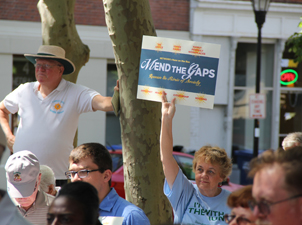
Funding for the current fiscal year ends on April 28. Congress needs to complete plans for funding the federal government for this current fiscal year and at the same time begin to create a budget for 2018.   Since Congress is on recess for four weeks before the April 28 deadline, there are only five weeks to get the job done. Decisions on appropriations will impact a number of NETWORK “Mend the Gap” priorities, but three programs are particularly vulnerable:  housing support for those in poverty, healthcare funding and funds to conduct the 2020 Census.

We know that funding for these programs mean so much to the lives of those in poverty.  Pope Francis reminds us that, behind every statistic, there is the face of a person who is suffering, … “Poverty has a face! It has the face of a child; it has the face of a family; it has the face of people, young and old. It has the face of widespread unemployment and lack of opportunity. It has the face of forced migrations, and of empty or destroyed homes.”

Housing vouchers are particularly at risk for this year. The current budget allotted $500 million less than the amount needed to fund currently held vouchers for the rest of the year. CBPP estimates that more than 100,000 vouchers could be lost in the next few months. 100,000 households could become homeless unless we can secure new funding.

The Affordable Care Act continues to be under attack.  One of the key ways opponents may move to cut the program is to defund its operating system.  House appropriators, for several years have denied the Center for Medicare and Medicaid Services and the IRS new funding to cover the administrative costs of ACA implementation.   These funds and more are at serious risk.

Past decennial censuses have tended to undercount communities of color, people experiencing poverty, immigrants, young children, Native Americans and rural residents. The systematic undercounting of these communities decreases their access to federal funding and proportional representation. If the Census Bureau does not receive increased funding to conduct necessary tests and prepare for 2020, we fear that these gaps in the census will persist.

This year, the funding decisions are particularly daunting, as the administration and many House Republicans are determined to increase military spending while adhering to the top level spending caps established in the Budget Control Act, 2011.  Doing this necessitates cuts in non-defense spending – mostly human needs programs – in order to not exceed the caps.

Further, at the Trump Administration request, Congress is considering a 2017 Supplemental Budget.   They propose that it would cover the added cost of the President’s “deportation force,” which we have seen escalate its activities in the last week.  It would include some war costs, but mostly would cover the cost of President Trump’s Border Wall which ranges from estimates $8 billion to $21 billion.  Removing this from the FY 2017 appropriations does not relieve all of us from paying for it. We would still need to fund the Supplemental through our tax dollars.  NETWORK will actively work to stop this bill.

In addition to completing work on the FY 2017 Appropriations, Congress faces passage of a Budget for FY 2018 – which goes into effect October 1, 2017.  They have yet to receive direction from the President, other than broad statements of cutting non-defense spending by a stunning $3.7 trillion over ten years. This equates to a 43 percent drop in meeting the basic support of people with limited income.

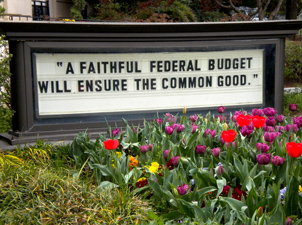
Increases in military spending and unwillingness of Congress to increase revenue put the burden of balancing the budget on the backs of people in need by reducing spending on human needs such as housing, healthcare and the census. This is in direct opposition to what NETWORK Lobby and Advocates for Catholic Social Justice continue to work to achieve. It is imperative that all of us engage with our members of Congress frequently to influence their spending decisions. We need to work hard to protect the dignity of all people in our communities.

Something Which Can Never Be Taken Away

Something Which Can Never Be Taken Away

By James Luisi
From NETWORK’s Catholic Social Justice Reflection Guide

Last spring I went to jail for the first time. Not because I had been charged with any crime or because I had been arrested—I was with a group of students from Boston College’s School of Theology and Ministry. We were in jail together that Sunday morning, seeking to pray and break bread with the inmates.

I suppose the jail matched what I could imagine based off a season of Orange is the New Black. The walls were painted cinder block. The doors locked behind us wherever we went. Corrections officers were stationed periodically throughout the hallways, buzzing us through.

I wasn’t even sure why I was there that morning or what I was expected to do. As part of a school-wide week-of-service, some of us had the opportunity to go to the jail to do “prison ministry” but I had no clue what that actually meant. Was I expected to talk to the prisoners? Counsel them? Tell them about God?

I breathed a sigh of relief when I learned I wouldn’t be going alone through the jail that day. Our task would be rather straightforward and simple: my fellow student and I would go with the seasoned chaplain to three locations in the prison; we would celebrate a communion service with a pre-written reflection from the chaplain and offer the prisoners a chance to say a word or two about the readings if they felt so called; and then we would pack up and go to the next location. I took comfort in the simple formula that our day would follow, knowing there was not much I could mess up so long as I didn’t miss getting buzzed through a door.

I don’t really know anything about the men I met in the jail that morning. I quickly learned that I was not being asked to “do” anything for them. There was nothing to do. The simple act of being present, of acknowledging the fundamental human dignity of the men in jail that day by praying with them, by sharing the Eucharist with them—that was all I could do.

Society often values human life only by what it can contribute to its prosperity. Most people might even agree with the reasonable-sounding idea that, for the most part, society should be structured to give to each person that which they have earned. It’s hard to argue with the logic of a meritocracy—if you work hard, you should be able to get ahead in life; if you pursue higher education, you should make more money doing less strenuous work; if you have an innovative idea, you should profit from your ingenuity.

People in jail are severely limited in their ability to contribute to society. In fact, they have been removed from society precisely so that society can extract a debt from them. It is not for me to say whether or not the men I met that day merited their sentences; in fact, many if not all of them may have been duly processed for a law they had broken.

But this is precisely the point. Human dignity is not only something which cannot be earned, it is also something which can never be taken away, even if one has committed a heinous offense. What I learned by praying with those in jail is that human dignity radically transcends both merit and demerit—nothing can add to nor detract from the humanity of any human being, in any circumstance, ever. A person couldn’t even renounce his or her own human dignity, so intrinsically is it linked to their very being!

We should be able to agree that those things which are necessary to uphold the human dignity of our fellow sisters and brothers—things like nutrition, shelter, healthcare, community, the opportunity to participate in society—are things for which no one must prove merit. Then, perhaps, we can begin to have a reasonable debate about how we can go about providing these things to all people. This might sound pretty radical, but then again, that’s human dignity.

James Luisi is a third year student at the Boston College School of Theology and Ministry, and a former NETWORK Government Relations Associate.

View the full Catholic Social Justice Reflection guide here.

View the Lent Calendar to take action on healthcare here.

Blog: NETWORK Evaluates New Healthcare Bill

NETWORK Evaluates New Healthcare Bill

Lucas Allen
March 7, 2017

NETWORK Lobby for Catholic Social Justice released our “10 Commandments of Healthcare,” a set of principles grounded in Christian faith and a concern for the common good. We know that healthcare is a human right that is essential for a dignified life, so each of these commandments seeks to protect that right to healthcare and provide health security for all.  Each of these principles form the fabric of a just healthcare system that cares for people living in or near poverty.

NETWORK’s test for any ACA replacement bill is simple: Does the bill protect access to quality, affordable, equitable healthcare for vulnerable communities? After reviewing the House GOP replacement bill, the answer is a resounding no. Instead of providing greater health security, the bill increases costs for older and sicker patients and drastically cuts the Medicaid program, all while providing huge tax cuts to wealthy corporations and individuals. This is not the faithful way forward and must be rejected.

Two House committees will begin “marking up” the health bill tomorrow. Democratic members of the Committees will offer amendments to expand coverage and protect Medicaid during the process but it is not anticipated they will be successful. The bill would then move to the Budget Committee next week then finally to the House floor likely the week of March 20th.

It is imperative that advocates voice opposition to the current form of the bill because silence will be interpreted as satisfaction.  Action now will impact the direction of the bill in the House and in the Senate, the body advocates believe is our best chance of stopping a bad bill.

How Does the GOP Bill Stack Up Against the 10 Commandments of Healthcare?

The following is a comparison of the House GOP plan – the American Health Care Act (AHCA) – with the principles outlined in the 10 Commandments of Healthcare.

1. Thou shalt provide affordable insurance and the same benefits to all currently covered under the Affordable Care Act.

FAILED: The AHCA would cause millions of people to lose access to health coverage. Policy changes would particularly harm people who are older, sicker, and less wealthy.

2. Thou shalt continue to allow children under the age of 26 to be covered by their parents’ insurance.

PASSED: The bill maintains the ACA provision that allows young adults to stay on their parents’ plan through age 26.

3. Thou shalt ensure that insurance premiums and cost sharing are truly affordable to all.

FAILED: This plan would make premiums and cost sharing far less affordable for millions of Americans. It repeals the ACA tax credits that were used by more than 10 million families in 2016, and offers smaller tax credits that do not adjust by income.

4. Thou shalt expand Medicaid to better serve vulnerable people in our nation.

FAILED: While the AHCA does not end the Medicaid expansion immediately, it would freeze enrollment in the year 2020. At that point, states would no longer be able to sign new enrollees up for the program, reversing the unprecedented coverage gains made since the passage of the ACA.  Not only does the AHCA end Medicaid expansion, but it threatens the entire Medicaid program with massive cuts.

5. Thou shalt not undercut the structure or undermine the purpose of Medicaid, Children’s Health Insurance Program (CHIP), and Medicare funding.

FAILED: The AHCA would end Medicaid as we know it in order to cut and shift Medicaid funding to tax breaks for the wealthy. It converts Medicaid to a per-capita cap, which would cap funds and force states to cut eligibility and benefits for the millions of children and families, seniors, and people with disabilities who rely on Medicaid today.

6. Thou shalt create effective mechanisms of accountability for insurance companies and not allow them to have annual or lifetime caps on expenditures.

HALF-FAILED: While the AHCA keeps the ACA ban on annual and lifetime limits, it removes many mechanism of accountability for insurance companies.

7. Thou shalt not allow insurance companies to discriminate against those with pre-existing conditions.

HALF-FAILED: The AHCA does not repeal the ACA ban on discriminating people with pre-existing conditions, but it makes it more difficult for people who have failed to maintain continuous coverage to get insurance. This will disproportionately impact people with pre-existing conditions and leave many with higher premiums.

8. Thou shalt not allow insurance companies to discriminate against women, the elderly, and people in poverty.

FAILED: The AHCA would allow insurers to charger older enrollees far more, which could leave the elderly with prohibitively expensive premiums on the individual market. It would also impose harsh penalties on people who fail to maintain continuous health care coverage, which would disproportionately affect people in poverty. People who struggle to get affordable coverage should be assisted, not punished and locked out of the insurance market.

9. Thou shalt provide adequate assistance for people enrolling and using their health coverage.

FAILED: The AHCA does not provide assistance for people enrolling, but actually makes it more expensive for people to enroll if they have gone without insurance for 63 days. This could lock out people who have lost coverage and want to enroll.

10. Thou shalt continue to ensure reasonable revenue is in the federal budget to pay for life-sustaining healthcare for all.

FAILED: The House GOP bill gives a massive $525 billion dollar tax breaks to the very wealthiest and corporations with the richest 400 families receiving a 7 million dollar tax break a year.  Meanwhile, there are $200 billion new taxes on working families.  The bill has not been officially scored by the non-partisan Congressional Budget Office although budget experts believe there will be significantly less revenue generated to assist low income individuals and families.

Lent Welcome from Sister Simone

Lent Welcome from Sister Simone

March 1, 2017

Welcome to NETWORK’s 40 days of Lent, “A Time to Pray, A Time to Act.” As I was reflecting on this time, I thought of two scriptural references. The first was Jesus’ withdrawal to the desert for 40 days before he began his public ministry. In this very challenging political time I believe that we need to engage in a intense spiritual practice of listening to the Spirit in our midst so that the new might emerge. I know that we cannot do “business as usual.” But it is less clear to me what the new approaches to this political chaos should be. Let us pray and listen together to the Spirit in these 40 days ahead.

The second scripture that I thought of was the story of the Exodus. In the Exodus the Jewish people wandered for 40 years sometimes with a cloud by day and a pillar of fire by night. Now we only have 40 days and not 40 years, but I realized the other day that each day feels a bit like a year. We wander without a strong sense of how we as a nation are a community. We complain about “Why can’t it be like it was?” In short we are lost and reliant on God’s generosity to see us through.

So welcome to a Lent of prayer and action: listening to the Spirit and calling Congress. This is what will create the common good. May we be faithful in the journey.

Take Action on Healthcare

This Lent, Take Action on Healthcare

Join over 2,000 Justice-Seekers in Calling Congress
Lucas Allen
February 28, 2017

Now is a crucial moment for access to healthcare in our nation. Repealing the Affordable Care Act (ACA) could cause 32 million Americans to lose health insurance and raise premiums by up to 100% by 2026. With lives on the line, Congress must treat healthcare as a right, not a privilege, and recognize that access to healthcare is required to protect the fundamental dignity of every person.

Some plans being considered by Republicans in Congress would not only repeal the ACA without much of any replacement, but also cut Medicaid and the healthcare services it provides to people in poverty, children, older Americans, and people with disabilities. Some in Congress would like to use these cuts to pay for unprecedented tax cuts to the extremely wealthy, further widening the gaps in our society by shifting resources from families struggling to make ends meet to the very wealthiest. Cutting Medicaid would further erode the promise that if you fall on hard times in this country, you will be taken care of.

Beyond political rhetoric, this moment is really a decision point for the kind of country and society we want to be. Are we a society which leaves people experiencing hard times out in the cold, or are we our sisters’ and brothers’ keepers? Catholic Social Justice requires that we uphold the dignity of all, which requires ensuring all have access to affordable, quality, equitable healthcare. This moment presents a threat, but also an opportunity to share our faithful vision of a healthcare system and society that advances the common good and puts people, not profit, at the center.

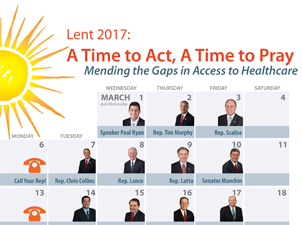
See the Lent Calendar for which Member of Congress the NETWORK community is calling each day during Lent!

View Calendar

Blog: New Immigration Guidance Implements Dangerous and Unfaithful Policies

New Immigration Guidance Implements Dangerous and Unfaithful Policies

Department of Homeland Security Memos Strike Terror in the Heart of Our Communities
Laura Peralta-Schulte
February 22, 2017

Throughout the Presidential campaign, then-candidate Donald Trump promised he would build a wall between Mexico and the United States and deport millions of immigrants living in America.  Now, the Trump administration is setting forth a course to make good on that promise.

On February 20, Secretary John Kelly of the Department of Homeland Security released two memorandums providing guidance on enforcement of immigration laws and on issues related to border security. The two memorandums, titled “Enforcement of the Immigration Laws to Serve the National Interest” and “Implementing the President’s Border Security and Immigration Enforcement Improvement Policies,” work together to create a mass deportation system that targets virtually any of the 11 million undocumented Americans living across the United States for deportation. The new guidance expands the ability to detain and deport most immigrants and seeks to limit due process protections and seeks to expand a program which compels state and local law enforcement officers to act as agents of federal immigration offices.  Further, the guidance seeks to remove protections for unaccompanied children and asylum seekers who are seeking refuge in the United States.  By prioritizing detention and removal over protection the Trump administration turns its back on our obligation to protect vulnerable people seeking asylum.

This guidance fails to serve the national interest and is intended to create chaos and confusion in our communities. Criminalizing our undocumented sisters and brothers will make our communities less safe, less secure and less peaceful. It is not the faithful way forward. People of faith must stand with immigrants and insist our local and state governments support our immigrant neighbors. We must also meet with our Members of Congress and ask them to oppose efforts to criminalize our communities. A border wall and the deportation infrastructure outlined in the memorandum cannot happen unless Congress provides money to fund the projects. We must demand that Congress rejects the Trump administration’s funding requests for the good of our nation.

If the Trump administration moves forward unchallenged, families will be torn apart and communities will be ruined.  We can and must fight back.  Our faith calls us to love our neighbors and welcome the stranger.  Now is the time to put our pray into action.

Standing Together to Meet the Challenges Ahead

Standing Together to Meet the Challenges Ahead

U.S. Representative Luis V. Gutiérrez
Published in the First Quarter 2017 issue of NETWORK’s Connection Magazine

There is no doubt that this is going to be a difficult year for America. Immigrants, women, people of color, Muslims, environmentalists, the LGBT community – there are many groups firmly in the crosshairs of the new Administration and the new Congress. Though only supported by a minority of American voters, the new President, Donald Trump, will not be shy in taking action to enhance his brand. We do not yet know the specifics, and it is clear that his opinions change about as quickly as you can hit refresh on your Twitter feed. But Trump’s lieutenants are the most clearly ideological and dangerous set of leaders ever assembled in American government on immigration and any number of issues we may care about.  There is a vindictiveness coming to government the likes of which we have never seen, and with shadowy figures like Breitbart’s Steve Bannon or the Federation for American Immigration Reform’s Kris Kobach calling signals behind the scenes, there is reason to prepare for the worst.

Immigrants and immigration were important campaign themes – or I should say, slandering immigrants and immigration were. The irony is that support for sensible immigration reform actually increased and support for mass deportation decreased during the year and a half that Trump campaigned for the White House. Across numerous polls, roughly 80% of the American people favor letting undocumented immigrants stay in this country and about 60% among Trump supporters. But that is not likely to translate into any sensible policies coming out of Washington. We expect to see the same recycled, deportation-only bills come through the House Judiciary Committee, but the difference will be that we no longer have a reliable Senate or White House backstop to contain self-destructive immigration ideas.

Their game plan is simple: make legal immigration harder for everyone – and impossible for most people – and then rail against the resulting illegalities, decry the black market, label everyone as criminals, and use good old fashioned fear of “the other” to marginalize immigrants. The goals will be to demonstrate that Republicans are being tough, cruel, and unsympathetic to immigrants – especially undocumented immigrants — and tough on Mexico and Muslims in particular.

To most Republican lawmakers, the illusion is more important than the substance of legislation because they are trying to placate their own voters, whom they fear because their own voters are being whipped up by advocates for reduced immigration who will not be satisfied until every undocumented immigrant is marched across the border and the country is sealed off from the world. It is an unachievable goal, not to mention a self-destructive one, but the tail is wagging the dog, and the minority of immigration opponents are dictating what does and does not constitute being “soft on immigrants.”

That Trump and Congress are being driven by such ideological extremes will be the downfall of their agenda. Americans favor legal immigration and are rightly concerned about uncontrolled and illegal immigration, but those driving the issue in the Republican Party are opposed to immigration, period. They want fewer people – especially fewer people of color – in “their” country. The American people don’t believe we will deport 11 million undocumented immigrants and they are right. But those driving the issue are hooked on the mass deportation fantasy and the idea that more than 10 million people will self-deport.  Most Americans, however, do not think a wall will actually work as an immigration control strategy and they sense that immigration is broader and deeper than the physical border to the South.

But many Americans still voted for Trump because he tapped into the frustration many people feel because no one has been able to make immigration a safe, legal, and orderly process for the American people and those who seek to become Americans.

So, supporters of immigration and immigration reform need to stick to our principals and keep fighting for our vision of a modern, 21st century immigration system because our vision is what the American people actually want. We have to do a better job of communicating that immigration reform is about more than being kind or respectful to immigrants. In the transactional world of American politics, doing something “for” one group is often perceived as doing something “against” everyone else, which is simply not the case with immigration.

And we must support our allies who will also be targeted by the Republican agenda, be that women’s health care, LGBT rights, people of color claiming their rightful place in America, or a business-driven assault on working people and mother earth. We must join arms with clergy and labor, progressives, and moderates so that when Republicans try to come after one of us, they will have to come through all of us. If the new President comes for the Muslims, I will be a Muslim. If they come for women’s rights, I will stand with women. When they deny climate science, I will make my voice heard. We must heed the warning Benjamin Franklin made to his fellow signers of the Declaration of Independence: “We must, indeed, all hang together or, most assuredly, we shall all hang separately.”


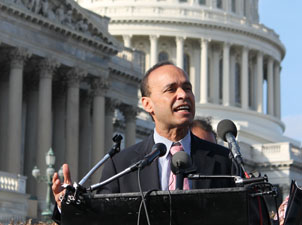
Congressman Luis V. Gutiérrez represents the fourth district of Illinois. He is nationally recognized for his tireless leadership championing issues of particular importance to Latino and immigrant communities.

Concern for our Common Home as Pruitt Confirmation Vote Nears

Concern for our Common Home as Pruitt Confirmation Vote Nears

Mackenzie Harris
February 14, 2017

Pope Francis says that we are called by our faith to care for our creation – that the degradation of the environment is a sin. During this polarizing time, I think it’s safe to say that we all need to remember the significance the future of our environment has on our very own lives, and future generations to come.

The rhetoric in the past few weeks, let alone the last year, has been astonishing to say the least. Using terms like “alternative facts” about science and the environment were just another ploy to delay action on climate change for the new Administration, according to members of Congress and advocates who spoke alongside Senator Tom Carper (D-DE) at a press conference about on the Senate confirmation process for Scott Pruitt to lead the Environmental Protection Agency last week.

The divide amongst our parties on climate change and the role of the Environmental Protection Agency has unfortunately grown deeper in this past election with President Trump denying the existence of a connection between human activity and climate change.

Sister Simone Campbell stated during the press conference that, “This is not polarized politics; these are actual facts. And we must respond to the cry of the earth and the cry of the poor.” Senator Carper, meanwhile, said there is an urgency to have the Environment Protection Agency backed by science, not opinion.

The fact that the future of the EPA could very well be in the hands of a man who has been scrutinized for his skepticism of the EPA is almost as frightening as President Trump’s failure to recognize climate change, or worse, his transition leader, Myron Ebell’s plan to cut the EPA’s workforce by two-thirds.

I know that global climate change threatens all people and all nations, and like so many other challenges to justice, global climate change disproportionately impacts people in poverty and others who are vulnerable and marginalized members of our society.

Ignoring climate change or cutting the EPA’s workforce has an effect on us all.

I fear that during this time of partisan divide we won’t hear the cry for our earth or the cry of the poor. I’m afraid that those most affected will be silenced by the deafening rhetoric of this new Administration. I hope and pray that President Trump will step back and realize what he is doing to our Mother Earth.

An Ethic of Resistance

Guest Blog: An Ethic of Resistance

Susan Rose Francois, CSJP
February 3, 2017

We have been hearing a lot about resistance in these early days of the Trump administration. In fact, on the first full day of his presidency millions of women, men, and children organized and joined together to stand for justice in the streets.

We have also been hearing a lot of questions about what comes next. How does this organic expression of outrage and concern for equality and the common good become an effective movement?  How do we take advantage of this moment in history to effect change, stop the carnage of unjust social policies—to repurpose a phrase from President Trump’s inaugural address—and promote justice for all, especially people who are poor and marginalized?

Whatever comes next, it is crucial that we develop an ethic of resistance that is grounded in human dignity and right relationship. Otherwise, we face the danger of recreating and repeating negative cycles of violent and dehumanizing language and actions.

Relationship is key to resistance—we are first and foremost human beings after all, created to be in relationship with one another.  It is our compassion for other human beings and our earth community that compels us to resist.  An ethic of resistance requires a firm commitment to hold fast to the truth of human dignity of all people and the integrity of creation, to lament the unjust social structures and social norms which foster and perpetuate dehumanizing and earth-destroying policies, and to seek to heal the relationships distorted by social sin.

In fact, we would all do well to read up on the history of resistance to social sin. Resistance is not futile, but neither is it easy. The Christian tradition of resistance begins with Jesus, and think of where his path of resistance led.  Jesus resisted dehumanizing social norms, created a wide web of relationship, and engaged in liberating action for the oppressed.  In the centuries since, Christians have followed in his footsteps and resisted social sin and injustice.  Human communities have even managed to resist extreme expressions of social sin, such as slavery and the Nazi holocaust. Please God, do not let our current situation reach such levels, but we must do all we can to resist even the most remote possibility of such extreme social sin emerging from the fog of fear, distrust, and isolationism.

In the words of Pope Francis, we must resist the globalization of indifference. “The globalization of indifference, which today burdens the lives of so many of our brothers and sisters, requires all of us to forge a new worldwide solidarity and fraternity capable of giving them new hope and helping them to advance with courage amid the problems of our time and the new horizons which they disclose and which God places in our hands.”[1]

The end goal of resistance should be right relationship.  To reach that goal we must carefully peel away the layers of disconnection which have been created through social sin.  The first layer of resistance is what has been happening in the collective awakening all around us.  We need to remove our own blinders not only to the existence of dehumanizing and earth-destroying policies and practices around us, but also to the ways that we ourselves are enmeshed within these unjust structures.  Only then can we work with integrity to socialize this awareness by raising the consciousness of others.

The next layer of resistance is an emotional one—lament.  Our critical consciousness must lead us to lament the reality of the benefits we receive at the cost of the heavy burdens born by others.  Because our actions of resistance take place within the dominant culture, within what Cynthia Moe-Lobeda calls a “paradox of privilege,”[2] we must lament before we can seek truth and justice in solidarity. Fr. Bryan Massingale believes that such lamentation “has the power to challenge the entrenched cultural beliefs that legitimate privilege.”[3] It is a crucial step toward expanding the web of relationship to include all persons, especially marginalized people.  The encouraging movement towards intersectionality within the emerging resistance movement is a positive step in this direction.

The final layer of resistance is to shift from inaction to action from within your sphere of influence to heal the relationships distorted by social sin.  Resistance actions are not and cannot be limited to grand scale marches and demonstrations.  Our daily lives as ordinary citizens, neighbors, and consumers are filled with individual choices that hold potential for collective power. Indeed, the history of social movements illustrates the collective power of resistance to social evil and its ability to effect lasting social change.


[1] Pope Francis, 2015 World Peace Day Message, no. 6

[2] Cynthia D. Moe-Lobeda, Resisting Structural Evil: Love as Ecologocial-Economic Vocation (Minneapolis, MN: Fortress Press, 2013),  61

[3] Massingale, “The Systemic Erasure of the Black/Dark Skinned Body in Catholic Ethics,” in Catholic Theological Ethics, Past, Present, and Future: the Trento Conference, ed. James F. Keenan (Maryknoll, NY: Orbis Books, 2011), 121.

Blog: Acting Out of Love and Listening

Acting out of Love and Listening

A Radical Response for our Troubling Times

Simone Campbell, SSS
February 2, 2017

I have been challenged by the new Trump Administration to find the right place for NETWORK in our effort to create an economy of inclusion. Part of me wants to resist every move, every nomination, every tweet, every lie, and every outrageous utterance. But I know that such absolute resistance, such “fighting against,” will reinforce the very behavior that I am resisting. It will lead to hate countering hate, and it won’t work. What is called for is something new.

Both before and after the election, I talked with some ardent Trump supporters to try to understand them. What I have come to see is that for many, if not most, their support for Mr. Trump comes from the fact that they feel betrayed by politicians and frightened for their children. They feel they have “worked hard and played by the rules” but not gotten ahead. They are struggling just as their parents did, or maybe things are even a little harder for them. Beneath their disappointment, I have come to see that there is shame for them in not living up to their  expectations.

This shame leads to anger directed at “business as usual.” They don’t care that Mr. Trump lacks any political experience. In fact, they like that because they feel betrayed by politicians. What they are not seeing is that it is conservative economic policies of “trickle-down” economics that are the heart of our ever growing income and wealth disparity.

Some of these shamed and angry voters have supported these policies for years, but do not understand that they privilege the top economic brackets and actually hurt everyone else. I am tempted at times to just “shake them” to try to get them to wake up to the consequences of their choices.

We are challenged by the Gospel, however, to do this work differently. We are challenged to fight for a vision of who we are called to be in our nation and our world. To create this vision we need to enter into a contemplative space where we let our guard down and listen to the Spirit (or what I call the wee small voice within) and then act out of that centered space.

This deep listening is risky business because it often calls on each of us to change in some way. It isn’t just about how “they” need to change. We need to say to ourselves that it is okay to be nervous about silence and listening, but we can’t let our reticence stop us. It is this very deep contemplation that is desperately needed in our nation right now.

I’ve discovered that this deep listening leaves me open to hear the stories of others grasp the reality around me in new ways, for example, my story of listening to Trump voters. It also allowed me to understand what Thomasina in Indianapolis meant when she told me she wasn’t going to vote because she didn’t want to hurt our country. She didn’t know how to choose when all she knew was negativity about both candidates, and she thought the only ethical choice was not voting at all! Deep listening lets me take in another’s experience and understand it in a new way. It is the first building block of community that we are in dire need of in our nation.

So in my worry and terror about the policies that we are going be advocating against over the next four years, I believe that we are being to a new level of engagement and action. Only love can cast out hate. We need to listen deeply and then act in love. Hard as it will be, we are called to take a radical step into the deep listening that can reveal the new. It feels like groping in the dark in very challenging times, but my experience over and over is that we are not left orphans. The words are given when they are needed. Community is nourished in this very struggle. We learned from the Vatican censure that despite pain and fear, staying faithful to our mission allows the Spirit to make something new…like a Bus.

Let us begin to advocate strongly together, but also begin a time of “deep listening.” Let us share with each other what we hear. Then we are prepared to lift up a vision of the 100% where all can work together to heal our nation. For such a challenging time we have been called. Let us respond as the prophet did:

Speak O Holy One, your servants are listening.