


Category Archives: Front Page

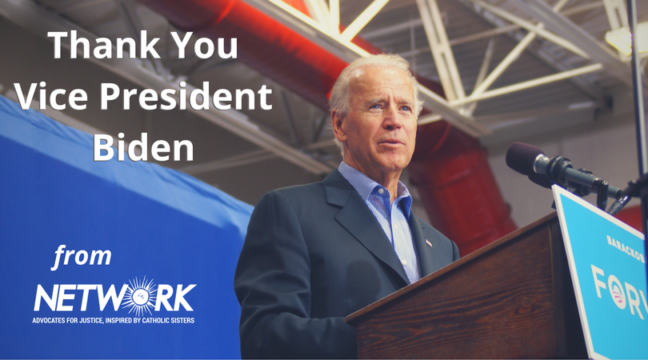
Thank You Vice President Biden

Join NETWORK in Thanking Vice President Biden

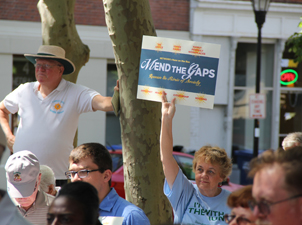
Inspired by his Catholic faith, Vice President Biden has worked for policies that would Mend the Gaps in our nation. Throughout his more than four decades in public service, Vice President Biden worked to expand access to healthcare, pass gun violence prevention legislation, and shape our nation’s foreign policy.

Join us in saying thank you!
Thank you Biden

In a Dark Time, the BRIDGE Act Stands Out

In a Dark Time, the BRIDGE Act Stands Out

Laura Muñoz
January 12, 2017

It’s now 2017 – a bright sunny year with new opportunities ahead and while I am excited for a new year I can’t help but notice the cloud of uncertainty hovering over my head. That cloud began to form when then Presidential nominee Donald Trump ran on the platform of repealing President Obama’s executive order on Deferred Action for Childhood Arrivals (DACA).

As a recipient of DACA, I have been able to work at jobs that I love (like NETWORK), obtain a driver’s license that allows me to travel, and most importantly live without the fear of deportation. Unfortunately, the few rays of sunlight that DACA has brought into my life after years of living in the shadows have been recently covered with a cloud of uncertainty and fear. Trump’s plan to repeal DACA would be unimaginable and utterly devastating not only for me but also for the roughly 800,000 individuals who have protection through DACA. Ending the program will be the beginning of a storm that will bring about harsh economic and emotional conditions for immigrant families– DACA recipients will be unable to keep their current jobs, support themselves or their families, and most significantly, once again feel the fear of deportation thick in the air.

Today, U.S. Senators Dick Durbin (D-IL) and Lindsey Graham (R-SC) re-introduced their bipartisan legislation to protect the individuals who currently have or are eligible for DACA. Similar to DACA, the Bar Removal of Individuals who Dream and Grow our Economy (BRIDGE) Act would provide temporary relief from deportation and work authorization to young undocumented individuals who were brought to the United States as children. Temporary protection under the BRIDGE Act would allow individuals, such as myself, to continue to work and study and be protected from deportation while Congress works on legislation to fix  the broken immigration system.

The reality is that the BRIDGE Act is not a replacement for the comprehensive immigration reform that we desperately need, nor does it protect all undocumented individuals living in the United States. It won’t protect my parents from deportation nor will it protect thousands of DACA recipients’ parents. With the dark cloud of uncertainty and the fear of being separated from our families hovering over our heads, the BRIDGE Act gives us the chance for a hopeful forecast of staying in the country that we consider our home.

Blog: Glimmers of Hope

Glimmers of Hope

Catherine G.
December 23, 2016

The reality of Donald Trump sitting in the highest ranked American office in less than 28 days is still unsettling to me.  Trump’s election feels like a scar that may heal in time, but the wound’s initial shock will forever be remembered. On November 8, it became blatantly evident that many of our American brothers and sisters believed that Mr. Trump was the best solution to their troubles and concerns.  Whether they ardently or begrudgingly supported Mr. Trump’s candidacy, over 62 million Americans decided that his racism, sexism, ableism and xenophobia were not dealbreakers. As an individual that values inclusivity and equity, that reality stings. As a woman of color, that reality stings a bit deeper.

It may be coincidental that we are approaching the winter solstice, when our days get shorter and darker. For me, the changing landscape echoes the pervading darkness looming from the election. We continue to be bombarded with messages that highlight our divisions. Undoubtedly, there are divisions in need of mending – however, to believe that our divisions are the entire American narrative ignores the numerous individuals across the nation that have and continue to unite with one another.

When all I could do was cry on my commute the morning following the election, the individual next to me reminded me that we’re in this together.  At a time when I had grown more despondent than hopeful, thousands of students showed me otherwise by coming together to lobby their members of Congress on criminal justice and immigration reform during the Ignatian Family Teach In. As I grew weary at the state of our nation, U.S. military veterans traveled to North Dakota to support the Standing Rock Sioux in opposing the Dakota Access pipeline.  When I felt plagued by inaction, activists were organizing demonstrations, marches and sit-ins aimed at protesting the normalization of intolerance and bigotry.

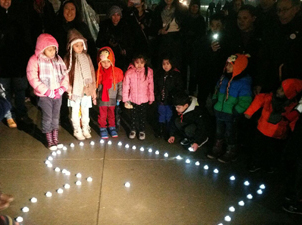
These glimmers of hope are analogous to the power a lone lit candle can have in a dark room. Despite how small or dim that candle may be in the midst of pervasive darkness, that candle still possesses the ability to illuminate. When that candle is joined by another candle, the effect can be profound.

Quite frankly, I may never come to terms that Mr. Trump was elected notwithstanding his campaign platform. However, as difficult as it may be, I refuse to submit to the notion that Donald Trump is representative of the American people. Instead, it’s these glimmers of hope amidst the chaos and darkness that I choose to uplift.

Blog: Concluding the 114th Congress, Moving Right Along to the 115th

Concluding the 114th Congress, Moving Right Along to the 115th

Sister Marge Clark
December 20, 2016

The 114th Congress ground to a halt about 1:00 a.m. on Saturday, December 10 after just barely managing to not shut down the government.  A vote passed extending 2016 funding levels into the seventh month of fiscal year 2017. We strongly believe, however, that one temporary Continuing Resolution (CR) after another is no way to responsibly fund our government.

As we prepare to enter 2017, NETWORK continues work to support all at the margins of society due to unemployment or under-employment, immigration status, health issues, and many other concerns. Our 2020 Policy Vision guides our lobbying, outreach, and education to mend the access and wealth and income gaps that are rampant in our nation.  With this Continuing Resolution in place, the only means of increasing funding where absolutely necessary is through an anomaly.

NETWORK’s 2020 Vision did not fare well in the Continuing Resolution.  We focused our efforts on three items desperately needing increased funding and  advocated forincreased funding in each of the three following areas:

1. Census 2020

This is one area that did receive an increase from 2016 funding in the CR. The Census Bureau will be allowed to spend money earlier in the cycle, in an attempt to meet urgent planning needs.  This does not give the Census Bureau additional money, as had been requested. Instead, it leaves them with the same uncertainty about long-term funding for comprehensive planning in many areas, including: the census communications campaign, development of in-language materials, updating address lists, and adequate enumerator training, not to mention making progress on updating all census IT systems and cyber-security protocols. Using this money will also reduce the funds available to conduct the annual American Community Survey which provides important data on economic and healthcare status used by many departments.

2. Refugee Resettlement

Meeting this grave responsibility requires sufficient funding for the Office of Refugee Resettlement (ORR) to welcome and support refugees as they strive to adapt and to thrive in the United States. In FY 2016, $1.67 billion in funding was calculated to serve 75,000 (and in the end assisted 85,000). The United States announced that, due to the global refugee crisis, we would accept 110,000. However, increased funding (a minimum of $2.18 million required to support the additional refugees, unaccompanied children and trafficking survivors) was not provided.

One allowance was made, if needed, for the housing and care of unaccompanied children, with the recognition that, due to the variability in the increased number of children coming into the country, it is possible that additional funds may be needed for this population.

3. Housing

Housing in the United States continues to be in short, and expensive, supply for households with low- or no-income. Federal rental assistance is critical for there to be available, affordable housing units. Thousands of public housing units are lost each year, from deterioration and lack of repair. At the same time, hundreds of thousands of families and individuals are homeless, living with others, in shelters, and even living on the streets. For many, they are unable to get rental assistance vouchers to help pay rent. NETWORK advocated for funding to at least be able to support the number of vouchers already in use, as well as funding to repair public housing. These requests, however, were not honored in the CR. The existing number of vouchers supported by the 2016 funds cannot be supported at 2017 costs. Additionally, owners’ costs will increase and those costs will be passed on to renters who are unable to cover that increase. This leaves federal housing assistance to cover the gap. Ultimately, with this CR, more households face homelessness.  A small increase was given for rural housing, in the Agriculture appropriation.

Our elected officials have left Washington for their winter break – to be with family, celebrate the holidays, and perhaps vacation. The same enjoyment is not available for members of our communities who rely on some government assistance to live a life with dignity. This may be a person sleeping on the street, a refugee stuck in a camp somewhere in the world, or those who will not be counted in the 2020 census, leading to inadequate funding for future years of “promoting the general welfare, and secure the Blessings of Liberty to ourselves and our Posterity…”  We hope all legislators take a moment during their time away from Washington to reflect on the needs of the common good.

Advent Reflection: When Will We Make Room?

Advent Reflection:
When Will We Make Room?

Sister Mary Ellen Lacy, DC
December 19, 2016

As the Advent season advances, we journey with Mary and Joseph to Bethlehem where they were met with insufficient housing. Consequently, when the time came, our Lord was born in a barn.  The Blessed Mother and St. Joseph were not lazy, unemployed or stupid (as some might say about those who are in need of shelter). On the contrary, they did precisely what they were asked to do at a very inconvenient time. And still, there was no room for them.

Today, many factors contribute to homelessness. Millions of families are one health diagnosis, one legislative action, one act of violence or one pay check away from homelessness. They, like the Holy Family, are responding to the many demands of life. And for some, it won’t matter. They will find no room at any inn.

Mr. McDermott lived on the same block as my mom for about 30 years with his wife and two sons. Mrs. McDermott was a nurse and he always worked, too. The kids went to the local Catholic school, grew up, married and moved away.  As the couple faced an empty nest, Mrs. McDermott was diagnosed with cancer. Toward the end of her battle, she was at the family home and Mr. McDermott was steadfastly present to her.

Last Christmas, on a cold, snowy afternoon, the ambulance came for Mrs. McDermott. The paramedics brought the dying woman out while her husband marched right beside them. His face was a billboard of numbing, incomparable sorrow. We pitifully looked on and offered our prayers as he trudged by us.

A couple months after the funeral, Mr. McDermott seemingly disappeared and the house was emptied of its contents. Subsequently, bank notices were posted on the front door and window. There were rumors, but I do not know whether he left the house due to foreclosure, taxes, or other reasons. I do know that Mr. McDermott was a good man who worked and did everything one could expect of him during a desperately painful time. In return, there was no longer room at his own inn.

Every day, people are responding to suffering and difficult situations with honor.  Can the same be said of our government?  As a community, we must call for the implementation of programs that enable families and individuals to live dignified lives. This includes ensuring access to affordable housing and healthcare, a living wage, and preventing domestic violence.

It is vital to increase the amount of subsidized housing that is clean, reasonably priced, and rodent-free.  Enhancing the Section 8 Housing Choice Voucher Program will allow more families to move from areas that have been decimated by government-approved policies including redlining, forced urban development, and a lack of infrastructure maintenance.

It has been more than 2000 years since Jesus came into our struggling world, seeking shelter. He continues to come to us in our neighbors. This time, let us provide more than just a barn.

Sister Mary Ellen Lacy is a public housing attorney and a “Nun on the Bus”

Advent Reflection: Waiting for the One Who Brings Life Abundantly

Advent Reflection:
Waiting for the One who Brings Life Abundantly

Lucas Allen
December 13, 2016

The season of Advent is full of hope and anticipation for the birth of Jesus, who “came that they may have life and have it abundantly” (John 10:10). Throughout the Gospels, Jesus models this abundant life by healing the sick with boundless compassion, especially for those experiencing poverty or exclusion.

Jesus’s healing example also calls me to imagine what our country and healthcare system could be if we took this message of abundant life and boundless compassion to heart. For our society to have life and have it abundantly, health must be a universal right, not a consumer good or a privilege for those who can afford it. Financial circumstances, zip code, race, ethnicity, or other factors should not influence access to life-saving medical care. A life-affirming healthcare system would provide universal coverage for the common good, with special concern for people who are vulnerable.

In this season of hope, it must be noted that our country has been moving closer to this vision. Never before have so many Americans had health insurance; in 2015 we achieved the lowest uninsured rate and the lowest child uninsured rate in history. Programs such as Medicaid, the Children’s Health Insurance Program, Medicare, and the Affordable Care Act have created a preferential option for those who would be left without care in a purely market-oriented health system. My family and I have known the fear of rising medical expenses and have benefited from these policies that lead to a healthier society.

As Jesus announced his arrival to John the Baptist saying: “The blind receive sight, the lame walk, those who have leprosy are cleansed, the deaf hear” (Matthew 11:5), maybe our progress in living out His teachings should be measured by whether those experiencing poverty or sickness have access to care as a fundamental right. This is the nation I hope for, and the one we are pushing for at NETWORK: one that extends Jesus’s healing touch to all.

So while I wait in hope for the humble birth of the one who came that we might have abundant life, I remain cognizant of the injustices that keep those born into poverty today from enjoying healthy, abundant life. At this crucial time, I remain hopeful that we will resist the path of putting profit over people and choose Jesus’s path of abundant life.

Advent Reflection: Immigrant Families Wait for an Uncertain Future

Advent Reflection:
Immigrant Families Wait for an Uncertain Future

Diana Pliego Padilla
December 7, 2016

During Advent we wait for the birth of Jesus. This year, however, as an immigrant with DACA protection, and parents without protection, the wait feels different. In the brief silences between my family’s laughter and chaotic chatter, I have noticed a different spirit in the air this holiday season. While this time is usually filled with hope and excitement for a new year, instead what hovers above our dinner table and lingers in our conversations is apprehension for what lies ahead. I know the same uneasiness rests in many homes as families anxiously wait for what is to come in these changing times.

My parents, like millions of other immigrants, left everything they knew to give their children a chance at a better, safer life. Mary and Joseph also once made the decision to uproot their life for the sake of their child. They left Bethlehem and fled to Egypt to keep their family safe after King Herod’s infamous order to kill all infant males under the age of two in Bethlehem. They moved to keep their family safe and to remain together.

Migration and resettlement should not be a privilege for some families, but a right for all. The value of family unity should be reflected in all our laws. Every child and family deserves the chance to live their life to the fullest potential, even if that means leaving their original home.

When we hear of children crossing our border in the arms of their mothers, it should be Jesus that we see. When we read about immigrant parents giving up everything they’ve ever known to provide the best future for their children, it should be Mary and Joseph that we imagine. When we think about humane and just immigration policies, it should be the Holy Family that we consider.

So if during Advent we wait, then let us wait with hope in our hearts. But as we wait, let us act. For we know faith without deeds is dead. Let our country lead with an example of true compassion for all our brothers and sisters, especially immigrant families like Jesus, Mary, and Joseph.

Diana Pliego Padilla was a 2015-2016 NETWORK Government Relations Associate

The Importance of Sister-Spirit under President-Elect Trump

The Importance of Sister-Spirit under President-Elect Trump

Emma Tacke
December 7, 2016

Four weeks ago, my metro ride was silent the morning after the election. It wasn’t the usual kind of quiet often found in the early hours of the day, but the kind of silence found at a funeral. I noticed the expressions of my fellow commuters and knew their downcast eyes and slack mouths mirrored what my own face must have looked like. The days immediately following the election were a blur of disbelief, anger, and grief. I struggled to find compassion for those I knew who voted for Trump. How could they support such a person for presidency? What kind of values are we upholding when we elect someone who has shown no respect for immigrants, people of color, the disabled, women, Muslims, and veterans?

As someone who works for an organization rooted in Catholic social teaching, I try to practice the “Sister-Spirit” values instilled by NETWORK’s founding Catholic Sisters. Even as I found Trump’s behavior reprehensible when he was running for president, I did my best to approach him with hope and welcome. How hypocritical it would have been for me to hate a man precisely because he was hateful?

Now that Donald Trump is going to be our nation’s president, the task of being compassionate towards him has increased tenfold. I have seen many responses from fellow well-meaning white people that it is time to move on and accept our new president and hope for the best. This is a view others cannot afford. This is not a matter of people who are upset being sore losers. Immigrant families, people of color, those living in poverty, the LGBTQ community, people with disabilities –these are just some of the groups that will be adversely affected by a Trump administration.

Living out Sister-Spirit values does not mean I will embrace what Trump believes in because he’s the president and hope he will “do what’s right.” In fact, it means just the opposite. Sister-Spirit calls for us to be feisty and bold, and prioritize the well-being of others, especially those at the margins. This means I must actively pursue justice and work for what’s right. As a person of faith I cannot be complicit in the bigotry and dangerous rhetoric of Donald Trump.  I will continue to face the challenge of keeping my heart open to Trump and approach him with hope and welcome, but not at the expense of those who are in very real danger of this presidency.

The United States was founded with the belief that the power should be in the hands of the people. As residents of this country, it not only our right, but our duty to contact our legislators and speak out against policies that strip away the rights and opportunities of those at the margins.  We cannot stand by and let the opportunity to advocate pass us by. Now is the time to put our faith into action and work for justice where there is none.

I will seek to understand Trump and his supporters, but I will not be a bystander to the threats he and his future administration pose. Now, more than ever, it is time to embrace Sister-Spirit and relentlessly pursue a world where love, justice, and inclusivity overcome hate, fear, and discrimination.

Advent Reflection Week One

Advent Reflection:
The Importance of the Census

Sister Simone Campbell, SSS
November 30, 2016

Woven into my Advent thoughts this week, is the marvel of the census. In many ways the census is at the heart of our Christmas story because it was Caesar Augustus’s census that required Mary and Joseph to leave Nazareth and return to Bethlehem to be counted.

I thought a census was about the emperor’s desire to know just how many people were under his rule. But reflecting on the reality, I realized it is also about Mary and Joseph’s desire to be seen and registered as family. The “House of David” is a metaphor for the familial ties to an extended clan. So the counting was important not only to the emperor, but also to the family. The census is both an individual and communal act.

So too, is our work on ensuring adequately funding for the 2020 census. The census seems quite mundane and individualistic, but it is a communal act. To be counted means that each individual is accorded the same dignity. It doesn’t matter whether the person is in a Manhattan penthouse, under a bridge or in an overcrowded apartment. Each individual is just one.

What I had failed to realize was the communal nature of the census. The census data collected in each state impacts the amount of federal funding  states recieve for many programs. It affects how we understand poverty and the struggle of low income families. For justice-seekers, the census data is a crucial tool that enables our government to provide for all. The census gives us a snapshot of our society and to be accurate it needs to include each and every person, especially the groups that are historically hard to count.

This Advent, let us work to prepare for the census for the individual dignity of having everyone seen AND for the communal vision that we are all connected.

Homeless in America

Homeless in America

Rev. LaTreviette Matthews 
November 21, 2016

Homelessness looks different for many people. The homeless are the two working parents with children, the veteran who fought for this country and came home to nothing, the single parent mother of two or an elderly person who has no family to take care of them. No one expects to be homeless. No one wakes up one day and says “Today is a good day to be homeless.” Through unfortunate circumstances, homelessness happens. We often take for granted that we will have a place to live every day, especially if you have always had a place to live every day.  As a single parent, educated African-American female, I certainly wasn’t expecting to be homeless. I was a manager of a program for the Department of Employment Services in Washington, DC making a salary comfortable enough to support me and my daughter. I lived in a nice three bedroom townhouse, in a safe neighborhood with decent schools.  My salary was so comfortable that I was able to afford a new car. Life was great.

One day, the grant for the program I was worked under was cut. My program ended and jobs were lost, including mine. I had been receiving survivor’s death benefits from my daughter’s father who had passed away and started receiving unemployment. Between those two means, meeting my ends became even more difficult. After the rent was paid, I juggled between paying the car note, car insurance and then deciding which household bill was not going to get paid that month.

I had applied to the Department of Social Services for assistance with my utilities and rent. Since I was receiving both survivor’s benefits and unemployment, I was overqualified for any assistance by $13. After my daughter turned eighteen I stopped receiving the survivor’s benefits. The only ends that were getting met were housing. My run with survivor’s benefits ended and I now qualified for public assistance. Applying for public assistance of any kind is humbling experience. I didn’t feel independent. I felt small. Each month I drove around to different churches and organizations that assisted with rent. I wasn’t able to apply to the same place twice within a 30 day period. I was at the point where my ends were not meeting at all. My daughter and I were evicted from our home of eight years.  I was devastated, ashamed and embarrassed. I applied to many shelters in the District, Maryland and Virginia area, but because I did not have school age children, I did not qualify. I was in a state of dysphoria. Not wanting to take on another expense, I reluctantly rented a very small storage unit for my big furniture items and stuffed the rest of my belongings in my small two door car.

All of my daughter’s life, it had been just she and I. I had prepared for her to leave for college as did she, but neither one of us was prepared for us to be ripped apart from each other. We scrambled around to find a secure living environment for her so that she could continue her education. It was the hardest thing I ever had to do. I wasn’t prepared for that. I cried leaving her. It was a different cry than leaving your child for college. It was so painful. Me on the other hand, I drove around for ten months with my belongings in my car, staying from house to house, floor to couch.

The difficulty that people who are homeless face is the uncertainty of the day. Not knowing where you will lay your head was stressful. It was a horrifying experience. Being homeless changed me. I saw people differently. The lens through which I saw the system had been radically tranformed. The United States of America is one of the richest countries and most powerful countries in the world and yet it failed me. A system that was put in place to prevent such adversity, has failed many. While I was blessed and was able to bounce back, for the millions of men, women, children, veterans and the elderly who were not so lucky, homelessness in America continues to be a huge crisis.