

Category Archives: Front Page

NETWORK Joins Call for Census Funding

NETWORK Joins Interfaith Group Calling for Census Funding

Lucas Allen
November 16, 2016

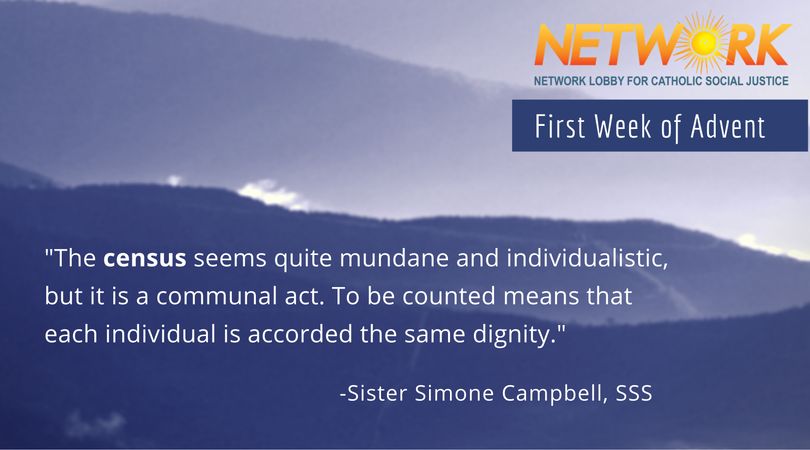
NETWORK and 18 other advocacy organizations from different faith traditions recently sent a letter urging Congress to fully fund the Census Bureau in preparation for the 2020 Census. The census is an issue of concern for people of faith because:

  • Communities of color, people experiencing poverty, immigrants, young children, and rural residents are often undercounted in the census, which decreases these communities’ access to federal funding and proportional representation
  • The Census Bureau needs increased funding in FY 2017 to complete testing to improve accuracy in counting these populations in preparation for the 2020 Census. Uncertainty about funding has already prompted the Bureau to cancel the 2017 Puerto Rico census test and both field sites for the 2017 census test (American Indian reservations and tribal lands in Washington and North/South Dakota)
  • We need the 2020 Census to be modern, accurate, and equitable so that Congressional districts, federal programs, and policies are better equipped to meet the needs of the country

For more information, read the full letter below

Download PDF here.

November 10, 2016

Honorable Harold Rogers
Chairman
Committee on Appropriations
H-305 The Capitol
Washington, DC 20515

Honorable Nita Lowey
Ranking Member
Committee on Appropriations
1016 Longworth H.O.B.
Washington, DC 20515

Dear Chairman Rogers and Ranking Member Lowey:

We, the undersigned faith organizations and members of the Interreligious Working Group on Domestic Human Needs, urge you to increase funding for the U.S. Census Bureau to match the President’s $1.634 billion budget request in the House and Senate Commerce, Justice, and Science bills. Our faith traditions compel us to care for those most in need, and providing adequate funding for an effective 2020 Census is a crucial prerequisite for federal policies and programs to respond to the needs of marginalized communities.

A failure to provide adequate funding for the Census Bureau will not only impact the effectiveness of the Census, but also cost taxpayers billions of dollars as the Census Bureau is forced to fall back on more costly counting methods of the past. These outdated methods tend to undercount communities of color, people experiencing poverty, immigrants, young children, and rural residents, which decreases these communities’ access to federal funding and proportional representation. If the Bureau does not receive increased funding in FY2017 to conduct necessary tests and prepare for 2020, we fear that these gaps in the Census will persist.

Some of the reasons our community of faith supports an effective and equitable 2020 Census include:

  • The 2020 Census will determine the allocation of $415 billion for the implementation of federal programs
  • Census data is used to monitor and enforce important federal programs such as the Job Training Partnership Act, the Older Americans Act, and the Civil Rights Act
  • Undercounting communities reduces their political representation and decreases their share of federal funding and support, further
  • A poorly-funded Census will negatively affect all, but particularly those most in need who will go uncounted if the Census Bureau cannot adequately prepare

Uncertainty about Congressional appropriations has already caused the Census Bureau to halt plans for important tests in FY2017. These tests were intended to prepare the Bureau to accurately count communities that have been undercounted in the past, such as Native American reservations and non-English-speaking communities. The impact of cutting these crucial tests will be felt by marginalized communities. It is unacceptable that Congressional inaction would force the Census Bureau to water down the Constitutional requirement of conducting a decennial census.

Stakeholders including state and local governments, businesses, civil rights organizations, housing and child advocates, and research organizations have voiced the need for a modern and accurate 2020 Census. As an interreligious community of organizations, we join in to urge you to support an equitable Census as a moral obligation. Our faith traditions teach that all humans possess inherent dignity—that everybody counts—and therefore we believe that nobody should go uncounted in our democracy. Funding the Census Bureau at the recommended amount of $1.634 billion is an important step in protecting and strengthening the 2020 Census.

Sincerely,

Bread for the World
Catholics in Alliance for the Common Good
Church World Service
Conference of Major Superiors of Men
Disciples Center for Public Witness
Ecumenical Poverty Initiative
Evangelical Lutheran Church in America
Franciscan Action Network
Friends Committee on National Legislation
National Advocacy Center of the Sisters of the Good Shepherd
National Council of Churches
NETWORK Lobby for Catholic Social Justice
Office of Social Justice; Christian Reformed Church in North America
Pax Chrsiti USA
The United Methodist Church – General Board of Church and Society
Union for Reform Judaism
Unitarian Universalist Association
United Church of Christ, Justice and Witness Ministries

Guest Blog: Talking to Trump Supporters Following the Election

Guest Blog: Talking to Trump Supporters Following the Election

Kate Lewicki
November 14, 2016

It’s been two days since the news of the election shook up America. And as I read that sentence again, without context, it may seem like the start of a tale filled with over reaction, however this time it’s not.

I sat up late on Tuesday night, into the hours of Wednesday morning and had trouble comprehending what I was seeing. I couldn’t wrap my mind around the fact that this man who has spoken out with such hatred and vitriol was about to be elected as our president of the United States. So I decide not to accept that reality for the night and go to bed.

Yesterday morning I woke up and I cried. I cried because I’m so scared of what this means for us as a nation and for me personally. The first thing I thought of is my trip to Wichita next week, where I’ll be surrounded by men for three days who all supported Trump. On each of these trips, I’m sexually harassed. Whether it’s from the guy who tried to rip my shirt off- that had a hole in the back I didn’t see – or the guy who propositioned me for a threesome with his girlfriend, or the guy who told me he only pays attention to me because my dress shows off my figure…I’m constantly surrounded by this behavior.

When I first started, I brushed it off. I said these men are harmless; they’re small town thinkers, or they don’t get out much. What I didn’t realize was that they aren’t harmless; their thoughts are reflections of deep-seated misogyny and the belief that women are objects. I can see that clearly now, as I see their elation in our President-elect and how they talk about his female opponent, Hillary Clinton.

My thoughts are all over the place with this: I’m hurt, I’m disappointed, I’m sad. I can’t believe we, as Americans, have let each other down. When I left for the airport yesterday morning, I was playing “The Sound of Silence,” and it was so fitting as the rain was coming down on my cab and I drove past so many people whose lives can potentially be flipped upside down in a few months.

I got on my flight still upset and just happened to sit next to none other than two of Trump’s district delegates…and they are PSYCHED. What a huge celebration for them, they won! White supremacy can continue to live on, oh happy day. So I decided to interject in their giddy talk and ask them about their candidate. Ask them what makes him so great to them, ask them how hard their lives truly were being white upper class males…

And we talked and talked and talked. I shared my thoughts and concerns, and asked them, as men who supposedly love their wives and daughters, how could they possibly vote for this man. I asked them when women’s reproductive rights are taken away, what are they going to do if their daughters, or wives or mothers are raped? I asked them if their daughters worked hard and if they believed they should be treated and paid the same as the men they worked with…of course they said yes, why wouldn’t they want their daughter to succeed. Then, slowly but surely, they started to understand what I was getting at….and they started bring up their candidate and how he isn’t the person he’s been portrayed as in the media and that none of the things he said were true. And I think what was really happening is that these men started to realize that some of the people they love may suffer from a decision they made solely based on their own interests…and it felt like progress..

It was at that exact moment I realized how sadly misinformed our society is. These men, both with incredible collegiate education backgrounds, were uneducated about the experiences of other people. They have lived in their white male bubble their entire life, they don’t understand why people would complain about not having money, or that they can’t get their welfare check, and on and on. And it’s because those things don’t exist in their reality. They have never faced discrimination, sexism, or other types of hardships, so it’s easy from that perspective to look at those people who have and say “Well I would just pick myself up by my bootstraps and deal with it.” Those sentences are easy to say when you have everything and nothing can touch you.

I then spent a day in Fresno with a woman from Texas who voted for Trump. And I listened to her. I wanted to know what was going on in her life that she, as a woman, felt compelled to listen to this man. And as she was speaking, it hit me again; the people who voted for him don’t even understand what they’ve done. They don’t understand life outside their bubble and it may be no fault to them. I know a lot of people who don’t understand the importance of interacting with those who are different than themselves and the importance of seeing other perspectives…this was something taught to me by my parents and instilled in me when I was very young.

I have had a lot of conversations with Trump supporters over the past few days and it has been eye-opening. I will never support the things this man stands for and I do think that there has always been an strong undertone of racism and sexism waiting to rear its ugly head and Trump has given that its day in the sun. However, I’ve realized after talking with this small group of people that they don’t understand, because they haven’t seen perspectives outside of those who are exactly like them. But most importantly, I learned that this is easy to persuade and change. After speaking with thie woman, telling her that the problem with our society is that people don’t realize the impact their vote has on other people, and we have a responsibility as Americans to look out for other people and not just ourselves…she started to get it.

As upset and disappointed as I am about the election outcome, I’m starting to see hope. I’m starting to see hope in the fact that I have access to people I can have these conversations with. Even if it’s one out of every fifty people I speak with, I have the opportunity to invite them to open their eyes and hopefully show them a perspective they would have never thought of on their own, and in their own communities. If anything, these past few days have lit a fire underneath me, showing me that my voice is just as powerful as theirs and I have the chance to make a real difference.

As Gloria Vanderbilt said “I have inside of me this image of a shining rock hard diamond, and no matter what happens to me…nothing can get at or crack.”

My diamond will continue to shine, and I will make it shine into others.

I am going to continue to speak the Nasty Women gospel of peace, love, equality and acceptance.

Kate Lewicki is a friend of NETWORK and a “Nasty Woman Prophet.” 

This Election, I’m Betting on Catholics to Follow Pope Francis

This Election, I’m Betting on Catholics to Follow Pope Francis

Since his election to the papacy, Pope Francis has challenged the world to embrace the needs of all, especially those at the economic margins of our society. He reminds us all of this challenge frequently, through historic visits to the U.S. Capitol, on unprecedented long airplane interviews, and even on Twitter. This election year, one thing is clear: Catholics understand Pope Francis’s challenge and are responding.

While Pope Francis spreads his message of welcome and inclusion, it appears some politicians choose to continue the dog whistle call of the far right –with a single issue — in an attempt to control the Catholic vote. But, this year it won’t work. Catholics know this election is not about a single issue, not just about the unborn. This election is about the future of the 100%, not the top 1%, not the 99%, not the 47%. All are at stake in this election.

Pope Francis put concern for the common good, for mending the gaps in our society, and for ensuring that all can live with dignity back front and center in Catholic dialogue. In doing so, he has given Americans who have been told otherwise for years a way to vote their faith and to do so with their heads held high. It turns out, says our Pope, that you can be a Catholic voter who prioritizes social and economic justice and equity. These are complex times calling for complex analysis.

People concerned with injustice, oppression, and poverty are the Pope Francis voters and this is the Catholic vote in 2016: No longer divided, but prescient. Now, we are asking: How do we respond to those who are being left out of our economy?

The campaigns would be well advised to engage this issue. The new Pope Francis voters are listening not just to campaign slogans but to the deeper story and lifelong positions of the candidates.

The revelation of the gutter language used by Mr. Trump shocked any person of faith and cannot be condoned. Time and again it demonstrates his disregard for women and disregard for those at the margins. The Pope Francis voters of our nation will send a resounding message: Donald Trump’s bigotry, misogyny, and racism are not consistent with faith values.

Mr. Trump’s abusive attitudes don’t stop with women. He has consistently denigrated Muslims, called people living in poverty “losers,” said all immigrants are criminal (even though he employs them in his buildings), and it doesn’t stop there. Anyone who riles Mr. Trump or does not satisfy his vanity receives the brunt of his ridicule. Donald Trump’s rhetoric, which to be clear has been revealed over and over again in this campaign, makes it even more apparent that this election is about policy AND about character. My conclusion is that anyone who cares about the dignity of all people, the needs of our earth, and the call to justice must make their choice of candidates on that basis.

The questions of our time include: How do we mend the income and wealth disparities in our nation? How do we engage the issue of white privilege and racism? How do we provide access to safe and affordable housing? How can we create a healthcare system that works for everyone and does not privilege the few? What does it mean to be a leading nation in the 21st century? We need to answer these complex life questions this election season. Pope Francis voters can handle this complexity and make a choice based on the needs of all.

Faith matters, people matter, our world matters. With everything that is happening in our nation and in our world, I am confident that Catholics will vote in response to Pope Francis’s call to end the exploitation of our people and our earth. This election, I’m betting on Catholics to follow Pope Francis.

Searching for Sister-Spirit in the Presidential Campaign

Searching for Sister-Spirit in the Presidential Campaign

Emma Tacke
October 27, 2016

At NETWORK, we work to embody the spirit of the sisters who founded our organization. There are several guiding principles of Sister-Spirit we try to follow, and my favorite is: Approach situations and people with hope and welcome. I am trying to find any hint of Sister-Spirit in this presidential election, but it feels like the time I tried to give my cat a bath: fruitless and more effort than it’s worth.

I know I am not alone when I say this presidential election season has been hard to bear. The hatful rhetoric expressed almost daily is painful to listen to. What mean-spirited tweet will be next, which outlandish accusation will be the topic of everyone’s Facebook feed?  Surely, someone must be playing a joke on our country – a cruel, unfunny one, but a joke nonetheless.

It is easy to become consumed with despair, frustration, and animosity for those who are espousing bigoted ideas that go against almost every value you hold dear.  Throughout this mercurial election season, amid the anger and fear, I often find myself thinking of the sentiment Dorothy Day expressed when she said “I really only love God as much as I love the person I love the least.” These are hard words to swallow when I frame them in the context of Republican presidential nominee Donald Trump.

The foundation of my faith rests on the notion that everyone is equally deserving of love, but can I honestly say I love Trump? Do I offer him the same empathy and patience I hope to receive from others? My faith does not tell me to love only those with whom I agree; it tells me to love everyone. There are no exceptions to this rule. Still, it is difficult for me to look at someone who has made it very clear he does not respect women, people of color, immigrants, or anyone who is different from himself and see him with compassionate eyes. This is not a man I would want to cross on the sidewalk, let alone a person I want running my country.

One could argue that I do not owe Donald Trump anything.  My loyalty should lie with the people Trump condemns, mocks, and disrespects, rather than wasting my time trying to force sympathy for a man so determined to bully his way to the presidency. On one level, I am inclined to agree. What does Trump deserve from me except my disapproval? Every time I hear him speak my shoulders tense and an instinctual urge to cut him down with dismissive sarcasm takes over. I have never felt such bitterness. Yet, underneath the disgust and horror is a small kernel of sympathy. I think of how very lonely life must be for a person who surrounds himself with hate. If I love God then I must try my best to love Trump, because God can be found in even the most contemptuous heart.  There must be something more beyond this twisted visage of cruelty and hatred he presents to the world. I have to believe there is something more. So, I am trying to hear the pain behind the poisonous words he spews.  I am trying to embrace Sister-Spirit and approach Donald Trump with hope and welcome.

Blog: Believing in Human Dignity in Every Circumstance

Believing in Human Dignity in Every Circumstance

Catherine G.
October 25, 2016

The recent killing of Keith Lamont Scott, a 43-year-old Black man in Charlotte, North Carolina, spurred uproar across the nation. News sources released information claiming that Mr. Scott had a violent past, suggesting his killing is somehow defensible. Nearly a year before Mr. Scott was shot to death by police, his wife applied for a protective order against him saying he threatened to kill family members with his gun. As a feminist, these allegations are deeply troublesome, but despite how egregious Mr. Scott’s behavior was, his life mattered. To suggest the contrary is a direct contradiction of Catholic Social Teaching.

Jesus’s teaching reminds us that human dignity cannot be taken away. If we really hold this doctrine to be true, then we are challenged to not succumb to our impulses that propel us to demonize rather than empathize. If we really hold this doctrine to be true, we must ask ourselves ‘why’ rather than make assumptions. As a nation, we have a strong tendency to attribute the negative actions of others to character flaws rather than the system and circumstances in which these individuals are acting.

Rather than use Keith Lamont Scott’s behavior to demonize him, our faith calls us to humanize. There may be a multitude of factors that influenced his propensity towards violence: factors we seldom discuss or aim to eradicate yet use to justify unwarranted shootings.  By the same token, I believe the officers pulling the trigger, both White and people of color, are trained within systems that have propagated and reinforced the myth of the “predatory Black man.” We are inundated with messages that encourage the notion of White as default and White as safe. These messages become internalized and result in implicit (and explicit) biases that can have lethal consequences.

This does not absolve blame from either party. However, it is time that we step back and start asking more critical questions. This is not just about the individual officer who shot Keith Lamont Scott. I am angry at the systems that continuously allow the killing of Black men under the guise of self-defense. Let us not be lured by narratives that suggest certain human beings are beneath human dignity. Let us, instead, be lured to the work of dismantling oppressive systems. We owe it to our faith.

Follow Pope’s Example of “Meddling” in Politics

Follow Pope’s Example of ‘Meddling’ in Politics

By Sister Simone Campbell, SSS
October 24, 2016

The world’s Catholics now have a Pope who prioritizes the common good, and encourages Catholics to get involved in politics. He has said “a good Catholic meddles in politics,” and getting involved in politics this election is desperately needed. I predict that this year, the first presidential election since the election of Pope Francis, we will see a rise in the Pope Francis voter: People who are genuinely concerned with exploitation of our people and our earth. These Pope Francis voters will come together this election season to defeat bigotry and hate.

While Pope Francis’s message is one of welcome and inclusion, we know that some politicians continue the dog whistle call of the political far right, attempting to control the Catholic vote through a single issue. In 2016, it won’t work. Our faith calls us to address the needs of all the people at the margins of our society. It’s not just about the needs of the unborn or those on death row. It’s not just about the needs of the top 1 percent, or the 99 percent, but it’s about the 100 percent.

This election can’t be about a single issue, it cannot just be about protecting the unborn, but also about protecting immigrants, Muslims, women, children and people in poverty. Any Catholic who has heard Donald Trump disparaging immigrants as criminals and rapists, advocating for sexual assault and the exploitation of women, denigrating Muslims, demeaning people of color by labeling them thugs, and calling people in poverty losers knows that he is not a presidential candidate deserving of the Catholic vote.

Recently, leaked and stolen emails from 2012 have revealed a conversation among several Catholics who are now tied to Hillary Clinton’s presidential campaign. This has been painted as “anti-Catholic bigotry.” Let me be clear: This is manufactured hysteria, a desperate political move and a farce. Those who are genuinely concerned about the interests of Catholics would promote the dignity of work, stand with those who are living in poverty against the structures of injustice, and rise above individual interest for the good of the whole community.

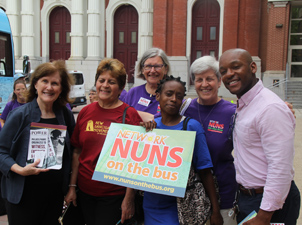
This October, I’m traveling through Cincinnati to talk with my fellow Nuns on the Bus, and all the Pope Francis voters who join him in his prayer: “I beg the Lord to grant us more politicians who are genuinely disturbed by the state of society, the people, the lives of the poor!” Nuns on the Bus Ohio has been committed to this effort, holding politicians accountable for the voter purge which would hinder access to democracy, working with immigrants and refugees to improve access to citizenship, and protecting our environment as stewards of the earth.

I am coming to Cincinnati to meet with people who are pursuing employment and seeking housing opportunities, to learn more about their lives, and to talk about issues that are most important to them this election season. I am also coming to Cincinnati to talk with people who aren’t Catholic, but share the conviction that we must do all we can to care for the common good. I invite you to join me for an election discussion that focuses on the common good. As people of faith, we must be a model for the media and for our candidates that we want a substantive conversation, not fights that tear apart the fabric of our society.

In 2016, Catholics are Pope Francis voters who work for the common good. We must not allow our polarizing election to turn us around.

Originally published in the Cincinnati Enquirer.

Voting to Mend the Gaps in Indianapolis

Voting to Mend the Gaps in Indianapolis

By Meg Olson
October 6, 2016

This past week, we traveled to Indianapolis and visited Southeast Community Services, an agency that provides GED preparation and job skills training. As Sister Simone spoke with 30 clients, we learned that there is a severe shortage of affordable housing in Indianapolis and that low wages are preventing parents and grandparents from adequately providing for their families. It was also clear many of the people sharing their stories didn’t feel like they should vote because they were poor or hadn’t graduated from high school, or because they felt like politics didn’t apply to them.

We showed two of our presidential candidate Side by Side videos, one that compared Clinton and Trump’s positions on affordable housing and one on living wages. Afterwards, Sister Simone asked, “So, what do you think?” Immediately, Thomasina raised her hand and said, “I’m going to vote! I wasn’t going to because I thought I was going to destroy something…but it’s important for my family! How do I vote?” Thomasina, who had just sold her car for $150 so she could buy her kids new school clothes, is going to vote for the first time in this election and add her voice to our democracy.

New Rules Promote Family-Friendly Workplace Policies

New Rules Promote Family-Friendly Workplace Policies

By Colleen Ross
October 5, 2016

Protecting and promoting the rights of workers is at the heart of Catholic Social Justice. The stories of people like Kathy whose “temporary” position does not provide insurance or paid sick days and Joan who shared the story of a nurse’s aide returning to work the day after experiencing a miscarriage show the need for continued advocacy on behalf of workers. Nationally, there are about 41 million workers who lack access to paid sick days, forcing them to choose between their health and a paycheck anytime they or a family member are sick. [1] This is both an exceptional and unjust state of affairs; every other developed nation requires access to paid sick leave for their workers. [2]

Members of Congress, Labor Secretary Tom Perez, and President Obama have called for legislation to provide American workers with paid sick days for years. In a significant step last week, the Obama Administration finalized a rule that requires businesses doing work on federal contracts to allow their employees to earn up to seven paid sick days a year beginning January 1, 2017. This rule could affect up to 600,000 people nationwide, and sets a strong precedent for businesses to follow.

In a related move last week, the Equal Employment Opportunity Commission (EEOC) published its final revisions to the EEO-1 form that will be used to collect data to prevent pay discrimination in workplaces. Though we have made progress as a nation in decreasing wage discrimination based on gender, race, or ethnicity, pay gaps still exist. As Pope Francis said “Why is it taken for granted that women should earn less than men? No! They have the same rights. This disparity is an absolute disgrace!” [3] NETWORK supports both the EEOC and the Labor Department in these steps towards realizing more just and equal conditions for all workers.


[1] http://www.nationalpartnership.org/issues/work-family/paid-sick-days.html

[2] https://thinkprogress.org/the-u-s-is-the-only-developed-country-without-paid-sick-days-obama-is-calling-for-that-to-change-21af09694174#.d55xrlwdn

[3]General Audience, April 29, 2015  https://w2.vatican.va/content/francesco/en/audiences/2015/documents/papa-francesco_20150429_udienza-generale.html

Voting: A Privilege and a Responsibility

Voting: A Privilege and a Responsibility

By Mackenzie Harris
September 27, 2016

As a millennial and a “Pope Francis voter” I cannot stress how concerned I am for our nation during this Presidential election. We’ve been faced with some of the most hateful messages from potential leaders of our country – it’s embarrassing. Frankly it isn’t what the title President of the United States of America means to me.

I may sound like just another millennial complaining about the government, but isn’t that how it should be? Shouldn’t we all be working for a better, more just society? It is a privilege that we live in a place where we decide the leaders of our country, so why not take advantage of it?

In many ways I think we get lost in our privilege and forget that we have the responsibility to use it to lift up the voices of people on the margins. And because we are Americans we have the right to speak directly to the causes at hand by voting, contacting our Members of Congress, or speaking out in our community.

I moved to Washington, D.C. to join NETWORK, and to use my privilege to work for the greater good. I’m inspired by NETWORK’s mission and my peers, who speak out about the importance of voting. The truth is, voting is the primary way to have a say in justice. As an American, each and every citizen has a responsibility to hold our government accountable for their actions through civic engagement and activism.

However, questioning our democracy and not doing anything about it is just a scapegoat to push the responsibility onto someone else. And in reality, it’s up to everyone.

Whether you have zero interest in getting caught up in the “drama” of politics or would rather spend your time occupying your mind elsewhere, I encourage you to spend time educating yourself on the Presidential candidates and the importance of voting. NETWORK has created Side by Side comparisons of the major Presidential candidates, and Senate races in several key states to help you see where the candidates stand on our Mend the Gap issues.

Although I am discouraged by the bigotry and hate spewed this past year, I am looking forward to Election Day as a time for unity in our nation. I am excited for our people to come together to work for the common good. I believe in this country and especially the people in it, because when faced with adversities we can overcome and together we can create systemic change.

This is the government we have; now it’s up to us to participate so our democracy works by choosing our leaders, and lobbying them on issues we care about.

Do you want to be a part of the group that says “voting is pointless” or turns a blind eye while our nation is in desperate need of your support?

I hope not. Register to vote today!

Gaps are Closing, but More Must be Done to Create an Economy of Inclusion

Gaps are Closing, but More Must Be Done to Create an Economy of Inclusion

By Lucas Allen
September 22, 2016

Nearly nine years after the start of the Great Recession, economic recovery has been painfully slow for many Americans and vast economic divides remain. However, promising new data released last week by the U.S. Census Bureau shows that 2015 was the best year of economic improvement for low- and middle-income Americans in decades. Here is some of the good news revealed in the report:

  • The poverty rate fell by 1.2 percentage points, the steepest decline since 1968
  • Real median household incomes rose by 5.2%, the largest increase since the 1960s
  • The percentage of Americans who lack healthcare fell to 9.1%, the lowest uninsured rate in our nation’s history

Most importantly, these economic improvements were distributed to all Americans—not just the wealthiest. This Census report shows that in 2015, our country made some much-needed positive steps toward mending the gaps in our divided society. While these improvements are certainly promising, a closer look at the report shows that we have much more work to do to create an economy of inclusion. The shared growth of the past year is welcome news, but it has not changed the reality that far too many people are struggling to get by in the world’s richest nation. It is a grave injustice that women, children, and people of color continue to bear a disproportionate burden of this suffering. The poverty rates of women who head families (36.5%), children (19.7%), and African Americans (24.1%) are all far higher than the average poverty rate of 13.5%.

One cause for hope in this report is that federal programs are working to lift people out of situations of poverty—they just need to be ramped up. The improvements our country makes, and the gaps that persist, are greatly impacted by policies and decisions made by Congress. For example, the Earned-Income Tax Credit (EITC) and the Child Tax Credit (CTC) kept 9.2 million people out of poverty, and the Supplemental Nutrition Assistance Program (SNAP) kept 4.6 million people out of poverty. These large numbers are hard to picture, but they represent millions of families who are able to make ends meet with support from these programs.

In his address to Congress last year, Pope Francis said, “A political society endures when it seeks, as a vocation, to satisfy common needs by stimulating the growth of all its members, especially those in situations of greater vulnerability or risk. Legislative activity is always based on care for the people.” Programs such as the EITC, CTC, and SNAP are great examples of legislation based on care for people and the common good. If you and I make our voices heard this election season, we can ensure that programs like these are protected and expanded to create an inclusive economy and society.

More resources:

https://networklobby.org/election2016/sidebysides/

https://networklobby.org/election2016/

https://www.census.gov/library/publications/2016/demo/p60-256.html