

Category Archives: Front Page

Reflection on Day Three: We Are All Hungry for Justice

Reflection: We Are All Hungry for Justice

Sr. Larretta Rivera-Williams
Thursday, July 14, 2016

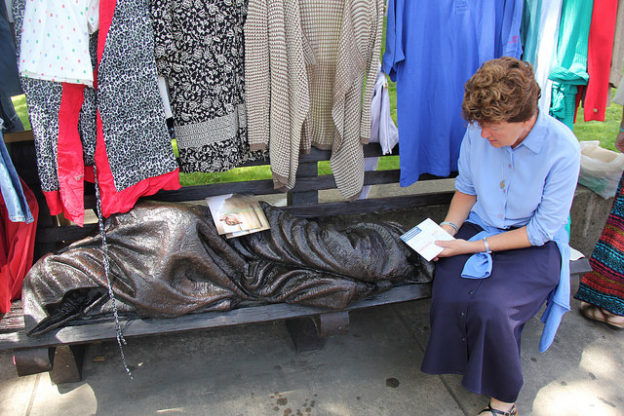
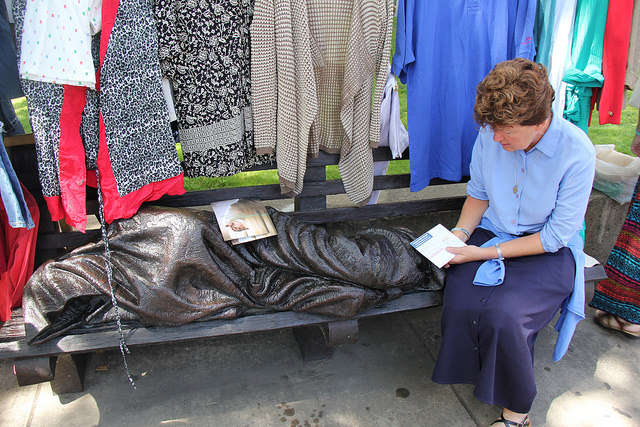
We can’t all sleep on a bed of clouds. Some people in our town have to sleep on stone or concrete streets.
-Layla age 12
Quote on display in Jefferson City at Central Missouri Community Action Agency Family Resource Center

So young and so astute to the world around her. I have never met Layla, but thousands can relate to stone pillows and the cold concrete.

I’ve never lived in public h28218291611_beb579f9bf_oousing; never feared the drug dealer residing next door. I have never had to use public transportation nor worry about what I would have to eat. I have been hugged, however, by those who have.

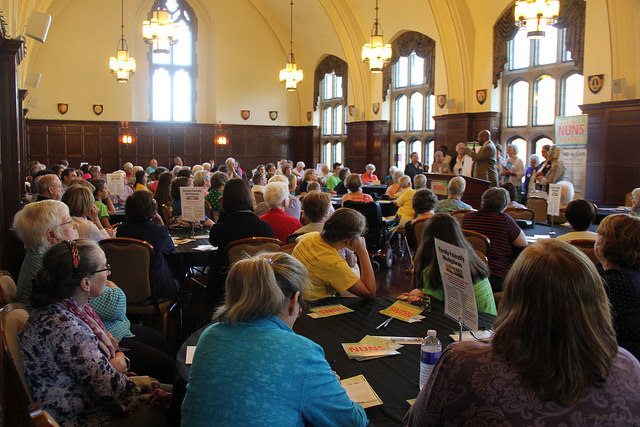
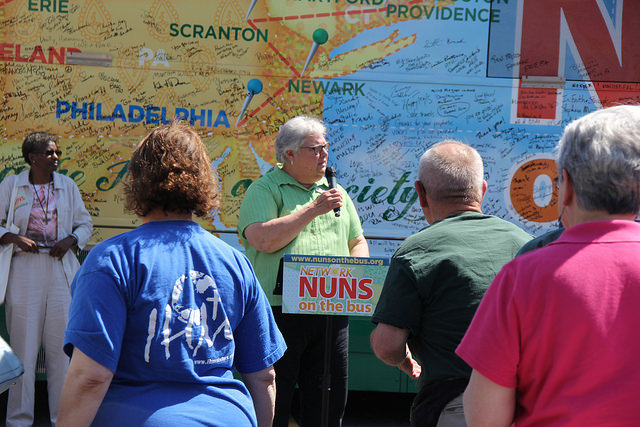
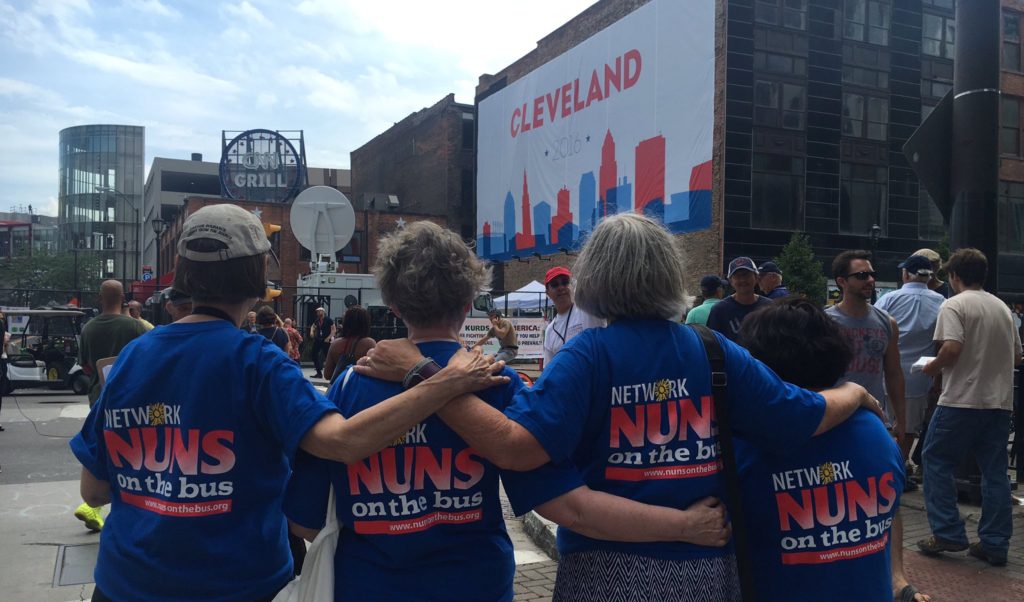
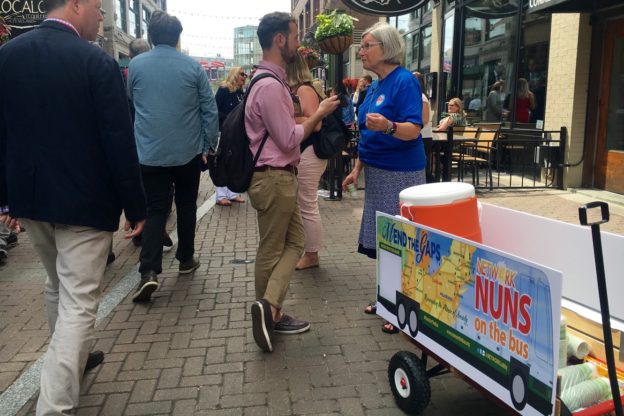
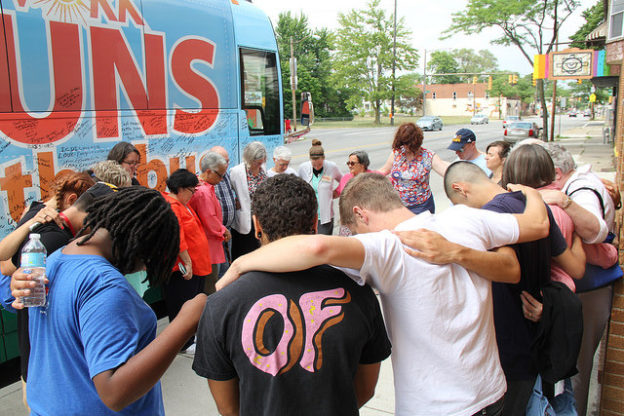
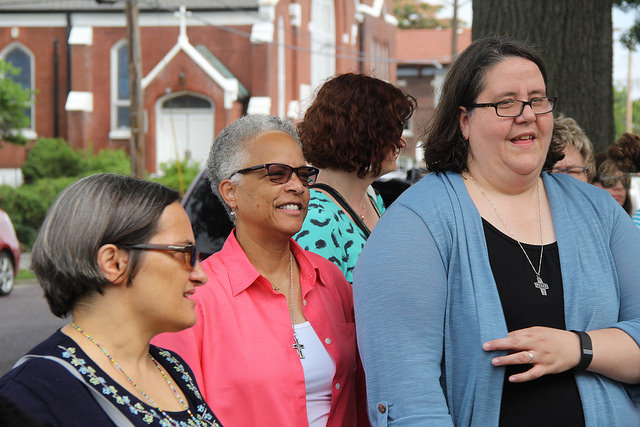
The people greeting us along the way are so grateful that we have chosen to visit with them. Men, women, and youth thrilled that Nuns on the Bus has made a stop in their city. What a humbling experience this has been!

When we step off the bus people cheer and rush forward to shake our hands. Some people with tears in their eyes want to hug us; telling us how much it means to have us with them. Sr. Susan is keeping count of the number of times Sr. Simone is introduced as a “rock star.”

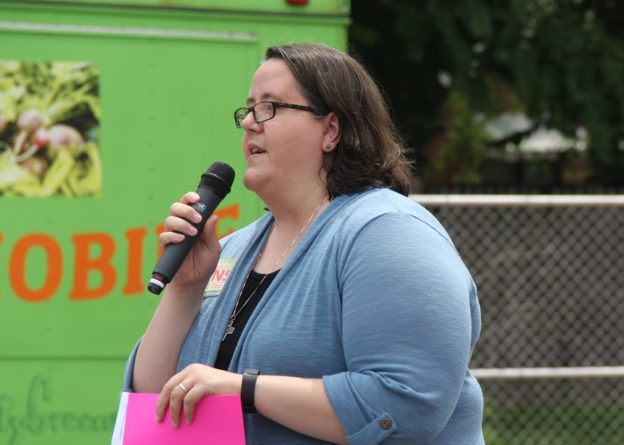
People are hungry for justice! People are filled with questions of “why” and “what can we do?” People are searching for answers in a country of uncertainty. People want to be listened to without being threatened, judged, or silenced.

Nuns on the Bus is scheduled to travel to 13 states and 23 cities. We have already been to three states and four cities. I know that we have given people a sense of hope and a start to finding the answers.

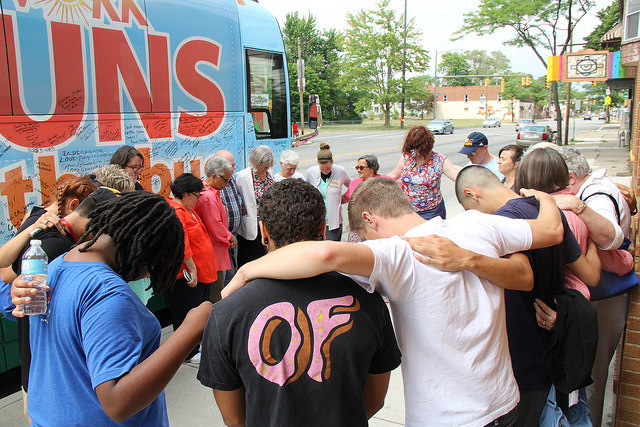
We begin our day with prayer. Grateful for the people we have met; emotionally moved and strengthened by their sacred stories. We continue forward with their blessings and the power of the Holy Spirit.

The bus is moving and bouncing us along east 64 to St. Louis. Before we lay our heads upon “a bed of clouds” tonight, I wonder how many people will we have met who are afraid of the drug dealer next door, need transportation to a second job that still only allows them to live from pay check to pay check? How many will we have met today who are in need of food and a place to call home; in need of health care to receive proper medical attention for an elderly parent, a sick child, or to seek proper care for themselves?

How many will we have met who are simply hungry for justice?

Reflection on Day Two: We the People

We the People

By Susan Rose Francois, CSJP
July 13, 2016

“We the people.”

27660810933_fd1e939a4b_oThese words from the preamble to our U.S. Constitution, which by the way I learned to sing as a child from an animated Schoolhouse Rock cartoon on Saturday mornings, were in my head and heart upon waking this morning in a simple convent room at the motherhouse of the Springfield Dominicans.

“We the People of the United States, in order to form a more perfection union, establish Justice, insure domestic tranquility, provide for the common defense, promote the general welfare, and secure the blessings of liberty to ourselves and our posterity…”

As I said, I learned to sing the preamble as a child and these words are indeed music to my ears. During my morning prayer I found myself wondering, just as I often do with the words of the Gospel, what if we actually lived them?

One of the privileges of being a Nun on the Bus is that we are going out to be with the people. Yesterday we met folks in Janesville, Wisconsin and Bloomington-Normal, Illinois who are struggling in this democracy of ours. They are struggling to make ends meet, to literally put a roof over their children’s heads.  They are struggling to access life-saving health care so that they can be healthy contributing members of our community. They are struggling to navigate our complex immigration system and fill out the right form at the right time so that they can have access to our democracy and share the responsibilities of citizenship.

Yesterday we also met people who are not necessarily struggling themselves, but whose hearts are moved to act for justice and with compassion to mend the gaps and reweave the fabric of our society.  They are advocates, immigration attorneys, volunteers in the local prison, social workers, friends, family members, neighbors and pastors.  They are every day good people. Goodness is a word that has already peppered our prayer and conversations on the bus.

We the people.  One thing that Sister Simone Campbell has been telling folks on the road is that if we the people created this mess, then we the people can get ourselves out of it.  People are struggling because of the policy choices we have made as a people, or that our elected representatives have made on our behalf.  What we need are policies which instead begin to mend the gaps and invest in the welfare of all the people.

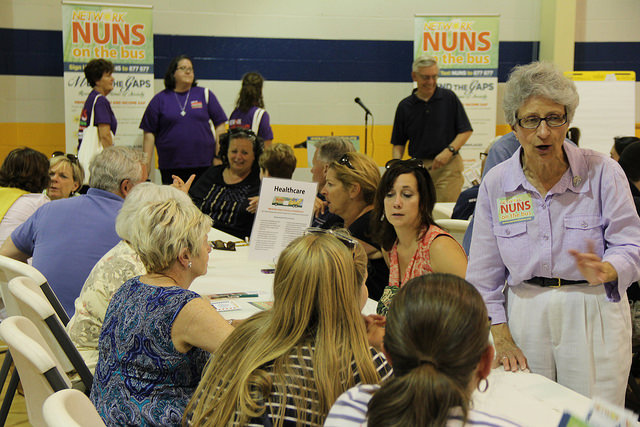
Last night during our caucus in Bloomington-Normal, I was lucky enough to sit around a table with some of these good people and discuss ways to mend the wealth and income inequality gap through tax justice.  Now, I will be the first to admit that taxes are not usually the most exciting conversation topic, and yet last night I was moved and inspired by the passion with which these folks talked about the desperate lack of funding for needed services in their community.  As tax payers and neighbors, they shared a common concern for the way our social safety net has been frayed and the future long-term health of our communities ignored in favor of short term profit and gain.

“We must regain the conviction that we need one another, that we have a shared responsibility for others and the world, and that being good and decent are worth it.”

Those words are not from the Constitution, but rather from Pope Francis in Laudato Si.

The folks I met at the caucus were the embodiment of that simple statement. I suspect the folks I meet today on the road in Springfield, Illinois and Jefferson City, Missouri will be further signs of hope for ways we can reweave the fabric of our society.

We the people are in this together.

Reflection: Nuns on the Bus 2016 — A Revolution of the Heart

Nuns on the Bus 2016: A Revolution of the Heart

Sr. Susan Rose Francois, CSJP
July 11, 2016

How do we mend the gaps and reweave the fabric of our society? That is the question at the center of this summer’s Nuns on the Bus tour which will cover more than 2,400 miles to meet with individuals, families, and communities in 13 states, 23 cities, and both political party conventions.

20160711_200935Of course, before you can answer a question as big as that, you need to cover the logistics. Monday afternoon, nine Catholic sisters gathered in a small conference room at Holy Wisdom Monastery in Madison, Wisconsin with the Nuns on the Bus staff to start our journey together. Some of the women have been on the bus before. Sister Simone Campbell, the nun on the bus, has of course been on all five bus tours. For other sisters this is a repeat experience, and for still others, myself included, this is a brand new adventure.

Mentally I have been preparing myself by learning about the seven policy recommendations to mend the gaps in wealth and income inequality and gaps in access to citizenship, housing, health care, and democracy.  I carefully studied the preparatory materials sent to us by the amazing staff at NETWORK.  I even looked up the weather forecasts in the various cities we will visit over the next eight days to make sure I packed accordingly.  Sitting in that small conference room as the staff reviewed the logistics with us, I thought to myself, I’m prepared.

Then something happened that is bound to happen when a group of nuns and people who hang out with nuns sit together in a circle. We shared some of what was in our heart. There was a common sense of excitement.  There was also some anxiety and fear of the unknown as we begin a journey that, for this group of sisters, will finish in Cleveland at the Republican National Convention. (Another group of sisters will then board the bus and head to Philadelphia and the Democratic National Convention.)

Within myself, I discovered a wondering that has been percolating quietly under the surface. In light of everything that has been happening in our country in recent weeks, from Orlando to Baton Rouge to Minnesota to Dallas, and in all of our hearts, is this really what I, what we should be about right now?  Someone else in our circle verbalized their own version of the same wondering

My heart, not my head, told me the answer. The Spirit has led us to this moment and brought us together for a purpose. There is such pain, sorrow and confusion in our society right now, and no one seems to know what to do.  Yet here we are ready to embark on a journey of encounter and listening to bring a politics of inclusion to divided places.  What better response could there be for this moment in history?

This intuition was confirmed when we joined a crowd of 300 plus at the First Unitarian Society in Madison for the pre-launch blessing.  First of all, I realized that there was no way that I could be prepared for the emotional experience of walking off the bus into a crowd of people who see the Nuns on the Bus as a symbol of hope for a broken world. Really, there are no words to describe the feeling, other than that this experience is bigger than any one of the individual women riding on the bus.

More importantly, every speaker during the evening program contextualized the meaning of this particular trip in the mess that we find ourselves in as a society, particularly the recent events these past weeks.  At the root of the violence, racism, and despair are policies that have created and perpetuated systemic injustice.  There are not many spaces in our sound-byte-world where those connections can be made at both the head and the heart level publicly. Nuns on the Bus is one of those spaces.

Earlier this week as I was preparing for my first Nuns on the Bus experience, I ran across a quote from Dorothy Day that sums it all up for me.  She said that the greatest challenge of her day, and I’d say it’s even more urgent today, is “how to bring about a revolution of the heart.”  To those who questioned small efforts in the face of big problems, she said this:  “A pebble cast into a pond causes ripples that spread in all directions. Each one of our thoughts, words and deeds is like that. No one has a right to sit down and feel hopeless. There is too much work to do.”

That is why so many people came out to the pre-launch blessing in Madison on Monday night, to cast pebbles into the pond, to add their signatures to the NOTB bus, to throw their lot in with the side of justice, goodness, and peace. As they blessed us on our journey, they found their way into our hearts and will journey with us.

So how to do we mend the gaps and reweave the fabric of our society? One step, one stop, one signature, one story, and one conversation at a time.  We cannot sit down and feel hopeless. There is still too much work to do in our revolution of the heart.

Speaker Ryan Fails to Consider His Faith in His Policies

Speaker Ryan Fails to Consider His Faith in His Policies

By Molly Burton, NETWORK Intern
July 7, 2016

My name is Molly Burton and I’m very excited to say that I’m interning at NETWORK this summer. I’m a rising junior at the University of Notre Dame, studying peace studies, gender studies, and philosophy. My ultimate career goal is to become a human rights lawyer and work in policy against sex trafficking and sexual based violence against women, so I’m excited for NETWORK to teach me more about the lobbying side of policymaking. I’m originally from St. Louis, MO and went to Catholic grade school (Mary, Queen of Peace) and high school (Nerinx Hall).

That description doesn’t just describe me, however, it describes hundreds, even thousands of people whose Catholic backgrounds guided them into the policy world. One of these people is current Speaker of the House, Paul Ryan. Though Speaker Ryan and I might share the same religion, I frequently (if not almost always) disagree with him. An example of this can be seen with Speaker Ryan’s recent release of his anti-poverty plan, “A Better Way to Fight Poverty.” House Republicans released this plan at the beginning of my third week at NETWORK and my third week on the Hill and it left me a little disappointed in how the House Republicans view poverty and those stuck in poverty. I have been grateful for the amount of pushback this plan is getting from critics both inside and outside of the Congress.

You’d think fighting poverty would be an issue that both parties would agree on, that we could put aside our differences and help those who need it the most. Well, it doesn’t seem to be that way at all. The 30 plus page document that Speaker Ryan released (that I couldn’t even get all the way through because it frustrated me too much) has an underlying message throughout that no one would be poor if they worked. For instance, the taskforce that “A Better Way” creates, “recommends that federal safety-net programs expect work-capable welfare recipients to work or prepare for work in exchange for receiving benefits. That’s the only way they can escape poverty.”

This idea bugged me just a little bit (a lot it bugged me a lot). It ignores the systemic nature of poverty and how truly difficult it is to escape it. It ignores how ingrained racism, sexism, and classism is in our society and how that constantly pushes people down. It ignores how society has ghetto-ized poverty and forced those who are perceived as different out towards impoverished, violent neighborhoods with poor education systems. Speaker Ryan’s poverty plan is not a better way to fight poverty; it is a better way to fight those in poverty.

His ideas aren’t going to make conditions better for anyone living in poverty. Honestly, the ideas that Speaker Ryan presented in his plan offended me and I’m sure anyone who has seen poverty first hand. In my opinion, Speaker Ryan misinterpreted what it means to help those in poverty by expecting from them to achieve what was handed on a silver platter to him and those surrounding him. His privilege makes him blind. Though I am incredibly privileged as well, I’d hope that the influences in my life, like my years of Catholic school and the Catholic Social Justice principles here at NETWORK, have given me a way to see those struggling with poverty without blindly demanding more work from a population that has been working as many shifts as possible at a minimum wage job and making still less than the federal poverty line. Don’t get me wrong, I respect Speaker Ryan’s right to his opinion and definitely acknowledge that he is way more informed about policy than I, an intern and not even a junior in college, am. Yet, I still ask Speaker Ryan to consider his Catholic faith and really ask himself if “A Better Way to Fight Poverty” really is a better way to fight poverty.

Read more from NETWORK about Speaker Ryan’s new anti-poverty plan here.

Nuns on the Bus Setting Out to Mend the Gaps

Setting Out to Mend the Gaps

July 8, 2016

The 2016 election cycle has been marked by anger, fear, polarization, and hate. It is difficult to listen to the news or participate in ordinary discussions in our nation without encountering a high level of hostility. And so, the Nuns on the Bus are hitting the road again, visiting some of our nation’s most economically challenged communities and some of the most prosperous. At every stop, we will meet with Americans who are struggling. We will hear their stories and call on everyone running for office to listen as well, and to do everything in their power to mend the gap –  to close the vast and growing economic and social divides that are weakening the fabric of our country.

To “Reweave the Fabric of our Society” we must mend the wealth and income gap and the access gap.  Throughout our Nuns on the Bus trip, we’ll share our ideas for mending the gaps, and learn from those we encounter about the gaps they experience in their lives.

Follow the trip on Twitter, Facebook, and Flickr. Share your story with us. Attend a Nuns on the Bus event.

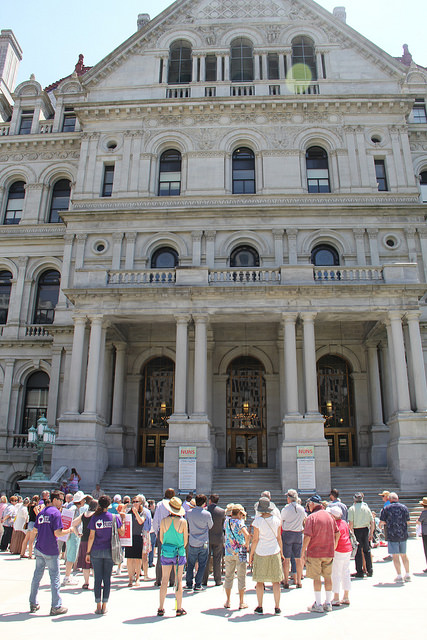
The final stop for the Nuns on the Bus tour was the Methodist Building across from the Capitol and next to the Supreme Court.

We look forward to our journey with you!

Blog: Will We Have a Clean Budget or Poison Pills?

Will We Have a Clean Budget or Poison Pills?

By Sister Marge Clark
June 27, 2016

Both the House and the Senate are working their way through funding bills (appropriations) for fiscal year 2017, which begins on October 1, 2016. Unfortunately, they are muddling through without the benefit of a budget that would allocate the amount of funding for each of the twelve areas of annual discretionary spending. This is because members of the House remain divided on what the overall spending amount should be: abide by the Bipartisan Budget Agreement signed by House and Senate in late 2015, or spend less—breaking yet another agreement. This disagreement opens the door for amendments that will benefit some special interest groups and limit spending on our common needs.

House Republicans often use this chaos to add things – whether it be harmful cuts to government assistance programs, or eligibility restrictions—that are undesirable or even irrelevant to the bills at hand. We refer to such amendments as “poison pill” riders. They ride on the bill, often without discussion or a separate vote. Examples of this include addition of work requirements for those receiving Supplemental Nutrition Assistance Program (SNAP) or drug testing to receive housing assistance. These added strategies further devastate the hopes of people trying to live in dignity and improve the status of their family.

NETWORK’s Mend the Gap principles and policy recommendations promote legislation that will allow families to live in greater dignity and move to a more stable position in their community. NETWORK Lobby is working to keep these “poison pill” riders from damaging the legislation necessary to ensure sufficient housing and healthcare and to protect workers and their families.

Last year, as the spending bills were rolled into an “omnibus” package to be voted on as a single bill, advocacy groups were successful in keeping poison pill riders off the package. We worked with one voice across very divergent groups, because we all see the potential damage to our communities. Now, the fight is more difficult because we have to fight riders on each individual spending bill. It takes more time to study and analyze each individual bill, and it takes more awareness of issues other than our own greatest concerns. But together, we fight on.

So far this year we have been successful in the Senate. There have been very few poison riders introduced. But, there are many bills to go. In the House, there is a constant need to watch what amendments are proposed, and to demand that members consider the implications of each of these amendments on the good of all the people, not just a privileged few. The further into the appropriations season we get – and the closer to the election – the more danger there is of amendments cutting assistance to people who are vulnerable. NETWORK Lobby continues to work for clean legislation for our nation’s spending priorities.

Guest Blog: Unbind Section 4: The Voting Rights Act is still needed

The Voting Rights Act is Still Needed: Unbind Section 4

By Leslye Colvin
June 23, 2016

The United States of America theoretically embraces voting as a sacred right. Unfortunately, the history and lived experience of systemic obstacles to the exercise of this right underscore the urgency of its protection, and the continuing need for Section 4 of the Voting Rights Act.

In 2015, NETWORK Lobby sponsored an interfaith advocacy retreat on economic inequality at Springbank Retreat Center in Kingstree, SC. Designed as a teambuilding exercise for Palmetto State advocates, invitations were extended also to those in neighboring states. More than a dozen South Carolinians from across the state, and a few outsiders, gathered on land made sacred by the blood of enslaved Africans and their descendants. After touring the former working plantation, the property managers showed a pair of shackles discovered on the grounds. This was the most emotionally charged moment of the gathering. A century and a half after the end of chattel slavery, we were hit by the literal and figurative weight of this tool of bondage. It was a tangible expression of the economic and racial injustices binding us to the struggle. Bound by this common desire, we worked, ate, and prayed together for three days.

Tragically, three weeks later, the falsehood that had sustained centuries of injustice walked into Charleston’s Emmanuel A.M.E. Church, a historic sanctuary, to dispense death. This man’s life experience was corrupted by centuries of an unjust and often legal system built upon the deception of racism and white privilege. The oppressive system simultaneously denies ones dignity and citizenry. The Martyrs of Emmanuel A.M.E. paid the ultimate price as did countless others who merely acknowledged their dignity and their citizenry.

As the nation mourned her latest martyrs, elected officials began responding to previously ignored calls to relinquish one of the final symbols of the Confederacy. Before I relocated to my home state of Alabama, the governor had unceremoniously removed the flag from the State Capitol. An act that even my optimism could not have foreseen.

Invited to be a silent observer at a meeting hosted by the Secretary of State on the possible restoration of voting rights to those who had been incarcerated, I left the meeting dismayed. Each participating elected official identified himself as a conservative as though the meeting was a campaign event. They then proceeded to address the moral turpitude of those who had been incarcerated. In Alabama and many other states, the incarcerated are disproportionately African-American. Having spent the majority of my life in Alabama and Georgia, I have never heard moral turpitude used to address those who profit from economic or racial injustice.

Whether it is real or perceived, no one freely relinquishes power. As African-Americans have demanded the recognition of their dignity and citizenship, they have often encountered violent opposition throughout history. From the Emancipation Proclamation to the 14th Amendment and Reconstruction to Brown v. Board of Education to the Voting Rights Act to the Civil Rights Act to the election of President Barack Obama – advances have consistently been met with incredulity and obstinance as opponents sought to revert progress. This is the context of Shelby v. Holder.

Amidst the pain and death, the 1960s were a season of hope.  In Christian scripture, after Jesus restores Lazarus to life, he instructs the community to unbind him. For centuries, African-Americans have called upon their government to unbind them. The Voting Rights Act was a tangible response this call. Almost as tangible as the shackles discovered at Springbank, it cannot unbind the deeply rooted systemic injustices of preceding centuries in five decades. Unbind us. Unbind Section 4 of the Voting Rights Act.

Leslye Colvin


Leslye Colvin is the Director of the Catholic Committee of the South, and a member of NETWORK.

Op-Ed: School Lunch Program at Risk and Congressman Mike Bishop Can Help

Op-Ed: School Lunch Program at Risk and Congressman Mike Bishop Can Help

Cherie Mollison,  East Lansing Catholics Network
June 16, 2016

Originally published in the Lansing State Journal. Read the original: http://www.lansingstatejournal.com/

For nearly half a century, the only fights about school lunch took place in cafeterias across the country with kids wielding fish sticks and chocolate pudding as weapons. Otherwise, in the fifty years since the Child Nutrition Act was signed into law, there was bipartisan consensus that as a nation, we should make every effort to ensure children from food insecure households and communities had enough to eat.

Today, that consensus is unraveling. Recently, the U.S. House of Representatives committee responsible for school breakfast and lunch and other nutrition programs voted to make it substantially harder to feed children in our communities. Sadly, our Congressman Mike Bishop, joined them, and the bill appears likely to pass.

Congressman Bishop voted yes on the so-called Improving Child Nutrition and Education Act of 2016 (H.R. 5003); a dangerous piece of legislation both because of the immediate cuts it makes to the critical programs that help to feed children, and for the clear message it sends about Congress’ future plans to undo our social safety net.

Of immediate concern is a provision that reduces the number of schools allowed to provide meals at absolutely no charge to students. Currently, schools can provide free meals to all students if 40 percent of the student body is automatically eligible. The new bill would raise that threshold to 60 percent.

This means that 7,000 schools nationwide, which have been providing free meals to 3.4 million children, will no longer be eligible to serve all students. Michigan has more than 500 schools in counties across the state that are eligible for, or already participating in, this program. For example, 40 percent of the students in Ingham County, which ranks 39th in the state in overall child well-being, qualify for free or reduced price lunches.

In many of these schools the students who don’t qualify for free meals live just above the poverty line and their families are still struggling. Allowing the school to feed all students not only helps reach those children who fall through the cracks, but also reduces the resources and administrative time it takes these schools to feed their students.

Furthermore, the bill includes a provision replacing critical nutrition assistance programs with “block grants” in three states as a pilot program. Abandoning tried and tested social programs, Congress would instead give the cash directly to state governments, with little or no oversight on how it is used. This would jeopardize standards, cause dramatic and unnecessary changes to how schools operate, and, in the long term, could mean significant funding redirected away from the child nutrition programs altogether. The bill’s proponents clearly want to take this dangerous experiment nation-wide – a risk we cannot afford to take with our children.

During a meeting with NETWORK earlier this spring, Congressman Bishop called himself a “numbers guy.” When it comes to child nutrition, the data doesn’t lie. The most recent Michigan Kids Count report found that nearly 1 in 4 kids are living in poverty, a 23 percent increase from 2006 to 2014.

Perhaps Congressman Bishop is unaware of the chaos and scrambling for resources that we know will follow the types of changes he voted for in the child nutrition bill. Or maybe he has simply accepted the misinformation his colleagues in Congress sold him and misguidedly thinks this is the way to help our children.

No matter what, Congressman Bishop has the opportunity and the responsibility to lead. He must get the facts, and step up and fight back against this proposal to take food – quite literally – out of the mouths of babes.

Cherie Mollison is a member of the East Lansing Catholics Network, a local affiliate of NETWORK, the national Catholic social justice lobby. NETWORK organizes the annual “Nuns on the Bus” tour, now in its fifth year.

Blog: Predatory Lending, the Latest Target for the CFPB

Predatory Lending, the Latest Target for the CFPB

Alice Kitchen, NETWORK Board Member
June 8, 2016

“You have been providing payday loans to people who are mentally retarded and mentally ill. You have provided payday loans to people who are illiterate, who cannot read the very contract you have them agree to. This is wrong”. These were the words of a staff member of St. Vincent DePaul Society in Southeast Missouri.  She was part of the 50-60 people who gave personal testimony at the Consumer Financial Protection Bureau (CFPB) Hearing in Kansas City, Missouri on June 2nd.

This public rally and hearing has long been in the works. In 2012, activists throughout Missouri gathered signatures to put payday lending reform on the statewide ballot. Signatures were easy to come by as citizens throughout the state saw these payday lending storefronts everywhere but mostly in low income communities. Missouri legislators failed to pass laws to reduce the ceiling on interest rates for payday loans below 450%. Industry leaders and the Missouri Equal Credit Opportunity have amply contributed to state legislators, the Black Caucus, and the Urban Summit to the tune of over $2 million in the past 3 years.

Photo courtesy of Andrew King

Photo by Andrew Kling

Over 1,000 people joined the public rally. The highlight for me was seeing Bishop James V. Johnston Jr., the new bishop of the Catholic Diocese of Kansas City-St. Joseph, alongside of the Rt Rev Martin “Bishop Marty” Field of West Missouri leading a long procession of faith leaders and social justice activists.

Bishop Johnson said to a local journalist “[predatory lending] is one of the most atrocious things that still exist in our society. It’s incredible that people can be exploited like this.”

The rally participants came from all over Missouri, parts of Kansas, Nebraska, Iowa, Texas, Florida, and Pennsylvania. Kansas City was selected for the hearing because some of the most egregious abuses have occurred here. As anticipated, two large charter buses pulled up in front of the Music Hall to deliver over a hundred payday loan workers from surrounding areas. The employees of these storefront payday loans made the pleas to oppose the proposed regulations. During the four hours of hearings many of them stated how their services helped people in desperate situations. Activists and faith based speakers prefaced their comments with their name with “and I am not paid to be here.” One woman working at a payday loan office made an emotional plea not to enforce the proposed regulations since she needed her job; she just purchased a home and has two daughters to support. How perverse is this?

The stories were painful to listen to as they told of loss of income to pay the rent, purchase medications, pay for transportation, feed their family and maintain their housing. Some told of their loss of their homes, the marriages, their cars were repossessed, and several committed suicide.

Predatory Lending Photo credit Andrew King2

Photo by Andrew Kling

Rev. Dr. Cassandra Gould, of Missouri Faith Voices, spoke eloquently about the need for strong regulation to put an end to the predatory nature of these loans.  Predatory lending, she said is “a scourge on minority communities.” She advocated support for the federal consumer agency’s new proposed regulations, especially the call for a measure of underwriting before a loan is issued. “Basically, to get a payday loan, all you need is a checking account and to be breathing,” she said. This was a woman who had worked in banking for 17 years before going to divinity school.

I testified on behalf of a graduate student of mine at the University of Missouri-Kansas City. She struggled with her classes, not because she was not capable but because she had student loans and a payday loan to the amount of $80,000. She had no transportation and a fragile housing arrangement; she was the guardian for her grandfather and worked at a coffee cafe to get by. She couldn’t be at the hearing because she finally got a job. With her marginal income it will take many years in the prime of her life to pay off her spiraling debt.

The Consumer Financial Protection Board posted their proposed new rules online just before the hearing. Proposed regulations are “Aimed at cleaning up unfair, deceptive or abusive practices that harm consumers” said Richard Cordray, Director of the CFPB. Many have said that what is most needed is a cap on the ceiling for interest rates. The CFPB does not have the authority to do this, but many suggest the cap that is put on military payday loans which have a ceiling of 36%. The 90 day comment period opened at the hearing and once the proposed regulations are finalized they will go into effect most likely next year. These rules do not require Congressional approval.

You can comment on the proposed rules online at https://www.regulations.gov/ or by phone at 855-729-2372.

Blog: 10 Things Speaker Ryan Could Do to Address Poverty Right Now

10 Things Speaker Ryan Could Do to Address Poverty Right Now

NETWORK Lobby
June 7, 2016

NETWORK Lobby for Catholic Social Justice welcomes anyone, any time, to the conversation about how to make sure no one in the United States lives in poverty. But we strongly dispute the claim that this is a deeply complicated problem requiring a brand new agenda, such as the one likely to be presented by Speaker Paul Ryan in the coming days. The fact is Congress knows, and has always known, how to end poverty. It is simply not that difficult, in the richest country the world has ever known, to create an inclusive economy where everyone has the resources to live with dignity.

In fact, we could do much of it as early as tomorrow.

Toward that end, we offer Speaker Ryan, the driving force behind the Republican “anti-poverty” agenda, 10 things he could bring to the House Floor tomorrow that would actually work. This is not everything that has to be done to mend the gaps in the fabric of our society, but it’s a darn good start.

  1. Raise the minimum wage to $15 an hour — Even as the economic recovery has brought lower unemployment, too many people working full-time jobs (or even two or three of them) don’t make enough to get by. A study by the National Employment Law Project found that $15/hour was the lowest wage that would still allow a single worker to meet the basic cost of living just about everywhere in the United States. Speaker Ryan could help lift thousands of workers out of poverty by passing H.R. 3164, the Pay Workers a Living Wage Act introduced in Congress last year.
  2. Guarantee paid sick leave — 49% of workers in America still lack paid sick leave and are forced to choose between losing the salary they desperately need and jeopardizing their health and the health of those around them. After passing a comprehensive paid sick leave policy New York City found not only that it improved the health and financial security of workers, but also that unemployment dropped and businesses grew.The Healthy Families Act (H.R. 932) was introduced in Congress more than a year ago. There’s no excuse not to pass this legislation today.
  3. Guarantee paid family leave — In addition to ensuring that everyone has the ability to take a sick day to care for themselves or their family, we must also guarantee paid leave for new parents and those who have to take extended time to care for a sick family member. Only 5% of workers in the lowest 25% wage category have access to paid family leave, compared to 22% of workers in the highest 10% wage category. The FAMILY Act (H.R. 1439), introduced in Congress last year, builds on successful legislation passed by cities and states around the country to create an insurance program that provides workers with the family leave they need.
  4. Expand and protect the Earned Income Tax Credit — The Earned Income Tax Credit (EITC) is one of our most effective anti-poverty programs. It provides tax relief to low-income workers to ensure that no one who labors to earn a basic wage is taxed back into poverty. According to the Center on Budget and Policy Priorities, the EITC helped lift 6.2 million people out of poverty in 2013. But the current law overlooks too many workers in need, including those low income workers without children and workers under 25 or over 65. Speaker Ryan himself discussed his support for addressing these gaps when he was Chairman of the House Budget Committee, now he has the means and the opportunity to make those changes today.
  5. Expand childcare subsidies — The high cost of quality childcare takes a dramatic toll on low-income families across the country. A report from theEconomic Policy Institute found that in every state, quality childcare cost more than 30% of a minimum-wage worker’s earnings. Access to high quality childcare allows parents to support their families and better prepares children to learn and grow into healthy adults. We shouldn’t ask people to choose between their kids and their paychecks — H.R. 4524, the Child CARE Act, is one way that Speaker Ryan could solve that problem.
  6. Ban the box — It’s no secret that admitting to having a criminal record is the kiss of death for job applicants. Conviction records are likely to reduce the prospect of a job offer or interview by almost 50%. There are currently 70 million people in America with arrest or conviction records, we are only just beginning to realize the massive economic implications of discriminating against the people who are reentering society and the workforce. Passing the Fair Chance Act (H.R. 3470) would allow people seeking to reenter the workforce the opportunity to apply based on merit, without facing discrimination.
  7. Pass immigration reform with a path to citizenship — For the millions of people who live in the U.S. without documentation or with only temporary permission to work, finding stable employment can be nearly impossible. Many more immigrants are barred from accessing the social programs they need because of decades of anti-immigrant legislation. By allowing immigrants to come out of the shadows and fully participate in society, immigration reform would benefit individual families and our community; the CBO estimated that immigration reform would reduce our federal budget deficit by $200 billion over ten years. H.R. 13, the Border Security, Economic Opportunity, and Immigration Modernization Act, had the votes to become law in 2014 and is a viable solution to fixing our broken immigration system. Speaker Ryan should work with his fellow members of Congress to pass real immigration reform now.
  8. Expand eligibility and opportunity for low-income housing units — There is a significant shortage of affordable housing units across the country. Bipartisan legislation in the Senate rumored to be introduced in the House of Representatives (The Affordable Housing Credit Improvement Act) would incentivize the building and preservation of almost 1.3 million homes. Speaker Ryan can move forward with his commitment to end poverty by developing a housing plan that focuses on ensuring that everyone has a home.
  9. Continue to make healthcare more affordable — The Affordable Care Act was a critical step toward making sure that all Americans can access the healthcare they need, but it stopped short of realizing the goal of universal healthcare. H.R.3241, the State-Based Universal Health Care Act of 2015, would allow states more flexibility and freedom to work toward universal healthcare. Speaker Ryan can move forward today to ensure that no one lives in the healthcare gap and take a powerful step toward alleviating the economic uncertainty and financial burden of families still left without health insurance.
  10. Reauthorize and improve the Child Nutrition and WIC Reauthorization Act — The landmark legislation that helps feed children in schools across the country has been under attack by congressional Republicans. Congress has sought to cut the number of schools eligible to feed all of their students and increase the amount of time and effort schools must put into qualifying for the program. Beyond these initial changes that will kick thousands of students out of the program, Republicans in Congress want to replace the entire program with ‘block grants’ that will seriously jeopardize our ability to feed children in need. Congress has an opportunity to improve child nutrition programs to feed more children who are hungry. If Speaker Ryan wants to lead on poverty, he can start by leading his party away from policies that take food from children.

As NETWORK’s Nuns on the Bus reminded Congressman Ryan in 2012, to implement programs that work to eliminate poverty, Congress must have the political will to raise reasonable revenue for these responsible programs. We can pay for these programs by closing tax loopholes and having the courage to fix our broken tax system. Right now, a loophole in tax law allows hedge fund managers to call a portion of their earnings a ‘capital gain’ instead of ‘income’ and that small difference costs the nation billions in tax revenue every year. The Carried Interest Fairness Act (H.R. 2889) is one such piece of legislation that promotes tax fairness in the United States.

Creative solutions to solving poverty are necessary, but we don’t need to look far to find the answers. What if — instead of giving the billionaires another break — we took that money and used it to expand Section 8, the federal program that helps low-income families find affordable housing? NETWORK Lobby judges all legislation by how it would affect people experiencing poverty. If Speaker Ryan is serious about this issue, we encourage him to use the same criteria.

Photo courtesy of Gage Skidmore