

Category Archives: Healthcare

At a Critical Time, NETWORK Advocates for Healthcare

At a Critical Time, NETWORK Advocates for Healthcare

Lily Ryan
June 26, 2017
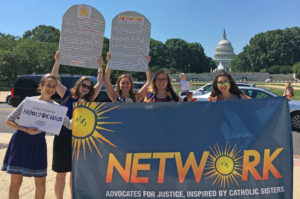
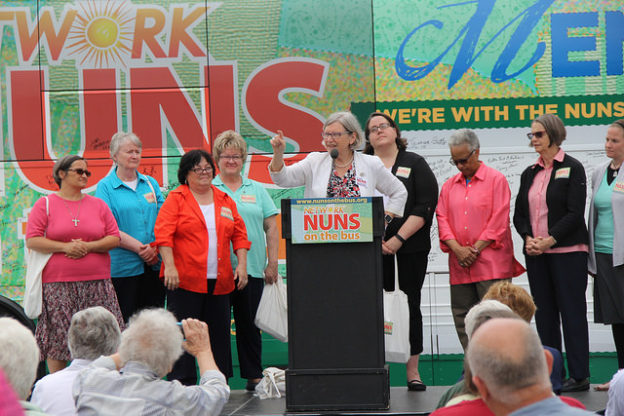
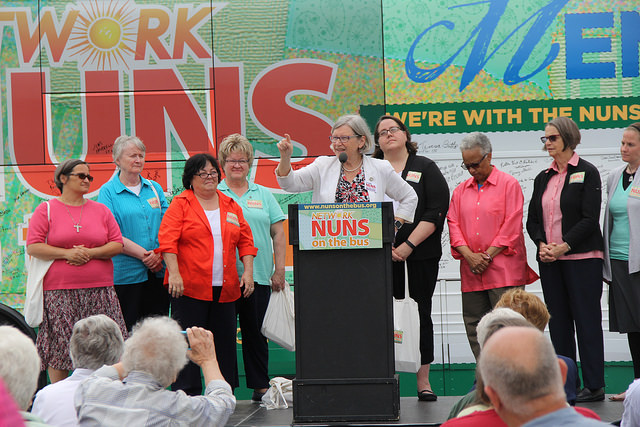
Last week, NETWORK joined members of Congress, healthcare advocates, and members of the faith community at a rally for healthcare outside the Senate. The collection of banners and signs in the crowd presented a colorful visual of the groups who had turned out to voice their opposition to legislation that would seek to strip coverage from the neediest Americans.

A group of mothers and children, some dressed up as super heroes, greeted speaker after speaker as they told the stories of a few of the 23 million people who face losing their insurance under the proposed GOP legislation. Members of the Senate’s Democratic minority urged the crowd to fight reductions in Medicaid and crucial aspects of the ACA and made forceful appeals to moderate Republicans to reject the legislation.

The stories from the rally were on my mind when the all-white, all-male Republican healthcare working group released the Senate bill Thursday. Unsurprisingly but still disappointingly, the “Better Care Reconciliation Act” is just as damaging as the AHCA.

These bills would take us back as a country and sacrifice the needs of the sick, the elderly, and children to give tax breaks to the wealthiest Americans. The Republican plan to dismantle the health care for millions of Americans does nothing to address existing problems with our current healthcare system and would exacerbate inequities in health coverage and access.

The faith community has a special role to play in resisting “TrumpCare,” as it is uniquely positioned to lift up the values of people of faith in the context of political decisions that will impact ordinary people. NETWORK is part of an interfaith coalition leading communities of faith across the country in lobbying members of Congress to protect the lives of those who depend on Medicaid and all whose healthcare is threatened by this legislation.
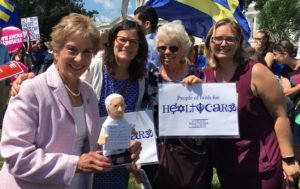
At the rally, NETWORK carried a small likeness of Pope Francis. Our little pope held a sign that said “Health is not a consumer good but a universal right, so access to health services cannot be a privilege.” This reflects Pope Francis’ constant reminders to live and act in a way that reflects the mutuality of all people.

It is our responsibility to take up Pope Francis’s challenge to seek the Kingdom of God on earth by fighting for policies that uphold the dignity of all people, particularly those at the margins of society. Together with people of faith across the country, we are standing up for healthcare and opposing a healthcare bill that takes from millions to give to the few.
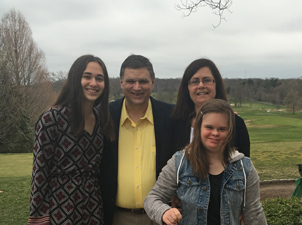
Lily Ryan is a summer intern with the NETWORK Communications team.

The McGrath Family’s Medicaid Story

Healthcare: The McGrath Family’s Story

NETWORK members Joe and Rita McGrath of Lafayette Hill, Pennsylvania know firsthand why Medicaid is important. It has been critical in keeping their daughter alive and the family from bankruptcy. When preparing for the arrival of their first child, Joe and Rita received the news their daughter would be born with Down syndrome. Some people asked Joe and Rita if they were going to terminate the pregnancy, but for the McGraths, it was never a question. The first few months of Maura’s life were difficult, but the McGraths pushed through the dark days with the support of friends and family.  A little more than a year later Joe and Rita welcomed their second daughter, Michelle.

Now 17 years old, Maura continues to be the blessing her parents have always known her to be. In addition to Down syndrome, Maura is also nonverbal and has been diagnosed with autism and behavioral issues. As a minor living with disabilities, Maura qualifies for Medicaid benefits. Even though Joe and Rita both work, the cost of Maura’s healthcare is too expensive for their family to afford on their own.

An integral part of Maura’s wellbeing is the care Maura receives from her home health aide, Williamina. Taking care of Maura is a full time job and looking after her became more difficult for her mother, Rita, after she fought cancer. Additionally, Joe has Parkinson’s disease. Medicaid provided the necessary funds for the McGraths to hire assistance, and in the past seven years Williamina has become like a family member.

In addition to a home health aide, Maura needs eight different medications, medical equipment and supplies, and frequent doctor appointments. Medicaid covers these costs. Without Medicaid the McGrath family would be in financial ruin. The cost of Maura’s medicine alone would be several hundred dollars every month. These are expenses the McGraths, and many families in similar situations, would be unable to afford without the help of Medicaid.

Joe and Rita have experienced the life-changing impact of affordable healthcare, and there are millions of families like the McGraths that need Medicaid. Each of these human lives is more valuable than cutting costs or turning a profit. We are one another’s keeper and the care Medicaid recipients are entitled to is our shared responsibility.

On March 24, 2017, during debate over the American Health Care Act (AHCA) in the House of Representatives, Rep. Brendan Boyle (PA-13) shared Maura McGrath’s story on the House floor and urged his fellow members to vote no on the AHCA.

We Come Alive Together

We Come Alive Together

Simone Campbell, SSS
April 27, 2017

As I write this, a few weeks ago Speaker Paul Ryan stated with righteous indignation that “well people shouldn’t have to pay for sick people.” This is one of his “principles” as he works to repeal the Affordable Care Act (ACA). I found this shocking because the whole principle of insurance is that you pay into it so that when you need to use it you can. Some have lower costs and some have higher costs, but all get the care they need when they need it. Costs average out over time. That is the whole theory of insurance and I thought Speaker Ryan would understand this “business model”. But apparently he does not.

The longer I pondered this misunderstanding of how insurance works, I came to see that there is even a deeper blindness. In the Republican commitment to individualism, they have lost sight of community and the common good. The biggest problem with the Republican effort at healthcare legislation is that it lacks the awareness that it is community which makes healthcare effective. It is not just about the individual. Healthcare is a communal good. This is why Pope Francis and his predecessors have clearly stated that healthcare is a human right.

Our nation’s hyper individualism is sucking the life out of our nation. Just focusing on myself is contrary to my Catholic faith and contrary to our Constitution. As I was pondering the Lenten readings, I was struck that all of the scriptures involve some aspect of community. No one is acting alone. This led me to an insight about Speaker Ryan’s flawed faith analysis.

The gospel reading on the second Sunday of Lent was the story of the Transfiguration of Jesus before the apostles. I love this story! Simon Peter both gets it wrong and gets it right. First, the truth of Jesus and the presence of Moses and Elijah are revealed to this small community. Peter and presumably the others are awed and surprised. Peter in his enthusiasm blurts out how good it is to be there and offers to “build a tent” as an altar for the three. But a bright cloud surrounds them and a voice says “This is my beloved…listen to him.” (Matthew 17:5) After a bit, Jesus helps the apostles stand up and tells them not to be afraid.

Reflecting on this scripture led me to know that we are called to see Jesus and the elders transfigured in our midst. In community we see the dazzling truth of the Divine’s presence and are urged to act. It made me think of our bus stop this past summer at Integrity House in Newark, New Jersey. It is a therapeutic community for people with substance use disorders. With guided interventions, staff and residents work together toward sobriety. We met with about 25 of their community members and heard about their struggles and hopes. Many residents previously had brushes with the law and had done jail time. They discovered that they could not do this work alone. Only in community could they be transformed. One woman said “It takes so much to fight addiction and depression! I can’t get rid of my demons by myself. I have to do my part, but alone I’m not enough.” She said by working in this community, however, she and others are being transformed.

While this was one woman’s story, I think it is also the story of our society that Speaker Ryan missed. It is not effective for us to be alone in our caring for our families, ourselves, or our communities. We are not made to be isolated. In fact, there is a lot of evidence that when I feel alone is when fear and division rise. We can only be “transfigured” in a group. Together we can be made new. This is the basis for sound, inclusive healthcare policy.

Let us remind our elected officials that we are our sisters’ and brothers’ keepers. If we embrace this truth and act in community, then we will have a healthcare system that works for all of us, not just the wealthy. Then we will be the people that we aspire to be—transformed and alive.

Originally published in Connection Magazine. Read the full issue here.

NETWORK Joins Moral Rally to Save Healthcare

NETWORK Joins Moral Rally for Healthcare Before House Vote

March 22, 2017

The day before the House of Representatives is scheduled to vote on a repeal of the Affordable Care Act (ACA) and the Republican replacement, the American Health Care Act (AHCA), NETWORK joined with Rev. William Barber, II, Faith in Public Life, and clergy representing many faiths, to speak on the moral call for healthcare for all. Laura Peralta-Schulte, NETWORK Senior Government Relations Advocate, spoke; watch her remarks or read the transcript below:

Healthcare is a matter of life and death.

For Catholics, our Church’s teaching on healthcare is simple: Healthcare is fundamental right, not a privilege for those who can afford it.

It was Pope Benedict who summed it up best when he said, “it is the moral responsible of nations to guarantee access to health care for all of their citizens, regardless of social and economic status or their ability to pay.”

Our long and rich tradition is based on the Gospel’s call to love our neighbor.  We are called to imitate the practices of Christ who ministered to the sick, cared for those in poverty, and went directly to the people who were on the margins.

Our teaching is not a theory or an intellectual exercise.  It is the way we are called to live in this very broken and suffering world.

The Catholic Sisters who founded NETWORK over four decades ago have shown an unwavering commitment to justice for healthcare.  We believed the Affordable Care Act was a huge step in the right direction.

NETWORK’s Executive Director Sister Simone, boldly proclaimed it in 2010 creating the “Nun’s Letter” and we were hopefully, a little bit a part of how that bill got passed.

And you know what? They were right.  The law has made a profound difference as we’re here today and look at these beautiful babies.

So, Speaker Ryan tomorrow your bill is on the floor and you are taking our country in a very different direction. That bill will deny healthcare to millions of people.  That includes almost 50,000 women, children, and men in your own district who stand to lose healthcare.

At the same time, the Speaker’s bill gives the pharmaceutical industry, the insurance industry, and the wealthiest families in America a big, fat tax cut paid for by none other than Medicaid.

Speaker Ryan we say to you today: This bill is shameful and violates the core beliefs of our Catholic faith.  Rather than providing a preferential option for the poor, it provides a preferential option for the wealthy and well connected.

It is not a faithful way forward.  We plead with House Members to reject this bill and the suffering it will produce.

Blessed Pope John Paul II said in his farewell address to America, “The ultimate test of your greatness is the way you treat every human being, but especially the weakest and most defenseless ones.”

Those comments were echoed by Pope Francis in his visit to Washington when he said, “You are called to defend and preserve the dignity of your fellow citizens in the tireless and demanding pursuit of the common good, for this is the chief aim of all politics.

Tomorrow, House Members have a choice.  Whose side will they chose? Will they stand with the 24 million Americans who will lose coverage under this bill, or not?

Speaker Ryan: You are called by faith to do better than this. In this season of Lent, we pray you and House Members will reject this bill for the health and well-being of the people you pledged to represent.

Blog: NETWORK Evaluates New Healthcare Bill

NETWORK Evaluates New Healthcare Bill

Lucas Allen
March 7, 2017

NETWORK Lobby for Catholic Social Justice released our “10 Commandments of Healthcare,” a set of principles grounded in Christian faith and a concern for the common good. We know that healthcare is a human right that is essential for a dignified life, so each of these commandments seeks to protect that right to healthcare and provide health security for all.  Each of these principles form the fabric of a just healthcare system that cares for people living in or near poverty.

NETWORK’s test for any ACA replacement bill is simple: Does the bill protect access to quality, affordable, equitable healthcare for vulnerable communities? After reviewing the House GOP replacement bill, the answer is a resounding no. Instead of providing greater health security, the bill increases costs for older and sicker patients and drastically cuts the Medicaid program, all while providing huge tax cuts to wealthy corporations and individuals. This is not the faithful way forward and must be rejected.

Two House committees will begin “marking up” the health bill tomorrow. Democratic members of the Committees will offer amendments to expand coverage and protect Medicaid during the process but it is not anticipated they will be successful. The bill would then move to the Budget Committee next week then finally to the House floor likely the week of March 20th.

It is imperative that advocates voice opposition to the current form of the bill because silence will be interpreted as satisfaction.  Action now will impact the direction of the bill in the House and in the Senate, the body advocates believe is our best chance of stopping a bad bill.

How Does the GOP Bill Stack Up Against the 10 Commandments of Healthcare?

The following is a comparison of the House GOP plan – the American Health Care Act (AHCA) – with the principles outlined in the 10 Commandments of Healthcare.

1. Thou shalt provide affordable insurance and the same benefits to all currently covered under the Affordable Care Act.

FAILED: The AHCA would cause millions of people to lose access to health coverage. Policy changes would particularly harm people who are older, sicker, and less wealthy.

2. Thou shalt continue to allow children under the age of 26 to be covered by their parents’ insurance.

PASSED: The bill maintains the ACA provision that allows young adults to stay on their parents’ plan through age 26.

3. Thou shalt ensure that insurance premiums and cost sharing are truly affordable to all.

FAILED: This plan would make premiums and cost sharing far less affordable for millions of Americans. It repeals the ACA tax credits that were used by more than 10 million families in 2016, and offers smaller tax credits that do not adjust by income.

4. Thou shalt expand Medicaid to better serve vulnerable people in our nation.

FAILED: While the AHCA does not end the Medicaid expansion immediately, it would freeze enrollment in the year 2020. At that point, states would no longer be able to sign new enrollees up for the program, reversing the unprecedented coverage gains made since the passage of the ACA.  Not only does the AHCA end Medicaid expansion, but it threatens the entire Medicaid program with massive cuts.

5. Thou shalt not undercut the structure or undermine the purpose of Medicaid, Children’s Health Insurance Program (CHIP), and Medicare funding.

FAILED: The AHCA would end Medicaid as we know it in order to cut and shift Medicaid funding to tax breaks for the wealthy. It converts Medicaid to a per-capita cap, which would cap funds and force states to cut eligibility and benefits for the millions of children and families, seniors, and people with disabilities who rely on Medicaid today.

6. Thou shalt create effective mechanisms of accountability for insurance companies and not allow them to have annual or lifetime caps on expenditures.

HALF-FAILED: While the AHCA keeps the ACA ban on annual and lifetime limits, it removes many mechanism of accountability for insurance companies.

7. Thou shalt not allow insurance companies to discriminate against those with pre-existing conditions.

HALF-FAILED: The AHCA does not repeal the ACA ban on discriminating people with pre-existing conditions, but it makes it more difficult for people who have failed to maintain continuous coverage to get insurance. This will disproportionately impact people with pre-existing conditions and leave many with higher premiums.

8. Thou shalt not allow insurance companies to discriminate against women, the elderly, and people in poverty.

FAILED: The AHCA would allow insurers to charger older enrollees far more, which could leave the elderly with prohibitively expensive premiums on the individual market. It would also impose harsh penalties on people who fail to maintain continuous health care coverage, which would disproportionately affect people in poverty. People who struggle to get affordable coverage should be assisted, not punished and locked out of the insurance market.

9. Thou shalt provide adequate assistance for people enrolling and using their health coverage.

FAILED: The AHCA does not provide assistance for people enrolling, but actually makes it more expensive for people to enroll if they have gone without insurance for 63 days. This could lock out people who have lost coverage and want to enroll.

10. Thou shalt continue to ensure reasonable revenue is in the federal budget to pay for life-sustaining healthcare for all.

FAILED: The House GOP bill gives a massive $525 billion dollar tax breaks to the very wealthiest and corporations with the richest 400 families receiving a 7 million dollar tax break a year.  Meanwhile, there are $200 billion new taxes on working families.  The bill has not been officially scored by the non-partisan Congressional Budget Office although budget experts believe there will be significantly less revenue generated to assist low income individuals and families.

ACA Replacement Takes Us Farther from Healthcare for All

ACA Replacement Takes Us Farther from Healthcare for All

Lucas Allen
January 26, 2017

Over the past few weeks, members of Congress have heard our voices loud and clear. Thanks to over 10,000 calls from NETWORK members and people of faith in all 50 states, Senators know that it is not okay to repeal the Affordable Care Act (ACA) without a replacement in place. Such a move would recklessly play politics with people’s lives and threaten access to healthcare for millions of Americans with no reassurance of an adequate replacement.

We are grateful that many Republican Senators have spoken out and urged their party to come up with a replacement plan before they repeal the ACA. Our calls and engagement helped make this happen. Last week, we met with Senator Susan Collins (R-ME), and appreciate her role as a voice of reason reigning in partisanship and ideological extremism to search for common ground. On Monday, Senator Collins and Senator Cassidy (R-LA) introduced the Patient Freedom Act of 2017 to advance the conversation of how to constructively move the discussion forward.

While we welcome the replacement proposal, we have said from the start that any replacement must be suitable and build on the progress of the ACA. We would only support a replacement or reform that is equitable, insures just as many or more Americans, and is more affordable for people. Our faith teaches that healthcare is a human right, and we would not support any replacement plan that takes coverage away from people or leaves people experiencing poverty or sickness out in the cold.

The ACA has provided over 20 million Americans with access to healthcare, promoted racial and gender equity in our healthcare system, and improved the lives and quality of coverage of many more. More Americans have health insurance than at any point in our nation’s history, and now is not the time to go backward. While we are glad that Senate Republicans have proposed a plan, the so-called Patient Freedom Act does not meet our criteria for a replacement we could support. It does not take care of those at the economic margins of our society, and many people covered under the ACA would not be able to keep their coverage. More people would be left without access to quality, affordable healthcare.

We call on Speaker Ryan and Majority Leader McConnell to slow down their fast-track process of repealing the ACA and to give the American people the time they deserve to examine the best way forward. This healthcare policy will impact almost every family and will have even greater implications for those experiencing poverty and vulnerability, so we owe it to all of our sisters and brothers to take a look at this policy, analyze it, and have our voices heard. We also call on you, our partners and fellow advocates, to share your story and perspective with us and with your elected officials.

Action Items

Advent Reflection: Waiting for the One Who Brings Life Abundantly

Advent Reflection:
Waiting for the One who Brings Life Abundantly

Lucas Allen
December 13, 2016

The season of Advent is full of hope and anticipation for the birth of Jesus, who “came that they may have life and have it abundantly” (John 10:10). Throughout the Gospels, Jesus models this abundant life by healing the sick with boundless compassion, especially for those experiencing poverty or exclusion.

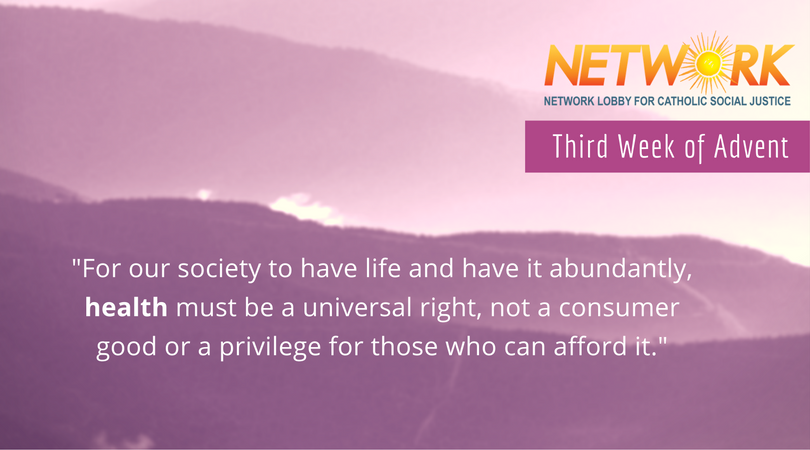
Jesus’s healing example also calls me to imagine what our country and healthcare system could be if we took this message of abundant life and boundless compassion to heart. For our society to have life and have it abundantly, health must be a universal right, not a consumer good or a privilege for those who can afford it. Financial circumstances, zip code, race, ethnicity, or other factors should not influence access to life-saving medical care. A life-affirming healthcare system would provide universal coverage for the common good, with special concern for people who are vulnerable.

In this season of hope, it must be noted that our country has been moving closer to this vision. Never before have so many Americans had health insurance; in 2015 we achieved the lowest uninsured rate and the lowest child uninsured rate in history. Programs such as Medicaid, the Children’s Health Insurance Program, Medicare, and the Affordable Care Act have created a preferential option for those who would be left without care in a purely market-oriented health system. My family and I have known the fear of rising medical expenses and have benefited from these policies that lead to a healthier society.

As Jesus announced his arrival to John the Baptist saying: “The blind receive sight, the lame walk, those who have leprosy are cleansed, the deaf hear” (Matthew 11:5), maybe our progress in living out His teachings should be measured by whether those experiencing poverty or sickness have access to care as a fundamental right. This is the nation I hope for, and the one we are pushing for at NETWORK: one that extends Jesus’s healing touch to all.

So while I wait in hope for the humble birth of the one who came that we might have abundant life, I remain cognizant of the injustices that keep those born into poverty today from enjoying healthy, abundant life. At this crucial time, I remain hopeful that we will resist the path of putting profit over people and choose Jesus’s path of abundant life.

Travel Log: Toledo Rally and Site Visit

Travel Log: Toledo Rally and Site Visit

Sister Margaret McGuirk, OP
July 16, 2016

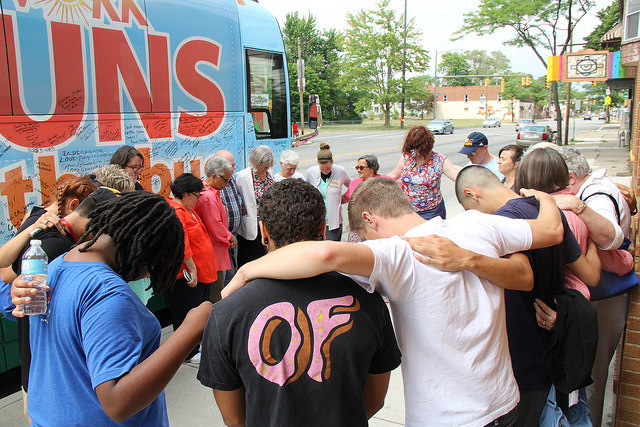
Holy Toledo! Here we are in Ohio. This morning began at 10 AM at the International Park in Toledo and our focus was on Access to Citizenship.

1ToledoWe were blessed by some wonderful speakers:
    • Sister Geraldine Nowak began her opening prayer with: Do not tire of working for peace for all people.
    • Pamela McGarey of the Amalgamated Transit Union 697 is a Paratransit Worker who drives a bus for the disabled. She said that the theme that the City promotes is “You do better in Toledo.” She is grateful for the good job that she has with benefits but laments the fact that her benefits do not cover her family. In order to get health care for her family she would have to pay $700 which would mean working 60 hours instead of 40 hours She called for universal health care
    • Enedilia Cisneros is with Farmer Labors Organizing Cooperative (FLOC). When she first came to the United States and began working in the fields, they had no way of asking for their basic rights. But with the help of FLOC they now receive benefits and are working for a living wage. Enedilia continues to work in the fields despite the fact she is now in her 60s and she is proud that she has four children who are not forced to do the backbreaking work that she has done over the years.
    • Dr. Jonathan Ross spoke passionately of the need for single payer universal health care and the expansion of Medicare. He said that even he who is a medical doctor and has years of experience as a medical doctor finds the system of payment complex and confusing. There are 10,000 deaths a year because people are not covered by health insurance and this happens year, after year.
    • Doug Jambard Sweet is dedicated to a constitutional amendment to block big money in politics. He spoke with conviction and hope that this change can be a major factor in mending the gap.
    • Representative Marcy Kaptur, who has served the thirteenth district of Ohio for 34 years. Her voting record reflects her deep commitment to the policies that bridge the gap and re-weave the fabric of our nation and she is a true friend of NETWORK.

2-ToledoIn the afternoon, we were hosted by Baldemar Velasquez who is the president and founder of the Farm Labor Organizing Committee (FLOC). Baldemar is an internationally recognized leader in the farmworker and immigrants’ rights movements.
The most exciting part of our discussion was the witness of youth who are being trained as organizers and future leaders of the community. The teenagers told us about recent projects they have been involved in with guidance from their FLOC mentors—one involving changing school policies about sexual harassment and another about engaging law enforcement around the issue of racism.

It was encouraging to see that the next generation of leaders is carrying the baton and learning from Baldemar and other labor organizers who paved the way for them. These young people are learning early how to Mend the Gaps!


See also:
Reflection on Day Six: Choosing Positive Change
Slideshow: Toledo Rally
Slideshow: Farm Labor Organizing Committee
Reflection: Connecting with Other Sisters

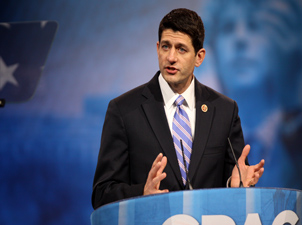
Blog: 10 Things Speaker Ryan Could Do to Address Poverty Right Now

10 Things Speaker Ryan Could Do to Address Poverty Right Now

NETWORK Lobby
June 7, 2016

NETWORK Lobby for Catholic Social Justice welcomes anyone, any time, to the conversation about how to make sure no one in the United States lives in poverty. But we strongly dispute the claim that this is a deeply complicated problem requiring a brand new agenda, such as the one likely to be presented by Speaker Paul Ryan in the coming days. The fact is Congress knows, and has always known, how to end poverty. It is simply not that difficult, in the richest country the world has ever known, to create an inclusive economy where everyone has the resources to live with dignity.

In fact, we could do much of it as early as tomorrow.

Toward that end, we offer Speaker Ryan, the driving force behind the Republican “anti-poverty” agenda, 10 things he could bring to the House Floor tomorrow that would actually work. This is not everything that has to be done to mend the gaps in the fabric of our society, but it’s a darn good start.

  1. Raise the minimum wage to $15 an hour — Even as the economic recovery has brought lower unemployment, too many people working full-time jobs (or even two or three of them) don’t make enough to get by. A study by the National Employment Law Project found that $15/hour was the lowest wage that would still allow a single worker to meet the basic cost of living just about everywhere in the United States. Speaker Ryan could help lift thousands of workers out of poverty by passing H.R. 3164, the Pay Workers a Living Wage Act introduced in Congress last year.
  2. Guarantee paid sick leave — 49% of workers in America still lack paid sick leave and are forced to choose between losing the salary they desperately need and jeopardizing their health and the health of those around them. After passing a comprehensive paid sick leave policy New York City found not only that it improved the health and financial security of workers, but also that unemployment dropped and businesses grew.The Healthy Families Act (H.R. 932) was introduced in Congress more than a year ago. There’s no excuse not to pass this legislation today.
  3. Guarantee paid family leave — In addition to ensuring that everyone has the ability to take a sick day to care for themselves or their family, we must also guarantee paid leave for new parents and those who have to take extended time to care for a sick family member. Only 5% of workers in the lowest 25% wage category have access to paid family leave, compared to 22% of workers in the highest 10% wage category. The FAMILY Act (H.R. 1439), introduced in Congress last year, builds on successful legislation passed by cities and states around the country to create an insurance program that provides workers with the family leave they need.
  4. Expand and protect the Earned Income Tax Credit — The Earned Income Tax Credit (EITC) is one of our most effective anti-poverty programs. It provides tax relief to low-income workers to ensure that no one who labors to earn a basic wage is taxed back into poverty. According to the Center on Budget and Policy Priorities, the EITC helped lift 6.2 million people out of poverty in 2013. But the current law overlooks too many workers in need, including those low income workers without children and workers under 25 or over 65. Speaker Ryan himself discussed his support for addressing these gaps when he was Chairman of the House Budget Committee, now he has the means and the opportunity to make those changes today.
  5. Expand childcare subsidies — The high cost of quality childcare takes a dramatic toll on low-income families across the country. A report from theEconomic Policy Institute found that in every state, quality childcare cost more than 30% of a minimum-wage worker’s earnings. Access to high quality childcare allows parents to support their families and better prepares children to learn and grow into healthy adults. We shouldn’t ask people to choose between their kids and their paychecks — H.R. 4524, the Child CARE Act, is one way that Speaker Ryan could solve that problem.
  6. Ban the box — It’s no secret that admitting to having a criminal record is the kiss of death for job applicants. Conviction records are likely to reduce the prospect of a job offer or interview by almost 50%. There are currently 70 million people in America with arrest or conviction records, we are only just beginning to realize the massive economic implications of discriminating against the people who are reentering society and the workforce. Passing the Fair Chance Act (H.R. 3470) would allow people seeking to reenter the workforce the opportunity to apply based on merit, without facing discrimination.
  7. Pass immigration reform with a path to citizenship — For the millions of people who live in the U.S. without documentation or with only temporary permission to work, finding stable employment can be nearly impossible. Many more immigrants are barred from accessing the social programs they need because of decades of anti-immigrant legislation. By allowing immigrants to come out of the shadows and fully participate in society, immigration reform would benefit individual families and our community; the CBO estimated that immigration reform would reduce our federal budget deficit by $200 billion over ten years. H.R. 13, the Border Security, Economic Opportunity, and Immigration Modernization Act, had the votes to become law in 2014 and is a viable solution to fixing our broken immigration system. Speaker Ryan should work with his fellow members of Congress to pass real immigration reform now.
  8. Expand eligibility and opportunity for low-income housing units — There is a significant shortage of affordable housing units across the country. Bipartisan legislation in the Senate rumored to be introduced in the House of Representatives (The Affordable Housing Credit Improvement Act) would incentivize the building and preservation of almost 1.3 million homes. Speaker Ryan can move forward with his commitment to end poverty by developing a housing plan that focuses on ensuring that everyone has a home.
  9. Continue to make healthcare more affordable — The Affordable Care Act was a critical step toward making sure that all Americans can access the healthcare they need, but it stopped short of realizing the goal of universal healthcare. H.R.3241, the State-Based Universal Health Care Act of 2015, would allow states more flexibility and freedom to work toward universal healthcare. Speaker Ryan can move forward today to ensure that no one lives in the healthcare gap and take a powerful step toward alleviating the economic uncertainty and financial burden of families still left without health insurance.
  10. Reauthorize and improve the Child Nutrition and WIC Reauthorization Act — The landmark legislation that helps feed children in schools across the country has been under attack by congressional Republicans. Congress has sought to cut the number of schools eligible to feed all of their students and increase the amount of time and effort schools must put into qualifying for the program. Beyond these initial changes that will kick thousands of students out of the program, Republicans in Congress want to replace the entire program with ‘block grants’ that will seriously jeopardize our ability to feed children in need. Congress has an opportunity to improve child nutrition programs to feed more children who are hungry. If Speaker Ryan wants to lead on poverty, he can start by leading his party away from policies that take food from children.

As NETWORK’s Nuns on the Bus reminded Congressman Ryan in 2012, to implement programs that work to eliminate poverty, Congress must have the political will to raise reasonable revenue for these responsible programs. We can pay for these programs by closing tax loopholes and having the courage to fix our broken tax system. Right now, a loophole in tax law allows hedge fund managers to call a portion of their earnings a ‘capital gain’ instead of ‘income’ and that small difference costs the nation billions in tax revenue every year. The Carried Interest Fairness Act (H.R. 2889) is one such piece of legislation that promotes tax fairness in the United States.

Creative solutions to solving poverty are necessary, but we don’t need to look far to find the answers. What if — instead of giving the billionaires another break — we took that money and used it to expand Section 8, the federal program that helps low-income families find affordable housing? NETWORK Lobby judges all legislation by how it would affect people experiencing poverty. If Speaker Ryan is serious about this issue, we encourage him to use the same criteria.

Photo courtesy of Gage Skidmore

Blog: Mary Ann’s Story Reminds Us Why ACA Enrollment Matters

Mary Ann’s Story Reminds Us Why ACA Enrollment Matters

By Mary McClure
December 14, 2015

As you may know, we are nearing the end of Open Enrollment season, when individuals and families can sign up for health insurance. In fact, December 15, the last day to enroll for January 1 coverage, is quickly approaching. Despite some politicians’ efforts repeal the Affordable Care Act (ACA), NETWORK continues to uplift and support the pro-life policy that made healthcare accessible to millions who were previously uninsured.

We continue to hear stories from people whose lives were changed because they had access to healthcare. Recently I re-read one of these, the story of Mary Ann Wasil, which was first told in the NETWORK Connection magazine (First Quarter 2014, p. 4-6).

At 39, Mary Ann was diagnosed with breast cancer despite having no family history of the disease. Mary Ann, a mother of three girls, needed a mastectomy and chemotherapy to save her life. During her chemotherapy, she suffered a stroke, which required additional surgery. At the same time, Mary Ann’s marriage was ending. She had made the decision years ago to leave her job as a police officer to raise her daughters; she had held a few part-time jobs since then which never had benefits.

In 2011, seven years after her initial diagnosis, her cancer returned. The end of her marriage meant she no longer had health insurance, and with a “preexisting condition,” both Mary Ann and her children were uninsurable. The chemotherapy for her second round of cancer cost around $25,000 per session. The Affordable Care Act was lifesaving legislation for Mary Ann, who was able to find an affordable healthcare plan through her state’s marketplace that covered her despite her preexisting condition.

What a blessing that so many lives have been saved through affordable access to healthcare! Thousands of moms, dads, grandparents, and others are also gaining this coverage by enrolling in health insurance for 2016. If you have not signed up for an insurance plan, it’s not too late to gain January 1 coverage: enrollees have until December 15 to sign up and avoid the penalty.

These plans can be affordable. Many people are eligible for tax credits or financial assistance and many plans are $75 or less per month. While the website may seem overwhelming, free and confidential help is available from trained, local professionals.

With the Affordable Care Act, millions of people have gained health insurance through the marketplace and through Medicaid expansion. NETWORK continues to advocate for and celebrate pro-healthcare legislation, working towards the day when healthcare is genuinely affordable and accessible to people of all income levels, with particular concern for the most vulnerable members of our community.