

Category Archives: Front Page

Healthcare Open Enrollment 2018

Healthcare Open Enrollment 2018

Mary Cunningham
November 2, 2017

At NETWORK we believe that healthcare is a human right. Regardless of financial status or geographic location, everyone should have access to quality, affordable care. It is vital that as people of faith we strive to protect the human dignity of all. One way of doing this is to encourage everyone who doesn’t already have coverage for a healthcare plan to sign up during Open Enrollment. Not sure where to start? Read below to see what Open Enrollment is all about.

Spreading the Word about Open Enrollment

One very important way to spread the word is to use your social media accounts to share facts with your friends and followers. When you tweet, use the hashtag #SoulsToEnroll to show your support for Open Enrollment. Another way to share information is to include an insert in your church’s bulletin with the dates for the Open Enrollment period and information about how to sign up.

For more ideas about how to promote healthcare enrollment, check out NETWORK’s Open Enrollment Toolkit.

Who Can Sign Up

Anyone can get coverage through a state marketplace or healthcare.gov if they are not already covered through a job, Medicare, Medicaid, CHIP or another source. Twelve states (California, Colorado, Connecticut, District of Columbia, Idaho, Maryland, Massachusetts, Minnesota, New York, Rhode Island, Vermont, Washington) have their own exchanges and their own deadlines to sign up for 2018 coverage. The rest of the country will use the federal exchange at healthcare.gov.

When to Sign Up

The Open Enrollment period this year starts November 1 and ends December 15. After this period, you can only enroll for 2018 health insurance if you experience a qualifying life event that makes you eligible for a Special Enrollment Period. Notice that this year the enrollment period is shorter than usual — it no longer ends on January 15. Thus, it is vital to go to healthcare.gov as soon as possible to look at plans and to sign up.

How to Sign Up

Individuals can sign up for a healthcare plan through healthcare.gov or their state-based marketplace’s website. These websites allow you to search different plans and get access to affordable healthcare coverage. By shopping around you can compare plans to see what best fits your needs. Even if you already have a plan, it’s worth checking out and comparing new options. Plans change from year to year, meaning the cost of your current plan may have changed.

While signing up for a healthcare plan may seem intimidating, you don’t have to do it alone! There are several ways to sign up including online, over the phone, in person, through an agent, or using a paper application. If you have questions there is also a 24/7 call center you can call every day (except Thanksgiving) during Open Enrollment for assistance. The number is 1-800-318-2596.

Why Sign Up?

Getting coverage is important! Signing up for a plan will help protect you from unforeseen injuries, illnesses or accidents. Access to healthcare is a right, and obtaining health insurance is an important step for securing access to care in the United States.

Despite the common conception that healthcare plans are costly, plans on healthcare.gov can be affordable. These plans are required to provide free preventative care with no co-pay. In addition, they must cover benefits like prescription drugs and maternity care. It is important now more than ever to sign up for a plan so you can guarantee you and your loved ones are protected. Spread the word!

Distracted

Distracted

Jeremiah Pennebaker
October 23, 2017

“The function, the very serious function of racism is distraction. It keeps you from doing your work. It keeps you explaining, over and over again, your reason for being. Somebody says you have no language and you spend twenty years proving that you do. Somebody says your head isn’t shaped properly so you have scientists working on the fact that it is. Somebody says you have no art, so you dredge that up. Somebody says you have no kingdoms, so you dredge that up. None of this is necessary. There will always be one more thing.” -Toni Morrison

I used to love watching football every Sunday with my parents. I remember the scene well: my mom, an avid New England Patriots fan, and my father, laying claim to both the Cowboys and the Steelers– the teams who thrived during his childhood– both screaming at the TV, the living room filled with the aroma of fried food, and the surround sound pumping the voice of Al Michaels throughout the house.

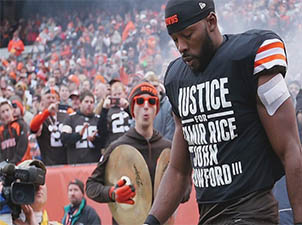
Football is a sentimental pastime for me, as I’m sure that it is for many people across the country. But like many others, football has become difficult for me to watch. Since the kneeling protests by Colin Kaepernick and a multitude of other players across the NFL have started, I have been distracted from the game that I love by something larger. I can no longer watch football without being reminded of how much my life does not matter. I can’t watch football without being reminded that as a Black man in America, I only exist as a problem that needs to be solved, an animal to be muzzled and caged, a commodity to be bought, sold, and discarded.

I can no longer plug in, turn on, and tune out of the daily distraction that is racism when I watch football. I can’t watch football without thinking that people care more about a song and a piece of cloth than they do about a 12-year-old boy being gunned down for playing in the park. It has tainted the game I love. Some in the United States would rather have me pledge allegiance to the flag than the country be a nation with liberty and justice for all. It is hard for me to stomach this and simply “stick to sports.”

Football was a distraction for me, and I’m sure for many others, from the daily struggles of life. Now, it brings my lack of humanity in our society to the forefront every Sunday when I hear about people heckling those who kneel in protest or see the overt and covert racist tweets about “ungrateful athletes.” I imagine that those people are frustrated because they are also distracted from their favorite pastime. This was something that they could retreat to when they did not want to be bothered by the distraction that is the Black man begging for change outside of the subway. The distraction that is the Black girl with the funny name and big hair who “only got the job because of affirmative action”. The distraction that is the Black kid at school who keeps complaining about the confederate flags flying in the parking lot. These distractions have infiltrated the sacred space of American football. It is no longer the noncontroversial space of hard work and meritocracy that Americans viewers are used to. They’re distracted because their once colorblind consciousness has been forced to recognize that these athletes are people too. Black people. Black athletes are Black lives and their lives should matter just as much as I want mine to.

A Budget Is a Moral Document

A Budget Is a Moral Document

Sister Kathleen Kanet
October 26, 2017

When you are frustrated and in pain over the political direction of your country, what do you do? The source of much of my anguish was over our 2018 Federal Budget.

To me a budget is a moral document. What I saw in this proposed budget were more benefits for the rich and fewer for the poor. I kept thinking and praying about how to reverse the situation. Who in the world has the moral authority to speak out on behalf of the poor? Why, of course, the nuns, the sisters in our country who could write letters to the author of that selfish document!

Here is a bit of the story of a project which I have begun: a call for American sisters and nuns to write letters to Paul Ryan, Speaker of the House of Representatives, and the main author and advocate of this very harsh budget.

Since the beginning of our country, U.S. sisters have been on the side of the poor and have worked toward the common good. We have many stories to tell which could encourage our political leaders to change our present policies. Who better than American sisters to help articulate what a faithful and just budget, inclusive for all, would be?

Many of us in religious life grew up with Vatican II. I am grateful that my congregation helped me to interiorize and to live out the mission of Jesus as he announced it: To bring good news to the poor, to proclaim release to the captives, recovery of sight to the blind and to let the oppressed go free! And to do so in joy!

This is the basis of my hope that this fall, many hundreds or even thousands of American sisters will be writing personal letters to a fellow Catholic, Paul Ryan. In our letters we will be sharing our stories about the needs of those we encounter in our ministries, and we will ask him to craft a budget that promotes the human dignity of all peoples.

It is lamentable that care for people who are poor, ill or elderly, for children, single mothers, and our beloved Earth is woefully missing in the proposed 2018 federal budget. Ironically, though, it calls for tax cuts for corporations and the rich and boosts a big military buildup. This letter-writing campaign is a great opportunity to “announce good news to the poor” and to promote the common good for all.

NETWORK , (founded by a group of Catholic women religious in 1971 to do Catholic social justice lobbying) has a proven track record of effective lobbying on economic issues. In the famous Nuns On the Bus effort of 2012, they traveled the country to draw attention to sisters’ work with the poor and to protest aid cuts on that year’s federal budget proposed by Paul Ryan.

This year, NETWORK was to introduce this campaign at the Leadership Conference of Women Religious (LCWR) meeting in August. Soon after, NETWORK should be following up with an invitation to all the sisters in the United States, to participate in a letter-writing campaign. They will coordinate the reception of the letters and will present them to Paul Ryan — with visits to other members of Congress — late in 2017.

Writing personal letters to Paul Ryan about the federal budget, and telling him and other lawmakers how that budget, as designed, will hurt many of the people we have worked with, are sorely needed prophetic actions.

It won’t be as easy as signing a letter or petition, or sending an email or making a phone call. It will take time, thought and commitment.

Currently, I am working with about two dozen of my own sisters of the Religious of the Sacred Heart of Mary to think about the letters we will be writing. We have had two meetings and more are planned for the coming few months. At the first meeting, 17 of us sat in a circle, listened to the invitation to this project, prayed quietly and then went around the circle sharing thoughts and comments. I heard “Great idea!” “Something concrete we can do!” “It is prophetic!” “Positive initiative.” As I listened to those initial comments, I was so encouraged.

In the past few months I have spoken with more than 100 sisters and others regarding this idea. Since I have been working in peace and justice initiatives for almost all my religious life, these conversations have been joyful reunions for me.

One of my first encounters was with a sister at LCWR. As I introduced myself to her, I mentioned that I was part of the Justice Peace Education Council, which in the 1980s presented hundreds of “Infusion Curriculum” workshops in Catholic schools in more than 50 dioceses throughout the country. Immediately she said, “Oh, I attended one and I remember it so well — it was so positive.” (The records of JPEC have been placed in the Schlesinger Library at Harvard, but are not yet available.)

I’m also encouraged to hear about the about the wonderful works of sisters already engaged in trying to promote the common good and change the moral imperative in our country. The founding director of NETWORK is still working for Earth justice at her motherhouse. One younger sister sends regular positive tweets to President Trump, modeling comments of love, healing, peace, goodness and relationship. Wouldn’t it be great if we could get the support and participation of all the sisters in the US?

Many of us are now beginning to wonder — in addition to the letters, how can we share this prophetic action with others in our country? Besides writing the letters and encouraging other sisters to get involved, how can we publicize this action to our family, friends and the public? How can we communicate our excitement at the possibility of filling the U.S. media with a new social vision?

There now exists a Facebook page: “A Fair and Moral Budget: Nuns Write Letters to Paul Ryan.” Join it and ask others on Facebook to do the same. Send us something to put on this page. Contact your communications people and ask them to be involved.

Hold a workshop writing meeting with your retired (but active) sisters.

When you write your letter, share it with others.

As do so many other powerful actions, this is beginning as a grassroots initiative — and now it is in the hands of the Holy Spirit.

We ask for your prayers from all over the globe for the success of this venture!

Reposted by permission of Global Sisters Report.

Interfaith Healthcare Coalition Urges a Vote on Alexander-Murray Bill

Interfaith Healthcare Coalition Urges a Vote on Alexander-Murray Bill

Lucas Allen
October 25, 2017

This week, NETWORK joined the Interfaith Healthcare Coalition in sending a letter to the Senate Majority and Minority leaders endorsing the Bipartisan Health Care Stabilization Act of 2017 negotiated by Senators Alexander and Murray and urging Congress to pass it without delay. The full text of the letter can be read below or downloaded as a PDF:


Dear Majority Leader McConnell, Minority Leader Schumer, Chairman Alexander, and Ranking Member Murray:

We write to you as religious organizations, congregational denominations, and faith traditions about the need to take quick, bipartisan action to stabilize the individual health insurance market. Our scriptures affirm our moral responsibility to ensure all may live with dignity and the opportunity to recognize their full potential. Access to affordable, quality health care should not and cannot be a privilege; it is a requirement rooted in faith to protect the life and dignity of every person.

We are encouraged and supportive of the Bipartisan Health Care Stabilization Act of 2017 negotiated by Senators Alexander and Murray and urge Congress to pass it without delay.
Our faith communities appreciate the value of open dialogue across difference. It is past time for Congress to move away from the partisanship and divisiveness that has plagued this issue and instead move forward in a collaborative and bipartisan manner. The individual market and those who rely on it to purchase coverage are facing instability and rising premiums, and this bill can provide relief. We call on Congress to quickly pass this bill to:

  1. Continue the Cost Sharing Reduction payments for two years to help provide multi-year stability. These payments are crucial for stabilizing the marketplace and they help people with low incomes afford copayments, deductibles, and other health care expenses;
  2. Restore funding for ACA outreach, education, and enrollment; and
  3. Streamline the section 1332 state waiver process to give states meaningful flexibility while maintaining guardrails to protect low income people, those with serious health conditions, and other vulnerable populations.

While this bipartisan package does not address all our concerns regarding access to quality, affordable health care in this nation, it represents a necessary and constructive first step to address the immediate problems within the individual market. We urge you to pass it without delay and are praying for your success.

Sincerely,

American Muslim Health Professionals
Bread for the World
Disciples Center for Public Witness (Disciples of Christ)
Evangelical Lutheran Church in America
Faith that Heals Ministries, Tennessee Conference United Methodist Church
Franciscan Action Network
Friends Committee on National Legislation
Hadassah, The Women’s Zionist Organization of America, Inc.
Islamic Society of North America
Leadership Conference of Women Religious
Methodist Federation for Social Action
National Advocacy Center of the Sisters of the Good Shepherd
National Council of Churches
National Council of Jewish Women, Inc.
NETWORK Lobby for Catholic Social Justice
Pax Christi USA
PC(USA) Office of Public Witness
Sisters of Mercy of the Americas’ Institute Justice Team
Society of St. Vincent de Paul, National Council of the United States
The Episcopal Church
Union for Reform Judaism
Unitarian Universalist Association
Unitarian Universalist Women’s Federation
United Church of Christ, Justice and Witness Ministries
United Methodist Church – General Board of Church and Society
Prioritizing Communities Recovering from Disasters

Prioritizing Communities Recovering from Disasters

Kaitlin Brown

October 24, 2017

In the past few months, natural disasters have ripped away the homes of many of our sisters and brothers in Florida, Texas, Puerto Rico, U.S. Virgin Islands, and California. Folks were left with limited time, just minutes in California, to pack up and flee to safety and are now returning to destroyed homes with few options. On conference calls with our housing partners working on the ground, I hear week after week about families in Puerto Rico going without electricity and clean water, and elderly folks in nursing homes in hurricane affected areas going without air conditioning. In Texas, people lined up overnight for D-SNAP (food stamps for those in disaster areas) only to be turned away for lack of identification. In Florida, low-income families and individuals were unable to afford the high cost of resort fees that came in addition to their FEMA hotel vouchers.

While these crises have unfolded, Congress moved quickly to pass the first of two supplemental disaster spending bills, and for this we are grateful. Right after Hurricane Harvey hit Texas in September, Congress passed a $15 billion aid package. This week, the House passed a $36.5 billion bill that is waiting to be voted on in the Senate. While this is a great start, it really is simply putting a Band-Aid on a much bigger problem. Experts expect more money will be needed down the road: Puerto Rico hasn’t been able to have damage assessments done to know how much money is needed, Texas alone has asked for $18 billion for recovery, and with wildfires still raging in California, the extent of the damage is not known.

So with this going on, and millions of people displaced, what has Congress decided to prioritize between now and the end of the year? Cutting taxes for the wealthiest corporations and individuals– a bill that would increase the deficit by $1.5 trillion– while also cutting crucial services for those most vulnerable. The budget plan voted on by Congress would be especially damaging for those affected by recent natural disasters, as it is focused on cutting crucial services for those most vulnerable, including SNAP and housing benefits, such as Section 8 vouchers. The tax bill that will quickly follow the budget, will add to our deficit by cutting taxes for the richest among us and corporations, while failing to supply any additional money to disaster relief and recovery.

As a person of faith, I think this is wrong. The need to care for the most vulnerable among us must take priority, and especially should not be neglected at the expense of tax cuts for the wealthiest. And while Congress has been bickering over the tax “reform” plan, many people in Puerto Rico are still without power and clean water, people in Texas and Florida are without stable, long-term shelter, and people in California are without entire cities. Our elected officials must do better to truly care for the most vulnerable among us.

Dear Paul Ryan: An Open Letter

Dear Paul Ryan: An Open Letter

By Sister Susan Francois
October 20, 2017

Dear Rep. Ryan,

By now, you may have noticed that you are the focus of a little project by Catholic sisters in this country who are concerned about the devastating effects of proposed cuts to the federal budget. In particular, many of us are seriously worried about potential cuts to human-needs programs that will harm the most vulnerable members of our society.

I know you already received an in-person, not to mention televised, message from Sinsinawa Dominican Sr. Erica Jordan. I don’t know Sister Erica personally, but I thought she did a pretty good job of framing the critical moral questions we need you and your colleagues in Congress to grapple with around the budget.

Ultimately, if we are to be a government of, for, and by the people, then we need to take into account not just numbers, but the real lives of people. Furthermore, for those of us for whom our Catholic faith provides a moral compass, we know that Jesus challenges us to have a particular concern for those who are living in poverty and struggling to provide for their families in our harsh economic reality.

Sister Erica, of course, spoke to you as one Catholic to another. Over the years, you have been vocal about your faith. I remember clearly being impacted by your response to the address of Pope Francis to Congress. It was so very genuine.

“He’s been calling for a dialogue and talking about very important principles about the dignity of every human person and how we need to attend to this,” you said then. You also cautioned against politicizing the pope’s message. “If a person tries to politicize this speech for some issue or partisan gain, that diminishes from the message itself.”

Everything gets politicized these days, doesn’t it? Politicized and polarized. If you think about it, our entire lifetimes (I’m about two years younger than you, according to your Wikipedia profile) have been a time of hyperpolarization, leading to the current gridlock in Washington and a decided lack of helpful discourse and debate in the public sphere, let alone dialogue!

I am heartened that you value Pope Francis’ call to dialogue. I also hope that if and when you read this letter, it will be received in the spirit with which it is intended — namely, dialogue.

In your conversation with Sister Erica on CNN, you shared your appreciation for the model of Catholic organizations that help the poor. You expressed that they do a “fantastic job in spite of government doing wraparound benefits for the poor to make sure that they get to where they are — from where they are to where they need to be.”

My religious congregation, the Sisters of St. Joseph of Peace, sponsors and supports nonprofit services for low-income women in Jersey City, New Jersey, and Seattle with a similar model. Both the York Street Project and Jubilee Women’s Center provide such wraparound services, treat the whole person, and assist the women they serve on their journey to self-sufficiency.

I found it interesting that you referenced the year 1985 in your response to Sister Erica, because that is around the time my sisters started both these innovative programs.

I agree with you that we need to encourage and support such programs, but as partners with government, not replacements for our civic duty to promote the general welfare. Such programs do not do a fantastic job in spite of government, but in tandem with life-giving government programs like the Community Development Block Grants (CDBG), which are in jeopardy in the budget proposals under consideration. At the York Street Project, for example, CDBG funds support the job readiness program at Kenmare High School, helping women who previously dropped out of the public school system to find jobs that will support their families.

You also told Sister Erica that we need to look at how we measure success in anti-poverty programs, shifting focus from dollars spent to outcomes.

“Is it working?” you asked. “Are people getting out of poverty?”

I agree that these are the key questions, but helping people get out of poverty requires an investment, not budget cuts. Program effectiveness is not free.

The women who come to Jubilee Women’s Center and York Street Project are motivated to break the cycle of poverty, as are the dedicated staff who journey with them. Yet the path from homelessness to stable housing is not an easy one. It is also complicated by real-life factors. Fifty-three percent of the women at Jubilee are survivors of domestic violence; 49 percent are coping with mental health challenges; 28 percent have physical health challenges; and 17 percent are in recovery from substance abuse. Knowing all this is one thing, but actually meeting the residents and hearing their stories of resilience is powerful.

At the same time, their resilience and our programs are not enough. Our creative and persistent staff navigate a patchwork of constantly changing government programs to help the women find stable permanent housing, including housing and urban development funds for rental assistance and the Low Income Energy Assistance Program, which helps working moms keep the lights on with a minimum-wage job. To be honest, we need more funding, not less, to reach the outcomes you name.

Take the example of the Supplemental Nutrition Assistance Program (SNAP) and Temporary Assistance for Needy Families (TANF). These are not just alphabet soup, but federal programs that add up to real soup for hungry kids and their parents.

When I visited St. Joseph’s Home at York Street, I saw the kitchen where staff help mothers learn how to cook homemade meals for their little ones with ingredients that make these dollars stretch to cover the whole month. This is no easy task on already-limited funds, and the proposed federal budget decreases this life-supporting funding.

I could go on and on, but I think you get the drift. And in any case, you will be receiving hundreds, if not thousands, more letters from Catholic sisters sharing real-life stories like these.

Please, Speaker Ryan, take these messages to heart. Consider them part of an ongoing dialogue, one that seeks to break through the partisan bickering and polarized debate and find common ground to serve the common good. I implore you to help craft a federal budget that attends both to the general welfare of our nation, but also the particular needs of the most vulnerable families in our country.


Reposted by permission of Global Sisters Report.

[Susan Rose Francois is a member of the Congregation Leadership Team for the Sisters of St. Joseph of Peace. She was a Bernardin scholar at Catholic Theological Union and has ministered as a justice educator and advocate. Read more of her work on her blog, At the Corner of Susan and St. Joseph.]

Broadening Horizons: A Deeper Understanding of Poverty

Broadening Horizons: A Deeper Understanding of Poverty

Mary Cunningham
October 10, 2017

“You’re going to Burkesville, Kentucky!” the headline of my email read. As a senior, I had decided to lead a spring break immersion trip to Appalachia, where I would accompany 12 participants from my college to engage in a week of service, immersion and solidarity with the community in Burkesville, Kentucky. I thought I had a pretty good idea of what to expect, but as usual, I was surprised.

Leading up the trip I did not understand what rural poverty looked like. I grew up in northern Massachusetts in a small, upper middle class town. I spent one summer during college interning at a church in downtown Boston, an area known for its large population of homeless individuals and high-concentration of drugs. Having been surrounded by this on a daily basis, I thought I had a pretty good understanding of what poverty looked like. My trip to Kentucky changed that.

Burkesville, a small, remote town in southern Kentucky has a vibrant spirit and a strong sense of community. And yet, as my week there unfolded, I noticed signs of poverty. We worked at the Burkesville elementary school where many of the kids were on a nutrition assistance program. Although the school provided some snacks, they were often unhealthy options. Talking with school administrators, we also learned that there were not a lot of viable job opportunities in the area. There was a large population of children and retired people, but there seemed to be a lack of middle-aged people contributing to the economic growth of the town. Seeing a community struggling with these issues was something I had heard about, but never encountered.

As an associate at NETWORK, I recently learned about the rural poverty I saw in Burkesville from a policy perspective. On September 28, I attended a briefing titled, “Urban and Rural Poverty in America” in the Rayburn House Office Building. One of the things that stood out to me was how a city’s remoteness and population size are connected to poverty rates. Research collected by the Salvation Army shows that states that are more remote and that have both high and low population concentrations tend to have higher levels of need than states that are less remote. Rural towns located far from large cities tend to have a harder time accessing government services and their residents are often underemployed. It was clear from the panel that these unique challenges facing rural communities make grappling with poverty across our country difficult.

Another interesting comment came from one of the panelists, John Letteiri, who works for the Economic Innovation Group. Mr. Letteiri noted that the decline of migration is one of the major causes of exacerbated rural poverty. He cited an interesting statistic: since the 1990s migration from rural to urban areas has fallen about 50 percent. Without mobility, residents of these rural towns are attached to the economic reality of their area. As I left the panel, I was left with a sharp reminder of my experience in Burkesville, Kentucky.

The way in which we understand poverty needs to constantly be reframed. We largely define poverty based on our own cultural perceptions, not the reality of the situation. As a society, we must take into account those who are forced into poverty due to social, economic, and political factors beyond their control and prioritize policies that support them. As poverty changes, so must our definition of it.

President Trump and Speaker Ryan Craft Immoral Tax Plan

President Trump and Speaker Ryan Craft Immoral Tax Plan

GOP Tax Framework Would Provide Huge Tax Cuts for the Wealthy, Hurt Working Americans
Laura Peralta-Schulte
October 4, 2017

The Trump Administration and Republican Congressional leadership recently unveiled new principles for the upcoming tax debate titled “Unified Framework for Fixing Our Broken Tax Code.” Supporters of this framework have made big promises about protecting the middle class and promoting growth, but the plan fails to deliver on those promises.

The proposed cuts are simply not designed to benefit middle-income and low-income families. In fact, the plan actually calls for raising the tax rate for low income Americans, the only group to receive a tax increase. Huge benefits flow, instead, to those who are doing the best in our economy and need assistance least – wealthy Americans and multinational corporations. The Republican tax framework would lower tax rates and carve out new loopholes to accompany the significant array of tax shelters that already exist, allowing the wealthy and big corporations to continue using legal means to avoid paying their fair share of taxes. This is wrong for our nation.

Income and wealth inequality is one of the greatest social and moral challenges facing our country, and tax policy is a significant driver of that inequality. Increasingly, Americans are living in two starkly different economic realities – one that is thriving with access to good services and vibrant communities and one where people struggle to get by with little to no investment in their communities. Catholic Social Justice calls us to live in solidarity with each other as one community. Therefore, we have an obligation to ensure that our tax code generates reasonable revenue for responsible programs that support our community.

Catholic Social Justice also requires us to make a preferential option for those experiencing poverty. Prioritizing those with the greatest need must be done so that all are able to meet their basic needs and live in community. We can begin to mend the income and wealth gap by requiring everyone to pay their fair share of taxes. President Trump’s framework, if enacted, will expand the gap between those of living with ample means and those struggling to provide for their families.

Supporters of this tax plan claim that a “trickle down” approach will boost the economy and help American workers, but evidence suggests this is not the case. Today, corporate profits are near record highs and corporate taxes are at record lows. Many corporations pay little to nothing in taxes due to existing tax loopholes. While cutting U.S. corporate rates would make U.S. corporations more profitable, there is no evidence that these cuts would boost employment or wages for American workers. Further, while the effective federal tax rates for the bottom 80 percent of households have fallen dramatically since 1979, inequality persists. The key problem that Congress should focus on addressing for the middle class is near-stagnant pay.

The history of trickle down policies shows that huge tax cuts for the wealthy will increase the federal deficit and force cuts to vital programs that all Americans depend on.  Right now, Congress is considering two bills that provide a roadmap for the risks this tax plan presents.  The House is considering a budget resolution bill which would make huge tax cuts while slashing $4.4 trillion in spending over 10 years to entitlement programs including: Medicaid, Medicare, TANF, SNAP, SSI, college aid, and tax credits for low-income workers. It also cuts $1.3 trillion over 10 years in housing assistance, K-12 education, child care, and other programs. In this bill, 2027 funding for federal programs would drop to 44 percent below their FY 2010 levels, taking inflation into account – the lowest level since before the Great Depression.

The second bill, a budget resolution in the Senate, would allow for a loss of 1.5 trillion dollars in revenue loss over 10 years.  While this bill does not explicitly call for the same cuts outlined by the House, increasing the deficit now will enable Congress to call for entitlement cuts in the near future. We must act now to stop Congress from passing damaging budget resolutions and unjust tax legislation.

Time for Congress to Pass Legislation for Dreamers

Time for Congress to Pass Legislation for Dreamers

Mehreen Karim
September 18, 2017

In the wake of President Trump’s decision to rescind DACA, we must urge our members of Congress to pass legislation that will keep Dreamers safe. There is no time to waste while Congress navigates multiple bills concerning the fate of DACA recipients. After assessing the bills currently on the House and Senate floor, NETWORK has evaluated the varying implications of the Dream Act, the RAC Act, and the Bridge Act. Stay in the know about these legislative pieces:

BRIDGE Act

The BRIDGE Act is a House bill that provides a temporary extension of DACA’s protections. As the most conservative bill on the floor, the BRIDGE Act provides no pathway to citizenship, but legalizes DACA’s original protections for another three years. We at NETWORK support solutions to the danger Dreamers currently face, but we cannot let Congress place a Band-Aid of a bill on our deeply fractured immigration system. Dreamers deserve a permanent and long-term pathway to living a life of dignity in the U.S.

RAC Act

While the RAC Act provides similar pathways to citizenship as the Dream Act (described below), it narrows the pool of recipients by allowing only those who arrived before the age of 16 and have been in the U.S. for five years. They are granted paths to citizenship either through working, going to school, or joining armed services. However, these individuals must stay in conditional status for five years—no exception. In this aspect, the Dream Act proves more efficient in that Dreamers would be eligible for a green card after being in school or work for some time.

Dream Act

Unlike the RAC and BRIDGE Acts, which are solely House bills, both the Senate and House are looking at versions of the Dream Act. NETWORK places its full support behind the bipartisan Dream Act as it provides a long-term path to citizenship and safety for a much greater population of Dreamers. Both the RAC and Dream Act grant Dreamers conditional status, however, the Dream Act grants protection to anyone who’s been in the US since they’ve been 17 or younger and has lived here for four years. Better yet, Dreamers on conditional status can get green cards after they’ve been in college for a certain amount of time or have been employed for at least 75 percent of the time they’ve had a work permit.

SUCCEED Act

The SUCCEED Act is a new bill introduced in the Senate that would disadvantage Dreamers considerably more than previous proposals. The SUCCEED Act is a partisan bill that endangers Dreamers and their families instead of protecting them. In order to be eligible for the SUCCEED Act, participants must meet unfeasible requirements that inconvenience Dreamers in every aspect of their path to citizenship. Under the SUCCEED Act, a Dreamer would have to wait a total of 15 years to become a citizen—at the very least. Additionally, this bill imposes an arbitrary cap on Dreamers that have lived in America for more than 20 years. Even though these are the individuals with the deepest ties to their lives here, they would be subject to deportation. The SUCCEED Act widens the potential for families to be torn apart as it limits the ability of Dreamers to legally sponsor their family members for residency. Under this bill, Dreamers must have waited 10 years in conditional status before they attempt to sponsor family members for permanent residency. The SUCCEED Act and its cosponsors, Senators Thom Tillis (R-NC), James Lankford (R-OK), and Orrin Hatch (R-UT),  have no evidence nor intention of protecting Dreamers. Their partisan bill merely employs harsh provisions meant to cause difficulty and fear for Dreamers and their families.