

Category Archives: Immigration

We Cannot Allow This Cruelty in Our Country

We Cannot Allow This Cruelty in Our Country

Fighting Immoral Policies Tearing Families Apart at the Border

U.S. Representative Pramila Jayapal
August 17, 2018

Our nation is in crisis. The words on the Statue of Liberty—”Give me your tired, your poor, your huddled masses yearning to breathe free”—seem far away as families on the border are separated as a result of President Donald Trump’s inhumane and cruel “zero tolerance” policy.  The policy has resulted in thousands of children being placed in tent cities, shelters, and foster homes across the nation, with no plan to reunite them with their parents.

Two weeks ago, I spoke with 174 women who were, at the administration’s orders, transferred thousands of miles from the southern border to a federal prison just outside Seattle. Most of these women were asylum-seekers, fleeing rape, violence, and persecution. The majority had been held in various facilities for over two weeks, many for over a month.

The mothers had been separated from their children at the border, and not a single one had spoken to their children since then. All but two of the mothers did not even know where their children were. They wept as they told me that they had been “deceived” by agents who told them to just leave the room for a minute to take a picture or see a judge, and when they returned, their children were gone. They didn’t even have a chance to say goodbye.

The women I spoke to had already made heartbreaking choices in deciding to come to the United States. One woman told me that her oldest child was shot killed by gangs, her second shot and paralyzed, and that she had to leave that paralyzed child in order to try and save her third child. She had been separated from that last child at the border and had not seen him in a month. Another woman traveled to the border with one child, leaving another child who was blind behind because she knew he could not make the difficult journey.

I am an immigrant and a mother, and what I heard breaks my heart.

We must demand that Trump fix the crisis he created, and reject his false claims that he has taken any action to do that. The executive order he signed does not reverse his zero-tolerance policy that created these abuses and violations; instead, it allows for the indefinite detention of children and their parents in family prison camps. His administration has challenged a previous court settlement that clearly states that children cannot be detained for more than 20 days. That means that, very soon, either he is going to separate families again or he is going to defy that court order and continue to detain children illegally. Does anyone seriously believe that incarcerating children is a solution to the crisis the president has created?

On top of that, the administration has no plans to reunite the thousands of children who have already been separated.

We cannot stand for this. As one of only a dozen members of Congress born outside of the United States, I began my organizing in the wake of 9-11, forming Washington’s largest immigrant advocacy organization to combat the abuses at the time against Sikhs, Muslims, Arabs, and immigrants. I saw then that strength emerges in times of crisis and that is what we must focus on building all over again today. That’s why I’m calling on Trump to overturn his zero-tolerance policy, reunite families, and release them from their prisons.

This isn’t about politics—it’s about right and wrong. We have to stand up for America.

Representative Pramila Jayapal represents the state of Washington’s seventh district. The first Indian-American woman in the House of Representatives, Representative Jayapal has spent the last twenty years working internationally and domestically as a leading national advocate for women’s, immigrant, civil, and human rights.

Originally published in Connection Magazine. Read the full issue here.

Humanizing the Immigration Debate: A Conversation with United We Dream

Humanizing the Immigration Debate: A Conversation with United We Dream

August 10, 2018

United We Dream, a youth-led organization with hundreds of thousands of members, is one of the strongest voices for immigrant rights in our nation. United We Dream has shaped the immigration debate on Capitol Hill and across the country since it was founded, advocating for Comprehensive Immigration Reform, Deferred Action for Childhood Arrivals (DACA) and Deferred Action for Parents of Americans and Lawful Permanent Residents (DAPA), and other legislation on the national, state, and local levels to improve the lives of immigrants and their families. 

Recently, NETWORK Government Relations Associate, Sana Rizvi, interviewed Juan Manuel Guzman, Community and Government Affairs Manager at United We Dream, to hear more about United We Dream’s history, current advocacy, and vision for a future of just immigration policy. This interview has been edited and condensed for clarity.

Sana: Hi Juan Manuel, thanks for talking with us. Could you give us a brief history of how United We Dream was created and how important it was, in that process, to be an immigrant-led organization?

Juan Manuel: Yes, absolutely. The co-founders of United We Dream, Cristina Jimenez and Julieta Garibay, always tell us how United We Dream  started. As you know in 2001, there was this Dream Act. It was a bill that was introduced by Senator Dick Durbin (D-IL), but it wasn’t up until 2006 or 2007 when immigrant youth, Dreamers, from different parts of the country had the opportunity to meet each other.

One of the catalysts of having United We Dream form is that idea of “Oh my gosh you are undocumented like me, but you live in another state and I didn’t know you existed.” So, United We Dream started as a network, a network of young immigrants who basically shared the same stories or similar stories and lived similar things here in the United States as undocumented immigrants. They decided to say, “Okay, you live in Texas, I live in New York, let’s keep in touch and see how we can move things forward.” So, that’s how it all started.

I think there was a point in the movement in which people, or at least the young people, their input was not as valid because young people making decision for themselves was not that mainstream. So, there was that need of people saying “No, I need to have a say about my life. Not only am I somebody who will tell his or her story, but I also want to be at that table where the decisions happen. I want to be able to influence that.” Because up until then it was other organizations doing the work and immigrant youth just being called to say their stories. More than the photo-op, immigrant youth wanted to have more influence on their own lives. So, they tell us that it all started with one desk. United We Dream only had a desk and a phone and people just trying to make the most out of it. As you know, it went from that desk and now it’s been 10 years.

Sana: We know that one of United We Dream’s guiding principles is “Our Stories are Power.” How do you use the power of stories in both mobilizing supporters and lobbying elected officials?

Juan Manuel: I think when politicians and the media and everyone talks about immigration in particular, it is a very hot issue. Sometimes when you don’t put a face to that, to those reports, when you don’t do that, you don’t humanize. What the stories do is basically put a face, a story, a human being, to what is being discussed. Politicians can talk a lot about policy but it is only when you understand the effect on people when it starts to make sense for you whether that policy is right or it’s wrong. So the stories are very powerful.

I did a lot of advocacy meetings with Republican offices for the DREAM Act campaign, for example. And you know, me, an undocumented immigrant, talking to Republican offices, that is not easy. But when I told them about the sacrifices of our families, for example, I remember telling this to one staffer: I told her, “Our families— our dads, or moms, our cousins— they worked hard for a better future. From dawn to sunset in backbreaking jobs, sometimes being abused, sometimes being treated unfairly, so we can have a better chance” and people would relate to that and say, “My mom worked a lot too and made a lot of sacrifices and you know what, I understand. It makes sense.” That is why our stories are so powerful.

Sana: What do you think is the most significant campaign that United We Dream has worked on in the past?

Juan Manuel: What a question. Probably the one that had the most impact is our DACA campaign. In 2010, right after the failure of the DREAM Act in Congress, United We Dream and other organizations decided to see how we could move into an executive branch strategy. Eventually, after a lot of work, activism, and organizing, immigrant youth were able to force the hand of the president of the United States into signing an executive order. It was the organizing, it was the strategizing, it was everything that made DACA happen. And that had, as you’ve probably seen, a huge impact on the lives of people, of families. It is not just about the DACA recipient who was able to get a work permit and be protected from deportation, but it was also an impact on the families, the economy, and the communities where we live. I think that is one of the most important results from our organizing.

Sana: So, moving onto the current situation which is, unfortunately, attacks on DACA and attacks on the immigrant community. With all of this, how is United We Dream balancing its priorities and what are some of your current campaigns?

Juan Manuel: I have to say the end of DACA [by President Trump] had a huge impact on United We Dream, because we are primarily led by undocumented young people. So the end of DACA took us to a 7-month [legislative] campaign for the Dream Act. That happened until March 5. We fought, we did everything that we could to find a legislative solution, but ultimately, politicians were not able to come up with a solution that provides a pathway to citizenship for immigrant youth but at the same time doesn’t hurt our families. So after March we decided to go back to the drawing board and see what is next.

I think at this moment what is important is that there have been a lot of leaders that emerged during the DREAM Act campaign. Even though there is that difficult reality that the future of the DACA program is in limbo, people have this energy, this willingness, to fight, to do something for their communities, to step up. There are many people in the country that we need to be involved at the local level. We have to see how we can protect immigrants at the local level. How do we work with the city council, how do we work with the school districts, how do we work with local organizations so we protect immigrants? Especially for people who are not protected or are losing protections, like TPS recipients or our own family who do not have any protection. How do we push for policies and people who are going to not only support us, but putting a stop to what has been coming from the federal government?

Sana: What keeps you all hopeful during this time? As an organization, I see United We Dream get up after we have a defeat and say, “Okay we are going to keep working, we are going to keep doing this.” What keeps that hope up?

Juan Manuel: I think we were able to see that in the DREAM Act campaign. We worked really long hours. We used to wake up really early, go to bed really late at night. Every day: working, going to Congressional offices, doing visits, doing actions, doing everything. We used all our energy and we were tired and it was difficult and it was cold, but at the same time you could see that people were still hopeful, were still energized and willing to fight. I think when you see that even though you might be tired, you might be burned out, you also have this sense of hope. In the worst times you can get the best out of people and I think that’s what gives me hope. When we didn’t have any certainty about our lives, it became the greatest leadership that we’ve seen. I think that’s what gives me hope that this is not over yet. We are going to keep fighting.

Sana: What is your long-term vision for just immigration policies in our country?

Juan Manuel: I think United We Dream has set it up clearly. It is not just about immigration. It goes beyond immigration. That was one thing we were able to see with President Trump coming to power. It is only not immigrants who are being attacked. It is also women. It is also our Muslim brothers and sisters. It is also the LGBTQ community that is being attacked, the environment. So I think the future for United We Dream and the vision is that we want to build this network of people, of people of conscience that want to work on behalf of these issues.

But most importantly, we want to seek racial justice because immigration is also a racial issue. You are seeing black and brown kids being separated from their families right now. They are not white kids. They are black and brown kids being separated from their families and black and brown people being incarcerated at such high levels. In the case of immigrants in detention centers, immigration detention centers, which are just jails— I can tell you that that is the future. Racial justice for issues that affect black and brown communities.

Sana: Are you hopeful that we will be victorious?

Juan Manuel: I think that sometimes we have to stumble and we have to fall a little bit so we can see the direction of our lives. I think that‘s true on a personal basis but also as a country. I think the country itself is waking up and people are saying, “I don’t agree with separating children, that’s not right. I don’t know what kind of political views you have but that is not a political issue, that’s a moral issue.” And I think people coming from that moral point of view will be able to say, “That is not the direction that we are going to go.” And I think progress, of course, is not linear, sometimes you have to take one step back to get two steps or three steps forward.

Sana: Can you give one word to describe how this movement makes you feel?

Juan Manuel: Wow, that’s a profound question. I think empowered. I joined the movement right around when Donald Trump was about to become the presidential nominee for the Republican Party. Before that, I was in the shadows and I felt very disempowered. That’s how you just feel. You don’t know your future here in the country. All these things being said about you and your community and your people. I had so much frustration and anger inside myself because of all the hateful things I was hearing. It was through the movement in United We Dream that I could feel empowered. I was able to say, “We can have an impact on the direction of our lives.”

Originally published in Connection Magazine. Read the full issue here.

Finding Holiness in the Struggle for Justice

Finding Holiness in the Struggle for Justice

Bearing Witness to the Pain of our Immigrant Family Calls Us to Action

I have shed tears watching the news coverage of ICE raids in work places. I have watched the separation of children, including very young children, from their parents in horror. I have had tears in my eyes as Temporary Protected Status for vulnerable people is ended without regard to the lived realities in these countries. I am shocked as the Republican Party, which always prided itself on being the party of “family values,” sets out with calculated cruelty to tear families apart. In the process, they are tearing the heart out of our nation.

But tears are not enough.

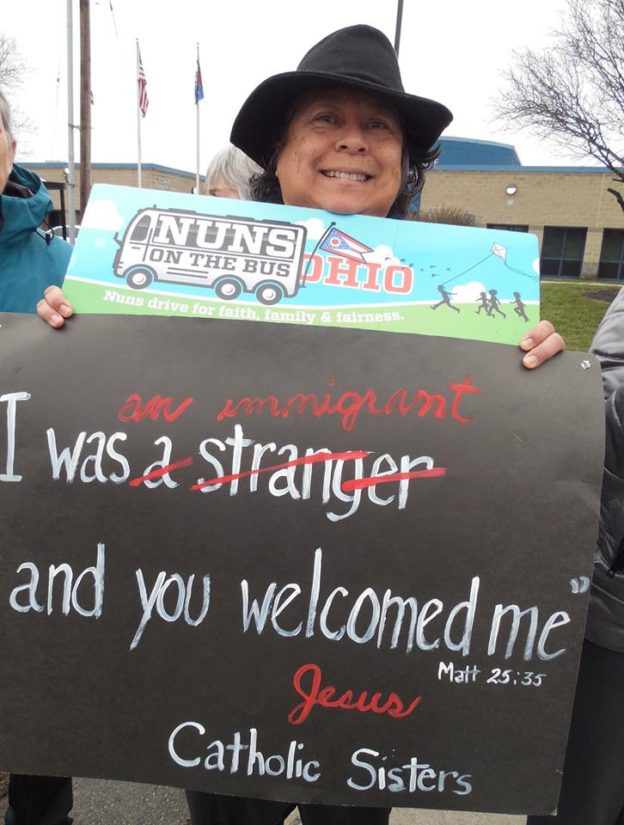
Pope Francis in his recent apostolic exhortation on holiness, Gaudete et Exsultate, challenges us with the insight: “The only proper attitude is to stand in the shoes of those brothers and sisters of ours who risk their lives to offer a future to their children. Can we not realize that this is exactly what Jesus demands of us, when he tells us that in welcoming the stranger we welcome him?” (Paragraph 102).

So how do we stand in the shoes of these immigrants? For some in Chicago it is being part of a prayer ministry for detained immigrants. In New Jersey, just across from New York City, it is providing detained people with basic necessities like stationery, stamps and international phone cards. In southern California, it is in providing parish identification cards and safe havens when Immigration and Customs Enforcement (ICE) is around. In Minnesota, it is state organizing to provide actual protection for undocumented families. On our southern border, it is leaving water along the paths immigrants travel. In schools, colleges and, universities, it is making education accessible for undocumented children and young adults.

Everyone engaged in these and myriad other ministries is putting themselves in the zapatos (shoes) of the immigrant.

As I don’t spend my time doing this direct work, I sometimes wonder how am I putting myself in these sacred shoes? I am lead once again to the crying need for systemic change in our immigration policy. Our nation is being torn apart. Our values are being trampled. Our people are being hurt.

A couple of weeks ago, a mother told me that her first grade son came home extremely worried. He feared that his parents would not be there for him when he came home from school. He and his pals at school were talking about what had happened to one of their pal’s parents. His anxiety was high as he blurted out in tears: “It isn’t fair!”

I know that primal cry. It resonates in my being. I want to stand up and say STOP! This is my part – and yours. Together we are called as the NETWORK community to lobby Congress to change these unjust laws. But it isn’t just our own members of Congress that need to hear from us. We can get our friends around the country to contact their members of Congress too. We need to be missionaries of the common good for our family members who are suffering.

If we are going to reclaim our country, we must act according to our faith values. We will put ourselves in the shoes of those seeking our help and do all in our power to change these unjust laws. I commit to you that I will not step back from the fray even when my heart is broken and I want to flee. Will you act with me in the face of this mounting horror?

It is in this struggle that we might come to know the holiness that Pope Francis talks about. He tells us that it is marked by perseverance, joy, passion and boldness, community and constant prayer. Let us continue our advocacy, knowing that in our time this is the Gospel path. Let us respond together to the invitation: Come Follow Me!

Originally published in Connection Magazine. Read the full issue here.
Encountering the Reality of the Southern Border

Encountering the Reality of the Southern Border

Mary Cunningham
July 20, 2018

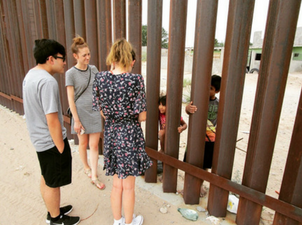
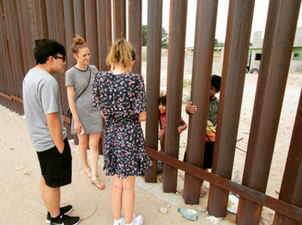
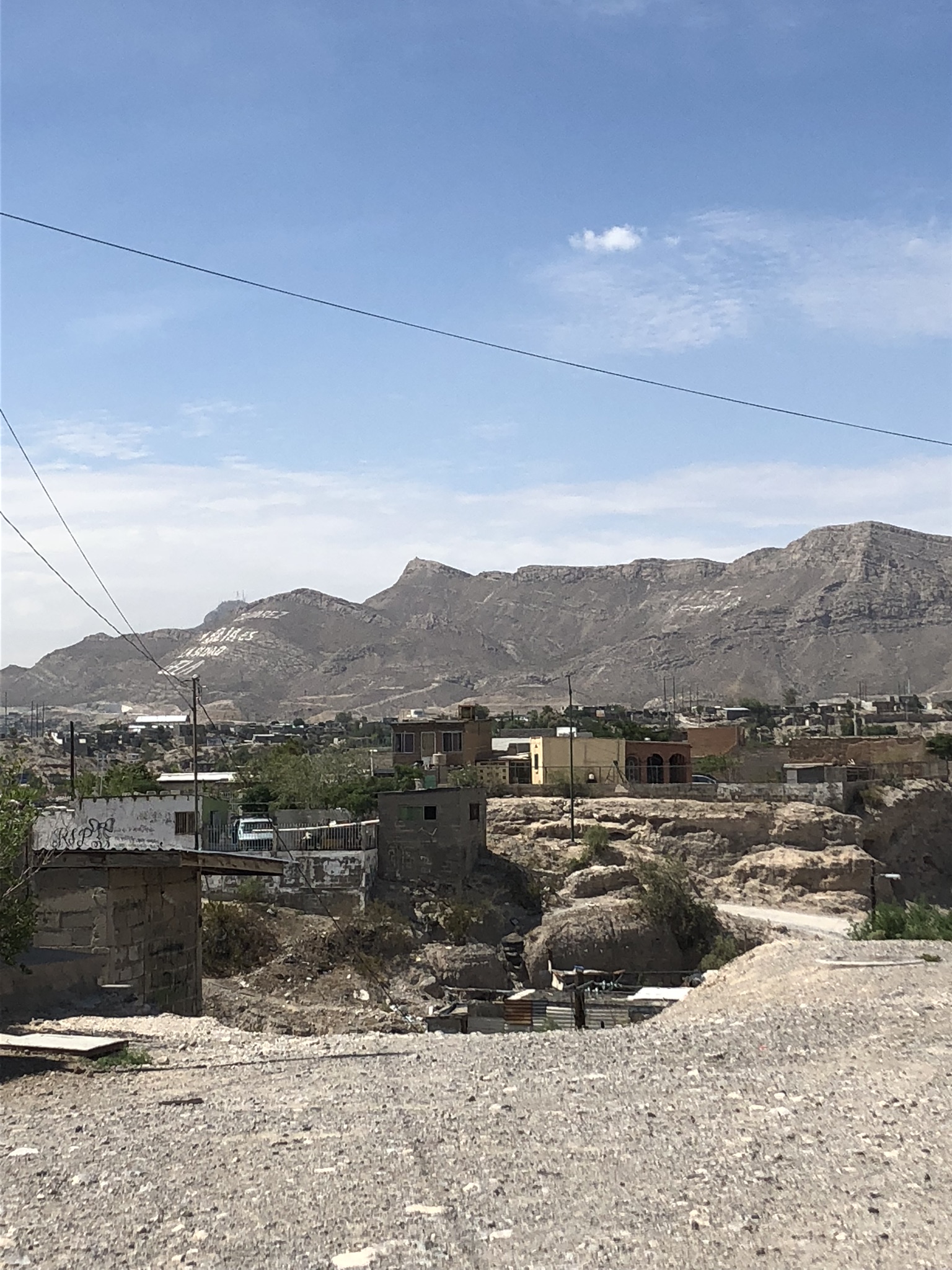
Ciudad Juárez, Mexico, and El Paso, Texas are just miles apart and yet they are worlds away. As you explore both, you notice the cities blend into one another: people living on one side, working on the other, Spanish and English spoken in both, and a shared industrial vibe. And yet, the cities remain two distinct realities – divided by a large border wall, 18 feet high in some places. People on one side are trapped by low wages, poor working conditions, violence, and persecution, and on the other trapped by their own minds and biases. But there is a deep inequality between the two countries, and, in the United States, an explicit denial of the experiences of people living south of the border – people most of us have never even met. It baffles me how a barrier can create not only physical separation, but a separation that is strongly emotional and visceral.

In early July I went to the U.S.-Mexico border for the first time. Working at a federal advocacy organization in Washington, D.C., I am constantly reading news about what’s happening at the border: people fleeing violence in countries such as El Salvador and Honduras, debates on funding for the border wall, family separation, the list goes on. Despite this, I always felt a desire to go the border – to meet people and hear their stories. D.C. is geared towards engaging with immigration on a policy level, but it often feels disconnected from what’s happening on the ground. This trip was a chance to immerse myself in the reality of the border—learning about the working conditions for people on both sides, the process for seeking asylum, the experience of migrants, the conditions in detention centers, Customs and Border Protection, and more. It was a chance to learn, but also a chance to feel the impact of the border and the precise division it creates.

At the beginning of the week we helped serve dinner at Nazareth Hall, a shelter for migrants recently released from U.S. Immigration and Customs Enforcement (ICE) and detention centers. Although there was a language barrier, the stories of the people we served food to were written all over their faces. We noticed the timidity of the group as they entered the dining hall and the slight relaxation that took over as they realized they were finally in a safe place. One woman came up to us after dinner with tears in her eyes, holding each of our hands for a few brief moments, as she repeated, “thank you.” We also got a tour of Annunciation House, a shelter for undocumented immigrants started by Ruben Garcia. (This is one of the only shelters available for migrants who are undocumented.) Interacting with migrants who had just been released from detention was a grounding experience. I spoke with one man from Cameroon who had been detained for 18 months. When I asked how that was, he just shook his head despairingly, claiming, “horrible.” It was evident that the conditions in detention centers are deplorable. Many local advocates we met with told us “make no mistake: these are prisons.”

In addition to helping at local shelters, we met immigration advocates and attorneys such as Anna Hey, Deputy Director of the Diocesan Migrant and Refugee Services (DMRS). Anna gave us an overview of the particular barriers facing migrants coming to the United States, explaining the snares they often get caught up in the legal process. Among all the things Anna shared with us, what stood out to me the most were the discrepancies between the number of people granted asylum from state to state, depending on where their case is heard. (In New York, New York the grant rate is 85%, while in El Paso the grant rate is a mere 6%.) Additionally, Anna noted how the whole “wait in line” argument is complete bologna. Some people applying for immigrant visas or Legal Permanent Residency (LPR) may have to wait over 20 years! Hearing about this and the lived experience of the clients Anna works with exposed the undeniable reality of our dysfunctional immigration system.

Towards the end of the week we crossed the border into Ciudad Juárez, Mexico. While there, we visited the Bibloteca Infantil, “El Buen Pastor,” a children’s library started by Cristina Estrada. Cristina explained how the limited economic opportunity in Juárez dissuades many people from finishing their education. Maquiladoras (foreign-owned and run factories) are common in Juárez and many Mexicans – often multiple members of the same family– end up working in them. We talked to a representative from Foxconn (an electronics manufacturing company), who told us that the starting wage is around $60 a week. Broken down, that means that at least three members of a family would have to work to make ends meet. Recognizing that many Mexican young people see factories like this as their only path, Cristina’s mission at the children’s library is to provide a space for young people to learn, study, and grow. She provides books for students and helps tutor them so they are able to recognize the value of education and where it can lead them. When one of our group members asked Cristina what she hoped to accomplish, she replied with tears in her eyes, saying her dreams had already been fulfilled. Seeing so many kids achieve their educational goals over the years is her greatest accomplishment.

This immersion trip brought me many things, but perhaps among the most important was that nothing is more powerful than the power of experience. Some elected officials choose to paint the immigrant population with broad strokes, calling them criminals, drug traffickers, or burdens to our country. But how fair is that, when these are people just like us, who each carry their own pain, struggles, and joys? There are so many stories that simply don’t get heard, because we don’t have enough time or space to tell them. While I know this immersion trip and these stories won’t change immigration policy overnight, they certainly changed me. I find hope at the individual level, where the stories of each individual person we meet transform our hearts and minds and push us in subtle ways to see anew. As the Columban motto goes, “A life unlike your own can be your teacher.”

A Play Date to Oppose Family Separation

A Play Date to Oppose Family Separation

Daisy Pitkin
June 27, 2018

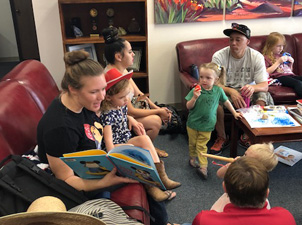
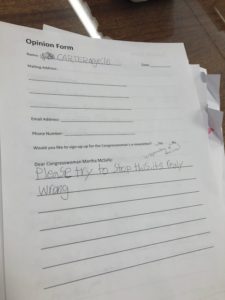
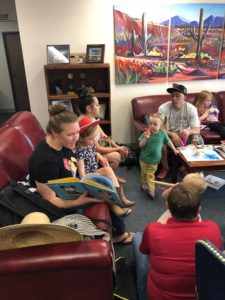
On June 13th, I and about 15 other parents and our children went to Representative McSally’s District Office in Tucson, Arizona to raise our deep concern over the separation of families at the border. Congress is in session, so Rep. McSally was not in her office. While waiting to see if we could speak with her by phone, we sang songs, read books, and ate peanut butter and banana sandwiches. We called our visit a “play-date,” and while we were there, some of the children filled out office-supplied opinion forms. Carter, who is ten, wrote: “Please make this stop it is realy [sic] wrong.”

We went to McSally’s office knowing that she would not be there, but after hearing about the suicide death of Marco Antonio Munñoz after CBP agents forcibly tore his three-year-old son from his arms, and after learning that hundreds of separated children are being held at shelters right here in Tucson, we felt it urgent to reach out to her in person. We are her constituents. She represents us in Congress. Isn’t this the way representative democracy is meant to work?

McSally issued a statement in response to our visit. It began, “It is most unfortunate that this group, organized by radical activists, broke into our office today to disrupt the workplace and prevent us from serving constituents…” She went on to claim that visits like ours “distract from the many issues our country faces.” Again, we are her constituents. We were there to speak with her about an urgent issue facing our country, happening to children and families in our community.

On the night after our play-date, my three-year-old son had a nightmare. I rushed to hold him and to quiet him so he wouldn’t wake his 9-month-old sister. He’d dreamed about a tiger scratching at his window, he said. “Tiger” has become a kind of stand-in for all sorts of unknowns, particularly sounds he doesn’t recognize. I asked if he could hear the branch scraping the window in the breeze. He nodded. I asked if that could that be the “tiger.” He nodded again, and after a few minutes, he fell back to sleep holding my hand. As I lay next to him, I wondered what a stranger might have said to him if he had awoken somewhere away from me. What would have happened if he had awoken to no one?

For me, and I imagine for many others who are outraged by the barbarity of separating families, this is the root of the issue: It is inhuman to make a child alone in the world, or to place her with strangers who aren’t supposed to touch or hold her, who don’t know how to comfort her.

More than 2,300 children have been separated from their parents or guardians due to the Trump administration’s “zero tolerance” policy. Hundreds of these children are being held at a shelter three miles from my home. It is possible that some of them will not see their families again. Yesterday, President Trump signed an executive order to detain immigrant children in camps indefinitely, this time along with their parents.

These policies are monstrously cruel. They are an attack on things I hold very dear: family, the well-being of children, empathy, community, love. So I and my friends who are parents and our children will continue to raise this grave moral issue to Rep. McSally as well as to our senators, city councilpersons, mayor, governor, and anyone else in a position to create safe, compassionate, humane immigration policies. Play-date anyone?


Daisy Pitkin is an Assistant Professor at the University of Arizona Honors College, where she teaches critical thinking and creative writing courses. She is the proud mama of two sweet children, ages 3 years and 9 months.

Two Bills Aimed at Ending Family Separation

Two Bills Aimed at Ending Family Separation

Sana Rizvi
June 11, 2018

As Congress struggles to find consensus on a solution to provide protections for Dreamers, the Administration’s new family separation policy has started a political fire storm creating moral outrage across the country and in Congress. There are two bills that would end the practice of family separation and provide relief to impacted families: The Keep Families Together Act (S. 3036) and the Humane Enforcement Legal Protections (HELP) for Separated Children Act of 2018 (S. 2937/H.R.5950). NETWORK strongly supports these bills.

The Keep Families Together Act (S. 3036)

The Keep Families Together Act prohibits the separation of families at the border. Senator Dianne Feinstein introduced this bill on June 7, 2018 and it currently has 31 Democratic cosponsors and no Republican cosponsors. The bill was created in consultation with groups who provide services to families at the border including Kids in Need of Defense (KIND) and the Women’s Refugee Commission. It mandates a prohibition on removing a child from a parent or guardian in an attempt to deter migration into the United States. It also provides a mechanism to reunite families who have been separated.

The HELP Separated Children Act of 2018 (S. 2937/H.R.5950)

Senator Tina Smith (D-MN) and Rep. Lucille Roybal-Allard (D-CA-40) introduced this bicameral bill on May 23, 2018. Although this act does not end the practice of family separation, it is a necessary step in protecting children until Congress can find a permanent legislative solution to unite detained families and prohibit the separation of families. The HELP Separated Children Act of 2018 would provide relief to families by:

  • Allowing parents to participate in proceedings affecting their children.
  • Allowing parents to make calls to arrange for the care of their children and ensuring that children can call and visit their parents while they are detained.
  • Protecting children from being forced to be translators for law enforcement when speaking to their parents.
  • Ensuring that parents can coordinate their departures with their children.
  • Requiring ICE to consider the best interests of children when making decisions on the detention, release, or transfer of their parents.

The bill currently has 24 Democrats sponsors in the Senate and 16 Democrats sponsors in the House.

With Democrats working to elevate this moral crisis to the public’s attention, all eyes are on Republicans for a legislative response. Protections for children have historically been a nonpartisan issue and thus these two bills should be supported by all Members of Congress.

We must work to secure Republican cosponsors on these bills so that Congress can pass legislation to end family separation. The practice of separation is so morally corrupt, that even immigration hardliner Rep. Mark Meadows (R-NC) leader of the House’s far right faction called the “Freedom Caucus” has called the policy a “horrible law.”  We call on Republicans to join their Democratic colleagues in ending the policy of family separation.

NETWORK will continue to monitor legislation closely and provide updates on this issue.

#WhereAreTheChildren and Family Separation at the U.S. – Mexico Border

#WhereAreTheChildren and Family Separation at the U.S. – Mexico Border

Sana Rizvi 
June 1, 2018

This past weekend, the internet became flooded with tweets asking #WherearetheChildren after a New York Times article reported that the Trump Administration had lost track of nearly 1,500 unaccompanied migrant children.

Let’s be clear: this is a very real question. As people of faith, the well-being of children, particularly of migrant children fleeing danger in their home countries to seek refuge in the United States, is paramount.

But — it is only the tip of the iceberg.

Immigration advocates are asking people to look beyond #WherearetheChildren. As Vox reporter Sarah Kliff explains:

“Immigration advocates… aren’t spending a lot of time worried about #WhereAreTheChildren. Instead, they say the real crisis is the Trump administration’s new policy of separating undocumented families apprehended at the US border — a policy that may have gotten conflated with the “missing” children story that went viral this weekend.”

What’s the difference? The “1,500 missing children” refers to unaccompanied minors, who arrived in the United States mostly during the Obama Administration, and through the Office of Refugee Resettlement under the Department of Health and Human Services, were placed in the care of family and foster care agencies.

#WherearetheChildren is a movement to find the 1,500 minors who mostly came across the border alone and were placed into the guardianship of foster homes or their own families (even if the family members are undocumented). HHS keeps track of these minors by calling the homes they were placed in and following up with them for their deportation court hearings. Immigration advocates are not asking #Wherearethechildren because these are not 1,500 minors who have been separated from their families. These are 1,500 families that did not pick up the phone when the government called asking for the whereabouts of undocumented children.

Now, the Trump Administration, has a new policy that an administration official referred to as a “zero tolerance policy,” which separates families seeking asylum when they reach the U.S. border.

Vox’s Dara Lind writes:

“The Trump administration’s solution [to logistical challenges related to detaining families as unit], now codified in policy, is to stop treating them as families: to detain the parents as adults and place the children in the custody of Health and Human Services as ‘unaccompanied minors.’”

This insidious policy separates families coming across the border together to seek asylum. Parents are turned over to ICE for criminal prosecution and their children are re-designated  as “unaccompanied minors,” even though they were forcibly separated from their parent/guardian.

As a result, the separated children can be sent anywhere in the U.S. regardless of the status or location of their parents, even if the parent or parents have been deported. In some cases, this makes family reunification nearly impossible. We must also ask #WhereAreTheChildren, for these young people being forcibly separated from their parents by U.S. agents.

There is no doubt that there are threats to unaccompanied minors, and  the Department of Health and Human Services must be very careful about where it is placing minors. #WherearetheChildren needs to be about the 1,500 children, and it must be a call to action to stop separating children from their parents . We need to fight against policies created to separate children from their families and recognize that the safest place for immigrant children is with their families and their communities.

Below are some resources on separated families:

“This is what’s really happening to kids at the border” (The Washington Post)

“The real immigration crisis isn’t “missing” children. It’s family separations” (Vox)

“Family Separation at the Border” (KIND and Women’s Refugee Commission’s two page backgrounder on what happens to separated children.)

2020 Census Gets Almost $2 Billion Increase from House Appropriators

2020 Census Gets Almost $2 Billion Increase from House Appropriators

Tralonne Shorter
May 30, 2018

On Thursday, May 17, 2018 the House Appropriations Committee approved $4.8 billion in overall funding for the Census Bureau, as part of the fiscal year (FY) 2019 Commerce, Justice, Science (CJS) spending bill.   The appropriation is a $1.985 billion increase above the FY 2018 enacted level; almost $1 billion above the President’s FY 2019 budget request.  The funds would primarily support 2020 Census activities such as technology improvements, address canvassing, End-to-End tests, and the opening of 248 Census field offices.

Regrettably, the bill contains several unacceptable provisions.  One major upset for advocates was a decision by the Committee to reject an amendment to remove the citizenship question.  NETWORK submitted written testimony and organized faith leader sign on letters in opposition to the citizenship question. We were also disappointed that the Committee included a big increase for illegal immigration enforcement.   In particular, the Committee approved a $126 million increase above FY 2018 for the Executive Office for Immigration Review (EOIR), a division within the Department of Justice that adjudicates immigration removal proceedings.  This increase would annualize 100 new immigration judge teams the Committee approved in the FY 2018 Omnibus and would provide funds for 100 additional immigration judge teams in FY 2019. This total increase of 200 new immigration judge teams over a two-year period would drastically reduce the immigration case backlog while resulting in more families being torn apart.

A floor vote on final passage in the House has not been scheduled, but we anticipate it will occur before the August recess.  The Senate Appropriations Committee is expected to consider its own FY 2019 CJS spending bill sometime in June.  NETWORK will continue to push for full funding and oppose the addition of a citizenship question.

A child wearing a cap walks with a backpack and a stuffed animal at the US-Mexico border

New Energy for DACA Solution in the House

New Energy for DACA Solution in the House

Sana Rizvi
May 11, 2018

After the Senate’s failure to pass DACA legislation, a small group of moderate Republican House members facing tough reelections are pushing to bring an immigration vote to the House floor. One such member is California Representative Jeff Denham (CA- 10), who has invoked an obscure House rule called the “Queen of the Hill” to vote on DACA legislation. Representative Denham has a total of 247 cosponsors on this resolution, which includes 195 Democrats and 52 Republicans (Find the complete list of cosponsors here.) Since the rule has greater support than the 218 needed, it was up to Speaker Paul Ryan to move the rule forward.

Due to Speaker Ryan’s failure to act, however, moderate Republicans have begun a discharge petition, which is a way to get the rule to the floor without the Speaker’s approval. The discharge petition will need 218 votes to be filed, requiring signatures from the entire House Democratic caucus and at least 25 Republicans. The current petition has 18 Republicans signed on and the Democratic caucus plans sign on when the Republican votes are secured, to ensure 218 votes.

This “Queen of the Hill” rule would trigger votes on four DACA bills. The bill with the most votes after the 218 majority will pass the House and continue to the Senate for consideration. Representative Denham’s office has reported that bills for consideration are the Dream Act (H.R. 3440), the Uniting and Securing America Act (USA Act, H.R. 4796), and Rep. Goodlatte’s Securing America’s Future Act (H.R. 4760). While both the Dream Act and USA Act offer DACA recipients protection from deportation and a pathway to citizenship, Rep. Goodlatte’s bill aims to cut legal immigration and provides no pathway to citizenship for DACA recipients. Although ordering of the votes for the Queen of the Hill proposal is up to Representative Denham, he left a fourth slot for any bill of Speaker Paul Ryan’s choosing. By offering Speaker Ryan the fourth slot, Rep. Denham has provided the Speaker with an opportunity to weigh in on the vote.

While all eyes are on the House for action around “Queen of the Hill,” the courts have also had significant movement around DACA these past few months. On May 1, 2018, a federal judge’s order prevented the Department of Homeland Security (DHS) from arbitrarily cancelling a young man’s DACA status after the government failed to prove that he had committed a crime. Another blow to the administration’s attempt to end of DACA came when a federal judge ordered the government to continue the DACA program and begin accepting new applications for the first time in several months. This has not gone into effect yet, however, as the judge gave the Trump administration 90 days to provide a compelling reason for shutting down the DACA program.

To complicate matters further, most recently, seven states led by Texas have brought a class action suit against the federal government for failing to end the DACA program completely. As these cases become more entangled and national injunctions begin to contradict one another, pressure for resolution will increase as well as the likelihood of the Supreme Court’s involvement.

Ultimately the DACA issue must be resolved with a legislative fix from Congress which could include a pathway to citizenship for DACA recipients, bringing resolution to this issue. NETWORK will continue to monitor this process and call on members of Congress to move towards a permanent legislative solution.

“Public Charge” Then and Now

“Public Charge” Then and Now

President Trump’s Anti-Immigrant Policy Remains True to its Origins 
Timothy Meagher
May 10, 2018

In 1837, Massachusetts began the first mass immigrant deportation program in the history of the United States. As Hidetaka Hirota’s new history of the Massachusetts deportations, Expelling the Poor, reveals, the program would last for more than a half a century and would deport over 50,000 immigrants. The deportees were not undocumented (there were few restrictions on immigrants coming into the country then).

Massachusetts law, however, permitted state officials to board ships and send some immigrants home because they seemed likely to seek public assistance or welfare, becoming a “Public Charge.” Later amendments to the law sent state officials on regular inspections of poorhouses or asylums searching for immigrants already living in the United States who had become public charges and could then be deported to “home” countries that some had not seen in decades. The state even deported immigrants like Hugh Carroll, who had become American citizens. Many of the deportees were mothers, abandoned or widowed, often with young children, who could not find work that allowed them to earn a living and raise their kids at the same time. They had no alternative but the poorhouse. All of these immigrants, as a contemporary newspaper pointed out, were evicted from Massachusetts “for the crime of being poor.”

Advocates of the law insisted that the deportations were necessary; foreign paupers were flooding the state, they argued, becoming “leeches upon our taxpayers.” Of course, there were other, powerful motives behind the law beyond a concern for the public purse.

Over the law’s course of fifty years the vast majority of the deportees were Irish Catholics; that was no coincidence. The deportation program began in the 1830s, when Irish immigrant numbers in Massachusetts were rising and native residents of Massachusetts responded with frenzied assaults on Irish Catholic neighborhoods and institutions like the Ursuline Convent in nearby Charlestown. The deportations reached their high point in the mid-1850s when the virulently anti- Catholic and anti- immigrant Know Nothings attacked Catholic Churches and took control of the state government, strengthening the deportation law, and fiddling with immigrant voting rights. To supporters and administrators of the law, Irish Catholic and pauper was a distinction without a difference: Irish Catholics were by their nature paupers or inevitably on their way to becoming ones. “Celtic pauperism is our stone of stumbling,” a prominent nativist leader stated, the Irish Catholic “ will not work when he can exist by begging.”

Now, the Trump administration has proposed expanding the federal criteria for determining whether a documented immigrant living in the United States is a “public charge.” The old criteria included receiving cash welfare payments, but the new rule would include participation of an immigrant or their dependent children– including U.S. citizens–  in “almost any form of welfare or public benefit,” including: the Earned Income Tax Credit, state Children’s Health Insurance Programs (CHIP), or federal health insurance subsidies. If defined as a public charge under this new rule, legal immigrants could be denied green cards or extension of their work visas and thus be forced to leave the country.

The Trump administration, of course, claims that it is only trying to “protect the American taxpayer,” just as Massachusetts’ old Know Nothings did a century and a half ago. Yet, as the Washington Post reported, changes in the definition of a public charge are frankly designed to “reduce the number of foreigners living in the United States,” which, of course, is also what the Know Nothings in Nineteenth century Massachusetts were trying to do.  Only the names, the homelands and often the races of the deportees are different. The same anti-immigrant sentiment has no place in our federal policies today.

During the Civil War, Peter Welsh, color sergeant in the 28th Massachusetts, a part of the Irish Brigade, died of wounds inflicted in the battle of Spotsylvania.  Earlier in the war, he had written home to his wife explaining why he was fighting for the Union: what, he asked, would have been the fate today of “hundreds of thousands of the sons and daughters of poor old oppressed Erin if they had not a free land like this to emigrate to, famine and hunger staring them in the face.”