


Category Archives: Front Page

Passing a Faithful Recovery Package to Build Anew

Passing a Faithful Recovery Package to Build Anew

Allison Baroni
August 4, 2021

On July 13, 2021, the Senate announced that it had reached an agreement on a $3.5 trillion recovery package to be passed through the budget reconciliation process. This package, which is based on President Biden’s Build Back Better vision, together with the $1 trillion bipartisan Infrastructure Investment and Jobs Act, comes at a time when the COVID-19 pandemic has laid bare the gross inequity and lack of federal investment in our communities and infrastructure.
Congress has a responsibility to meet the moment, respond to the needs and demands of the people, and make a once in a generation investment in our public infrastructure. To do so, Congress must include the following priorities in a bold, faithful recovery package:  

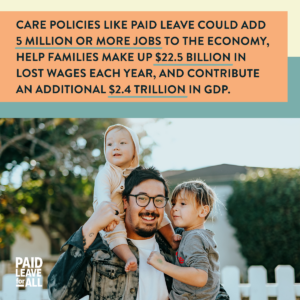
  • Ensure any national paid family and medical leave program has progressive wage replacement, job guarantees and anti-retaliation language, inclusive definitions of family, and centers women of color in all decisions to ensure racially equitable access.  
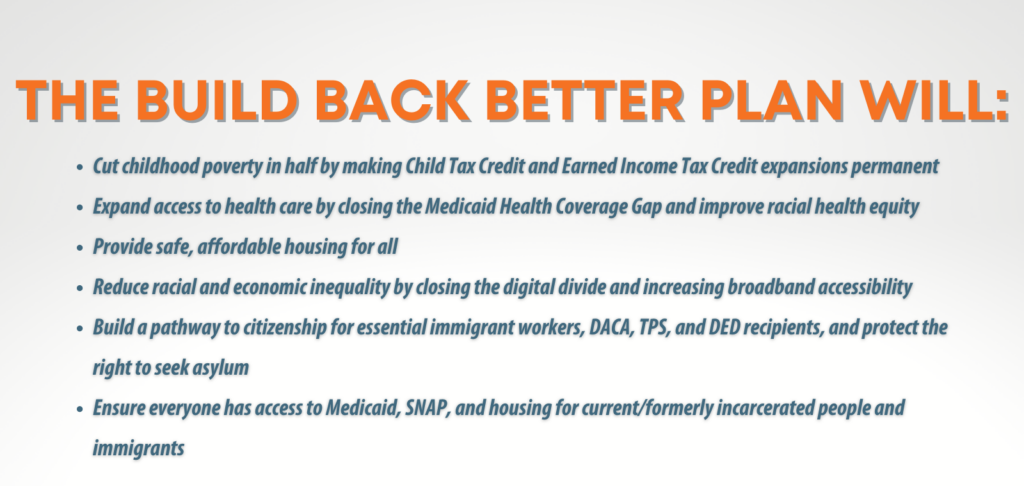
  • Make the new Child Tax Credit and Earned Income Tax Credit expansions permanent and ensure all immigrants, regardless of legal status, can access the Child Tax Credit and human needs programs.  
  • Establish a pathway to citizenship for all undocumented immigrants including Dreamers, Temporary Protected Status (TPS) holders, and essential workers.  
  • Enact a set of federal standards for Unemployment Insurance (UI) including mandatory 26 weeks of benefits, adequate replacement wage levels (i.e. 75% of wages up to 2/3 of the state’s average wage), and ensure that unemployed workers’ access to benefits is racially equitable. 
  • Provide resources for multi-year rental assistance and address the ongoing unmet need for affordable housing by building affordable housing units. 
  • Make the broadband subsidy permanent to increase access to health care and other critical needs in communities across the country. 
  • Close the Medicaid coverage gap for non-expansion states and provide Medicaid to people who are incarcerated. Finance health expansions by allowing Medicare to negotiate drug prices. 

As always, we will hear critiques that these priorities are too costly. Yet the human cost of not making these needed policy changes is far higher than $3.5 trillion could ever be. Far from a simple policy decision, the choice to include or reject these policy priorities has far-reaching consequences for the lived experiences of those in the United States. For every refusal to include these policy priorities, families in the U.S. face dire circumstances and decisions. 

 Behind all the political rhetoric, lies a simple and important question that we as a nation must answer: who are we beholden too? In Pope Francis’s most recent encyclical, Fratelli Tutti, he reminds us of the answer to that question. Reflecting on the story of Cain and Abel, he writes:  

“Cain kills his brother Abel and then hears God ask: ‘Where is your brother Abel?’ (Genesis 4:9). His answer is one that we ourselves too often give: ‘Am I my brother’s keeper?’ (ibid). By the very question he asks, God leaves no room for an appeal to determinism or fatalism as a justification for our own indifference. Instead, he encourages us to create a different culture, in which we resolve our conflicts and care for one another.” (57)   

We are at a tipping point. As our nation races toward devastating income inequality, inadequate access to health care, and a dearth of quality affordable housing and living-wage jobs, the breadth and depth of the policy response necessary can at times seem daunting. It can be all too easy for us to turn away from the task, to absolve ourselves of our responsibility to one another.  

But, as Pope Francis says, if we are to build a culture of care, it must be done. Congress cannot afford to pretend that bold and immediate action is not necessary to improve and protect the lives of everyday people: the neighbor whose home is in danger of flooding, or the one who never had one to begin with. The parent struggling to pay childcare and the relative unable to access health care.  

These everyday struggles are the result of policy choices. The question facing Congress can be reduced to this: Will we choose to be a nation that refuses to take care of its own, one that accepts poverty as inevitable? Or will we challenge that lie, asserting that no cost is too high to take care of each other? If we listen honestly to God’s question to Cain, we will find that there is only one answer! 


Allison Baroni is a rising senior at Villanova University where she studies Peace and Justice & Theology. Allison is a member of the NETWORK Government Relations team this summer. 

Recovering Together: Creating a Pathway to Citizenship

Recovering Together: Creating a Pathway to Citizenship

Achieving an Equitable and Inclusive Recovery through Budget Reconciliation
Ronnate Asirwatham
August 3, 2021

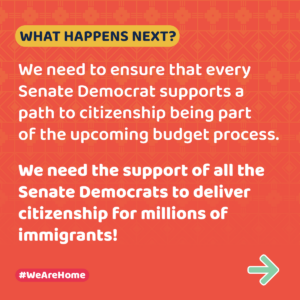
This week, Democratic Congressional leadership continues debating what will be included in the $3.5 trillion recovery package. The transformational recovery package will be passed through the budget reconciliation process, which only requires 50 Senate votes for a bill to pass and become law. This provides a unique opportunity to create a pathway to citizenship for millions of our undocumented community members that cannot be missed.
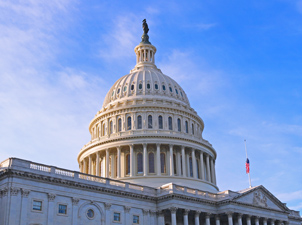
We are calling on all Senators to support including a pathway to citizenship for Dreamers, Temporary Protected Status (TPS) holders, farm workers, and essential workers in the recovery package.

With a simple majority vote, Democrats can finally deliver a pathway to millions of undocumented people who have lived and worked in the United States under the fear of deportation for too long.

It is a moral failure that today in the U.S. millions of immigrant workers are considered “essential” and “deportable” at the same time. Congress has a moral imperative to provide a pathway to citizenship for immigrant essential workers and their families through the reconciliation process.

A pathway to citizenship for Dreamers, TPS holders, farm workers and other essential workers has overwhelming bipartisan support. Now is the time to extend a pathway to citizenship to millions of our neighbors.

Take Action

Call your Senators at 888-738-3058. Tell them to support including a pathway to citizenship for Dreamers, Temporary Protected Status (TPS) holders, farm workers, and essential workers in the recovery package.

We Need A More Just and Humane Immigration System

We Need a More Just and Humane Immigration System

Mercy Adoga
August 26, 2021

At NETWORK, we are advocating for a more just and humane immigration system especially at our southwestern border for all immigrants including Haitian, Afro-Caribbean, and African immigrants. 

However, some of the Biden administration’s actions do not support such a system. On August 2nd, President Biden indefinitely extended Title 42 of the U.S. Code to prevent asylum seekers from coming to our borders . This is a flagrant violation of U.S. asylum lawstreaties, and the Constitution. The Biden administration’s misuse of Title 42 to expel asylum seekers puts all expelled immigrants especially black immigrants in grave danger of gang violence, kidnappings, and separates families. Since Biden took office in January of this year, NGOs have tracked at least 6,356 kidnappings, sexual assaults, and other violent attacks  against people blocked at ports of entry or expelled.

President Biden also unveiled a blueprint that has been created for a fair, orderly, and humane immigration system. the Department of Homeland Security has followed up with proposed administrative regulations to flesh out the blueprint. NETWORK welcomes some of the proposed regulations such as those that will expand the categories of asylum seekers eligible to have their cases decided before U.S. Citizenship and Immigration Services (USCIS). These interviews allow asylum seekers to present their claims in a less traumatizing, non-adversarial setting and will contribute to reducing the immigration court backlog. 

However, both the blueprint and proposed regulations allow the government to expand its use of expedited removal, provide only an immigration court “review” rather than an actual hearing, and end the essential life-saving safeguard of asylum office reconsideration of negative credible fear determinations.

These are harmful policies that have been tried, tested, and failed. NETWORK and other organizations have written to the Attorney General the reasons why expedited removal should not be used. These policies frequently lead to the unlawful deportation of people seeking asylum, who are often denied the chance to request protection by Customs and Border Protection (CBP) officers.

A new NETWORK and Kino Border Initiative joint report provides a snapshot of the CBP abuse at the border. All 35 cases recorded in this report say they asked for asylum but the CBP denied them their right to pursue their asylum cases and expelled them instead.  The Administration’s choice of a deterrence policy over a just and humane one will needlessly subject families to abusive treatment and inhumane conditions in CBP and ICE detention cells as the government seeks to deport them

NETWORK Recommendations

At NETWORK we recognize that the current immigration processes occurring at the southwestern border are detrimental to immigrants. We would like to spread awareness about the dangers while also proposing potential solutions to address some of the concerns surrounding the immigration system. 

Asylum seekers should enter into a welcoming, timely, and effective system rather than being subjected to rushed and inefficient screening and adjudication procedures. We ask for: 

  1. The right to seek asylum restored at all points of entry at our southern border 
  2. End the misuse of Title 42 at the U.S. Mexico border
  3. Improve the fairness of asylum office interviews and refer asylum seekers for full asylum interviews at their destination locations without the use of expedited removal — a fundamentally flawed process that endangers refugees   
  4. Ramp-up case support initiatives and funding for legal representation, use legal parole authority and do not send people seeking U.S. refugee protection to immigration jails while their asylum cases are adjudicated.
  5. Support faith and community-based welcome organizations to provide welcome and temporary care in border towns and in the interior of the U.S. 
  6. End immigration detention. 
  7. Ensure that all asylum seekers have the right to legal representation not only legal orientation programs.

We hope that taking these steps among others will lead to a more timely, just, and effective immigration system that positively affects all immigrants including those who are Haitian, Afro-Caribbean, and African. 

Welcome to NETWORK’s Summer Immigration Education

Welcome to NETWORK’s Summer Immigration Education!

Mercy Adoga
July 31, 2021

This summer NETWORK offers a series of educational videos providing information about the United States’ Immigration system. In this video series, NETWORK’s Government Relations Director Ronnate Asirwatham will be discussing various topics surrounding the U.S Immigration system such as Title 42, MPP (Migration Protection Protocols), the difference between the asylum process and refugee process, and more. To learn more, please watch the videos below.


Mercy is a graduate student. She is one of the summer volunteers at NETWORK this year and has been working on the Summer Immigration Education and Advocacy Initiative.

Dear Neighbor: Reflections on Service at the Border

Dear Neighbor: Reflections on Service at the Border  

Sr. Cecelia Cavanaugh, SSJ 
July 29, 2021

As I finish unpacking my luggage after spending two weeks at the Texas-Mexico border, I find myself “unpacking” experiences, conversations, and my own emotions. As a word nerd, it did not seem an accident to me that the call to the border came on March 25, the feast of the Annunciation – God’s Word to Mary, Mary’s word to God, and the Word Made Flesh making a dwelling among us. As Sisters of Saint Joseph, we profess an active, inclusive love of every kind of dear neighbor from whom we do not separate or distinguish ourselves, just as Jesus was like us in all things but sin.  

Many of us had responded last year to a similar invitation although we faced different realities since changes in administrative policies have (happily) resulted in a great influx in the number of persons found eligible to cross and seek asylum. I have been encouraged and lifted up by the support and enthusiasm of so many who cannot make the trip but want to help and want to know about the experience. Individual sisters, friends, and family members made donations, offered airport rides, babysat plants, covered home responsibilities, and corresponded often during our trips. Those returning from service offered perspective and advice to those preparing to go. Once home, I met a sister who left the morning for Laredo and passed on some tee shirts identifying us as Sisters of Saint Joseph, Hermanas de San José, bearing a motto, “Love Boldly.” I felt that I was passing a baton in a relay.  We have scheduled zoom meetings so that border volunteers can share their experiences with our Sisters and Associates in Mission. We like to say, “where one of us is, we all are,” and that is absolutely my experience. 

My service included using Spanish, which eased some interactions, provided, I hope, some support to our dear neighbors, and opened me to worlds of story, anguish, humor, extra rations of smiles and tears. The word nerd in me reveled in the rich variety of language I met – a reflection of dialects and indigenous influences in each country from which people had emigrated. Folks standing in line helped translate Spanish with Spanish, creating community. I learned five new words for “baby bottle,” for example, and that “calcetas,” a word I knew to mean “shackles” is used in some countries to mean “socks.”  

Two linguistic encounters have stuck with me. Time after time, as I worked a line for clothing distribution or a counter where we provided hygiene items, baby supplies, and some over-the-counter medications, people made the same request. ¿Me regala. . .? They were asking for me to give them something. But instead of the verb I expected, “dar,” to give, they consistently used “regalar,” to gift.  

I’ve since learned that in some countries, regalar is used interchangeably with dar.  Regalar can mean to give away – which we were certainly doing. Why did it strike me so forcefully? Why did it stick with me? I think at first, it struck me in its humility and as a way of lowering oneself. “Would you gift me….” implies that the giver is somehow superior to the receiver and I resisted that notion. Secondly, nothing these dear neighbors were requesting was anything other than an essential of life: milk and a sippy cup for a toddler, diapers, diaper rash ointment, soap, shampoo, one change of clothes. This shone a bright, uncomfortable light on my abundance.  I knew from firsthand experience that everything we had to give had been purchased with donations. I was a mere vehicle through which generous people offered help to others. I wasn’t gifting or giving anything on my own. The necessities of life are gifts from God, of course – but they shouldn’t be gifts for some and everyday abundance for others. This calls me to continue to examine how I consider what I have in light of what others need. If I make do with less (hardly a sacrifice), could my sister from Honduras have enough to feed and clothe herself and her children?  

The second phrase which was new to me was, “Simplemente.” Literally, “simply,” my new friends used it as we ended our conversations. Can I offer you anything else? Would you like some other item? A smile and “Simplemente,” meant they had “enough.” When “simply” means “enough,” no one wants for anything. I’m sure you can tell that instead of just sharing the fruits of so much generosity with my dear neighbors, they are the ones who gifted me with new questions. I continue to have a deep sense that the little time I spent with them and the small plastic grocery bag of supplies we provided are paltry in light of need. When I feel underwhelmed considering what I offered in light of what they need and all to which they have every right as God’s children, they console me with their sweet smiles and “Simplemente.” 


Read more from Sr. Cecelia: Called to Serve Our Neighbors at the Border  

Cecelia J. Cavanaugh SSJ is a Sister of Saint Joseph of Philadelphia and a former Nun on the Bus.   

Catholic Sisters to President Biden and Senator Schumer: Pass S.1!

Catholic Sisters to President Biden and Senator Schumer: Pass S.1!

Meg Olson
July 26, 2021

Today, NETWORK members delivered a letter signed by 3,685 Sisters in support of S.1, the For the People Act, to President Biden and Senate Majority Leader Schumer. The letter urges President Biden and Senator Schumer not to let minority opposition prevent the Senate passing the For the People Act any longer. Click here to tweet about the Nuns’ Letter or share it with your friends on Facebook.

The Sisters’ message: “As Catholic women religious, we see and affirm the dignity of every person. Knowing that all people are made in the image and likeness of God, we cannot tolerate policies or practices that suppress voters’ ability to participate fully in our democracy, especially Black, Brown, and Native American voters.”

Sister Quincy Howard, OP, NETWORK Government Relations Specialist, who helped organize the letter, said, “Sisters feel a real urgency to respond to the rising threat to our democratic institutions. A healthy democracy is our means for creating a better world and therefore this is a moral issue of the utmost importance.”

Sr. Susan Wilcox, CSJ, a NETWORK member and the Justice, Peace, and Integrity of Creation Coordinator for the Sisters of St. Joseph of Brentwood, helped to deliver the letter to Senator Schumer’s district office. She said, “Voting is a right and a responsibility, but voting rights are under attack. Strict voter registration requirements, extreme partisan gerrymandering, voter purges, and long waits times are disruptive and disenfranchising. We need democracy reform now to protect our next election.”

After receiving the letter, Senator Chuck Schumer said: “Republican state legislatures across the country are engaged in the most sweeping voter suppression in 80 years, and I applaud the Sisters of St. Joseph in Brentwood and beyond for their support of American democracy and for S.1, The For The People Act. The Senate vote I held last month, with all 50 Democrats voting in favor, represented the starting bell – not the finish line – in our fight to protect democracy, and as majority leader, I am exploring all options to bolster voting rights and advance democracy-reform legislation for another vote on the Senate floor.”

Amplify the Sisters’ Message, Join Team Democracy

With Congressional redistricting starting soon, now is a critical time to protect our democratic institutions. NETWORK members are organizing local events to raise support for the provisions included in S.1. If you are in one of the cities below, be sure to join your local “Team Democracy” event. (More local events still to be announced!)

  • Indianapolis, Indiana
  • Cleveland, Ohio
  • Flourtown, Pennsylvania
  • Monroe, Michigan

Learn more about these events and R.S.V.P. at networklobby.org/TeamDemocracy.

Community Conversation: Sisters on the Border

Community Conversation: Sisters on the Border

Mercy Adoga
July 21, 2021

On June 29, 2021, NETWORK hosted a community conversation with the “Sisters on the Borders.” Sr. Doreen Doreen, CSJ, and Sr. Patrice Patrice, CSJ engaged in conversation and shared their experiences.

Sr. Doreen began by mentioning a question she received prior to this conversation. The question was, “How did I become involved in this work?” Sr. Doreen expressed her gratitude for this question as it helped her reflect on her many years of service. She later went on to speak about her experience after Vatican II and how that time pushed her toward direct service. She visited jails, volunteered in homeless shelters, and taught ESL in Spanish-speaking communities. Sr. Doreen said when speaking about her work, “My commitment to living the Gospel led me to this.”

Sr. Patrice spoke next and also shared Sr. Doreen’s experience of reflecting prior to this conversation. Sr. Patrice spoke about her work with refugees in Cambodia, the border of Sudan and Ethiopia as well as Haiti. Sr. Patrice explained that all refugees want to stay in their home countries but their home is no longer safe for them for a variety of reasons including environmental concerns, gang violence, or government mismanagement. Sr. Patrice also joined other Sisters and volunteers in El Paso, Texas to assist migrants. She explained that one, “had to be open to what the needs were.”

With her most recent work in San Diego, CA, Sr. Patrice expressed her gratitude for the different organizations that came together regardless of background to assist refugees. She was also aware of the fact that refugees’ arrival in the states is just the beginning of their journey and that they face many challenges in the immigration process in the United States.

The latter half of the evening was led by Ronnate Asirwatham, NETWORK’s Government Relations Director, who took to explain immigration policies that the Sisters discussed such as Title 42 and MPP(Migrant Protection Protocols) After Ronnate explained these policies, viewers were given reflections questions to discuss in the breakout rooms. These questions included, “What has been your experience with immigration in your community?” “How have certain policies or laws impacted the situation at the border?” “What narratives about immigration do you hear in general? How do those compare to your experience?”

If you would like to learn more or re-watch this conversation, find the recording on NETWORK’s YouTube channel.


Mercy is a graduate student. She is one of the summer volunteers at NETWORK this year and has been working on the Summer Immigration Education and Advocacy Initiative.

Recovery Update: Building Anew with a Bold Recovery Package

Recovery Update: Building Anew with a Bold Recovery Package

Laura Peralta-Schulte
July 21, 2021

Right now, Congress is crafting their budget reconciliation proposal. Over the next weeks and months, our elected officials will decide what policy priorities to include and what to leave out.

Budget reconciliation gives us the opportunity to make bold, transformational investments in our families and our communities by:

  • Making the Child Tax Credit and Earned Income Tax Credit permanent
  • Increasing access to health care, eldercare, childcare, education, and broadband
  • Building affordable housing and increasing access to rental assistance
  • Providing a pathway to citizenship for those with DACA, TPS, farmworkers, and other essential workers
  • Establishing a national paid family and medical leave program, and more.

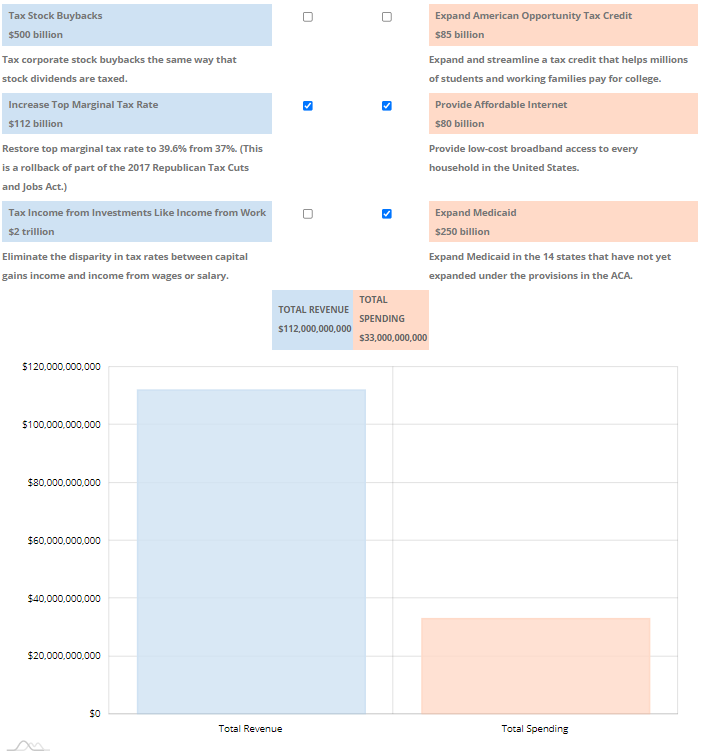
We cannot go back to the status quo of exclusion and inequality. We must build anew with racial and environmental justice at the center. The recovery package Congressional Democrats are working to pass through budget reconciliation will make bold investments in a more just future. We can afford this by reforming our tax code to ensure that the wealthiest people and big corporations pay their fair share of taxes. We urge Congress to unrig the tax code by:

  • Repealing the 2017 Republican corporate tax cuts
  • Strengthening IRS enforcement to prevent tax evasion
  • Eliminating tax breaks that encourage offshoring
  • Closing tax loopholes used by big corporations to avoid paying their fair share, and more.

Fixing our tax code is essential to closing the racial wealth gap and creating an economy that benefits all of us.

Allying with the We Serve with Love Campaign

NETWORK Allies with the We Serve with Love Campaign

Gina Kelley
July 19, 2021

In June, in celebration of Pride, NETWORK Lobby signed on as an ally of the We Serve with Love Campaign. This important campaign, led by the National Center for Lesbian Rights, aims to lift up faith-based direct service providers providing services to LGBTQ+ people and families. Additionally, this campaign educates faith-based providers on how to offer the most welcoming and safe services to LGBTQ+ people and increases understanding of the intersectionality of poverty and the discrimination people encounter because of their LGBTQ+ identities.

Speaking about NETWORK’s support of this campaign, Chief Lobbyist Laura Peralta-Schulte, said “At NETWORK we advocate for federal policies that respect the dignity and ensure the economic security of all in the United States, no exceptions. Today, 1 in 5 members of the LGBTQ+ community live in poverty, more than double the national rate. No one should have to struggle to make ends meet because of who they are or who they love. Motivated by our faith, which calls us to love one another, NETWORK is proud to support the We Serve with Love campaign, shining a light on faith-based service providers that provide safe and inclusive support to members of the LGBTQ+ community.

We know that people of faith and the LGBTQ+ community are not, and should not be divided against one another. Many people of faith are members of the LGBTQ+ community – around 20% of LGBTQ+ people in the U.S. are Catholic. People of faith, and majorities of all voters, support laws that protect LGBTQ+ people from discrimination. Treating everyone, regardless of their identity, with dignity and respect is a universal value.

We are proud to celebrate the service providers who practice acceptance and love with everyone who needs their aid.