

Category Archives: Front Page

Bus Blog: The Center for Worker Justice of Eastern Iowa

Bus Blog: The Center for Worker Justice of Eastern Iowa

Caraline Feairheller 
October 01, 2020

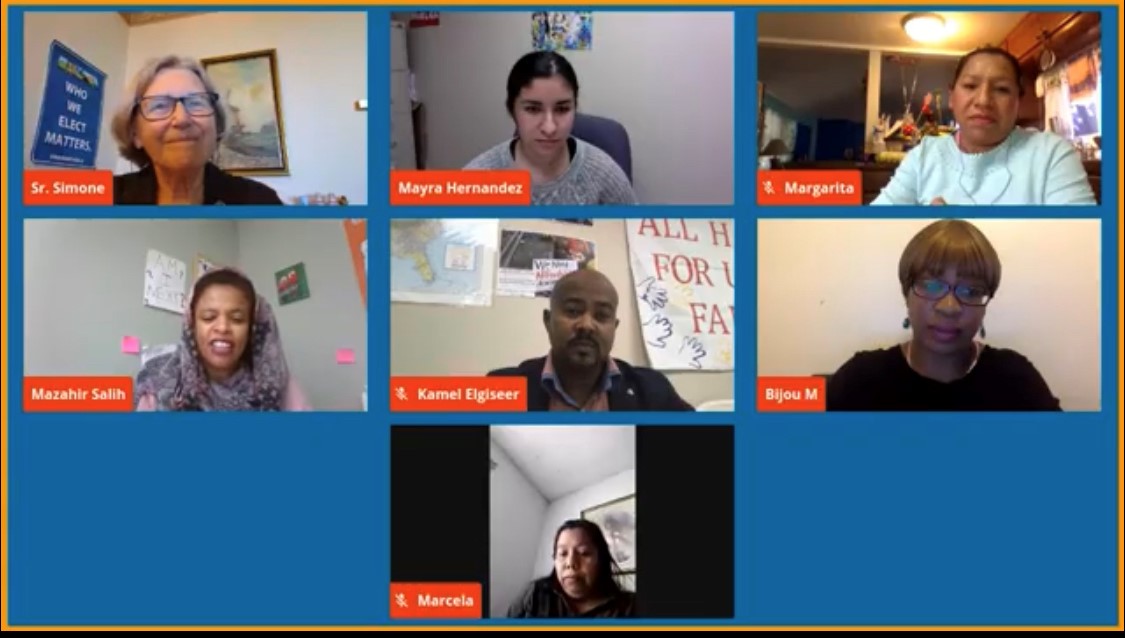
On Wednesday September 30, the Nuns on the Bus virtually visited the Center for Worker Justice of Eastern Iowa. The Center for Worker Justice (CWJ) was founded to unite low-wage workers in Eastern Iowa across race and immigration statute to achieve social and economic justice through education, direct services and community alliance. The CWJ prioritizes defending worker’s rights, improving housing options for low-income residents, and providing assistance to those affected by immigration policies.

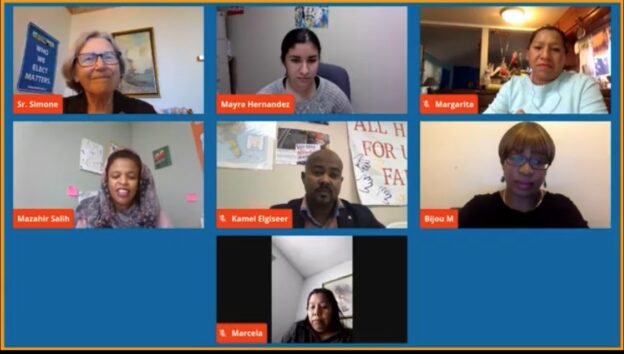
During the virtual conversation, Sister Simone Campbell was joined by the Interim Executive Director Mazahir Salih, the CWJ President Marcela Hurtado, the CWJ Vice President Kamel Elgiseer, the CWJ Leader Bijou Maliabo, the CWJ Leader and Board Member Margarita Baltazar and community organizer Mayra Hernandez.

S

Since its founding in 2012, the CWJ has had several campaign victories such as establishing the first Midwestern Community ID program for Johnson County. Community IDs are important as they allow for people to access library cards, open bank accounts, acquire medication, and create a sense of belonging.

The CWJ also works to raise the minimum wage. Mazahir Salih shared her story saying, “When I came to this country back in 1997, I worked as a cashier at McDonald’s and they paid me minimum wage which was $5.25. In 23 years, the federal minimum wage has only risen $2.” In order to combat this injustice, the CWJ organized that the county level to raise the minimum wage to $10.10. However, the state of Iowa argued that individual counties could not raise their own minimum wage, so the CWJ created and tracks local businesses that have committed to a $10.10 wage.

Beyond organizing, the CWJ also focuses on education. As CWJ President Marcela Hurtado said “we want to educate the community to know their rights!” as well as “educate our white neighbors, who may think we [immigrants] are all the same.” The immigrant experience is broad and those who are most vulnerable are those who do not have access to government resources and language accessible resources. However, as the virtual conversation demonstrated, the Center for Worker Justice of Eastern Iowa is about meeting the needs of the people and if there is a need they will respond.

Watch the Nuns on the Bus site visit to The Center for Workers Justice of Eastern Iowa to learn more. Watch on Facebook or YouTube.

Spirit-filled voters gather in Detroit

Spirit-filled voters gather in Detroit

Sister Jan Kilian
October 1, 2020

“I think I can! I think I can!” said the little train chugging up the mountain; so says this big bus virtually zooming across the United States.

With Sr. Simone Campbell at the wheel, the Network bus made it to the Carney Latin American Solidarity Archive, or CLASA, at the University of Detroit Mercy on Oct. 1. We were co-hosted by the Sisters, Servants of the Immaculate Heart of Mary.

Gail Presbey from CLASA described the archived stories of immigrants struggling for ways to make a livelihood in their new land. The stories we continue to hear of racial and gender discrimination, poverty, disenfranchisement, nonacceptance into community, impairment of the right to vote, struggles to welcome the stranger — all are archived even as they continue today. Immaculate Heart of Mary Sr. Elizabeth Walters and Barb Beasley described their work with yearlong education and action networks to prepare for the upcoming election.

We spent a few moments breathing in deeply and breathing out slowly in prayer, led by Barb Beasley.

We share the air on Earth. We breathed this shared air into our lungs during prayer. All together, we breathed this air out of our lungs. We live in and walk through air we share, every living being on Earth; we are united as one in the very breath we share. We are all in this together.

Voting is a communal action and a moral imperative. As the discussion began, I was reminded of a statement from a previous town hall: “Bad politicians are elected by good citizens who don’t vote.”

Some of the concerns raised by these spirit-filled voters in Detroit included the right to life, climate change, economics, health care, immigration, racism and getting out the vote. Sister Simone spoke of her new book, Hunger for Hope, which is available through Network. We must bring moral vision to all issues of public life.

[Sr. Jan Kilian is a Franciscan Sister of Little Falls, Minnesota. She has an academic background in hospital medical records, human development, and spiritual direction.]


This blog was originally published on Global Sisters Report.

Where Democracy and Science Fiction Merge

Where Democracy and Science Fiction Merge

Sister Michele Morek
September 25, 2020

I am a 2020 nun on the bus, and it is a “Star Trek” experience.

Instead of climbing on a bus Sept. 25, I walked to the back bedroom of our home in Roeland Park, Kansas, turned on the computer, and — “Beam me up, Scotty” — I was at a town hall in Buffalo, New York, engaging in my first virtual Nuns on the Bus event.

The 2020 Nuns on the Bus tour began Sept. 21 in Pittsburgh, but the official kickoff was Sept. 23 with House Speaker Nancy Pelosi, Sen. Cory Booker, Mary Kay Henry of the Service Employees International Union, the Rev. Willie Barber II, Amy Jo Hutchison, and the Rev. Otis Moss III. I especially liked Amy Jo, who gave a vivid personal account of what it’s like to live in poverty in America.

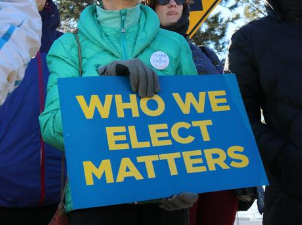
The bus trip will conclude with a national rally Oct. 23 after crisscrossing 16 states with 63 live events, including town halls and site visits, spreading the message: “Who we elect matters.”

I jumped on the bus because I am worried. How can we have a democracy if we can’t talk to our family or neighbors about things that matter?

The first stop I made on the bus was the town hall for “Spirit-filled voters” in Buffalo. After a quick Zoom tutorial, we heard from Social Service Sr. Simone Campbell, executive director of Network, the Catholic lobby for social justice that organizes the bus tour, and three of the Nuns on the Bus — including me! — about why we are multi-issue voters.

All attendees got to talk to each other in small groups in virtual breakout rooms about how our faith informs our political engagement. (It is always good to start a conversation with discovering shared values.) We also discussed what issues we care about and why we are multi-issue voters, before coming back to share in the large group.

From the discussion, I picked up several good tips about how to talk about difficult issues:

  • Tell a personal story about why you feel the way you do about an issue. (Nobody can argue with a personal story.)
  • Ask them how their stories brought them to hold their values and opinions.
  • Listen with attention and compassion.

The really cool thing about this virtual tour? Whether you are a nun in real life or not, you can be a nun on the bus in an interactive game. Personally, I am well on the way to coloring in my bus for a prize. Click on the website to see the many wonderful activities and features. And then just say, “Beam me up, Scotty!”

And follow Network on Facebook and Twitter.

[Ursuline Sr. Michele Morek is Global Sisters Report’s liaison to sisters in North America. Her email address is [email protected].]


This blog was originally published on Global Sisters Report.

Nuns on the Bus visit St. Joseph’s Neighborhood Center on Virtual Tour

Blog: Nuns on the Bus visit St. Joseph’s Neighborhood Center on Virtual Tour

Audrey Carroll
September 25, 2020

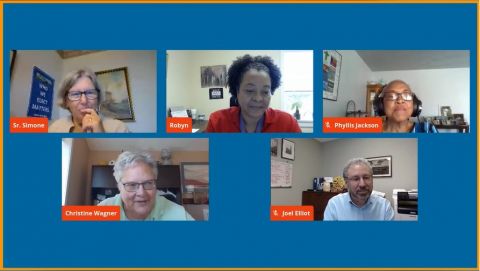
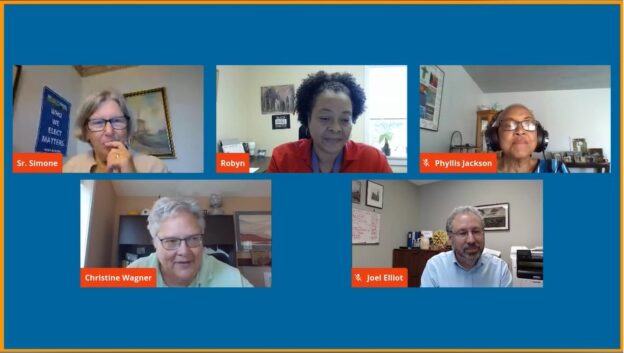
On Friday, September 25, the Nuns on the Bus Virtual Tour made a site visit to St. Joseph’s Neighborhood Center in Rochester, NY. St. Joseph’s Neighborhood Center provides comprehensive physical and mental health services to people who are uninsured and under-insured  in and around Rochester. During the visit, Sister Simone Campbell, SSS,  spoke with Robyn Carter, Director of Health Access, Phyllis Jackson, Community Wellness Project Manager, Joel Elliot, Director of Development and Communications, and Sister Christine Wagner, SSJ, Executive Director about the organization’s wholistic approach to providing health care, along with their racial equity work.

According to Sr. Christine, St. Joseph’s Neighborhood Center is “at the epicenter of the healthcare crisis, economic crisis, and racial equity crisis.” The services that St. Joseph’s Neighborhood Center provides are directly affected by the social determinants of health, such as race, income, gender, age, and more. Surveys determining health and wellness needs for community members are compiled by patients of St. Joseph’s Neighborhood Center in order to provide substantial, holistic care. Sr. Christine describes St. Joseph’s Neighborhood Center as “fiercely independent,” because the organization is 100% funded by the community. The organization does not take insurance because of the barriers it causes, and does not receive state or federal funding. St. Joseph’s Neighborhood Center provides comprehensive care and services that are as accessible as possible to community members so people are not stuck waiting for important care. “We hear so much about why healthcare for all can’t work,” said Phyllis Jackson. “But it’s working!”

Watch the Nuns on the Bus site visit to St. Joseph’s Neighborhood Center to learn more. Watch on Facebook or YouTube.

NETWORK Joins Partners in Supporting Pregnant Workers Fairness Act Vote

NETWORK Joins Partners in Supporting Pregnant Workers Fairness Act Vote

Sister Quincy Howard, OP
September 15, 2020

National policies must ensure family-friendly workplace protections in order to respect the needs of each individual. Workers, especially women of color, must have a work environment where everyone can balance work and family responsibilities. NETWORK Lobby joined its faith and religious organization partners on Friday, September 11th in signing on to a letter to the House of Representatives supporting the Pregnant Workers Fairness Act (H.R. 2694).

The letter read: “Our faith traditions affirm the dignity of pregnant individuals and the moral imperative of ensuring their safety. We also affirm the dignity of work and the obligation to treat workers justly. It is immoral for an employer to force a worker to choose between a healthy pregnancy and earning a living. By passing the bipartisan Pregnant Workers Fairness Act (H.R. 2694), Congress will ensure that workers who are pregnant will be treated fairly in the
workforce and can continue earning income to support themselves and their families.”

Read the letter of support below:

“Dear Representative,

On behalf of the undersigned religious and faith-based organizations representing a diversity of faith traditions and communities across the nation, we write today in support of healthy workplace environments and conditions for pregnant workers. We urge you to pass the Pregnant Workers Fairness Act (H.R. 2694). People of faith across the ideological spectrum understand that prioritizing the health and safety of pregnant workers should not be a partisan issue. The Pregnant Workers Fairness Act would ensure that pregnant workers can continue safely working to support their families during a pregnancy. The bill requires employers to make the same sort of accommodations for pregnant workers as are already in place for workers with disabilities.

Our faith traditions affirm the dignity of pregnant individuals and the moral imperative of ensuring their safety. We also affirm the dignity of work and the obligation to treat workers justly. It is immoral for an employer to force a worker to choose between a healthy pregnancy and earning a living. By passing the bipartisan Pregnant Workers Fairness Act (H.R. 2694), Congress will ensure that workers who are pregnant will be treated fairly in the workforce and can continue earning income to support themselves and their families. Efforts to distract from the central goal of ensuring pregnant workers can maintain their health and the health of their pregnancies by inserting unnecessary, harmful, and politically divisive language into this bill undermines our obligation to protect pregnant workers across our country.

While many pregnant individuals continue working throughout their pregnancies without incident, there are instances when minor accommodations are necessary at the workplace to ensure the safety of the expecting mother and the baby. All too often, requests for simple workplace accommodations like a stool to sit, a water bottle, or a bathroom break are denied. Within the COVID-19 context, such critical accommodations might include proper protective equipment, telework, or staggered work schedules that offer employees commute times which avoid crowded public transportation and increased exposure. Currently, pregnant workers may continue to work without necessary accommodations because they fear losing their jobs and need the income, thus endangering their health or the health of their pregnancy. Without these protections, it is not uncommon for pregnant workers to be let go or forced out onto unpaid leave for requesting accommodations. Many others must quit their job to avoid risking the health of their pregnancy.

Passing the Pregnant Workers Fairness Act is a moral and economic imperative; two-thirds of women who had their first child between 2006 and 2008 worked during pregnancy, and 88 percent of these first-time mothers worked into their last trimester. Keeping these women healthy and in the workforce is paramount to family economic security. Nearly 25 million mothers with children under 18 are in the workforce, making up nearly 1 in 6 of all workers. And about 3 in 4 mothers in the workforce are working full time. Millions of families rely on their earnings. In 2017, 41 percent of mothers were the sole or primary breadwinners in their families, while 23.2 percent of mothers were co-breadwinners. Whole families suffer when pregnant workers are forced out of a job.

The undersigned religious and faith-based groups are united in support of the Pregnant Workers Fairness Act. We strongly urge you to vote for the Pregnant Workers Fairness Act, and to vote against any motion to recommit that may be offered.

Sincerely, the undersigned:
Ameinu
Arizona Jews for Justice
Aytzim: Ecological Judaism
Bend the Arc: Jewish Action
Catholic Labor Network
Church World Service
Columban Center for Advocacy and Outreach
Congregation of Our Lady of Charity of the Good Shepherd, U.S. Provinces
Faith Action Network
Faith Action Network – Washington State
Franciscan Action Network
Friends Committee on National Legislation
Keshet
Jewish Alliance for Law and Social Action
Jewish Family & Children’s Service of Greater Boston
Jewish Women International
Justice Revival
National Advocacy Center of the Sisters of the Good Shepherd
National Council of Churches
National Council of Jewish Women
Network of Jewish Human Service Agencies
NETWORK Lobby for Catholic Social Justice
Pax Christi USA
T’ruah: The Rabbinic Call for Human Rights
United Church of Christ, Justice and Witness Ministries
Union for Reform Judaism
Uri L’Tzedek
Women of Reform Judaism

Read the letter here

Labor Day 2020: Our Sick Economy and the Need for Structural Change

Labor Day 2020: Our Sick Economy and the Need for Structural Change

Laura Peralta-Schulte
September 7, 2020

Pope Francis, in his August 26 virtual general audience said, “The [COVID-19] pandemic has exposed and aggravated social problems, above all that of inequality. These symptoms of inequality reveal a social illness; it is a virus that comes from a sick economy.”

To that I say, Amen.

The reality of inequality in the United States is on full display during this COVID-19 crisis in both subtle and substantial ways. With the exception of “essential” professions, COVID-19 has not negatively impacted highly compensated white-collar workers, particularly those without small children. One simply has to turn on their laptop from the comfort of home to be “in the office.” There is no health risk and even some benefits, like eliminating a hurried commute. Many wealthy, white working parents have found ways to outsource educational and childcare services even in the pandemic, allowing them to continue working while their children receive care. For these workers, exposure to risk is a matter of choice. If desired, the wealthy can both work and get their material needs met from the safety of their home.

At the same time, at the very top of the economic scale, the pandemic has created incredible wealth. In 2020, U.S. billionaires have twice as much combined wealth as the bottom half of Americans – $2.95 trillion versus $1.5 trillion. Just 614 billionaires hold more wealth than the whole bottom half of our country. That is to say: 614 people hold more wealth than 61 million households.

During the first four and a half months of the coronavirus pandemic, while most families were stretching their budgets to stock up on food and other necessities, U.S. billionaires’ wealth grew by $685 billion. As our coalition partners Americans for Tax Fairness point out, this increase in wealth is about 80% of the total sum spent on Medicare for 2020, a lifesaving program which serves more than 62 million people. Medicare and other entitlement programs are routinely attacked as being too expensive and contributing to the national debt. How is it that hundreds of billion dollars is an acceptable sum when it is going to those at the top, but too expensive when it is providing health insurance to millions of people? Which one is a better investment in our nation’s people and our future?

The richest 1% now own half of the value of the U.S. stock market and the top 10% own 92%. This dangerous amount of inequality is causing real problems in our nation, even before the coronavirus pandemic.

Now, however, low-wage workers are suffering tremendously as a result of the COVID-19 crisis, particularly in Black and Brown communities. The pandemic has already killed over 180,000 people in our nation and continues to spread, putting low-wage workers and their families at severe health risk. Low-wage workers and essential workers must leave their homes to continue earning money, and the stress is even greater with children. With the closure of daycare centers and schools and with no ability to afford expensive childcare services, parents face huge challenges.

At the same time, our economy continues to hemorrhage predominately low-wage jobs. There are nearly 12 million fewer jobs in August than in February. More than 30 million workers are still filing for unemployment or are waiting for benefits, including 1.6 million workers who made new claims just last week, an increase from the previous week. Black and Brown communities suffer the highest rates of economic distress; unemployment remains in double digits for Black, Asian, and Hispanic populations. Unemployment reports do not even count the millions of workers who are underemployed or have been pushed out of the workforce altogether. Families risk eviction, food shortages, and toxic stress as they try to navigate the harsh new economic reality caused by the pandemic.

This Labor Day we must ask ourselves a fundamental question. What are our economic structures that allow such tremendous wealth to be held by the few while millions struggle to live in dignity? In 2019, CEOs in the S&P 500 received an average of $14.8 million in annual compensation. The average S&P 500 CEO to worker pay ratio was 264–1, a historic high. These same executives pay lobbyists to break up unions and work against increasing the $7.25 federal minimum wage. The economic status quo rewards a few not the collective. We as a society worship a false idol, the stock market, and measure the health of our economy by its success or failure, while families on the lower end of the economic ladder continue to struggle.

The Gospel and Catholic Social Justice ask us to live differently, to prioritize the needs of community and ensure everyone has what they need to survive and flourish. We as a society are failing; are we willing to follow Jesus’s example and flip over the tables in the temple to call out for justice?

Pope Francis ended his teaching with a challenge for the faithful. “We are experiencing a crisis. The pandemic has put all of us in crisis. But let us remember that after a crisis a person is not the same. We come out of it better, or we come out of it worse. This is our option. After the crisis, will we continue with this economic system of social injustice and depreciating care for the environment, for creation, for our common home?”

This Labor Day, let us pray for the grace to work together for a more healthy, more just, and more perfect union.

Reflecting on the 57th Anniversary of the March on Washington

Reflecting on the 57th Anniversary of the March on Washington

Tralonne Shorter and Leslye Colvin
August 27, 2020

On the eve of the 2020 March on Washington, the NETWORK community gathered to pray, reflect, and recommit ourselves to the work of racial justice. Watch Tralonne Shorter and Leslye Colvin’s reflections.

Join the Virtual March on Washington at www.2020march.com.

Read Tralonne’s Reflection:

Nearly six decades ago, Ella Baker said these notable words: “Until the killing of Black men, Black mothers’ sons, becomes as important to the rest of the country as the killing of a white mother’s son, we who believe in freedom cannot rest until this happens.”

On the eve of the 57th Anniversary of the March on Washington, Ms. Baker’s words still hold true for Black moms who are growing weary of marching for justice fighting against racism and sexism from slavery until now.

The nonstop police killings of Black people have been triggering and traumatizing for many within the African Diaspora. For me, these shootings and ensuing protests have stirred up feelings stemming from August 2014. It was the tragic death of Michael Brown, an unarmed 18-year-old African-American male killed by Darren Wilson, a white Ferguson police officer after a routine pedestrian stop violently escalated.

At the time of Brown’s death, I was four months into motherhood and beaming with purpose. As the proud mother of a beautiful Black baby boy, it was heartbreaking to see Brown’s dead body strewn across the pavement as though he were animal carcass for nearly five hours — almost as long as it had taken me to give birth to my son. But as a social justice advocate, I was compelled to take action. For me, Brown’s death, and the countless other Black victims of police brutality, including Jacob Blake, magnified disparities in communities across the United States besieged by institutional racism. In these communities disproportionately poor, people of color are over-disciplined in schools, over-represented in jails, and under-represented in all levels of government leadership, including among elected prosecutors, judges, and police chiefs.

Six years since the Ferguson protests, I am still haunted by Michael Brown’s death and the lack of justice for every Black and Brown family that has lost a loved one under similar circumstances. A U.S. Department of Justice probe found that the Ferguson police department’s racially discriminatory policing practices “routinely violates the Constitution and federal laws.” Yet a majority white grand jury decided not to indict the officer who killed Michael Brown, thanks to a widely unknown doctrine called Qualified Immunity.

Qualified Immunity was created as a response to policies put into place during the Reconstruction-era enforcement of the 14th Amendment. The doctrine shields police officers from being held legally accountable when they break the law so long as their unlawful action was not sufficiently obvious. This outdated doctrine nullifies an important civil rights statute that allows individuals to sue officers for violating their civil rights, thus rendering justice impossible.

In fact, I am more likely to win the lottery, than see impunity end for racist police officers conditioned to shoot first, ask questions later.

Michael Brown’s killing in Ferguson and the protests that followed shined a spotlight on how little was known through empirical data about the extent to which over-policing occurs in Black and Brown communities. More data was needed, including the frequency of traffic stops, excessive use of force, and officer involved shootings. At the time, there were few think tanks tracking data on officer-involved shootings, so the Washington Post launched an ongoing investigation on this matter in 2015 and found that the FBI undercounted fatal police shootings by more than half. This is because reporting by police departments is voluntary and many departments fail to do so.

According to the Washington Post report, since 2015 there have been more than 5,000 fatal shootings involving on-duty police officers, with 1,022 incidents in 2020. While the data shows that half the people shot and killed by police are white, the rate at which Black people are killed by police is more than twice as high as the rate for white people. Over 95% are young, men between 20-40 years old. Of course there are outliers, Tamir Rice who was just 12-years old playing with a toy gun at a playground when a police officer shot and killed him.

Our flawed criminal justice system is just one example of an institution peppered with individuals blinded by privilege, lacking cultural competencies and multi-disciplinary backgrounds in social justice. The criminal justice system especially, must be diversified, particularly because power dynamics overly favor police, prosecutors, and judges who have the power to impugn communities of color.

For Black families, children are taught early, right along with learning multiplication, how to navigate encounters with law enforcement officers. I have already practiced giving my son, who is six “The Talk.” ‘No fast movements. Always show your hands. Keep copies of your driver license, proof of registration, and insurance in your sun visor. Always get a receipt. Do not travel by yourself late at night. Do not travel in a pack. A drunk woman cannot consent. Always answer yes sir/ma’am. Don’t worry about trying to tape or record the encounter, just get home to me safely and alive, we can sort out the rest later.’

The truth is: We live in two different worlds. With two separate justice systems. With two standards of scrutiny. I pray, I’ll never have to give “The Talk,” but once my son who is projected to reach six feet tall hits a growth spurt in the next three years, God forbid he encounter the wrong police officer out of my watchful protection. There are no guarantees that he will come home to me alive. None.

But the sad reality is people of color are still treated as strangers in a country that never fully embraced us as kinfolk. It’s a misnomer to believe that race is real. Race is a false social construct designed to promote the supremacy of whiteness. The murders of Michael Brown, George Floyd and others including the deaths of Brown immigrants in U.S. detention facilities is a manifestation at the highest levels of this false doctrine. Similar to the lynchings during slavery and Jim Crow; today’s killings of Black and Brown people in police custody continue to send a clear message: Black Lives Don’t Matter.

The presumption that people of color are somehow threatening when unarmed, regardless of age, mental health, educational, or social status, is truly demoralizing. Undoubtedly, hearts and minds cannot be legislated. But laws are needed at the federal, state, and local level to mandate police accountability and force investigations, prosecutions and win convictions. Congress can show true conviction by passing the Justice in Policing, a comprehensive police accountability bill, passed by the House in June but is currently stalled in the Senate. The bill would outlaw chokeholds, no-knock warrants, train law enforcement on de-escalation methods, limit the use of military equipment, and finally end impunity for police officers by holding them liable for breaking the law. Former Attorney General Loretta Lynch said: “The conscience of this country cannot rest until this country’s laws protects all of its citizens.”

Beyond passing the Justice in Policing Act, we must root out every manner in which this country has systemically and intentionally devalued Black lives. This includes closing gaps in wealth, income, health care, voting, representative democracy, affordable housing, and opportunity. We all must be as outraged as the Mothers of the Movement by the pernicious and unrelenting acts of racial inequity and injustice. A feeble pursuit of justice, is no justice at all.

Praying for a New Creation to Come from Chaos

Praying for a New Creation to Come from Chaos

Sister Simone Campbell
August 20, 2020
Sr. Simone’s Invocation to the Democratic National Convention,
Thursday, August 20, 2020.

Good evening.

I’m Sister Simone Campbell, Executive Director of NETWORK and Leader of Nuns on the Bus

Tonight marks an important next chapter in our story of who we will become as a nation. So I speak to you with a sense of urgency and hope, knowing the difficult work ahead, grounded in my faith.

The very first paragraph of the Scripture that informs the three Abrahamic traditions tells us: the Divine Spirit breathed over the waters of chaos and brought forth a new creation.

Encouraged by this promise that a new creation can come from chaos, let us pray:

O Divine Spirit!

During the weeks and months ahead, stir our hearts and minds that we might fight FOR a vision that is worthy of you and your call to honor the dignity of all of your creation.

A vision of who we are as a people, grounded in community and care for all, especially the most marginalized.

A vision that cares for our earth and heals the planet.

A vision that ends structural racism, bigotry and sexism so rife now in our nation and in our history.

A vision that ensures hungry people are fed, children are nourished, immigrants are welcomed.

O Spirit, breathe in us and our leaders a new resolve… that committed to this new American Promise, we will work together to build a national community grounded in healing, fearlessly based on truth, and living out of a sense of shared responsibility.

In the name of all that is holy, O Spirit, bring out of this time of global and national chaos a new creation, a new community that can, with your help, realize this New Promise that we affirm tonight.

With profound hope, let We The People say: Amen!

Watch Sr. Simone at the Democratic Convention

Watch Sister Simone at the 2020 Democratic Convention

On the final night of the 2020 Democratic National Convention, Sister Simone Campbell will offer a prayer for our nation. Watch the live stream Thursday night starting at 9:00 PM Eastern!

If you’re on social media, be sure to tag Sister Simone and NETWORK.
Twitter: @Sr_Simone and @NETWORKLobby
Facebook: @SisterSimoneCampbell and @NETWORKLobby

Be sure to check out all of our Election 2020 resources.