


Category Archives: Front Page

‘Tis The Season… The Election Season

‘Tis The Season… The Election Season

Charlotte Hakikson
March 18, 2020

There’s always one thing we can look forward to every four years and no, it’s not the summer Olympics. I’m talking about the United States presidential election. In less than seven months, the American people will vote for their next commander in chief. Amidst everything that is happening, especially with COVID-19, who we elect matters now more than ever. This country needs a leader who will put its citizens’ wellbeing, health, and safety first. We at NETWORK, understand the importance of being able to participate in such an important and historic election, so we have designed a toolkit to prepare folks for this moment.

Our election toolkit has everything you need to help assess who the right candidate is for the job. With the help of our 2020 Mend the Gaps Policy Platform, we’ve created a list of questions to ask a candidate at a town hall to gage how they intend to mend the gaps in our nation. Our letters to the editor (LTE) toolkit will help you produce compelling writing that will be read in both local and national newspapers. Use our “Do It Yourself Candidate Side-By-Side” to determine which Presidential, Senate and House candidate aligns closest with NETWORK’s 2020 Policy Platform and your personal views. Finally, don’t forget to engage with the candidates on social media using our social media pro tips.

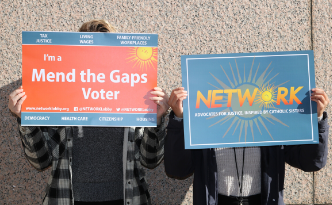
Show your commitment to being a “Mend the Gaps Voter” this Election Season with the use of NETWORK’s newly created placards. Make your voice heard in person and online! Take a picture with the placards and use the hashtags #MendtheGapsVoter and #My2020Vision. Be sure to tag @NETWORKLobby as well. Whether you’re at a candidate’s rally, polling place, or Member of Congress’s office, snap a photo of yourself with the placard.

Discover your choice candidate in our election toolkit. This is a living document that is continuously being updated to reflect what is going on in the election and adding new resources to alleviate some of the stress that comes with the voting process. Continue to check out the webpage and stay up to date by following us on social media!

Coronavirus: Our Call to Social & Economic Transformation

Coronavirus: Our Call to Social & Economic Transformation

Giovana Oaxaca
March 16, 2020

I did not expect to text my high school classmate this weekend to ask about her mother’s coronavirus experience. The truth is, I haven’t texted this classmate in almost a decade, but circumstances change. Global pandemics put things in perspective and you find yourself reaching out to all manner of people you have really talked to in years. Hi, How are you? How are things back home?

My classmate’s mother, Beth, went through a bureaucratic nightmare with deadly consequences. After returning from a trip abroad more than a month ago, she found herself exhibiting symptoms of coronavirus. She decided to take extra measures and self-quarantine. But, at that time, information about the virus was sparse in the United States, and county health officials had no tests available to administer when she asked. They recommended she quarantine herself.

“At that time, we knew so little, and I was at a real loss as to how even do that,” she said. Over her quarantine, she suffered a sinus infection and unfortunately ended up infecting her 83-year old mother, at high-risk of developing deadly symptoms. She tried to get her mother tested too but was faced with the same shortage of answers.

Almost a month later, a doctor declared that Beth and her mother had had the virus, after reading their chest x-rays. “When the nasal congestion turned into a sinus infection, I thought I was no longer contagious. Now I find out that I probably was,” Beth wrote. The consequences for her mother could have quickly turned deadly. But for now, Beth says,“[she] is still in isolation.”

Beth’s nightmare doesn’t end there: Beth’s entire family will remain in quarantine, including my classmate who is a seasonal worker, and is likely to be laid-off in the next few days. Sarah, Beth said, is bracing for a future without a job.

The demands of responding to a pandemic is beyond what any one family should have to go through alone. What kind of nation would we be if we didn’t respond to a salient public health crisis now, when the consequences of inaction can be deadly? This virus is crystalizing our need to redress inequalities in our healthcare system, guarantee paid family and sick leave, and support families through smart economic policy.

Last week, the House passed the Family First Coronavirus Response Act (H.R 6201). The bill would put resources in testing and treatment. It would affect sweeping changes in our nation’s paid sick leave and unemployment insurance laws, ensuring that working family’s livelihoods are not disrupted. It makes sure families are fed, by expanding nutrition programs, and health care and other workers are protected. It ensures states are well prepared to respond, by boosting federal funding for Medicaid.

As the Senate prepares to act and soon vote on the House bill, additional steps will need to be taken to address wide-scale financial distress caused by the economy constricting. The hallmark of Congressional efforts to stem this health emergency and any related economic downturn should meet the needs of working families. Above all, Congress must ensure accessible and affordable testing and treatment for the Coronavirus, regardless of income, location, disability, or immigration status. It must also:

  • Ensure all have the support they need to take sick leave and care for family members without risking their jobs or their paychecks.
  • Ensure low-income workers and individuals facing hardship have the assistance they need to put food on the table and provide for their families.
  • Give special care and attention to individuals at increased risk of infection, including individuals in prison, immigrants and children in detention, in long-term care facilities, and experiencing homelessness.
  • Economic stimulus measures should focus first on low-income and vulnerable communities. Such policies also have the strongest economic impact. Any bailouts and emergency assistance for major industries and businesses must be paired with comparable assistance for low-wage workers and vulnerable individuals.
  • Oppose any efforts to use the pandemic as an excuse to further militarize the border or exacerbate immigration deportation and detention.

While we laud recent passage of the House bill, and recommend swift action on these emergency measures in the Senate, we recognize the need for a stronger and wider social safety net, especially for the disproportionately impacted like low-wage workers, domestic workers, and people of color. In terms of paid family and sick leave, we strongly Congress take up and pass the Family Act, and the Healthy Families Act, which would guarantee seven days of paid sick leave.

Our federal tax code incentivizes massive wealth accumulation and the prioritization of profit, driving a greater wedge between the share of the population who have only some, if any, savings for an emergency, and those who a lot. This preferential treatment for the wealthy can only have consequences down the line, as we’re discovering, since the Federal Reserve’s fiscal response to economic crisis has done little to touch on the lives of everyday working families. The slow degradation of our nation’s labor laws, the stagnation of wages and benefits, and the country’s insistence on lending a lifeline to corporations and not people is a thorough indictment of our economic policy.

Coronavirus’ indiscriminate path is showing us that the inequities in our systems continue to leave millions of Americans vulnerable to economic instability and health care insecurity. Because it’s no longer a manner of if, but when, we rewrite our nation’s social and economic policy to better meet the needs of families in crisis, we must summon the same political courage and haste it will have taken to pass these emergency measures.

***

Beth is an ordained minister with the United Methodist Church. I am thankful of her courage in sharing her account of living with coronavirus and for reminding me that spiritual practice can serve as a lifeline in times of hardship.

A Prayer to Face COVID-19 with Hope and Solidarity

Coming Together to Face COVID-19 with Hope and Solidarity

Meg Olson
March 13, 2020

In this time of concern and uncertainty about COVID-19, we are keeping you and every member of the NETWORK community in our hearts and our minds. The importance of human dignity and relationship is made clear in a crisis such as this. We encourage you and your loved ones to follow the instruction of health officials and your state and local leaders, and fall on the side of extra precaution for the sake of protecting your own health and that of your community. Below is a prayer for our nation and our world as we respond to coronavirus together.

Dear God,

In this time of uncertainty and fear, help us be love, mercy, and peace for ourselves and for others as we face coronavirus in the Unites States and around the world.

Help us hold close in our hearts those who have died, and their loved ones who mourn them.
Those who are sick or are trying to seek medical care.
Those who don’t have paid sick leave, benefits, or job security.
Those whose schools have closed and don’t have access to food, safe homes, or technology.
Those can’t travel to be with loved ones who are ill or dying.
Those who are facing discrimination and harassment because of their ethnicity.
Those who are struggling with loneliness during this time of social isolation.
Those who are frightened and losing hope.

Help us find joy, however small it seems.
Help us remain hopeful.
Help us remember that “All shall be well, for there is a force of love moving through the universe that holds us fast and will never let us go.”

Amen

Heather Boushey Visits NETWORK Lobby

Heather Boushey Visits NETWORK

Ness Perry 
March 3, 2020

Today, NETWORK is proud to have Heather Boushey, the President and CEO of the Washington Center for Equitable Growth at our office to talk about mending the gaps in our nation’s growing wealth and income disparities.

As a regular writer for popular media, including The New York Times, The Atlantic, MSNBC, and CNBC, Boushey has made quite an impact on what it means to be a woman in our economy.

Focused on the inequality, Boushey has actively been an advocate for economic inequities in the social fabric of our nation. In fact, her new book Unbound: How Inequality Constricts Our Economy and What We Can Do About It is all about how economic inequality ultimately hurts people, businesses, and the overall growth of our country. Boushey argues that stagnant wages and lack of workplace benefits further complicate financial instability for many people. Our economic policy must work to heal inequality and create new solutions for people to be supported, not hindered, by our government.

Click here to purchase her new book and learn more about the author.

Welcoming Immigrants at the Kino Border Initiative

Welcoming Immigrants at the Kino Border Initiative

Emily Tekolste
March 2, 2020

“¿Como te llamas?” I asked. “What’s your name?”

“Elsa,” she replied.

“No it’s not,” my friend Tracey quickly said. Tracey works at the Kino Border Initiative as education coordinator, and I had gone down to visit her and see for myself what was going on at the Mexico-U.S. border.

Still, the little girl became known to me as “Elsa” for much of the rest of my trip to Nogales, Sonora. Despite her fluency in Spanish, I learned that she came from Russia with her parents and younger brother. Only her dad – who is a few years younger than I am – was with her. Her mother had been detained elsewhere with her brother, and they were working to be reunited as they fled religious persecution in Russia and sought safety in the United States. Elsa quickly learned Spanish in the four months they’ve been waiting at the border in Nogales.

Last week, I was privileged to spend four days in the comedor (soup kitchen) run by the Kino Border Initiative (mainly Sisters Cecilia and Engracia and their team of staff and volunteers) just across the border from the United States. With many volunteers from both sides of the border – including several U.S. Americans who had come from other parts of the country to volunteer for up to a month – I shared life with migrants from Mexico, Central America, and other parts of the world. We fed nearly 200 people two meals per day in multiple shifts.

There were so many children – from infants still nursing to teenagers and young adults. There was so much hope even in the midst of trauma. There was a spirit of generosity – so many of the migrants themselves active in the work of the comedor, helping to feed and clean during and after every meal.

When I was in Nogales, MPP (the so-called Migrant Protection Protocol implemented a year ago by the Trump Administration, also known as “Remain in Mexico”) had just begun on the ground in Nogales. Asylum-seekers fleeing violence in Mexico, Guatemala, Honduras, El Salvador, Russia, and many other places now have to go through asylum court before they can enter the U.S. There’s a great deal of corruption in the metering of people getting to meet with U.S. officials, and migrants must face asylum court in El Paso, a 5-hour drive from Nogales. For people without transportation, this means expensive bus tickets for a minimal chance at safety (less than 1% of asylum-seekers are granted asylum by the U.S. government).

There’s so much more to say about my time at the border. What struck me most when I first arrived was the normalcy in the midst of such uncertainty and trauma. Families were living. Children were joyful or upset, depending on the moment. One little girl, who I began calling “La jefa,” the boss, was running around re-setting the tables when I met her. She’d eaten and was now intending to be the best helper there as she put out new napkins, spoons, and cups. And as we began hearing stories (for me, mostly from other volunteers who could translate the Spanish that most migrants spoke), this normalcy seemed anything but normal. I began thinking of the lost educational opportunities for these kids as they waited. I began to see the future of frustration in school as they continued to work through the trauma they’d experienced and then had to make up for so much lost time and language barriers. I began to see the lost potential of so many human beings just seeking a place to live safely and take care of their families. I began to see the vast differences between my world and their worlds – all because of where I was born and the color of my skin.

As I begin to grapple with these realities in a new way – in light of a few relationships I began to develop during my time with Kino – I am reminded in a new way of the importance of changing the system. We need to ensure policies are created to recognize and honor the fullness of the human person, no matter what their country of origin. We need policies that recognize that poverty is itself a form of violence. We need policies of welcome and policies that create an opportunity for all to thrive.

And so I return to Washington to continue the work of justice, of building teams of advocates and organizers, of lobbying to change policy and educating to change the social narrative. And I hope you will join us.

Sweet Home: Finding My Political Independence in the Heart of Dixie

Sweet Home: Finding My Political Independence in the Heart of Dixie

Anne Marie Bonds
February 26, 2020

College football. Amazing, unhealthy food. Devout Christians. Farmers. Home. What do you think of when someone says they’re from Alabama?

When I say I’m from Birmingham, Alabama, people usually react like this: “Ughhhh…Ooofff…I’m sorry…”. This is because there are often some pretty disparaging stereotypes associated with those living in the Heart of Dixie: Trump-supporting, Bible thumping, uneducated, college football-loving rednecks.

In many ways, they can be right. I remember when my brother broke our family’s oven out of rage after Alabama lost the Iron Bowl to Auburn in 2013. I remember catching catfish with just my bare hands in the river by my house as a teenager. I also remember my Dad thanking God for Donald Trump’s election during our Thanksgiving prayer in 2016.

How did I, a self-proclaimed Democrat, working for a social justice organization, come from a state like Alabama?

For a long time, I stayed away from all things political, mainly because I didn’t understand it. When the announcement came over my elementary school speakers that President George W. Bush had been elected for a second term, I cheered along like all the other kids, but I honestly didn’t even know who that was at the time. During the 2008 election, I told my mom I supported Obama, simply because I thought his name was cool.

In reality, I didn’t have to worry about politics because nothing the government changed would affect me and my family. As a white, upper middle-class woman, whose parents both worked secure jobs with benefits, I didn’t have to worry about anything negatively impacting my family. My privilege meant I didn’t have to participate in politics if I didn’t want to. So, I spent most of my teenage years living a blissfully ignorant life: unaware of the vast amounts of poverty, homelessness, and injustice occurring every day in a place I had dubbed the ‘bad side of town.’ My white, suburban bubble was pervasive and opaque. I was blind to the ways that the government and the nation are failing the most impoverished and vulnerable in my community.

For me, that all changed when my father was diagnosed in 2013 with ALS, a terminal neuromuscular disease. ALS is unique in that it doesn’t really discriminate: people from all areas of life have to endure a terminal disease if diagnosed. Throughout my father’s journey with ALS, I learned that although ALS is such a difficult, miserable disease, many of those diagnosed were more stressed by the financial instability the disease caused. Every week, my father and I would meet with others with ALS and their loved ones, and instead of speaking on ALS itself, they spoke of how hard it was to stay afloat financially, while also paying for their desperately needed care.  Most of the people would have to decide between paying for their medicine or their caregiver; their wheelchair or their home.

When I looked around at those with ALS in my community and my state, I saw a group of people dealing with a horrible, evil disease. I saw heroes who, even when their body was failing them, continued to work to provide for their families and those they loved. Even as I saw such misfortune and unnecessary evil in the face of ALS, I saw something else much more disheartening. I saw people who had been abandoned. People who had been forgotten, both by their government and their community.

Through this experience working and living with those suffering with ALS, I realized something vital to my political identity: all people, regardless of where they come from, must be considered and respected in the eyes of our government and society. Not just the white, and not just the wealthy. It is easy to disregard this when your interests are being served on Capitol Hill, but, if we are going to call ourselves the greatest country in the world, a true democracy, then no person or group can be abandoned by our government or our people.

So, if you’re reading this and wondering how you can get involved outside of your white, suburban bubble, I challenge you to speak and live with those different from you. People from all genders, ethnicities, socioeconomic statuses, abilities, etc., all have a different perspective to share. Meet with those who have been disenfranchised and invalidated by our government, media, and culture. Realize that they, just like you, are entitled to dignity and worth, and they deserve a seat at the table when policy is being made.

President Trump’s Budget Fails to Mend the Gaps… Again

President Trump’s Budget Fails to Mend the Gaps… Again

NETWORK Government Relations Team
February 14, 2020

We believe the budget is a faithful, moral document that should reflect our values as a nation. Unfortunately, the President’s FY2021 budget that came out earlier this week does not do this. President Trump’s budget proposes$4.8 trillion in drastic cuts to non-defense discretionary spending for vital federal agencies, including a 37% spending cut for the Department of Commerce and a 15% cut for the Department of Housing and Urban Development. This will increase the gaps between the wealthy and the impoverished in our nation.

President Trump’s budget abandons the most vulnerable in our nation by reducing funding for fundamental social safety net programs. The budget would increase the number of uninsured people in the United States, cut desperately needed assistance for low-income families, and invest almost nothing into our nation’s dilapidated infrastructure. It is time to mend the racial and income gaps in our nation. We cannot accept this immoral and divisive budget proposal from President Trump.

Once again, President Trump lays out a budget that provides a preferential option for the rich while gutting critical programs proven to lift people out of poverty. His budget would give an additional 1.4 Trillion dollars in tax breaks to the wealthy paid for by cuts to Medicare, Medicaid, and other safety net programs.  This is sinful.  We must heal the wounds of economic and racial injustice with those facing systemic exclusion and oppression. We echo the words of the Prophet Isaiah who warned the corrupt rulers of his time, “Woe to those who make unjust laws, to those who issue oppressive decrees, to deprive the poor of their rights and withhold justice from the oppressed of my people, making widows their prey and robbing the fatherless.”

The president’s budget proposal lays out another hopeless roadmap that offers no relief or clear pathway to prosperity for disheartened working families. The proposal includes $4.4 trillion in steep cuts to nondefense spending over 10 years, starting with $42 billion for FY2021 to offset increased funding for defense and immigration enforcement. This president fails the moral test of great leaders to care for those with the least among us– the 99% of the country who are over-worked, under-valued, and under-resourced.  We must expect more from our leaders and urge Congress to reject this budget by investing in affordable housing, health care, Medicaid, SNAP, and fair elections.

Here’s how President Trump’s FY2021 budget proposal would negatively impact the Common Good and widen the gaps across our nation:

Endangers the health care of the most vulnerable in our nation by attempting to repeal the Affordable Care Act (ACA), and by imposing deep cuts to Medicaid and Medicare.

  • Proposed cuts of $1 trillion in Medicare, Medicaid, and the ACA over the next ten years
  • Implements mandatory work requirements for Medicaid beneficiaries
  • Ends Medicaid expansion for states that have opted to expand coverage. This will eliminate care for the 13 million people who secured care from the expansion
  • No proposals for an ACA replacement plan if it is struck down by the Supreme Court
    • This will lead to elimination of the ACA’s protection against discrimination based on pre-existing conditions and the ACA’s requirement that health plans cover essential health benefits

Implements irresponsible and discriminatory immigration policy.

  • Requests $2 billion to build 82 miles of border wall, plans to divert an additional $7.2 billion from other accounts, and brings the total allocated over Trump’s term to $18 billion.
  • Includes $3.1 billion for 60,000 beds, in ICE detention centers, an increase of 6,000 beds from last year’s budget.
  • Adds $182 million to hire 750 new Border Patrol agents, a quarter more than last year, and $544 million to double Immigration and Customs Enforcement staff.
  • Calls for a 3.2-percent increase in funding for the Department of Homeland Security to carry out immigration enforcement and family separation, but cuts the Department of Justice by 2.3-percent for all federal law enforcement
  • Requires Social Security Number for public benefits
    • Discriminates against non-citizen residents who do not have a Social Security Number

Increases income inequality and racial wealth disparities through more tax cuts for the 1% and drastic cuts to safety net programs.

  • Permanently extends the 2017 Tax Cuts and Jobs Act for high-income taxpayers
  • This will cost $1.4 trillion through 2030 for tax breaks for the wealthiest in our nation
  • Cuts SNAP by $182 billion (30% of the program) over ten years
  • Cuts basic assistance for those with disabilities through Social Security Disability Insurance
  • Reduces support for families experiencing poverty by cutting the Temporary Assistance for Needy Families (TANF) program by $20 billion over ten years
  • Eliminates the Social Services Block Grant

Decreases security in our nation’s elections.

  • Cuts the Election Assistance Commission, the federal agency that secures our nation’s voting machines, by 14%
  • Diverts $1.1 billion on cybersecurity spending from the Federal Election Commission to the Department of Homeland Security

Inadequately invests in our nation’s dilapidated infrastructure.

  • Proposes $190 billion in one-time funding for a new infrastructure initiative
    • This investment in our nation’s housing and infrastructure is a short-term fix for a long, expensive problem
    • It will not be enough to adequately address our nation’s housing problem
  • Cuts various infrastructure programs that support highway, mass transit, airport, and port infrastructure through discretionary appropriations
  • Weakens community efforts to enable families to secure housing free from discrimination and fight housing policies that restrict housing access

President Trump continues to promise that he will protect the health care of working families, but his FY2021 budget proposal is just another attack on care for our nation’s most vulnerable. The Trump administration continues to gut the backbone of our nation’s social safety net by slashing funding for Medicare and Medicaid, as well as through continued attempts to enforce Medicaid work requirements. Also, by attempting to repeal the Affordable Care Act with no suitable replacement, President Trump continues to jeopardize the lives of millions who rely on the ACA for quality and affordable care.

President Trump’s proposals shown above illustrate his misaligned priorities. Every dollar spent in carrying out punitive immigration policy, is a dollar less in critical human needs programs, serving communities across the country. President Trump is requesting a huge windfall for agencies that police, detain, and separate families, but neglects food security programs, health, and more. President Trump’s FY2021 budget is a statement of values, which show that the president is more concerned with funding his border wall than serving the people of the United States.