

Category Archives: Front Page

Catholic Social Justice Embodied at the Catholic Day of Action

Catholic Social Justice Embodied at the Catholic Day of Action

Kamila Mehdi
August 1, 2019

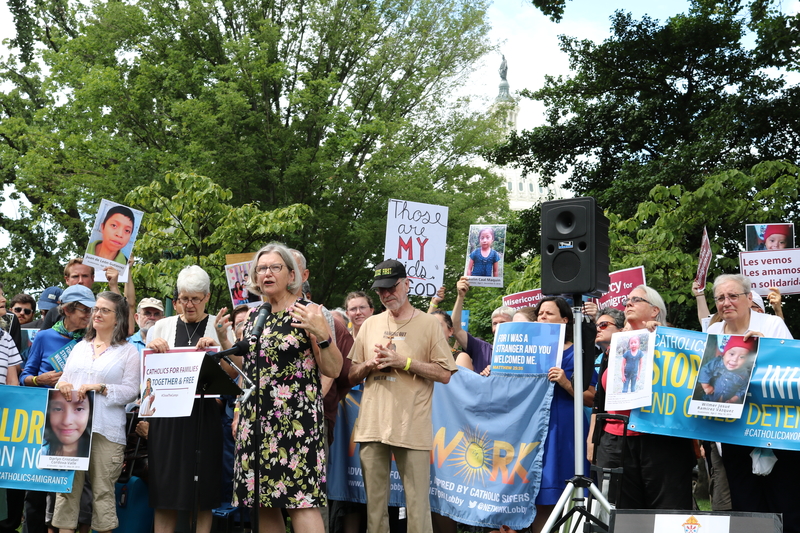
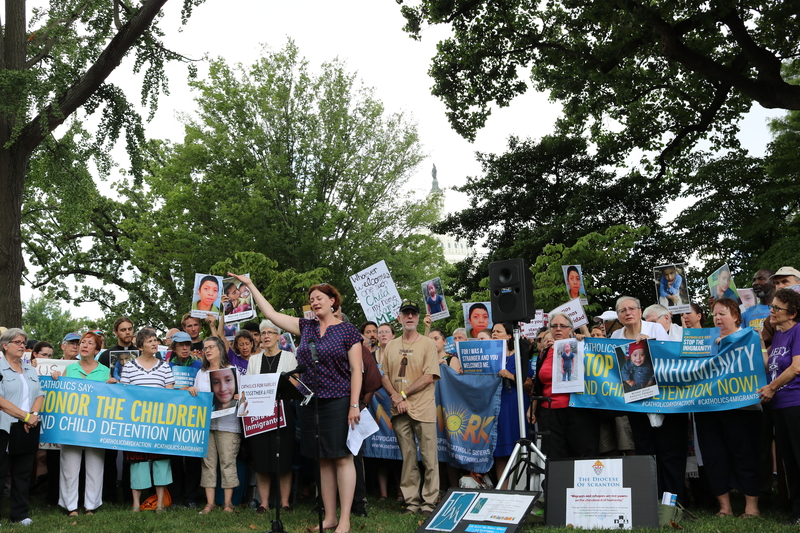
As someone who grew up in a non-faith based home, I had difficulty wrapping my mind around the concept “Catholic Social Justice.” I had never thought of the three words strung together because the term social justice to me was just that, no matter what background you came from. What I have been fortunate to learn this summer as a NETWORK volunteer is that Catholic Social Justice to me means progressive, open advocates that put their faith in the forefront and back it by various acts with the intention of ensuring a better tomorrow. This was clear to me as NETWORK joined the Catholic Day of Action for Immigrant Children last Thursday, July 18.

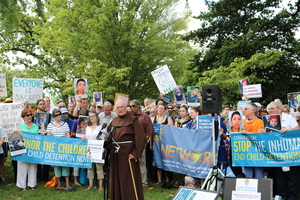
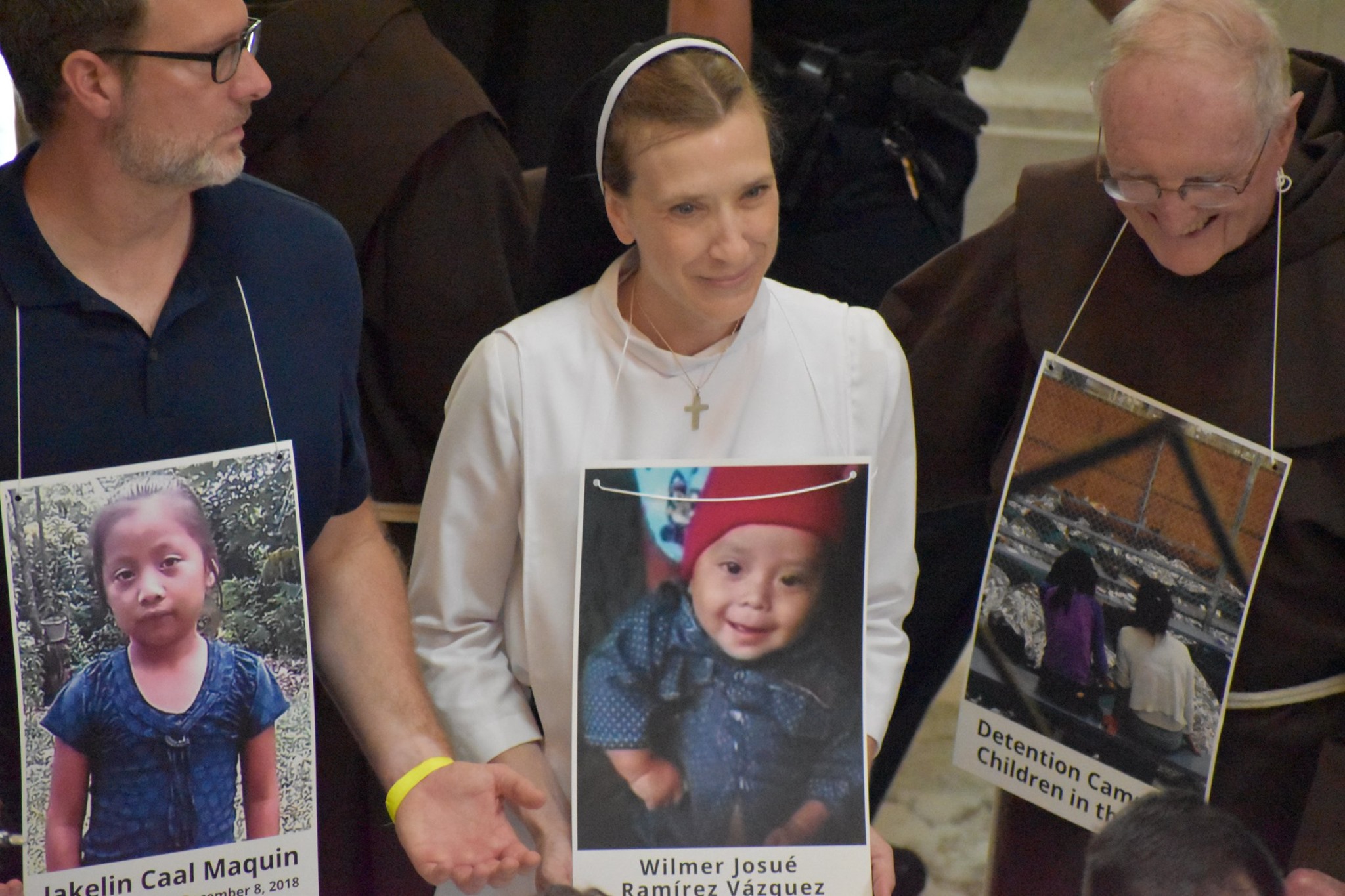
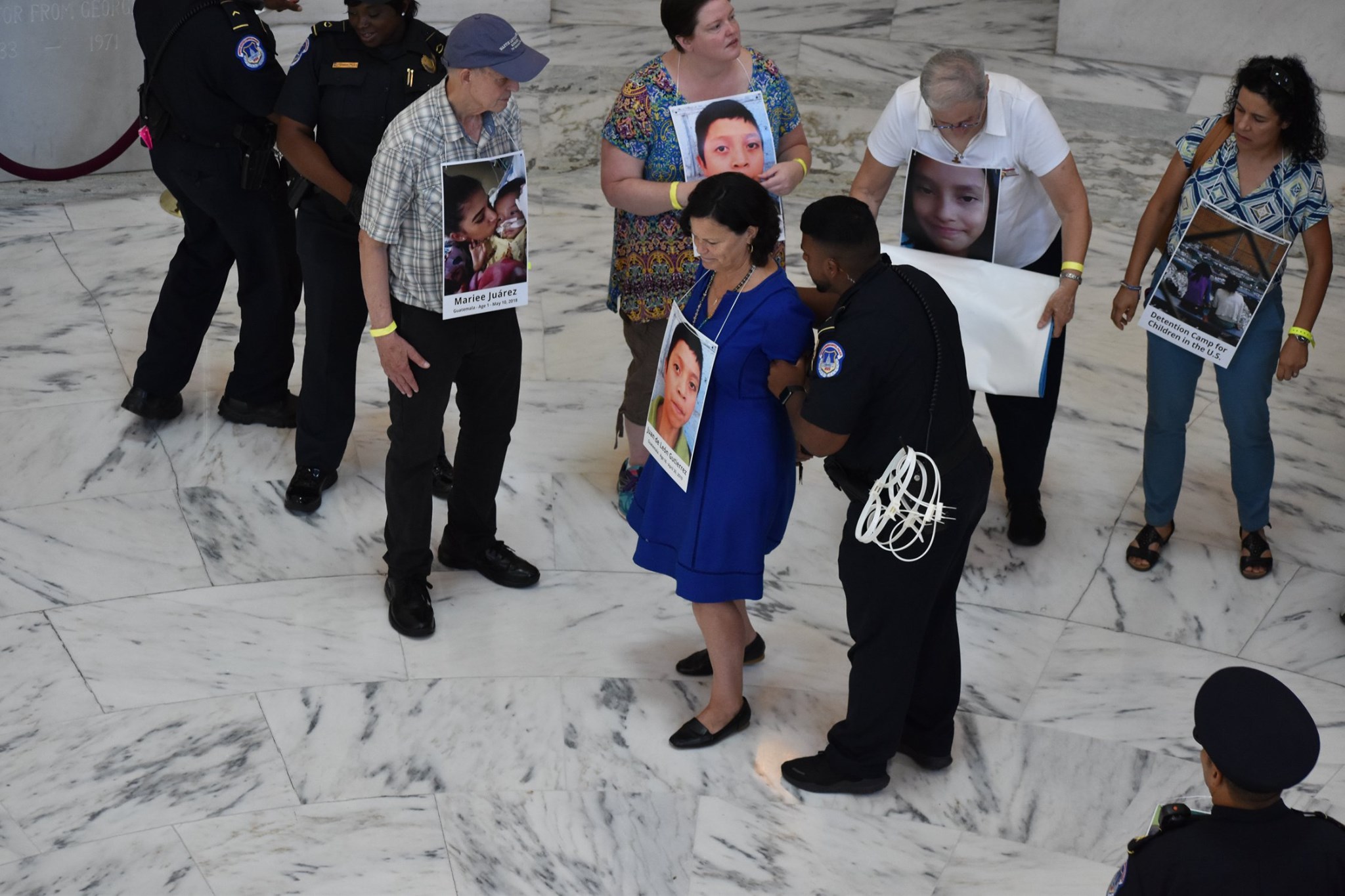
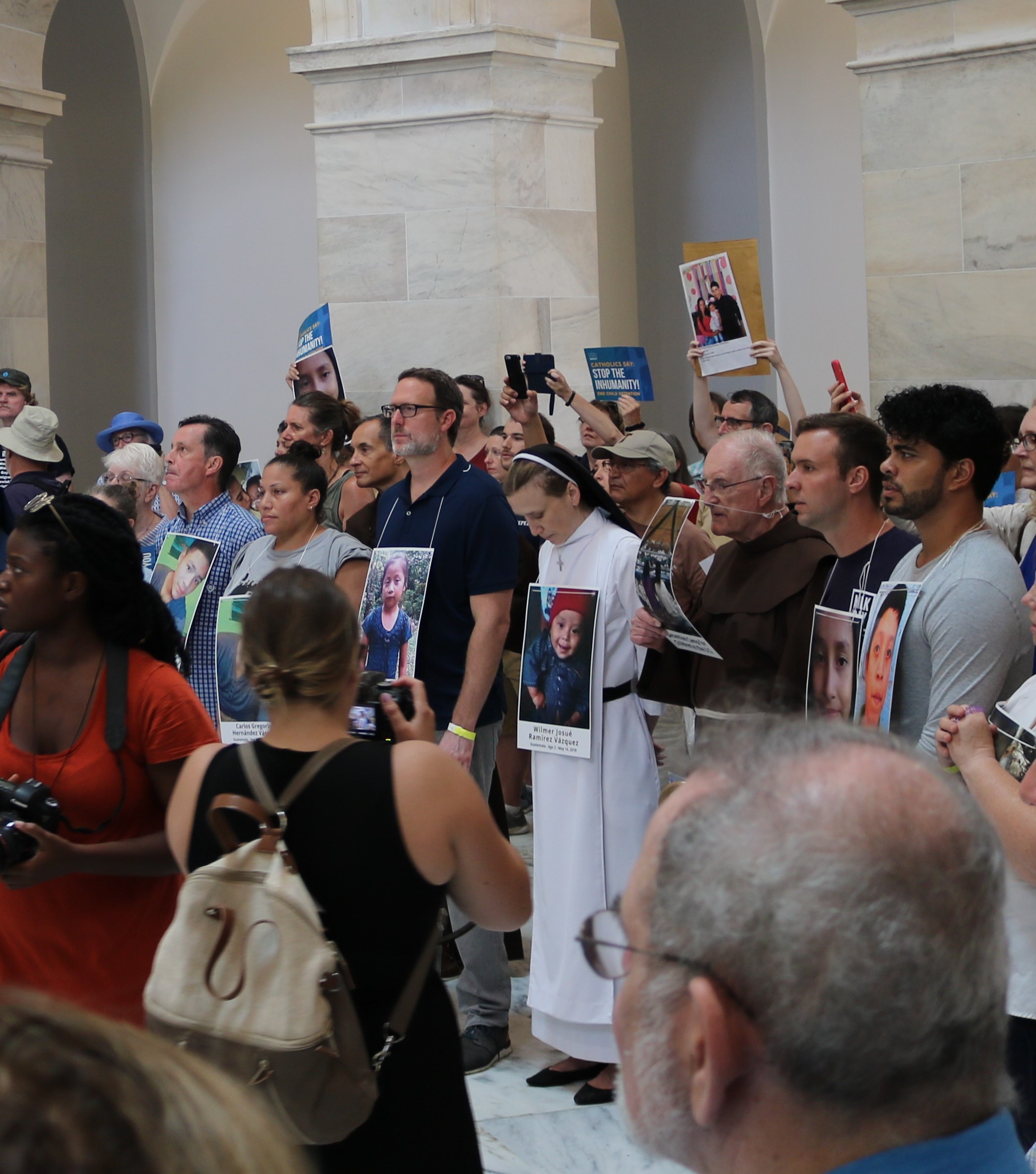
The gathering took place in the rotunda of the Russell Senate Office Building to call for an end to the inhumane and immoral practice of child detention. Sisters, brothers, and lay Catholic advocates from nearly 20 national organizations comprised the more than 200 individuals at the gathering, which was followed by 70 Catholic leaders participating in nonviolent civil disobedience. I was lucky to be present for the entirety of the gathering, which had a significant impact on me and individuals I interacted with in the rotunda.

The demonstration was bold, but the individuals participating in nonviolent civil disobedience were bolder. They proceeded into the rotunda with the names and pictures of the eight children who had died in custody or seeking asylum, and circled the space with five individuals lying down in the shape of a cross through the whole nonviolent civil disobedience. For me, this act showed how deeply interconnected faith and social justice were to the individuals participating in the nonviolent civil disobedience, as well as their vulnerability in order to make the courageous statement.

As the action went on, individuals working in the Russell building crowded the upstairs to see what exactly was going on. Displeased tones echoed behind our group from individuals jaded by “yet another protest” which they initially interpreted as Catholic extremists trying to make a point. But after asking us the reason of protest, we explained and gave them a better understanding of the concept of “Catholic Social Justice.” These same individuals were surprised by the concept and shared the appreciation I had for the participants of the action, which lead to some productive conversations.

Leaving the protest, I wondered if I too would have made those assumptions before learning more about Catholic Social Justice at NETWORK. I soon realized that regardless, I have been given the opportunity to expand my views and opinions and for that, I am thankful.

Faith Values Are Social Work Values

Faith Values Are Social Work Values 

Afton Neufeld
July 31, 2019

Anyone interested in entering the field of social work is quick to learn that they cannot do so without a deep belief in the social work core values. These core values are what guide everything from social work ethics to how the profession is carried out across the country and at times our world. As a person of faith, I believe that my relationship with the creator and conviction of scripture led me to believe in these core values long before I was aware of their importance in social work. So, how exactly do the social work core values and faith values line up?  

I will examine the six social work core values and how they line up with a faith calling (I am pulling from my Christian faith lens, but these values can transcend across multiple faiths): 

1. Service 

Service is something we see Jesus doing throughout the gospel. In John 13, we see Jesus washing the disciples’ feet, a gesture of humility and service. Soon after, he instructs his followers to “wash one another’s feet,” not just literally, but also in how they were called to humble themselves serve others.  

2. Social Justice 

Social justice is another theme we see in stories and commandments across the Bible. From the Old Testament to the New Testament, we see references to welcoming those on the margins of society. A specific call in Deuteronomy 27:19 warns against withholding justice from the immigrant, orphan, or widow.  

3. Dignity and Worth of the Individual  

A parable in Matthew 18 describes a shepherd who leaves his herd of 99 sheep to go find the single sheep that is lost, and compares that situation to the way God pursues his people. This highlights the heart of the text, illustrating that God cares so deeply for his people that he desires a personal relationship and values each and every person 

4. Importance and Centrality of Human Relationships 

From Genesis we see the Trinity as the Godhead three in one, living in relationship before time even existed, and we see relationships (between people and God, between individuals, and between groups) referenced in pretty much every chapter onward. From giving to one another to pursuing conflict resolution with your neighbor, human relationships (and healthy ones at that) are central to the Bible.  

5. Integrity 

Integrity, simply put, is the value of honesty. The Bible tells us, quite literally, “Do not lie” in Leviticus 19:11. We also see God calling upon humankind to have integrity, both with God and with one another, in several scriptures including the Ten Commandments in Exodus 20.  

6. Competence 

Competence is interesting in a faith/social work cross over. Usually when we see things relating to a person’s ability to do something successfully (i.e. competent) in the Bible, it is either attributed to God, or emphasized as something you don’t need for Jesus to accept you. However, the Bible does warn us against laziness and lack of work ethic. In Colossians 3:23 it reads, “Whatever you do, work at it with all your heart.In Proverbs we also read wisdom around the correlation of a strong work ethic and the blessings that come from it.  

While there weren’t social workers in biblical times, the same urgings all those years back are still applicable to our work and relationships today. An honest and competent day’s work for a social worker is certainly not for those without belief in individual dignity, valuing the importance of relationships, integrity, and a strong work ethic 


____________________________________________________________________________________ 

Afton Neufeld is a NETWORK volunteer currently obtaining her Masters in Social Work at University of Nevada, Reno. Her social justice heroes include Jesus, Rev. Martin Luther King Jr., and Catholic Sisters. 


Strengthen Working Family Tax Credits to Reduce Poverty and Expand Opportunity

Strengthen Working Family Tax Credits to Reduce Poverty and Expand Opportunity

Chuck Marr
July 24, 2019

Many people across the country have stories about how a little-known part of the tax code—the Earned Income Tax Credit and the Child Tax Credit—helped support their families and get ahead.

“As a single mother and new graduate, I count on the Child Tax Credit tremendously,” Travis from Tennessee told the national advocacy organization MomsRising.  “I am typically in the category of the ‘working poor,’ meaning I don’t make enough money to live above the poverty line, but I don’t qualify for state aid.  This makes it extremely hard to afford anything other than our base line bills and groceries for the month.  If something goes wrong with my car or an appliance in my house, it causes me panic attacks because I don’t [know] where I’ll get the money from. . . .  [T]he Earned Income Tax Credit also provides my daughter and I with funds that allow me to pay for opportunities for her that would otherwise be unavailable.”

Many low-income working families like Travis’s struggle to get by, as their costs have risen faster than their wages over the last several decades. Policymakers can help by strengthening the Earned Income Tax Credit (EITC) and Child Tax Credit (CTC). These two highly successful federal tax credits lift millions of people out of poverty and give working people and children a better shot to get ahead, both now and over the long term.

Improving the EITC and Child Tax Credit — through changes like those in the Working Families Tax Relief Act, recently introduced in the Senate — should be a key part of an agenda to reduce income inequality and boost working people’s wages.
The EITC, enacted under the Ford administration in 1975, has long enjoyed bipartisan support.  President Reagan called the 1986 tax reform bill, which substantially expanded the credit, “the best anti-poverty, the best pro-family, the best job creation measure to come out of Congress.” President Clinton signed another major EITC expansion in 1993, while Presidents Bush and Obama enacted improvements as well.

Working people receive the EITC starting with their first dollar of earned income; the credit grows with their earnings until reaching a maximum level and then phases out at higher income levels. The EITC offsets federal payroll and income taxes and boosts the incomes of people who work hard but earn little. Families across the United States use EITC refunds to pay for necessities, repair homes, maintain vehicles they need to get to work, or get additional education or training to boost their employability and earning power.

Stephanie in Missouri, for example, explains: “I am a single working mom of four. My income is low, but I’m proud to support my family, running my own business from home which allows me to be here for my kids. Without the EITC my income would not be enough to cover our basic necessities, like food, housing and utilities.”
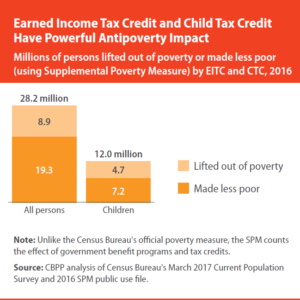
The extra money that people get from the EITC also helps them achieve more financial stability. The EITC lifted about 5.8 million people out of poverty in 2016, including about 3 million children.

The Child Tax Credit, enacted in 1997 and expanded with bipartisan support since 2001, helps working families offset the cost of raising children. It’s worth up to $2,000 per child under age 17 and is partially available to low wage working parents.

The CTC lifted roughly 2.8 million people out of poverty in 2017, including about 1.6 million children, and lessened poverty for another 13.1 million people, including 6.7 million children.

Congress Can Improve the EITC and Child Tax Credit

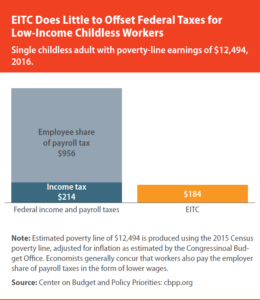
Despite their success, both the EITC and the Child Tax Credit have shortcomings that policymakers should address in order to target more assistance to those who need it most. The EITC for working people not raising children in the home is extremely small — too small even to fully offset federal taxes for workers at the poverty line. A childless adult earning poverty-level wages of $13,340 as a cashier, for example, owes $1,135 in federal income and payroll taxes and receives an EITC of just $172. As a result, this person is one of the over 5 million low-wage childless working people whom the federal tax code taxes into, or deeper into, poverty.

Beyond a threshold of $2,500 of earnings, the Child Tax Credit amounts to 15 cents on each additional dollar earned. This means the poorest children qualify for a very small credit or none at all, even though they are the children who need it most and for whom it would have the largest impact.

Unfortunately, when policymakers made major changes to the tax code most recently in 2017, they largely ignored the opportunity to raise living standards for low- and moderate-income people. The 2017 tax law was heavily tilted toward the wealthiest households and profitable corporations instead of working families. And even its highly touted increase in the CTC provided zero or only a token amount (ranging from $1 to $75) to 11 million children in low-income working families because their incomes were too low.

A landmark bill in Congress offers a promising path forward. The Working Families Tax Relief Act, introduced in the Senate by Senators Sherrod Brown, Michael Bennet, Richard Durbin, and Ron Wyden with more than 40 co-sponsors, would significantly strengthen the EITC and CTC. These expansions would make 46 million households more financially secure and benefit 114 million people — including 49 million children. Families of all races would benefit, including 24 million white families, 9 million Latino families, 8 million Black families, and 2 million Asian American families.

The bill would build on the EITC’s success among families with children, boosting their credit by roughly 25%. And it would substantially improve the credit for low-wage working people without children at home. It would raise their maximum credit (from roughly $530 to $2,100), raise the income limit to qualify for the credit (from about $16,000 for a single individual to about $25,000), and expand the age range of workers eligible for the credit (from 25-64 to 19-67). The above-mentioned cashier would see her EITC rise from $172 to $1,797, lifting her $662 above the poverty line.

The bill would also make big improvements in the Child Tax Credit.  As discussed above, the current credit partly or entirely leaves out many poor families with children because they earn to little. The bill would make the CTC available to all poor families – and not dependent on earnings — and expand the credit for children under age 6. Almost all low- and middle-income families with children would receive a $2,000 Child Tax Credit for each child age 6 or older and $3,000 per child under 6.

The larger tax credit for young children would help respond to the special economic challenges that families with young children can face.  Parents in these families tend to have lower wages because they are often less advanced in their careers, and the high cost of child care for young children can force many parents to choose between paying that expense or getting by on just one income.

To better target the Child Tax Credit to families who need it most, the bill would also begin phasing the credit down for married couples with incomes over $200,000 (compared to $400,000 under current law) and single parents with incomes over $150,000 (compared to $200,000).

Putting its EITC and CTC expansions together, the bill would make a substantial difference for low- and moderate-income working families. A single mother of two earning $20,000 would get a $3,700 increase, for example, while a married couple with two young kids making $45,000 would get a $3,500 increase. The bill would cut child poverty by 28%, lifting 3.1 million children out of poverty and making another 7.7 million children less poor.
The bill would also have lasting benefits for children, helping not only them but our country as a whole.  Studies show that kids in low-income families that receive added income from working-family tax credits like the EITC and Child Tax Credit do better in school and are likelier to attend college. They also are likelier to earn more as adults due to their higher skills and more years of education. And, kids whose families receive working-family tax credits are likelier to avoid the early onset of illnesses associated with child poverty, further boosting their earnings ability.

“Both the EITC and Child Tax Credit have made a huge difference for our family and have been critically important to our financial stability as parents of young children,” Kathleen from Utah explains.

That’s a key message for policymakers as they debate ways to reduce inequality and restructure the 2017 tax law to expand opportunity for low-wage working families. Strengthening the Earned Income Tax Credit and Child Tax Credit would advance both of those goals.


Chuck Marr is the Director of Federal Tax Policy at the Center on Budget and Policy Priorities (CBPP). CBPP is a nonpartisan research and policy institute founded in 1981 to analyze federal budget priorities, with a particular focus on how budget choices affect low-income Americans. CBPP pursues both federal and state policies designed to reduce poverty and inequality and to restore fiscal responsibility in equitable and effective ways. Learn more at www.cbpp.org.

Special thanks to MomsRising for sharing the stories from people and families across the country who receive the Earned Income Tax Credit and Child Tax Credit.

This story was originally published in the July 2019 issue of Connection magazine. Read the full issue.

Taking Action: Three Women, Three Stories

Taking Action against Child Detention: Three Women, Three Stories

Laura Peralta-Schulte
July 22, 2019

Last week, Catholics came together to call for an end of the inhumanity happening at the U.S. border and in detention camps around the country. Our day of action was an attempt to draw attention to the corrupt and deadly practices funded by our government. As a participant in civil disobedience, I was deeply inspired by the Catholic Sisters, Priests, and lay leaders participating, many of whom have spent their entire lives in the service of justice and peace. They are models of goodness, wisdom, and courage in the service of God.

There were, however, three women participating who engaged in civil disobedience for the first time.  They are not Catholic clergy, not part of a Catholic organization or a religious order. I spoke with each of them while we were processed for violating the law. I would like to share their stories, because they offer a new model of religious activism for us.

The first woman was the mother of two teenage girls. She is one of the few people in her close circle of friends who is documented. Each of her friends desperately wanted to join in civil disobedience but were rightly concerned about the threat of deportation. She reported the pain is very deep in her community over the treatment of migrants at the border and the raids in the U.S. Her daughters discouraged her to engage in civil disobedience out of fear for their mother. Her husband too was fearful. She insisted, however, she had to join because she could. Her witness and action was a bold example of courage led by the Spirit.

The second woman, also a mother, works for a big company and is not typically engaged in activism.  She decided to join in the action as she sat in church two weekends ago listening to the story of the Good Samaritan. Her priest posed the question, “Who is your neighbor?” and something just clicked.  While she confessed she normally is slow and methodical when making decisions, she instantly decided to participate. It was a moment of moral clarity. She followed the Spirit and took a leap of faith.

The third woman works for a local elected official. This work puts her in direct relationship with immigrant communities. She shared how her county is proactively engaging in know your rights training and trying to foster a safe community for immigrant families. She joined the action because she sees the pain and trauma in her community. She came because she wanted people to know she stands on the side of children and families in detention. She engaged in a prophetic act of witness.

As people of faith, we are all called to act for justice. The sacred call is not limited to our faith leaders, but extends to each of us. No matter who you are, you can participate in the creative process of the Spirit and work for change. Whatever road you take – through prayer, writing a letter to your Member of Congress, joining a vigil or civil disobedience – just do it. We must show courage, act out of faith, and bear witness to the pain of our world, if we are to use our collective energy to end the inhumanity of child detention in our nation.

You Should Be Ashamed, Mr. President, But You Are Not

You Should Be Ashamed, Mr. President, But You Are Not

Laura Peralta-Schulte
July 18, 2019

We have a white supremacist in the White House. The proof is in front of our eyes:  President Trump’s racially divisive political history, his use of race baiting as an arc throughout his 2016 campaign, cruel policies that disproportionately impact people of color, and repeated offensive statements while in office all reveal a consistent belief in white, Christian nationalism.

Trump’s recent tweets aimed at four Members of Congress who are women of color–Representatives Ayanna Pressley (MA-07), Ilhan Omar (MN-05), Alexandria Ocasio-Cortez (NY-14), and Rashida Tlaib (MI-13)–telling them to “go back to where they came from” and “if they are not happy living in the United States, they can leave” fits squarely into his world view. Worse, in signals the continuation of a divisive political strategy to separate the people of the United States by race, religion, class, and status. President Trump’s supporters responded to these tweets and the President’s continued criticism of Representative Ilhan Omar by chanting “Send her back” at a campaign rally in Greenville, North Carolina.

We cannot excuse President Trump’s blatantly racist, xenophobic, un-American behavior. His words are crass and demean the Presidency. They violate the very notion of patriotism and debase the values that this country claims to hold dear in word and in deed. This behavior serves to legitimize white supremacy and if the President can say these things without censure, without consequence, without people, especially white people, calling him out, then his allies and supporters feel justified. So, Mr. President, we at NETWORK Lobby for Catholic Social Justice call you out. You are a bigot and danger to our country, to our Constitution, and to our future.

The question is, what can we do to hold the President accountable?

The answer lies in the words of the four new Members of Congress affectionately known as “The Squad” at the press conference they held after the President’s tweets. Their message: Do not let this racist, xenophobic President distract you. Representative Ayanna Pressley said, ”This disruption is a distraction from the issues of concern to the American people, their failure to reduce the cost of prescription drugs, their failure to promote affordable housing, their failure to effectively deal with issues like healthcare and gun violence.” Representative Alexandria Ocasio-Cortez echoed Representative Pressley and said, “We love all children in this country, that’s why we are fighting for good education for all children. We love all people and that is why we are fighting for healthcare for all. We will get back to the business of American people who have been marginalize and do the work they sent us here to do.  We will not be silent.”

Let the people say Amen.

Everyone in our nation has a role to play in calling out white supremacy when we see it. We also have a sacred spiritual call as people of faith to actively engage in a mission of pursuing Gospel justice on behalf of those who have been marginalized, those who have been excluded, and those who have been denied justice.

There is legislative advocacy we can do this year to ensure that Congress funds Community Health Centers so people can access healthcare. We must stop Congress from continuing to fund cages for immigrant children and families. We must press Congress to pass real prescription drug reform.  Together, we can honor the request of our newest elected officials to keep our eye on the prize now and get ready for the business of electing candidates who share our mission in 2020.

Orange sign that says "It's in the Constitution: Everyone Counts"

Census Update: Victory! No Citizenship Question

Census Update: Victory! No Citizenship Question

Sister Quincy Howard, OP
July 17, 2019

After months of twists and turns regarding the possibility of a citizenship question on the 2020 Census, the Trump administration finally announced the conclusion of this saga last week. The final decision: there will be no question about citizenship included in the census.

This is a victory because including a citizenship question would have prevented a full and accurate count from being completed. The census is constitutionally mandated to count all persons in the United States and census data is used for distributing federal funding, congressional apportionment, and more. So, a full and accurate Census count is vitally important for our nation. The Census Bureau’s own data predicted that, if the question were included, between 5% and 12% of noncitizen households would decline to participate. Additionally, six former census directors and a Census Bureau internal analyst all said a citizenship question would harm the count. Without an accurate count, communities that are undercounted would be under-funded and under-resourced for the next decade.

When the Commerce Department first announced it was pursing the addition of a citizenship question over a year ago, advocacy organizations, voting rights advocates, and community-based partners all responded in strong opposition. Multiple suits were brought against the Commerce Department on the basis of both procedural standards as well as “discriminatory animus.” While the final decision from the Supreme Court did not reject the citizenship question itself, it did reject the justification the Trump administration used to argue for its inclusion. Due to the rapid timeline for printing and executing the impending 2020 count, the Trump administration has finally given up on including the citizenship question on the census.

In order to save face after backing down from the citizenship question, President Trump issued an executive order directing the Commerce Department to gather citizenship data from other federal agencies. We will remain alert for more details of this new plan for compiling citizenship data.

In June, we responded to the Supreme Court decision with cautious optimism. Sister Simone said “I’m relieved to see that the Supreme Court, which can be so divided along partisan lines, recognized that this Republican scheme to reduce the count in the 2020 Census was an attempt at crass manipulation of the data by the Trump Administration.” Now, we remain optimistic about the prospects for the 2020 Census. We are re-focusing on accomplishing a fully representative, fair and accurate count of all people living in our nation so that we can accurately distribute federal funding and political representation until our next count takes place in 2030.

Raise the Wage Act Will Positively Impact Workers

Raise the Wage Act Will Positively Impact Workers

Elisa McCartin
July 11, 2019

This week, the nonpartisan Congressional Budget Office (CBO) released its report on H.R. 582, the Raise the Wage Act. This legislation would gradually increase the U.S. federal minimum wage to $15 an hour by 2024 and would further eliminate the tipped wage of $2.13 by gradually raising it to meet the federal minimum wage of $15 an hour. NETWORK strongly supports this bill as it would substantially reduce income inequality and poverty across the United States. The CBO report highlights the numerous ways this bill will benefit low-income workers, as outlined by the Economic Policy Institute.

Some groups have responded to the CBO report by pulling out selective data chosen to alarm the public about the costs of raising the minimum wage. We believe, however, that the data supports our stance in favor of raising the wage. According to the report, 27 million low-income workers’ wages would increase with a $15 minimum wage. Low-wage workers would see their annual earrings rise by $44 billion by 2025. Moreover, a $15 minimum wage would lift 1.3 million people out of poverty. This bill will have a profound impact on reducing rampant inequality in the U.S. by raising the wages of the lowest-income workers.

The CBO report further demonstrates that the benefits of this bill greatly outweigh potential costs. Even accounting for their prediction of some job losses, the CBO concluded that the average low-wage worker would earn $1,600 more per year. The CBO’s job loss prediction was also based on faulty methodology that focused primarily on subgroups of workers like restaurant employees. Studies that look holistically at the low-wage workforce find that a $15 minimum wage does not reduce employment.

Research conducted by the Quarterly Journal of Economics found that across 138 state-level minimum wage increases, there were no measurable employment losses. For example, between 1979 and 2016, states with the highest minimum wage increases experienced no negative employment effects. Minimum wage increases at the city-level have had no detrimental impact on restaurant employment levels. In 1968, when the U.S. had its highest minimum wage adjusted for inflation, there was no adverse impact on employment. Thus, while the CBO’s central estimate predicted some job losses, its other “likely” estimates projected that there may be no job losses as a result of a $15 minimum wage in 2025.

Even if the CBO’s job loss predictions were fully accurate, a $15 minimum wage would still tremendously benefit low-wage workers. According the CBO, 7% of the lowest-wage workers could face job losses, while 93% would earn 12% more an hour. An additional 10.3 million people would earn above $15 an hour by 2025 with no employment reductions. Furthermore, because jobs will pay higher wages, even workers experiencing “job-losses” would likely have higher annual incomes due to wage increases. The CBO acknowledged that families may be able to cut back working hours or the number of jobs per family with higher wages, contributing to these “job-loss” statistics. Thus, these job-loss numbers are best interpreted as fewer hours worked throughout the year because there will be a reduced need to work extreme hours to make a living wage.

NETWORK and our partners are incredibly proud to support the Raise the Wage Act. For decades, the U.S. workforce has been exploited under a system that fails to guarantee workers a living wage. The Raise the Wage Act is a first step in truly transforming our economy into a moral economy.


Elisa McCartin is a NETWORK volunteer and student at Georgetown University.

Trump Administration Seeks to Re-Define the Poverty Line

Trump Administration Seeks to Re-Define the Poverty Line 

Elisa McCartin
July 10, 2019

The Trump administration is escalating its attacks against working families and using the power of the executive branch to implement their agenda unilaterally. This circumvents the legislative process and is a rejection of the legislative branch’s power 

How Agency Rule Changes Work 

Our many federal agencies create and implement policies that have profound impacts on our nation. Members of President Trump’s cabinet can direct the agencies to alter their policies and procedures by proposing specific rule changes. The agencies are required to give citizens and organizations a specified time period (usually 30-60 days) to comment on proposed changes before the agency is allowed to make a final rule. The agency must consider every comment before they implement their decision. These comments are often the only means the public has to check the power of these rule changes.  

After a rule change goes into effect, people or organizations can then challenge the agencies in court and the agencies must prove they considered every argument in every submitted comment. Because of this requirement, NETWORK and many of our partners have submitted comments on the harmful proposed rule changes the Trump administration has been rolling out in various federal agencies. We encourage our members to keep track of these sly and underhanded harmful policy proposals and submit comments to prevent or at the very least, stall, the Trump administration from enacting more damaging policies without Congressional approval.  

Proposed Poverty Line Rule Change 

One proposed rule change that NETWORK and many other advocacy organizations submitted comments to the Office of Management and Budget (OMB) about would alter the inflation measurement used to determine the U.S. poverty line. The Official Poverty Measure (OPM) in the U.S. is calculated based on three times the estimated cost of a subsistence food budget for an average family, and adjusted for inflation each year. The OMB usually uses the Urban Consumer Price Index (CPI-U) as the inflation adjustment mechanism. The OMB’s proposed rule would mandate a switch from using the CPI-U to the chained Consumer Price Index (C-CPI-U) or the Personal Consumption Expenditure Price Index (PCEPI). The inflation index the OMB uses to adjust the poverty line is extremely important because it will alter families’ eligibility for social programs.  

Both proposed alternative inflation indices—the chained CPI and the PCEPI—underestimate inflation. The CBO reports that the chained CPI grows 0.25 percentage points slower than the CPI-U. This is because the chained CPI and PCEPI account for when consumers substitute goods for one another in the marketplace based on price increases. However, low-income families do not have the level of economic flexibility where they can exchange goods for one another, thus making this measurement inaccurate. Moreover, low-income families feel inflation more severely than middle and high-income families. Low-income people spend a larger percentage of their income on housing, and home rents have risen at double the inflation rate. Using indices that underestimate the inflation rate to determine the poverty line is an utterly inaccurate measure of the costs low-income families face. These should not be used to calculate the poverty line in the U.S.  Our principles of Catholic Social Justice teach us to prioritize the needs of those at the economic margins. This proposed rule denies the fundamental realities of people struggling to make ends meet. 

Furthermore, this move would have devastating effects of people who currently qualify for federal programs. The Center of Budget and Policy Priorities (CBPP) calculated that switching to the chained CPI would lower the poverty line by 2.0% and using the PCEPI would reduce the poverty line by 3.4%. This dramatic reduction would prevent millions of individuals and families from receiving benefits and social services, as they would no longer be eligible even though their actual economic status remains unchanged. As a result, the CBPP projects that more than 250,000 senior citizens would no longer qualify for Medicare Part D Low-Income Subsidy, 150,000 seniors would have to pay premiums exceeding $1,500 per year, 300,000 children would lose medical coverage under the Children’s Health Insurance Program (CHIP), 250,000 adults who gained coverage under the Affordable Care Act (ACA) would lose it, and 150,000 consumers would no longer receive cost-sharing assistance in ACA marketplaces.  

The U.S. poverty line is already too low—20% of people living in the U.S. do not meet one or more of nine basic need standards. This change would strip millions of life-saving supports, compounding the already severe impacts of poverty, homelessness, and hunger in our society. As people of faith, we are called to support those in need—not further entrench vulnerable families in poverty. 

NETWORK believes that it is our obligation to prevent the catastrophic effects of this proposed rule. The Trump administration is circumventing the legislative branch where citizens have more influence, amplifying the need to closely follow and comment on agency rule changes spearheaded by Trump Cabinet members. Although the period for submitting comments on this rule has closed, it is our imperative to continue tracking OMB’s decision making, to hold the executive branch accountable to the people, and to advocate for policies that mend the gaps 

___________________________________________________________________________________ 

Elisa McCartin is a NETWORK volunteer and student at Georgetown University. 

Walking in Grace: A Reminder of the Grace in Mending the Gaps

Walking in Grace: A Reminder of the Grace in Mending the Gaps

Elisa McCartin
July 9, 2019

In the new photo book Walking in Grace, author Alison Fogg Carlson highlights the stories of former gang members who are transforming their lives at Homeboy Industries. Father Greg Boyle S.J. founded Homeboy Industries thirty years ago, and has dedicated his life to serving the Los Angeles community impacted by gang activity. Father Greg and the Homeboy community unconditionally welcome gang members looking to change their life. To facilitate this process, Homeboy Industries provides services such as tattoo removal, education, workforce development, substance abuse treatment, mental health care, and legal assistance. Walking in Grace illustrates the impact of these services with powerful photos by Michael Collopy alongside poems and stories of former gang members who have been touched by Homeboy Industries.

In 2018, Nuns on the Bus had the privilege of touring Homeboy Industries and meeting members of the Homeboy community. At Homeboy, the Sisters witnessed the life-changing transformations that go on every day. They learned that every year 10,000 people turn to Homeboy to redirect their life, making Homeboy Industries the largest gang intervention, rehabilitation and reentry program in the world. After the visit, Sister Julie Fertsch, SSJ wrote, “They [Boris, Janet, Christina, Selena, George, and Allison] inspired us with their stories of radical transformation, of the many ways they found “home” at Homeboy Industries.”

One of Fr. Greg Boyle’s quotes in Walking in Grace summarizes how Homeboy works to mend the gaps: “Our locating ourselves with those who have been endlessly excluded becomes an act of visible protest. For no amount of our screaming at the people in charge to change things can change them. The margins don’t get erased by simply insisting that the powers-that-be erase them. The trickle-down theory doesn’t really work here. The powers bent on waging war against the poor and the young and the ‘other’ will only be moved to kinship when they observe it. Only when we can see a community where the outcast is valued and appreciated will we abandon the values that seek to exclude.”

At NETWORK, we recognize the importance of connecting with communities in need and addressing the harm years of disinvestment and structural oppression cause. Our 2020 Vision to mend the gap articulates the pressing need to identify and advocate for policies in the areas in our society where people are left behind and forgotten. Collectively, we must seek out ways we can be in solidarity with overlooked communities.

The stories told in Walking in Grace remind us of the truly transformational power of community and kinship. In order to truly mend the gaps in our society, we must eliminate judgement, unease, and insecurity. We must fearlessly pursue justice and inclusion.


Elisa McCartin is a NETWORK volunteer and student at Georgetown University.

Freedom for Some, But Not for All

Freedom for Some, But Not for All

Mary Cunningham
July 4, 2018

July 4, 1776: the day the Declaration of Independence was adopted. Since then, each July 4th we celebrate our nation’s freedom from an overbearing colonial rule and our fervent patriotism. We dress in red, white, and blue, enjoy cookouts with neighbors in our backyards, and watch from picnic blankets as fireworks erupt across the sky. Yes, the day has become commercialized, but the words of the Declaration of Independence remain as pertinent in our current political climate as they were when they were first written.

The document written by our founding fathers clearly declares our commitment to “unalienable Rights” defined as “Life, Liberty and the pursuit of Happiness.” It even goes so far as to say that when a government fails to protect these rights, it is the duty of the people to alter or abolish it, and that a leader whose actions resemble a tyrant cannot be trusted to rule and uphold the freedom of the people. Thus, we see the intricate and fragile relationship that exists between the government and the governed.

Take a snapshot of the United States at this exact moment, and you will realize that we have do not have good governance, and that many in our country still lack the rights which the Declaration of Independence deems “inalienable.” In his “I Have a Dream” speech, Rev. Dr. Martin Luther King Jr. talked about what was meant by this term: “This note was a promise that all men, yes, black men as well as white men, would be guaranteed the unalienable rights of life, liberty, and the pursuit of happiness. It is obvious today that America has defaulted on this promissory note insofar as her citizens of color are concerned.”

The default on the promise of “inalienable rights” was evident during Rev. Dr. Martin Luther King Jr.’s time and it is still evident today for people of color and all on the economic margins seeking to live freely in the United States. We see this in the recent decision by the Supreme Court to uphold the Trump administration’s travel ban, Congress’s failure to pass a Dream Act to protect DACA recipients, and state and federal attempts to impose work requirements on human needs programs that help our nation’s most vulnerable families and individuals. How do these political decisions enhance the life, liberty, or happiness of the people they impact? They don’t.

On a more personal level, we have begun to fail one another, as violent discrimination and exclusion continue to reign. Our nation has endured countless acts of police brutality and racial profiling. I am astonished on a daily basis by the attacks on communities of color, like the recent shooting of high school student Antwon Rose. If we set a standard that “all men are created equal,” shouldn’t we hold all people to that standard, regardless of race, gender, or religious beliefs?

A few days ago, one of my coworkers sent around a video from the show, Dear White People, to our staff. In the video, the character Reggie reads a poem he wrote for an open mic night—his rendition of the Declaration of Independence:

We hold these truths to be self-evident
that all men are created equal
that they are endowed by their creator
with certain inalienable rights
Among these life, liberty and
the pursuit of happiness
unless you’re loud and black
and possess an opinion
then all you get is a bullet
A bullet that held me at bay
A bullet that can puncture my skin
take all my dreams away
A bullet that can silence
the words I speak to my mother
just because I’m
other
A bullet – held me captive
gun in my face
your hate misplaced
White skin, light skin
but for me not the
right skin
Judging me with no crime committed
reckless trigger finger itching to
prove your worth by disproving mine
My life in your hands
My life on the line
Fred Hampton
Tamir Rice. Rekia Boyd
Reggie Green
Spared by a piece of paper
a student ID
that you had to see before
you could identify
me
and set me supposedly
free
Life
liberty
and the pursuit of happiness
for some of us maybe
There’s nothing
self-evident
about it

The Declaration of Independence pronounced the individual rights that cannot be taken away. In 1776, that only included white, male landowners. After much hard work and sacrifice, we know that all people deserve these same unalienable rights. But, we see that as a nation today, we fall despairingly short of this. The words of the Declaration of Independence should not be an ideal or something that we aspire to. They must be the law of the land, the fabric which knits our country together. For if we cannot claim our freedom, what do we have left?