


Category Archives: Spirit Filled Network
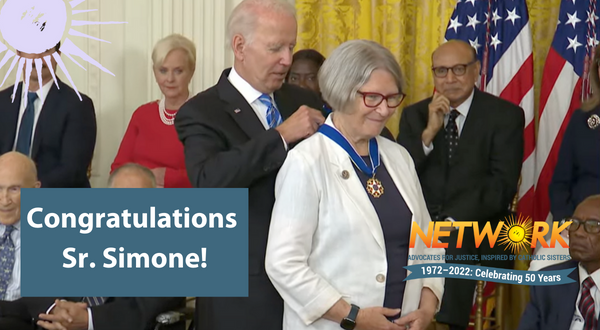
Watch Sr. Simone receive the Presidential Medal of Freedom

Watch Sister Simone receive the Presidential Medal of Freedom
Mary J. Novak
July 7, 2022
On July 7, 2022, President Joe Biden awarded Sister Simone Campbell, SSS and 16 other extraordinary Americans with our country’s highest civilian honor, the Presidential Medal of Freedom. While leading NETWORK from 2004 to 2021, Sister Simone propelled NETWORK’s mission of political ministry into the national spotlight with her committed advocacy for justice.
President Biden said that Sister Simone and her fellow medal recipients “embody the soul of the nation — hard work, perseverance, and faith,” and I strongly agree. It is people like Sister Simone and each of you — advocates for justice, participating in politics to dismantle systemic racism and advance the common good — who give me hope.
As we witness rising tension and growing threats to our democracy, it is more important than ever to lobby for federal policies that dismantle systemic racism and create a country where all people can thrive.

A Juneteenth Reflection
Min. Christian S. Watkins
June 28, 2022
Can you imagine being free and emancipated from the brutally lethal system and culture of enslavement and not knowing it? This was the case for enslaved people in Texas who were not informed of their freedom until two years after Emancipation. On Monday, June 20, 2022, our nation celebrated Juneteenth, the commemoration of the announcement in Galveston, Texas (General Order No. 3 delivered on June 19, 1865). The Union Army marched from Galveston Island to the Negro Church on Broadway — since renamed Reedy Chapel A.M.E. Church, liberating African Americans from enslavers, many of whom had migrated to Texas after the Civil War to escape Union control, Reconstruction mandates, and oppress Black people.
The delay of freedom ecause of racial bias in Texas is a shame. To be clear, over the past 157 years, our country has experienced moments of racial justice. It’s sad that as the United States carries the mantle as the world-wide beacon of democracy, and a place where all are free to enjoy life, liberty and the pursuit of happiness, social progress and equality measures that weave Black people into the American Dream have been short-lived.
In fact, I believe that it is more accurate to assert that the Black experience in the United States is more closely aligned with great economic and social inequity, loss of life and liberty, and damage to the souls of Black people, than it has ever been tied to equity and equality. From overcoming treatment as three-fifths of a person as slaves, the denigrating effects of the post-antebellum era, the violence of the Jim Crow era, the fight for voting rights, and the ongoing struggle for equity in housing, education, wages, healthcare, etc., Black people face great harm. The racist policies and white supremacy that lingers in the laws, policies and decisions of those who hold dominant power has had tragic, and sometimes deadly, outcomes for Black people.
How can this harm be eased when the United States has yet to fully reckon with, and atone for, slavery — its original sin?
NETWORK Lobby, the Why We Can’t Wait coalition of our partners, other justice-seeking organizations, and civil rights advocates asked President Joe Biden to sign an executive order for reparations by Juneteenth 2022 — and begin the nationwide racial healing and repair. He declined.
Juneteenth symbolizes the enduring Black American spirit and persistence to overcome injustice – despite the numerous delays and denials of equality. It’s time for the waiting to stop. Our President (and Congress, too) can and must do all they can to enact measures that address the long-lasting legacy of slavery. It was a grave mistake to avoid redress and reparations as slavery ended. The consequences of that inaction continue to cast a pall over our government, cultural institutions, criminal legal system, and our economic affairs.
It’s important to name that it is not too late to take action. The opportunity for Black Americans to freely, fairly and fully participate in our nation’s economy and democracy is still available. A reparations study is vital, but there are other measures our national leaders can take:
- Enact key provisions of President Biden’s economic agenda and bipartisan legislation that have been obstructed must be enacted that would help eliminate deep-seated racial inequities in our economic and political systems.
- Address the staggering racial wealth gap
- Stabilize our democracy by fortifying voting rights against exclusion efforts and suppression tactics,
- Create penalties for law enforcement agents who harm or kill Black lives without cause
- End the disparity in policing and sentencing that has created biased mass incarceration rates by race
- Stop allowing violence against immigrants.
As NETWORK advocates for the creation of a reparations commission, we continue supporting policies that will build our country anew by advancing racial justice and racial equity. We invite justice-seekers to advocate with us. Click here to find ways to take action.

The Dobbs Decision and NETWORK’s Continued Work for Racial and Economic Justice

The Dobbs Decision and NETWORK’s Continued Work for Racial and Economic Justice
Joan F. Neal, Mary J. Novak, and Sr. Erin Zubal, OSU
June 24, 2022
The Supreme Court’s decision in Dobbs v. Jackson Women’s Health Organization will have deep ramifications in people’s lives, many of whom may not even realize it yet. Undoing nearly half a century of precedent and jurisprudence will undoubtedly have a disorienting and destabilizing impact on our laws, the provision of maternal health care, and our already fraught civil discourse.
At NETWORK, we speak from five decades of women-led, person-centered advocacy and hundreds of encounters with women, families, and communities across the country that have been disinvested in, and marginalized by, our systems and structures. As a Catholic organization with 50 years of political ministry in a pluralistic democracy, we recognize the role and distinction of the moral and legal questions at issue here.
This Supreme Court decision leaves NETWORK with the following questions from our perspective of pursuing justice and the common good through federal policy:
- Will state and federal legislatures now introduce and pass a groundswell of policies to offer a robust social safety net of resources for all women and families that allow everyone to thrive?
- Are religious leaders prepared to allocate resources through the largesse of their institutions and donors to ensure that any gaps in the social safety net are filled?
- Will this decision lead to an increase in maternal mortality for the people who are already the most lacking in access to resources in our society, especially women living in rural, low-income communities and women of color?
- Will state legislatures continue to pass invasive and punitive measures that create a culture of surveillance and criminalization of women, including those experiencing ectopic pregnancy or miscarriage?
- Will this decision create a chilling effect among medical providers, making them hesitant or unable to provide life-saving care to patients suffering conditions such as ectopic pregnancy or hemorrhaging after a miscarriage?
With polarization and extremist violence growing in our country, people of faith have a moral duty to work toward the common good across a spectrum of issues. Catholic teaching states that a focus on one moral priority cannot lead to “dismissing or ignoring other serious threats to human life and dignity” (“Forming Consciences for Faithful Citizenship” #29).
For anyone who has made ending federal protections for abortion the singular focus of their political activity, we at NETWORK urge you to expand your focus to include the economic realities of women and families. Now is the time to listen to the experience of women, particularly women living in rural, low-income communities and women of color.
Founded by Catholic Sisters and imbued with their charisms, NETWORK educates, organizes, and lobbies to create a society that promotes justice and the dignity of all. We invite all who share our passion for justice to work with us to create a more just, equitable, and inclusive future.
Joan F. Neal is NETWORK’s deputy executive director and chief equity officer. Mary J. Novak is NETWORK’s executive director. Sr. Erin Zubal, OSU, is an Ursuline Sister of Cleveland and NETWORK’s chief of staff.
NETWORK’s Reparations Vigil in Cleveland Featured Revered Traci Blackmon
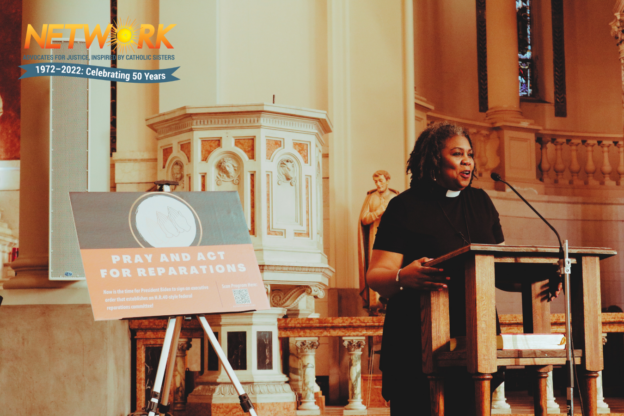
NETWORK’s Reparations Vigil in Cleveland Featured Reverend Traci Blackmon
Elissa Hackerson
June 17, 2022
NETWORK Lobby for Catholic Social Justice hosted Repair and Redress: A Vigil for Reparations (In-Person) on Wednesday, June 15, 2022 at St. Aloysius – St. Agatha Parish in Cleveland, OH. People in the parish church and school community, sisters, the Cleveland NETWORK Advocates Team, justice-seekers, and NETWORK staff made a powerful stand for reparations for Black Americans and called for an H.R.40-style reparations commission by Juneteenth. NETWORK’s reparations vigil in Cleveland featured Reverend Traci Blackmon, Associate General Minister, Justice and Local Church Ministries (United Church of Christ). The United Church of Christ shared a condensed video presentation of her remarks.
Rev. Blackmon’s stirring and powerful remarks spoke to the theological call to repair a society broken by the sin of chattel slavery and the racism that has followed in its wake and addressed society’s need to atone and provide redress. Rev. Blackmon declared that it is time to end government charity for Black people (giving fish) and deliver justice (equitable access to the lake).
The reason we have not reckoned with racism in this country–decision makers have decided that God cannot be Black, that God cannot be Brown. That God indeed must be white and therefore we have created a fractured and disabled society.Rev. Traci D. Blackmon
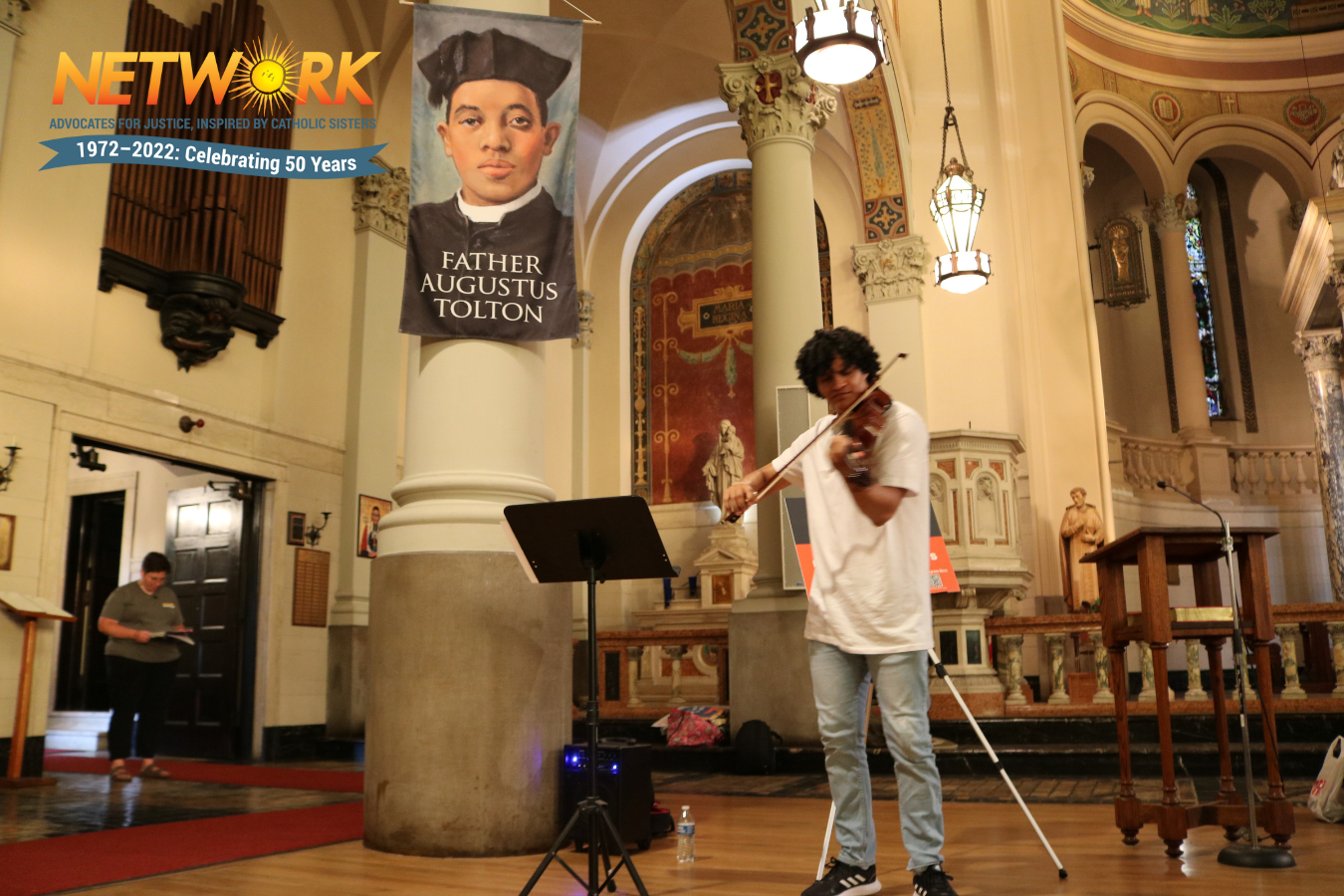
A classically trained violinist from Venezuela added music to the vigil.
NETWORK’s Build Anew agenda calls for a society where we all share equally in God’s abundance. For this to happen, our country’s laws, policies, and norms must:
- Dismantle Systemic Racism
- Cultivate Inclusive Community
- Root Our Economy in Solidarity
- Transform Our Politics
As Rev. Blackmon stated so clearly in her vigil remarks, “Reparations is about the church and the people and the society moving from charity to justice. Moving from hand out to hand up. Moving from simply offering to give someone a fish to giving them access to the lake so they can fish for themselves.”
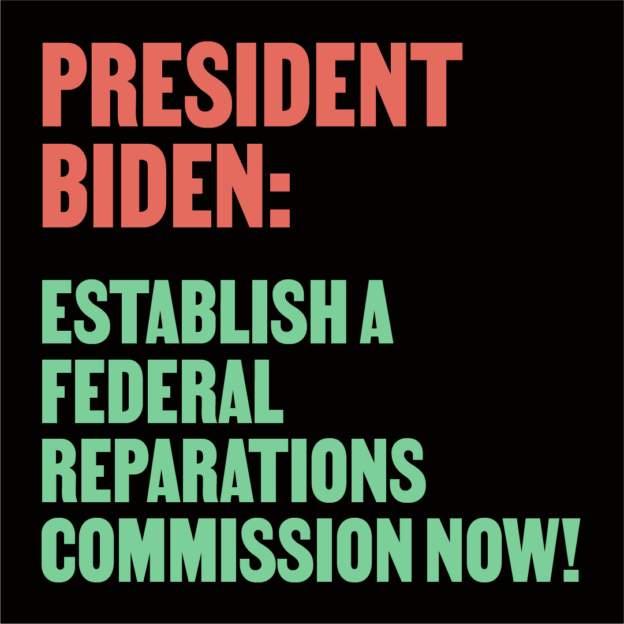
Now Is the Time to Address, Repent, and Repair
Now Is the Time to Address, Repent, and Repair
On Juneteenth, we honor and observe those in Galveston, Texas who were the last to receive the news that all enslaved people were now free. As important as it is for Juneteenth to be a national holiday, this national commemoration must be paired with support for policies that name and address the legacy of slavery and Jim Crow that continue to this day. To ignore our country’s sin of legalized chattel slavery, to pretend that it did not exist, or that it is no longer relevant to modern life, is to be in complete denial.
Joan Neal, NETWORK Lobby for Catholic Social Justice Deputy Executive Director and Chief Equity Officer, contributed open remarks for NETWORK’s recent H.R.40 Webinar. Watch below.
Slavery happened. Black human beings were put in chains, in bondage, and in indentured servitude, for more than 200 years. It is a part of America’s history and we must start by telling the truth about it. Especially, people of faith, for whom honesty and truth-telling are values. Scripture and our religious tradition tell us you cannot be truly free of sin unless you admit that you have sinned, make a firm determination to sin no more, and, make restitution for what was lost. The sin is not forgiven until all parties are whole again. As a country, as a people, we cannot move beyond this evil until and unless the country tells the truth about our history and takes responsibility for the wrong it has done to a group of its own citizens.
The question of reparations for slavery has been on the table in this country for two centuries. Even though the 13th Amendment ended legal slavery in the United States in 1865, the residual bondage of African-Americans has continued even to this day. The ideology of white supremacy not only persisted, it found ways to morph chattel slavery into second-class citizenship through laws, structures, systems and cultural traditions at every level of our society. Enough is enough!
More than four hundred years of racist policies, laws and practices have deprived African-Americans of equal access to participation in the cultural, political, social and economic life of this country. And the Catholic Church not only condoned this evil, but participated in it. The global Catholic Church supported the Atlantic Slave Trade starting with the Doctrine of Discovery, which appears in the 1455 Papal Bull of Pope Nicholas V, authorizing the enslavement of African people in the pursuit of new territory for Portugal and Spain. In the United States, many religious orders including the Jesuits, as well as individual Bishops, dioceses and churches, embraced enslavement, Jim Crow laws, and other forms of discrimination and racism.
The Catholic Church gave slave ownership moral absolution and enthusiastic acceptance. Moreover, centuries of racist violence, like what we saw in Charleston, South Carolina and Buffalo, New York, and oppression, like the many states where voter suppression laws are being passed to depress the Black vote, continue to be incompatible with and contradictory to the Christian call to love one another as we love ourselves and to live in right relationship.
It is time to confess, to repent, and to repair. The harmful legacy of white supremacy and the enduring racial wealth gap must no longer deny Black people good health, educational and economic outcomes.
How do faith teachings call us to respond? What is our moral responsibility in the face of this history as well as the ongoing impact of the legacy of slavery?
As Catholics and as followers of Christ, our faith calls us to be in solidarity with all who have been or are marginalized and to act for what is right and just. That means in this case, if you are white, to fearlessly tell the truth about white supremacy, racial injustice and lack of equity in our society in order to diminish the impact of historical and contemporary racism in today’s political, social and economic systems, frameworks and institutions. It means that you courageously face up to the original sin of this country, renounce it once and for all, and do all in your power to repair the damage that has been done to your neighbor. It means that you take responsibility for the sins of the past, repair the wrongs done in this day and time, and ensure that the sins of your ancestors are not visited upon your children, your neighbor’s children or their children’s children or anyone in the future.
The prophet Micah told us what God expects of us– ‘to do justice, to love mercy and walk humbly with God.’ Now is the time for the United States to ‘do justice’ for African-Americans. Individual reparations programs, like that of the Jesuits, are commendable but they are not enough. We need a national reparation program that achieves a meaningful closing of the wealth gap between Black and white Americans, now estimated to be $11 trillion.
That is why we, NETWORK Lobby for Catholic Social Justice, support establishing a federal commission to study reparations, either by passing H.R.40 through Congress, or through an executive order from the Biden-Harris administration. This will take the first step forward to do justice with mercy.
Now is the time. Now is the time to take the step forward, to say no more evading responsibility, no more denying the truth of the past, no more refusing to repair the wrong. Catholic teaching is clear: Our entire national community must move forward together toward reparatory justice so we can become that beloved community we envision.
Now is the time to address, repent, and repair. This Juneteenth, 157 years after that momentous day in Galveston, may our reflections on the symbolic importance of this anniversary move us to action.
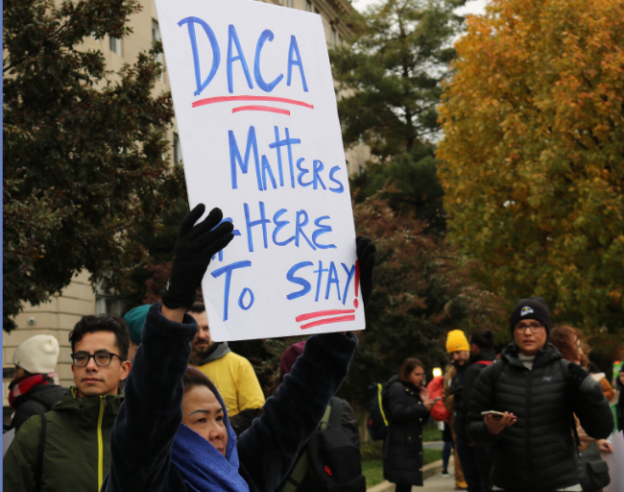
A Decade of DACA: Haziel’s Story
A Decade of DACA: Haziel’s Story
Haziel A.
June 15, 2022
At the age of three, I arrived in the United States with my aunt, grandparents, and older sister from La Paz, Bolivia. It was 2001 and my parents were not able to come with us due to a restriction in visa approvals after the 9/11 attacks, and their visas were denied for the next four years. I recall moments when I missed my parents and did not understand why we had to be apart. I eventually grew accustomed to not having my parents around.
Although I do not remember my parents outwardly telling me that I was undocumented, there were three instances when I realized that I was, in fact, undocumented and felt the repercussions of being undocumented. The first time was when I wanted to go on class trips in elementary school outside of the country and could not. The second time was when I saw my older sister, who is also undocumented, struggle to get through high school and college. The third one was when my father was detained by ICE at a traffic stop as he was coming home from work one night and taken to Farmville Detention Center. In 2012, I was 14 and Obama took executive action and announced that DACA would be enacted in Washington, D.C. I remember watching the announcement on TV feeling a sense of relief that I would not have to endure the struggles that my sister, my dad, and the community around me did.
Fast forward a decade to today, I recently graduated college from Virginia Commonwealth University with a Bachelor’s degree in Computer Information Systems. I have also gotten my driver’s license and have been able to apply and accept work in my field and moving constantly toward my dream job. While DACA has been able to secure me during my upbringing, the future of DACA is still and always will be at stake due to the fact that it is not a permanent protection. There are many things that I wish I had known growing up, one of them being that the looming uncertainty I have felt my entire life was caused by the fact that even when there was a “solution” presented by the government, it was never a permanent one. My dream for the future of this country is to repair and rebuild from the ground up as a collective to bring about real solutions in our flawed systems that do not feel like just Band-Aids. I believe that my family and our communities deserve to contribute and exist peacefully as we have always done even in the midst of all the disruption and chaos. Although DACA has given me many opportunities that I will forever be grateful for, for many, it is also a gatekeeping Band-Aid solution and a constant reminder to 825,000 of us that our undocumented communities are not wanted. It is ultimately a temporary solution to an even greater problem that this country needs to fully address.
Name abbreviated for anonymity.
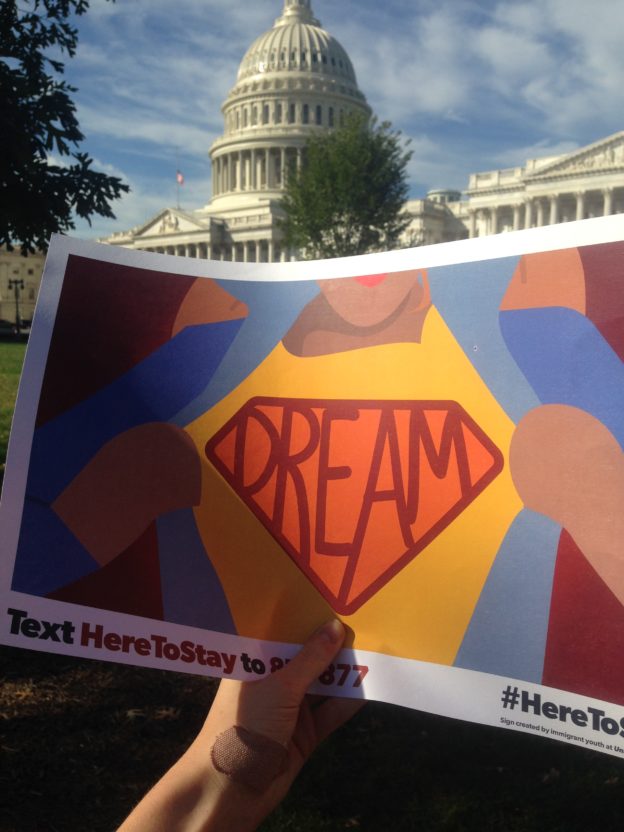
A Decade of DACA: Cecilia’s Story
A Decade of DACA: Cecilia’s Story
Cecilia Y.
June 14, 2022
As a child, we don’t see the world as it is. A child’s worries are not always the same as an adult’s. For some children, their worries may be getting a new toy, wondering what they’ll have for lunch, or even with whom they will play. For other children, their worries are wondering what their parents look like, where and with whom they sleep that night, or even worrying about their safety, security, shelter, and food. As a six-year-old, I had the same worries as the latter. I immigrated from El Salvador to live with my parents in the U.S. at this age. I left behind my family and friends I grew up with.
My parents were immigrants themselves, and we were constantly worried that if anything happened, anyone of us could be deported back to El Salvador. My parents worked jobs such as being a construction worker, doing house cleaning, and being a restaurant worker. All this was done so that in the future, I could receive the education they could not achieve.
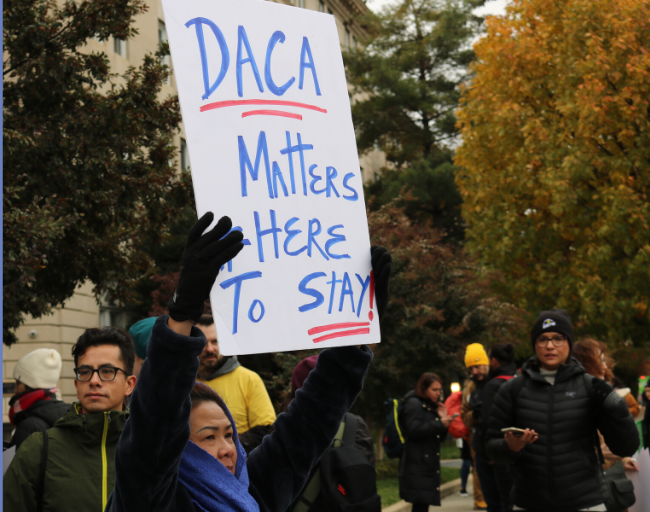 Coming to the U.S. was a difficult transition. I went to public school, where I learned how to speak English and helped others from other Spanish-speaking countries learn English, too. My joy in helping others began in elementary school and continues growing. I dreamed of helping others and supporting their dreams. I wanted to go to college so that I could obtain a degree that would allow me to be a teacher to teach, support, and care for children. Being a DACA recipient has made all of this possible.
In high school, I was afraid I wouldn’t go to college because I would have to pay out-of-state tuition, but DACA made it possible for me to search for organizations that support Dreamers in their educational journey. I was able to go to college and pay in-state tuition. During my time in college, I was financially helping my family. DACA allowed me to work at a part-time job. Now that I have graduated from college with a degree in Elementary Education, I can work at a school and help and support students in their learning and social development.
Until this day, I continue to worry about what will happen if my DACA is rejected. I worry that I will no longer be able to impact many students’ lives. I worry that I will be deported back to El Salvador even after I have made a life here in the U.S. I worry about the lives of those children who will lose their families and homes because they will no longer be able to work in their everyday jobs. My dream for the future of our country is to take that worry away from all those children and their families. Permanent protection for Dreamers will ensure they continue to make an impact in others’ lives, and it will provide protection for their families and for generations to come.
Name abbreviated for anonymity.
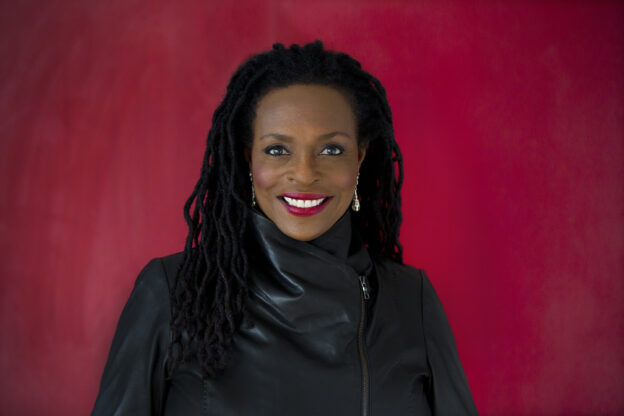
Rev. Dr. Jacqui Lewis Delivers Keynote Speech at H.R.40 Policy Update
Rev. Dr. Jacqui Lewis Delivers Keynote Speech at H.R.40 Policy Update
Elissa Hackerson
June 8, 2022
On June 1, 2022, NETWORK Lobby for Catholic Social Justice hosted a webinar to educate and mobilize advocates about an H.R.40-style federal reparations committee to study the impact of slavery — and the racist policies and laws that were created in its wake. NETWORK Staff was joined by Rev. Dr. Jacqui Lewis, Senior Minister for Public Theology and Transformation at Middle Collegiate Church in New York City. Rev. Lewis delivered a keynote speech that positioned reparations in a scriptural, theological framework for over 300 webinar attendees.
Rev. Lewis’s reflection zoomed in on human history with examples of humans capturing and conquering God’s people. And she challenged the ideology that some people deserve access to freedom and liberty more than others. She asserted that the ideology of whiteness has broken Black people, baptized the Holocaust, and broke Indigenous people. Reparations will bring healing, and we who have followed a Jewish rabbi into a world of faith seek repair.
Repairers of the Breach
Rev. Lewis began her remarks with scripture as a frame, choosing a beautiful call to the kind of worship, fasting and feast that God wants in Isaiah 58. “A call to be different kinds of faithful people. A call to Israel then, and to us now, to fix what’s broken in the world…to heal the world. When we do this, God says our names will be changed. We will be called repairers of the breach, restorers of streets to live in.”
Why Reparations?
“Because we have participated, friends, in the breaking of the covenant with God. In the breaking of God’s design, in the dismantling of God’s hope and dream for us. And, I’m not talking about what happened in the Garden [of Eden] where Adam and Eve disobey and eat of the tree of knowledge of good and evil.”
Sacrifice Honors God’s Creation
Rev. Lewis goes on to share that from our Biblical origin story until today, our human desire to be like God, to make a world with God, has been corrupted along the way. White supremacists have imposed their worldview and ideology in a biased way, subduing God’s people.
We are to fast, worship, welcome the outsider, feed the hungry, clothe the naked…not hold onto ideology and a sense of supremacy. This connection to repair and connection to God is the healing and reparations required to “restore the created order” and realize that everyone has enough in “God’s economy.”
Email Congress to Close the Medicare Coverage Gap and Save Lives

TELL CONGRESS: CLOSE THE MEDICAID COVERAGE GAP
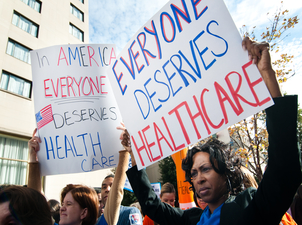 Over 2 million low-income adults living near the poverty line in 12 states don’t have health insurance. They earn less than $12,880 per year – too much to qualify for traditional Medicaid, but not enough for Affordable Care Act subsidies. Congress needs to finish the ACA and close the Medicaid Coverage gap in budget reconciliation so that people with limited financial resources can live healthier lives.

