
Tag Archives: social justice

Hispanic Heritage Gives New Life to Our Culture and Economy

Hispanic Heritage Gives New Life to Our Culture and Economy


This Month Reminds us of the Responsibility to Bring Culture, Faith, Community, and Resilience to Justice Work

Jonathan Alcantara
October 1, 2025


For Hispanic Heritage Month (September 15-October 15), NETWORK’s Sr. Carol Coston Fellows share their thoughts on the importance of this observance in the U.S. The following is Part 1 of two-part reflection by Jonathan Alcantara of Marquette University. (Read Part 2.)
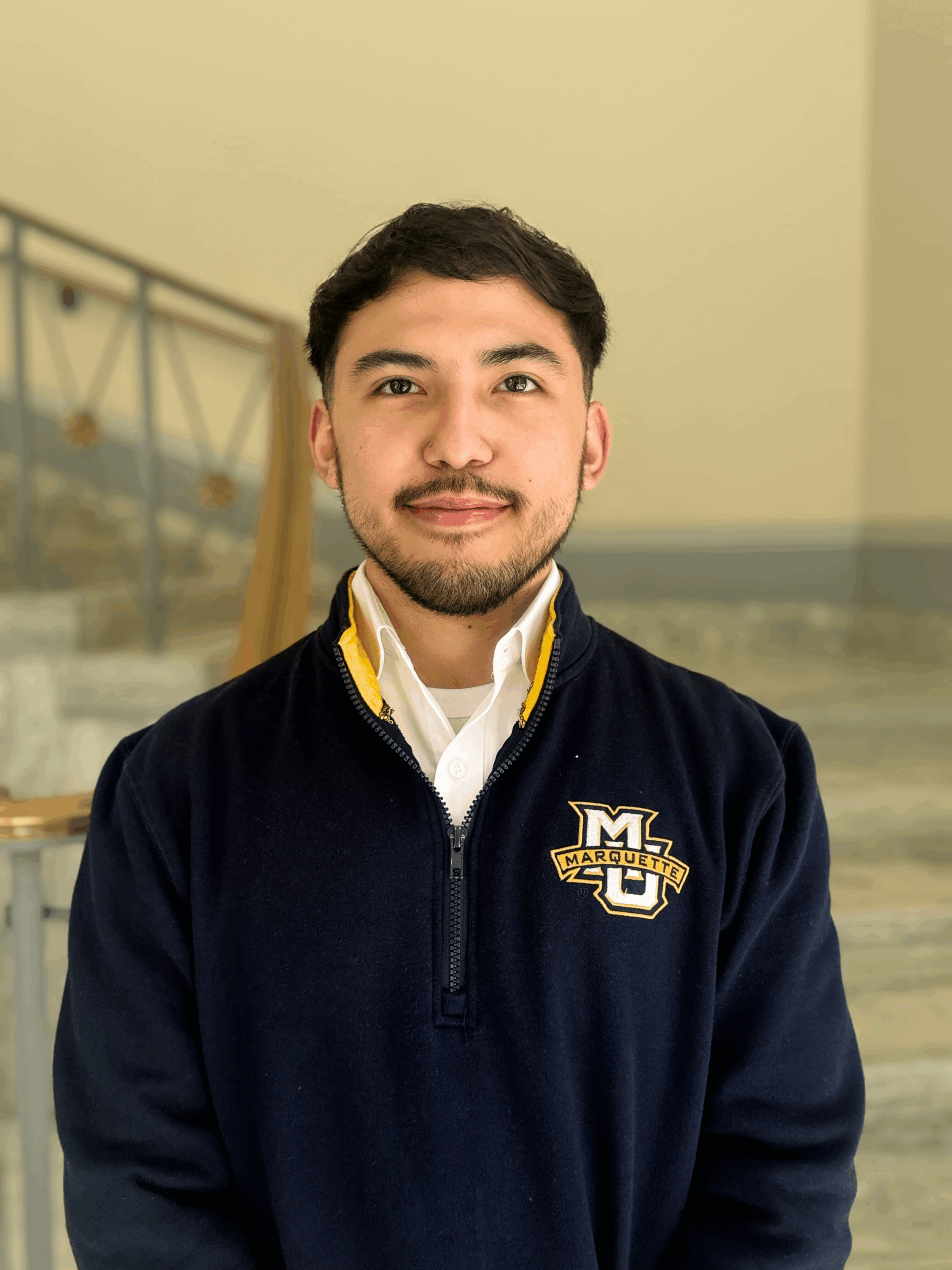
Jonathan Alcantara, a 2025 Sr. Carol Coston Fellow in NETWORK's Young Advocates Leadership Lab (Y.A.L.L.)

Jonathan Alcantara

Hispanic Heritage Month is not just a time for us to honor our cultura with music, food, faith, and festivals. It is also a reminder of the responsibility to carry the values of our culture, our faith, our community, and our resilience into the work of justice especially in times like these. To me, this time of the year is a celebración of who we are, where we come from, and the challenges we face to help positively shape where we are going in the future.

Growing up in the metro Atlanta area, I saw my Latino heritage recognized not only during celebrations but in the everyday actions of our determination. Our family gatherings were filled with stories, delicious authentic comida mexicana, laughter that makes our stomach hurt, and the occasional chisme, but through all this there were also unmistakable examples of our families’ hard work and sacrifice.

Those experiences continue to guide and shape me as a first-generation Mexican American college student. As a student studying finance at Marquette University, a Jesuit community that emphasizes service, community, and justice, I remind myself every day that my Mexican and Latino heritage is more than just a set of traditions passed down to each generation but it’s the light, the source that pushes and strengthens us to lead with purpose, to advocate for justice, and to build stronger communities and a more just nation.

As I sit and reflect on this year’s Hispanic Heritage Month, I cannot ignore las injusticias that MY Latino community has and is currently facing in 2025. The federal government has intensified immigration enforcements to drastic measures. The recent Supreme Court ruling has opened the door to racial profiling and aggressive deportations.

As a result, the fear that Latino communities and neighborhoods that has existed for years has deepened even further. Since January, families have lived in constant anxiety and worry about raids, deportations, and having their families separated. These actions not only harm families and individuals but break trust in public institutions and weaken the connections that unite and make our community strong and resilient.

Despite this, the impact and strength of our economic contributions speak for themselves. The 2025 Latino GPD in the U.S. has recently surpassed $4 trillion, making our community one of the most powerful and largest economies in the world. Latinos have some of the highest labor participation rates, strong entrepreneurship, and growing levels of higher education. Still the inequalities continue through unfair wage gaps sometimes even with a college degree. Latina women, specifically, experience some of the most significant gaps, earning less than both white women and Latino men, while Latino men’s earnings fall short of his peers despite having equal qualifications.

Whether we are Latino, Black, Asian, or White, we all deserve to be paid fairly for our work. It matters just as much that many families, not just Latinos, rely on programs like SNAP and Head Start which are being threatened by recent federal legislature like the summer reconciliation bill, and political playbooks like Project 2025. In reality, Latinos contribute to face unfair barriers while significantly contributing to the U.S. economy. Now more than ever, there needs to be change.

Learn more about NETWORK’s Young Advocates Leadership Lab (Y.A.L.L). Read Part 2 of this reflection.
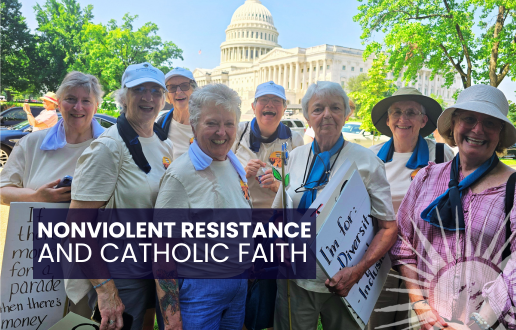
Sinsinawa Dominican Sisters from Wisconsin join in the Sisters Speak Out: Prayer and Public Witness for Immigrants and a Just Economy event on Capitol Hill on June 24.

Nonviolent Resistance and Catholic Faith

Nonviolent Resistance and Catholic Faith

Two Traditions Promote Beloved Community

Virginia Schilder
September 23, 2025
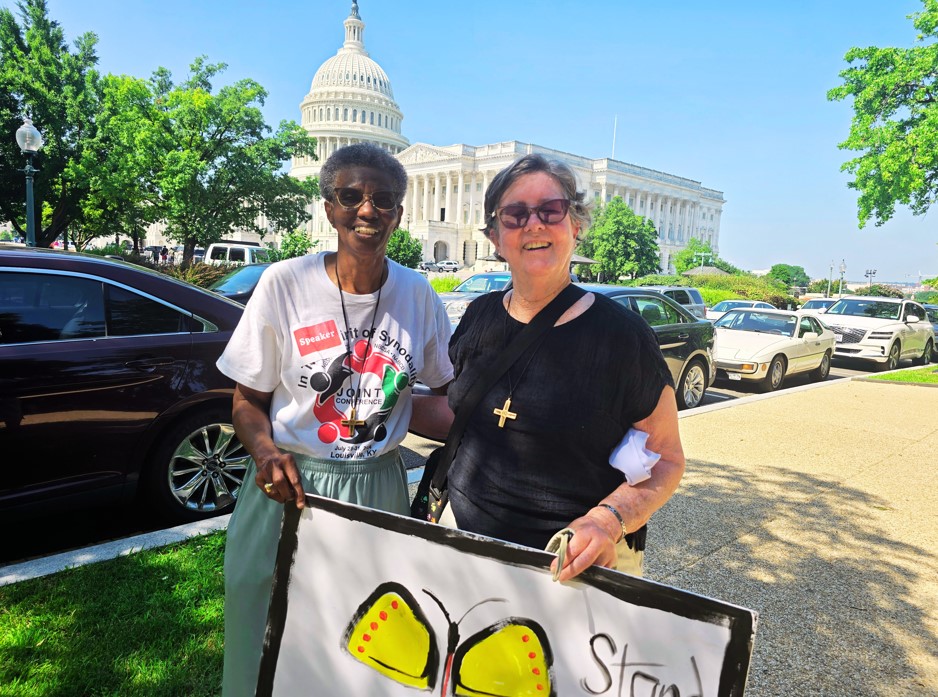
Sr. Patty Chappell andSr. Ann Howard, SNDdeN hold a sign at the June 24 Sisters Speak Out event on Capitol Hill.

Sr. Ann Howard, SNDdeN hold a sign at the June 24 Sisters Speak Out : Prayer and Public Witness for Immigrants and a Just Economy event on Capitol Hill.

Before this year, Aiden Bondurant had only ever protested one time: against the execution of Khaliifah Williams in Missouri. But in just the first half of 2025, she went to five protests — joining her community members in voicing their opposition to the deportations of immigrants, predatory ICE arrests at courthouses, and the proposed budget that would hand tax breaks to the ultra-wealthy by slashing programs like Medicaid and SNAP.

“It was clear that for the hundred people protesting on the street, there were thousands more in our community who felt the same,” Bondurant says. She recalls many passing cars affirming the protests with their “honks of support.”

Bondurant is one of the millions of people across the U.S. who have taken part in peaceful protests since the second Trump administration took office. These protestors are regular people who share a fundamental belief in a future where all can thrive. They are people who refuse the lies that try to pit them against their neighbors and who insist that they can together make life better in their communities.

History affirms their insistence. Countries that have started to slide into fascism have been able to redirect towards democracy through nonviolent civil resistance from ordinary people. Research from Erica Chenoweth, a researcher at Harvard University, shows that it only takes about 3.5 percent of the population actively engaging in protests to effect real, lasting change. In the U.S., that’s around 11 million people — about the population of North Carolina.

Advocates in action

Today, millions of peaceful demonstrators across the country are joined by hundreds of NETWORK justice-seekers, including members of NETWORK Advocates teams like Mary Nelson, OFS, and Krista Zivkovich.

Nelson, a Secular Franciscan and retired physical therapist, is the leader of the Western Pennsylvania NETWORK Advocates Team. Along with the several communities of women religious in her local Erie area, Nelson participates in regular protests. Lately, the focus of those demonstrations has shifted to making sure Erie upholds its designation as a “Welcoming City” to its many refugee and immigrant community members.

Nelson comes to nonviolent protest guided by the rules that direct her life as a Secular Franciscan, which call members to “be in the forefront in promoting justice by the testimony of their human lives and courageous initiatives.”

She prays, “I am hopeful that more people will feel comfortable speaking out against the tyranny and injustice we are currently facing.”

Krista and Ed Zivkovich participate at an Ohio Hands Off rally in April.

Krista and Ed Zivkovich participate at an Ohio Hands Off rally in April.

Nearby in Ohio, Krista Zivkovich was inspired the join the Cleveland NETWORK Advocates Team by the first Nuns on the Bus tour. She describes herself as “a Matthew 25 Catholic,” guided by the question, “Why aren’t you doing what you say you believe?”

Zivkovich and her husband have joined in many nonviolent protests over the years, from local protests with Moms Demand Action for gun safety reform to calling for climate action in Washington, D.C. When some of her fellow parishioners at her church in Painesville were deported during the first Trump administration, she joined prayer pilgrimages hosted by her parish.

Since President Trump returned to office, Zivkovich has been to five protests, including ones targeted to her Congressman David Joyce (OH-14), who has held no local in-person town halls. Because her husband runs the food pantry at their parish, the couple knows how communities rely on SNAP and other food programs — knowledge she shares with her Congressman’s staff.

“Rev. Theodore Hesburgh said, ‘Voting is a civil sacrament,’” Zivkovich explains. “I believe that peaceful protests calling for adequate funding for food, health care, truth in government, etc., are also civic sacraments. Visible signs of our belief that the government should uphold the life and dignity of all.”

NETWORK advocates like Zivkovich, Nelson, and Bondurant join a long tradition of faith-based civil resistance, in which Catholics play a central role. The history of Catholic nonviolence includes landmark figures like Dorothy Day who protested war and poverty, and Sr. Antona Ebo, FSM, who marched at Selma for civil rights.

Day and Ebo are just two of scores of Catholics who drew from a rich array of the Catholic tradition’s resources to ground, nurture, and guide participation in nonviolent protest and public witness for justice. And of course, the example of Jesus himself is a key source.

“Jesus is the ultimate model of active nonviolence,” Sr. Louise Lears, SC affirms.

From injustice to love and hope
Sr. Louise Leers, SC speaks at a Cleveland townhall on the 2024 Nuns on the Bus & Friends Vote Our Future tour. Photo Jacob Schatz, CCR Studios

Sr. Louise Leers, SC
Photo: Jacob Schatz, CCR Studios

The Sisters of Charity of Cincinnati charism statement concludes with the words, “We dare to risk a caring response.” For two Sisters of Charity we spoke with, “risking a caring response” has meant a decades-long commitment to nonviolent protest.

Sr. Louise’s first experience with nonviolent resistance was in the 1980s at a nuclear weapons test site in Nevada. That experience kicked off her long commitment to peaceful resistance. This has included actions like the March For Our Lives, the Hands Off rallies, and the Poor People’s Campaign. She has joined rallies and marches, fasted for a moral budget, and held protest signs with other Sisters on busy streets.

Sr. Mary Ann Humbert, SC, spent 10 years traveling to protest the School of the Americas in Fort Benning, Georgia, notorious for its training of Latin American military personnel. “We all knew the risk of ‘crossing the line’ onto government property — for which we could be arrested,” she says. “Jesus spent his attention to both the victimized and the authorities who were carrying out unjust laws and expectations. I feel called to do the same to the best of my ability.”

While some, like Srs. Louise and Mary Ann, have been protesting for decades, others are newer to demonstrating. Sr. Betty McVeigh, a Sister of St. Joseph of Philadelphia (Chestnut Hill), began her involvement in nonviolent protests only after health challenges moved her to retire from 51 years in ministry in education and pastoral work.

She has found that, “It is in the reaching out, making connections, and building bridges that I discover the courage to participate in nonviolent protests and to advocate for justice.”

Those bridges are also built in smaller-scale acts of care. Sr. Caroljean Willie, a Sister of Charity of Cincinatti, Ohio recounts one experience: “Midway through the protest, a pickup truck filled with immigrants drove by and passed out water to all the participants. It was an incredible feeling of ‘We are in this together.’” She adds, “The main fruit of this work is that it brings an awareness to others that people care about justice, that people care about others, that people care about the world in which we live.”

These acts of care are central to the power of nonviolent action. They make the protests themselves bring to life the beloved community of mutual care, joyfulness, and healed relationships. As these participants know, nonviolent resistance has never been only about acting against injustice, but acting for loving communities.

“The injustices we see around us often stem from fear, division, and isolation,” Aiden Bondurant notes. “For me, nonviolent protest is a lamenting act of love.” She adds, “We are meant
to be together, and Christ always invites us to that.”

Spirit-filled hope permeates nonviolent action, and it grows in the new relationships formed there.

“Participating in these peaceful protests most of all gives me hope. I meet and share with other people who share my concerns and have compassion,” Krista Zivkovich says.

Sister Louise Lears believes that finding hope is a fitting response.

“I have learned that nonviolence is a circle, and everyone has a place in the circle,” she says. “Any action on behalf of justice has ripple effects.”

This story was published in the Quarter 3 2025 issue of Connection.