



Profiles in Hunger
When States Cut Nutrition Programs, We See Immediate Harm
Erica Walden
May 6, 2026
The Farm Bill presents a timely and critical opportunity for Congress to restore and strengthen SNAP. But the current House Farm Bill—the Farm, Food, and National Security Act of 2026 (H.R.7567)—misses that opportunity as written. The Senate must reject the current flawed House Farm Bill that does not reverse any of the crushing SNAP cuts and program changes. Instead, Congress must take immediate action to restore critical SNAP funding. Will you join us today in writing to our Senators, asking them to vote NO on the flawed House Farm Bill (H.R.7567), and instead restore critical SNAP funding?
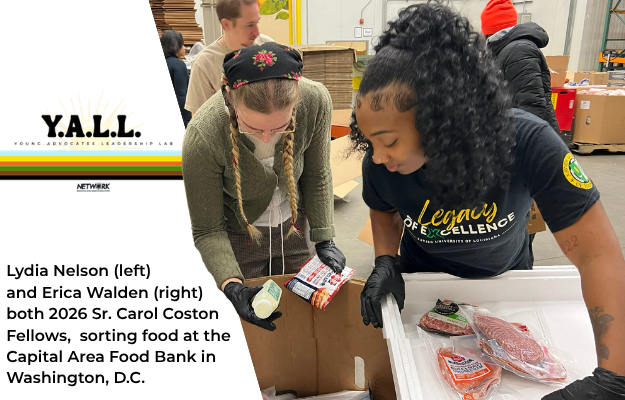
This reflection from Erica Walden, a 2026 Sr. Carol Coston Fellow with NETWORK’s Young Advocates Leadership Lab (Y.A.L.L.), show the devastating difference that policy changes make in the lives of people who need access to food:
Lack of access to food is a source of systemic oppression in the U.S., deeply tied to public health, economic stability, and social equity. The Supplemental Nutrition Assistance Program (SNAP) serves as a primary defense against hunger for millions of people, yet recent, inhumane changes to federal policy reveal how vulnerable these programs are.
Recent data from states such as Arizona, Pennsylvania, and New York demonstrate that without strong federal advocacy, food assistance programs can quickly become unstable, leaving large populations at risk.
In Arizona, as a result of the state implementing changes in keeping with President Trump’s Big Budget Bill, including stricter work reporting requirements and limits on eligibility. According to recent data provided by ABC 15, “SNAP enrollment has fallen dramatically in Arizona in just three months,” with “about 533,000 people” receiving benefits in January, marking “a 31% decline from October.”
This significant drop highlights how quickly access to food assistance can change, often not because fewer people need help, but because of administrative or policy shifts. When hundreds of thousands of individuals lose access to benefits in such a short time, it worsens food insecurity, especially for low-income families who rely on SNAP as a primary food support.
Similarly, in Pennsylvania, policy changes at the federal level have directly impacted SNAP participation. Reports from WJACTV indicate, “Nearly 60,000 Pennsylvanians have lost SNAP benefits since September… likely tied to changes in work reporting requirements mandated by a Congressional Republicans’ budget bill signed into law by President Trump.”
Work reporting requirements, while intended to encourage employment, often fail to account for the realities faced by vulnerable populations, such as inconsistent work hours, caregiving responsibilities, or lack of access to transportation. The examples from Arizona, Pennsylvania, and New York (which also introduced stricter work reporting requirements, leading to 180,000 people leaving SNAP) clearly demonstrate that food security in the United States is highly sensitive to federal policy decisions.
Access to food assistance can vary dramatically depending on where someone lives. This creates a patchwork system in which some states may implement stricter requirements or administrative barriers, while others provide more accessible support. Advocacy at the national level helps establish baseline protections that ensure all people, regardless of geography, have access to the resources they need to avoid hunger.
Reliable access to food is closely linked to broader economic outcomes. When individuals and families have enough to eat, they are better able to work, attend school, and contribute to their communities. When children go to school, they can focus on their work instead of their hunger.
Conversely, food insecurity can lead to increased healthcare costs, reduced productivity, and long-term developmental issues for children. Dramatic declines in SNAP enrollment and the implementation of stricter work reporting requirements reveal how quickly access to food assistance can be reduced, often affecting millions of people. It diminishes the consideration of people’s humanity, treating access to food as if it were a business.
By prioritizing food security at the national level, we can better protect our neighbors and promote a healthier, more stable society. By advocating for strong federal food assistance programs, we can address not only immediate hunger but also the long-term economic health of the country.
Erica Walden is a student at Xavier University of Louisiana and a Sr. Carol Coston Fellow in NETWORK’s Young Advocates Leadership Lab (Y.A.L.L.).

Thank y’all for your efforts in serious civic engagement!