

Category Archives: Front Page

Join Repair and Redress: A NETWORK Vigil in Clevelan

Register for Repair and Redress: A Vigil for Reparations in Cleveland (In-Person)

Cleveland Reparations Vigil (in-person)

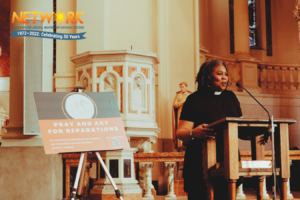
NETWORK Lobby for Catholic Social Justice hosted Repair and Redress: A Vigil for Reparations (In-Person) on Wednesday, June 15, 2022 at St. Aloysius – St. Agatha Parish in Cleveland, OH. People in the parish church and school community, sisters, the Cleveland NETWORK Advocates Team, justice-seekers, and NETWORK staff made a powerful, holy stand for reparations for Black Americans and called for an H.R.40-style reparations commission by Juneteenth.

Reverend Traci Blackmon, Associate General Minister, Justice and Local Church Ministries (United Church of Christ), The United Church of Christ led the opening prayer and gave stirring  remarks.

You can click here (or on the image below) to watch some of Rev. Blackmon’s remarks.

Want to learn more about Cleveland’s NETWORK Advocates, who are volunteer justice-seekers rooted in the community, or about future reparations events and actions? Contact Catherine Gillette, NETWORK Grassroots Mobilization Organizer or Sister Eilis McCulloh, HM, Grassroots Mobilization Fellow.

Tell Congress to Close the Medicare Coverage Gap and Protect Black Mothers and Babies and essential workers

Email Congress to Close the Medicare Coverage Gap and Save Lives

TELL CONGRESS: CLOSE THE MEDICAID COVERAGE GAP

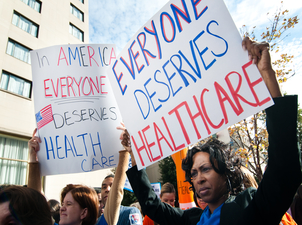
Healthcare is a human rightOver 2 million low-income adults living near the poverty line in 12 states don’t have health insurance. They earn less than $12,880 per year – too much to qualify for traditional Medicaid, but not enough for Affordable Care Act subsidies. Congress needs to finish the ACA and close the Medicaid Coverage gap in budget reconciliation so that people with limited financial resources can live healthier lives.


Email Congress and let them know: budget reconciliation must close the Medicaid coverage gap.

Grassroots Mobilization Team Announces 2022 Summer Social Justice Workshops

Summer Social Justice Workshop Series Ends Soon

NETWORK Lobby’s Grassroots Mobilization Team has two remaining 2022 Summer Social Justice Workshops this month. We hope you can register for one and bring friends and family with you! Are you interested in attending future workshops and trainings? Please complete the form at the bottom of this page.

Racial Wealth and Income Gap Workshop

The median wealth gap between Black and white families in the United States is one of the more glaring symptoms of our racially unjust economic system. In fact, in 2019 white families had 7 times the wealth of Black families. This massive difference in wealth is no accident. Instead, it was created and has been sustained by generations of racist federal policies.

NETWORK’s Racial Wealth and Income Gap workshop combines an informational presentation, interactive simulation, individual reflections, and group discussion to educate participants about the origins of our nation’s racial wealth and income gap.

Over the course of the workshop, participants engage with 12 different federal policies, implemented throughout our nation’s history, which led to the intentional divestment of the Black community and provided the structure for what we understand as white privilege today. The workshop dispels claims of America’s meritocracy as well as popular “bootstrap” narratives by providing participants with an opportunity to examine the institutional and political realities of racism. We’re proud to offer this workshop

Thurs.,  July 12, 12:30 pm ET | 9:30 am PT


The June 29th workshop is over.

Tax Justice for All – Unveiling the Racist Impacts of the U.S. Tax Code

This interactive workshop tackles the issue of inequality in the U.S. tax code. You will follow five different families through a lifetime of tax code implications to see the ways the U.S. tax code disadvantages women and people of color. Participants will then work together to reimagine the tax code and see how we can use the tax code to create a society that truly advances us toward justice for all. (Both sessions will cover the same content.

Join us for one of our upcoming dates and help us reimagine a tax system that leaves no one behind!

We are unable to record these sessions.

Thurs., July 7, 12:30 pm ET | 9:30 am PT


The June 14th workshop is over.

Transformative Conversations to Bridge Divides

In our increasingly polarized society, many of us avoid engaging in tough conversations, especially with loved ones with differing beliefs. But rather than avoiding these difficult conversations, it is essential to engage and be in relationship with those with whom we disagree. As Pope Francis reminds us: “differences are creative; they create tension and in the resolution of tension lies humanity’s progress.”

We invite you to join one of our upcoming Transformative Conversations to Bridge Divides workshops. In this workshop, participants will explore the ways society is structured to divide us and develop the skills needed to begin to break down those divides with their loved ones.

The June 9 workshop is over.

The June 22 workshop is over.

[ninja_form id=”1″]

Hopes for a Reparations Commission Moves to the White House

Hopes for a Reparations Commission Moves to the White House

Julia Morris
June 1, 2022

For over a year the drum beat for reparations has been building. After 30 years of Congressional delays, for the first time on January 4, 2021 H.R. 40 made it out of committee and onto the House floor. House leadership knows this will not pass in the Senate, so the pressure is now on the Biden Administration to establish a committee to execute a reparations study, which will lay out the plan to make amends for the United States original sin of slavery and the systemic racial oppression that followed. Reparatory justice activists, social justice groups, and faith-based organizations are urging the Biden Administration this spring to finally follow through on a commitment made on the 2020 campaign trail. The Biden-Harris campaign promised, in ‘Lift Every Voice: The Biden Plan for Black America’, to tackle systemic racism and the continuing impacts of slavery by “supporting a study of reparations.” 

You may ask what would this look like? A commission will study the impact of 400+ years of racist policies, laws, and practices that have deprived Blacks fair access to participation in America’s cultural, political, social and economic life. Join NETWORK in calling for President Biden to establish a commission to study reparations via executive order, call the White House at 1-888-422-4555 or email the White House here. 

The commission would evaluate programs like the Homestead Act and the GI Bill. Both were federal programs designed to help families achieve economic footing in times of change. The Homestead Act granted land out West at the turn of the 20th Century, and the GI Bill helped forge the middle class after World War II with home buying and educational opportunities for veterans These programs paved the way for the US middle class, it was not accidental or unintentional that these programs were denied to Black families. In fact, today schools are more segregated now that they were at the time of Brown vs. Board of Education. 

Chattel slavery was abolished in 1865, but because of the legacy of discrimination that flows from slavery, the Black community continues to suffer. For too long in this country, the expectation and delivery of better housing, education, jobs – has only been a reality for white families. The legacy of being Black is discrimination and oppression. We see it in our societal frameworks, access to fair wages and quality employment, the criminal legal system 

What is not named cannot be healed. This is a historic opportunity to, using the frame of the Catholic tradition, name our original sin of slavery and move towards repair.  

NETWORK is joining with partner organizations to urge President Biden to create a federal commission to study reparations by Juneteenth (June 19, 2022). Add your voice, call the White House at 1-888-422-4555. Or email President Biden to issue an executive order to create a federal commission to study reparations today!

From the Archives: Called to Challenge the Treatment of Poverty

From the Archives: NETWORK’s Vision Comes to Life

Sr. Mara Rutten, RSM
July 20, 2022

Dear Friend,

This week, I am back again with another story about the people and events that made NETWORK the organization it is today. This time, we’ll fast-forward to the 1990s and explore a key project from NETWORK’s long history of advocating for economic justice.

Some of NETWORK’s most spirited organizing and lobbying in the 1990s came in response to President Bill Clinton’s “Welfare Reform.” As far as NETWORK was concerned, the “reform” was an affront to the dignity of the human person, in particular, low-income families. NETWORK made sure the President and Congress knew how unjust the proposed welfare legislation was.

NETWORK's 1977 Legislative SeminarParticipants, 1970's

As President Clinton signed the 1996 Personal Responsibility and Work Opportunity Reconciliation Act into law, NETWORK staff, including Executive Director Sr. Kathy Thornton, RSM, marched in protest outside the White House gates.

By 1996, we were 20 years into lobbying and organizing and we knew what we had to do: form partnerships, lobby and testify before Congress, and rally at the White House. Of course, we surveyed those closest to the pain of poverty to find out what they actually needed from policy and how they’d be impacted by President Clinton’s new law.

NETWORK believed the measures supported by President Clinton would make life worse for the 35 million people who struggled with poverty. NETWORK wasn’t alone. The Daughters of Charity, the Sisters of Mercy, the Federation of the Sisters of St. Joseph, and Pax Christi USA joined us to form the Welfare Reform Watch Project.

Our strategy was long range and considered diverse geographical areas. The nationwide, multi-year project rigorously monitored the new legislation in order to evaluate both its effectiveness and its limitations. The first Welfare Reform Watch Project report, “Poverty Amid Plenty,” was released in April 1999.

This report was the focus of NETWORK’s 1999 Lobby Day on Welfare Reform. The day began with a policy seminar on Capitol Hill attended by nine members of Congress and staff from 66 Congressional offices! Then, 62 NETWORK members left to lobby more than 50 Congressional offices.

While the 1999 Lobby Day was quite successful on Capitol Hill (thanks to the 400 NETWORK members who wrote their Members of Congress inviting them to the policy seminar), there would be many more Lobby Days in the years to come. Our economic justice advocacy on the Hill continues to this day, and I look forward to many more successful lobbying efforts in the coming weeks, months, and years.

This essay is part of a collection shared by NETWORK historian, Dr. Mara D. Rutten, to celebrate our 50th anniversary. To read more from the archives, click the links below.

Read From the Archives: NETWORK’s Vision Comes to Life
Read From the Archives: Spirit at Work from the Beginning

NETWORK’s history in our Cool Timeline

NETWORK Lobby Advocates for Catholic Social Justice

Ecological Justice Means Economic Justice

Laudato Si Week Calls Us To Reject Oppressive Structures

Virginia Schilder
May 26, 2022

This is part two in a three part reflection on Laudato Si Week (May 22-29, 2022) which celebrates the anniversary of Pope Francis’ encyclical on integral ecology and care for creation by inviting all people of goodwill and prayer and study to on how they can tackle the climate crisis. 

Read Part One Here | Read Part Three Here

Ecological injustice is intimately linked to economic injustice. They both refer to how we live in our common home, Earth – in fact, the “eco” in both “ecology” and “economy” comes from the Greek word “oikos,” meaning house!

At present, we distribute the resources of our home through a global economy that is based on accumulation, consumption, competition, extraction, and exploitation. Global, imperial capitalism has long been driving the degradation of local sustainable economies and food systems, as well as natural resources depletion, habitat destruction, and the mass pollution that has created climate change. In this way, our capitalist system and its concentration of resources is fundamentally at odds with ecological flourishing, which is predicated on practices of sharing, cooperation, reciprocity, and respecting limits.

The central role of capitalism in ecological degradation further exemplifies the way in which the ecological crisis is inseparable from our structures of economic, racial, and social oppression. All of these interconnected realities reflect a need for something that Pope Francis calls “integral ecology” in his 2015 encyclical Laudato Si.

Integral ecology refers to an interstructural and holistic approach to political, social, economic, and environmental problems. What integral ecology gets at, essentially, is that we live in an interconnected world. We are connected to each other, as well as to the Earth’s lands, waters, air, non-human life, and climate. Similarly, structures of power and oppression – such as capitalism, racism, patriarchy, and colonialism – are also intertwined.

This is why Pope Francis observes, “We are not faced with two separate crises, one environmental and the other social, but rather one complex crisis which is both social and environmental.” Francis emphasizes that the health of our institutions has implications for the health of the environment, our bodies, and our communities. As a result, Francis offers, “Strategies for a solution demand an integrated approach to combating poverty, restoring dignity to the excluded, and at the same time protecting nature.”

Integral ecology has much to teach us about ourselves as holistic, interdependent communities. It helps us see the ways in which our present socioeconomic structures disrupt harmony with other humans and the Earth. Many of us may feel alienated from one another, from the land we inhabit and the other creatures around us, from what we produce and what we consume. But in ecosystems, all beings are enwrapped in an enormous web of reciprocal interrelation.

Jesuit Fr. Thomas Reese highlights Pope Francis’ teaching that “Relationships take place at the atomic and molecular level, between plants and animals, and among species in ecological networks and systems. For example, [Francis] points out, ‘We need only recall how ecosystems interact in dispersing carbon dioxide, purifying water, controlling illnesses and epidemics, forming soil, breaking down waste, and in many other ways which we overlook or simply do not know about.’”

We too are embedded in these webs. Pope Francis affirms that the natural world is not simply our “environment.” Nature is not something separate from us, nor the mere setting in which we live. Rather, “we are a part of nature.” Plants, animals, the air, water, fungi, bacteria, and soils are members of our communities — or rather, we are members of their communities! — and our flourishing is linked to theirs.

We have the choice of either participating in our ecosystems with care and respect, or forgetting our embeddedness, taking more than we need, and ravaging the land and each another.

Virginia Schilder, a graduate student attending divinity school in Massachusetts, completed a one-year fellowship with NETWORK’s Communications team in early May 2022.

NETWORK Lobby Advocates for Catholic Social Justice

Ecological Justice Means Racial Justice

Laudato Si Week Calls Us To Recognize Our Interrelatedness

Virginia Schilder
May 24, 2022

This is part one in a three part reflection on Laudato Si Week (May 22-29, 2022), which celebrates the anniversary of Pope Francis’ encyclical on integral ecology and care for creation by inviting all people of goodwill and prayer and study to on how they can tackle the climate crisis.

Read Part Two Here |Read Part Three Here

Ecological justice is about more than ending climate change and restoring damaged landscapes. It is about recognizing our interrelatedness and interdependence with one another, with land, air, and water, and with the non-human life forms alongside us — and then creating social and economic structures that affirm this reality.

At NETWORK, ecological concern permeates all of the policy areas we work in. As we promote the Build Anew agenda specifically, what does it mean to prioritize ecological health and cultivate an ecological orientation?

On one level, it means that our policies must always keep ecological impact in mind. No policy can be fully just if it comes at the expense of our lands, waters, air, or other living beings. This is especially true for job creation, which does not truly help our communities if the new jobs are in the business of exploiting the very resources we need to live. It is critical that as communities grow – with more housing, schools, libraries, parks, and food markets – that development is focused on meeting real needs instead of ceaseless land conversion that depletes natural spaces, pushes out long-term inhabitants (both human and non-human), and accelerates pollution.

Dr. Kate Ward, assistant professor of theology at Marquette University, wrote last year in Connection magazine, “Integral development is a distinctively Catholic reassessment of economic development. Just like national budgets can be both moral and immoral documents, so also economic development can impede or impel authentic human development.”

Rather than alienate us from ecosystems, all forms of development should strengthen our ecological relationships and uphold ecological well-being. All policies have ecological effects, meaning ecological impact should be at the forefront of all policy discussions.   But going even further, an ecological orientation in our policy work means a holistic, multi-issue commitment to transforming the structures that denigrate human beings and the Earth alike.

The intertwining exploitation of people and land is evident in the way that women, the economically marginalized, and Black, Brown, and Indigenous communities are disproportionately harmed by ecological destruction. While climate change affects everyone, these populations are made especially vulnerable to inadequate infrastructure, poor water quality, deforestation, hazardous waste, and increased exposure to climate change-driven disasters and displacement.

Environmental racism refers to the reality that communities of color bear most of the burden of environmental degradation. Communities of color frequently face restricted access to clean air and water, green spaces, and nutritious and locally-sourced food. These forms of racism severely threaten the health of communities of color, especially as toxic waste facilities and highways are overwhelmingly (and intentionally) built in Black and Brown neighborhoods.

Environmental racism implicates housing, food, public health, and economic policy. Measures such as creating accessible, affordable housing and ending racist zoning practices have not only racial but also significant ecological justice dimensions.

Virginia Schilder, a graduate student attending divinity school in Massachusetts, completed a one-year fellowship with NETWORK’s Communications team in early May 2022.

NETWORK Mourns the Lives Lost in Uvalde

NETWORK Mourns the Lives Lost in Uvalde

May 24, 2022

We grieve the murder of innocent children in Uvalde, Texas. The loss of so many lives to gun violence in our country is a tragedy that must not be acceptable to us or to our elected officials.

This perpetual violence in our society is evil. We must envision, and create, a better future. May we come together to transform our politics and transform our country so that we consistently affirm and protect the God-given dignity of every person,

We hold the children, families, teachers, and entire Uvalde community in our prayers  and all whose lives have been impacted by gun violence.

Prayer: Let the Shooting End from Sisters of Mercy of the Americas.

Social Poet Award Winners | NETWORK Lobby Celebrates 50 years of Justice

Social Poets are Writing the Future

In Young Activists, NETWORK Sees What Pope Francis Sees

Don Clemmer
May 22, 2022
Social Poet Award Winners | NETWORK Lobby Celebrates 50 years of Justice

NETWORK’s 2022 Social Poet awardees at the 50th anniversary gala, Justice Ablaze.

On his 2015 trip to Bolivia, Pope Francis addressed social activists gathered there for the second World Meeting of Popular Movements. He told them that “popular movements play an essential role, not only by making demands and lodging protests, but even more basically by being creative. You are social poets: creators of work, builders of housing, producers of food, above all for people left behind by the world market.”

The following year, addressing these same groups gathered in Rome, he added that the popular movements “are sowers of change, promoters of a process involving millions of actions, great and small, creatively intertwined like words in a poem.” In his 2021 address to the same gathering, he began simply, “Dear social poets.”

Pope Francis’ messages to the Popular Movements have included some of the most striking rhetoric of his pontificate, decrying demagogues who exploit people’s anger and fear to demonize immigrants and other people pushed to the margins of society. In 2021, he said that protests following the murder of George Floyd most reminded him of the Good Samaritan in the world today.

NETWORK joins Pope Francis in centering the importance of young activists in the work of writing a better future for the world, one that dismantles systemic racism, roots the economy in solidarity, cultivates inclusive community, and transforms politics. So for NETWORK’s 50th anniversary, we honor four young activists as “Social Poets.” The four inaugural recipients of this award write with their lives the challenges and transformative potential that the decades ahead hold for those pursuing justice in the name of the Gospel.

Taylor McGee | Catholic Social Poet
Taylor McGee celebrates her social poets award with her mother at NETWORK's Justice Ablaze gala

Taylor celebrates her social poets award with her mother at NETWORK’s Justice Ablaze gala.

A faith-based justice-seeker studying at St. Edward’s University in Austin, Taylor McGee has a gift for convening people from different backgrounds in faith contexts and using the encounter to open up old or familiar ideas about God and the world in new ways. As a faith and culture leader for St. Edward’s campus ministry, McGee, 20, has led an Earth Day event featuring discussion of Pope Francis’ Laudato Si’; a fish fry that invited local Black-owned businesses to campus and featured Black gospel music; and — her favorite — a virtual art exhibit, “Mirroring Mary,” which curated images of Mary from the various cultures represented on the St. Edward’s campus.

“I’ve been so blessed to have a great community given to me and understanding the similarities and differences within that community,” says McGee, adding, “If this is a community that I’m trying to serve, then I need to be in that community.” A Black woman and a cradle Catholic who has had to step back to see the eurocentrism of her own experience of church, she has majored in religious studies because, in part, “As a Black woman, you have to have that credibility.”

She credits Pope Francis for being explicit in his naming of problems in society, since working around problems without naming them leaves room for people to mute them. “I’m still in the South, and I know how things are,” she notes. But still she sees “Do everything in love” as what it is to be a social poet. This means “to be explicit in love and to not condemn and to not condemn people for their unlearning,” which can be challenging in activist spaces. But God invites everyone.

Ivonne Ramirez | Catholic Social Poet

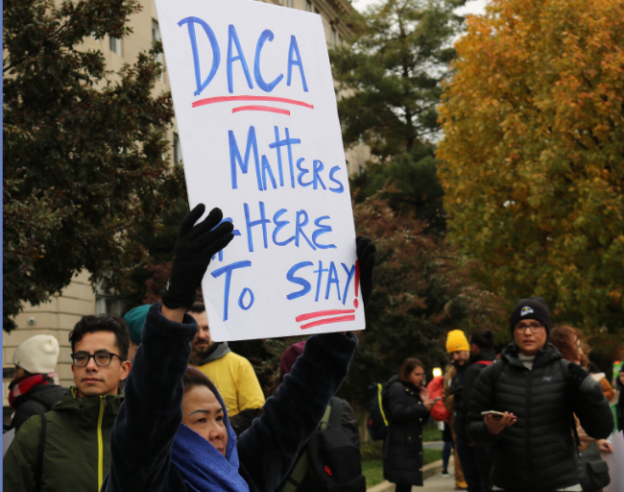
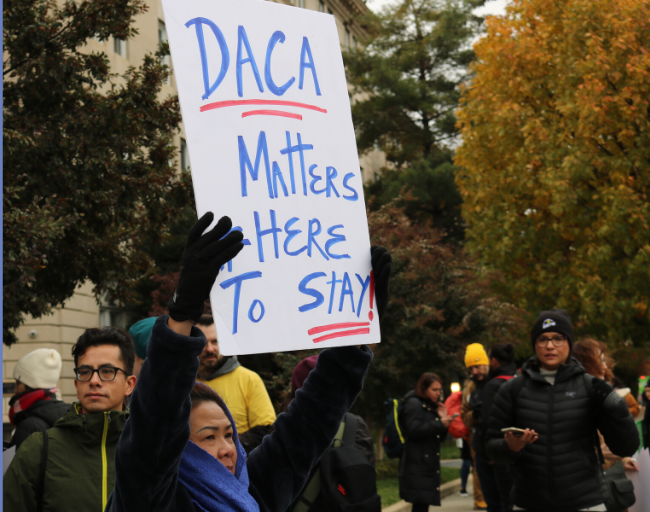
Ivonne Ramirez uses educIvonne Ramirez, Catholic Social Poet Award Winner | NETWORK Lobby Celebrates 50 years of Justiceation and advocacy in her efforts to change the hearts and minds of fellow Catholics regarding the plight of DACA recipients like herself living in the Archdiocese of St. Louis. “If you are a devout Catholic, you should be with us, not against us,” Ramirez, 27, says of the need for the Church to be in solidarity with immigrants, especially young people who do not have documented status in the U.S. “These are your neighbors. … We need to teach people what is DACA and what it looks like in our parish.”

Ramirez is a catechist at Our Lady of Guadalupe, a predominantly Spanish speaking low to moderate income parish in Ferguson, Missouri, and also chaperones teen events and is a frequent speaker at parish teen retreats. Her mentor and role model is Sr. Cathy Doherty, SSND. “We’re starting a movement. We’re slowing and surely starting to see,”

Ramirez says of her efforts to educate priests and other church leaders to address immigration with their communities. This includes a recent meeting of several DACA recipients with St. Louis Archbishop Mitchell Rozanski to share their stories.

As DACA recipients can’t vote, she especially wants to communicate to people that they have power to help their neighbors and that who they elect matters. Ramirez also says the popular term for DACA recipients – “Dreamers” – is a misnomer. “We’re not dreaming. We’re actually working for something,” she says.

Marie Kenyon, director of peace and justice for the archdiocese, agrees: “Ivonne is a breath of hope to Hispanic youth in the parish, especially those without permanent legal status. Over the years she has found her voice in expressing and witnessing immigration issues to the church and the region. Her energy, creativity and ways of expressing her faith are just what is needed in our church today. … She is a true servant leader!”

Christian Soenen | Catholic Social Poet

Christian Soenen, Catholic Social Poet Award Winner | NETWORK Lobby Celebrates 50 years of JusticeChristian Soenen has learned the weight of what it means to accompany people on their immigration journey, most recently as an education and advocacy intern at the Kino Border Institute in Nogales, Arizona. “You think that you understand the kinds of things that people are going through,” says Soenen, 23. “I thought I knew what was going on, and then I got to the border. I personally felt very disarmed. … You get very invested in the present, in the people who are suffering presently.”

A graduate of University of Texas at Austin who has engaged in immigration advocacy since high school, Soenen’s experiences at the border confronted him with the crushing impact of a broken system. During his time at Kino, Sr. Tracey Horan, SP, served as a collaborator and guide. “He demonstrates a sincere humility in his awareness both of what he has to offer the movement toward dignified migration and that his efforts are part of something bigger that is beyond him. I have been particularly impressed by his growth in identifying and empowering migrant leadership,” Horan says of Soenen.

“The moment you step away [from the border] it is so easy to forget the weight of that,” Soenen says of the end of his time with Kino. “I don’t think we can allow ourselves to forget.” The border experience has shown him how many dehumanizing structures people acquiesce to on a daily basis, and he adds, “I don’t know how you break out that.”

Despite the hopelessness of the circumstances, Soenen does see the Gospel alive in the struggles of migrant people and those who serve them. “Liberation is the fundamental focus of everything that is prophetic and Gospel,” he says. And the life and death of Jesus shows where God identifies: “We have had the ultimate symbolic example, and we’re still waiting for the world to realize what that means.”

Jennifer Koo | Catholic Social Poet

Jennifer Poo, Catholic Social Poet | NETWORK Lobby Celebrates 50 years of JusticeJennifer Koo first learned about Jesus when she was 17, in a high school history class. Now the only Christian in her multi-faith family of Southeast Asian immigrants, Koo, 24, says her newfound faith “offered me some hope and comfort in trying to grapple with all the inequity and brokenness that I was seeing all around me.”

Koo grapples with human brokenness all the time through her work for RESULTS, an anti-poverty advocacy organization, which she serves from Connecticut. As Koo discovered grassroots advocacy as a young adult, she also discovered a vocabulary to describe the oppression she’d experienced growing up, which “reminded me that I’m not alone in this journey towards justice.”

But while she’s not alone, she recognizes that the journey is different for people of color, people with disabilities, and others. “The stakes of the work that we are involved in, it’s not the same for everyone,” she notes. “This work can be incredibly exhausting and painful and tiring, and it can be very exhausting to feel as though you are being tokenized in a movement.”

One of Koo’s numerous endeavors has been to create self-care resources for activists. “I take this approach of seeing the people inside the advocate. We are not advocacy tools. We are people with our own lives,” she says. Upon learning that she is one of four Social Poets honored by NETWORK, Koo’s first response was to learn about the organization, which led her to being “overjoyed to see that this kind of space exists.”

This includes NETWORK’s commitment to growing as a multicultural, anti-racist organization that prioritizes looking at the person within the advocate. She also appreciates NETWORK giving her “help to contribute in making waves in this movement.” Each Social Poet is receiving $500 and will participate in the Advocates Training as part of NETWORK’s 50th anniversary celebration.

Don Clemmons is NETWORK’s content and editorial manager. This article originally appeared in Connection, NETWORK’s quarterly magazine (Second Quarter 2022 – “Celebrating Sister-Spirit: Our 50-Year Justice Journey”  *Special 50th Anniversary Edition*).

From the Archives: Called to Challenge the Treatment of Poverty

From the Archives: Centering Encounter for 50 Years

Sr. Mara Rutten, RSM
April 7, 2022

Dear Friend,

As we get ready for our 50th Anniversary Advocates Training and Gala next week, I invite you to reflect on the words of Sr. Jan Cebula, OSF:

“Yes, we face some critical choices as we decide
what kind of a people-a country-we want to be. It’s OUR choice
and we all have decisions to make at this pivotal time. Are
we going to choose: to remain isolated or recognize the strength
of community? To be fearful or reach out with compassion and love?”

~ Sister Jan Cebula, OSF, Nuns on the Bus 2016

In recent years, NETWORK continued to build on the legacy set by the lobbyists and organizers who came before, harnessing the power of community to advocate for federal policy change.

From 2012 up through a virtual campaign in 2020, NETWORK’s Nuns on the Bus NETWORK's Nuns on the Bustrips encouraged communities across the country to share their stories of how national policy issues of immigration, health care, and federal budgets are not just statistics, but have real impact on their personal experiences.

NETWORK lobbyists and organizers worked with people in the communities the Bus visited to meet with Members of Congress and advocate for policies that better serve their families and communities.

Throughout 2019 and in early 2020, NETWORK Lobby Raises Rural Voiceswe hosted roundtable discussions listening to diverse groups of more than 250 people living in rural communities all across the United States. NETWORK published a report titled “Raising Rural Voices,” lifting up their hopes and hardships, to help guide federal policy decisions in Washington.

“This report reflects the ‘active listening’ that doesn’t occur frequently enough within states or with policymakers in Washington. Too many decisions are made without understanding the perspective of rural residents or acknowledging the values of shared obligations.”

~ Kathleen Sebelius, Former Kansas Governor and Secretary of Health and Human Services, Forward to “Raising Rural Voices”

And friend, over the last year the NETWORK community has continued to prioritize encounter in our organizing. NETWORK's Title 42 White House ProtestJust last December, more than 80 Catholic Sisters and their advocacy partners rallied outside the White House to bear witness to their experiences serving migrants at the Southern Border and protest the inhumane misuse of Title 42 and call for its end. While strides forward have been made, there is still much to do in order to build a humane and just asylum system.

As we celebrate NETWORK’s 50th Anniversary, we recommit to centering encounter in our advocacy. This important work can only happen in community, and we are grateful to count you as part of our NETWORK community.

I have enjoyed sharing my stories with you over the past few weeks. Through the many changes in technology and shifts in politics over the years, NETWORK has remained steadfast in our political ministry. Together, we will continue to work for economic and social transformation for many years to come.

Read From the Archives: NETWORK’s Vision Comes to Life
Read From the Archives: Spirit at Work from the Beginning
Read From the Archives: Called to Challenge the Treatment of Poverty