

Category Archives: Front Page

NETWORK Lobby invites you to join your Lent 2022 journey with ours. Our weekly Lenten lesson includes reflections and a video series on individual bias and racism and racist policy built into the US tax code

Lent 2022: Lent Calls Us to Atone

Lent 2022, Week 6: Lent Calls Us to Atone

View earlier Lenten Reflections: Ash Wednesday | Week 1Week 2Week 3 | Week 4 | Week 5 

Mary Novak
April 8, 2022

Watch Tax Justice For All

The Conclusion (starting at at 38:37)
As Lent gives way to Easter, we must ask ourselves, how can we atone for our part in the systemic evils that oppress so many? How can we carry the lessons that we’ve learned this Lent with us? One practical exercise is found in NETWORK’s Tax Justice Calculator. In the final video installment, our interactive tax calculator lets you simulate the impact that a more just tax code could have.

Questions for reflection:

  1. How can I incorporate what Tax Justice For All taught me about racist policies and laws into my daily life?
  2. How can I continue to do the work of recognizing racist structures and policies and (if applicable) how they directly or indirectly benefit me?
  3. What would it look like for our society to be transformed into one that has eradicated racist structures and policies?

What does it mean for us to atone?

This Lenten season, NETWORK invited you to journey with us in exploring racist impacts hidden in something mundane: the tax code. Through our Tax Justice for All resource, we examined how tax policies historically and systematically disadvantage Black and Brown families and disproportionately benefit white people and the ultra-wealthy.

We all have a part in this. Those of us with the right to vote to bear a responsibility for who we elect and the policies they enact. And Catholics and other people of goodwill have a moral duty to see that our government policies benefit people pushed to the peripheries of society. Pope Francis calls this a lofty form of love.

As we journey through Lent in preparation for Holy Week, the language associated with Jesus’ suffering and death becomes familiar: atonement. But this complex concept is too often oversimplified as Jesus dying “for our sins.” Accepting this shortened summary fails to capture the pernicious nature of sin in our world and convey what is demanded of us as participants in God’s transforming grace. This is why we have focused on one aspect of structural sin with our Tax Justice For All series.

It is important to reflect more broadly as well. On April 9, 2022, NETWORK will host a special conversation on “White Supremacy and American Christianity,” featuring Robert P. Jones, CEO of the Public Religion Research Institute (PRRI), Father Bryan Massingale of Fordham University, and Dr. Marcia Chatelain of Georgetown University, the recipient of the 2021 Pulitzer Prize in History. Watching this conversation can also serve as a form of penance, educating ourselves about the reality of white supremacy in U.S. Christianity. 

Many people do not realize that the Catholic Church did not abolish ‘penitential days’ on Fridays year-round. In fact, the Bishops’ 1966 statement says “Friday should be in each week something of what Lent is in the entire year.” Today, in place of — or in addition to — fasting from meat on Fridays, people are encouraged to engage in other personal penance.  

As someone who holds many privileged identities in our society, I can think of no worthier personal penance than the reflecting on systemic racism, examining my own complicity in it, and finding paths forward to end the sin of racism.  

In the hope of Easter, I believe accepting this work of penance will allow each of us to atone and be transformed. 

Good and gracious God, as we prepare ourselves to share in the joy of Easter, open our hearts and minds. Help us to see what we would rather not see, especially the suffering caused by the injustice of systemic racism. Help us reflect on these painful realities and see them for what they are. Help us to avoid despair and to move from reflection to action, galvanized by your Spirit. Grant us the courage to speak out and the clarity to cooperate with your grace in building the world anew. Amen. NETWORK Prayer to Move from Reflection to Action

Judge Jackson’s Nomination Soon to Move to the Senate Floor

Judge Jackson’s Nomination Soon to Move to the Senate Floor

Julia Morris
April 1, 2022

Next Monday, the Senate Judiciary Committee will vote  on whether to send the Honorable Ketanji Brown Jackson’s nomination for the Supreme Court to the Senate floor. This will likely split the committee in a party line vote, but not necessarily derail the prospect for a final confirmation vote later next week. The particular day for confirmation depends on how much Republicans want to obstruct before leaving town.

Senator Susan Collins (R-ME) publicly expressed her support for nominating Judge Ketanji Brown Jackson. In her statement Sen. Collins expressed her concern with the manner in which these hearings have proceeded saying, “In my view, the role the Constitution clearly assigns to the Senate is to examine the experience, qualifications, and integrity of the nominee … [I]t is not to assess whether a nominee reflects the ideology of an individual Senator or would rule exactly as an individual Senator would want.” Sen. Collins’ support means Vice President Kamala Harris will not have to break a 50-50 tie for the nomination.

At NETWORK, we urge the Senate to confirm her nomination with all deliberate speed. As our Executive Director Mary Novak stated:

“In the Sermon on the Mount, Jesus proclaims a new law of love known as the Beatitudes. He said: Blessed are those who hunger and thirst for justice. We the People are hungering for justice. We need our political and judicial systems to live up to the vision of ‘right relationship’ where every person’s sacred worth is respected. On behalf of NETWORK’s 100,000 members and supporters, I express our strong support for the swift and historic confirmation of Judge Ketanji Brown Jackson to the United States Supreme Court.

“Judge Jackson’s service as a federal public defender, the first defender nominated since Justice Thurgood Marshall, means she experienced firsthand the way our criminal legal system works for some but not all of us. This unique experience will allow her to bring a commitment to equal justice for all, grounded in human dignity to the Court.”

Join us in celebrating this occasion. Call 888-897-9753 to urge both of your Senators to Confirm the Honorable, and extremely qualified, Ketanji Brown Jackson!

NETWORK Lobby invites you to join your Lent 2022 journey with ours. Our weekly Lenten lesson includes reflections and a video series on individual bias and racism and racist policy built into the US tax code

Lent 2022: Lent Calls Us to Remember Our End

Lent 2022, Week 5: Lent Calls Us to See True Gifts

Inequity hurts our country. More importantly, it hurts the broader Body of Christ when generations of families are ensnared in cycles of financial hardship. A new status quo is needed! As we enter Lent’s final days, let us be mindful of how we can advocate for justice that extends past our earthly lives.

View earlier Lenten Reflections: Ash Wednesday | Week 1Week 2Week 3 | Week 4

Watch Tax Justice For All – Week 5 (starting at at 29:50).
This week, we explore family, housing and taxes to explore advantages that contribute to wealth: imputed income, mortgage interest deductions, and home equity gains.
The system of penalizing poor families and rewarding wealthy ones supercharges the already growing racial wealth gap. We know that this type of inequity hurts our country, but more importantly, it hurts the broader Body of Christ by ensnaring generations of families in cycles of financial hardship.
Questions for reflection:

  1. How have you directly benefited from the efforts of a previous generation?
  2. What do you hope to pass on to future generations?
  3. How can reflecting on the end of our earthly lives help us become better advocates for justice?

Thank you to NETWORK Grassroots Mobilization team members Sr. Emily TeKolste, SP for co-leading us through these lessons. We’ll watch the end together next week!

A month ago, on Ash Wednesday, we heard the priest say, “Remember you are dust and to dust you shall return.” Lent reminds us of our death and calls us to focus on the last things. This includes how we will be judged before God, but it also includes how we find ourselves and our families at the end of our lives.

Recently, my wife and I were married at our home parish, surrounded by the community that raised us. After the big day, we eagerly shifted our focus to the next chapter—starting our household together. With new jobs, a new city and a new apartment, we kicked off the New Year with a blank canvas, ready to create our version of a Holy Family.

She and I are first generation Americans and college graduates. Thanks to the incredible sacrifices of our parents, and several strokes of good fortune, we found ourselves in the position to do what our families could not: build wealth.

As we combined our budgets and planned for our financial future, we were grateful for the sacrifices our families made to provide us with this opportunity. However, at the same time, we were mindful that our financial plans would have to account for the fact that neither of our parents have retirement savings. In a few years, we will have to support them in old age.

Unfortunately, in our country, this situation is not unique. We can see it illustrated in the mixed-citizenship status family with parents who don’t hold retirement assets, or in the single mother heading into old age with a high personal debt-to-income ratio due to emergency expenses. There are countless families who find themselves in the cycle of an upward generational transfer of wealth, where younger generations are financially supporting their parents, rather than receiving wealth from them.

Our tax code does not reward this spending framework. It also disadvantages these families by not offering help, in the form of interest deductions, on certain debts like medical bills, credit cards, or personal loans. Many families are limited in their ability to save, invest, build wealth, retire comfortably and pass down wealth to future generations.

In contrast, wealthy—and overwhelmingly white—families enjoy a very different set of rules in our tax code when it comes to passing down wealth. The “stepped-up” basis loophole for inherited assets protects these families. They can dodge taxes on their wealth when transferring it from one owner to the next. The value on investment assets gained during the original owner’s possession is not taxed upon being inherited by the new owner. In other words, the assets are “stepped-up” in value and the new owner is able to realize tax-free gains. On top of that, estate and other inheritance loopholes allow wealthy families to avoid taxes on up to $23 million when passing down wealth.

The system of penalizing poor families and rewarding wealthy ones supercharges the already growing racial wealth gap. We know that this type of inequity hurts our country, but more importantly, it hurts the broader Body of Christ by ensnaring generations of families in cycles of financial hardship. A new status quo is needed! As we enter into the final week of Lent, let us be mindful of how we can continue to advocate for a justice that extends past our earthly lives.

Good and gracious God, as we prepare ourselves to share in the joy of Easter, open our hearts and minds. Help us to see what we would rather not see, especially the suffering caused by the injustice of systemic racism. Help us reflect on these painful realities and see them for what they are. Help us to avoid despair and to move from reflection to action, galvanized by your Spirit. Grant us the courage to speak out and the clarity to cooperate with your grace in building the world anew. Amen. NETWORK Prayer to Move from Reflection to Action
NETWORK Lobby invites you to join your Lent 2022 journey with ours. Our weekly Lenten lesson includes reflections and a video series on individual bias and racism and racist policy built into the US tax code

Lent 2022: Lent Calls Us to See True Gifts

Lent 2022, Week 4: Lent Calls Us to See True Gifts

Wealthy white people cling to the narrative that they’ve earned their wealth and shouldn’t have it taxed, while Black and Brown families whose sweat and blood built that wealth for white families face heavier tax burdens and fewer tax benefits. The reality, though, is that all we have is gift. The whole of Creation and our very lives are unearned gifts from God.

View earlier Lenten Reflections: Ash Wednesday | Week 1Week 2Week 3

Emily TeKolste, SP
March 25, 2022

Watch Tax Justice For All – Week 4 (starting at at 19:06).
This week, we explore the impact of tax codes on employment-based income and reveal preferences enjoyed by the well-resourced. Areas like Joint filing bonuses, Earned Income and Child Tax Credits, and corporate CEO compensation are discussed. Did you know that in the last 40 years, CEO’s compensation has increased 1,070%; but typical workers’ compensation has increased by 11%?
Following his election nine years ago, Pope Francis spoke of desiring “a church that is poor and for the poor.” We must always remember whose Good News we proclaim – Good News for the poor.
Questions for reflection:

  1. Do our policies live up to that promise of good news for the poor?
  2. How can we be for those who are unjustly burdened by our system?
  3. How can we witness to the actions of Jesus and reflect the values of the Good News that casts down the mighty from their thrones, lifts up the lowly, and sets captives free?

Thank you to my NETWORK Grassroots Mobilization teammate, Colin Martinez Longmore, for co-leading us through these lessons. We’ll watch more together next week!

Today we celebrate the Annunciation, the feast of the shocking announcement of an angel to a young Palestinian girl that God would enter into and redeem human history in the humble form of a child born to her. Her response “How can this be, since I have no relations with a man?” could be read as ‘I have done nothing that could have caused this to happen.’ It’s a reaction of amazement and grace, recognizing the great generosity of God.

This past weekend, I participated in a discussion group for one of my sisters who is preparing to profess final vows this summer. A group of eight sisters – some who have lived religious life for over 50 years – gathered to discuss the vow of poverty and reflect on the related chapter from Sr. Juliet Mousseau’s new book, Prophetic Witness to Joy: A Theology of the Vowed Life. One theme that stuck out for me from this reading and the discussion was that of believing that all we have is gift.

In communal ownership, the vow of poverty, women religious abandon the idea of the need to earn basic sustenance for ourselves and for all in society. 

As Sr. Juliet says, “A practical result of this common ownership and sharing is to remove the connection between what I have earned and what I can spend. No longer is personal worth or worthiness equated to financial income.” She continues, “In disavowing personal wealth and ownership, we also recognize that all we have is gift…Because those resources are recognized as gift, they must be used for the benefit of the society as a whole.”

In my work over the past couple of years, particularly in researching and teaching about injustice in the U.S. tax code, I see how little the attitude of gift is reflected in our society, especially in light of the giftedness that wealth and it’s preferential treatment in the U.S. tax code are to white people in our country. White families benefitted from stolen land and stolen labor to build their wealth and then built a tax code that preferences the ultra-wealthy while taxing most Black and Brown families at higher rates due to their lower levels of wealth.

Wealthy white people cling to the narrative that they’ve earned their wealth and shouldn’t have it taxed, while Black and Brown families whose sweat and blood built that wealth for white families face heavier tax burdens and fewer tax benefits. The reality, though, is that all we have is gift. The whole of Creation and our very lives are unearned gifts from God.

Perhaps this is why immediately after the angel announces to her the gift of Jesus, Mary proclaims the “Magnificat,” a prayer that declares and celebrates a God who casts down the mighty and lifts up the powerless. This prayer is a continuation of the entire prophetic tradition of the Hebrew Scriptures and a precursor of the Gospel – the Good News of Jesus’s life.

Good and gracious God, as we prepare ourselves to share in the joy of Easter, open our hearts and minds. Help us to see what we would rather not see, especially the suffering caused by the injustice of systemic racism. Help us reflect on these painful realities and see them for what they are. Help us to avoid despair and to move from reflection to action, galvanized by your Spirit. Grant us the courage to speak out and the clarity to cooperate with your grace in building the world anew. Amen. NETWORK Prayer to Move from Reflection to Action
NETWORK Lobby enthusiastically celebrates Judge Jackson's nomination to the United States Supreme Court.

NETWORK Strongly Supports Confirmation of Judge Jackson to Supreme Court

NETWORK Strongly Supports Confirmation of Judge Jackson to Supreme Court

Ahead of this week’s nomination hearings for Judge Ketanji Brown Jackson, NETWORK sent a letter strongly supporting her confirmation to the Supreme Court to Senate Judiciary Committee Chairman Dick Durbin and Ranking Member Chuck Grassley.

Watch Judge Jackson’s nomination hearings here.

The letter asks Senators Durbin and Grassley to ensure a respectful, thorough, and swift confirmation process for Judge Jackson.

Judge Jackson’s work representing criminal defendants as well as her participation on the bipartisan Sentencing Commission is particularly meaningful from the Catholic tradition. As the letter explains,

The Gospels echo a sacred call proclaimed by the prophet Micah to act with both justice and mercy (Micah 6:8-9). During World Youth Day 2016, Pope Francis used the three parables in Luke Chapter 15—the lost sheep, the lost coin, and the prodigal son—as a model of Christian mercy, saying: “Our Lord’s mercy can be seen especially when he bends down to human misery and shows his compassion for those in need of understanding, healing and forgiveness.” Judge Jackson’s work to eliminate racial disparities in sentencing and other sentencing reforms as well as her call for robust public defense systems to ensure just, fair, and reliable outcomes demonstrate her profound regard for the humanity of defendants. This is Christian mercy in the public square.

As the Supreme Court regularly decides critical civil rights and civil liberties cases, Judge Jackson’s confirmation will lend an important perspective to the Court’s deliberations. Her more than 600 rulings reflect her dedication to being a fair-minded, even-handed jurist committed to equal justice for all. She has garnered respect and recognition across partisan and ideological lines, and received broad support from the Senate for several high-level appointments. Judge Ketanji Brown Jackson is undeniably qualified to serve on the highest court in the land.

Read the full text of the letter here.

Sign NETWORK’s letter to show your support for Judge Ketanji Brown Jackson’s Supreme Court nomination!

NETWORK Lobby invites you to join your Lent 2022 journey with ours. Our weekly Lenten lesson includes reflections and a video series on individual bias and racism and racist policy built into the US tax code

Lent 2022: Lent Calls Us to See Injustice and Build Anew

Lent 2022, Week 3: Lent Calls Us to See Injustice and Build Anew

Now that we’re aware of government discrimination, we may balk at feeling responsible for it. But, we’ve seen it. The discrimination has been laid bare. We can’t unsee the injustice.

View other 2022 Lenten Reflections: Ash Wednesday | Week 1 | Week 2 | Week 4 | Week 5|
Week 6

Meg Olson
March 18, 2022
Watch Tax Justice For All – Week 3 (at the 14 minutes and 24 seconds mark).
This week, we see how wealth and education intersect to impact economic outcomes for our families. Consider how tax codes and laws can cause real harm. We’ve compared current marginal tax rates to those of the 1960’s and have seen how the 1960’s tax schemes contributed to equitable economic prosperity. Today we tolerate a destabilizing stratification of wealth where the ultra-wealthy and wealthy are favored under the tax code. Why should those who earn exponentially more than the rest of us, like CEOS, be exempt from paying their fair share of taxes?

Questions for reflection:

  1. When is a time that I have benefitted from something I didn’t earn?
  2. When I encounter someone who is suffering some misfortune such as poverty, do I assume they somehow deserve it? Does my opinion change based on that person’s race?
  3. What am I prepared to do to ensure that structures in my world are more equitable?

Thank you to NETWORK Grassroots Mobilization team members Sr. Emily TeKolste, SP and Colin Martinez Longmore for leading us through these lessons. We’ll watch more together next week!

View earlier Lenten Reflections: Week 1Week 2Ash Wednesday

When we encounter something unpleasant, we sometimes say we ‘can’t unsee’ that, and residual trauma can linger for years, or even decades. Seeing can change us forever – so it’s important that we do it. When we navigate through life with blinders on, we don’t see the harm we cause, but Lenten repentance relies on clear and honest reflection. Without clarity, how can we achieve true conversion and foster a deeper relationship with Jesus and His Father?

We know that you want to create change that makes life more just. But before we advocate for policies that dismantles systemic racism, we must free ourselves from harmful biases, like the idea that wealth correlates to deservingness. In this Sunday’s Gospel, Jesus underscores this point: “Those eighteen people who were killed when the tower of Siloam fell on them—do you think they were more guilty than everyone else who lived in Jerusalem? By no means!” (Luke 13:4-5). It’s a striking comment on our culture that people are tempted to expect bad things to happen, like drive-by shootings or failing schools, in rougher neighborhoods; and good things to happen, like new single-family homes and dog parks in good neighborhoods.

Federal, state, and local laws have negatively impacted economic progress for Black and Brown people. From post-WWI federal public housing policy, red-lining, and the tax code to the ‘War on Drugs’ and school funding, the dire gap in wealth disparity between white and Black families can be traced to government intervention. A 2015 study by the Federal Reserve Bank of Boston showed that the median net wealth of Boston’s white households is nearly $250,000, while that of Black households is $8. Let that sink in. All Black and Brown people aren’t prevented from wealth-building opportunities like buying a home, contributing to a child’s 529 college savings plan, and saving for retirement. But as the Boston data shows, far too many have been unable to overcome the obstacles of discriminatory lending, housing, and tax policy to live the liberative, dignified life that God wants for ALL OF US.

Now that we’re aware of government discrimination, we may balk at feeling responsible for it. But, we’ve seen it. The discrimination has been laid bare. We can’t unsee the injustice.

Before the COVID-19 pandemic, a market spawned for on demand, short term contracted work. This “gig economy” boomed during the COVID-19 shutdown as services like Lyft, Uber Eats and dog walking were in high demand. The people in these jobs may  provide vital services, but they don’t enjoy wages, benefits and labor protections that traditional employers must provide. A significant portion of gig economy workers are Black, Brown, and immigrants. Their wages are unpredictable and stagnant and they are practically barred from the opportunity to build wealth.

St. Joseph’s feast day is tomorrow. Use his example to see the sacred character of all who seek to make a home for themselves and provide for their families. Consider how what we’ve seen together in the Tax Justice For All resource can help us Build Anew the economic and social structures that are just for all, especially those who struggle to overcome racist policies and laws.

Good and gracious God, as we prepare ourselves to share in the joy of Easter, open our hearts and minds. Help us to see what we would rather not see, especially the suffering caused by the injustice of systemic racism. Help us reflect on these painful realities and see them for what they are. Help us to avoid despair and to move from reflection to action, galvanized by your Spirit. Grant us the courage to speak out and the clarity to cooperate with your grace in building the world anew. Amen. NETWORK Prayer to Move from Reflection to Action

Two Years of the Immoral Misuse of Title 42: Virtual Day of Action

Two Years of the Immoral Misuse of Title 42: Virtual Day of Action

Ronnate Asirwatham
March 21, 2022
Watch the Livestream at 1:00 PM Eastern/10:00 AM Pacific

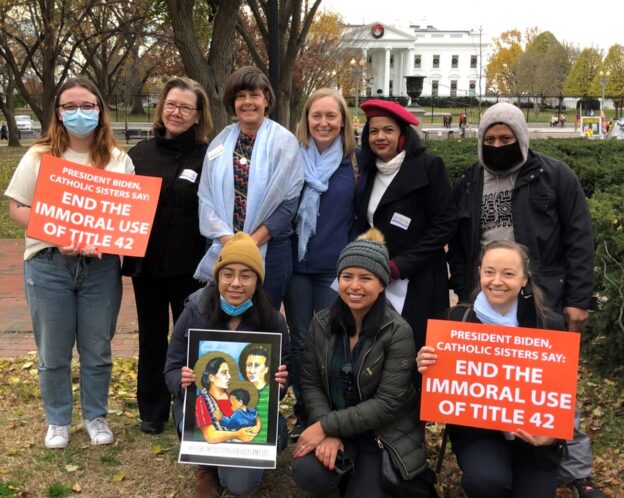
March 21, 2022 marks two years since President Trump authorized Title 42, a racist, inhumane policy with no medical basis that turns migrants and asylum seekers away at our country’s Southern border. Since President Biden came into office, NETWORK’s community of justice-seekers and our partners have repeatedly called on his administration to end the misuse of Title 42 and restore asylum — to no avail.

Last week, President Biden ended Title 42 expulsions for unaccompanied children. While this is a small win, it makes no sense to say unaccompanied children don’t bring disease, but children with families do. President Biden needs to follow science and allow the CDC to end the Title 42 expulsion policy for all immigrants at our Southern Border.

Take Action on Social Media

From March 18 to March 21, Kino Border Initiative invites people of faith to pray on social media. Your prayers will lift up a Via Crucis (Way of the Cross) in Nogales, Mexico organized by seven migrants to mark two years of Title 42.

Here’s how to participate: 

  • Wear red and make a sign that says, “Save Asylum! End Title 42!”
  •  Take a photo of yourself or you and your friends
  • Post your photo on the social media platform of your choice, with a prayer

Kino has asked that you name the seven migrants in your prayers. They are: Lisandro, Miriam, Esmeralda, Victor, Manuel, Sarahi, and Rosario. In your post, be sure to tag @NETWORKLobby, @KinoBorder, @POTUS, and use the hashtags #SaveAsylum and #EndTitle42.

Equal Pay Day: Privilege Should Not Predict Pay

Equal Pay Day: Privilege Should Not Predict Pay 

Gina Kelley
March 15, 2022

This year Equal Pay Day is March 15th, symbolizing how far into the year women have to work to earn what men earned the year before [1]. Women are not a monolith, a woman’s race, assigned gender at birth, ability, or sexuality can widen the gap. Therefore we mark multiple ‘equal pay’ days throughout the year to raise awareness for the persistent gender and racial income gaps that have become the norm.  

May is AAPI Women’s Equal Pay Day, marking the 85 cents Asian American, Native Hawaiian, and Pacific Islander women earn for every dollar a white man does. June and July have LGBTQIA+ and Moms Equal Pay Days respectively. Black Women’s Equal Pay Day is in September marking the 63 cents they earn in comparison to white male counterparts.  

Both Native and Latina equal paydays are in December with Native women earning 60 cents on the dollar and Latina women earning 57 cents. Meaning that Native and Latina women have to work over two years just to earn what a white man earns in one. 

Cents on the dollar can seem abstract. A recent study found that in 2021 the difference in median earnings nationally found that in U.S workers employed full-time last year women earned $10,000 less. This difference in median earnings varied by states with states and territories like Wyoming, Washington, D.C., and Utah having gendered wage disparities of more than $15,000.  

In an even bigger picture, some reports have estimated that women earn over 400,000 dollars less than their male counterparts do over the course of a 40-year period. The total wage differences between men and women on average is more than $799 billion every single year. 

These gender and racial discrepancies are harmful examples of the ways our society undervalues women and communities of color. There are multiple ways labor laws and employment practices create this loss of women’s wages.  

Blatant pay is discrimination is only one of the ways these inequities are formed. Job segregation is a subversive way that women are overrepresented in lower-paying (and often) service-providing industries due to assumptions about the types work different genders are best suited due to an imagined inherent gendered quality. However, compounding on top of job segregation is that across occupations women are most often employed at the lower end of the wage distribution. A powerful example of this is that women make up 52.8% of legal positions in the U.S but only 37.4% of lawyers are women—meaning that women disproportionately occupy lower-paying positions like legal assistants and paralegals.  

NETWORK continues to actively support policies that address economic inequalities. This includes major labor law reform like the Protecting the Right to Organize Act because we know that collective bargaining agreements and implementing standard wage policies are critical steps to closing these gaps for women and people of color. We also know that creating a national paid family and medical leave program is instrumental in making sure women are not punished for the caretaking responsibilities they disproportionately hold. We also support legislation that implements equitable employment practices like the Paycheck Fairness Act, the Schedules That Work Act, and the Part-Time Worker Bill of Rights.  

This Equal Pay Day and this Women’s History Month we have to recognize that labor issues are women’s issues and these issues matter and demand prioritization. Women’s issues require our attention now more than ever and what women need is economic stability and just labor laws.  


1 All studies referenced compare women’s earnings to non-Hispanic white men—even if something more general like “male counterparts” is used. There are also harmful disparities between men of color and white men.  

International Women’s Day: Celebrating NETWORK Foundresses’ Spirit, Wisdom, and Legacy

Celebrating NETWORK Foundresses’ Spirit, Wisdom, and Legacy

March 8, 2021

In honor of International Women’s Day (March 8) and to kick off Catholic Sisters Week (March 8-14), watch NETWORK’s Foundresses tell the story of creating a Catholic, woman-led organization to educate, organize, and lobby for justice in their own words!

Featured in This Video:

NETWORK Foundresses Carol Coston OP, Dr. Mary Hayes SNDdeN, Angela Marie Fitzpatrick OSU, Teresina Grasso SP, Mary Reilly RSM, Marilyn Huegerich OSF, Peggy Neal, Liz Morancy and NETWORK Executive Director Mary J. Novak