


Category Archives: Front Page

President Biden Continues Action on Immigration

President Biden Continues Action on Immigration

Ronnate Asirwatham
February 8, 2021

Last week, President Biden signed three new executive orders on immigration, actions critical to respecting the rights and dignity of immigrants in our nation, and respecting and honoring family unity.

  1. Task force to reunite families

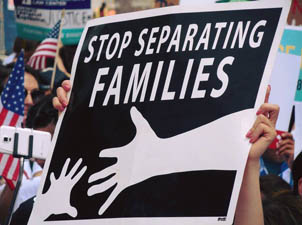
The first executive order he signed creates a task force to reunite children in the U.S. with their parents who were deported under the Trump administration.

  1. Review MPP and the misuse of Title 42 public health authority

Another order directed newly sworn in DHS Secretary Mayorkas to “promptly review and determine whether to terminate or modify” the Migrant Protection Protocols program, which forced asylum seekers to remain in Mexico while waiting for court proceedings. With a backlog of thousands of cases, this policy forced immigrants and asylum seekers from many countries to spend months or years in dangerous and inhumane conditions waiting for court decisions. The order also includes the review of the misuse of Title 42 public health authority, and the third-country transit ban. The Title 42 public health authority has enable ICE and CBP to expel asylum seekers and unaccompanied children without any due process. While we welcome this review we would ask that the use of Title 42 be suspended while the review is being conducted, just like the MPP.

  1. Review public charge

Finally, in his third executive order, President Biden instructed heads of agencies to review the public charge rule, which the Trump administration changed to effectively impose a racially-motivated wealth test on immigrants, punishing legal immigrants who use public benefits by hurting their chances to receive green cards.

These actions build on the executive orders signed two weeks ago, on the first day of the Biden-Harris administration. Previously, President Biden fortified DACA (the Deferred Action for Childhood Arrivals program), which was under constant threat during the Trump presidency, reinstated DED (Deferred Enforced Departure) for Liberians, halted funds to Trump’s border wall, and ended the travel ban on Muslim-majority and African countries.

Stopping Unjust Deportations

President Biden’s acting DHS Secretary issued a 100-day moratorium on deportations on January 20, 2021, however, a Texas federal judge barred enforcement of the moratorium until February 23. This stay on the moratorium only affects Texas.

However despite the acting Secretary’s stay order ICE (Immigrations and Customs Enforcement) continued carrying out deportation flights, including flights to Jamaica, Honduras, Guatemala, and Haiti.

Because of a lot of nationwide advocacy and activism.  a deportation flight  with immigrants from Cameroon, Angola, and the Democratic Republic of the Congo was cancelled. However other flights especially those to Haiti have continued and this is having a devastating effect on Black Haitian communities. We are working with several advocacy groups to ensure future deportation flights are  cancelled until all cases can be reviewed. A majority of immigrants who are being deported post inauguration are those who have been expelled under the Title 42 order and therefore they have not been given any due process rights.

Looking Ahead to Comprehensive Immigration Legislation

As President Biden signed the executive orders, he said, “I’m not making new law. I’m eliminating bad policy.” In the coming weeks and months, President Biden and members of Congress plan to pass a new law (or laws) to reform our immigration system. Some legislation is familiar – the Dream Act, the Dream and Promise Act, and the Farm Workforce Modernization Act have been introduced in previous congresses – but President Biden also seeks to pass broader reform. This will be a critical opportunity to build our immigration system anew, and we will keep NETWORK members updated on how to support this legislation.

Harriet Tubman and the $20 Bill

Harriet Tubman and the $20 Bill

Sister Mara Rutten, RSM
February 5, 2021

On January 25, 2021, amid the flurry of activity in his first week in office, President Joe Biden’s administration also moved forward with the stalled plans to put Harriet Tubman’s image on the $20 bill. Within the hour, friends and colleagues alike vied to be the first to tell me this news, because for weeks I had been adamant that, along with a COVID-19 rescue package and immigration and criminal justice reform, we needed Harriet Tubman.

Tubman would be the first African-American on U.S. currency and the first woman on a bill in wide use. The public chose her for this honor from among a number of candidates — suffragettes, abolitionists, politicians, and activists — as part of a campaign to put a woman on the $20 bill to commemorate the centennial of the 19th amendment in 2020. It was to be the beginning of a larger movement in currency redesign that would include women and people of color on other denominations. In 2019, the Treasury Secretary Steven Mnuchin announced years-long delays for these plans.

I had voted for Harriet Tubman to replace Andrew Jackson on the $20 bill, because I admired her, and because although she appears larger than life, she embodies all the pain and promise of our country. Born into slavery, she escaped to freedom — and then risked it repeatedly in order to save scores of others. During the Civil War, she became a Union nurse, scout, and spy, and after the war became a champion of equality for both African-Americans and women. She made the world she was born into a better one, and we built on that legacy. Her heirs in the struggle ended segregation, secured the vote, and opened up economic opportunities she may never have thought possible.

But her accomplishments, like ours, were not the end of the story. She spent most of her life living in poverty, working a number of jobs to support herself and her family, including her elderly parents. The government repeatedly refused to acknowledge her contributions to the war effort and compensate her accordingly. And for all she did for the cause for freedom, she was never eligible to vote. We have also faced setbacks, for despite the progress we’ve made since her death in 1913, the income gap is staggering, and Black women in particular have been left behind, earning only $.62 to the dollar that white men earn.[1] Legal means of voter suppression, such as poll closures, voter identification requirements, and gerrymandering have proliferated. Black and Brown communities are at an increased risk of infection and death from COVID-19 due to chronic discrimination, lack of access to healthcare, inadequate housing, and underemployment.[2]

Putting Harriet Tubman on the $20 bill is not going to change any of this — that is up to us. It is a symbol, but symbols are powerful. What matters is that, along with all of the other social, environmental, and economic priorities of our nation, her appearance on the $20 was among them. This sends a powerful message about where we’ve been and how we’re going forward. It means that we will be reminded every day as we go about our business at toll booths and grocery stores and ATMs, that this is our country, that we come from more than just the patriarchs. That for every Thomas Jefferson there is a Sojourner Truth; for every Alexander Hamilton, a Rosa Parks; for every George Washington, a Fanny Lou Hamer. And to know, every day, that we as a nation acknowledge and rejoice in this as we struggle to live up to it.


[1]National Partnership for Women & Families, “Black Women and the Wage Gap,” NationalPartnership.org March 2020.  https://www.nationalpartnership.org/our-work/resources/economic-justice/fair-pay/african-american-women-wage-gap.pdf NationalPartnership.org

[2]Centers for Disease Control and Prevention, “Health Equity Considerations and Racial and Ethnic Minority Groups” ccdc.gov 24 July 2020. https://www.cdc.gov/coronavirus/2019-ncov/community/health-equity/race-ethnicity.html


Moving Toward a Culture of Encounter on Inauguration Day

Moving Toward a Culture of Encounter on Inauguration Day

Sister Simone Campbell, SSS
February 4, 2021

Two weeks ago, our nation’s 46th President Joe Biden woke up and, with our first woman Vice President Kamala Harris, brought our nation’s Congressional leadership – men and women of both parties, of various religious backgrounds – to a morning Catholic mass at St. Matthew’s Cathedral in Washington, D.C. From that private, socially distanced mass, President Biden went on to take the oath of office on the balcony of the Capitol in a ceremony imbued with themes of Catholic Social Justice.

With so many challenges facing our nation, I cannot think of a more important time for Catholic Social Justice to take center stage, inviting people of all faiths or secular backgrounds to come together in this critical work of rebuilding our nation and guiding our way forward together. For too many years, racism, sexism, and growing economic inequality have been promoted by White House policy. In Congress, we’ve maintained the status quo with harmful repercussions for Black people, Native Americans, Latinx and AAPI communities, women, families and individuals on the economic margins, and all those with intersecting identities.

On Inauguration Day, the whole country witnessed speech after speech testifying to the value of caring for one another, especially those members of our community facing the most difficult circumstances. We also heard about the critical importance of caring for our planet, being active participants in our communities – what Pope Francis calls “meddling in politics,” and more. These values, inspired by principles of Catholic Social Justice, call us to put the common good above the benefit of any individual or small group. This is what is needed in our nation right now.

Putting the Focus on Listening

In his inaugural address, President Biden said, “Let us listen to one another. Hear one another. See one another.” In his own words, President Biden called us to what Pope Francis has been promoting for years – a culture of encounter. This is the culture fostered by Nuns on the Bus, traveling to different cities and states, meeting people and families and just listening to their stories. I invite you to listen to these stories, which we’ve shared over the years.

In Fratelli Tutti, Pope Francis writes, “The ability to sit down and listen to others, typical of interpersonal encounters, is paradigmatic of the welcoming attitude shown by those who transcend narcissism and accept others, caring for them and welcoming them into their lives. Yet today’s world is largely a deaf world…” As we move forward we must do whatever we can to change from being a world closed off from listening and meeting one another. We are called by our faith and patriotism to create something new. We are challenged to create a culture of encounter out of a culture of indifference. As President Biden said, “We must end this uncivil war…  We can do this if we open our souls instead of hardening our hearts.”

However, it was quickly evident that for us Catholics the “uncivil war” does not just refer to the insurrection in the Capitol on January 6, 2021. It was also evident in the attack by Archbishop Gomez, president of the US Conference of Catholic Bishops, on President Biden before he was inaugurated and then on Inauguration day itself. Archbishop Gomez’s actions were not endorsed by the Bishops’ conference and, in fact, have been criticized by many of its members. Pope Francis recently affirmed the Archbishop’s work on immigration reform. With the specific reference, it seems to me that there is an implicit critique of his attack on our new president.

In order to end this “uncivil war,” I believe that we at NETWORK need to continue our effort at encounter and listening. I know from listening to women across the country that the focus of some of our leadership on the criminalization of abortion does nothing to respond to many of their real needs. Let’s begin working to end the uncivil war by lifting up women’s stories and their real needs.

Building Anew Together

In her powerful inaugural poem “The Hill We Climb,” Amanda Gorman, our nation’s youngest inaugural poet and a young Black Catholic woman, declared, “We will rebuild, reconcile, and recover.”

Now, we must come together to face our history and build anew. In the midst of this COVID-19 pandemic, economic crisis, and acting out of white supremacists, the time to boldly respond to the needs of the common good is now. We must ensure that all have access to health care. All people need to be able to feed, clothe, and house their families. We must dismantle structural racism and end white supremacy. This is the building anew that is called for.

We need a new imagination to create a way forward in these unprecedented times. What is old is not working and something new needs to emerge. But I have hope that we can meet this challenge. As Ms. Gorman concluded, “There is always light, if only we’re brave enough to see it. If only we’re brave enough to be it.”

Build Anew: A Justice Agenda for All of Us

Build Anew: A Justice Agenda for All of Us

Colleen Ross
February 3, 2021

Last week, during NETWORK’s January 2021 Legislative Webinar, Government Relations Associate Gina Kelley introduced NETWORK’s new policy agenda, the Build Anew Agenda.

The Build Anew Agenda is a response to NETWORK’s direct encounters with people and families as well as the direction of the country overall over the past several years. Year in and year out, we’ve seen how our society in the United States has been deliberately organized to benefit white people over people of color. This structural advantage occurs at all levels: the political, social, and individual.

The growing economic disparity and increasing individualism that results from maintaining our current racial hierarchy and economic inequality must end. As the COVID-19 pandemic has shown, we are all connected to one another and our health, wellbeing, and lives depend on one another.

The Build Anew Agenda is our pathway forward to realizing our vision of a just and inclusive society.

Four cornerstones, based on the principles of Catholic Social Justice are the foundation for building our country anew in 2021 and beyond.

Cornerstones to Build Our Country Anew
  • Dismantle Systemic Racism
  • Cultivate Inclusive Community
  • Root Our Economy in Solidarity
  • Transform Our Politics

In meeting and listening to people and families across the country – engaging in what Pope Francis calls “a culture of encounter” – we at NETWORK have come to know that we must find a way to realize our vision of a just and inclusive society where all can thrive. This includes especially those most often left out: women, people of color, people on the economic margins, and those at the intersections of these identities.

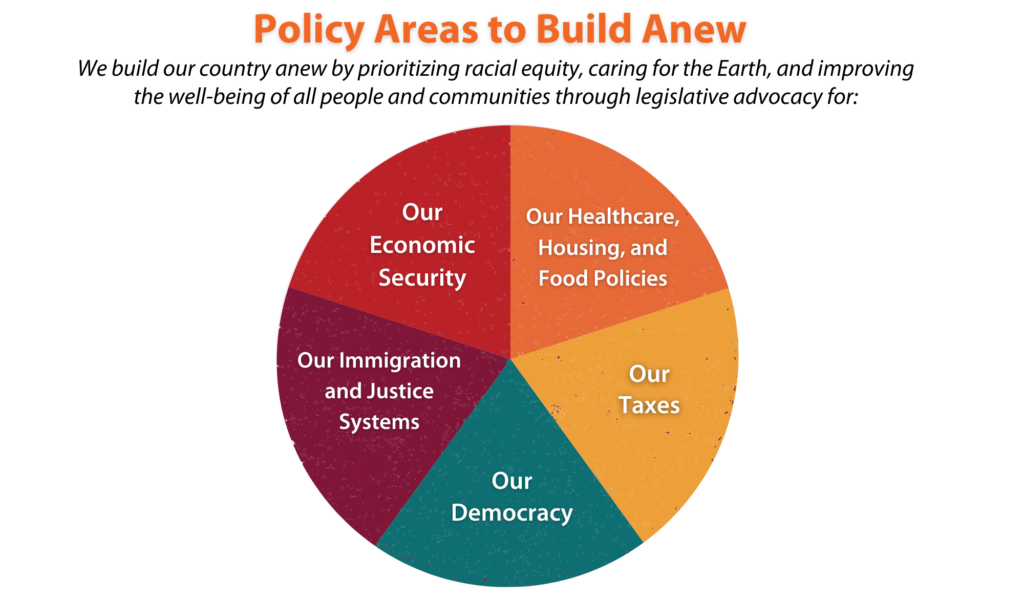
List of policy areas in a pie chart: Our economic security, Our healthcare, housing, and food policies, Our democracy, Our taxes, and Our immigration and justice systems

Despite our divisions, we proclaim the truth that all people in the United States, together, make up one single community. Pope Francis says, “Hope would have us recognize that there is always a way out, that we can always redirect our steps, that we can always do something to solve our problems.”

I invite you to join in the work of supporting NETWORK’s Build Anew Agenda by advocating for federal policies that dismantle systemic racism, eliminate the wealth and income gap, improve the well-being of our communities, and allow all people to thrive. We must build anew across sectors, and across divides, to address injustice and disparities in our country

The For the People Act Will Transform Our Democracy for the Better

The For the People Act Will Transform Our Democracy for the Better

Audrey Carroll
February 1, 2021

The For the People Act (H.R.1/S.1) is comprehensive legislation that will make sweeping reforms to restore and protect our democracy.  Making pro-democracy reforms is the first step to making progress on all our other policy issues. NETWORK supports the For the People Act because Catholic Social Justice teaches us that we have a responsibility to participate in our civic society, and this civic duty begins with voting. Protecting the sacred act of voting means ensuring that every eligible voter is able to exercise this right to make their voices heard. No individual or community should be disenfranchised based on their race, ethnicity, gender, religion, disability, or class. Among other critical reforms to strengthen our democracy, The For the People Act would ensure that elections are free, fair, and accessible in every state. Every Members of Congress should be supporting this pro-democracy bill.

H.R.1/S.1 Will:

Protect and Expand Voting Rights

    • H.R.1/S.1 will include voting protections such as automatic and same-day voter registration, prohibiting the purging of eligible voters from registration rolls, restoring voting rights to people with prior felony convictions, standardizing access to early and absentee voting, and prohibiting known voter suppression tactics.

End Partisan Gerrymandering

    • H.R.1/S.1 will ban the practice of partisan gerrymandering and require states to establish independent redistricting commissions with a clear process for public participation in congressional redistricting. Districts that are drawn fairly with public input help ensure a government that reflects and responds to the people rather than the will of politicians.

Prioritize the Will of the People over Profit

    • H.R.1/S.1 will get dark money out of politics by improving transparency in campaign finance and strengthening disclosure for political ads and donors so voters know who is trying to influence them.
    • H.R.1/S.1 will create an alternative campaign finance system by matching small donor contributions. This will allow Americans of all economic means to amplify their voices in our democracy.

Strengthen Ethics Rules

    • H.R.1/S.1 will fortify ethics laws and strengthen enforcement by closing loopholes for lobbyists, requiring presidential candidates to release their tax returns, and supporting the oversight of watchdogs to enforce the law.

Protecting our democracy and making our election systems fair and accessible means we can hold our elected officials accountable for progress on key issues of justice such as living wages, health care for all, immigration reforms, racial equity, and more. The Biden Administration has named democracy reform as a first priority and the new Senate leadership has followed the House example by designating the For the People Act as their first legislative priority in the 117th Session.

Passing federal democracy reforms couldn’t be more urgent.  We know that gerrymandered State legislatures across the country are already looking to crack down on voter access based on lies of widespread fraud in the 2020 election cycle.  In addition, the congressional redistricting process, which takes place every ten years, is around the corner and could result in 10 more years of extreme partisanship due to gerrymandering. It will be an uphill battle but we hope to see swift passage of the For the People Act early in the session as a first step to achieve the common good in our society.

Protecting Expression, Not Criminal Acts

Protecting Expression, Not Criminal Acts

India-Grace Kellogg
January 28, 2021

For the past year, our nation’s capital has been flooded by protestors. The Black Lives Matter protests following George Floyd, Breonna Taylor, and countless other people of color’s deaths at the hands of police re-invigorated a debate on what ”acceptable” protests look like. To many, the debate highlighted a clear break in the types of information that citizens are receiving about important topics, whether through their own lived experiences or through the media they are consuming. On one side, Black Lives Matter protestors were considered justice seekers facing violent suppression of their Constitutional right to protest while the other side balked at property damage, arguing that it was about looting and not protesting. When the Proud Boys and other pro-Trump groups arrived in Washington, D.C., a shift in police reaction and rhetoric angered many and highlighted the disparity in the way protestors are handled depending on what they look like and what causes, and perhaps more importantly who, they are supporting.

Complex and deeply personal to each person in this country, the debate on how people in the United States should express their views has always been, in itself, a part of who we are as a country. Our First Amendment rights invite debate with our government and, importantly, dissent to the majority opinion. The breach of the U.S. Capitol building may have seemed brazen and paralyzing to many watching it, but in hindsight, it may be the logical course of events in a country where a leader contributed to decimating trust in our democracy. But, in the aftermath of the events on January 6, 2021, it seems dire to address, factually, the ways we express grievances to our government, and name when that expression no longer honors the values and intent of our Constitution. Those who walked up the steps of the Capitol building, even those who simply passed the first barricade were not the first to step past the boundaries of what the Constitution protects under the First Amendment. Their violent trespassing, many of them armed and with an intent to harm elected officials, was far outside of the bounds of free speech protected by the First Amendment.

Earlier, at a protest on December 12, 2020, Trump supporters openly burned a Black Lives Matter flag taken from the Asbury United Methodist Church, a historic Black church. Proud Boys leader Enrique Tarrio, who admitted to burning the flag but later pleaded not guilty, faces destruction of property charges and was ordered to stay out of Washington by a judge. The D.C. police department labeled the burning of the flag a potential hate crime.

In the District of Columbia, hate crimes such as this act as an enhancement of the crime committed. Under D.C. Statute §22-3703, Bias-Related Crime Act, a person found guilty of a bias-related crime will be fined or imprisoned up to one and a half times the maximum fine or designated term. A bias-related crime means that a criminal act demonstrates the accused prejudice toward a victim. The statute covers a multitude of bases for the accused’s prejudice, including race, color, religion, and political affiliation. While the statute specifies a limited amount of crimes, Aboye v. U.S. established that the term “designated acts” means any criminal act under D.C. law. Therefore, anyone who commits a crime in D.C. that demonstrates their prejudice against the victim of that crime can be charged with an enhanced sentence under §22-3703.

Looking specifically at the actions of the Proud Boys and Enrique Tarrio on December 12, bias-related crime charges could be brought. If it can be established that burning the Black Lives Matter flag demonstrates Tarrio’s prejudice to the actual or perceived race, color, religion, or political affiliation of the Asbury United Methodist Church, Tarrio could be charged with a bias-related crime. However, the crime must not have been committed but for the prejudice. (Lucas v. United States) The prosecution would need to show that Tarrio would not have burnt the Black Lives Matter flag but for his prejudice. While this is a decision left to the discretion of the prosecutor, the potential legal repercussions of burning a Black Lives Matter flag are important to highlight.

While the public debate may often rely on the morality and the nation’s values relating to how we protest, there are legal realities involved that cannot be ignored. The violent attack on the Capitol was not the first, and most likely will not be the last, time that white supremacists and other pro-Trump groups claim Constitutional rights to excuse their criminal actions.

The Constitution does not protect all expression nor does it protect violent actions, as a long history of legal debates have proven. Many states have enhanced penalties for bias-motivated crimes, many that have been challenged for violating the First Amendment. The D.C. Bias-Related Crime Act was upheld as constitutional to the extent that it provides an enhanced penalty for crimes that an individual commits against a victim simply due to their own prejudice against the victim’s protected characteristic (Lucas v. United States).

The First Amendment protects many forms of expression but it does not protect criminal expressions of prejudice against another’s protected characteristics. The precedent concerning what expression is protected by the Constitution is vast and the decisions of the Supreme Court of the United States serve to uphold the intent of the Constitution over what many may consider to be justice for those harmed by certain type of expressions. The Proud Boys and those who claim that they are seeking to uphold the values of our country may claim to be within their rights and to be fighting for our nation, but their actions are not protected by the very Constitution they claim to be protecting. While we as a country should and will continue to debate the nuances of protests and their aftermath, we should also continue to do the work of understanding what we are truly debating – when does our expression of disagreement step past what our national conscience believes should be protected? And why?

NETWORK Supports Raising the Federal Minimum Wage

NETWORK Supports Raising the Federal Minimum Wage

Caraline Feairheller
January 28, 2021

On January 25th, 2021 Representative Bobby Scott and Senator Bernie Sanders introduced the Raise the Wage Act of 2021 which seeks to gradually raise the federal minimum wage from $7.25 to $15 by 2025.

NETWORK agrees that it is well past time to raise the wage. It is shameful that low income workers have gone over a decade without a raise from the federal minimum wage. The multiple pandemics of COVID-19 and structural racism have exposed how immoral the $7.25 wage is as essential workers are being asked to risk their safety while still living below the poverty line. The legislation is a crucial step in addressing income inequality and would lift the pay of nearly 32 million workers which in turn would stimulate the economy and promote job growth.

The legislation would not only make efforts to close the racial wealth gap, but also gradually phase out the subminimum wages for tipped workers, youth workers, and workers with disabilities. As Pope Francis says in Evangelli Guadium, “The dignity of each human person and the pursuit of the common good are concerns which ought to shape all economic policies.” The dignity of each person can be recognized through fair wages.

Just Released – NETWORK’s 2020 Congressional Voting Record

In 2020, the United States faced unprecedented threats to the health and wellbeing of our democracy, including the dual crises of the COVID-19 pandemic and systemic racism. The COVID-19 pandemic ravaged our communities and hit communities of color the hardest. Despite this, Congressional negotiations stalled month after month, as Senator McConnell refused to agree on measures needed to support workers and families.

President Trump and his administration exhibited failed leadership in response to both the COVID-19 pandemic and the Black Lives Matter movement, with perilous consequences. The Trump administration’s failed leadership cost the lives of our neighbors, our family, and our community members who were essential workers, health care workers, teachers, and grandparents. NETWORK supported President Trump’s impeachment, but the Senate failed to end President Trump’s increasingly dangerous presidency with nearly every Republican Senator voting to acquit President Trump on both the first and second articles of impeachment.

In 2020, Members of Congress had a moral responsibility to legislate with the best interests of our people at heart and prioritize addressing the racial disparities in the coronavirus pandemic. This year’s Voting Record demonstrates how elected officials voted in 2020 on policies related to COVID-19 relief, democracy, workers’ rights, impeachment, police reforms, and more. Members’ scores are a reflection of their commitment to the wellbeing of our democracy and to protecting the lives of people and families across the United States. These votes have consequences for our nation and for our people. Download the 2020 Congressional Voting Record.

President Biden Rescinds Muslim Travel Ban on Day One

President Biden Rescinds Muslim Travel Ban on Day One

Colleen Ross
January 25, 2021

Last week, as one of 17-Day One executive actions, President Biden rescinded Donald Trump’s travel ban on Muslim-majority and African countries. During the Trump presidency, this travel ban faced numerous legal challenges in its various forms. The Supreme Court ultimately approved this callous and discriminatory policy, which resulted in more than 41,000 people denied visas. Now, this harmful expression of Islamophobia and anti-blackness has been terminated.

The travel ban kept family members apart from one another, ended job opportunities, and upended students’ academic careers. While the battle over the travel ban in courts was about legality and intent, the travel ban raised moral questions about the United States identity as a nation that welcomes immigrants and values family unity.

Muslim advocates and people across the country opposed to this discriminatory policy pushed back every step of the way. President Biden’s quick action to rescind the ban is a good first step, but much more will have to be done to reunite families and restore the U.S.’s relationship with foreign countries. In Congress, passing the No Ban Act, which NETWORK supports, would prevent future discriminatory policies being passed.

Welcoming individuals of all backgrounds is a value we must continue living up to in our nation, and a basic tenet of Catholic Social Justice. Now that the travel ban is overturned, we continue working to instill justice and respect for immigrants into all of our policies.

President Biden Extends Federal Eviction Moratorium on Day One

President Biden Extends Federal Eviction Moratorium on Day One

Audrey Carroll
January 21, 2021

On the first day of the Biden-Harris administration, President Joe Biden signed a series of executive orders. Among these was an order to extend the federal moratorium on evictions through the end of March. The moratorium is implemented through the Center for Disease Control and Prevention and seeks to aid tenants financially affected by the COVID-19 pandemic. Yesterday the new director of the CDC, Rochelle Walensky, MD, released a statement saying, “I will extend the order halting residential evictions until at least 3/31/21. The COVID-19 pandemic has presented a historic threat to our nation’s health & has also triggered a housing affordability crisis that disproportionately affects some communities.”

According to data from the U.S. Census Bureau, nearly one in five households were behind on rent in December 2020. President Biden’s executive order provides vital relief for renters struggling to make payments and maintain their housing, especially essential workers and Black and Brown communities who have been the most impacted by COVID-19. Without this action by President Biden thousands may have lost their homes, says president of the National Low Income Housing Coalition Diane Yentel. However, the order lacks enforcement from a federal agency to penalize landlords who unlawfully evict tenants. The CDC order is not an automatic eviction ban, but provides some immediate security for renters as the Biden administration continues to work on their American Rescue Plan which will allocate $25 billion in rental assistance.

No one should live in fear of losing their housing or falling behind on rent. NETWORK agrees with Pope Francis, who said during his 2015 visit to the United States, “We can find no social or moral justification, no justification whatsoever, for lack of housing.” We at NETWORK support the swift actions taken by the Biden-Harris administration on Day One to provide assistance to renters, with an emphasis on alleviating the housing crisis in communities of color. We look forward to working alongside President Biden and our partners to advocate for policies that recognize safe, affordable housing as a human right.