

Category Archives: Front Page

Healthcare is a human right

The Forgotten Ones

The Forgotten Ones

Maria Gomez and Bibi Hidalgo
June 5, 2020

The majority of eligible Americans have now received stimulus checks through the CARES Act, except for the excluded workers — the forgotten ones — who we depend on in many facets of our lives. These forgotten — but essential — workers pick the ripe fruits we eat; they cook the warm meals at our favorite take-out restaurants; and they sanitize checkout devices at grocery stores late into the night so that we will be less afraid of COVID-19 when we shop. Regardless of their legal status, they disinfect our surroundings and feed us.

As one of the 1,400 Community Health Centers across the country that serves families below the poverty line, Mary’s Center in the Washington, D.C. region is on the frontlines of this crisis. We have seen the health and job insecurity that our nation now confronts through the eyes of the 60,000 adults and children we have served annually since 1988. Each day the people who reach out to us are seeking life-saving medicines, health care, shelter, food and income. Our telemedicine team ensures that line cooks and sanitation workers have access to hypertension and asthma medications. Our counselors talk with them when they experience emotional hardships. Thousands of people — 54,000 to be exact — had a total of 270,000 visits to our five centers in 2018 and that number is now growing significantly.

Across the U.S., community health centers serve 29 million people, which is close to 10 percent of the population. No hospital system in the U.S. serves a number that size. Yet as it stands today, millions of low-wage workers and their families are in danger of collapse, unless we can work together as a whole society — philanthropy and big business, local and state government, families and communities — to ensure everyone overcomes the COVID-19 crisis and that we build a more resilient society.

In the absence of a unifying government, we need to do this ourselves.

We can accomplish this by having federally qualified community health centers in major cities partner with business executives and philanthropies to create a national plan that will stem this crisis and help rebuild the country. Last week Congress passed another stimulus measure providing small businesses loans through the Paycheck Protection Program. It remains to be seen whether any of the small and micro-businesses in our community that hire our clients gain access to the program. Up until now that hasn’t been the case. In the meantime, their workers are facing the despair of day-to-day survival.

National nonprofits, foundations and government bodies are having urgent calls daily to determine how they can provide relief to community organizations in addition to any stimulus operating support. If the 2008 financial crisis is any lesson though, it is time we flip the script and have community organizations lead the national conversation about what is sorely needed.

Ten million families still lost their homes despite the 2.7 million families who benefited from mortgage modifications supported by the 2008 Troubled Asset Relief Programwhich took a top-down approach to problem-solving. By the time resources arrived to community organizations providing housing counseling to Latinx and African-American families who had been misled by lenders to take out subprime mortgages, it amounted to table crumbs that did not leverage local knowledge of how to build trust, engage and serve the most economically vulnerable.

Community Health Centers across the nation are eager to collaborate with the private sector and state and local governments to find solutions. We can help large corporations track the patterns we see on the ground with the pandemic and the resources that are needed to rebuild communities and ultimately a robust economy. Pharmaceutical companies can ensure that frontline community health centers across the United States have a steady supply of diabetes, asthma and life-saving medications available. Health care distributors can ensure we have medical supplies, such as masks, bandages and thermometers.

Together with major grocery chains and wholesale companies, we can ensure that low-wage workers who did not receive a stimulus check have provisions to feed their families. By working together, we can create a stabilization supply-chain to feed, clothe and shelter the forgotten ones. The ones who are ultimately indispensable to you, me and all of us as a nation.

Maria Gomez is president and CEO of Mary’s Center, a Washington D.C. region Community Health Center, and Presidential Citizen Awardee @MarysCenter.

Bibi Hidalgo is co-founder of Future Partners LLC and served as an economic policy appointee in the Obama White House and U.S. Treasury @BibiHidalgo.

Originally published at TheHill.com.

Women's hands raised

Sister Simone and Faith Leaders Declare: Black Lives Matter to God

Sister Simone and Faith Leaders Declare: Black Lives Matter to God

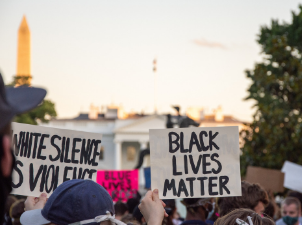
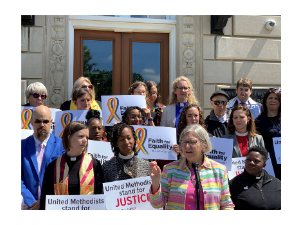
On Wednesday, June 3, Sister Simone joined faith leaders outside of the Metropolitan AME Church in Washington, D.C. to declare that Black Lives Matter and Black lives are sacred to God. Together, the speakers demanded the immediate cessation of racist police abuse of protesters; accountability for the white supremacist killings of George Floyd, Breonna Taylor and Ahmaud Arbery; and called our nation to end systematic racism everywhere from the local courthouse to the White House.

Black lives matter to God. People of faith demand that Black lives matter to our government.

Speakers, including Sister Simone :
Rev. Jennifer Butler, CEO, Faith in Public Life Action Fund
Rev. Andre Towner, District of Columbia Baptist Convention
Rev. Aundreia Alexander, National Council of Churches
Rabbi Jason Kimelman-Block, Bend the Arc Jewish Action
Rev. Leslie Copeland-Tune, National Council of Churches
Lisa Sharon Harper, Founder and President, Freedom Road

Read Sister Simone Campbell’s remarks:

Good morning, I am Sister Simone Campbell, Executive Director of NETWORK Lobby for Catholic Social Justice. And I am so honored to be here this morning and stand with my brothers and sisters for this call to end the racism that has rampaged through our nation for centuries. Rev. Alexander, you noted the beginnings of it in 1619. Here, just across the river, down the river a little in Virginia, we have had those seeds of our original sin as a nation. And we must repent, change, and beg forgiveness.

And so, I want to direct my remarks to my white brothers and sisters who might feel uncomfortable, unsure, slightly timid that they might say something wrong. Let me tell you, the time is now for us as white people to mend our ways. Change our direction. Welcome our brothers and sisters as one. And for those of us in the Christian tradition, to live up to the command to love one another. But it’s not just about the personal relationships. I want to highlight a couple of the structural problems we face as a nation that too often get glossed over because it makes us white folk uncomfortable.

So take a deep breath, we’re grown ups. We can do this. We can do this! And look at the structure that created the economic imbalance in our society.

After the civil war, white plantation owners got reimbursed by our federal government for their loss of labor. That provided the nest egg, the money that helped south to flourish in reconstruction. But did the laborers get reimbursed for their hours and hours and hours of toil? No. And the one promise of 40 acres and mule got quickly withdrawn. “Oh we couldn’t possibly… you know it just really doesn’t work fiscally… We just couldn’t possibly do it.” That is one of the beginnings.

Then we have a whole series of legislation that looks perfectly fine on the face of it, but when it comes to the application, is racist at its core. Post-World War II, we had the fabulous G.I. Bill – it meant all the difference in the world to my family. But then in my study I discovered, Black families were left out. Black military folks weren’t able to apply. If they even were eligible, then they were eligible then they couldn’t get into a college or buy a house because “Oh you know those neighborhoods are dangerous.” That is the structural racism that we’ve got to change. That is the way forward to make it a difference in the United States. Maybe even finally, United. Can’t we come together on this truth of what we hunger for? An economy that supports us all? Its not just us, people of faith that say this – its everyone knows: we all do better when we all do better.

But white folk, we’ve got to change. It’s up to us. We’ve got work to do. We have a challenge ahead of us and I am very proud of my organization – that has a diverse membership – but, well it’s still mostly white. I am very proud that our Board three weeks ago made the determination that in order to address this issue of racism we have to start at the top. And we have committed ourselves to oppose reelection of this president who promotes the most grievous, racial, what we call dogmas in our nation. We have got to stop this at the voting booth.

Now, I want to give you a piece of good news. Yesterday, the people of western Iowa woke up and they voted to nominate not Congressman Steve King who has been in Congress I think its seven or nine terms, no! They voted for a new person because they were tired of his racism. Well, if western Iowa can do that my friends, I have heart for the white folk listening. We can do this. And my African American sisters and brothers, know that our effort to engage the structural racism that you know all too keenly is done in solidarity with you. Being a part of you, supporting you, knowing that your voice has got to lead because you know the deepest pain of it all.

And so, I want to close with a piece of scripture that I hold onto, but think of it in a new way. White folk, you know, we are called to act justly. Let us act justly and end this racism. To act justly to love tenderly. We have got to expand our love so that we include everyone, and walk humbly with our God. I know that it is only with the assistance of the spirit of the Divine that we will be able to make these changes, but my dear friends, with the spirit we can have the courage, the fire of commitment and indeed, the change we seek. Who we elect matters, November 3rd matters, and how we stand together matters. Let us make us one people, finally, for the United States of America.

Sr. Simone: Appalled by President’s visit to St. John Paul II Shrine

Appalled by President’s visit to St. John Paul II Shrine

Colleen Ross
June 2, 2020

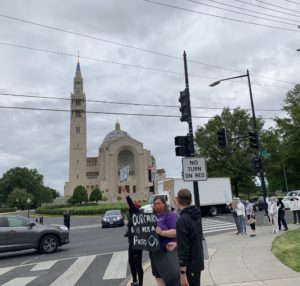
After hearing that President Trump and the First Lady were scheduled to visit the Saint John Paul II National Shrine in Washington, D.C. today, Sister Simone Campbell and the entire NETWORK community expressed their disappointment at the President’s repeated calls for violence against protesters and his actions that disrespect the pain of the Black community and put Black lives at further risk.

Sister Simone says, “President Trump is now using the Catholic faith in another photo op to defend his appalling refusal to address racism and police violence in the United States. He is trying to create a false dichotomy of peaceful protesters versus the Church. That could not be further from the truth, and any Christian who believes it does not understand Jesus’s message.

“Saint John Paul II himself spoke out against racism multiple times during his papacy, I hope President Trump learns that history during his visit.”

How To Organize During a Pandemic

How To Organize During a Pandemic

Alex Burnett
May 27, 2020

Recently, journalists have written extensively about the anti-lockdown protests gripping our nation. During the past month, The New York Times published at least 15 stories about anti-lockdown protesters, highlighting their propensity to carry assault weapons, flaunt social distancing, display Confederate flags, and secure funding from prominent conservative donors. This reporting is crucially important, especially since many of these demonstrators espouse white supremacist rhetoric and actively participate in neo-Nazi organizations, like The Proud Boys.

Despite its significance, this reporting can eclipse stories about progressive activists who are struggling for a socially just COVID-19 response. Workers in at least 7 states organized strikes involving more than 1,000 people in March and April, but the media largely ignored their historic organizing and instead focused primarily on the anti-lockdown crowd.

In this blog post, I want to highlight some progressive activists—specifically, The Poor People’s Campaign (PPC) and National Nurses United (NNU). Both NNU and PPC are building grassroots support for a COVID-19 response that advances racial and economic justice, while recognizing we cannot “return to normal” if this pandemic abides. By demanding immediate COVID-19 relief alongside permanent systemic change, PPC and NNU are demonstrating how other justice-seekers can effectively organize during the coronavirus lockdown.

The Poor People’s Campaign: Working Towards a “New Normal”

A national coalition led by Rev. Dr. William J. Barber II and Rev. Dr. Liz Theoharis, The Poor People’s Campaign quickly recognized why coronavirus hit the U.S. remarkably hard. The PPC condemned the federal government’s reckless and uncoordinated response,” but maintained, “The current emergency…results from a deeper and much longer-term crisis”—the “evils of racism, economic exploitation, and militarism,” described by Dr. Martin Luther King, Jr. in May 1967. To fully address the COVID-19 crisis, the PPC argued that the U.S. must eliminate racism, poverty, and our environmentally destructive wartime economy.

Approximately 50 years after Dr. Martin Luther King, Jr. led the Poor People’s March on Washington, Dr. Barber revived Dr. King’s efforts at building a mass, multiracial movement of working-class people intent on transforming American society. Since 2017, the PPC organized 43 state committees, comprised of low-income people and faith leaders, lobbied federal and state policymakers around their Moral Agenda, and coordinated civil disobedience nationwide. With support from dozens of social justice organizations, including NETWORK, the PPC is now turning their attention to the COVID-19 crisis, hoping to bring the kind of pressure that many lawmakers haven’t felt since the 1960’s civil rights revolution.

To accomplish this ambitious goal, the PPC is working closely with local organizers, explained Adam Barnes, who coordinates the PPC’s faith partnerships and The Rights & Religions Program at The Kairos Center for Religions, Rights, and Social Justice. Since January, the PPC mobilized its members to support local responses to the COVID-19 crisis—including rent strikes, mutual aid networks, workplace walkouts, and anti-hospital closure demonstrations. These expressions of “non-cooperation,” Barnes emphasized, are faithful responses to the coronavirus pandemic. Since half the U.S. population lived in poverty before coronavirus eliminated a single job, the PPC believes these actions are urgent.

Crucially, the PPC’s local organizing amplifies their national advocacy. On April 3rd, the PPC sharply criticized COVID-19 relief legislation for funneling trillions of federal dollars into investment banks without guaranteeing healthcare, income, and housing for all Americans. To bolster their message, the PPC organized a National Week of Action, scheduled for May 21st (5/21). On May 21st, justice-seekers can call or email Senate Majority Leader Mitch McConnell and House Speaker Nancy Pelosi and ask them to support the PPC’s Moral Agenda and COVID-19 demands, which would provide immediate COVID-19 relief and reduce racial and economic inequality. Additionally, as part of this week of action, religious communities can host special services amplifying the PPC’s message and mourning the 250,000 people killed by poverty each year. Click here to learn more about the May 21st week of action.

Much of this activism is building towards the PPC’s Mass Poor People’s Assembly and Moral March on Washington. NETWORK is proud to join the Poor People’s Campaign as a mobilizing partner for the Mass Poor People’s Assembly and Moral March on Washington Digital Justice Gathering, on June 20, 2020. At this historic event, which PPC organizers hope will be the largest digital gathering of low-income people in U.S. history, PPC speakers will denounce what “normal” looked like before the pandemic—140 million people living in poverty, an irredeemably racist criminal justice system, widespread voter suppression in communities of color, and unsanitary deportation camps, which separate immigrant families. After offering solutions to these “normal” problems and the COVID-19 crisis, PPC speakers will help participants develop plans for building grassroots power in their communities. To RSVP for the PPC’s June 20th event, click here.

“We’ve seen how broken our system really is,” Adam Barnes told me. “I can guarantee you that the people in power are going to push for us to ‘return to normal,’ but this is a chance for us to do things differently.” Adam is right. By supporting innovative groups, like NNU and the PPC, we can struggle for a solution to this crisis that pushes us towards something better than “normal.” Hopefully, it will resemble justice.

National Nurses United & The Long Struggle for Health Justice

The largest labor union of registered nurses (RNs) in the United States, National Nurses United responded to COVID-19 months before it dominated headlines. On January 30, 2020, NNU sent a letter to the World Health Organization (WHO), which demanded better COVID-19 protections for healthcare workers. By mid-March, the union had lobbied most federal health agencies, spoken with dozens of Members of Congress, and organized a national day of action, in which thousands of nurses demanded more personal protective equipment (PPE) and coronavirus testing. Crucially, NNU emphasized that our nation’s broken healthcare system was not prepared for a pandemic requiring mass testing and hospitalization. According to a March 2020 NNU analysis covering 48 states, over 70% of hospitals did not have sufficient PPE or a plan for treating COVID-19 patients.

Over the next 2 months, NNU continued pressuring policymakers and employers to prioritize people over profit in their coronavirus response. Besides demanding the Cook County Department of Corrections release incarcerated people from jails and prisons, NNU continually stressed that COVID-19 disproportionately harms low-income people of color. With these stakes in mind, nearly 100,000 NNU nurses organized May Day actions across 13 states, during which they called on the Occupational Health & Safety Administration (OSHA) to better protect healthcare workers and their patients. Most recently, NNU brought the heat to the White House, where nurses coordinated a vigil-protest honoring 88 recently deceased nurses.

NNU’s flurry of activity offers a model for progressives interested in organizing during the coronavirus lockdown. By combining digital actions, vigils, and confrontational protests, NNU created many avenues for participation, leading to remarkably high levels of turnout. Additionally, NNU did not limit their demands to one branch of government or a single negligent employer. Through pressuring federal and state policymakers alongside the private sector, NNU demonstrated that our entire healthcare system bears responsibility for the harm wrought by coronavirus. A longtime advocate for safe staffing levels and patient protections, NNU was ideally positioned to make this clear.

To learn about upcoming NNU actions, visit their website.

What Can the New Deal Tell Us about our Future?

What Can the New Deal Tell Us about our Future?

Lee Morrow
May 18, 2020

We are at a national turning point. The coronavirus pandemic has decimated our economy, creating an unemployment level not seen since the Great Depression. We know that there will be long term impacts from this crisis, but we’re at a juncture where we have to choose: do we solve the problems of the past or double down on an economy that kills? To create an economic system that values all of our workers and provides for all in need, we will need a far-reaching legislative agenda. This is necessary and within reach. There will be a national struggle to create structural change. In order to better understand the obstacles that social justice advocates will face as we work for change, we must learn from past historical struggles that led to critical social justice legislation.

In the 1930s, our nation faced struggles that mirror our own today. In the Great Depression, unemployment reached 25%. There was collective agreement that federal policy could bring the economy back from the brink. The Democrats won the presidency and majorities in the House and Senate on a platform of relief, recovery, and reform. This platform became the New Deal. This vast package of legislation passed between 1933 and 1939 included laws that created the Social Security Administration, put people back to work through the Civilian Conservation Corps and Public Works Administration, invested in low income regions through the Tennessee Valley Authority and Rural Electrification Act, and reformed banking and labor through the Glass-Steagall Banking Act, National Labor Relations Act, Fair Labor Standards Act, and Securities Exchange Act which created the Securities and Exchange Commission. New Deal laws provided financial relief to individuals, employed millions, built nation infrastructure and public housing, protected labor, and regulated an out of control finance industry.

In hindsight, these massive legislative changes seem like common sense given the scale of the Great Depression. But at the time, there was push-back. Republican legislators were against the New Deal because of conservative anti-welfare ideology, but their influence was small due to Democratic majorities. In order to pass his legislation, President Roosevelt spent more time building coalitions of support within the Democratic Party. That included appeasing populist Democrats who wanted more wealth redistribution and labor protections, as well as joining forces with racist Southern Democrats who supported segregation. FDR’s choices have had far reaching consequences.

The President answered challenges from his left by proposing tax reform and supporting protections for labor unions. This pressure had a profound impact on federal policy, and to this day the right to organize labor is protected by the National Labor Relations Board (NLRB) that FDR created. The President also chose to work with Southern Democrats to pass his signature New Deal policies, allowing segregationist legislators to include local control of new programs. This led to many of the most important New Deal programs being unavailable to people of color in Southern states. The impact of this choice can be seen today in our generational racial wealth gap.

FDR’s biggest obstacle to his New Deal was the Supreme Court. In 1935, the conservative majority court struck down the National Industrial Recovery Act and its Public Works Administration. In 1936, the justices struck down the Agricultural Adjustment Act and its ability to adjust crop prices. These laws were signature achievements of the New Deal, and the President initially attempted to pack the courts in order to nullify the threat. This backfired spectacularly, with bipartisan rebuke. These losses forced FDR to redouble his efforts to pass legislation that could withstand scrutiny by a conservative Supreme Court.

There are many lessons to learn from the New Deal era. The most obvious is that this historic package of legislation could not have passed without single party control of the government. Negotiations were still needed to gain support for the New Deal, but it never could have happened without Democratic majorities and a national mandate from the voters. Elections have consequences.

The second important lesson is that negotiations have long term impacts. By giving into the demands of Southern Democrats, FDR left people of color out of the New Deal recovery and set them back for generations. Progressive pressure also forced FDR to go further than he originally planned, with positive consequences for all working people. Deals with the devil must be fought against, and progressive pressure can make a difference.

The third lesson is that a conservative Supreme Court will attempt to stop legislation they believe goes too far. FDR’s initial plan to change the composition of the court was a failure. The only way around this threat is carefully crafted legislation and a strong legal defense.

These three lessons – that elections are critical, negotiations have consequences, and conservative courts will be an obstacle – are important learnings for our current moment.

We are months away from a national election in which control of the Presidency, House, and Senate are on the line. Depending on who wins that election, legislative negotiations will make or break our ability to protect vulnerable communities and respond to the damage caused by the COVID-19 pandemic. And any legislation that is agreed to will have to pass the legal tests set by conservative courts.

It is our duty to learn from the past, work for the common good, and rebuild our nation for all people. To end this crisis and create an economy that reflects Catholic Social Justice, we need to embrace this challenge. We have the power to create a society that promotes justice and the dignity of all in the shared abundance of God’s creation.

Sisters Urge Cardinal Dolan to Rethink Support for President Trump

Sisters Urge Cardinal Dolan to Rethink Support for President Trump

Colleen Ross
May 15, 2020

The Sisters of the Holy Names, U.S.-Ontario Province added their voices to the many Catholic voices rejecting Cardinal Dolan’s praise of President Trump. The Sisters of the Holy Names, along with the Sisters of Providence of Saint Mary-in-the-Woods and the Sisters of St. Joseph of Carondelet all authored letters in recent weeks addressing Cardinal Dolan’s statements of support for President Trump. Read about all of the letters in coverage from Global Sisters Report. We applaud these women religious for their prophetic witness and their faithful witness to the Gospel.

Read the Sisters of the Holy Names, U.S.-Ontario Province letter here, or below:


We, the Leadership Team of the Sisters of the Holy Names (SNJM), U.S.-Ontario Province, would like to add our voices to the thousands of others telling Cardinal Dolan how shocked and saddened we were when we heard him publicly praise President Trump in a speech given April 25, 2020:

“I salute his leadership… and praise his leadership and sensitivity to the feelings of the religious community.”

As a community of women religious who for the past 175 years have been educating people based on the values of justice, respect and the teachings of the social encyclicals of the Church, we find it particularly offensive for Cardinal Dolan to raise up as a model for all of us – especially our students – a person whose actions are so contrary to Gospel values and everything we teach. These include:

  • Bullying and making fun of people.
  • Calling people from other countries degrading names.
  • Promoting policies that favor the rich.
  • Lacking a sensitivity to people suffering and in need.
  • Protecting life in the womb but opposing policies that help families with life after birth.

We, as women religious and educators, are confident that when our students list the values they are being taught in our schools and compare them to statements, policies and actions the President expresses and lives by, they will be very puzzled why Cardinal Dolan could consider President Trump an “inspiring leader.”

Certainly meeting and talking to the president of our country is an important, privileged and significant event. We count on “speaking truth to power” as a guiding principle.

As we go forward and live together into these days of the COVID-19 pandemic, we pray for wisdom, compassion and integrity in our church and civic leaders as well as strength and healing for the people of our world.

Peace and many blessings,
The Leadership Team of the Sisters of the Holy Names, U.S.-Ontario Province
Sister Mary Breiling SNJM
Sister Maureen Delaney SNJM
Sister Guadalupe Guajardo, SNJM
Sister Margaret Kennedy, SNJM
Sister Mary Rita Rhode, SNJM

DACA Decision Looms during the COVID-19 Pandemic

DACA Decision Looms during the COVID-19 Pandemic

Giovana Oaxaca
May 14, 2020

The Supreme Court’s upcoming decision over whether the President acted unlawfully in 2017 in abruptly terminating Deferred Action for Childhood Arrivals (DACA) hangs over our nation against the backdrop of an unprecedented global pandemic. The COVID-19 pandemic introduces a host of new variables to consider, like the devastation of death to COVID-19, job losses, and ensuing economic, housing, and food insecurity being felt across the nation. Financial hardship is already more likely to strike those with limited access to paid sick leave, health care, and safety net programs like low-income people; immigrants; people of color; LGBTQ communities; and incarcerated and detained people. However, since the start of the outbreak, more than 40% of Latinx, and nearly a half of Black adults have said they won’t be able to pay some of their bills, compared to about a third of all Americans.

Yet, in the midst of a pandemic, the Supreme Court is still expected to issue a decision which could lead to a loss of work permits and protections from deportation for an estimated 650,000 DACA recipients living in the United States. The economic and social wellbeing of millions would fall precipitously as 650,000 DACA recipients reckon with the loss of their status and jobs during this time of uncertainty. About 254,000 U.S.-born children have at least one parent who holds DACA and in total, 1.5 million people live with a DACA recipient. Some DACA recipients, like Luz Chavez Gonzalez, have had to step up as sole providers for their families during widespread lay-offs — both of Luz’s parents, and her two siblings have lost their jobs due to the pandemic. The pandemic spotlights Latinx families vulnerability to economic insecurity during emergencies.

Impact of COVID-19 on DACA Recipients and their Families

Nationwide, immigrant are overrepresented in nearly every industry supplying essential jobs and services. An estimated six million immigrant workers, including more than 200,000 DACA recipients, are working to keep U.S supermarkets stocked and residents healthy. Many states extended broad authority for many businesses considered essential to keep operating, but few have done enough to enforce state and federal workplace protections. As a result, thousands are getting sick on the job. Farmworkers, workers in the meat packing industry, and domestic workers who are immigrants have been some of the hardest hit. More and more evidence has emerged that Latinx COVID-19 health disparities stem from systemic inequities. Latinx people are more likely to have low-paying service jobs that require them to work through the pandemic; have limited access to health care; live in close quarters; and as a result, are less likely to call out of work or seek treatment when they fall ill.

This is, in no small part, the consequence of systematic and ongoing efforts to deny workplace protections and services to low-income and people of color based on immigration status. The implementation of the Trump administration’s public charge rule that went into effect on February 24, 2020 is a case in point. Researchers found that the rule would lead to a decline in the health and financial stability because of immigrant families’ fears over how their use of public benefits would affect their adjustment of status petitions. Now, the very worst possible outcomes of excluding immigrants from federal programs are playing out at the worst time.

Despite the pressing need for greater COVID-19 medical attention, immigrants were mostly left out of Congress’ COVID-19 relief packages. Immigrants were also left out of the CARES Act economic impact payments due to language prohibiting payments for households with ITIN (Individual Taxpayer Identification Number) filers, a detail not gone unnoticed. An Institute of Taxation and Economic Policy analysis found that 4.3 million adults and 3.5 million children were denied this benefit through the ITIN exclusion. Future payments should remedy this exclusion.

For all these destabilizing factors raised, a SCOTUS decision on DACA in favor of the Trump administration would be catastrophic not just for DACA recipients, but the families they provide for and the broader immigrant community in the U.S.

DACA Recipients Urge Sensitivity

On March 27, plaintiffs from one of the three DACA cases up for consideration, Wolf, et al., v. Batalla Vidal, et al, appealed to the Supreme Court that Justices consider the full breadth of consequences stemming from a decision during the pandemic. They also flagged Acting Director of Immigration and Customs Enforcement (ICE) Matthew Albence’s alarming threats of imminent deportation: “If they get ordered removed, and DACA is done away with by the Supreme Court, we can actually effectuate those removal orders.” The Supreme Court accepted this filing by plaintiffs and it was entered into the official record in a small victory for DACA recipients.

In the lead up to a decision, a Freedom of Information Act (FOIA) request by immigrant’s rights activist also produced more evidence of a credible fear of DACA recipient’s information being used in immigration enforcement. Namely, the FOIA uncovered edited congressional testimony and a trail of emails showing that ICE had been dishonest about its unobstructed access to DACA information, like addresses and last known filing date. Thus, even as it appears that the country is entering in a protracted recession, DACA recipients now also have to navigate around this landmine decision with possible deportation attached.

Where applicable, DACA recipients are still encouraged to submit renewals. Catholic Legal Immigration Network  (CLINIC) has a stepped up to provide up to date information for DACA recipients needing to renew. Inquiries about whether to renew should always be made to legal practitioners. CLINIC’s legal resources are available here.

Act in Solidarity with Immigrant Communities

This administration has been very blunt about its prejudice against the poor, brown, and Black immigrants, therefore, it very unlikely it will do right by recognizing the contributions of immigrants during the pandemic. It falls our elected representatives to support COVID-19 relief for immigrants and protect DACA recipients through legislation.

The Supreme Court decision could come at any time between now and the end of June. Please sign our petition asking the Senate to pass legislation protecting Dreamers: #Faith4DACA petition. Help us show that justice-seekers support DACA recipients in this time of hardship for them and for the country that we share.

For A Better COVID-19 Relief Plan, Let’s #FundFamilies

For A Better COVID-19 Relief Plan, Let’s #FundFamilies

Ness Perry 
May 12, 2020

On Thursday, May 7, 2020, NETWORK Lobby and our partners Moms Rising, Children’s Defense Fund, First Focus, and The Coalition on Human Needs gathered virtually for a tweet storm encouraging Congress to #FundFamilies. This digital action aimed to ask for increased, consistent cash assistance for families and an expansion of the Child Tax Credit and Earned Income Tax Credit in response to the COVID-19 crisis. Social media is key to putting pressure on Members of Congress while in-person lobbying and hill visits are no longer an option.

NETWORK participated in the #FundFamilies tweetstorm because our faith teaches us to care for people at the margins in our country. Our economic recovery package should support those who need it the most, which is why we call on Congress to provide cash payments to every adult until the pandemic is over. This should be given to households that did not receive prior support from the CARES Act. This includes low- or no-income families that do not file tax returns, and families with ITINs including mixed-immigration status households.

Families need direct aid, as well as credits in the coming tax season. We know that the Earned Income Tax Credit and the Child Tax Credit works, therefore we must expand it to provide aid for more families. The Child Tax Credit leaves behind more than 1/3 of children in families who earn too little to get the full credit — including 1/2 of Black and Latinx children. In order to mend the racial wealth and income gap, we must call on Congress to provide relief for all families, especially families of color.

Here are some highlights from the event:

https://twitter.com/RepBarbaraLee/status/1258442973332869124

NETWORK Activists Build Support for Mend the Gaps Agenda

NETWORK Activists Build Support for Mend the Gaps Agenda

Alex Burnett
May 12, 2020

During Congress’s February recess, over 100 NETWORK members visited 85 Congressional offices in 28 states. The purpose of these visits was discussing their Representative’s performance on NETWORK’s 2019 Congressional Voting Record. The 2019 Voting Record evaluated whether Members of Congress voted in accordance with Catholic Social Justice and NETWORK values. While we scored 10 votes in the House, we were unable to score the Senate, which took no substantive votes on Mend the Gap issues in 2019.

Many NETWORK members met and spoke directly with their Representative about their score. These justice-seekers emphasized the importance of federal legislation in advancing racial, economic, and gender justice. Additionally, they highlighted NETWORK’s work to mend our nation’s gaps in Washington, D.C. and across the country. In-district meetings like these help NETWORK members build relationships with their Representatives, which are critically important for NETWORK’s advocacy.

As a token of gratitude, Members of Congress who scored over 90% on our Voting Record received a congratulatory certificate. NETWORK members delivered these certificates to 72 Congressional offices in 27 states, marking the largest number of in-district visits organized by NETWORK in the past five years.

We are proud to celebrate elected officials who consistently demonstrated integrity in turbulent times. For Representatives with lower scores, NETWORK members urged them to prioritize their most marginalized constituents in 2020 and attempted to find common ground in our values moving forward.

Though NETWORK’s inability to score the Senate was frustrating, I felt beyond grateful for our members’ dedication and energy. I corresponded with 46 NETWORK activists in 10 states and felt frequently moved by their moral clarity.

NETWORK members across the country understood the importance of Congressional action, spoke urgently about the need for change, and relished visiting their Representative’s office. Your passion for justice gives me hope!

Alex Burnett is a 2019-2020 NETWORK Grassroots Mobilization Associate.

Sr. Johanna Rickl, CHM, Sr. Lynn Mousel, CHM, and Roberta Shadensack (CHM Associate) meet with Representative Loebsack (IA-02)

NETWORK member Karen Menzie spoke with Matthew Key, a staffer in Representative John Carter’s office (TX-31)

Sister Bernadine Karge, OP and Sister Benita Coffey, OSB with 100% voter, Rep. Jan Schakowsky (IL-09)

Gloria Romero Roses presents a 100% certificate to Raul Martinez Jr., Deputy Chief of Staff for Representative Donna Shalala (FL-27).

In Wisconsin, Margaret Wood presents Rep. Ron Kind (WI-03) with a 100% certificate.

100% voter Rep. Cindy Axne (IA-03) meets with Srs. Jeanie and Elaine Hagedorn, CHM and other constituents and justice-seekers.

Sister Phyllis Tierney, SSJ congratulates Rep. Joseph Morelle (NY-25) on his 100% voting score