

Category Archives: Front Page

A Play Date to Oppose Family Separation

A Play Date to Oppose Family Separation

Daisy Pitkin
June 27, 2018

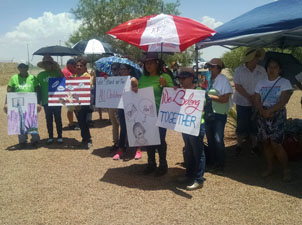
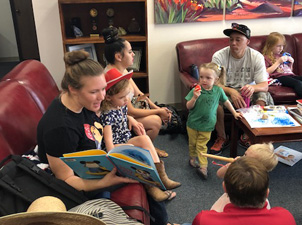
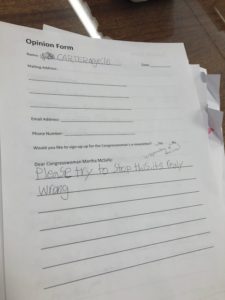
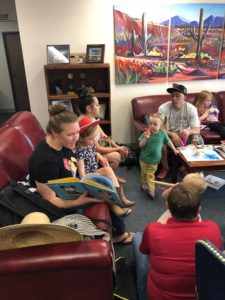
On June 13th, I and about 15 other parents and our children went to Representative McSally’s District Office in Tucson, Arizona to raise our deep concern over the separation of families at the border. Congress is in session, so Rep. McSally was not in her office. While waiting to see if we could speak with her by phone, we sang songs, read books, and ate peanut butter and banana sandwiches. We called our visit a “play-date,” and while we were there, some of the children filled out office-supplied opinion forms. Carter, who is ten, wrote: “Please make this stop it is realy [sic] wrong.”

We went to McSally’s office knowing that she would not be there, but after hearing about the suicide death of Marco Antonio Munñoz after CBP agents forcibly tore his three-year-old son from his arms, and after learning that hundreds of separated children are being held at shelters right here in Tucson, we felt it urgent to reach out to her in person. We are her constituents. She represents us in Congress. Isn’t this the way representative democracy is meant to work?

McSally issued a statement in response to our visit. It began, “It is most unfortunate that this group, organized by radical activists, broke into our office today to disrupt the workplace and prevent us from serving constituents…” She went on to claim that visits like ours “distract from the many issues our country faces.” Again, we are her constituents. We were there to speak with her about an urgent issue facing our country, happening to children and families in our community.

On the night after our play-date, my three-year-old son had a nightmare. I rushed to hold him and to quiet him so he wouldn’t wake his 9-month-old sister. He’d dreamed about a tiger scratching at his window, he said. “Tiger” has become a kind of stand-in for all sorts of unknowns, particularly sounds he doesn’t recognize. I asked if he could hear the branch scraping the window in the breeze. He nodded. I asked if that could that be the “tiger.” He nodded again, and after a few minutes, he fell back to sleep holding my hand. As I lay next to him, I wondered what a stranger might have said to him if he had awoken somewhere away from me. What would have happened if he had awoken to no one?

For me, and I imagine for many others who are outraged by the barbarity of separating families, this is the root of the issue: It is inhuman to make a child alone in the world, or to place her with strangers who aren’t supposed to touch or hold her, who don’t know how to comfort her.

More than 2,300 children have been separated from their parents or guardians due to the Trump administration’s “zero tolerance” policy. Hundreds of these children are being held at a shelter three miles from my home. It is possible that some of them will not see their families again. Yesterday, President Trump signed an executive order to detain immigrant children in camps indefinitely, this time along with their parents.

These policies are monstrously cruel. They are an attack on things I hold very dear: family, the well-being of children, empathy, community, love. So I and my friends who are parents and our children will continue to raise this grave moral issue to Rep. McSally as well as to our senators, city councilpersons, mayor, governor, and anyone else in a position to create safe, compassionate, humane immigration policies. Play-date anyone?


Daisy Pitkin is an Assistant Professor at the University of Arizona Honors College, where she teaches critical thinking and creative writing courses. She is the proud mama of two sweet children, ages 3 years and 9 months.

Faces of our Spirit-Filled Network: Rachelle Wenger

Faces of our Spirit-Filled Network: Rachelle Wenger

Rachelle Wenger
June 25, 2018

How did you first learn about NETWORK?

I first learned about NETWORK through Dignity Health. Dignity Health is one of the largest healthcare systems in the nation. Its mission is to deliver compassionate, high quality, affordable health care service—especially to those who are poor and vulnerable. Advocacy is central to its mission, and NETWORK has been a longtime partner in helping the organization to advance its policy priorities. As the Director of Public Policy & Community Advocacy, I can’t imagine being able to do my work without our collaboration with NETWORK.

What inspired you to get involved and join NETWORK?

To sum it up, it’s the Sister-Spirit that inspires me and that continually draws me in. I’ve been so fortunate to grow up (and be raised by) incredible women religious. They’ve shaped my love for people and community since I was a little girl—through my formative years in elementary school and high school. And as I came to Dignity Health as a young mother and someone starting out in a career in Catholic healthcare, it was always the Sister-Spirit that moved me, made most sense to me, and gave me the reason for why and how I’m called to this work.

What issue area are you most passionate about?

Other than health and healthcare, I’m most passionate about immigration, equity issues (homelessness and poverty), and the environment. As an immigrant to this country from the Philippines at age of five, I have a deep understanding of what it means to be “the other,” to be displaced and to be indebted (this utang ng loob, literally translated in Tagalog means, “a debt of one’s inner self”). All this while continuing to practice what it means to be authentically one’s self, value this broader sense of being home, and give back to and cherish community. There is so much suffering in our neighborhoods, our nation, and our world today. I believe that our passions direct us to seek justice, build meaningful connections, and experience joy and love.

How are you engaging your community on important social justice issues?

I get to wake up to the best job in the world. I wouldn’t even call it work, except that I actually get paid for doing something I love. At Dignity Health, I get to live out my passions, work on social justice issues at both the legislative/regulatory policy and community levels, mobilize grassroots advocacy efforts, and partner with so many amazing organizations, businesses, and leaders of all sorts of shapes, sizes, and backgrounds.

How has your advocacy for social justice shaped your view of the world?

I’m often on a plane these days and I never seem to tire looking out of the window—the view still takes my breath away. The sun sometimes gets too bright or the darkness too mysterious and I have to put the window cover down. And so I close my eyes to reflect and pray. Life is so precious. Every day that we get to have to be in it, to be a part of it, and do our part for it—makes me feel so blessed. Advocacy is more than just seeking social justice; it’s actually experiencing this incredible gift in the world called humanity.

How does your faith inspire you to work for justice?

Faith is all things quite alive in and around me, and is also in those things in between that seem like contradictions—that in the moment can’t get quite pinned down by time. In a word, faith is everything to me. Faith lets me know that the work I do to advance justice matters—that it’s meaningful and that there’s more work still to be done.

Who is your role model?

Wow, to pick one would be impossible for me. Every day, at every turn, there is someone or even something that inspires me and that I want to practice to become. Like my dad, who is recovering from a stroke and who I see fighting his way back from paralysis to walk again; like Sister Regina Ann, who I got to know during a break at a NETWORK Board retreat while we sat under a dogwood tree as if the chaos of time stopped for a moment so we could enjoy the beautiful spring afternoon; like my children, Keana Sky and Tristan Blue, who show me the resilience and unbreakable bond of love.

Is there any quote that motivates or nourishes you that you would like to share?

I recently gave a TedTalk style presentation at the closing plenary session of a CleanMed conference, since titled “Finding Your Voice in the Climate Story.” And there was this one quote from Nigerian storyteller Chimanda Ngozi Adichie that I included: “The single story creates stereotypes. And the problem with stereotypes is not that they are untrue, but that they are incomplete. They make one story become the only story…The consequence of the single story is this: … It makes our recognition of our equal humanity difficult.”

It’s just such a powerful way of recognizing what harm we do to ourselves and each other when we fall for the single story. How truly precious everyone’s voice is and how our own story contributes to the greater story of what is humanity.

What social movement has inspired you?

There are lessons to be gained from all the modern day social movements. The one I’m most interested in right now is how our country will continue to grapple with healthcare so that it is accessible and affordable to all. We’ve been able to make gains, but we’ve also made some steps backwards. What inspires me most are the many women and men that work day in and day out to care for others—despite the political winds, despite the brokenness still of our nation’s healthcare system, despite the long road ahead to one day get to a place where we no longer look at healthcare solely as a human right, but as something everyone can depend on during their time of need.

Not a Page in Your Handbook

Not a Page in Your Handbook

Garrison Mays
July 21, 2018

A few weeks ago, I took it upon myself to binge watch the second season of Dear White People, a series on Netflix. There was an episode where one of the supporting characters Lionel, a gay Black man, goes on a little adventure to find the right gay network where he can thrive and be himself. He goes through all the gay stereotype crowds: the Black gays, the theater gays, the overly sexual gays, etc. After his party hopping, he finds out that none of them accept him, regardless of the fact that they all share similar sexual identities. It should have worked out, right? Very wrong. Some people didn’t like Lionel because he wasn’t “gay enough,” others because he wasn’t “Black enough.” The list goes on as to why Lionel doesn’t fit other’s ideas of what he should be.

Like Lionel, I went to a Predominately White Institution (PWI) as an openly gay Black man.  However, unlike Lionel who had some sort of base network, I had a hard time finding a group  that understood and supported the three important attributes – my sexual orientation, my race, and my gender – that make me who I am.  In some groups, I got dumb questions about my blackness, and in others I got dumber questions about my gayness to the point where they weren’t inquisitive, but disrespectful.

Throughout my four years in college, it has been very difficult to feel 100% comfortable at this PWI. I have always bounced around from one white group to another, straight and gay groups alike, to better understand my place.  Lionel’s main network is made of thoughtful, smart, and decent Black people who don’t judge him by his gayness or his awkward blackness, but by his actions and the way he communicates. As my time was wrapping up at this PWI, I found a space that was judgement free with different types of people: straight, gay, Black, Latinx/Mexican, trans–all thoughtful and thought-provoking individuals that care about being inclusive and inquisitive about things that are unfamiliar.

I say all of this to say that Pride Month is a time for celebrating who you are. I for one bask in and appreciate this month so much as I try to find my place in this world that is just now coming around to the idea of the LGBTQ+ community. Nevertheless, this is an ongoing experience for me. I always try and fight the urge not to exclude a person because they don’t abide by the textbook or the website definition of what a queer person is. I’m not for everyone and vice versa–I understand that. But everyone deserves a chance to try and be comfortable in their surroundings. Happy Pride Month!

Garrison is a young chocolate smart-alec, who shares his opinion and wants to hear yours. He graduated from Xavier University in Cincinnati, OH in the spring of 2018 with a bachelor’s in marketing. He is excited to explore the opportunities that present themselves to him moving forward. He loves Beyoncé more than most, his favorite movies are The Incredibles and Reservoir Dogs, and you can find him lying in his hammock listening to the podcast The Read to decompress from people.

Juneteenth: A Celebration and Call for Freedom

Juneteenth: A Celebration and Call for Freedom

Jeremiah Pennebaker
June 19, 2018

“In its spread across the country and gradual supplanting of other emancipation celebrations, Juneteenth has always retained that sense of belatedness. It is the observance of a victory delayed, of foot-dragging and desperate resistance by white supremacy against the tide of human rights, and of a legal freedom trampled by the might of state violence. As the belated emancipation embedded in the holiday foretold generations of black codes, forced labor, racial terror, police brutality, and a century-long regime of Jim Crow, it also imbued the holiday with a sense of a Sisyphean prospect of an abridged liberty, with full citizenship always taunting and tantalizing, but just one more protest down the road.” – Vann R. Newkirk II, “The Quintessential Americanness of Juneteenth”

“What’s Juneteenth again?” I ask myself in my head because I did not want to admit out loud in front of my fellow interns that I didn’t know the meaning behind it. We were trying to figure out how to better integrate racial justice themes into our summer service locations. For the longest time my only connection to Juneteenth was an obscure Boondocks reference. Luckily for me there was another Black student in our intern small group who was able to explain what it was. “Juneteenth is the celebration of coming freedom,” she said.

“Coming freedom” tells us that freedom exists, but it is not here yet. The Emancipation Proclamation — the legislation that freed all enslaved Black women and men on U.S. soil — was signed into law on January 1, 1863. But like many things concerning the freedom and civil rights of Black individuals, the process was delayed. Juneteenth was established two-and-a-half years after the Emancipation Proclamation on June 19, 1865, when Major General Gordon Granger issued Order #3 in the district of Galveston, Texas informing the residents that slavery was abolished and that the freed people should now operate under an employer/ employee relationship.

Over two years after the Emancipation Proclamation, news of liberation finally reached slaves in the southernmost parts of the country. Despite this, enslavement and mistreatment of Black people continued as slave owners took their slaves to the yet-to-be-unionized New Orleans, where emancipation was just folklore. There was no relief or instant jubilation as many might imagine; instead, some faced consequences if they celebrated too openly or tried to run away. This is evident in the account of former slave Susan Merritt in Leon Litwack’s book, Been in the Storm So Long: The Aftermath of Slavery: “Those who acted on the news did so at their peril. You could see lots of niggers hangin’ to trees in Sabine bottom right after freedom, ’cause they cotch ’em swimmin’ ‘cross Sabine River and shoot ’em.’”[1] Although slaves were free in theory, they were not free in practice.

Coming freedom is the Black American Dream–the idea that we will be free one day as it has already been proclaimed. Growing up in the church I imagined that freedom was something similar to the idea of kingdom come. As my father would say, we stand on tiptoe anticipation for the day that we can lay our burdens down and rejoice in the presence of the Lord. But what I’ve also learned about kingdom come and coming freedom is that obstacles still lie between us and the freedom. Lynch mobs and police units still lie between us and the coming freedom. Protests and assassinations still lie between us the coming freedom. Colorblind classmates, coworkers, and Members of Congress still lie between us and coming freedom. But the hope within coming freedom and the jubilation of Juneteenth lies within the fact that regardless of what lie between us and coming freedom, it is still coming.

[1] What Is Juneteenth?

Questions to Ask Yourself for the 2018 Primaries

Questions to Ask Yourself for the 2018 Primaries

Mary Cunningham
June 14, 2018

With midterm elections rapidly approaching, it is time to start thinking about primaries. While certain state primaries have already passed, there are some that are just around the corner! Primaries are preliminary elections used to determine which candidates will face off for the general election scheduled for November 6, 2018. With a surge of new candidates on the ballots, particularly women, it is important to ascertain whether or not these candidates will implement the policies you care about if elected to office. So with all that in mind, what are the important questions you should ask yourself before voting in your state’s primary?

  1. How will the candidates lived experience and background contribute to a more nuanced and diverse Congress?

When you see photos of most Members of Congress you will notice a striking pattern: they are typically white, middle-aged men. Imagine what it would be like to have more diverse voices in our offices– people of different genders, races, and religious affiliations. Take women as an example: according to Vox, women currently constitute less than 20% of Congress. That boils down to just 22 female senators and 83 female representatives in a Congress made up of 535 people total. It’s even more discouraging when you look at the number of women of color in Congress. According to Axios, 30 states have never elected a woman of color to Congress. Instead of leaving it up to the men to decide, we need female perspectives on issues such as paid-family leave and childcare. There is hope in the fact that more women are running for Congress, but that hope will only be realized if we take the extra step and vote for them!

  1. What is the candidate’s approach to the importance of human dignity for all in local, state, and federal policies?

As Catholics we hold dear the belief that all people have an inherent dignity: rich or poor, citizen or noncitizen.  We do not get to decide whether or not someone is not worthy of love. In Pope Francis’s new apostolic exhortation he calls us to value the life of migrants as we would any other life. Multiple candidates for the midterm elections have come out with flagrant anti-immigrant agendas. There is no place for these egregious mindsets in Congress. We need elected officials who recognize that there is value in every human being and who will enact policies that allow all to reach their full potential. This means recognizing the plight of those who cross the border and the dignity of all people, not making unsubstantiated assumptions about them!

  1. How will the candidate respond to the most vulnerable members of their community?

Back in November, the Republican tax bill passed, promising tax cuts for the wealthy largely at the expense of the poor. The new law is estimated to increase the United States debt by over $1 trillion.  Almost immediately after its passage, Republicans pivoted and took aim at safety net programs. This can be seen in the recent efforts to introduce Medicaid work requirements, SNAP work requirements, and harsh policies imposed on those who receive federal housing subsidies.

In another blatant show of hypocrisy, several House Representatives voting for stricter work requirements and SNAP restrictions in the Farm Bill are themselves benefitting from the federal farm subsidies they will pocket if the bill passes. It’s one thing to claim to support the needs of your constituents, but it’s another to fight for policies that actually help them. Without access to federal assistance programs, many families will not be able to stay afloat. When casting your vote, ask yourself: can you rely on that candidate to protect the needs of people who are marginalized?

When voting for a candidate, it is important to be informed about their platform. Furthermore, as Catholics, it is important to make sure that the people we elect to office represent our closest held values—whether that be dignity of life, care for the poor, or others After all, these are the people that will be representing you and all you stand for over the next few years. That should not be taken lightly!

Researching Representatives in Favor of HR2 Reveals a Hall of GOP Hypocrites

Researching Representatives in Favor of HR2 Reveals a Hall of GOP Hypocrites

Mackenzie Kuhl
June 13, 2018

The 2018 House Farm Bill, also known as H.R. 2, failed a vote in the House on Friday, May 18, by a vote of 198 to 213. This bill, which put to shame the historically bipartisan process of Agriculture and Nutrition special interests working together on a compromise, severely failed NETWORK’s principles to protect and prioritize the Supplemental Nutrition Assistance Program (SNAP). Despite the bill’s failure a few weeks ago, the House is predicted to vote again on or around June 22.  At NETWORK, we have and continue to call representatives to vote “No” to this bill.

In the past, farm bills have been largely bipartisan. However, this year’s $867 billion Farm Bill has sparked controversy not only because of its proposals to cut SNAP benefits by $21 billion and add mandatory work requirements, but also because of its ongoing ties to immigration negotiations. To make matters worse, many of the Republican representatives advocating for cuts to SNAP and tougher work requirements could reap extreme financial benefits from federal farm subsidies if the bill becomes law.

According to CNN, “Since 2002, Congress has added in multiple means-testing for federal farm subsidies to prevent them from going to the hands of wealthy farm-owners. But, tucked away in Sec. 1603 of the new bill, is an exemption for ‘pass-through’ businesses from the means testing requirements.” With some basic accounting adjustments, millionaires and billionaires could collect their farm subsidies once again from this Farm Bill. Even Daren Bakst of the Heritage Foundation (a conservative think tank) calls it “basic cronyism.” Essentially, these congressional leaders are prioritizing their own financial gains over the very communities they are supposed to be protecting—including children and those most vulnerable to hypocritical acts like this one.

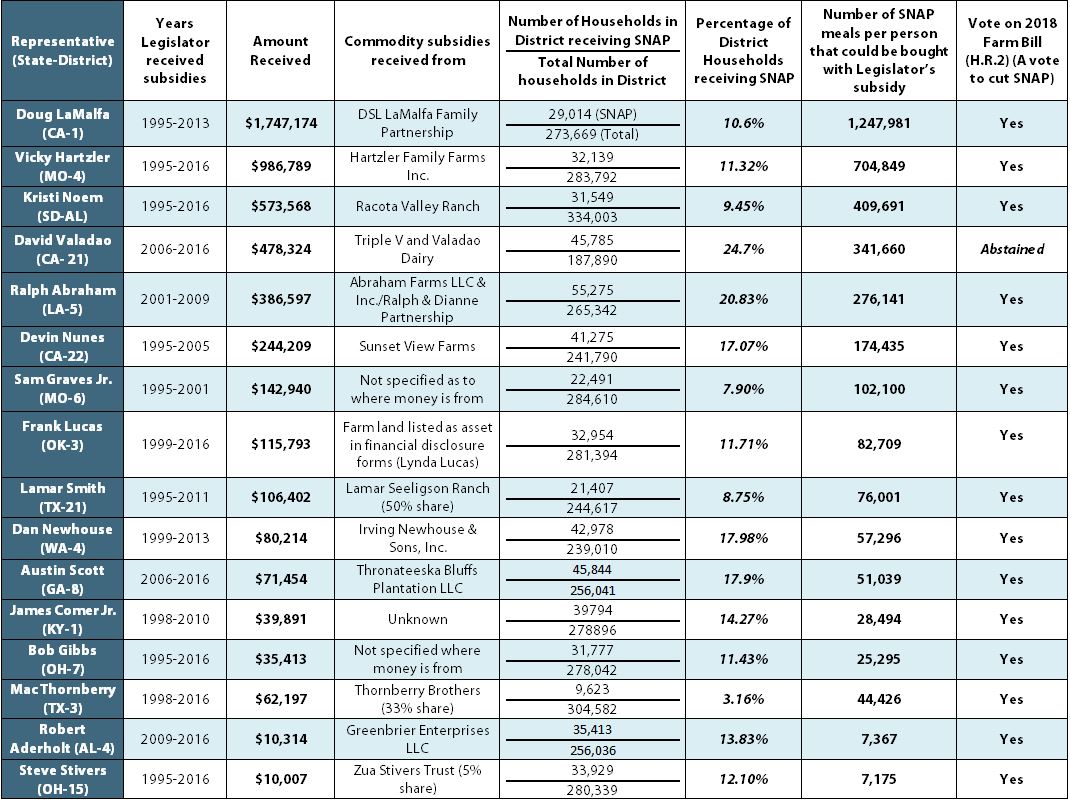
The Environmental Working Group (EWG) pulled together data to investigate the top 16 GOP members who would benefit from farm subsidies. This includes Rep. Doug LaMalfa (CA-1) who raked in more than 1.7 million in subsidies from 1995-2013 for his shares in the DSL LaMalfa Family Partnership, and Rep. Vicky Hartzler (MO -4), who collected more than $986,000 from 1995 to 2016 for her shares in Hartzler Family Farms Inc.

Overall, the EWG reports that 60% of farm subsidies go to the top 10% of farmers.  Additionally, The Heritage Foundation exposes some myths surrounding the subsidies that “’Family Farms’ do not necessarily mean ‘small farms’.”

To put this in perspective, NETWORK researched the number of households that receive SNAP benefits in each representative’s district.  We divided the total number of households per district by the households that participate in SNAP to see what percentage of households would be affected by cuts to SNAP while their representative reaped financial gain.

The comparisons were stark. Rep. Ralph Abraham (LA-5) received more than $386,000 in subsidies from 2001-2009, and while 20.8% of his district participated in SNAP.  Rep. David Valadao (CA-21), who abstained from the first round of voting on H.R.2, received more than $478,000 within 10 years (2006-2016) while 24.7% of his district participated in SNAP.

So how much do these representatives serve to gain from the subsidies? Enough to pay for thousands upon thousands of SNAP meals.

Each SNAP recipient receives an average of $1.40 per meal.  Since the issue at hand is to determine whether members of Congress were voting for their own personal enrichment while jeopardizing the food security of their constituents, NETWORK calculated how many meals each subsidy amount would pay for. The results and the vote of the members on H.R. 2 are in the chart below.

And, here’s the ultimate hypocrisy: Not only have they voted for a bill that would allow them to personally benefit while hurting their constituents, many of these very representatives have spoken out against “fraud, waste, and increased spending” for government assistance programs.

Rep. Frank Lucas said during a 2011 subcommittee hearing, “I’m concerned that the broad-based categorical eligibility increases opportunities for waste, fraud, and abuse.”  Rep. Kristi Noem, who received the third-largest amount of subsidies, has said, “Loopholes and fraud in the current program have led to federal spending on SNAP to increase by 270 percent over the past ten years.”

What do we make of all of this? Many GOP representatives in favor of H.R. 2 are choosing personal profit over the most vulnerable people in society. These elitist, hypocritical actions directly contradict the values which people of faith live by. If this bill comes up for a vote again, these Members of Congress must vote no.

Mackenzie Kuhl is a summer intern with the NETWORK Government Relations Team.

NETWORK Celebrates Pride

NETWORK Celebrates Pride

NETWORK Communications Team
June 13, 2018

Happy Pride Month! Our faith teaches us that people of all sexual orientations and gender identities have human dignity, and that is surely something to celebrate!

At NETWORK, we acknowledge that too often members of the LGBTQ+ community are not recognized to extent that they should be. This is true in all of society – but it is especially true in Catholic and other religious settings.

Of course, NETWORK has ‘Catholic’ in our name, which means that very often people hear that word and draw conclusions (not entirely unwarranted) about what our positions may be on issues like LGBTQ+ equality. Especially this month, as the LGBTQ+ community celebrates Pride, and moving forward, NETWORK wants to make it clear that we welcome and affirm all members of the LGBTQ+ community. We are actively working so that all justice-seekers can find a home in NETWORK, when other religious corners of the country (or of the internet) can feel particularly polarizing. NETWORK was founded by Catholic Sisters, is motivated by Catholic Social Justice, and is open to all who share our passion.

NETWORK and our society (including those of us who are allies) need to do a better job of acknowledging the contributions of the LGBTQ+ community in our shared work for justice. We recognize that many members of the LGBTQ+ community can experience injustices when they shop, where they work, and beyond. We also know that many members of the LGBTQ+ community are working alongside us on all justice issues. As we look forward at mending the gaps in our society with an intersectional focus, we promise to do our best to recognize the many identities our justice-seekers have.

To all LGBTQ+ members of the NETWORK community: Happy Pride Month! We see you, we affirm you, and we are grateful for all that you do to make the world a more just place.


Two Bills Aimed at Ending Family Separation

Two Bills Aimed at Ending Family Separation

Sana Rizvi
June 11, 2018

As Congress struggles to find consensus on a solution to provide protections for Dreamers, the Administration’s new family separation policy has started a political fire storm creating moral outrage across the country and in Congress. There are two bills that would end the practice of family separation and provide relief to impacted families: The Keep Families Together Act (S. 3036) and the Humane Enforcement Legal Protections (HELP) for Separated Children Act of 2018 (S. 2937/H.R.5950). NETWORK strongly supports these bills.

The Keep Families Together Act (S. 3036)

The Keep Families Together Act prohibits the separation of families at the border. Senator Dianne Feinstein introduced this bill on June 7, 2018 and it currently has 31 Democratic cosponsors and no Republican cosponsors. The bill was created in consultation with groups who provide services to families at the border including Kids in Need of Defense (KIND) and the Women’s Refugee Commission. It mandates a prohibition on removing a child from a parent or guardian in an attempt to deter migration into the United States. It also provides a mechanism to reunite families who have been separated.

The HELP Separated Children Act of 2018 (S. 2937/H.R.5950)

Senator Tina Smith (D-MN) and Rep. Lucille Roybal-Allard (D-CA-40) introduced this bicameral bill on May 23, 2018. Although this act does not end the practice of family separation, it is a necessary step in protecting children until Congress can find a permanent legislative solution to unite detained families and prohibit the separation of families. The HELP Separated Children Act of 2018 would provide relief to families by:

  • Allowing parents to participate in proceedings affecting their children.
  • Allowing parents to make calls to arrange for the care of their children and ensuring that children can call and visit their parents while they are detained.
  • Protecting children from being forced to be translators for law enforcement when speaking to their parents.
  • Ensuring that parents can coordinate their departures with their children.
  • Requiring ICE to consider the best interests of children when making decisions on the detention, release, or transfer of their parents.

The bill currently has 24 Democrats sponsors in the Senate and 16 Democrats sponsors in the House.

With Democrats working to elevate this moral crisis to the public’s attention, all eyes are on Republicans for a legislative response. Protections for children have historically been a nonpartisan issue and thus these two bills should be supported by all Members of Congress.

We must work to secure Republican cosponsors on these bills so that Congress can pass legislation to end family separation. The practice of separation is so morally corrupt, that even immigration hardliner Rep. Mark Meadows (R-NC) leader of the House’s far right faction called the “Freedom Caucus” has called the policy a “horrible law.”  We call on Republicans to join their Democratic colleagues in ending the policy of family separation.

NETWORK will continue to monitor legislation closely and provide updates on this issue.

CHIP Funding Once Again at Risk

CHIP Funding Once Again at Risk

On Wednesday, June 6 NETWORK and 17 other faith-based organizations sent a letter to Congress to oppose H.R.3, which includes 7 billion dollars in cuts to CHIP as a part of the rescission process.

Download as a PDF.

June 6, 2018

Dear Representative:

We, the undersigned 18 organizations, representing various religious denominations, urge you to vote NO on H.R. 3, the Spending Cuts to Expired and Unnecessary Programs Act. As currently written, this measure contains a harmful provision that would rescind $7 billion in funding for the Children’s Health Insurance Program (“CHIP”). As people of faith we believe that healthcare is a human right and that care for children is a sacred responsibility. If enacted, this rescission to CHIP would threaten the health and well-being of the 9 million children who utilize the program every year.

We are especially concerned with the $2 billion in cuts to the CHIP contingency fund. This fund has consistently been used in times of economic downturn, natural disaster, and other uncertain times to ensure that children can have access to healthcare. More recently, a similar fund was used when Congress was unable to pass a CHIP funding bill before individual state funding for the program ran out. If this fund was not available during the reauthorization process last year, thousands of children would have lost healthcare while Congress failed to act. Congress should not take away this vital security measure for the health of our children.

Recent Congressional action to pass a 10-year extension of CHIP was a major success for the 115th Congress, but this risky rescission could undercut the program and undermine this success. CHIP, as it is currently funded, is projected to decrease the deficit by $6 billion over 10 years.1 The health of our children is too important to be used as additional means to pay down the deficit. It is especially relevant to protect our children from additional cuts after the passage of the tax bill provided enormous benefits to the wealthy and large corporations while adding over $1.7 trillion to the deficit. Children must not pay for the enrichment of the wealthiest in our nation.

CHIP has enjoyed bipartisan support and success for more than 20 years. It has proven to be an effective investment in the health of our children and should be protected and supported. Our faith traditions teach us to protect the most vulnerable people, especially children. We believe that a rescissions package that threatens to take healthcare away from children does not live up to our moral obligation. We urge you reject and refuse a vote on H.R. 3, until and unless these harmful CHIP cuts are removed.

Sincerely,

American Muslim Health Professionals

Congregation of Our Lady of Charity of the Good Shepherd, US Provinces

Evangelical Lutheran Church in America

Faith in Public Life

Franciscan Action Network

Hadassah, The Women’s Zionist Organization of America, Inc.

Interfaith Worker Justice

National Advocacy Center of the Sisters of the Good Shepherd

National Council of Churches

National Council of Jewish Women

NETWORK Lobby for Catholic Social Justice

Poligon Education Fund

Religious Institute

Union for Reform Judaism

Unitarian Universalist Association

Unitarian Universalists for Social Justice

Unitarian Universalist Women’s Federation

United Methodist Church – General Board of Church and Society

1. Congressional Budget Office. “Cost Estimate of Extending Funding for the Children’s Health Insurance Program for Ten Years”. January 11, 2018.

The Right to Vote: Then and Now

The Right to Vote: Then and Now

Claudia Brock
June 6, 2018

Every election my mom likes to remind my sister and me of the time we accompanied her to vote in the 2000 presidential election. At the ages of 4 and 6, we were convinced that voting was one of the most glamorous and exciting things an adult could do. After all, you had to be 18 and you got to have a say in who ran the country. On Election Day, my sister and I donned our finest tutus and costume jewelry to accompany our mom to the polls for this truly sophisticated event. Imagine our disappointment when we walked into our local elementary school’s cafeteria and waited as our mom went into the voting booth, only to head out the door five minutes later. I’m not sure what my sister and I hoped to see, but we were grossly unimpressed.

When I voted for the first time in the 2012 election, the experience was completely different—entering a voting booth at a local park pavilion felt plenty exciting. I had carefully researched all of the candidates on the ballot and even called my county election commission to make sure I could bring my notes into the booth with me. I took, and still take, my right to vote very seriously because not only do I help elect leaders I think will benefit my community, but I also understand that thousands of women fought for my right to be in the voting booth.

The Nineteenth Amendment, which prohibits states and the federal government from denying the right to vote on the basis of sex, was originally introduced in Congress in 1878 and was finally passed 41 years later on June 4, 1919 and submitted to the states for ratification. Suffragettes had marched, protested, and lobbied for the inclusion of women in the vote since the 1848 Seneca Falls Convention in New York. For 71 years, these women built a grassroots movement, but they also were imprisoned, endured physical and sexual assaults, were disowned from their parents, and had their parental rights terminated as a result of their work and beliefs.

Despite their work for greater access to democracy, these women failed to address the dual oppression of racism and sexism faced by Black women. Suffragettes barred Black women from the movement and presented voting rights as an extension of white supremacy to make it more palatable to other white Americans. It was not until the Voting Rights Act of 1965, which outlawed discriminatory polling laws like voting taxes and literacy tests, that Black women secured the right to vote.

In the United States, those who vote have more representation than those who do not. This is a problem when you consider that there are still efforts to suppress the votes of people of color, including the dismantling of the Voting Rights Act, strict voter ID laws, racial gerrymandering, polling place intimidation, voting roll purges, and more. As I reflect on my first time voting, I realize my experience was ripe with privilege: I had the time and resources to go to the polls, my name was not purged from the voting roll, I was not asked to show ID, I was not harassed at the poll, and there were enough poll workers present so my voting lasted only 10 minutes.

Voting is a great step in reducing inequality of all kinds and achieving racial equity through public policy. It plays a large role in the allocation of government resources, who benefits from public policies, and the size of government. If you are able to vote, you should! You can register here. Around the anniversary of the passage of the Nineteenth Amendment, use your voice to advocate for voting rights to create a more perfect and inclusive union.