


Category Archives: Front Page

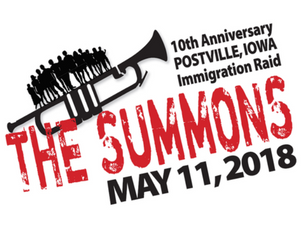
How Will We Answer the Summons?

How Will We Answer the Summons?

Rebecca Eastwood
May 9, 2018

Although I have lived in Washington, DC for the past four years and have grown and learned so much in our nation’s capital, I will always be a proud Iowan.

Often confused with places like Ohio or Idaho, Iowa is known for things like corn and caucuses. The events of May 12, 2008, however, permanently marked Iowa on the map for a different reason.

Headlines in the weeks that followed read:

Immigration Raid Jars Small Town

Immigration Raid at Meat Processing Plant in Iowa Largest Ever in US

I was 16 at the time and attended high school in Decorah, IA. When the news reached our classrooms that day of helicopters and federal agents surrounding the meatpacking plant in Postville, the town next door, I was confronted with the reality of our broken immigration system that, because of my privileged background, I never before had to consider.

We would soon learn in the hours and days following that what transpired was the largest worksite immigration raid (at that time) in U.S. history. As I reflect on the events that day ten years ago I recognize it as the moment that truly summoned me to social justice work.

For a town of approximately 2,400, Postville was one of the most diverse communities in Northeast Iowa. In addition to a number of other distinct communities, Postville was home to a large Latino/a population. Drawn by the promise of opportunity, education, and safety, families set down roots in Postville.

The raid tore these roots apart. Immigration and Customs Enforcement agents arrested almost 400 people working at the kosher meatpacking plant, AgriProcessors, in the span of a few hours. Agents descended on the plant, chased, shackled, and carted away mothers, fathers, sisters, and brothers.

Children came home from school to empty houses. Community members took refuge at St. Bridget’s, the local Catholic church, terrified they would be next or that they would never see their family members again. The raid upended the schools, economy, and families of this small community.

In the chaotic weeks following, the local community stepped up to attempt to repair what our federal government had ripped apart. Centered in St. Bridget’s, volunteers helped people find their family members, the majority of whom were detained in the Cattle Congress buildings, prosecuted en masse, and eventually deported.

Through this response effort, I spent some time volunteering, mostly using my high school Spanish to entertain children while their family members did all they could to pull their lives back together.

This experience would never leave me. I could not forget the child asking when they would see their dad again or the mother trying to keep her family fed while wearing an ankle monitor. I was shaken out of my complacency and forced to answer the question: who am I summoned to be in the face of this injustice? Answering that question led me to Washington, DC to advocate for policies that would keep families together and uphold the dignity of migrants- attempting to prevent other communities from experiencing the same trauma as Postville.

The raid seared into our collective memory the devastating impact of inhumane immigration policies. We no longer need to look back a decade, however, to remember the suffering caused by immigration raids.

Only one month ago, ICE conducted the largest worksite raid of the Trump administration. The circumstances were all too familiar: agents surrounded a meatpacking plant in Tennessee. They arrested nearly 100 people. Terrified families gathered at the local Catholic church for support.

In the past year, the federal government has targeted thousands for detention and deportation, including those who have lived here for decades. They have systematically rescinded legal status for those with Deferred Action for Childhood Arrivals (DACA) and Temporary Protected Status (TPS). They are separating families seeking safety at our southern border.

Who are we as a nation summoned to be in the face of these injustices? Will we challenge harsh, anti-immigrant rhetoric and policy? Will we demand a system that recognizes migrants as whole persons worthy of dignity? As people around the country observe the ten-year anniversary of the raid we pray that in answering this summons we will never mark another anniversary like this.

Postville is everywhere. How will we respond?

Becca is the Advocacy Coordinator for the Columban Center for Advocacy and Outreach in Washington, DC. The Columban Center is the national advocacy office for the Columban fathers, a Catholic order of priests and lay missionaries living and serving in 15 countries. Her advocacy work focuses on immigration, environmental, and economic policy.

One Year of Policy Changes since the House Vote on ACA Repeal

One Year of Policy Changes since the House Vote on ACA Repeal

Kaitlin Brown
May 4, 2018

One year ago today, 217 Republican Members of Congress voted to pass the American Health Care Act (AHCA) in the House of Representatives. This legislation essentially repealed the Affordable Care Act (ACA), and could have left 20 million people without access to quality, affordable health insurance. Thanks to the hard work of healthcare advocates, the bill was stopped in the Senate after two more months of debate and votes. Just because the bill failed, however, does not mean threats to affordable healthcare have ended. In the past year since the failure of the AHCA, the Trump administration has worked through many different channels to try to actively sabotage the success of the Affordable Care Act.

Already, we are seeing the effects of this sabotage on the uninsured rate and cost of premiums in the United States. A new study by the Commonwealth Fund, estimates that 15.5% of adults are uninsured, which is about three percent higher than in 2016. This “death by a thousand cuts” effort by the administration means that an additional four million people are already without insurance. The uninsured rate is only expected to go up as premiums increase and people are priced out of the individual market.

Below is a step-by-step analysis of the steps the administration has made to take affordable healthcare away from millions of Americans:

June 8, 2017: In a Senate Budget Committee hearing on June 8th, then-Health and Human Services Secretary Tom Price would not answer if the Trump administration would allow cost-sharing reduction (CSR) payments, leading to an uncertainty for insurance companies, and ultimately higher rates. Cost-sharing reduction payments are a key part of making sure that health insurance premiums stay affordable for consumers. Insurance companies need set their rates about a year in advance, and need to know if they will be given cost-sharing reduction payments or not to keep premiums affordable.

July 20, 2017: The Department of Health and Human Services begins a public campaign against the ACA through promoting a videos series of people harmed by the Affordable Care Act, tweets, and removing information about the ACA’s provisions from its website.

July 29, 2017: The American Health Care Act (AHCA) fails in the Senate. President Trump tweets that he will not make CSR payments any longer if the bill is not passed, causing more uncertainty for insurance companies.

August 31, 2017: The Trump administration cuts the advertising budget for the individual marketplace by 90%.

September 22, 2017: The Centers for Medicare and Medicaid Services (CMS) announces that  Healthcare.gov, the website where many people sign up for health coverage, will be unavailable most Sundays of the open enrollment period. This is a key time for many faith-based groups who help people enroll after church services.

October 12, 2017: In a move that could leave one million people uninsured by 2018, the Trump Administration decides to end CSR payments.

December 22, 2017: As a provision of the recently passed tax bill, the ending of the individual mandate is signed into law. This could cause thirteen million people to not have insurance, as well as raise premiums by 10% due to a lack of younger, healthier people in the individual marketplace.

January 12, 2018: CMS announces that it will approve Kentucky’s request to institute work requirements within the Medicaid program. This will cause low-income people who are unable to meet or document the new requirements to lose coverage.

February 1, 2018: Indiana’s Medicaid Work Requirement waiver is approved.

February 20, 2018: CMS proposes a rule that would allow short-term health insurance plans to be used for a year. These plans do not need to meet the standards set by the Affordable Care Act, and do not need to cover benefits including: maternity care, mental health services, pharmacy services, and more. They also are not required to cover people with pre-existing conditions. In addition to harming people who use the plan as long-term insurance, this would continue to draw young, healthy people away from the individual marketplace.

March 5, 2018: Arkansas’ Medicaid Work Requirement waiver is approved.

April 9, 2018: CMS announces a rule that makes it harder for consumers to learn about different healthcare plans, as well as loosens the standards of coverage that had previously been in place by the Affordable Care Act.

This is just a small sample of the actions that the Trump administration has taken to take healthcare away from millions of people. The Center for Budget and Policy Priorities has an exhaustive list of every action that the administration has done in the past year to try and undermine the success of the ACA.

What the Trump administration has not been able to accomplish through the legislative process, they have moved to doing through executive actions. These harmful actions have already caused four million people to be without coverage, and will continue to affect millions more as premiums increase. Others will be stuck in short-term insurance plans that do not provide adequate coverage, and could be liable for thousands of dollars in healthcare bills in an emergency setting. NETWORK will continue to resist the Trump administration’s continued attacks on the healthcare of our sisters and brothers.

The Trump Administration’s Attacks on Immigrant Families

The Trump Administration’s Attacks on Immigrant Families

Sana Rizvi
May 2, 2018

It shouldn’t come as a surprise that the Trump administration has anti-immigrant policies, considering our current president won an entire campaign on an explicitly anti-immigrant platform. Yet, I am still outraged by the horrific nature of these policies and how they have attacked the very foundation of our society: families.

How can we not be outraged? When did our political leaders forget the value and sacredness of family?

I have heard my entire life that our nation is a nation of immigrants. If that is (at least partially) true, why do we treat immigrants in this country today as second-class citizens? Why do we allow our government to tear immigrant families—people who came to this country for safety and security—apart?

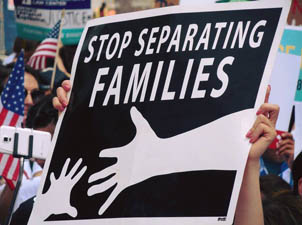
Over the past few months, as advocates fought to keep DACA (Deferred Action for Childhood Arrivals) in the news cycle, the Administration took action to uproot our immigrant communities by ramping up detentions and intentionally separating children from their parents.

Here are just a few examples:

On October 24, 2017, Rosa Maria Hernandez, a 10-year-old undocumented girl with cerebral palsy, was arrested by border agents while being taken into surgery. National outrage came swiftly, and it was a rare moment of national spotlight, which led Rosa Maria to be released on November 3, 2017.

A few weeks later, 1-year-old Mateo was separated from his father, who was applying for asylum as a family unit at the same time as several other families. Onlookers who resisted the separation of father and son were forcibly told by the arresting officer that doing so would hurt their own claims for asylum. The four children taken during that encounter were then processed as unaccompanied minors and sent to foster care in separate states.[i]

In March, a Congolese woman was finally reunited with her 7-year-old daughter after being separated from her for several months by almost 2,000 miles, a situation DHS Secretary Nielsen herself could not rationalize.[ii]

These are just a few recent examples, but the everyday reality is that Immigrations and Customs Enforcement (ICE) is systematically seeking to separate parents from their children. [iii]

In Islam, heaven is under your mother’s feet and looking at your parents with love is considered a form of worship. Woe to those who tear children away from heaven.

As a person of faith, I am deeply troubled by the leniency our collective conscience has allowed to those who tear families apart in the name of national security. Family separation has gone from a once-abhorred policy to being a common state-sanctioned practice.

Two recent ICE directives have made this possible: The first instructed agents on how to separate children from their parents, removing key elements of earlier policies that allowed prosecutorial discretion to provide assistance to parents who need help retaining their parental rights in immigration courts. The second changed an ICE policy to begin long-term detainment of pregnant women, despite multiple lawsuits and reports of miscarriages occurring from the conditions of detention.[iv]

One of the most memorable verses in the Quran asks “Was not the earth of God spacious enough for you to flee for refuge?” (Quran 4:97) Every time I read it, I am reminded that we erected strict borders, even though God asked us to never turn away people who come to your door in need.

What excuses will we make in front of God when asked why we treated our neighbors as criminals and increased their suffering when they came to us for help? What will we say when we are shown the children who fled to a country they did not know and were torn from their mothers?

[i] “Five Outrageous ways ICE Separates Families” Amnesty International USA. Dec. 18, 2017. https://medium.com/@amnestyusa/five-outrageous-ways-ice-separates-families-fe0452653272

[ii] “Durbin says Homeland Security admits separating Congolese mother and child ‘a mistake’” Chicago Tribune. March 7, 2018. http://www.chicagotribune.com/news/opinion/huppke/ct-met-congo-family-separated-immigration-huppke-20180307-story.html

[iii] Our friends at Hope Border Institute recently published a report of asylum seekers at the El Paso Sector of the border being deterred from entry through cases of family separation and the horrific conditions of detention, find that report and more resources here: https://www.hopeborder.org/sealing-the-border

[iv]  “Detained  Women Suffering Miscarriages Due to ICE Negligence, Activists Say” NETA February 12, 2018 https://netargv.com/2018/02/12/detained-women-suffering-miscarriages-due-ice-negligence-activists-say/

Feast of St. Joseph the Worker

Feast of St. Joseph the Worker

Mary Cunningham
April 30, 2018

“He carried out this vocation with complete fidelity until at last God called him, saying: ‘Good and faithful servant, enter into the joy of your Lord.’ ” – St. Bernardine of Siena

On May 1, we celebrate the feast of St. Joseph the Worker. Pope Pius XII established this feast day in 1955 to honor St. Joseph and celebrate the Catholic Church’s commitment to the dignity of labor. St. Joseph cared for Mary, his wife, and Jesus, his son, through his work as a carpenter, representing for us the ideal of dignified work and faithful contribution to the common good. His example reminds all workers to participate in God’s continuing creation each and every day through our own labor.

As I reflect on St. Joseph the Worker, I am reminded of the teacher strikes emerging throughout our country in the past few months. Beginning in West Virginia –and growing to Colorado, Kentucky, Arizona, and Oklahoma– teachers are uniting to demand higher wages and better conditions for the schools where they teach. The teachers rallying are from states with some of the lowest salaries for educators in the country. They are calling for more state funding for public education, which is currently inadequate.

In a pivotal move, teachers are leaving their classrooms to go on strike. In West Virginia, the teachers hoped to point out not only inadequate pay, but also changes to PEIA (Public Employees Insurance Agency), a health insurance company that covers state employees. They also wanted to highlight the large number of teacher vacancies (700 in West Virginia) resulting from poor school conditions and low teacher pay. In Colorado, teachers rallied at the State Capitol for various reasons, among them fear of changes to retirement and pension plans. United for a common mission, these teachers have gained national attention, and in some cases, secured greater education funding.

Like teachers, workers across professions are joining together to demand just wages and benefits for their work. At the Christian Care Home  in Ferguson, Missouri, healthcare workers participated in a 104 day-long strike because the nursing home mishandled vacation and violated  the contract for time off  for its employees. Around 65 full-time employees and 25 part-time workers participated in the strike, which eventually led to a 20 cent an hour raise to $9.85 an hour. Christian Care Home also agreed to cover health insurance rates and cover payouts for unfair labor practices. This is another striking example of what it looks like to take action to secure dignified labor.

As we celebrate St Joseph the Worker today, we recall all workers who have experienced injustice and sought better working conditions for themselves and those around them. The teachers going on strike, and all teachers across the United States, are shaping our education system and forming the young women and men who will soon enter the workforce, and serve as our politicians, engineers, and innovators. Their contribution to the common good cannot be understated. All workers deserve dignity, fair compensation, and safe work environments that allow them to shape our shared future and contribute to the common good.

Striving For Holiness In Our Advocacy

Striving For Holiness In Our Advocacy

Mary Cunningham
April 26, 2018

In his recently-published apostolic exhortation “Rejoice and Be Glad,” Pope Francis explores what it means to be holy in a world often tainted by egoism and a disregard for the marginalized. He calls us all to follow Jesus in order to embody His holiness and live out His mission in the world. In one section of the apostolic exhortation, Pope Francis lists the “signs of holiness in today’s world:” Perseverance, Patience and Meekness, Joy and a Sense of Humor, Boldness and Passion, Community, and Constant Prayer. What do these mean, and how do they apply to our own lives and our advocacy?

Perseverance, Patience and Meekness

“They do not desert others in bad times; they accompany them in their anxiety and distress, even though doing so may not bring immediate satisfaction.” (#112)

Working for justice can be draining. I am always amazed by our lobbyists who constantly advocate for policy goals that may or may not be realized. It is difficult to measure how much one lobby visit or one conversation can influence a policy maker. While our lobbyists might not feel immediate satisfaction from their actions, they continue to do this work because they are hopeful that through advocacy we will move towards a more positive future. As we continue in our work for justice, it is important to look towards our ultimate goal to avoid being weighed down in moments of distress.

Joy and a Sense of Humor

“Hard times may come, when the cross casts its shadow, yet nothing can destroy the supernatural joy that ‘adapts and changes, but always endures, even as a flicker of light born of our personal certainty that, when everything is said and done, we are infinitely loved.’”  (#125)

In our political climate it can be hard to find joy, let alone a sense of humor. The current administration makes daily decisions that threaten the livelihood of our sisters and brothers both in the United States and across the world. In the face of this adversity, it is important to cultivate the inner sense of joy and positivity we need to move forward.

At NETWORK, I find joy in my co-workers, who find time to engage with one another in meaningful ways even when they are bogged down with hill visits, or grassroots organizing. I also find joy in the hope that our work will contribute to promoting the common good and dismantle the oppressive systems currently in place.

Boldness and Passion

“God is eternal newness. He impels us constantly to set out anew, to pass beyond what is familiar, to the fringes and beyond. He takes us to where humanity is most wounded, where men and women, beneath the appearance of a shallow conformity, continue to seek an answer to the question of life’s meaning. God is not afraid! He is fearless! He is always greater than our plans and schemes. Unafraid of the fringes, he himself became a fringe (cf. Phil 2:6-8; Jn 1:14).” (#135)

Going to the fringes requires a willingness to enter into moments of discomfort and leave our own privilege. One of our goals at NETWORK is to engage in dialogues and actions surrounding racial justice. As a white person, I often struggle with these conversations. I try to make sure I am being respectful in the language I use, while also acknowledging my own privilege, which can be uncomfortable. In the advocacy space, it is important not to let our fears overcome our passion. We are human. God calls us to enter into difficult conversations and to be bold so that justice can be advanced. Complacency is resignation. As Dr. Rev. Martin Luther King, Jr. said in his Letter from a Birmingham Jail, “injustice must be rooted out by strong, persistent and determined action.”

Community

“Contrary to the growing consumerist individualism that tends to isolate us in a quest for well-being apart from others, our path to holiness can only make us identify all the more with Jesus’ prayer ‘that all may be one; even as you, Father, are in me, and I in you’ (Jn 17:21).” (#146)

It’s a human tendency to think we can do everything on our own. Sometimes it feels easier to do it that way instead of consulting our sisters and brothers for help. However, in our work for justice, we must always seek out our neighbors. Our Grassroots Mobilization team constantly puts this into action by building advocates teams across the United States and mobilizing them to be active voices in their communities. We also see this sense of community in our spirit-filled network at NETWORK that participates in action alerts, webinars, and more. Without them, out work would not be possible.

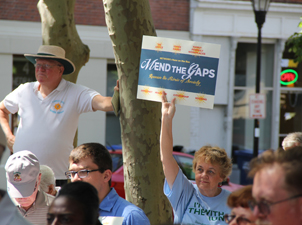
Another key part of advocacy is building relationships with other organizations advancing justice and lifting up the work they are doing. At NETWORK we work on our Mend the Gap issue areas, but we can only cover so much! Without the great work of our partner organizations, the uphill battle towards economic and social justice would be a lot more challenging. When we recognize the value of community, we are all able to combine our unique strengths to work towards a common goal.

Constant Prayer

“Trust-filled prayer is a response of a heart open to encountering God face to face, where all is peaceful and the quiet voice of the Lord can be heard in the midst of silence. In that silence, we can discern, in the light of the Spirit, the paths of holiness to which the Lord is calling us.” (#149)

Pope Francis emphasizes the importance of discernment by asking, how do we faithfully follow God? Being in prayer with God means being in conversation with Her and asking where do you most need me? Although this can be unclear, only in talking to God can we ensure that we are doing all we can to live out Her mission.

A huge part of our work for justice requires listening and bearing witness to what is going on around us. We must occasionally set aside doing and focus on openness: letting God’s will enter our hearts and our minds. We have to remind ourselves of why we are doing this work. Only then can we ensure we are truly living out God’s call for us.

Overall, there is a lot to take from the pope’s apostolic exhortation. Pope Francis assures us that we are all called to be holy in our own unique way. The “signs of holiness” are the means through which we can animate our advocacy and achieve holiness in our lives.

Arrest a Nun, Not a Dreamer

“Arrest a Nun, Not a Dreamer”

Mary Cunningham
April 25, 2018

Catholic sisters held these signs as they gathered with around 200 other advocates during the National Catholic Day of Action with Dreamers on February 27, 2018. Members of the Catholic community met on Capitol Hill to demand a legislative solution from Congress for the nearly 800,000 DACA recipients who face uncertainty about their legal status in the United States. PICO National Network organized the day of events along with Catholic organizations including: Catholic Legal Immigration Network Inc., Franciscan Action Network, the Leadership Conference of Women Religious, Pax Christi USA, and NETWORK.

The event highlighted Dreamers’ precarious position and called on advocates and people of faith to move towards action. Sister Quincy Howard, OP, a Government Relations Fellow at NETWORK, attended and reflected on the way we are treating Dreamers in this country: “I hope that people’s eyes and hearts can be opened to the suffering of these young people who have done nothing wrong. Dreamers are our teachers, our students, and our neighbors, and our government is currently threatening them with exile from the only home they know.”

The day began with a press conference outside the Capitol building with speeches from Sister JoAnn Persch, RSM, Father Tom Reese, SJ, and others. After the speeches, the attendees recited the Sorrowful Mysteries of the Rosary together. The crowd then moved into the Russell Senate Office Building and those who chose to participate in the civil disobedience formed a circle, singing and praying together in the center of the rotunda. After issuing several warnings, Capitol police arrested around 40 Catholic leaders, many of them women religious.

Sisters participated in the act of civil disobedience because they felt it was a moral imperative and a small sacrifice compared to the lived experience of the Dreamers. Sister Diane Roche, RSCJ, Director of the Office of Justice, Peace and Integrity of Creation at the Stuart Center in Washington, D.C. said “If there is an issue worth getting arrested for, this is it. This is my first time ever, and I can’t think of anything I’d rather do to stand in solidarity. It is a small enough thing compared to what they are going through.”

The action was a stark reminder that although Dreamers and supporters are organizing and advocating tirelessly, Congress has still failed to pass a legislative solution that will protect them from deportation. Each day that goes by, Dreamers face more uncertainty about their future.

As Sister Ann Scholz, SSND,  LCWR Associate Director for Social Mission and NETWORK Board member, said: “Our mission as Christians is to welcome those who are in need as we would welcome Jesus. So really, we can do no other than be here today to stand with Dreamers and ask our elected officials to provide the welcome that is theirs because they are created in the image of God just as we are.

Originally published in Connection Magazine. Read the full issue here.

Cover 1

Caring for Our Gift

Caring for Our Gift

Hannah Mullally
April 20, 2018

“We have forgotten that we ourselves are dust of the earth; our very bodies are made up of her elements, we breathe her air and we receive life and refreshment from her waters.” -Pope Francis, Laudato Si: On Care for Our Common Home.

To me, these words from Pope Francis’s 2015 encyclical Laudato Si: On Care for Our Common Home encompass the importance of incorporating environmental care and justice into faith. We are of the earth; we are made from the earth; we depend on the earth. In forgetting this, we lose sight of our duty and responsibility to care for the gift of earth which sustains us.

The first Earth Day in the United States on April 22, 1970 brought the idea of care of creation into the mainstream. When we celebrate Earth Day this year, we continue the fight to be responsible stewards of our home while also recognizing the additional issues into which environmental justice reaches. We cannot discuss responsible environmental care without acknowledging how environmental degradation first and foremost impacts those with the least privilege. This degradation is especially unjust because those contributing the most to it are the privileged of the world. Recognizing the connection between environmental justice and human justice brings new meaning to Jesus’s words, “Whatever you do to the least of my people, you do to me.” If we contribute to environmental degradation and allow disrespect toward our environment, we are hurting the most vulnerable among us and therefore the very Being who gifted us this Earth.

Viewing care of creation through the lens of Catholic Social Justice makes it clear that this is an issue of justice we should be fully invested in. This is not an issue of political persuasion, but a component of human and environmental dignity that Catholics and non-Catholics alike should fight for. Unfortunately, today there are powerful individuals who claim to speak from a place of Christian morality while simultaneously expressing disdain toward the idea of environmental justice. The profession of respect for life and humanity these influencers make falls woefully short when it does not include clean water, air, and soil for every person on this earth. As fellow Christians, we must remind these individuals, and ourselves, that care of creation is a central component of our belief system.

Although working towards environmental justice can feel like a daunting challenge, for me it is a straightforward effort at its core. Care for creation simply means respect for our earth and by extension ourselves. We are a part of the earth, “we ourselves are dust of the earth; our very bodies made of her elements,” and we are stewards of humanity and the Earth. Let us become the stewards of our gift we are meant to be. Let us make our Creator, our Giver, proud.

Hannah Mullally is currently pursuing her Master’s of Science in Wildlife and Fisheries at the University of Tennessee, Knoxville. She earned her Bachelor of Environmental Science from Creighton University in 2016. Hannah aspires to work for a conservation non-profit organization where she can communicate the importance of environmental stewardship to the public and work to conserve the beautiful natural places of our planet. She also hopes to integrate environmental justice into her conservation work and advocate for the right of all people to live in a healthy world. When she is not working on research or advocacy, Hannah takes advantage of living near the Great Smoky Mountains by hiking, backpacking, and biking.

Laura Muñoz Lopez: Faces of our Spirit-Filled Network

Faces of our Spirit-Filled Network:
Laura Muñoz Lopez

April 18, 2018

Laura Muñoz Lopez is a former NETWORK Government Relations Associate. She currently works as a special assistant for Immigration Policy at American Progress in Washington, D.C.

How did you first learn about NETWORK?

I was visiting D.C. to see Pope Francis and decided to go to the Nuns on the Bus “last stop party” (at Tortilla Coast) in 2015. Sister Mary J. Curcio told me about the Associate Program over chips and margs, and the rest is history!

What inspired you to get involved and join NETWORK?

I knew the 2016 Presidential Election was going to be historic, and as I was graduating and finding what was next for me, I wanted to be more involved in immigration policy. Learning about NETWORK, their work, and mission seemed like the next step.

What issue area are you most passionate about?

Immigration! All aspects of it, but specifically permanent protections and citizenship for Dreamers, Deferred Action for Childhood Arrivals (DACA) recipients, and the millions of undocumented parents who brought their children to the US for a better life. Temporary Protected Status (TPS) is also an immigration issue that has not received the proper attention it needs.

How are you engaging your community on important social justice issues?

Recently, I have been invited to participate in town hall and county council meetings to ask Montgomery County, Maryland to fund the deportation defense fund aimed at helping undocumented immigrants who have been detained and/or are in deportation proceedings. I also recently participated on a panel hosted by the Montgomery County League of Women Voters which highlighted the importance of community safety to ensure immigrants feel safe and secure in the presence of local police. I will be speaking with the Montgomery County Young Democrats later in April on the impact of immigration policies in the local community.

How has your advocacy for social justice shaped your view of the world?

I grew up keeping my immigration status a secret, so when I was able to obtain DACA and live my life without secrets, I realized that sometimes the most powerful advocacy tool is your voice and your story. Through sharing my story and truly listening to others’ stories of struggle and success, I have realized that we draw our strengths from our moments of weaknesses and when we share our experiences we help others overcome their challenges.

How does your faith inspire you to work for justice?

Growing up as undocumented and living below the poverty line, my church was always a place of safe haven and help. Our church in South Carolina often provided assistance with bills and gifts at Christmas because my parents couldn’t afford them. When it was time to go to college, my church gave me a scholarship to help in my studies. Beyond these gifts, the church and my faith taught me that it is our duty as humans and people of faith to help whenever it’s possible to do so. I try my best to “pay it forward” because that’s what our faith teaches us to do.

Who is your role model?

My role model is my mother – Liliana. She left her entire family — who she is extremely close with — at the age of 26 with her two young daughters in hopes of finding and creating a better future for them in the United States. Such a sacrifice is not decided on lightly and my mother has never regretted her decision. She works as much as she can, gets underpaid and yet never complains because she is thankful to have the opportunity. My mother is my role model because she gave my siblings and me everything she dreamt of, and so much more.

Is there any quote that motivates or nourishes you that you would like to share?

“If not you, then who?” This quote has given me the strength and motivation to continue to work in a policy area that not only is very personal to me but is extremely difficult, and at the moment is causing more harm than good to immigrants across the country. If we, as individuals who have a duty to care for one another and help each other succeed, don’t take action to create change, who will? We are the change we are waiting for.

What was your biggest accomplishment as an activist in the past year?

On a personal level, I was able to adjust my immigration status from a DACA recipient to receive permanent residency in the U.S. – the country I have called home for almost 22 years. Another accomplishment was seeing the immigration movement expand to communities that were not involved before, but who saw the harm the current administration has and continues to cause our communities. As an activist, I always welcome and am overjoyed by the intersectionality of issues that allows people to come together in the pursuit of justice for all underrepresented people.

What are you looking forward to working on in 2018?

I will continue to work on immigration policy and activism as much as I am able to. My work for 2018 includes trying to ensure Dreamers and DACA recipients are protected from deportation so they are able to stay in the communities they call home as well as working with local organizations to foster conversations with immigrants and nonimmigrants to make sure their communities are safe and welcoming.

Let’s Change Course Starting This Tax Day

Let’s Change Course Starting This Tax Day

Simone Campbell, SSS
April 17, 2018

I’m usually proud to pay my taxes, but this year is different.

Ordinarily I am glad to contribute to the common good. I’m glad that some of my taxes go to fund food programs and housing programs for so many in our nation who have been excluded from economic prosperity. I delight in paying my taxes to fund the education of the next generation. I am glad to pay my taxes to support critical healthcare for so many in our nation. I still criticize the amount of money going to the military for violence in our world, but I do my part even in that.

I am glad to contribute my part to “forming a more perfect Union.” It is part of my Catholic faith to contribute to the common good. In the past, I have delighted in faithfully, patriotically doing my part.

But this year is different. I am haunted by the fact that this year is the last time that our current tax code will be in effect. The Republican-controlled House, Senate, and White House enacted a new tax code in December 2017. This new code increases our national deficit by $3 trillion dollars by shifting yet more money to corporations and those at the very top of the income scale.

This same dramatic decline in federal revenue is also the excuse that some Republicans, like Speaker Paul Ryan, are already using to explain why the government must cut funding for food to feed hungry children or senior citizens. It is the same excuse that politicians are using to claim our nation cannot afford to provide access to quality, affordable, equitable, accessible health care. It is the same excuse that they are using to say that it is all right if our families don’t have a place to live, because we refuse to invest in affordable housing. Our Republican elected officials are saying it is all right if the income and wealth gap in our nation continues to grow and our low-wage working families continue to suffer.

In short, the Republicans in Congress are proud that they are creating even bigger economic divides in our nation through their skewed tax policy.

But I know that their preference-the-rich policy does not faithfully support our people or our national needs. It fails the Pope Francis test when he says, “The dignity of each human person and the pursuit of the common good are concerns which ought to shape all economic policies” (Joy of the Gospel, 203). It fails the Jesus test when he instructs us to love our neighbors. It fails the test of the Hebrew Scriptures that call on us to care for the orphan and the widow.

This tax policy fails any faith test. We as a nation will be judged because of it.

But that is not all. In our diverse society, not all of us are people of faith. But what we do share in common is our founding document of the Constitution. The key is found in the preamble where we assert “We the People of the United States, in Order to form a more perfect Union…insure domestic Tranquility…promote the general Welfare.”

This profoundly flawed Republican tax law is undermining our Union. It promotes the welfare of the few over the many. It sows the seeds of social discord by preferencing those who already have so much.

This tax law makes me weep for who we have become as a nation. We are failing our people. President Franklin Roosevelt said, “The test of our progress is not whether we add more to the abundance of those who have much; it is whether we provide enough for those who have too little.”

This Tax Day, let us resolve to change course. Let us set our sights on the common good, not individual wealth. Let us as a nation raise reasonable revenue for responsible programs. This is what will make America great again.

Originally published at https://www.redletterchristians.org

Proposed House Farm Bill Adds Insult to Injury

Proposed House Farm Bill Adds Insult to Injury

Sr. Quincy Howard, OP
April 16, 2018

The recently-passed Republican Tax law is an insult to people living in poverty. The way the tax benefits were structured clearly revealed who our GOP lawmakers think are worthy public assistance. The tax-cuts lavish benefits on wealthy individuals and large, profitable corporations to the tune of $1.9 trillion over the next ten years. While most of the GOP talked about help for the middle class, in reality, middle income households received nominal tax cuts on a temporary basis (through 2025) depending on their circumstances.

Families and individuals experiencing poverty, however, were never part of the discussions during the creation of HR1 (The Tax Cuts and Jobs Act). Republican leadership pointed to discredited trickle-down economics in response to any questions about how the tax law would impact jobless and underemployed people. Their projections of economic growth would magically meet the needs of common good. Enough said.

Fast forward four months to the farm bill released by the House last week. The farm bill (HR2) is the second part of this equation. In stark contrast to the tax debate, the House GOP is now squarely focused on the unemployed, underemployed, and those working for poverty wages in our nation. This time though the objective has shifted drastically from providing benefits via tax cuts to severely limiting the benefits that the government should provide.

Substantive changes to the SNAP program proposed in this bill would take food off the tables and empty the refrigerators of millions of food-insecure individuals and households that currently receive nutrition assistance. Instead, the GOP proposes feeding them hollow promises of “opportunity” through ill-conceived job training programs which are divorced from the reality of the 21st century.

Congress is intent on making sure corporations and so-called job creators receive massive tax cuts, trusting they will in turn raise wages and increase employment opportunities.  Low-income workers, the unemployed, and the underemployed are expected to jump through hoops and continuously scramble to demonstrate that—yes, indeed they really are trying to work! Only then are they deemed worthy of nutrition assistance to help feed themselves and their families.

At the release of the farm bill, House Agriculture Committee Chair Conaway described the bill’s proposed workforce development program as a “historic investment in opportunities for SNAP recipients.” On one hand he describes how “SNAP recipients want to be beneficiaries of… economic growth. They want to take advantage of opportunities and meet the needs of our nation’s businesses.”  Yet in the same statement he claims: “to ensure this investment yields results, we’re also making these work requirements mandatory.” These conflicting statements lay bare the judgement that is piled onto people experiencing poverty and the GOP’s twisted approach to “helping” by taking food from those who need it.