


Category Archives: Front Page

Competing Healthcare Visions

Competing Healthcare Visions

Lucas Allen
September 15, 2017

On September 13, two visions of healthcare were on display in the U.S. Senate. Senators Bill Cassidy (R-LA), Lindsey Graham (R-SC), Dean Heller (R-NV), and Ron Johnson (R-WI) introduced yet another attempt to repeal the Affordable Care Act, which would take health coverage away from tens of millions of Americans by cutting Medicaid and ACA funding. On the same day, Senator Bernie Sanders (D-VT) and 16 Democratic cosponsors introduced “Medicare for all” legislation, which after a four year transition would create a national health insurance system that would cover all people in the U.S.

The Medicare for All Act of 2017 is an aspirational bill that reflects a moral vision of healthcare as a right, not a privilege or a consumer good available to those who can afford it. It would expand Medicare to all ages and broaden the benefits to include comprehensive vision and dental care with zero premiums, copays, and deductibles for all. With Republican majorities in the House and Senate opposing the bill, it has no chance of passage in the near future. As an organizing tool and a messaging bill, however, the bill is a welcome addition that shows one way our nation could guarantee quality, affordable healthcare for all.

The new ACA repeal proposal led by Senators Cassidy and Graham would do quite the opposite. Under the familiar guise of state flexibility, it would replace the ACA’s marketplace subsidies and Medicaid expansion funding with a shrinking block grant. In addition, it includes a per-capita cap on Medicaid that would increasingly cut the program over time. While it has not yet been analyzed by the Congressional Budget Office, it is likely that such deep cuts would cause millions to lose health coverage over time. After months of partisan repeal attempts have failed and given way to bipartisan conversations, this return to a harmful repeal proposal is unfortunate. The Cassidy Graham bill does not appear to have the votes to pass at this time, but it is important to remain vigilant.

With the number of uninsured Americans at an all-time low of 28.1 million, policies that would set us back and cause more to go uninsured are not acceptable. We must mend the gaps in access to healthcare so that everybody has access to the quality, affordable healthcare they need to thrive. As Pope Francis said, “health is not a consumer good, but a universal right, so access to health services cannot be a privilege.”  The Medicare for All Act reflects this moral vision of healthcare as a right, but the latest ACA repeal bill does not.

Sr. Simone responds to Bannon’s Comments about Immigrants and the Church

Sr. Simone responds to Steve Bannon’s Comments about Immigrants and the Church

September 7, 2017


Trump Administration Announces ACA Funding Cuts

Trump Administration Announces ACA Funding Cuts

Lucas Allen
September 1, 2017

On August 31, the Trump administration announced that they will slash funding for enrollment assistance, outreach, and education for the Affordable Care Act by 90%. This sabotage of the ACA marketplace will result in fewer people signing up for coverage under the ACA and higher premiums for those who do.

The Washington Post reports:

“The Trump administration is gutting federal funds that help Americans sign up for health coverage under the Affordable Care Act, cutting grants to grass-roots groups that assist with enrollment by 40 percent and slashing an advertising budget from $100 million to $10 million.

The announcement late Thursday afternoon, just nine weeks before the start of the fifth annual enrollment season, is the first indication of how an administration determined to overturn the health-care law will oversee the window for new and returning consumers buying coverage for 2018.”

Read more: Trump officials slash advertising, grants to help Americans get Affordable Care Act insurance

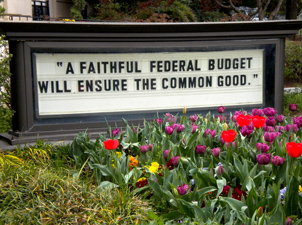
Once again, the Administration is putting politics above people rather than legislating for the common good. This decision will cause more people to struggle to access affordable healthcare and fails to mend the gaps in access to healthcare in our country.

September is the Month for Budget Bipartisanship

September is the Month for Budget Bipartisanship

Marge Clark
August 24, 2017

The House and the Senate will return to the Capitol on September 5 with serious tasks before them. There is not yet a federal budget for Fiscal Year 2018 (FY18), however members are proceeding to votes on funding all 12 appropriations bills without top line spending limits in either chamber. Current spending authority from the FY17 budget runs out on September 30, and additionally, the debt limit must be agreed to by September 29.

Members of Congress continue to work on tax reform, and they hope to use the reconciliation process to bypass the need for Democratic votes. If reconciliation is used, passage in the Senate needs 51 votes, rather than 60. Reconciliation, however, can only be used after a budget has been passed, the same in House and Senate. This is not looking promising. One escape from this requirement for Congressional leadership may be through use of the existing FY17 reconciliation approved for healthcare, which they were not able to use. This is possible if the parliamentarian is in agreement with the change.

The House has passed a package of four appropriations bills nicknamed the “security minibus” with hope of bringing an eight-bill “megabus” to the floor in early September. House appropriations bills exceed the defense spending caps set in a 2011 agreement by an additional $72 billion in defense spending for 2018. Nondefense spending is set at $4 billion below its cap of $515.7 billion. Surpassing the 2011 limits will trigger the sequestration process, unless there is a bipartisan deal to raise the caps – which has been done in previous years. The House will most likely pass appropriations bills along party lines – no need for any Democratic votes. However, Democrats continue to push for parity (that there be some increase in nondefense spending whenever there is an increase in defense spending). They have given up on an equivalent increase.

The House realizes its appropriations package would be very unlikely to pass in the Senate where it needs Democratic votes. The House bill, then, simply exists for the purpose of expressing the severity of cuts Republican leaders want to make to human needs assistance to the elderly, children, those unable to work, and people with physical and mental disabilities.

The Senate has yet to pass any appropriations bills. The appropriations committee has begun working on six bills, but none have gone to the Senate floor. Their bills are being set at current year spending levels. Even this would break the 20111 statutory cap by $2 billion (defense) and $ 3.8 billion (nondefense).

As previously mentioned, exceeding the caps triggers extreme, automatic across-the board cuts called sequestration, unless both chambers come together to form an agreement to raise the budget caps for FY18. This has been done in FY16 and FY17. It is unlikely that can be completed before the end of September, despite Speaker Paul Ryan’s assertion that talks with the Senate are happening, and that they will act before the deadline.

Appropriations are must-pass legislation. If there is not agreement by the end of September when the FY17 budget runs out, the options include a Continuing Resolution (CR) or a government shutdown. A CR could be put in place until December – which has frequently been done in recent years.

One issue contributing to the likelihood of a September 30 shutdown is President Trump’s insistence that funding for the southern border wall be included for FY18. If funding is not resolved through a CR, the border wall could also cause a shutdown in December.

Additional “must-pass” legislation includes raising the debt limit. It is clear that Congress cannot use accounting tricks to pay the bills any longer than September. We do not want to default on our debts as a nation. Treasury Secretary Mnuchin calls for a “clean” bill to raise the debt ceiling, meaning no spending or cost cutting demands attached. Members of Congress as less inclined to do this. The debt ceiling is a great place to put pressure on members to pass something that has split support and would be hard to pass.  It is possible that “the wall” would be attached to raising the borrowing limit – which cannot be put off past September 29, according to Mnuchin.

Funding of the Children’s Health Insurance Program (CHIP) is also must-pass in September, as its authorization and funding run out at the end of September. This could also be used as a place to raise the debt limit.

August is quickly coming to its end, and the September 5 return of Congress is almost here. Since members have not really started negotiations over raising budget caps, lawmakers on both sides of the aisle, in both chambers are predicting a short-term continuing resolution. Most do not want to chance a shutdown, and they need more time to develop a final spending plan. Stay tuned!

Talking Faith and Taxes

Talking Faith and Taxes

We all pay taxes. Let’s talk about it! Here’s a framework for approaching a conversation about taxes:

1. Begin with faith or values. Many faith traditions have teachings on taxes and economic justice.

    • Judaism has long preached about justice, and a just social order. The word tzedakah is connected to the obligation we have to make acts of financial charity towards people who are poor, carrying with it the idea that wealth is from God, and those with financial means have the responsibility to ensure those who lack resources are cared for and given the opportunity to eventually succeed on their own.
    • From the same religious foundation, Christianity embraced the ideals of social justice preached by Jesus. Early Christian communities stressed collective well-being and called upon one another to sacrifice for those who were poor and marginalized. Often, they created funds from community collections in order to provide goods and services to the widowed and poor. Most Christian religions continue to emphasize just economic practices and acts of charity.
    • Islam upholds the practice of Zakat, one of the five pillars of Islam. Initiated by the prophet Muhammad, Zakat is the obligation to give a portion of one’s wealth out of concern for those who are poor or dispossessed. In addition to its obvious use on earth, Zakat is seen as necessary for one’s salvation.

2. Discuss options for our tax system. There are three main types of taxes.

    • Progressive — A higher rate is paid by higher income brackets than lower income brackets (Note that this is achieved by applying higher marginal tax rates to higher levels of income)
    • Flat — A flat tax applies the same rate of taxation to all payers
    • Regressive — A lower rate is paid by higher income brackets than lower income brackets

3. Talk about what we don’t pay

    • Tax Expenditures encourage certain activities and benefit certain groups, and they come in three basic forms: deductions, exclusions, and credits.
    • Not all tax expenditures are bad — the Earned Income Tax Credit (EITC) lifts more families out of poverty than any other program, but others give wealthy corporations a sizeable cut on the taxes they pay that contribute to the common good.
    • The issue is that the government doesn’t count expenditures in the budget. Since these aren’t listed as expenses they’re often overlooked. Once a deduction is written, the money we could have collected is largely forgotten and the money we miss out on could lead to belt tightening and cutting in places that aren’t really at fault.

4. Think about the benefits we share in as a result of tax revenues

    • Whether it’s a public good that we all benefit from or a program that benefits certain groups, our tax revenues care for the common good in our nation and across the world.
    • Many of the programs funded by our taxes go to providing services or care for the marginalized that our different faith traditions call us to care for—those who are poor, sick, hungry, or otherwise vulnerable.

It really is up to us to decide what we want to do with our taxes, and the way we spend our tax dollars reflects our priorities as a nation. Start a conversation with a neighbor, family member, or friend about how our tax system can best provide for the common good.

For a more in-depth discussion of these topics, download NETWORK’s tax justice curriculum “We the Taxpayers” at: www.networkadvocates.org/WeTheTaxpayers

Originally published in Connection magazine. Read the full issue here.

We Are Committed to Racial Justice

We Are Committed to Racial Justice

The acts of terror in Charlottesville this weekend are sinful and the direct result of white superiority, power, and control in our country. We add our voice to the chorus of justice-seekers and faith communities decrying, condemning, and actively working to dismantle white supremacy. During these challenging times in our country, we thank you for being part of the network of justice-seekers who make up our NETWORK community.

From our founding, NETWORK has sought to be a multicultural, anti-racist organization. But it is one thing to say we are committed to racial justice, and another thing to live it out: to do the work to dismantle white supremacy in our culture and in our federal policies. Throughout our history, but even more so over the past several years, we have worked to interweave our commitment to racial justice into all of our work – from our organizational culture to the policy issues we work on.

Some changes in our society can happen right away, but the long-term change we seek is not something that is fixed easily or all at once. As NETWORK has worked to renew and strengthen our commitment to racial justice, we’ve implemented changes to how we do our work – changes that will make us a more inclusive organization, better equipped to do the work of racial justice.

Today, we share and recommit ourselves to NETWORK’s pledge to be an anti-racist organization, inclusive in our actions and in our organizational identity, structure, and membership. We do so, because:

  • We believe in and espouse Gospel values that reflect the dignity and sanctity of every human being;
  • We recognize and celebrate the richness of the differences that exist among the peoples and cultures of our country and our world, while definitively affirming how much we have in common; and
  • We acknowledge our moral responsibility to witness to the truth that we are all one human family, made in the image of the Creator.

This is not new for NETWORK nor is it just a stock response to current events. This is a journey that we are on together — one that we look forward to sharing with you in the months and years to come.

Supporting Tax Policies that Benefit Women and Families

Supporting Tax Policies that Benefit Women and Families

Anna Chu and Jillian Edmonds
August 16, 2017

The Trump administration and Republican leaders in Congress have promised to release a tax reform plan this summer, which is likely to include some of the largest tax cuts in decades. As elected officials debate tax reform, we must ensure policies that slash taxes for the wealthy few and big corporations under the guise of growing the economy do not become the new law of the land. The fallacy that tax cuts for the rich and corporations grow the economy has been the conservative talking point since Ronald Reagan first touted trickle-down economics, and has been widely discredited.[i] But not only is President Trump sticking to the same failed playbook of the past, the tax principles he released in April lack some of most important tax strategies that would help working families. For example, his principles do not mention expanding the Earned Income Tax Credit (EITC), an effective anti-poverty program which would greatly benefit working women and families. In 2013, the EITC lifted 6.2 million people – including 3.2 million children – out of poverty (when taking into account the indirect employment and earnings effects of the EITC, this number nearly doubles).[ii]

Although there are reports that President Trump is considering improvements to the Child and Dependent Care Tax Credit, those potential improvements alone do not mitigate the other troubling aspects of his tax plan. For instance, President Trump proposes reducing the corporate tax rate by 60 percent and getting rid of the estate tax, which impacts only the richest 0.2 percent of estates (including his own estate).[iii] Coupled with his budget, which guts crucial programs that provide basic living standards to low-income Americans, what emerges is a clear picture of the Trump administration’s economic policy—giving big payoffs for the wealthy few and big corporations, while pulling the rug out from everyday women and their families.

Tax Cuts for the Rich Just Make the Rich Richer

President Trump’s tax plan would be a massive giveaway to wealthy Americans and big corporations, and would harm women and families if enacted into law. He proposes slashing the top marginal individual tax rate to 35 percent and consolidating the current seven tax brackets into three. He also proposes slashing the corporate tax rate to an astoundingly low 15 percent. While he claims that such tax cuts would grow the economy and “create 25 million new jobs over the next decade,” this couldn’t be further from the truth. A Congressional Research Service analysis of the top tax rates since 1945 found little or no association between reducing taxes on the wealthy and increased savings, investment, or productive growth.[iv] A review of research by the Center on Budget and Policy Priorities of the impacts of a 1993 tax hike and the 2001 tax cut also revealed that job creation and economic growth were actually stronger in the years after the 1993 tax increases than in the years following the 2001 tax cuts.[v]

Instead of creating jobs or economic growth, tax cuts for the rich just make the rich richer. An analysis of OECD countries found that there was no correlation between the top tax rates and economic growth, but there was a correlation between lower top tax rates and greater income inequality.[vi] The earlier CRS study also found that cutting the top tax rate concentrates wealth at the top of the income spectrum because it incentivizes higher pay at the top end of the scale and allows those people to keep more of that money. By cutting taxes for the wealthy and corporations, President Trump’s tax plan will contribute to growing economic inequality in our nation, which harms both our current economy and future growth.

Tax Cuts Threaten Funding for Critical Programs

While women and families likely won’t get a fair shake in this upcoming tax plan, it’s not their only worry. President Trump’s tax principles work alongside his federal budget, which would cut programs that provide a basic living standard to low-income families. His budget proposes eliminating heating assistance for people in poverty, funding for meals for seniors, and several housing assistance. These cuts will affect women the most, potentially creating an even greater poverty gap between men and women. The Tax Policy Center found that cutting the corporate income tax to 15 percent would cost $2.4 trillion 10 years — and that number skyrockets to $4 trillion if the 15 percent rate applies to pass-through income.[vii]

Unless the White House plans to simply increase the deficit, these tax cuts must be paid for somehow. The Trump administration has claimed it would pay for these cuts by raising tax revenue from other sources and from economic growth, but the budget shows they are more than happy to slash critical programs that provide a basic living standard for women and families. President Trump’s budget proposes dismantling Medicaid as we know it and cutting its funding above and beyond the cuts in the ACA Repeal Bill. SNAP funding would be cut by nearly $200 billion over the next decade – which would result in many states making it more difficult for families to get food assistance..

The President’s desire to give huge tax cuts to wealthy people such as himself and take away critical programs that are lifelines for many women and families flies in the face of what his voters wanted and is a recipe for economic disaster. We can learn from what happened in Kansas, where massive tax cuts enacted in 2012 led to decreased revenue, underfunded schools, and cuts to services. Massive budget cuts won’t make America great again – but they are likely to hurt many people.

A Tax Plan that Actually Helps Women and Families

Our tax policies should help the most vulnerable Americans by improving family tax credits and raising enough revenue for programs and services that support struggling families, rather than giving more tax cuts and loopholes to the wealthy and corporations. To have a tax plan that actually helps working women and families, President Trump and Congressional leadership should consider abiding by the following principles:

  • Don’t give more tax cuts for the wealthy and big corporations.They should pay their fair share in order to have a tax system that works for all of us.
  • Tax policies shouldhelp the most vulnerable now. Tax reform should preserve — and improve — tax credits like the Earned Income Tax Credit, Child Tax Credit, and Child and Dependent Care Tax Credit that help families make ends meet.
  • Support progressive tax reforms that would raise needed revenue— and expand opportunity for a stronger future for everyone. Every year, special interest tax loopholes cost the federal government billions of dollars. That’s money that could be used to support struggling families and give them a chance for a better life.

A tax policy that supports women and children requires that everyone pays their fair share regardless of their income or political power. It allows the government to fully support families that need assistance when they are struggling, as well as fund public parks, clean air enforcement, and other government activities that benefit everyone. Rather than giving the wealthy and corporations the largest slice of the pie, a tax policy that supports women and children expands the pie for everyone, resulting in more opportunities that keep America great.


[i] CNN Money. “The ‘trickle down theory’ is dead wrong.” http://money.cnn.com/2015/06/15/news/economy/trickle-down-theory-wrong-imf/

[ii] Center on Budget and Policy Priorities (CBPP). “EITC Boosts Employment; Lifts Many More Out of Poverty Than Previously Thought.” http://www.cbpp.org/blog/new-research-eitc-boosts-employment-lifts-many-more-out-of-poverty-than-previously-thought

[iii] CBPP. “Repealing Estate Tax Would Provide Windfall to Heirs of Wealthiest Estates.” http://www.cbpp.org/research/federal-tax/repealing-estate-tax-would-provide-windfall-to-heirs-of-wealthiest-estates

[iv] Congressional Research Service. “Taxes and the Economy: An Economic

Analysis of the Top Tax Rates Since 1945.” https://fas.org/sgp/crs/misc/R42729.pdf

[v] CBPP. “Recent Studies Find Raising Taxes on High-Income Households Would Not Harm the Economy.” http://www.cbpp.org/research/recent-studies-find-raising-taxes-on-high-income-households-would-not-harm-the-economy?fa=view&id=3756

[vi] Piketty, Thomas and Emmanuel Saez. “Top Incomes and the Great Recession: Recent

Evolutions and Policy Implications.” http://www.imf.org/external/np/res/seminars/2012/arc/pdf/PS.pdf

[vii] CNN Money. “A 15% corporate tax rate could be very expensive.” http://money.cnn.com/2017/04/24/news/economy/trump-corporate-tax-rate/

[viii] National Women’s Law Center. “Cutting Programs for Low-Income People Especially Hurts Women and Their Families.” https://nwlc.org/resources/cutting-programs-low-income-people-especially-hurts-women-and-their-families/

Originally published in Connection Magazine. Read the full issue here.

Getting Tax Reform Right for Our Nation

Getting Tax Reform Right for Our Nation

US Representative Mike Thompson (CA-05)
August 7, 2017

Economic inequality is a real problem that too many families face. Incomes have not kept up with the cost of living, and hardworking Americans are struggling to get by. So as Congress considers reforming our tax code, it must focus on leveling the playing field for the middle class and working families.

It’s been over thirty years since Congress made comprehensive changes to our tax code. A lot has happened in the interim—and our policies haven’t kept pace. We’ve seen the rich get significantly richer while the middle class keeps shrinking. Congress has the power and responsibility to change this trend. We can and should focus on reforms to create good, stable, high-paying jobs and help the men and women in our communities take advantage of the opportunities available to them now.

For instance, I’ve spoken with a number of my constituents who are trying to care for their kids, work a fulltime job, and go back to school so they can land a promotion or change careers. They are superheroes trying to do it all for their families, and they could benefit greatly if Congress expanded access to the American Opportunity Tax Credit, which helps millions of students and working families pay for college.

We should also look at policies that combat inequality. Expanding the Low-Income Housing Tax Credit, for instance, would provide more families with a place to call home. Improving the Child Tax Credit to keep pace with inflation would ensure families with young kids are able to pay their bills. I’ve co-sponsored legislation to expand all of these tax credits and provide additional help to everyday Americans.

These are not the only solutions, but they should be part of the discussion. Unfortunately, a number of my colleagues seem to think tax reform simply means tax cuts. That’s just not true.

It’s especially irresponsible to just cut taxes for the wealthiest among us—forcing everyday Americans to carry the bulk of our nation’s tax burden. Unpaid-for tax cuts create serious shortfalls, forcing our government to borrow more and more money. As lenders cut checks to federal borrowers, there could be less financing—and opportunities—available to entrepreneurs, mom-and-pop shops, and new startups. That’s bad for economy, American ingenuity, and anyone who wants to achieve their dreams.

We can make our tax code fairer, more competitive, and more efficient, but it shouldn’t come at the expense of a ballooning national debt. And Congress shouldn’t make promises it can’t keep.

While the corporate tax rate is in need of reform, simply slashing it to 15 percent is not going to help middle class families. It benefits big businesses that in some cases already pay less than their fair share in taxes while shipping jobs overseas. Tax cuts alone will not solve our problems. We need comprehensive reforms and programs that put people first.

We need to have the difficult conversations about what’s fair and what’s best for our communities. Tax reform isn’t easy, but it’s necessary if we want to close the wealth gap and help our families thrive.

Partisan rhetoric and ideology can’t be allowed to divide us. One party alone shouldn’t make changes to a tax code that affects all of us. We need to make sure we address the concerns of all our constituents, regardless of party.

As a senior member of the House Committee on Ways and Means, I’m ready to work with Chairman Kevin Brady and my colleagues on both sides of the aisle to make our tax code fairer. But make no mistake: Democrats will oppose any tax plan that only helps the rich get richer while forcing working families to shoulder even more of our country’s tax burden.

Originally published in Connection magazine. Read the full issue here

Make Your Voice Heard on Capitol Hill!

Make Your Voice Heard on Capitol Hill!

Brie Baumert
August 1, 2017

We participate in the political life of our nation through an important task: by reaching out to our members of Congress with our opinions and concerns. Too often, our First Amendment right to petition to the government is overshadowed by other powerful aspects of the Constitution. Yet, this power we have is extremely effective, exceedingly important, and all the more necessary in our nation today. Beyond our duty as citizens, for some of us, our faith encourages us to be involved in the political process. The principles of Catholic Social Justice teach us that we have a responsibility to participate in politics out of a concern for and commitment to the good.

Contacting your members of Congress is easier now than ever before. With the help of technology and social media, there are many ways to get in touch with Representatives and Senators, including sending letters and faxes, visiting their offices in person, using social media outlets like Facebook and Twitter, writing a letter to the editor in your local newspaper, attending town halls, and most commonly, directly emailing and calling your members of Congress.

Since President Trump took office in January 2017, a flood of phone calls and emails has been pouring into Capitol Hill. So many people have been contacting their congressional representatives that voicemail inboxes have been filled to capacity, phone lines have been busy, and emails have been bouncing back. Before President Trump’s inauguration, many Washington, D.C. offices received on average anywhere from 120 to 200 calls in a given week. Those numbers have more than doubled this year! Congressional offices claim that during the week of January 30, 2017, the Senate received 1.5 million calls a day. Three of those days were the busiest in the history of the Capitol switchboard. The outpouring of civic involvement, especially in light of the recent presidential election, is evident, and is making a difference in the legislative realm.

Needless to say, constituent input does matter greatly. “Everything is read, every call and voice mail is listened to,” Isaiah Akin, the deputy legislative director for Oregon Senator Ron Wyden, said.

The response by elected officials to these grassroots movements reveals that civic participation works. Contacting your members of Congress matters, whether your Senators or Representatives are Republicans or Democrats! It is critically important for Americans to stand up and make their voices heard. Let’s keep up the pressure on our elected officials to represent their constituents faithfully!

If you have never called your members of Congress, I urge you try. It’s simple, easy, and effective. Here’s how to do it:

  1. When there’s something important happening on Capitol Hill, NETWORK’s Action Alerts will ask you to call or email your members of Congress. Make sure you are signed up to receive action alerts via email (sign up here if you don’t already) and sign up to receive text alerts on your phone from NETWORK by texting “NUNS” to 877-877.
  2. Read NETWORK’s tips on emailing Congress or calling Congress to make sure you’re comfortable and confident contacting your members of Congress.

That’s it! You’re ready to get started contacting your representatives. I encourage you to not only reach out to your members, but to teach your friends how to contact their members of Congress and work towards Mending the Gaps!

Brie Baumert is a summer intern with the NETWORK Grassroots Mobilization team.

The Healthcare Fight Still Isn’t Over

The Healthcare Fight Still Isn’t Over

Twitter Healthcare Graphic

Good news: due to incredible pressure from activists around the country like you, Senator McConnell pushed back a vote on healthcare until after the July 4 recess. But we can’t let this delay lead to passage like it did in the House — we’ve got to keep the pressure on! 

Call your Senators at 1-888-738-3058 NOW
to oppose the GOP health plan and protect Medicaid.
Call twice to reach both Senators.

These calls matter whether your Senators are Republicans or Democrats! Here are a few ways you can make noise in your community over the next few days:

  1. Keep making phone calls, and enourage anyone you know in Alaska, Arizona, Iowa, Louisiana, Maine, Nevada, Ohio, Pennsylvania, Tennessee, or West Virginia to make their calls as well.
  2. Read the news and write Letters to the Editor. These short messages should clearly state your opposition to Medicaid cuts and the Senate health proposals, and mention your Senator(s) by name. See our tips for getting your LTE published on NETWORK’s website, and send us published pieces at [email protected].
  3. Meet with your Senator at their office, town hall, 4th of July event, or elsewhere. Bring these:
  4. Post on social media! It sounds silly, but Senators and reporters alike are watching what’s being said online. Find your Senator on Facebook and Twitter, and let them know your thoughts using #Faith4Medicaid, #SaveMedicaid, and #ProtectOurCare. Or share NETWORK’s posts on Facebook or Twitter. You may want to share these graphics: