

Category Archives: Front Page

Blog: Putting People First in Our Budget Crisis

Blog: Putting People First in Our Budget Crisis

Rachel Schmidt
Aug 13, 2015

The federal budget is a complicated piece of legislation, and it’s easy to get overwhelmed. “Wonky” data, words like “sequestration,” and polarized political parties are enough to make anyone’s eyes glaze over. However, the budget is not merely something elected officials tend to busy themselves with. It is essential to bring about the common good, the development and fulfillment of all people in society, by creating a faithful budget.

Too often in budget negotiations, Congress neglects to bring forth the faces and stories of people who are intimately affected by cuts to human needs programs. It’s easy to get lost in the ideology of politics and deficit reduction, but like Pope Francis insists, “service is never ideological, for we do not serve ideas, we serve people.” Therefore, it is critical that we do not lose sight of the real issue:  the federal budget is a tool that must faithfully serve the common good.

The political landscape has made finalization of the federal budget difficult. Initially, the fear was that sequestration would take place. Sequestration means that programs, both on the defense and non-defense discretionary sides of the budget, are automatically cut once previously established budget limits are reached. In theory, sequestration was supposed to be too horrible to go into effect, but in reality, the threat of this austerity measure is becoming more commonplace. In recent years budget negotiations have led to the government shutting down, programs being stopped, and government workers not being paid. It’s these political games that endanger the wellbeing of people in the most vulnerable situations, who rely on safety net programs funded from the non-defense discretionary side of the budget.

Congress had a deadline to approve the Fiscal Year 2016 budget by September 30 in order to keep the government fully operational for the next year. They did not actually come to a final decision by this time. Instead, they passed what’s called a Continuing Resolution (CR) to provide short-term funding through December 11 and put off addressing the real issue of planning for the next fiscal year. Now, as the December deadline approaches, we must be diligent in requiring Congress to commit to funding a faithful budget that serves the common good.

Again, it’s important to remember that a budget is about more than just numbers; it’s about people. To learn more about how this affects real people, watch these two stories from our friends at Witnesses to Hunger:

This story of Jahzaire Sutton shows the stress and impact budget negotiations can have on small children. It is unbelievable that in the United States a mother has to go hungry so her children can eat. Cuts to the program, Women, Infants, and Children (WIC) could be disastrous for families like Jahzaire’s. Since 2010, WIC has been cut 17.4%.

Jahzaire’s mother is already skipping meals. Do we want Jahzaire and his younger siblings to go hungry too? As a society, are we willing to do what it takes for the future of our children? When Congress makes a commitment to providing for the common good, people like Jahzaire’s mother won’t have to go hungry anymore.

This story of Tianna Gaines Turner shows how a family could rely upon several programs funded by the government due to economic hardship or medical needs. Cuts across the board can mean that Tianna’s family won’t have access to as many resources for health, utilities, and food, which are necessary for day-to-day living. For example, Community Health Centers  have already been cut nearly 40 percent in the last five years. We aren’t going to reduce our deficit by more cuts to human needs programs that have already been decimated.

Tianna was vulnerable enough to share her own experiences of having to make these choices in testimony before the Ways and Means Committee of Congress to enumerate to importance of not making cuts to the federal budget; they better listen! How will you do what it takes to make sure Congress remembers that people’s lives are at stake with these budget negotiations?

Unfortunately, Congress is more interested in increasing funding for the defense budget than making sure families like Jahzaire’s and Tianna’s are cared for. Confusing terms, political jargon, and party politics cannot be excuses to ignore the importance of a faithful budget that fully-funds human needs programs for all families who need support from society. We must answer Pope Francis’s call to encounter and stay connected to people and their stories to keep perspective. We must uphold these values as responsible residents of the United States. We must require that our legislators not forget the development and fulfillment of all people in society.

Blog: Senator Kirsten Gillibrand’s Work for Women and Families

Senator Kirsten Gillibrand’s Work for Women and Families

By Carolyn Burstein
May 23, 2014

The Family and Medical Leave Act (FMLA) celebrated its 20th anniversary in February of this year. Back in 1994, the legislation, which guaranteed up to 12 weeks of unpaid leave to workers recovering from a serious medical condition and those caring for seriously ill spouses, parents or children or for new children, was a significant advance for this country. However, the law’s shortcomings are glaring:

  • Unpaid leave often is financially impossible for many people. According to the Center for Law and Social Policy (CLASP), that’s the main reason people don’t take family and medical leave.
  • Only applies to employers with 50 or more workers and excludes recent hires. Over 40% of the workforce isn’t covered by the law nor are those who haven’t worked for their current employer for at least 12 months or 1,250 hours.
  • Doesn’t cover reasons people often need to take time off to care for their parents
  • Person needing care must have a “serious medical condition”
  • Doesn’t cover care for grandparents, in-laws, siblings or adult children

Largely because of these shortcomings, Senator Kirsten Gillibrand (D-NY) and Rep. Rosa DeLauro (D-CT) introduced “The Family and Medical Insurance Leave Act” (S 1810/ HR 3712) in December 2013. The bill, which has not yet garnered Republican co-sponsors, would ensure 12 weeks of paid leave a year for a new child, to take care of an ill family member or to care for oneself. At this time only 12% of workers have access to paid leave through their employers. Just three states — California, New Jersey, and Rhode Island — have instituted paid family leave.

Paid leave would be available to every worker regardless of the number of employees in the firm or how long s/he had been employed there. The legislation would create a federal insurance program with an independent trust fund within Social Security where all employees and employers would make payroll contributions of .2 of 1% of wages (or roughly $1.50 per week for a typical worker). Like Social Security, wages would be taxed up to a cap of $117,000 per year. The person taking paid family leave would receive 66% of pay during leave up to a maximum of $4000 per month. However, it should be noted that two major flaws still exist: 1) care does not cover grandparents, in-laws, siblings or adult children, and 2) the definition of a “serious medical condition” still applies. In the latter two cases, “paid sick leave” laws should handle these situations.

If the Gillibrand-DeLauro bill becomes law, it would make many more Americans eligible for a benefit usually offered in the U.S. only at large companies such as Bank of America or Goldman-Sachs. The U.S. is the lone hold-out of all developed nations (and even many others not-so-developed) in not having a guaranteed maternity leave policy. Other countries offer up to 40 or more weeks of paid leave for mothers (and the U.K. passed a bill several months ago allowing moms and dads to share 50 weeks of paid leave).

Let’s examine the human dimension. Without paid maternity leave, many women struggle to afford time off to take care of themselves and their newborns after the birth of a child. According to the Center for American Progress (CAP), over 40% have to take unpaid leave, and 25% either quit or are let go from their jobs when a new child arrives. The financial hardship is clear: 1/3 borrow money, dip into savings, and/or put off paying bills, while about 15% even have to go on public assistance to survive.

In her talks around New York State, Sen. Gillibrand reminds her audiences that in over 40% of families, women are the primary breadwinner. This fact alone places the Family bill (as it has become known) on an entirely different level — a unique place where it deserves universal congressional support. Her own Senate office grants three months paid maternity leave, one of the most generous in Congress.

Only about 15% of men get paid family leave when a new child arrives. Although 85% take leave at that time, nearly all take a week or less. But paid leave entirely changes that situation, as data from California affirms. Since 2004, with paid leave, 75% of California men take off an average of three weeks with the birth of a child. The vast majority of these men have claimed in surveys that they want to spend more time with their children and split parenting equally with their partners, and paid family leave may be the key to achieving this goal.

Seniors, too, would benefit greatly from a policy allowing paid family leave since 62% of caregivers for parents and/or loved ones have full-time jobs and often find it difficult to take unpaid leave. Making sure that these caregivers are at least partially compensated will not only make it easier to take care of their loved ones, but it will also allow the burgeoning population of older Americans to stay in their homes rather than the less cost- effective path of going into nursing facilities.

CAP maintains that research findings show that paid family leave also benefits the economy in several ways:

  • Keeps people in the labor force and even expands it
  • Reduces the chance that family members will have to quit their jobs when someone becomes ill
  • Reduces turnover and employment interruptions to the benefit of employers. California’s program alone has been estimated to save employers $89 million per year in reduced turnover costs. A study of companies listed in Working Mother magazine’s “100 Best Companies for Working Mothers” finds that the availability and usage of work-family programs and policies have a positive impact on company profits.
  • Allows people to return to their original jobs where their experience can benefit the economy as a whole

It is possible that, as more states join California, New Jersey and Rhode Island in passing their own versions of the “Family Act,” more momentum will be created for federal action.

As part of her efforts to foster job creation, Sen. Gillibrand is focused on an agenda to create economic empowerment and security for women because she feels strongly, according to her literature, that women are the key to economic recovery. In addition to paid family and medical leave discussed above, Kirsten, a working mom, is also heavily involved in the following efforts, most legislation of which she herself has introduced:

  • “Paycheck Fairness Act,” and “The Fair Minimum Wage Act of 2013” to create fundamental fairness for women and economic stability for families and children, and to slow the decline of real wages.
  • “National STEM (Science, Technology, Engineering and Math) Education Tax Incentive for Teachers Act” that provides STEM teachers who work in low-income, high-need schools a tax credit to cover 10% of their undergraduate tuition. Closely related to this effort is the “Undergraduate Scholarships for Science, Technology, Engineering and Mathematics Act” that would establish a new program under the National Science Foundation (NSF) to award 2,500 undergraduate scholarships each year for students’ full tuition (program would seek out low-income, high-achieving students) during their last two years at a state institution. These efforts together would help ensure that all students have a path to higher education and success in careers that will define the economy of the future.
  • “Small Business Lending Enhancement Act of 2009,” that would spur small business growth and create jobs by increasing access to loans from credit unions, especially for women. She is also working on legislation to reform the Small Business Administration to help women-owned businesses access federal contracts.
  • “Family Work Flexibility Act,” that would offer businesses a $500 tax credit to help pay the cost of equipment, such as computers and telephone lines that would enable more employees, especially women, to work from home.
  • To make child care more affordable for working families, Gillibrand is working with Senator Barbara Boxer (D-CA) to double the amount of credit with a maximum deduction of $6000 for families using “The Dependent and Child Care Tax Credit.”
  • “The Strong Start for America’s Children Act,” would establish a federal-state partnership to increase the number of high-quality early childhood educators and improve the student-to-teacher ratios in preschools. It would also increase the hours per day and weeks per year families have access to high-quality early education programs.

These are just some of the numerous efforts Gillibrand has been espousing and advocating over the past few years since she entered the Senate in 2009. We would say that she is “one busy woman in support of other women,” especially women who are among the poor and vulnerable of society. We at NETWORK are impressed with her agenda for the empowerment of women and, in turn, support her efforts as outlined above.

The recession has demonstrated that keeping a job is an absolute necessity. Losing one because of giving birth, helping a parent recover from a stroke, or care for a dying family member is a catastrophe that can be avoided at minimal cost, as the Gillibrand-DeLauro “The Family and Medical Insurance Act” shows. It’s hard to understand the reluctance of any fair-minded Republican to support this bill since, as the National Association of Mothers’ Centers says, it preserves the connection to self-sufficiency through employment so that the family can withstand a temporary emergency that allows them to care for each other without resorting to under-funded public programs paid for with tax dollars..

How long will it be before the U.S. joins every other industrialized country in the world in providing paid family and medical leave?

Blog: The Emerging Progressive Agenda

The Emerging Progressive Agenda

By Carolyn Burstein
May 21, 2015

May 21, 2015 | By Carolyn Burstein

In a May 12 Washington Post blog, Katrina vanden Heuvel called recent events in advancing a progressive reform agenda a “stunning” development. She was referring to the convergence of agendas put forward by a number of grassroots groups, such as:

In addition, individual progressive leaders are also being heard. Examples include:

Given the groups and individuals involved, it is only natural that their specific perspectives on some issues would differ, but vanden Heuvel points out that what is “more striking is their scope of consensus.”

All groups and individuals agree that a truly shared prosperity is the challenge of our time and that only when working families enjoy higher incomes will inequality diminish. And the extreme inequality we are now experiencing is clearly the result of policy choices, rather than the inevitability of globalization or technological innovation.

The above-mentioned groups and individuals also agree that economic growth is the engine of greater equality. Stiglitz, in particular, has written not only in his May 12 Roosevelt Institute report, but in most of his other books, such as The Price of Inequality and The Great Divide, that promoting greater equality does not sacrifice economic growth – that the two are indeed compatible.

Senator Elizabeth Warren and Mayor Bill deBlazio, in their joint op-ed in the May 6 Washington Post, rue the “increasing disparity between rich and poor, cronyism and an economic system that works only for those at the top” and conclude that such inequality is “bad for the middle class and bad for our economy.”

Indeed, EPI’s report includes this same point about inequality today: “public figures as wide-ranging as the president, Pope Francis and economist Thomas Piketty have brought inequality to the forefront of public debate.”

Central elements of the emerging progressive agenda are manifest in these areas and are often intertwined:

  • Place a higher priority on full employment through public investment in large-scale infrastructure renovation and innovation. Rebuilding roads and expanding other means of transportation, as well as modernizing bridges, power grids, and sewers is an excellent means of decreasing unemployment. This type of investment lays the foundation for long-term competitiveness, increased prosperity, and a high quality of life at all levels of society.
  • Focus on climate change by investing greater resources in renewable energy and energy efficiency (although all groups have not emphasized this element). De-carbonizing the power sector and tackling the inefficiency of our existing building stock will force us to underscore our commitment to long-termism and will send clear signals to clean energy companies that Americans are willing to fulfill their environmental commitments and believe in a sustainable future.
  • Raise the minimum wage to a “living wage,” and require every job in the U.S. to meet a minimum standard of quality – in wages, benefits and working conditions. If the rewards of growth are to be widely shared, then workers must be empowered to form unions and bargain collectively to ensure they capture their share of productivity increases rather than seeing profits accrue primarily to shareholders. To achieve greater bargaining rights for workers, stricter penalties will have to be imposed on illegal anti-union intimidation tactics. Excessive executive compensation must be curbed and management incentives that lead executives to plunder their own companies must be eliminated. EPI’s report, in particular, calls for broad-based wage growth.
  • Guarantee women’s economic equality, ensure national paid sick/family leave and high-quality child care. Crack down on wage theft and revise overtime laws to bring them into line with today’s economy.
  • Support progressive tax reform by raising taxes on concentrated wealth in order to provide resources for needed public investment. End the situation where huge multinationals pay lower taxes than small domestic businesses and billionaire investors pay lower tax rates on their investment income than working families pay on their wages and salaries. Revenue is needed to support long-term investment in an economy that must work for all. Raise the top marginal rate of taxes by converting all reductions to tax credits and limiting their use. Eliminate all corporate welfare and other tax expenditures that foster inefficiency and inequality.
  • Oppose trade deals that hurt American workers. This statement is a major part of deBlazio’s national agenda. Even Stiglitz, a believer in globalization, states that balance must be restored in global trade agreements “by ensuring [that] investor protections are not prioritized above protections on the environment and labor, and increasing transparency in the negotiation process.” The “Populism 2015 Platform” is in full agreement with Stiglitz. Other groups and individuals do not mention trade, but challenge all entrenched structures that fuel inequality.
  • Eliminate institutionalized racism whether in jobs, housing or any practice, and recognize a society of increasing diversity, which begins with comprehensive immigration reform. Such reform includes an end to all racial disparities, expanded voting rights, and an end to mass incarceration. Reform of our biased criminal justice system must reduce incarceration rates and related financial burdens for poor communities. Immigration law must provide a pathway to citizenship for undocumented workers.
  • Make basic investments in public education, including universal pre-K, various paths to debt-free college, and relief to the generation now burdened with student debt. Raising skill levels is critical to increasing growth over the long-term. This desire includes many facets of education, such as increasing apprentice programs, better on-the-job training, increased levels of work-based training – as well as investment in public education by eliminating all financial barriers to higher education.
  • Strengthen and expand shared security for the 21st century, especially for Social Security, Medicare, Medicaid, unemployment benefits, food support and housing assistance. As the “Populism 2015 Platform” states, “greater shared security makes the economy more robust by enabling entrepreneurs and workers to take risks, knowing that they can survive failures.” Both Bernie Sanders and Joseph Stiglitz emphasize Medicare for all. Several of the agendas call for greater access to good jobs that provide dignity, especially for the young and particularly in times of high unemployment.
  • Break up big banks (Summers, Ball et al do not include this element in their agenda, whereas this is an important element of the Stiglitz plan) and curb the excesses of Wall Street. Stiglitz calls for stricter penalties for companies and corporate officials who break the law. Related to this, he also calls for reducing the conflicts of interest in Federal Reserve governance and instituting more open and accountable elections to these offices.
  • Curb big money, especially “dark money” in politics, and crack down on corruption. These ideas are clearly in the forefront of the agendas of the Bernie Sanders, Joseph Stiglitz and “Populism 2015 Platform’s” agendas. The latter also includes a crackdown on payday lenders and any schemes that exploit vulnerable working families.

Only the “Populism 2015 Platform” calls for the use of U.S. military intervention as a “last resort” and pleads for a reduction in military budgets in favor of properly supporting humanitarian programs.

As Stiglitz has said in many of his works and repeats in his “Rewriting the Rules of the American Economy,” markets are shaped by laws, regulations and institutions. And these rules matter. For the past 35-40 years we have chosen, through our political elections, the opposite path – believing that our markets could work perfectly guided only by themselves. The result has decimated America’s middle class and caused untold suffering among more vulnerable low-income individuals and families.

We finally seem to have a consensus emerging among grassroots non-profits and significant leaders that can be said to constitute a progressive agenda. This emerging consensus deserves strong support. We at NETWORK have worked toward nearly all aspects of the emerging progressive agenda and will continue to support an agenda that reverses stagnating wages and brings economic equity to all Americans, including undocumented workers.

Blog: NETWORK Response to House Budget Proposal

NETWORK Response to House Budget Proposal

NETWORK Staff
March 23, 2015

The Fiscal Year 2016 GOP Budget, A Balanced Budget for a Stronger America, starts off with soft words that mask harsh policies. At NETWORK we have serious concerns about their claim to promote a better place to live and work, for all. They claim that they need to cut programs in order to grow the economy by giving further tax breaks to the wealthy. But, we have 30 years of experience that their trickle-down economics has only served to shift wealth to the top. Pope Francis says that trickle down theories “have never been confirmed by the facts, expresses a crude and naive trust in the goodness of those wielding economic power and in the sacralized workings for the prevailing economic system. Meanwhile, the excluded are still waiting.” We here at NETWORK are still waiting to see a responsible blue print of government spending that prioritizes the needs of the majority of our people over additional preference for the wealthy. The actions they propose are hard to imagine creating a better place to live.

They assert that their plan will balance the budget in less than ten years, without any increased revenue. Their proposed $1.017 budget doesn’t balance in FY2016. However, in 2017 it comes closer as non-defense discretionary spending is cut twice as much as in 2016.

Some may read the GOP budget narrative and perceive it as being for the 100%, since they co-opt the language of compassion. However, on more careful reading and comparison between the narrative and funding tables it is clear that their budget would not bring about a better place FOR ALL to live, and certainly not to thrive. They speak about the need for all to have sufficient nutrition, yet they turn SNAP into a state run block grant, no longer an entitlement program available to all who meet criteria. This is one of many examples of the language not matching their actions.

NETWORK is seriously concerned about what is stated in neither the House nor the Senate budget statement – yet we hear from many sources that it will be heavily addressed in amendments to both. We believe that some Members will propose elimination of vital supports to taxpaying immigrant families, many of whom have citizen children. Programs such as the Child Tax Credit and the Earned Income Tax Credit help ensure families have the money to pay for basic needs.  Yet, word is out there that amendments would be proposed to eliminate Deferred Action for Childhood Arrivals (DACA), law since July 2012, and Deferred Action for Parents of Americans and Lawful Permanent Residents (DAPA), the president’s immigration actions in response to the failure of Congress to pass comprehensive reform. They would also deny family-friendly supports such as the Supplemental Nutrition Assistance Program (SNAP), non-emergency healthcare, housing assistance, tax credits and worker protections. Any one of these would be devastating to our nation – not just to the immigrants directly affected.

There are disturbing processes laid out in this budget plan. Although sequestration is maintained, true parity between defense and non-defense discretionary spending is lost, due to the slush fund called the OCO (Overseas Contingency Operations). Reconciliation instructions will be adopted, in which each committee is instructed to reduce the deficit, and to seek ways their committee can help to repeal the Affordable Care Act. A deficit-neutral reserve fund will be established to allow for further military spending or tax expenditures later in the year. A budget gimmick (Dynamic Scoring) allows spending and tax cuts to be justified by imagining some fiscal impact of the policy several years out – with no specific information on how that would be.

Several areas of the House GOP Budget proposal are particularly distressing:

Healthcare

The budget would do grave damage to the progress that has been made in providing affordable, accessible healthcare in the United States. Instructions in the budget to repeal the Affordable Care Act (ACA) are an attack on the 16.4 million Americans who have enrolled in insurance plans this year. Furthermore, the budget would privatize Medicare and convert Medicaid into block grants, decreasing significantly the funds available to states for participants in those programs. Finally, the budget repeals Medicaid expansion, moving the eligibility level back down to each state’s individually decided Medicaid level, which was on average 67% of the federal poverty level before the ACA was passed. All of these harmful changes are made with no significant plans to institute replacements for the coverage that will be lost.

Security

When asked what makes them feel secure, people generally speak about the ability to support themselves and their families. That means sufficient income to afford housing, adequate food, child care and healthcare. Rarely do they respond that nuclear weapons, drones and other military equipment make them feel safe. In fact, many speak to the discomfort and fear they have due to the huge numbers of weapons we hold.

Pentagon funding increases included for now and into the future make it evident that the House GOP budget prioritizes military defense over real human security. NETWORK hopes they follow through with their intent to increase support of veterans and their families.

However, the House budget accepts sequestration for limiting spending in the Pentagon base budget, which is raised to $523 billion, $1 billion over the FY2015 limit. Non-defense spending would be $493 billion, giving the Pentagon $30 billion more than programs to meet human needs. The Overseas Contingency Operations fund would provide an even greater boost of $90 billion to defense.

Non-Defense Discretionary

There is a discrepancy between recognition of needs and funding to meet those needs. Even in the commentary on their budget, this discrepancy is clear.

One statement lays out the need. In the same section, the funding is ridiculed as meant to increase government spending, rather than to meet the needs

“Right now, there are those in our nation who are truly struggling to make ends meet – who need our support…. Our charge is to address these challenges in a way that is compassionate and constructive – mindful of the fact that Washington does not hold the answer to every question.” A Balanced Budget for a Stronger America, p.26

This quote sounds supportive of the 100%. However, the quote below presents a negative view of spending on programs to meet the need.

“Financial aid and job training programs are measured by how much money goes in rather than how much achievement comes out. Similarly, food stamps, public housing assistance, and development grants are judged not on whether they achieve improved health and economic outcomes for the recipients or build a stronger community, but on the size of their budgets.” A Balanced Budget for a Stronger America, p. 26

Housing

The budget recognizes that the number of families heavily burdened by rent continues to grow.

HUD guidelines are that housing costs should be 30% of household income. Rather than providing additional housing that meets the guidelines, this budget eliminates thousands of housing vouchers and denies funding to the National Housing Trust Fund, designed to make available more units of housing affordable for low- and extremely-low income households. These are the families and individuals most likely to become homeless.

Jobs and Labor

Certainly, there is a need for more well-paying jobs within the United States. Republicans plan to increase jobs by providing more tax relief to the wealthy and to corporations.

We have seen this approach before as Congress reduced taxes for corporations in 2001 and 2002, promising that would create jobs – but the only new jobs were outside our borders, and many existing jobs were offshored. How will this be different?

Their plan to expand energy is another way in which they purport to produce jobs. Production and installation of green technologies would certainly do this – but the focus is on oil, gas and coal. And, finally, they claim that jobs will be created by reducing regulations – at what price to the environment and to human health?

Entitlements

One of the ways for the federal government to save money is to shift responsibilities and costs to the states.

Entitlements are defined by federal legislation, but many entitlement programs are jointly operated with states. The GOP budget would remove several entitlements. The mandatory elements of the Pell Grants would be eliminated. Both SNAP and Medicaid expansion, adopted by many states would be replaced by block grants called “State Flexibility Funds.” Each of these would provide less funding and place a greater burden on the states – while being framed as “respecting federalism.”

  • Temporary Assistance for Needy Families (TANF): Currently, there is a waiver allowing a single parent with a very young child to receive TANF benefits, even though not working. This waiver is removed in the budget.
  • Nutrition Assistance: The Supplemental Nutrition Assistance Program (SNAP) has been found to be efficient in meeting urgent needs, the most adaptable on short notice. It is counter-cyclical, with use growing as the economy is bad and shrinking as the economy improves. Just what it is intended to do. It has a negligible error rate. SNAP is attacked and cut significantly in this budget, accused of not being well run. A smaller amount of money, instead, would be provided for a State Flexibility Fund in 2021. State Flexibility Fund is another name for a block grant which would be vulnerable to discretionary cut, when it is implemented. Another cut to the SNAP program is the elimination of funding for efforts to increase SNAP enrollment.
  • Income and Disability Insurance: There is recognition that when people are unable to work, they need assistance. However, this budget mistakenly considers disabled persons as “double-dipping” when they are laid off from the minimal work they are able to do and receive unemployment benefits as well as the very meager disability insurance. Neither of these amounts alone allows a person to live in dignity. Yet, our vulnerable neighbors are denied this combined assistance.

Revenue

A faithful budget requires that our nation pay for and invest in programs that support the common good. Revenues raised through our tax system should pay for the public needs of society, and set us on a sustainable path to economic growth and stability. The Republican budget fails the test of fairness and justice by providing significant tax relief to wealthy corporations and individuals who are thriving in today’s economy by dropping rates and repealing the alternative minimum tax – while failing to provide tax relief to those who need it most: working class families and individuals who struggle to make ends meet.

Under this proposal, Republicans would allow the expiration of the Earned Income Tax Credit (EITC) and Child Tax Credit after 2017, meaning 13 million families (a total of 25 million children) would lose part or all of these tax credits in 2018. At the same time, billions of dollars each year in tax expenditures would be given to those in the top economic bracket.

These tax proposals are similar to what we have been hearing from the House majority for the last several years. It is likely that reconciliation will be used to make more specific tax expenditures. There is no attempt to make a case for any good that would come from their tax policies.

NETWORK continues to believe that the government needs to work from the base of “Reasonable taxes for responsible programs.” This implies that ALL individuals, corporations and other businesses should pay their fair share of what is needed for the nation to be a place where ALL can live and work, and to thrive. For this to happen, needs such as those addressed above must be adequately funded. Additionally, money must go into infrastructure repair and enhancement, and into protection of our fragile ecosystem.

Sister Simone Campbell’s Op-ed Marking First Anniversary of Pope Francis (Newsday, March 12)

Sister Simone Campbell’s Op-ed Marking First Anniversary of Pope Francis (Newsday, March 12)

By Sister Simone Campbell, SSS
March 13, 2014

Newsday http://www.newsday.com/opinion/oped/campbell-francis-challenges-catholics-to-live-the-gospels-1.7370525

Campbell: Francis challenges Catholics to live the Gospels

Published: March 12, 2014 3:43 PM
By SIMONE CAMPBELL

In a recent interview with an Italian newspaper, Pope Francis warned against calling him a “superman” or “star,” deeming the descriptions offensive. He is, he said, a normal man who laughs, cries and has friends.

And yet, people around the globe respond enthusiastically to him as if he alone can satisfy a deep hunger for a renewed Roman Catholic Church focused on Gospel messages of compassion, inclusiveness and mercy.

The truth is, no single individual can satisfy our spiritual hunger. The challenges are too great: sexual-abuse scandals, Vatican financial misconduct and the perception that the church is deeply disconnected from those it is supposed to serve.

Pope Francis has reached out to everyone — particularly those who are struggling — and made it clear that all of us Catholics are to be part of the transformation. Not easy, but he helps pave the way by calling us to be joyful believers in the power of the Gospel. Joyful . . . not fearful people focused on sin and punishment, as many of us have been of late.

His apostolic exhortation “The Joy of the Gospel,” published in November, highlights his views of the change he is leading in the church and in the world. He is trying to build the peace Jesus gave to the Apostles. He challenges us to end turf battles, whether they be within Vatican offices or elsewhere, and embrace processes that bring us together. He knows that the heart hungers for unity and we must open the door to make that happen for each of us.

He also tells us that reality — read, real people’s lives — is more important than any theoretical construct. This is critical for social justice advocates like myself as we work to apply faith to lived reality. Stories told us by parents struggling to feed their families break our hearts and cause us to grow in a way that a federal budget battle or a Congressional Budget Office report never will.

And finally, he states that building peace requires inclusion of all because individual shapes are needed to form the whole. Each of us matters.

Some skeptics want him to immediately focus on church structural issues such as the role of women and shared decision-making. While critically important, these issues cannot be resolved without first engaging in spiritual conversion.

It won’t be easy. Almost everyone resists, seeking to assign blame for individual failings to others. Pope Francis understands such resistance, but he is engaged in leading the transformation. Simple acts like living in a modest communal residence and personally calling people reaching out for help directly connect him to the world. This is transformational for a church hierarchy accustomed to palaces, fancy capes and inaccessibility.

By focusing on everyone, Pope Francis seeks to heal barriers that separate us. He calls us to connect our spiritual lives with the real world around us and to live out our spirituality by being justice-makers. This requires political engagement for the common good.

By asking us to open ourselves to the movement of the Spirit, he has created deep challenges for us. We cannot authentically connect with others until we acknowledge pain and injustice that have wounded so many. We must let our hearts be broken by injustices we witness, weep together, and atone for our previous inaction or participation before we can truly experience conversion. Pope Francis calls us to this cleansing act, leading to forgiveness and new life.

We must all participate with him in renewing ourselves and our world in the Spirit — for that is the Gospel’s call.

Sister Simone Campbell is the executive director of Network, A National Catholic Social Justice Lobby, and author of “A Nun on the Bus: How All of Us Can Create Hope, Change, and Community.”

Blog: Statistics, Food Trucks and Victory—My First Week as a NETWORK Intern

Statistics, Food Trucks and Victory—My First Week as a NETWORK Intern

Bethan Johnson
June 28, 2013

In a week of 5,000 postcards, 40 hours of work, 13 hours of Texan filibustering, 11 Senate office visits, 5 Starbucks trips, 4 major Supreme Court decisions, 3 wrong stops on the Metro, 2 Congressional sittings, and more weight gained because of delicious food truck lunches than I’m willing to admit, at first glance my first week interning with NETWORK would appear to boil down to the number one—one successfully Senate-passed comprehensive immigration reform bill.

Having never worked in federal politics, my knowledge of Washington came almost exclusively from The West Wing and The New York Times. When imbibing information from these kinds of sources, certain nuances get lost. For me, Washington became the manifestation of pure belief in statistics.

In a town seemingly obsessed with numbers and among people who rely upon figures to write policies, vote on legislation, and even to understand themselves, I wondered how I would fit in amidst the figures. As I rode the bus to work I thought back to the emails I had received in the weeks before arriving: “think federal budget, taxes, and debt limit.” The email seemed to confirm my suspicions: everything in Washington boiled down to numbers.

My boss told me to prepare myself for work on appropriations and taxation, which would—theoretically—shake out over the course of my stay Washington. I wondered what, aside from making coffee and drafting meeting minutes, I could add to anything so calculated and divisive.

You see, numbers and I never seemed to get along. I never could sit through a math class without my mind drifting and I decided upon History and English for majors in college in part to escape math. In short, the sum total of my mathematical capabilities is my parlor-room trick of doing simple computation in my head. And even though I’d spent years arguing for social change and studying America’s political movements, the concept of belonging to such an official and intense political community felt foreign. I wondered how long it would take before they spotted the intern.

Although the answer to that question proved to be “not long,” it was soon overshadowed by the mountain of work left before the truly life-altering decision on comprehensive immigration reform. I walked into the office to be put to work almost directly. I was thrust into meetings on strategy and development before I’d even figured out where the bathroom was.

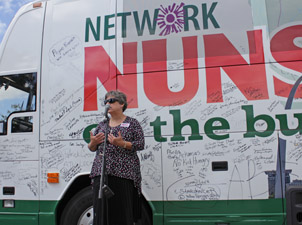
And then, before my very eyes, my intern life began. I quickly discovered that as the NETWORK program “Nuns on the Bus” travelled around the country rallying the public around comprehensive immigration reform, the fleet of fervent advocates implored listeners to mail in NETWORK postcards to show their Members of Congress. These postcards, eventually estimated at 5000 in total, found their way to my desk. To ensure that all three affiliated elected officials saw the personal notes, we copied them twice over and delivered each by hand; my job, seemingly mundane but actually critical, was to man the photocopier for two days. By the end of day two we had organized, photocopied, and cut each postcard for delivery and delivered them to Senate offices with the same hope of success as the original sender.

In the end, the thousands of postcards and hundreds of hours of labor contributed to two final numbers: 68-32. These two numbers will prove extremely significant. On a personal level, the statistic represents a victory for NETWORK and the apparent successful culmination of my contribution to the campaign; on the national stage, the figure will inevitably change the course of millions of lives. Over 11 million undocumented workers will be given a brighter pathway to citizenship.

While the 68-32 figure may have allowed our nation sorely-overdue room to grow, the values cannot and will not encapsulate the significance of this vote. As I spent hours alphabetizing, moving, photocopying, and stacking the post cards we received, I saw the statistical value of the cards fade into the background. While the size was impressive and the campaign’s manpower was wide-reaching, I became fascinated with the capital we weren’t calculating.

Largely lost between their mailing and our reception was the idea of effort. While the questions we asked were basic contact information, the reality behind each postmark was the level of passion needed to fill out the card at all. In this town the distinction between keen interest and direct act seems less blurred than before. Without people committed to direct action, those individuals willing to fill out postcards or attend our “Nuns on the Bus” events, the passion we have would prove little more than a whisper in the halls of Congress. As we tabulated the size of each stack and the logistics of delivery, the personal almost got lost in the numerical.

Each postcard carried with it a message, some simple—“comprehensive immigration reform now!”—and others more personal; one person even filled out all of the personal information questions with the word “undocumented,” scrawling “help me get out of the shadows” near the edge of the card. The stories and calls for change from around the country were housed on those cards and, by photocopying them and delivering them to senators, I helped connect constituents to representatives.

Just like my understanding of Congress, my knowledge of the inner-workings of the Metro system, and my inability to avoid the food trucks near Union Station, I recognize that the bill adopted by the Senate is imperfect. With 48 amendments and plans that create a climate of militarization along one of our borders, the bill feels to me like progress and not perfection.

I feel much the same about my assumptions about Washington and my potential here at NETWORK. Although statistics eventually determined the fate of this bill, I’ve come to see that in the heart of downtown Washington the political climate is warmer than the cold, hard statistics of appropriations bills and approval ratings, and this political community more sentimentally connected than it seems. In reality, Washington is a hybrid, a creature that feeds on both statistics and sentiment. And maybe I can lend a hand to the mighty task of infusing life back into statistics and increasing socially-conscious funding to the point that they can change the world. It won’t be perfect, it most likely won’t be pretty either, but it will be progress.

In the end, even the highlights of the last week cannot parse out figure from feeling. 11 million people—the comprehensive immigration reform bill is a promise to 11 million people. The legislation I had even the slightest hand in promoting is one step closer to helping millions of members in American society gain citizenship, and I read the words and saw the widespread passion of the American electorate; these are the moments I feel proud to call my own.

On Environmental Justice

On Environmental Justice

By Neal Davidson
June 29, 2012

I am working this summer as an intern for NETWORK. I have been assigned to do environmental research, and I’ll be doing a weekly blog throughout the summer on my findings. My overall goals are: to define climate change, to define the way that change is affecting people in poverty in the United States, to explore how its effects relate to Catholic social teaching, and to research ways to address the problem.

In the past, advocacy for legislation regulating America’s effect on the world environment has primarily come from environmental interest groups. I would like to clarify the misconception that climate change only adversely affects rainforests and many animal species; our nation too often focuses exclusively on this aspect of climate change and not on the damage being done to humans. The change in the climate has a disproportionate effect on people at the economic margins. Moreover, the increasing frequency of natural disasters is forcing the displacement of large populations across borders and people are struggling to find homes. Citizens of certain island nations will see their country completely submerged within our lifetimes. We have a moral imperative to counter the threats posed by the increasing intensity of droughts and other natural disasters.

We are called to be stewards of the earth and protect human dignity, and by disregarding our obligation to protect the gifts we have been blessed with, we endanger our lives and our morality. In my blog posts, I hope to provide convincing information from a variety of sources, combined with real and creative solutions to the dilemmas caused by our rapidly changing earth. If you have specific questions, please feel free to email me at[email protected].

Blog Post #1 – Global Warming: The Vicious Cycle

Blog Post #2 – Environmental Justice: A Vital Part of Catholic Social Teaching

Blog Post #3 – The Basics of Renewable Energy

Blog Post #4 – Some New and Inspiring Solutions

Blog: What Can You Do In This Uncertain Time?

What Can You Do In This Uncertain Time?

By Jean Sammon
April 30, 2012

The Vatican Congregation for the Doctrine of the Faith released a report on April 18, 2012 that is highly critical of the U.S. Leadership Conference of Women Religious (LCWR). The report, as well as the news release from the U.S. Conference of Catholic Bishops, also implicates NETWORK, in that it calls for a review of LCWR’s affiliation with NETWORK along with reform of LCWR. (See www.usccb.org/news/2012/12-062e.cfm)

Since NETWORK was founded by women religious (a.k.a. Catholic sisters) 40 years ago, we have maintained a close relationship with LCWR. We will continue our solidarity as we continue to serve people who are marginalized, and advocate for human dignity and the common good. We do not know what the future holds, but we will not let our voice be silenced.

Many people are asking what they can do during this uncertain time in our church and our nation. We offer this partial list of suggestions, confident that people will find other creative ideas as we all pay attention to the Spirit moving among us.

UNITE HERE comes to NETWORK

UNITE HERE comes to NETWORK

By Page May
July 22, 2011

On Wednesday a group of housekeepers with the UNITE HERE union visited the NETWORK office. We listened to their stories of exploitative working conditions at various hotels around the country. Several of the women discussed the long hours working at backbreaking speeds for no overtime pay; high stress conditions; the lack of appropriate work tools for housekeepers which has led to chronic pain; and an unsafe environment.

Their visit was part of a larger campaign- Breaking the Silence. This national campaign aims to raise awareness to the many abusive practices that housekeepers must face every day and create safer worker conditions .

“Hotel housekeepers- overwhelmingly women, immigrants, and people of color- are the invisible backbone of the hotel industry…The women who work as housekeepers routinely face a broader spectrum of dangers at work, from sexual harassment to the debilitating injuries that many women sustain after years of making beds and scrubbing floors…. Sexual assault is one of a range of hazards that housekeepers experience. The rate of injury among hotel workers is 25 percent higher than among service workers overall. Among hotel workers, housekeepers have the highest rate of injury—50 percent higher than hotel workers overall.

Their campaign is garnering support for unionization and a number of “common sense preventative measures to make their work safer, such as increased security staff, working in teams, and replacing the traditional dress uniform with a pants and tunic uniform. In addition, the union fully supports two pieces of legislation recently introduced in New York that would 1) provide panic buttons to employees to use in case of emergency 2) require hotel and motel owners and operators to provide comprehensive sexual harassment awareness training.”

For more information on safety concerns that housekeepers face, visit www.hotelworkersrising.org/injuries/.

Booking a hotel room? You can use this guide to find a union hotel where UNITE HERE members are employed. You’ll be supporting good union jobs and safer conditions for housekeepers! Click here to find out what hotels to avoid on our boycott list.

Blog: Why Focusing on Social Justice, in All Its Many Forms, Is the Only Way to Ensure a Voice for All

Why Focusing on Social Justice, in All Its Many Forms, Is the Only Way to Ensure a Voice for All

By Carolyn Burstein
June 25, 2015

Catholic Social Teaching, starting with Pope Leo XIII’s famous encyclical Rerum Novarum and continuing through the many papal encyclicals and the teachings of bishops’ conferences throughout the world, to the most recent encyclical last week of Pope Francis, Laudato Si’, is the source of my beliefs on social justice. Actually, there is little, if anything, in these writings, that isn’t part of Christ’s own teachings and life example, as the pastor of my parish is fond of saying.

Ignatian Volunteer Corps (IVC) led me to NETWORK

It is love of these teachings that impelled me to join the Ignatian Volunteer Corps (IVC) after retiring from work in both the private and public sectors. The IVC is a national organization (with 16 regional groups throughout the country) that partners with various agencies that either serve those who are poor and marginalized, believe strongly that their voice should be heard, or advocates with them, as NETWORK does. As a member of IVC, I have had the opportunity to tutor disadvantaged kids in grades six through eight who were falling behind in their studies; serve homeless people who live on the streets at drop-in day centers; serve in various capacities at actual homeless shelters, and, for the past two years, do research to assist NETWORK’s lobbyists and blog for the NETWORK website.

Unfortunately, my service at NETWORK is ending (this is my last blog), but I will continue to work for greater social justice through IVC at another agency, whose identity I do not know yet. It has been a great privilege to contribute to NETWORK’s important mission of lobbying on issues critical to social justice causes, and to get to know a number of wonderful people who labor in this vineyard of love. There is so much to be done before thevoice of all can be heard in their local communities, in their local governments, in the halls of Congress.

About the IVC

People in IVC must be 50 or older, be available for part-time work (about two days a week), and stimulated to serve those on the margins of society. There is also a strong spiritual component in IVC – more on this below. As a result, IVC has former foreign-service officers, military, laborers, lawyers, contractors, professionals, managers, scientists, housewives, and workers from every walk of life you can imagine. These are the people who volunteer to teach English-as-a-second-language, to tutor kids, to care for abandoned children, to work with those in prison, those who are dying, people who are homeless and very elderly people. They also work with people in hospice, immigrants, refugees, and others, too numerous to mention — as well as advocate with them and anyone whose voice is undeard. Many of our IVC members also provide indirect service to marginalized people by serving in an administrative capacity.

So what is IVC’s spiritual component? Remember that we are the Ignatian Volunteer Corps, so we derive much of our spirituality from Ignatius and the Jesuits, although most of us agree that our spirituality is Christian. It should be pointed out that our membership is primarily Christian because our numbers include a small number of Protestants. We are members of the world church – White, Black, Latino/a, Asian – who believe that the Jesuit charism, especially as it has unfolded since Vatican II, embraces all aspects of social justice that have been emphasized in Catholic Social Teaching.

Among the many spiritual opportunities afforded to IVC members are two retreats and one Day of Recollection annually, a spiritual reflector (director) with whom we can take a more intense spiritual journey (each region has numerous reflectors available for members), if that is desired, and monthly small-group meetings (some regions have as many as four or five) during which we discuss our service ministries, Scripture and a book on contemporary theology, social justice or Ignatian spirituality. Many members have said that the spiritual component of IVC is not only the highlight of their membership, but also prevents “burn-out” from squandering their ministry. And I agree.

I have to admit that among the many issues of social justice, I am especially concerned about the availability of sufficient “affordable housing” for poor individuals and families both in my community as well as nationwide. This interest accounts for my nine years of service at homeless shelters and has impelled my membership in the National Low Income Housing Coalition (NLIHC).

NLIHC is an all-round advocate of housing for the poor and vulnerable members of our communities. It also provides major support for the National Housing Trust Fund (NHTF), a fund that would largely assist extremely-low-income residents of a locale to afford housing. As of June 23 (yesterday), the Senate Appropriations Committee had left the NHTF intact during its deliberations over the Housing and Urban Development (HUD) budget, but had gutted other aspects of housing for low-income individuals and families. Sequestration has done further damage. When events like this happen, it merely makes me more determined to convince other members of Congress, through emails or calls, to vote in opposition to damagin.

My Farewell

Enough of my special issue! Your journey will be different than mine. I encourage everyone interested in social justice to determine what impels you to desire justice for others. Once you have chosen your specialty, go for it! Get involved, to the extent possible, and make your mark, whether that be in your neighborhood, your larger community, or the national stage. There can never be too many people who are ardent practitioners of Catholic Social Teachings. As I said in my title, working for social justice is the only way we can ensure that all voices are heard. And thank you for being a reader of my blogs.