



Joint Employer Rule Moves DOL Backwards
Elisa McCartin
August 23, 2019
The Trump administration has announced many harmful rules changes in the last several months, including Joint Employer rule change explained below. This blog follows our previous blog about the Trump administration’s proposal to re-define the poverty line. Read that blog here.
Proposed Joint Employer Rule Change
On June 25, 2019, the Department of Labor (DOL) closed its commenting period on a proposed rule that would alter Section 791 of the Fair Labor Standards Act (FLSA), which governs joint employer liability. The proposed rule would create a four question standard to determine if one is legally considered a joint employer and is liable for their employees, making it dramatically more difficult to hold putative employers accountable.
In its current form, the FSLA stipulates that employers must be “not completely disassociated” in order to be considered joint employers who share liability of an employee. The DOL’s plan is to update this criteria based on a Court of Appeals case Bonnette vs. California Health and Welfare Agency (1982), to include a higher standard that requires employers to share direct control over an employee in order to be considered liable. Under this standard, to be considered a joint employer, one must have the power to 1) hire or fire the employee 2) supervise and control the works schedule of conditions of employment 3) determine the employee’s rate and method of payment and 4) maintain the worker’s employment record. In 2015, the D.C. Circuit Court ruled in the case Browning-Ferris Industries of California vs. National Labor Relations Board (NLRB) that indirect control of an employee is sufficient to qualify someone as a joint employer. Despite this more recent precedent, the Trump Administration is trying to revert back to this outdated legal framework from the 1982 Bonnette case.
By adopting this higher standard, the DOL would make it nearly impossible to prove that a putative employer should be considered a joint employer and thus held accountable for their employee’s treatment. American workers in contract labor positions often work under the jurisdiction of someone who does not directly control the terms of their employment, but oversees their daily activities and work environment. Holding people in these positions accountable for workplace conditions, treatment and environment of the people working under them would become extremely difficult to litigate against if the DOL goes through with the proposed change. Unjust conditions such as organizing restrictions, discrimination, and harassment would all essentially become state-sanctioned. Moreover, collective bargaining would become obsolete, as only employers are legally required to allow workers to bargain. As a result, this rule change has the potential to radically shift work-place power dynamics more heavily in favor of employers at the expense of employees’ rights and protections.
Every person has the right to work in a safe and nurturing work environment. By making harder to prove that putative employers should be considered joint employers, it will be increasingly difficult to ensure employees work in fair conditions. Pope Francis reminds us that we must create moral and ethical economies which protect workers and our environment. The DOL’s proposal only further elevates the managerial class at the expense of workers, who deserve equal protections and enforcement by the government. We cannot operate businesses in good faith without ensuring there are strong mechanisms in place to protect employees.
This proposed rule change represents the Trump administration’s continued efforts to chip away at worker protections and undermine the working class. At NETWORK, we recognize the dignity of all workers. We acknowledge the gross injustices at hand in the American workforce. We will continue to stand in solidarity with workers and organized labor to put an end to the rampant injustice that further weakens the most vulnerable and powerless in our society.
___________________________________________________________________________________
Elisa McCartin is a NETWORK volunteer and student at Georgetown University.

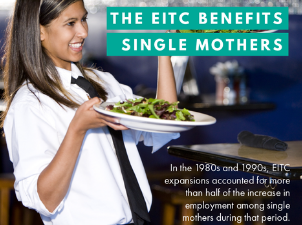
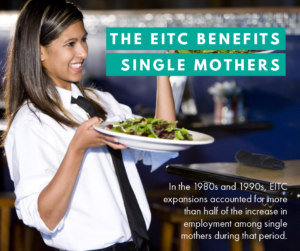 Improving the EITC and Child Tax Credit — through changes like those in the Working Families Tax Relief Act, recently introduced in the Senate — should be a key part of an agenda to reduce income inequality and boost working people’s wages.
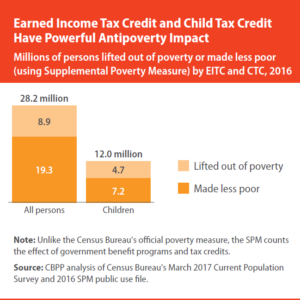 Stephanie in Missouri, for example, explains: “I am a single working mom of four. My income is low, but I’m proud to support my family, running my own business from home which allows me to be here for my kids. Without the EITC my income would not be enough to cover our basic necessities, like food, housing and utilities.”
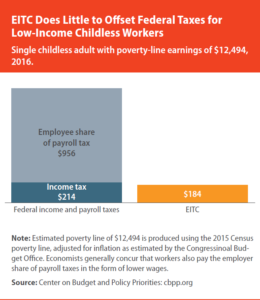 Despite their success, both the EITC and the Child Tax Credit have shortcomings that policymakers should address in order to target more assistance to those who need it most. The EITC for working people not raising children in the home is extremely small —
  Putting its EITC and CTC expansions together, the bill would make a substantial difference for low- and moderate-income working families. A single mother of two earning $20,000 would get a $3,700 increase, for example, while a married couple with two young kids making $45,000 would get a $3,500 increase. The bill would cut child poverty by 28%, lifting 3.1 million children out of poverty and making another 7.7 million children less poor.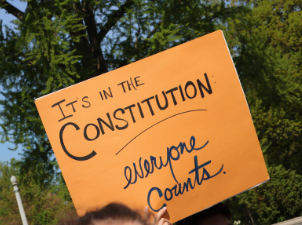

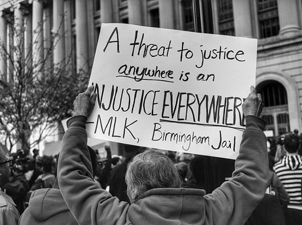

 What does it mean for those of us who are not directly impacted? This is the key faithful question of our time. As people grounded in sacred texts that call for welcome and love, how do we respond? Do we look away because it all seems overwhelming? Do we chose to sit in our comfortable homes, go to our pools, enjoy a barbeque with family and friends completely detached from this terror? Or, do we engage in acts of resistance and love?