

Category Archives: Spirit Filled Network

Taking Action: Three Women, Three Stories

Taking Action against Child Detention: Three Women, Three Stories

Laura Peralta-Schulte
July 22, 2019

Last week, Catholics came together to call for an end of the inhumanity happening at the U.S. border and in detention camps around the country. Our day of action was an attempt to draw attention to the corrupt and deadly practices funded by our government. As a participant in civil disobedience, I was deeply inspired by the Catholic Sisters, Priests, and lay leaders participating, many of whom have spent their entire lives in the service of justice and peace. They are models of goodness, wisdom, and courage in the service of God.
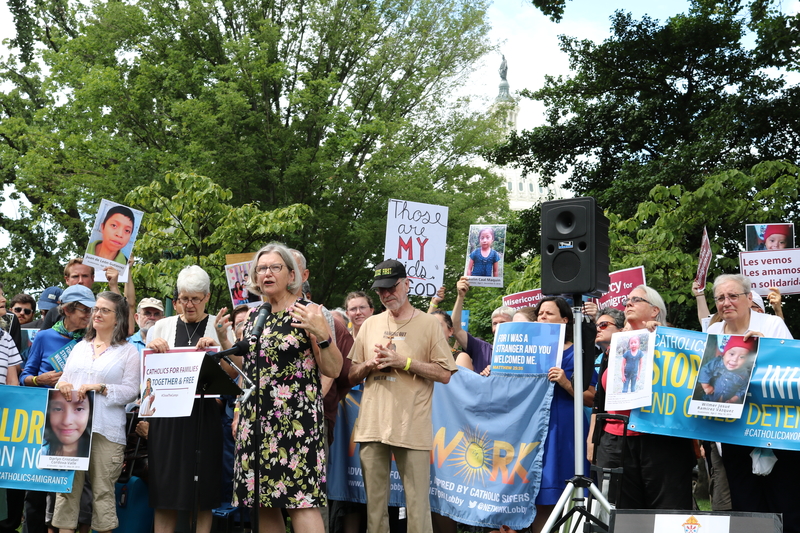
There were, however, three women participating who engaged in civil disobedience for the first time.  They are not Catholic clergy, not part of a Catholic organization or a religious order. I spoke with each of them while we were processed for violating the law. I would like to share their stories, because they offer a new model of religious activism for us.

The first woman was the mother of two teenage girls. She is one of the few people in her close circle of friends who is documented. Each of her friends desperately wanted to join in civil disobedience but were rightly concerned about the threat of deportation. She reported the pain is very deep in her community over the treatment of migrants at the border and the raids in the U.S. Her daughters discouraged her to engage in civil disobedience out of fear for their mother. Her husband too was fearful. She insisted, however, she had to join because she could. Her witness and action was a bold example of courage led by the Spirit.
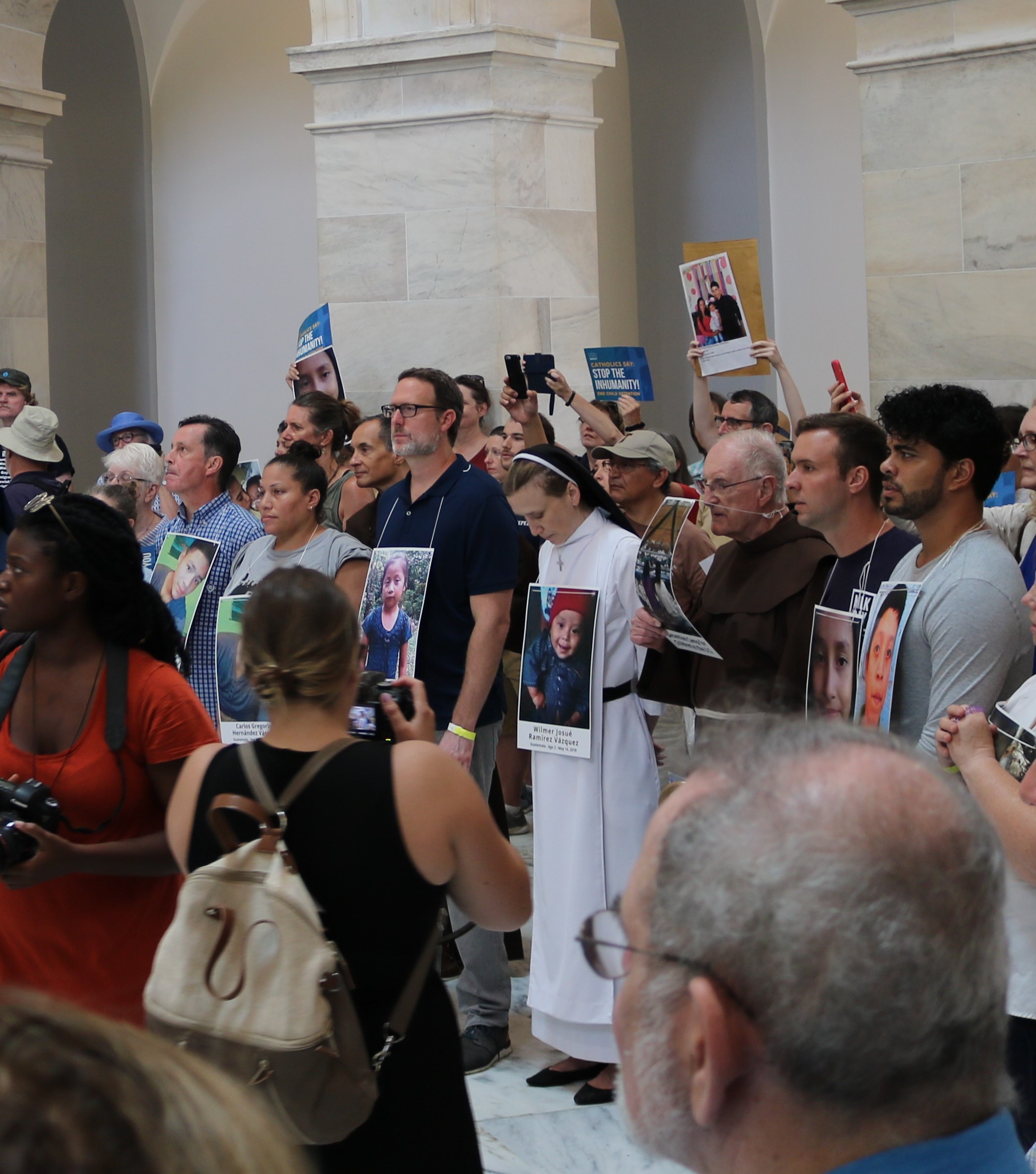
The second woman, also a mother, works for a big company and is not typically engaged in activism.  She decided to join in the action as she sat in church two weekends ago listening to the story of the Good Samaritan. Her priest posed the question, “Who is your neighbor?” and something just clicked.  While she confessed she normally is slow and methodical when making decisions, she instantly decided to participate. It was a moment of moral clarity. She followed the Spirit and took a leap of faith.

The third woman works for a local elected official. This work puts her in direct relationship with immigrant communities. She shared how her county is proactively engaging in know your rights training and trying to foster a safe community for immigrant families. She joined the action because she sees the pain and trauma in her community. She came because she wanted people to know she stands on the side of children and families in detention. She engaged in a prophetic act of witness.
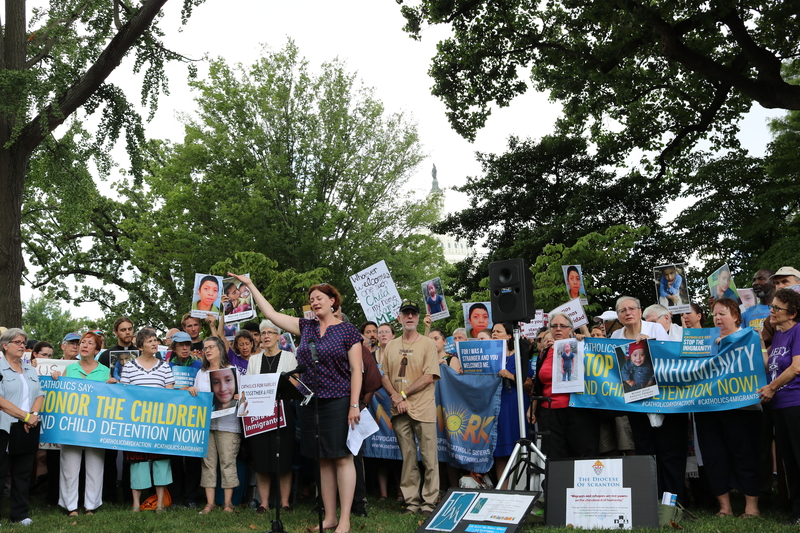
As people of faith, we are all called to act for justice. The sacred call is not limited to our faith leaders, but extends to each of us. No matter who you are, you can participate in the creative process of the Spirit and work for change. Whatever road you take – through prayer, writing a letter to your Member of Congress, joining a vigil or civil disobedience – just do it. We must show courage, act out of faith, and bear witness to the pain of our world, if we are to use our collective energy to end the inhumanity of child detention in our nation.

You Should Be Ashamed, Mr. President, But You Are Not

You Should Be Ashamed, Mr. President, But You Are Not

Laura Peralta-Schulte
July 18, 2019

We have a white supremacist in the White House. The proof is in front of our eyes:  President Trump’s racially divisive political history, his use of race baiting as an arc throughout his 2016 campaign, cruel policies that disproportionately impact people of color, and repeated offensive statements while in office all reveal a consistent belief in white, Christian nationalism.

Trump’s recent tweets aimed at four Members of Congress who are women of color–Representatives Ayanna Pressley (MA-07), Ilhan Omar (MN-05), Alexandria Ocasio-Cortez (NY-14), and Rashida Tlaib (MI-13)–telling them to “go back to where they came from” and “if they are not happy living in the United States, they can leave” fits squarely into his world view. Worse, in signals the continuation of a divisive political strategy to separate the people of the United States by race, religion, class, and status. President Trump’s supporters responded to these tweets and the President’s continued criticism of Representative Ilhan Omar by chanting “Send her back” at a campaign rally in Greenville, North Carolina.

We cannot excuse President Trump’s blatantly racist, xenophobic, un-American behavior. His words are crass and demean the Presidency. They violate the very notion of patriotism and debase the values that this country claims to hold dear in word and in deed. This behavior serves to legitimize white supremacy and if the President can say these things without censure, without consequence, without people, especially white people, calling him out, then his allies and supporters feel justified. So, Mr. President, we at NETWORK Lobby for Catholic Social Justice call you out. You are a bigot and danger to our country, to our Constitution, and to our future.

The question is, what can we do to hold the President accountable?

The answer lies in the words of the four new Members of Congress affectionately known as “The Squad” at the press conference they held after the President’s tweets. Their message: Do not let this racist, xenophobic President distract you. Representative Ayanna Pressley said, ”This disruption is a distraction from the issues of concern to the American people, their failure to reduce the cost of prescription drugs, their failure to promote affordable housing, their failure to effectively deal with issues like healthcare and gun violence.” Representative Alexandria Ocasio-Cortez echoed Representative Pressley and said, “We love all children in this country, that’s why we are fighting for good education for all children. We love all people and that is why we are fighting for healthcare for all. We will get back to the business of American people who have been marginalize and do the work they sent us here to do.  We will not be silent.”

Let the people say Amen.

Everyone in our nation has a role to play in calling out white supremacy when we see it. We also have a sacred spiritual call as people of faith to actively engage in a mission of pursuing Gospel justice on behalf of those who have been marginalized, those who have been excluded, and those who have been denied justice.

There is legislative advocacy we can do this year to ensure that Congress funds Community Health Centers so people can access healthcare. We must stop Congress from continuing to fund cages for immigrant children and families. We must press Congress to pass real prescription drug reform.  Together, we can honor the request of our newest elected officials to keep our eye on the prize now and get ready for the business of electing candidates who share our mission in 2020.

Walking in Grace: A Reminder of the Grace in Mending the Gaps

Walking in Grace: A Reminder of the Grace in Mending the Gaps

Elisa McCartin
July 9, 2019

In the new photo book Walking in Grace, author Alison Fogg Carlson highlights the stories of former gang members who are transforming their lives at Homeboy Industries. Father Greg Boyle S.J. founded Homeboy Industries thirty years ago, and has dedicated his life to serving the Los Angeles community impacted by gang activity. Father Greg and the Homeboy community unconditionally welcome gang members looking to change their life. To facilitate this process, Homeboy Industries provides services such as tattoo removal, education, workforce development, substance abuse treatment, mental health care, and legal assistance. Walking in Grace illustrates the impact of these services with powerful photos by Michael Collopy alongside poems and stories of former gang members who have been touched by Homeboy Industries.

In 2018, Nuns on the Bus had the privilege of touring Homeboy Industries and meeting members of the Homeboy community. At Homeboy, the Sisters witnessed the life-changing transformations that go on every day. They learned that every year 10,000 people turn to Homeboy to redirect their life, making Homeboy Industries the largest gang intervention, rehabilitation and reentry program in the world. After the visit, Sister Julie Fertsch, SSJ wrote, “They [Boris, Janet, Christina, Selena, George, and Allison] inspired us with their stories of radical transformation, of the many ways they found “home” at Homeboy Industries.”

One of Fr. Greg Boyle’s quotes in Walking in Grace summarizes how Homeboy works to mend the gaps: “Our locating ourselves with those who have been endlessly excluded becomes an act of visible protest. For no amount of our screaming at the people in charge to change things can change them. The margins don’t get erased by simply insisting that the powers-that-be erase them. The trickle-down theory doesn’t really work here. The powers bent on waging war against the poor and the young and the ‘other’ will only be moved to kinship when they observe it. Only when we can see a community where the outcast is valued and appreciated will we abandon the values that seek to exclude.”

At NETWORK, we recognize the importance of connecting with communities in need and addressing the harm years of disinvestment and structural oppression cause. Our 2020 Vision to mend the gap articulates the pressing need to identify and advocate for policies in the areas in our society where people are left behind and forgotten. Collectively, we must seek out ways we can be in solidarity with overlooked communities.

The stories told in Walking in Grace remind us of the truly transformational power of community and kinship. In order to truly mend the gaps in our society, we must eliminate judgement, unease, and insecurity. We must fearlessly pursue justice and inclusion.


Elisa McCartin is a NETWORK volunteer and student at Georgetown University.

Faces of our Spirit Filled Network: Beth Ford McNamee

Faces of our Spirit Filled Network: Beth Ford McNamee

Beth Ford McNamee
June 26, 2019

Tell us a little about yourself and the work you do.

I am a Campus Minister at Saint Joseph’s University (SJU). I coordinate a weekly community service program of about 300 students who commit to serve weekly with local community partners in Philadelphia and Camden. The program involves relationship-based service and peer-led, faith-based social justice reflection and discussion. I also coordinate a Campus Ministry Associate program at SJU. This program gives recent college graduates a one year paid experience working full-time on our staff to discern ministry as a full-time career. I am also currently a student in the Interdisciplinary Doctor of Education Leadership Ed.D. program at SJU. My spouse Jeremy and I have a four year old son Aaron.

How did you first learn about NETWORK and what inspired you to get involved?

I first learned about NETWORK when I was a graduate student at Washington Theological Union in Washington, DC. I was studying theology there and seeking to live out a faith that does justice as I had encountered in my Jesuit education at Saint Joseph’s University and as a Jesuit Volunteer. I was inspired by all those at NETWORK who were challenging us to examine public policies and their impact on people on the margins. I worked with a few folks at NETWORK in a committee to help plan the annual Ecumenical Advocacy Days conference. In addition, quite a few of our Saint Joseph’s University graduates have worked as NETWORK associates. My imagination was captured by the Nuns on the Bus tours. SJU was proud to host the Nuns on the Bus tour this past October 2018.

What issue area are you most passionate about?

This is such a difficult question to answer! Immigration justice, racial justice, and care of God’s creation are often among my top issues. However, because education has been such a gift in my life, I also focus on education equity and access to higher education.

How are you engaging your community on important social justice issues?

I help coordinate campus participation in several local, national, and international justice efforts. Our department coordinates the following student groups: Hawks for Just Employment (campus workers’ rights issues), Hawks for Life (focuses on human dignity and a consistent ethic of life), POWER University (local community organizing around various justice issues), a delegation to the Ignatian Family Teach-In for Justice, and Catholic Relief Services, SJU’s Refugee and Immigrant Working Group, and others!

How has your advocacy for social justice shaped your view of the world?

Advocacy for social justice issues has expanded my awareness of human need and systemic justice issues. I believe that it is a duty as part of my faith.

How does your faith inspire you to work for justice? (if applicable)

I’ve been formed in Ignatian spirituality which is grounded in gratitude, finding God in all things, a relationship with Christ, discernment, co-laboring empowered by the Holy Spirit, and a call to live a faith that does justice (and much more!). My faith is grounded in relationships; all people are members of one human family created in the image and likeness of God; when members of the human family suffer, all suffer, and all are called to work for the full realization of God’s reigning in justice, love, and peace.

Who is your role model?

Dorothy Day.

Is there a quote that motivates or nourishes you that you would like to share?

“Injustice anywhere is a threat to justice everywhere. We are caught in an inescapable network of mutuality, tied in a single garment of destiny. Whatever affects one directly, affects all indirectly.” Martin Luther King, Jr.

“We cannot love God unless we love each other, and to love we must know each other. We know him in the breaking of bread, and we are not alone any more. Heaven is a banquet and life is a banquet, too, even with a crust, where there is companionship. We have all known the long loneliness and we have learned that the only solution is love and that love comes with community.” – Dorothy Day

What social movement has inspired you?

Does Nuns on the Bus count? 🙂

What was your biggest accomplishment as an activist in the past year?

In all honesty, it has been balancing commitments as a spouse, mother, minister, and doctoral student while making time for prayer, health, and showing up for prayer, protests, and advocacy opportunities when I am able. I’m also proud of my associates and student leaders who deepened our social justice and advocacy efforts in our programs this year.

What are you looking forward to working on in the coming months?

I am looking forward to working with a mentor to develop a course in faith-based community organizing. I’m also looking forward to this summer for much-needed time for justice-related strategic planning and for sabbath rest.

Faces of Our Spirit-Filled Network: Leslye Colvin

Faces of Our Spirit-Filled Network: Leslye Colvin

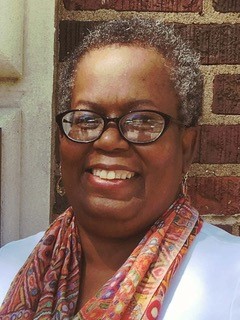
Leslye Colvin
May 3, 2019

Tell us a little about yourself and the work you do.

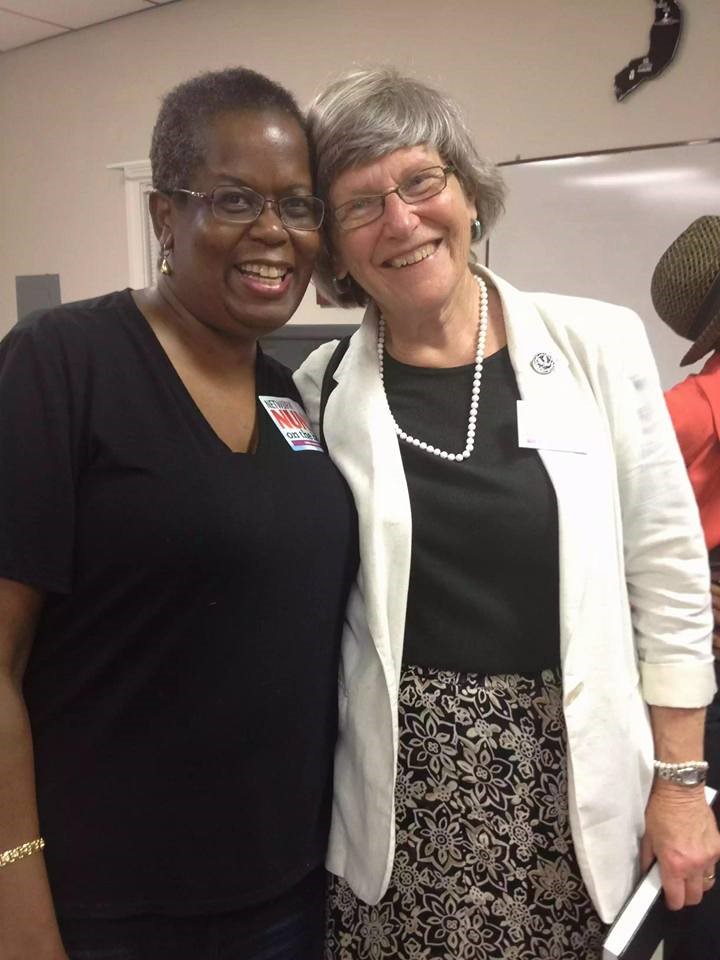
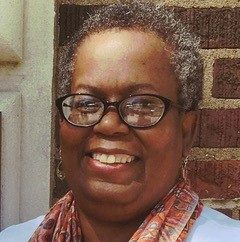
Leslye Colvin with Sr. Simone Campbell at Good Shepherd Services during a 2013 Nuns on the Bus stop in Chamblee, GA.

I am a native and resident of Dothan, AL. In addition to serving on the Boards of NETWORK, I work as the communications coordinator for Gathering for Mission, a project of Catholic Committee of the South. Founded in the 1930s, CCS is a regional network of clergy and laity addressing issues of racial and social injustice. Inspired by Pope Francis, Gathering for Mission provides practicums in dialogue for dioceses across the United States.

How did you first learn about NETWORK and what inspired you to get involved?

After years of social justice ministry in my parish, I was aware of NETWORK when I began working in Justice and Peace Ministries for the Archdiocese of Atlanta in 2011. It was during this period that I had my first opportunity to meet Sr. Simone Campbell and other women religious as part of NETWORK’s Nun on the Bus tour in 2013. More than a decade earlier, I completed JustFaith through which I gained the vocabulary to speak of what I consider to be the transcendent heart of the Gospel – the Church’s social justice tradition. It was apparent to me that NETWORK was upholding this tradition by acknowledging the dignity of those marginalized by society. Unfortunately, some of my colleagues did not share this perspective. The pushback that I received underscored the urgency of the organization’s work and strengthened my resolve to do more to support it.

What issue area are you most passionate about?

Our communities and our lives are diminished by the absence of those exiled to the margins; both are enriched by their presence and voices. Understanding that our nation was established on the flawed and exclusionary concept of white privilege, I am very passionate about the resulting systemic denial of dignity and justice. My experiences as an African-American woman lead me to be an ally for and in solidarity with other people of color, the economically disadvantaged, immigrants and refugees, religious minorities, and members of the LGBTQ community.

How are you engaging your community on important social justice issues?

When living in Atlanta, some of my friends rented a small house to begin the ministry of El Refugio, a house providing hospitality and lodging for those visiting men detained at Stewart Detention Center in Lumpkin, GA. El Refugio also coordinates visits with the men who are detained because of their immigration status.  After moving home to care for my mother, I realized that Lumpkin is now only an hour and a half drive as opposed to the two hours plus drive from Atlanta. I am sharing information on the ministry and recruiting volunteers while engaging them on the need for comprehensive immigration reform. Journeying to a detention center and visiting a detained man are transformative experiences.

How has your advocacy for social justice shaped your view of the world?

My world view influences my advocacy. Universally, regardless of culture or faith, there is a desire for dignity. My view was enhanced when, as a graduate student, I resided in a dormitory where more than sixty percent of the residents were from other countries, and many were of other great faith traditions.

How does your faith inspire you to work for justice? 

Faith and working for justice are deeply and strongly interwoven. As a Christian embracing the Incarnation, I pause in considering that Jesus lived as a marginalized and economically disadvantaged person in an occupied land. This compels me to question the standards of the society in which I live.

Who is your role model?

As a child – African-American and Catholic – in a majority Christian, yet racially segregated society, I knew early that my race and my faith tradition were obstacles for many. Sister Thea Bowman continues to inspire me to live as God’s child in a complex world.

Is there a quote that motivates or nourishes you that you would like to share?

“You have been told, O mortal, what is good, and what the LORD requires of you: Only to do justice and to love goodness, and to walk humbly with your God.”  – Micah 6:8

What social movement has inspired you?

I am inspired by the long struggle of resistance to the indignities born of the concept of white supremacy. I am mindful of the people of the First Nations, the Africans who resisted kidnapping, and those of various ethnic backgrounds who survived dehumanizing conditions while in a land that espoused “liberty and justice for all.” Although I was born in Alabama in 1958, I know that the Civil Rights Movement of the 1960s was part of a much larger struggle for liberation and citizenship that continues today.

What was your biggest accomplishment as an activist in the past year?

I have had a few monumental accomplishments within the past nine months. The first was to collaborate with six other students from the Living School of the Center for Action and Contemplation to respond to our times by writing Barmen Today: A Contemporary Contemplative Declaration. As of this moment, we have 12,000 signatories including the Living School faculty – Rev. Richard Rohr, Dr. James Finley and Rev. Cynthia Bourgeault.

Another accomplishment was traveling to Rome for the book launch of The Catholic Women Speak Network’s Visions and Vocations to which I submitted “Life, Freedom and Dignity: Reflections of A Black American Catholic.” While in Rome, I had a 40-minute interview on the concept of race with Vatican Radio.

What are you looking forward to working on in the coming months?

I look forward to gathering with 40 other Living School students in a few months for an intensive program guided by Father Richard Rohr.

To Repair Democracy

To Repair Democracy

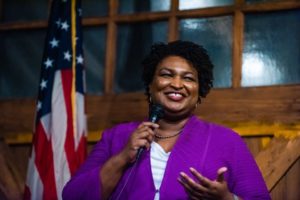
Stacey Abrams
May 28, 2019

Within the corridors of government – from the highest levels of federal and state leadership to county and city municipal bodies – public servants and community advocates, carrying deeply-held motivations like faith, family, and service, fight relentlessly. Their mission: to ensure that decision-makers enact policies to enrich and protect the lives of those they govern. In my home state of Georgia, advocates continue to wage an impassioned battle for Medicaid expansion, which will cover more than 500,000 Georgians who need healthcare access. They demand a world-class public education from cradle to career to empower Georgia’s children regardless of zip code.  Refusing to accept economic insecurity as a given, they push for economic opportunity to reach every corner of our state’s 159 counties.
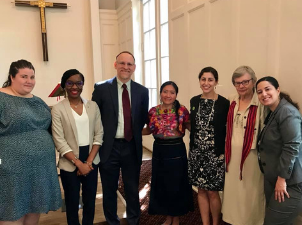
But dreams of expanded economic and social prosperity, of policy outcomes that truly lift up people, are built on a foundation of hearing every voice from the people, through free and fair elections in a thriving democracy. Yet, as the 2018 midterm elections proved, particularly in Georgia, from voter registration to ballot access to full confidence that votes cast are counted, our elections are in dire need of repair.

Fixing our broken democracy stands as a foundational prerequisite to progress. Our work to achieve healthcare access, education parity, social and economic justice and more, they each depend the fundamental obligation that undergirds them all—eradicating voter suppression and ensuring that our elections are fair fights.

After acknowledging the result of widespread election irregularities following my race for governor last year, I redoubled my commitment to voting rights and founded Fair Fight Action, calling on my fellow Georgians of all stripes to join me in pursuing a fair and equitable elections system that operates effectively, efficiently and equally.

In this pursuit, our strategy recognizes that the path to progress is both political and legal. Therefore, we filed a voting rights lawsuit in federal court that details how the seamless integration of incompetence and malfeasance through arcane or manipulated laws deprive citizens of their constitutional right to vote. Likewise, we have engaged in local efforts to thwart legislation that would deepen disenfranchisement, and we have participated in a national conversation about the restoration of the Voting Right Act. Our motives are simple: we cannot allow an immoral and unacceptable system of voter suppression to tarnish our elections, as we have unfortunately witnessed in full force after the Voting Rights Act was effectively neutered in 2013.

Voter suppression has ravaged voter registration, ballot access, and ballot counting processes alike. Attacks on third-party registration submissions and databases rife with errors and security concerns, the discriminatory ‘exact match’ policy blocking many registrations from voters of color, and wildly reckless voter roll purges (which once circumscribed the right to vote for a woman who had lived in the same house and voted at the same precinct continuously for over thirty years), serve as infamous examples of suppression executed by top elections officials in Georgia.

Ballot access has fared no better, with our most recent cycle producing myriad instances of absentee ballots that never arrived, regular voters forced to cast provisional ballots, unacceptably long lines, precinct closures, vulnerable or inadequate equipment, disparate treatment based on county lines, and ill-equipped elections staff. And ballot counting processes include absentee ballots never found, provisional ballots never accounted for, and insecure voting machines producing inaccurate, unverifiable tallies, all within districts surgically gerrymandered to drown out the voices of marginalized voters.

Make no mistake, while our fight has taken root in Georgia’s tarnished elections, our nation’s democracy is imperiled. While Georgia has uniquely linked together a dizzying array of voter suppression tactics, examples of voices silenced can be found across the country. Luckily, we can also hear the clarion call of faith from organizations like Nuns on the Bus, who have been warriors against discrimination and disenfranchisement for decades. From the movement in the 1960s that produced the Voting Rights Act, led by faith leaders like the Southern Christian Leadership Conference and Reverend Dr. Martin Luther King, Jr., to the Georgia churches that have directly joined our ongoing lawsuit as co-plaintiffs, voices of faith are indispensable to framing the moral imperative of free and fair elections that affirm the inherent worth and dignity of every person and every voice in our democracy.

Faith undergirds my every step in this work. My parents, retired ministers and civil rights workers, instilled in me and my siblings a deep respect for the right to vote. As we continue to demand full, unfettered voting rights for citizens in Georgia, the cradle of the civil rights movement, I call on NETWORK and its members to join us in our call for the end to voter suppression wherever it may be found. Whether through supporting the Voting Rights Advancement Act in Congress, or advocating for ballot security on the local level, or holding every presidential candidate accountable for putting forth a plan to end this abominable practice, together we can finally establish an electoral system that operates under the consent of the governed, where policies of, by, and for the people, truly flourish. And, in the process, repair democracy itself.


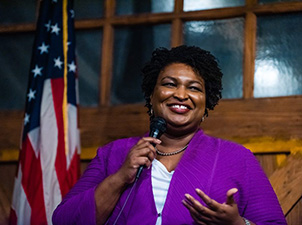
After running for governor of Georgia, Stacey Abrams joined Fair Fight Action in 2018. Fair Fight’s mission is to advocate for election reform and engage in voter education and turnout to secure the voting rights of Georgians. Fair Fight brings awareness to the public on election reform, lobbies the state legislature for election reform and engages in targeted voter registration and other voter outreach programs and communications.

***

This story originally appeared in the April 2019 issue of Connection Magazine. Read the full issue here.

Rabbi Kimelman-Block: Mourning Children Who Died at U.S. Border

Mourning Children Who Died at U.S. Border

Rabbi Kimelman-Block
May 28, 2019

On Thursday, May 23, 2019, NETWORK joined faith partners in a prayer vigil for children who have died in the custody of Border Patrol. Rabbi Jason Kimelman-Block shared the following remarks: 

Rabbi Abraham Joshua Heschel recounted a story of when he was a little child in Europe, he was studying the book of Bereshit, Genesis with his teacher.  They began studying the story of Akedat Yitzhak, the binding of Isaac.  They read about God’s command to Abraham to sacrifice his child. They read about the three day journey. They read about Abraham and Isaac carrying the wood to Mount Moriah, of Abramac tying Isaac to the altar, and grasping the knife in his hand.  Little Heschel, as a young boy, began to weep. The teacher reassured him – “No, child — please read the rest of the story — don’t you know? Isaac was spared! An angel comes and rescues him at the last moment!

Heschel responded.  “But the angel came at the very last second!”  What if the angel was delayed and had arrived too late?  That would have been the end of Isaac — and the story of the Jewish people would have ended there on that alter?!”

The teacher responded — “Young boy — don’t you know; an angel cannot be late!”

Heschel then instructed all of us “It may not be possible for an angel to be too late, but is all too possible for a human being, of flesh and blood, to be too late.”

We say this morning, with broken hearts and with tears in our eyes that we were too late.

We were too late for Carlos, 

We were too late for Wilmar, 

We were too late for Jakelin, 

We were too late for Felipe, 

We were too late for Juan.

And we were too late for Claudia Patricia Gómez González, who one year ago today was shot was shot in the head by a Border Patrol agent while seeking safety in the United States. 

May all of their memories be blessings — 

And may we be blessed to see this society finally declare “no more”  and act decisively to stop this cruelty.

Let us declare this morning that all of us, this entire society, must take responsibility for these children’s deaths.  In the words of the grown-up Rabbi Heschel “in a free society, some are guilty, but all are responsible.” 

Let us confess the fact, that despite our protests, despite our opposition, despite our support for immigrants, for these children — for Carlos, Wilmar, Jakelin, Felipe, Juan, Claudia — we failed and we were too late.

And let us also resolve that we will not be too late for the next children.

By demanding accountability to those in charge of detention facilities; 

By demanding accountability for ICE and CBP — and demanding that Congress rein them in – by demanding Congress defund hate;

By calling for the resignation of the government officials in charge of implementing immoral and cruel immigration policies.

Let us resolve, not in words or in tears, but in action that we will not be too late.


Rabbi Jason Kimelman-Block is the Washington Director​of BEND THE ARC: Jewish Action.

NETWORK Strongly Supports the Equality Act

NETWORK Strongly Supports the Equality Act

Siena Ruggeri
April 26, 2019

NETWORK Lobby for Catholic Social Justice urges a yes vote on H.R. 5, the Equality Act. NETWORK is open to all who share our passion. We are proud to raise our voices for our LGBTQ+ friends and colleagues to ensure they live free from discrimination. We know that all people have inherent dignity. No one should tolerate hate or discrimination towards any member of our human family. In our efforts to mend the gaps in our society, we will leave no one behind.

Guided by our Catholic Social Justice values and founded by women religious, we welcome and affirm all LGBTQ+ members of our human community. In the spirit of our founders, our work is guided by relationship and encounter. We have seen the pain, alienation, and violence that our society has inflicted upon members of the LGBTQ+ community. We call upon Congress to end these grave injustices.

We cannot mend the gaps of our society without changing how our nation has permitted discrimination on the basis of sexual orientation and gender identity. Those who identify as part of the LGBTQ+ community live in fear of being denied a place to live, losing their job, barred from bathrooms, and refused medical care because of who they are and who they love. We must act for the common good and heal our nation. We must end the unique oppression LGBTQ+ people encounter in their daily lives.

Passing the Equality Act would offer legal protections in every aspect of the lives of members of the LGBTQ+ community. It builds upon existing federal civil rights laws to explicitly prohibit discrimination on the basis of sexual orientation and gender identity in education, employment, housing, credit, federal jury service, public accommodations, and the use of federal funds. While many aspects of LGBTQ+ equality have been affirmed by the courts, it is important to enshrine LGBTQ+ civil rights protections into law to provide certainty for all people.

As people of faith, we are disturbed by how our beliefs have been used to deny the sacredness and dignity of members of our community. Our scripture tells us that we should walk towards everyone—no exceptions. We are called to radical acceptance and see God in all people. Guided by this prophetic vision of justice, we urge Congress to vote yes on H.R. 5 and pass the Equality Act.

“How to Lobby:” Training the Stone Ridge Sophomore Class

“How to Lobby:” Training the Stone Ridge Sophomore Class

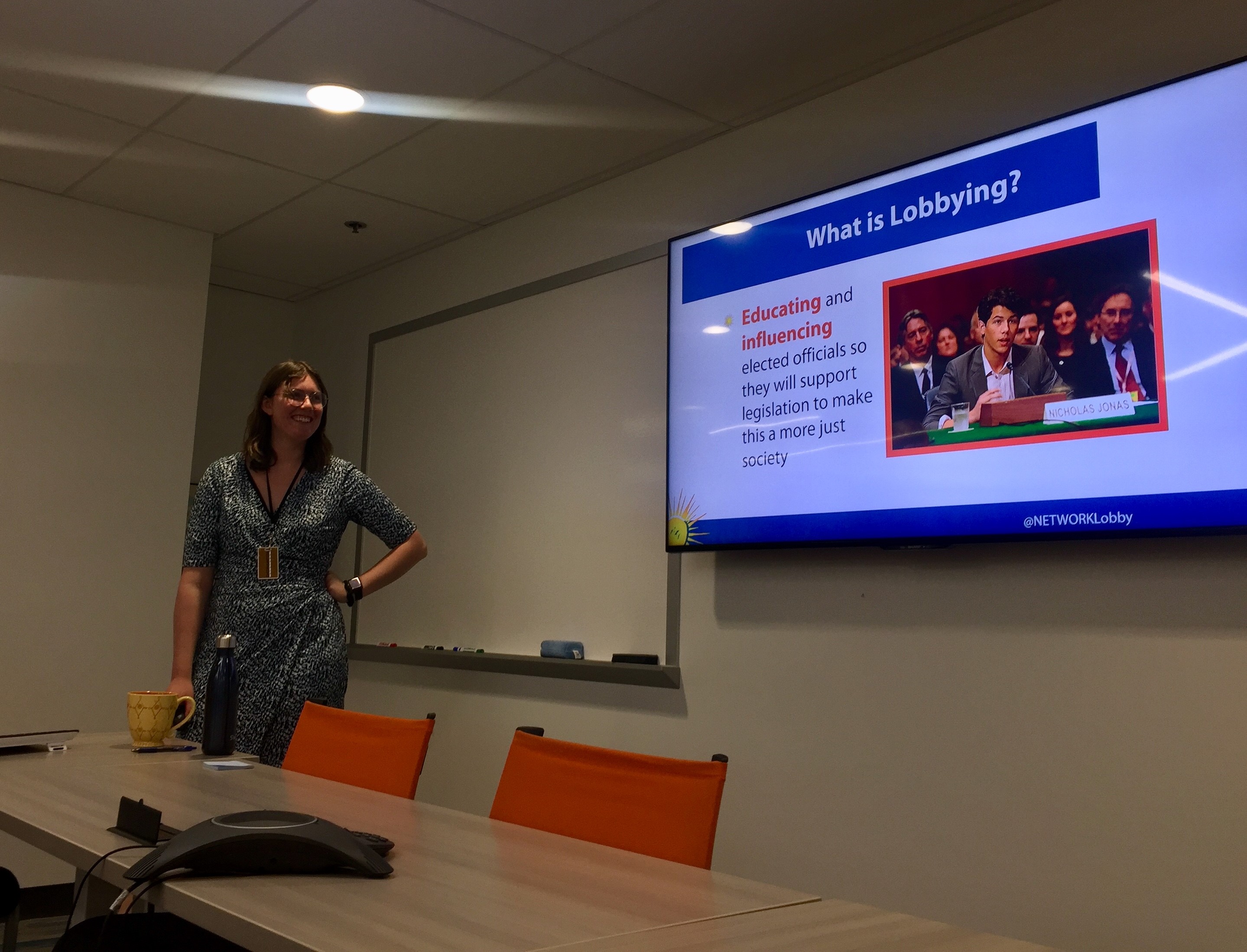
Last week, the Grassroots Mobilization team welcomed the last of the Stone Ridge School of the Sacred Heart sophomore class to our office for a “How to Lobby” Presentation before taking them up to Capitol Hill to visit their federal legislators.  Beginning in October, we (Erin Sutherland and Alannah Boyle, Grassroots Mobilization Associates) have had the opportunity to train and accompany the entire sophomore class at Stone Ridge on dozens of lobby visits.

In each visit, we taught the sophomores about the importance of Family Friendly Workplace policies, including paid family medical and sick leave. Right now, there are two great bills going through both the House and Senate: The Healthy Families Act (H.R. 1784/S. 840) which guarantees workers the right to earn sick days to care for themselves or a family member, and the FAMILY Act (H.R. 1185/S. 463), which provides workers the opportunity to access paid sick leave.  Through Stone Ridge’s Social Action program, a group of approximately ten sophomores visited the NETWORK office every other week for the past seven months. It is only at the end of this program that we see the magnitude of our reach.

Alannah Boyle, Grassroots Mobilization Associate, presenting to Stone Ridge students.

Erin:

“I had not gone on a lobby visit until I started working at NETWORK. For me, when I had heard of lobbying in the past, the word connoted meeting of special interests, of wealthy people in suits, speaking more eloquently on issues than I could.  However, after going to my first lobby visit in coalition (and with coaching from Sr. Quincy Howard, Government Relations Advocate at NETWORK) this past fall, I realized that the only thing needed for a successful lobby visit and sincere conviction in an issue I cared about. Alannah and I tried to pass on these two important skills to our students by staging mock lobby visits with lots of contingencies (what if we need to meet in the hallway, as is common?  Or if the staffer we meet with tries to change the topic of our visit?) to help make the girls prepared and confident for whatever could come their way.  We also talked with the students about how, as women, the right to paid family and medical leave has or will affect us personally at some point in our lives, between becoming a parent, to needing to take care or a relative, or taking time off in the wake of personal trauma.

“Every few weeks, I was humbled to accompany such eloquent and diligent young women to advocate for such important policies. It made me hopeful to see the next generation already engaged in federal advocacy – years before I was!  It also reinforced my belief that lobbying can and should be accessible to all as a way to engage with our legislators on issues that matter to us.”

Alannah:

“Unlike Erin, I had been on a few lobby visits prior to beginning my work here at NETWORK. The first time I went on a lobby visit was as a college student after attending the Ignatian Family Teach-In when I myself was first trained by a NETWORK staff member on how to lobby, almost five years ago. I vividly remember how excited and equipped I felt after completing my first training and attending my first lobby visit. Realizing now that Erin and I have trained almost 100 high school students, and equipped them with these same skills, has been incredibly rewarding. We all have the ability to lobby and advocate our elected officials on issues that matter to us. As constituents, our Members of Congress work for us. NETWORK’s “How to Lobby” training helps to answer the questions that can make lobbying seem scary.”

Barmen Today: An Act of Divine Obedience

Barmen Today: An Act of Divine Obedience

Leslye Colvin
April 8, 2019

Responding to the signs of the times, people of goodwill have historically raised their voices on behalf of the common good. How the voice is raised – whether literally or figuratively, individually or collectively – is determined by a number of variables including the challenge and the desired outcome. Examples of these efforts include Mahatma Gandhi’s Salt March, Rev. Martin Luther King, Jr.’s Letter from Birmingham Jail, Marian Wright Edelman’s Children’s Defense Fund, and Bryan Stevenson’s Equal Justice Initiative. NETWORK, founded by women religious to lobby for social justice at the federal level, is a living model of speaking for the common good. In each instance, the action is inspired by the transcendent truth of human dignity and is viewed as an act of conscience, faith, or divine obedience. Depending on the circumstances, speaking truth may be accompanied by the grave risk of physical harm or death. In spite of the risk, people of goodwill are duty-bound to speak.

Many Americans have observed the recent rise in blatantly hateful physical and verbal attacks against people of color, immigrants, religious minorities, and members of the LGBTQ community. Knowing that racist and xenophobic rhetoric are attributable to America’s historic and continuing original sin, having it affirmed by those sworn to protect the Constitution of the United States is a direct threat to the common good. Seven students from the Living School of the Center for Action and Contemplation were drawn together by their shared concerns. Entering a discernment period, they agreed with the prophetic words of Rev. Dietrich Bonhoeffer: “Silence in the face of evil is itself evil. Not to speak is to speak. Not to act is to act.”

In 1934 Germany, Bonhoeffer, theologian Karl Barth, and other Christians were greatly disturbed by the rise of Nazism, and the large number of churches who remained silent in light of the contrast between Christ’s teachings and Adolf Hitler’s agenda. These church leaders responded by raising a unitive in the Theological Declaration of Barmen that has since been embraced by a number of Christian traditions. Inspired by this historical document, the Living School students wrote and released Barmen Today: A Contemplative Contemporary Declaration with the full-support of their teachers: Rev. Richard Rohr, Rev. Cynthia Bourgeault, and Dr. James Finley.

Known as the Barmen Today circle, the small collaborative group echoes Bonhoeffer by stating, “[B]ecause we want to remain faithful to both the Divine which we seek to understand and the Love which we seek to live, we choose to not be silent. We choose to speak and act.” Issued as an invitation to engage in both contemplative practice and nonviolent resistance, the text of the document speaks to common ideals and today’s challenges. Available in English and Spanish, Barmen Today has received more than 11,000 signatories since its release in August 2018.

One of the signatories is songwriter and recording artist Alana Levondoski who was so touched by Barmen Today that she volunteered her talents to write and record “Divine Obedience,” the document’s theme song. According to Levondoski’s lyrics, “There comes a time for Divine Obedience.” Thousands of others join her and the circle in declaring this to be the time for Barmen Today. Will you?

To read, sign, and share, Barmen Today, visit bit.ly/barmentoday. For information on the Living School, see www.cac.org/living-school/. To learn about Alana Levandoski and her work, visit alanalevandoski.com.