


Category Archives: Front Page

NETWORK and 3,500 Catholic Sisters Call for Immediate Action on Voting Rights

NETWORK and 3,500 Catholic Sisters Call for Immediate Action on Voting Rights

Sr. Quincy Howard, OP
January 13, 2022

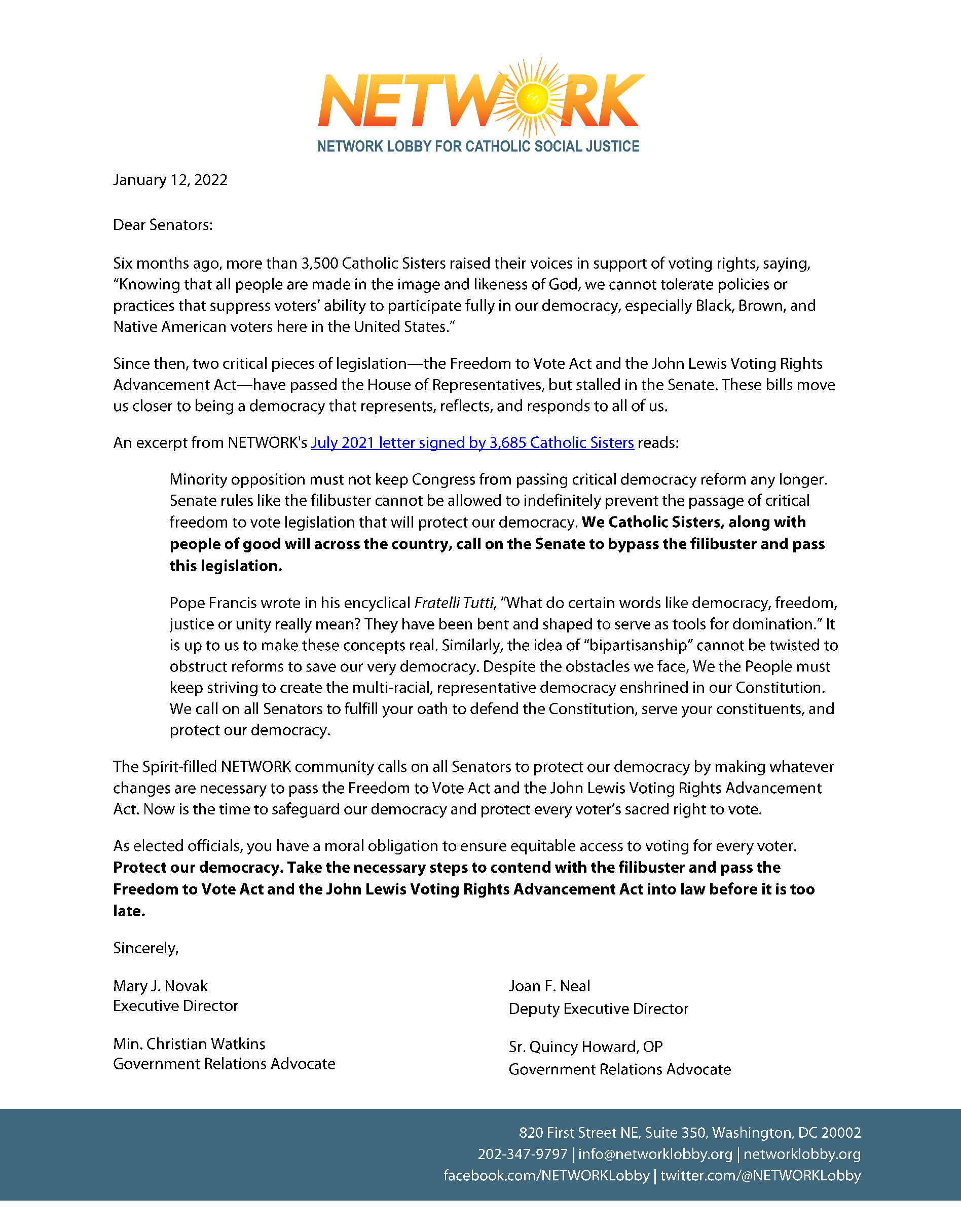
Today, NETWORK Executive Director Mary J. Novak, Deputy Executive Director Joan F. Neal, Government Relations Advocate Minister Christian Watkins, and I sent an urgent letter to all members of the U.S. Senate calling on them to support the passage of H.R. 5746, the Freedom to Vote: John R. Lewis Act.

This message to the Senate follows the House’s 220 – 203 vote to send the Freedom to Vote: John R. Lewis Act to the Senate for urgent consideration. While Senate Majority Leader Chuck Schumer is now able to circumvent the filibuster to hold debate on this legislation, as he wrote in a recent letter to Democratic Senators, “to ultimately end debate and pass the voting rights legislation, we will need 10 Republicans to join us—which we know from past experience will not happen—or we will need to change the Senate rules as has been done many times before.”

Quoting a previous letter signed by 3,500 Catholic Sisters, we urge all Senators to take the necessary steps to contend with the filibuster and pass the Freedom to Vote Act and the John Lewis Voting Rights Advancement Act into law before it is too late. 

As the Sisters wrote in July 2021, “Minority opposition must not keep Congress from passing critical democracy reform any longer. Senate rules like the filibuster cannot be allowed to indefinitely prevent the passage of critical freedom to vote legislation that will protect our democracy.

We know that the possibility to create a more just society ultimately rests upon the health of our democracy and the freedom of all voters to cast their ballots and have them counted. We are staunch supporters the Freedom to Vote Act and the John Lewis Voting Rights Advancement Act and applaud recent efforts to force debate on these bills.

Now is the time to safeguard our democracy and protect every voter’s sacred right to vote.

Read the text of NETWORK’s letter here. 

January 6 Makes Us Confront an Ugly History

January 6 Makes Us Confront an Ugly History

Sr. Emily TeKolste, SP
January 6, 2022

One year ago, we watched in horror as the Capitol was under siege by its own citizens. A crowd composed largely of white men, many of whom were carrying weapons or symbols of violence, attacked and took over the halls of government while Congress was attempting to certify the election results. We saw symbols of white supremacy including Confederate battle flags, shirts referencing the Auschwitz Concentration Camp, and Christian religious imagery.

Make no mistake, the confluence of white supremacy, Christianity, and a violent attack on our democracy was no fluke; it was the result of hundreds of years of preparation and a continuation of a long tradition of white Christian terrorism.

During the height of slavery in the United States, white Christian leaders developed a theology to justify enslaving Black people and continued to use and develop this theology to justify white supremacy. By emphasizing personal piety and downplaying the social dimensions of the Gospel, American Christian theology has created the conditions whereby many of its practitioners don’t even see the social reality in which they live.

Despite years of involvement in right-wing political causes, right-wing Christian commentators throw accusations of politicizing Christianity at liberation theologians, practitioners of Catholic Social Justice, and anyone who wants to apply the social dimensions of the Gospel to the world in which we live. The impacts of years of intentionally tying racism to Christian theology persist among white Catholics, white mainline Protestants, and most strongly white Evangelicals, as documented by research from the Public Religion Research Institute (PRRI).

So how did we get here? The development of Myth of the Lost Cause is fascinating and troubling – a false narrative pushed by the United Daughters of the Confederacy and others into schools, churches, and public monuments. This narrative recast the Confederacy as about family and heritage instead of the reality: the Civil War was about the right of enslavers to continue enslaving Black people. While this narrative has been perpetuated in many public spaces, it’s critical that we address the ways that it has been perpetuated in American Christianity.

As Clint Smith explores in “Why Confederate Lies Live On” (published in The Atlantic), one of the ways well-documented historical falsehoods about the Civil War live on is through church buildings that honor the so-called Confederate martyrs in stained glass, including the chapel at the Blandford Cemetery in Petersburg, Virginia, that Smith highlights. In the book White Too Long, Robert P. Jones traces the explicitly Christian theological connections to the Lost Cause narrative. In fact, the whole Lost Cause narrative draws on an eschatology that proclaims the future victory of Jesus over the world. Its implication: “Just as Jesus was resurrected from the dead and will ultimately come again to rule the earth in righteousness, there will yet be a time when the noble ideals of the Confederacy, even if not the practice of chattel slavery itself, will rise again.”

This is made even more explicit by the fact that the Lost Cause has been depicted in stained glass in Christian churches across the South. Robert E. Lee, Stonewall Jackson, and Jefferson Davis were depicted as or with Jesus, the New Testament apostles, and the Old Testament patriarchs in the sacred art of stained glass windows. In the Lost Cause narrative of American Christianity, the very people leading the charge for continuing to enslave Black people and elevate white supremacy became saints, and the Confederacy became the God’s Chosen People.

Perhaps most pernicious is when these connections between Christianity and the perpetuation of white supremacy become invisible, as they have largely done through a theology focused on individual salvation and a personal relationship with Jesus. Jones points to a 2000 study by Michael Emerson and Christian Smith: “Particularly in questions related to race, they found that white evangelicals’ cultural toolkit consisted of tools that restricted their moral vision to the personal and interpersonal realms, while screening out institutional or structural issues.” If we cannot see the structural issues at play, we will never be able to address them.

It’s fascinating to me as Smith shares of the many Confederate sympathizers he talks to how much emphasis they place on “truth.” They say that they want the story told to be “truth” while denying well-documented truths about the white supremacy behind the formation of the Confederacy. In a New York Times article following the white supremacist massacre at Emanuel AME church in South Carolina, Greg Stewart, a member of the Sons of Confederate Veterans, says, “You’re asking me to agree that my great-grandparent and great-great-grandparents were monsters.”

It can be painful to grapple with the truth of our own family and personal histories, but we must do exactly that. Whether we are members of the Sons of Confederate Veterans or not, we have been raised in a culture infused with white supremacy. The institutions we love have been shaped by white supremacy. And it’s clear that our Christian and Catholic faiths and Church have been shaped by white supremacy. We must confront this if we are to correct it – to heal and move into a new day of justice, peace, and equality.


For further reading:

  • How the Word Is Passed: A Reckoning with the History of Slavery across America By Clint Smith
  • White Too Long: The Legacy of White Supremacy in American Christianity by Robert P. Jones
  • Racial Justice and the Catholic Church by Fr. Bryan Massingale
  • Divided by Faith: Evangelical Religion and the Problem of Race in America by Michael O. Emerson and Christian Smith
  • White Evangelical Racism: The Politics of Morality in America by Anthea Butler

Why Catholics Should Be Actively Engaged in Efforts to Protect Our Democracy

Why Catholics Should Be Actively Engaged in Efforts to Protect Our Democracy

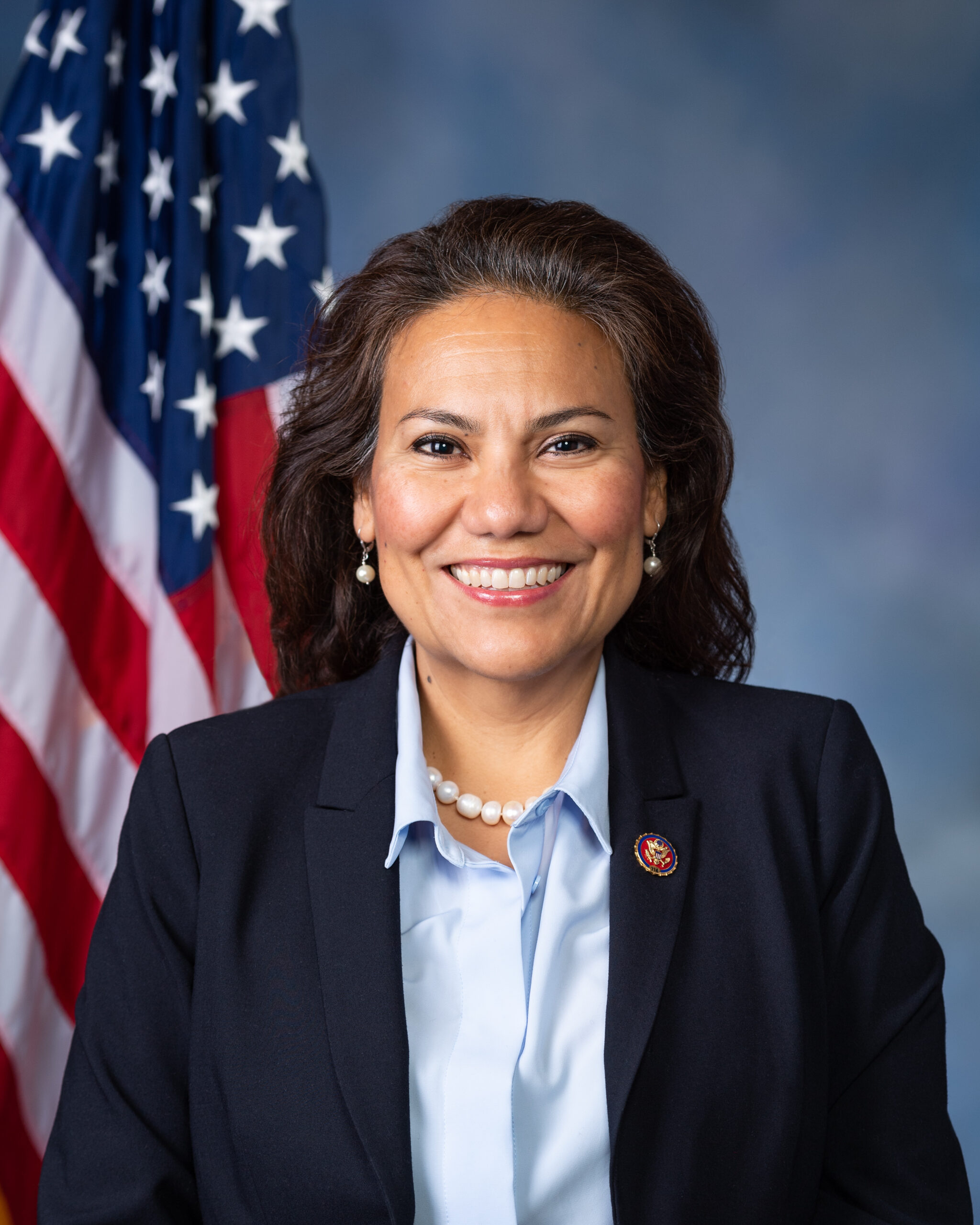
Congresswoman Veronica Escobar
January 6, 2022

Rep. Veronica Escobar represents Texas’ 16th Congressional District. She took office on January 3, 2019, making history as the first woman elected to this seat. This reflection appears in the First Quarter 2022 issue of Connection magazine, NETWORK’s official member publication.

When Catholics think about how they can live out the values of their faith through their politics, protecting their democracy is probably not the first thing that comes to mind. But it should be. Not only does the church support democracy as the form of government best suited to guarantee the protection and flourishing of all people, but people of goodwill have the responsibility to exercise solidarity toward those on the periphery who become the most vulnerable when democracy comes under threat.

Some threats are easier to see. On January 6, 2021, our nation and the world witnessed the most direct assault on U.S. democracy in our history: violent insurgents storming the U.S.

Capitol in an effort to stop me and my colleagues from certifying the 2020 presidential election. Not only were the insurgents trying to upend a Constitutionally mandated process, but they were trying to silence the voices of Black and Latino voters in places like Arizona and Georgia who decided the election for President Joe Biden.

The pushback from Republicans was swift and unmistakable.

Some 17 states, including my state of Texas, enacted restrictive voting laws that disproportionately burden voters of color and limit their access to the ballot box. In November, the Justice Department sued Texas, noting its strict limits on assisting voters at the polls burdens people with disabilities and limited English proficiency. This is just one example of why our country urgently needs the John Lewis Voting Rights Advancement Act and the For the People Act, both of which passed the House in 2021 but have languished in the Senate.

“Democracy is based on mutual respect, on the possibility that each person can contribute to the good of society and on the consideration that different opinions do not threaten the power and security of states, but through honest debate mutually enrich them and enable them to find more suitable solutions to pressing problems,” Pope Francis argued in early 2021.

Shutting people out of the voting process is no way to ensure honest debate, and it’s telling that the lawmakers most adamant on enshrining these restrictions into law are also the ones least serious about finding solutions to the pressing problems mentioned by the pope: climate change, mass migration, and unprecedented economic inequality. Those who benefit from these crises know very well that including the voices of marginalized people in these systems could reduce their power and influence, as it did in 2020.

And it’s this awareness that should galvanize the 70 million Catholics in the U.S. and all people of goodwill to fight alongside those who stand to be the most impacted by the erosion of our democracy. The House of Representatives is doing the work — we sent the John Lewis Voting Rights Advancement Act and the For the People Act to the Senate. We have been patient, we have been willing to work with the Senate, and even supported the Senate-authored Freedom to Vote Act as an alternative to our bills.

But we are running out of time. We must urge the Senate to work for the American people. Whether that means passing the For the People Act or the Freedom to Vote Act, the Senate must act now.

“If one part of the body suffers, then the whole body suffers with it,” St. Paul wrote (1 Cor 12:26). The same applies to threats to democracy. My district is over 83 percent Latino, and we know what it means to have destructive policies inflicted on our communities and families without them ever having a say.

A threat to one person’s voice is a threat to everyone’s. As Pope Francis has reminded us in his teachings on caring for the environment, we are all connected. Women have had the right to vote in this country for only a century, and the original Voting Rights Act passed in 1965 only to be gutted by the Supreme Court nearly 50 years later.

We must take seriously our responsibility to ensure that the rights of all, not just the wealthy and influential few, are protected equally. The Senate and President Biden must pick up where the House left off on voting rights. A democracy that ensures the participation of only the wealthy and powerful is not worthy of its name.


This story will be published in the upcoming First Quarter 2022 issue of Connection. Become a NETWORK member to receive a copy mailed to your home. 

The Time is Now

The Time is Now

Min. Christian Watkins
January 4, 2022

As we approach the one year anniversary of the January 6th insurrection, it is troubling to see that the quick passage of H.R.1 and the John Lewis Voting Rights Advancement Act in the House was followed by months of Republican obstruction in the Senate.

Despite month after month of aggressive and concerted attacks on voting rights and election administration by Republican state legislatures, the Senate has failed to respond by addressing the filibuster rule—the only remaining block to enacting critical protections.

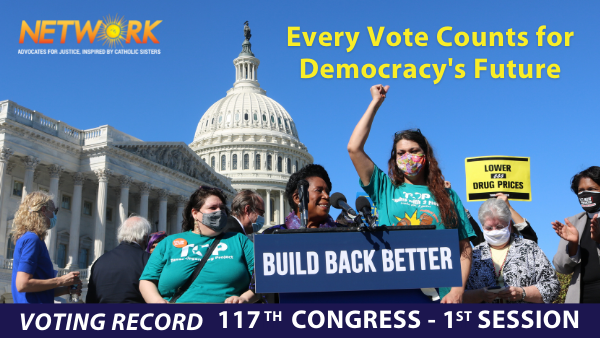
The Freedom to Vote Act and John Lewis Voting Rights Advancement Act represent NETWORK’s top priorities: to protect our democratic institutions and to advance a transformative, once-in-a-generation investment in families and communities. The Build Back Better Act along with reforms in the Freedom to Vote Act and the John Lewis VRAA support families and protect the voices of those who have been systemically left behind in our economy and our democracy, particularly in the poor working class and in communities of color.

We urge Congress to take up continued negotiations on the Build Back Better bill and to take steps to pass the Freedom to Vote Act and the John Lewis VRAA immediately upon your return.

Founded by Catholic Sisters, we continue their legacy today by building a just society that ensures our people have what they need to live dignified lives. We know that a functioning democracy also reduces inequality, gives the most vulnerable a voice, and protects the God-given dignity of every voter.

Our nation—and the Senate—cannot successfully move into 2022 without a candid assessment of the legislative disappointment at the close of 2021. The failure of the Senate to pass protections for our democracy and voting rights was a worst-case scenario for advocates wanting meaningful solutions to the problems confronting us.

The threats to our democracy are real and present and, without needed protections, could mean that the January 6th insurrection was a precursor to worse attacks to come. We must invest in a better future for everyone and ensure that the foundation of our democratic institutions remains sound.

The time to act is now. NETWORK urges Congress to seize this pivotal opportunity to enact transformative legislation on behalf of working families and our democratic institutions across the United States. If not, we will squander this chance to build a stronger and more equitable nation where prosperity and power are shared, rather than hoarded by special interests and the privileged few. We call on you to act faithfully and with speed to pass these critical bills.

Advent 2021: What Does It Mean To Have ‘God With Us’?

Advent 2021: What Does It Mean To Have ‘God With Us’?

Meg Olson
December 17, 2021

The Fourth Sunday of Advent symbolizes Peace with the “Angel’s Candle” reminding us of the message of the angels: “Peace on Earth, Good Will Towards All.” For the conclusion of NETWORK’s Advent reflection series, Meg Olson, NETWORK Director of Grassroots Mobilization, reflects on how the Incarnation, which we celebrate with the birth of Jesus at Christmas, has the potential to transform our politics:

This Christmas, Remember What It Means To Have ‘God With Us’

At this time of year, Christians sing “O Come, O Come Emmanuel,” a name that means “God Is With Us.” What does it mean to have God with us in our politics? To find Jesus in our federal policies? The angels heralded the Savior’s birth with “Peace on Earth, good will toward men,” but how can one look at the dysfunction of our politics and find good will, let alone feel it?

Many Christian scholars have noted that in the Incarnation, God arrived in the form of vulnerability, a defenseless child who relied on others to meet his every need and defend him from danger. It’s because of the agency, tenacity, and loving devotion of Joseph and Mary that Jesus even survives to see adulthood.

As we are called to recognize Jesus in all people, the Holy Family models for us the devotion that Christians must live out in solidarity with all members of the human family. Jesus was the savior, but God wants all of us to participate by living out love for the most vulnerable in concrete, even transformative ways.

This spirit animated 47 Catholic sisters to travel to Washington, D.C. 50 years ago this week to participate in the founding of the NETWORK Lobby for Catholic Social Justice. They recognized that living out the Gospel required them to work for the common good by advocating for economically and racially just federal policies. We now celebrate the legacy of their witness by seeking to dismantle systemic racism, rooting our economy in solidarity, building an inclusive community, and ultimately, transforming our politics.

Pope Francis has reminded us that the political realm is a place where we can live out one of the highest forms us love. So many decisions affecting the common good and the lives of people pushed to the margins by our systems come to the fore in debates over federal policy. In this fourth week of Advent, as we prepare to welcome Emmanuel into the world, let us deepen our commitment to educate, organize, and lobby for justice with joy!

Take Action!

50th Anniversary Kick Off Event

Celebrating Sister-Spirit

 Our 50-Year Justice Journey
Join us online to celebrate the beginning of NETWORK’s 50-year justice journey.
Virtual Kick-Off Event

Friday, December 17, 2021
8:00 PM Eastern/5:00 PM Pacific

Fifty years ago in December, 47 Catholic Sisters gathered in Washington, D.C. and the spark that would become NETWORK was ignited. Shortly after that gathering, NETWORK opened its doors in April 1972.

Since then, NETWORK has grown from a small lobby of Catholic Sisters to one that reaches thousands of justice-seekers across the country. Through political ups and downs, the NETWORK community has continuously advocated for federal policies that advance racial and economic justice and promote the common good.

Save the Date

NETWORK Advocates Training and 50th Anniversary Gala
Spring 2022, Washington, D.C.

More information to follow!

Support NETWORK by becoming a member!

Advent 2021: Celebrate the Alleviation of Child Poverty

Advent 2021: Celebrate the Alleviation of Child Poverty

Sister Eilis McCulloh, HM
December 10, 2021

The Third Sunday of Advent (Gaudete “rejoice” Sunday – pink candle) symbolizes Joy with the “Shepherd’s Candle” reminding us of the Joy the world experienced at the coming birth of Jesus. As part of NETWORK’s ongoing Advent reflection series, Sr. Eilis McCulloh, HM, NETWORK Grassroots Mobilization Fellow, shares how cutting child poverty via federal policy is one cause for rejoicing this year:

This Advent, Celebrate the Alleviation of Child Poverty

At Christmas, God appears to us as a defenseless child. In the U.S., child poverty threatens millions of children. Children are a source of joy, hope, and renewal in every life they touch. Their existence should not be marked by such suffering, and as followers of Jesus, we should answer their cry with action. Happily, in March of this year, that’s exactly what happened.

The American Rescue Plan of 2021, which NETWORK supported, made the Child Tax Credit fully refundable, meaning families who qualified for the credit have received direct payments from the government rather than having the amount counted toward their taxes at the end of the year. Those payments have reduced child poverty in the U.S. by 40 percent! The majority of the children who benefitted are children of color.

We know that the Child Tax Credit has brought stability to children whose lives have been rocked by instability, especially during the COVID-19 pandemic. With the direct payments, families have been able to keep a roof over their heads, food on the table, and pay utility bills and, as a result, their children are able to focus more fully on school. This has the power to affect an entire generation of children.

As NETWORK prepares to celebrate the 50th Anniversary of our founding, we can look to this success as an example of the vision that animated the Catholic Sisters who gathered in Washington one cold December weekend with a vision of politics transformed by the belief that the federal government can create legislation that serves the common good. Half a century later, Pope Francis shares this vision, writing in his encyclical Fratelli Tutti that politics are “a lofty vocation and one of the highest forms of charity.”

NETWORK will always seek this highest form of charity – better translated as love – such as in our continued lobbying for the Build Back Better bill and its provisions that will serve families, such as the expansion of the Earned Income Tax Credit and Child Tax Credit and the four weeks of paid family leave and medical leave. This Advent, let us prepare for the arrival of Jesus by making our country a more hospitable place for all children. That’s something worth celebrating!

Take Action!

Advent 2021: The Moral Demands of Migration

Advent 2021: The Moral Demands of Migration

Ronnate Asirwatham
December 3, 2021

The Second Sunday of Advent symbolizes Faith or Love with the “Bethlehem Candle” reminding us of Mary and Joseph’s journey to Bethlehem. In this week’s Advent reflection, Ronnate Asirwatham, NETWORK of Government Relations Director, looks at how the journeys surrounding the birth of Jesus align with the suffering of migrant people in our world today:

Advent Evokes the Moral Demands of Migration

Jesus entered the world as a victim of forced migration with nowhere to go. Just as Joseph and Mary traveled far from home and were turned away, so too our world faces a refugee crisis that manifests itself across different continents and intersects with crises and conflicts sparked by political oppression, drug trafficking, and climate change.

As Jesus spent his first night in a cave used to shelter livestock, countless families around the world have spent years in refugee camps, living in conditions that most people in the U.S. cannot fathom. And just as the Holy Family fled into Egypt, so also the people at our border flee unimaginable violence and other threats to their well-being.

On Christmas Eve 2017, Pope Francis preached on this stark reality and its religious dimensions:

“So many other footsteps are hidden in the footsteps of Joseph and Mary. We see the tracks of entire families forced to set out in our own day. We see the tracks of millions of persons who do not choose to go away but, driven from their land, leave behind their dear ones. In many cases this departure is filled with hope, hope for the future; yet for many others this departure can only have one name: survival. Surviving the Herods of today, who, to impose their power and increase their wealth, see no problem in shedding innocent blood.”

We should ask ourselves this Advent with whom we’re identifying, the refugee child who is God incarnate or the insecure tyrant who devalues his existence. One example of this is the Biden administration’s continued use of Title 42, a Trump-era policy used to expel an unknown number of asylum seekers at the U.S.-Mexico border, putting them in harm’s way and denying them the opportunity to seek life-saving protection. The coming of Jesus at Christmas is an urgent present day reality when we choose to recognize his presence in those who still seek refuge today.

Take Action!

Title 42 Livestream

Stay Tuned!

Livestream will begin Friday December 3 at 10:00 AM Eastern.

Contact the White House 

Email the White House about this event – Tell them to Rescind Title 42 

The White House comment line is only open Tuesday-Thursday from 11 AM-3 PM Eastern. 
Dial 1-888-496-3502 to call the comment line. 

Write a Letter to the Editor about Title 42  

Tuesday, December 7, 2021 at 7:00 PM Eastern

Register for NETWORK’s Title 42 LTE Training here.

Post on Social Media 

Use the Title 42 Social Media Toolkit and share to your, or your organization’s, Twitter, Instagram, or Facebook Accounts.