

Category Archives: Front Page

The Trump Administration Continues to Sabotage Health Care for Millions

The Trump Administration Continues to Sabotage Health Care for Millions

Anne Marie Bonds
January 31, 2020

On Thursday, the Trump administration announced that they would accept applications from states that want to set up a Medicaid block grant. Under this new guidance, states will have established spending caps on the amount that they receive in federal funding for Medicaid, likely resulting in drastic cuts to Medicaid beneficiaries across the nation.

Medicaid’s current coverage guarantees health care that is always available when you need it most. People who have fallen on hard times can enroll in Medicaid and receive a core set of services, no matter how many must enroll into the system. By creating block grants for Medicaid, the Trump administration is capping the amount the government can spend on care for those on Medicaid, putting beneficiaries at risk of losing their health care coverage.

Trump’s plan to create Medicaid block grants will ensure that working families who are currently covered by Medicaid will endure cuts to their benefits and services. This will cause long wait times at the doctor’s office for the poorest in our nation, and it will put 70 million people at risk of going bankrupt before affording their desperately needed care.

This proposal is just the next attempt at destroying our nation’s Medicaid system. With Trumps’ previous attacks on Medicaid through work requirements and his repeated attempts to invalidate the Affordable Care Act, the President has disregarded the lives and dignity of the poorest in our nation.

Medicaid block grants are just the newest attack on low-income families by the Trump administration.

The Prevailing Lesson from NAFTA & USMCA: All Trade is a Work in Progress

The Prevailing Lesson from NAFTA & USMCA: All Trade is a Work in Progress

Giovana Oaxaca
January 29, 2020

The House passed the United States-Mexico-Canada Agreement Implementation Act (USMCA), also known as NAFTA 2.0, mid-December after more than a year of intense negotiations. The revised agreement delivers stronger rules for labor and the environment, and a new mechanism for enforcement of its numerous obligations, while also dismantling an unscrupulous settlement regime letting corporations off the hook for violating domestic laws. The new agreement also strips Big Pharma giveaways enshrined in the President’s first draft. Ultimately, the agreement will attempt to modernize and ameliorate some of the 1990’s North American Free Trade Agreement’s (NAFTA’s) flaws. All that is to say, the USCMA constitutes a deliberate attempt to reign in the adverse impacts of trade liberalization under the previous NAFTA standard. The USCMA is the floor for all future agreements.

The product of negotiations between House Democrats’ Trade Working Group—led by House Speaker Nancy Pelosi and Ways and Means Chairman Richard Neal—and the White House, the revised agreement addresses serious flaws in the initial proposal that left President Trump’s desk in 2018.  Trump’s deal included Big Pharma giveaways, lax rules around environmental and labor rule enforcement, and other serious concerns for the faith community. Changes were hard-won, by congressional Democrats, union and consumer groups. After an internal political struggle to take up the USMCA, the Senate voted and passed the revised trade deal in early January of 2020. President Trump is set to sign the agreement into law on Wednesday of this week, sealing one of this topmost campaign promises.[1] Mexico and Canada are expected to ratify the agreement. On Mexico’s part, President Andrés Manuel López Obrador has been supportive.[2] The final sign-off will come from Canada’s parliament before the deal is fully ratified. Standard practice dictates that officials must spend the next few months working to meet all the necessary obligations outlined in the agreement before it can enter into force.[3]

For better or worse, the revised trade deal will define the landscape for bilateral trade between the United States, Mexico, and Canada for the near future, and ultimately, impact the wellbeing of the people that inhabit them. Appraising the deal, Public Citizen’s Lori Wallach explains, “Although the new deal still includes problematic terms, the alternative is status quo NAFTA, not a more improved deal.”[4] As much as the President would like to boast the agreement as the pinnacle of trade achievements, the reality is it will take a lifetime commitment from the triumvirate leaders of the United States, Mexico, and Canada, their industries, and officials, to work to expand the benevolent obligations of the agreement for effective change to come. Going forward, it will also take constant vigilance and strict observation of the principles of common good for a faithful and just trade arrangement to emerge.

Globally, unfair trade practices have exacerbated social and economic inequality by hitting the most vulnerable to swift changes the hardest. They are the underclass of workers displaced and poorer because of outsourcing in Ohio’s manufacturing industry and they are also the workers whose labor was exploited by wage suppression in Michoacán; they are the indigenous peoples of Canada whose land was uprooted by lucrative oil pursuits; and they are the countless others. In Mexico, the federal minimum amount a worker can expect to receive for their labor in one day is just $4.25. Despite Mexico’s efforts to ameliorate wage stagnation, it is simply not possible to do without taking into consideration the underpinning trade structure which enables corporate exploitation of so-called cheap labor.[5] Subsequently, of the three million Americans displaced from their jobs due to technology, trade, and policy choices, a majority have suffered a pay cut.[6] The USMCA finally earned the support of labor, consumer, and environmental groups once it began to address these unfathomable consequences.

Trade liberalization produces disproportionate losers and winners. Barring the intervention of governments, via fair trade policies and domestic federal policies that redistribute gains in the form of public sector goods, (or laws that curb corporate offshoring and outsourcing) the burden of the losses in trade settle mostly on the marginalized and poor. Striving towards a just traded arrangement means minimally accepting that the current system leaves out the neediest in favor of the wealthy.

Provisions in NAFTA, as other free trade agreements, have generally favored large corporations over the welfare of the people and environment. In ExxonMobil and Murphy Oil v. Canada, NAFTA’s Investor-State-Dispute Settle (ISDS) regime absolved a complaint brought up against the oil giants in violation of domestic law. The cases of exploitation against people and planet are too numerous to name.[7] Contrary to conventional theory, broad damages to people’s economic stability, the environment, and health caused by our trade policies outweigh the gains consumers get from cheaper imported products.

Rectifying the Ongoing Damage of NAFTA

Can the USMCA rectify the ongoing damage of NAFTA? The answer is complicated. Trade experts affirm that the USMCA is a floor, for a good trade agreement would require expansive changes. “[It] would additionally require climate provisions, stronger labor and environmental terms, and truly enforceable currency disciplines, and not limit consumer protections for food and product safety and labeling, the service sector, online platforms and more.”[8]

The Senate’s vote on USMCA highlighted this tension.[9] Nine Democratic senators voted against the agreement because it did not meaningfully address environmental and labor concerns. The sole Republican, Sen. Toomey (R-PA), voted against the deal on grounds that it would inhibit international trade.

Our Moral Duty as People On Trade

On trade, the Catholic Church is a firm proponent that treatises must respect human, civil, political, economic, social, cultural, and environmental rights at the individual, family and community levels, as well as the rights of nations and peoples.[10]

Compendium of the Social Doctrine of the Church teaches: “Today more than ever, international trade — if properly oriented — promotes development and can create new employment possibilities and provide useful resources.”   “[E]thical criteria … should form the basis of international economic relations: the pursuit of the common good and the universal destination of goods; equity in trade relationships; and attention to the rights and needs of the poor in policies concerning trade and international cooperation. Otherwise, ‘the poor nations remain ever poor while the rich ones become still richer'”(#364).

Trade is an extremely relevant topic when it comes to many polarizing issue areas, from migration, to wages and environmental stewardship—all issues we, as a people, care very much about. As a people, we have a moral duty to make the slow and arduous effort of pursuing the common good according to the principles the Catholic social justice.[11] Pope Francis put this best when he wrote: “We must pray for the conversion of people in business and politics that they will be truly moved by the suffering of those on the margins and lead us towards more just policies.” NETWORK will continue to monitor trade, and its connection and relevance to the world around us.

[1] “Senate passes USMCA, but much work remains.” Sabrina Rodriguez. POLITICO. https://www.politico.com/news/2020/01/16/senate-passes-usmca-in-major-win-for-trump-099744

[2] “Los Negociadores Comerciales De Estados Unidos, Canadá Y México Firman El Acuerdo Modificado Del T-MEC.” CNN. https://cnnespanol.cnn.com/2019/12/10/los-negociadores-comerciales-de-estados-unidos-canada-y-mexico-firman-el-acuerdo-modificado-de-usmca-t-mec/

[3] “USCMA is Far From a Done Deal.” Sabrina Rodriguez, POLITICO. https://www.politico.com/news/2020/01/24/usmca-is-far-from-a-done-deal-103339

[4] “NAFTA Vote Reveals New Reality for Trade Deals.” Lori Wallach. Public Citizen. https://www.citizen.org/news/nafta-vote-reveals-new-reality-for-trade-deals/

[5] “Mexico: The Importance of Minimum Wages in NAFTA Negotiations.” Leslie Palama and Carlos Vejar. Holland & Knight LLP. https://www.shrm.org/resourcesandtools/legal-and-compliance/employment-law/pages/global-nafta-mexico-minimum-wage.aspx

[6] “How to Respond to Job Losses from Technology, Trade, and Policy Choices.” Andrew Stettner, The Century Foundation. https://tcf.org/content/report/respond-job-losses-technology-trade-policy-choices/?session=1

[7] “Case Studies: Investor-State Attacks on Public Interest Policies.” Public Citizen. https://www.citizen.org/wp-content/uploads/egregious-investor-state-attacks-case-studies_4.pdf

[8] “NAFTA Vote Reveals New Reality for Trade Deals.” Lori Wallach. Public Citizen. https://www.citizen.org/news/nafta-vote-reveals-new-reality-for-trade-deals/

[9] “Here Are The 10 Senators Who Voted Against Trump’s North American Trade Deal.” Sylvan Lane. The Hill. https://thehill.com/policy/finance/478636-here-are-the-10-senators-who-voted-against-trumps-north-american-trade-deal

[10] Pope John Paul II, Encyclical Sollicitudo rei socialis, 33.

[11] Evangelii Gaudiaum. Pope Francis.

SCOTUS Punishes Vulnerable Immigrant Families

SCOTUS Punishes Vulnerable Immigrant Families

Laura Peralta-Schulte
January 27, 2020

A narrowly divided Supreme Court today allowed the Trump administration to begin enforcing a wealth test, called “Public Charge,” for immigrants seeking a green card. Under this rule, immigration officials could deny green cards or visas to legal immigrants seeking permanent residency if they’ve used Medicaid, nutrition assistance, or other safety-net programs, or if they’re considered likely to do so. The justices voted 5-4 along ideological lines. This controversial immigration rule will go into effect now, even as lower courts wrestle with multiple legal challenges against them.

Today’s court decision will increase confusion and fear broadly across immigrant families about using public programs for themselves and their children, regardless of whether they are directly affected by the changes. There have already been significant reports of families who are not affected by the ruling taking themselves or their children off lifesaving programs like the Children’s Health Insurance Program and SNAP.

Public charge is just one of many attacks on low-income families, immigrant families, and communities of color by the Trump Administration.

Read more from Bloomberg News:

“The Trump rule changes what critics say is a longstanding understanding of federal immigration law and its bar on permanent residency for ‘public charges.’ The new rule expands the definition of public charge and gives officials broad power to determine that someone is at risk of falling into that category.

The rule will ‘radically disrupt over a century of settled immigration policy and public-benefits programs,’ New York, Vermont, Connecticut and New York City argued in a filing that urged the court to leave the rule on hold.”

What Congress Needs To Do Before 2020

What Congress Needs To Do Before 2020

Ness Perry 
December 11, 2019

December is shaping up to be a big month for Congress. Before the end of the year, there are a few crucial issues they must act on.

Funding the Government

Congress has until December 20, 2019 to prevent a shutdown. Last year’s government shutdown hurt government employees and hindered federal spending alike. A budget for FY 2020 must be confirmed before December 20 or risk another shutdown.

While the House allocated zero additional funds for DHS border enforcement, the Senate’s funding bill includes a $5-billion-dollars for additional border enforcement. We applaud the House for putting human rights first by voting to allocate no additional funds to DHS. Senate Democrats also voted against giving more money to be DHS. In order to avoid a shutdown, lawmakers must either agree on all 12 spending bills (including DHS) or pass another continuing resolution (CR). A full year CR would result in $100 billion dollars less in funding for federal programs.

Regarding impeachment, Senate Republicans could use impeachment as a bargaining chip and refuse to vote on a spending bill until their demands on impeachment are met.

Trade

USMCA negotiations have just reached agreement. Speaker Pelosi and President Trump were previously negotiating on mechanisms to enforce labor regulations as well as pharmaceutical companies’ ability to include provisions for biologic drugs, which would make it harder for competitors to put generic versions on the market. Lastly, they had to reach agreement about worker protections. Now that the deal has been made, President Trump needs to sign the agreement before the winter recess so that it doesn’t drag on into 2020.

VAWA Reauthorization

Over six months ago, the House passed H.R.1585, a bipartisan bill to re-authorize and improve the Violence Against Women Act (VAWA). Now, the legislation has reached an impasse in the Senate. Democrats and Republicans have both introduced legislation to reauthorize VAWA (Violence Against Women Act) after attempts to reach bipartisan agreement faltered. Senator Dianne Feinstein (D-CA) introduced a Senate version of the House VAWA reauthorization passed with bipartisan support(S.2843).

This bill closes the “boyfriend loophole,” extending existing gun restrictions to include dating partners, which has attracted opposition from the NRA. The bill also expands protections for LGBTQ+ people and Native Americans. Senator Joni Ernst (R-Iowa) authored her own bill in the Senate, which does not include these provisions. It is unclear if Senators Feinstein and Ernst will come to an agreement before 2020. We must pass VAWA reauthorization to protect and support all survivors of sexual violence and we continue to advocate with them at the center of our politics.

Census

Congress allocated funding for the 2020 Census at $7.3 billion for the year. This amount will apply until the end of the current continuing resolution, on December 20. Congress must act to retain full Census funding in order to make sure everyone is counted.

Health Care

H.R.3. (The Lower Drug Costs Now Act) is expected to get a rules committee markup early this week, and will then receive a full floor vote later on in the week. An amendment by Texas Representative Lloyd Doggett (TX-35)would allow people without insurance to access the lower drug prices negotiated. Through the demand of moderate Democrats in the House, this provision was unfortunately omitted. It is unclear if this amendment will make it into the final version of the bill.

Taxes

We are hoping to see a short-term expansion of credits under the Earned Income Tax Credit and the Child Tax Credit. More than 5 million workers not raising children aged 19-67 would no longer be taxed into, or deeper into, poverty each year. Furthermore, improvements in the CTC to make it fully refundable for all families would lift nearly 2 million children above the poverty line. But, it is unknown at this time if Congress will act before the end of the year.

Immigration

The House Rules Committee will hear the Farm Workforce Modernization Act of 2019 this week, which will establish a special citizenship status for certified agricultural workers. A floor vote of this bipartisan bill is expected on Wednesday afternoon.

Healthcare is a human right

A Moral Case for Reining in Drug Companies, Lowering Drug Prices

A Moral Case for Reining in Drug Companies, Lowering Drug Prices

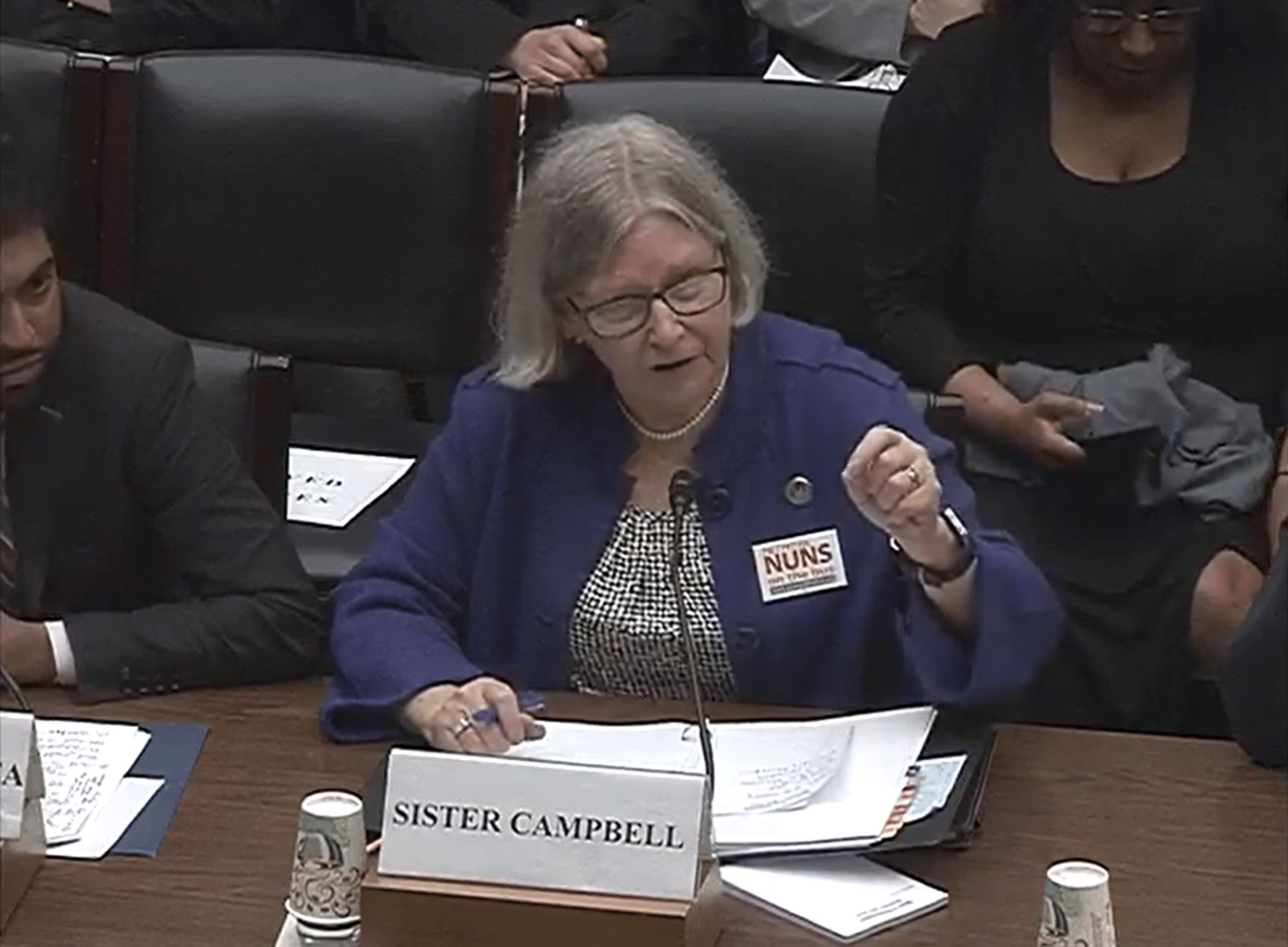
The cost of health care should not be a matter of life or death. But for millions of Americans, the cost of prescription medication forces them to ration their treatment or even go without medication entirely. That fact, which is completely at odds with core principles of fairness and health care as a human right, is why I joined more than 7,000 nuns to speak out against the potential repeal of the Affordable Care Act (ACA), and it’s why I am now calling for Congress to take action to lower drug costs. 

While the ACA has addressed a number of the ways insurance companies reap record profits on the backs of patients, huge pharmaceutical companies continue to control too much of our healthcare system. This goes against our values as Americans — and against Catholic Social Justice. 

Rather than caring for our neighbors, we are seeing the same kind of corporate greed we’ve come to expect from massive health industry companies who routinely pad their profits by putting patients’ lives at risk. This time it’s the giant drug corporations and manufacturers that are making the rules that allow them to set prices as high as the market can bear.  Last year, roughly 28 million Americans saw the costs of their medications rise, while pharmaceutical companies benefited from huge tax breaks and pulled in record profits. 

The numbers are especially stark for Americans with diabetes. Three Pharma giants control the country’s supply of insulin — Novo Nordisk, Eli Lilly and Sanofi — and they are using their power to rake in as much profit as possible, no matter the human cost. Each of them charge at least $270 per-vial for insulin, meaning diabetic patients are often paying $800 or more for their monthly supply of medication. To put this in perspective, that’s three times what patients in countries like Pakistan pay. 

I recently learned the story of Nick, a 68-year-old retiree living with Type 2 Diabetes in Bellingham, Washington, who has started traveling to Canada to buy insulin across the border because his copays kept increasing. He told the Catholic Sisters that I work with that his insulin ultimately cost him $500 out of pocket for a two- or three-month supply. In Canada, he can get the same amount of insulin for $40 out of pocket. 

Over the past 10 years, the cost of insulin has tripled despite no changes to the formula itself. It’s no wonder one in four diabetics report rationing their insulin because they can’t afford the exorbitant cost. Meanwhile Eli Lilly, the nation’s largest insulin producer, continues to reap billions of dollars in revenue. In 2018 alone, Eli Lilly brought in $9 billion in revenue from their diabetes medications but paid $0 in federal taxes thanks to the 2017 GOP tax law.

The greed of these corporations — and of the companies making millions off of essential drugs like those that treat cancer and HIV — is a moral crisis, and we need Congress to pass legislation that puts power back in the hands of the people and patients. 

The Lower Drug Costs Now Act (HR-3) is the first step to stopping drug companies’ from prioritizing their bottom line over our health. The legislation will allow Medicare to directly negotiate hundreds of drug prices, extend those prices to people with private insurance, and hold drug corporations accountable for charging U.S. patients many times more than what people in other countries pay for the same medicine. 

Make no mistake: Big Pharma is fighting tooth and nail against this legislation, lobbying hard to stop lawmakers from supporting it. They are even claiming new drug innovation will be negatively impacted by the bill, when the reality is that most drug research and development is funded directly by taxpayer dollars. In fact of the 210 drugs approved by the FDA for use between 2010 and 2016, all were developed with National Institutes of Health (NIH) publicly funded research. Americans are literally dying because they are unable to afford the drugs that their taxes paid to create.

Industry opposition has nothing to do with concern for patients. Companies like Pfizer and Johnson & Johnson are against this legislation because it will cut into their record profits. Rather than helping the patients he promised to protect, President Trump is pandering to the corporations and protecting the status quo. 

Trump talks a big game when it comes to lowering drug prices, but he’s dragging his feet now that there’s viable legislation to do just that. If the president really wants to help seniors and the millions of Americans struggling to afford their prescriptions, he should tell Senate Majority Leader Mitch McConnell to support HR-3. 

As a Catholic, I believe — I know — we are better off when we take care of each other. We are better off when we recognize that there is more than enough to go around if we share. Everyone deserves access to affordable medicine, and legislation like HR-3 is a big step toward ensuring no one is forced to choose between skipping a prescription and putting food on the table.

Our elected leaders have a moral obligation to take bold action to ensure everyone can access the medicines they need. After all, we are a country founded on principles of ‘We the People,’ not ‘We the Corporations.’ It’s time we started acting like it. 

Sister Simone Campbell is executive director of NETWORK Lobby for Catholic Social Justice. NETWORK is a member of the Lower Drug Prices Now coalition. 

A Report From The Border

A Report from the Border

Ness Perry
December 2, 2019

At the United States Southern Border, refugees, asylum seekers, and migrants are looking for a place to find safety. They are asking one thing of our nation – to accept them with open arms. While this is a basic request, our policies do not represent what our morals say. Our faith teaches us that all immigrants deserve basic human dignity, and that we should love thy neighbor, despite their country of origin. Trump administration programs like the Migrant Protection Protocol puts people in danger in Mexico while they await their asylum and immigration hearings in the United States, thus stripping them of their dignity. To learn more about this specific administration order, watch these interviews where we spoke to two specialists from the field.

Imelda Maynard is the Senior Staff Attorney at Catholic Charities of Southern New Mexico, located in Las Cruces New Mexico. She specializes in immigration and holds her J.D. from The University of Oklahoma.

Dr. Alejandro Olayo-Méndez, S.J. is an Assistant Professor at the School of Social Work where he works on issues surrounding humanitarian aid and migration processes.

Follow @NETWORKlobby on twitter for more updates about MPP and other immigration policies

The Supreme Court Holds Lives of Millions in Their Hands

The Supreme Court Holds Lives of Millions in Their Hands

Joan Neal
November 26, 2019

As the Supreme Court deliberates the fate of more than a million young undocumented immigrants who arrived or were brought to this country as children, it is important to be clear about their real identity and history. Contrary to the prevailing rhetoric in some corners of our country, recipients of the Deferred Action for Childhood Arrivals (DACA) status, are educated, hardworking, upstanding, tax paying, individuals who are American in every way except legal citizen status.

The Center for Migration Studies, a research and think tank organization headquartered in New York, has just released a comprehensive statistical study of this group of more than 1 million people. The report also documents the many ways in which these young immigrants have and continue to contribute to the United States, which for most of them is the only country they have ever known.

CMS’ timely report shows how deeply DACA recipients are embedded in society and the web of ties that bind them to their communities and country. It shows how they are spread out across the United States, how educated they are as compared to the general population, and how extensively they participate in the U.S. labor market. Perhaps some readers will be surprised by these findings. Some may even ignore them, or worse yet, refuse to believe them. But facts are facts, and CMS’ research is comprehensive and verifiable. The report clearly shows that, over time, these undocumented immigrants have made our country stronger, more diverse, and more economically productive. Rather than being a drag on our country, DACA recipients as a group have contributed significantly to American society and prosperity.

It is imperative, therefore, that the Supreme Court avail itself of all of the relevant facts surrounding DACA recipients and those who would be eligible if the program were still in force. And so should we. Read the report at https://cmsny.org/publications/daca-supreme-court-alulema-111119/. Then pass it on. The lives of millions of people, indeed the future of our country, depends on what we do next.

NETWORK FY 2020 Appropriations Updates

NETWORK FY 2020 Appropriations Updates

Appropriations Bill
House
Senate
Subcommittee Committee Floor Subcommittee Committee Floor    Reconciled?
Labor-HHS-Education (H.R.2740) Passed
(April 30)
Passed
(May 8)
Passed
(June 19)
Transportation-HUD (H.R.3163) Passed
(May 23)
Passed
(June 4)
Passed
(June 25)
Passed
(September 17)
Passed
(September 19)
Passed
(October 31)
Commerce-Justice-Science (H.R.3055) Passed
(May 17)
Passed
(May 22)
Passed
(June 25)
Passed
(September 24)
Passed
(September 26)
Passed (October 31)
Financial Services Passed
(June 3)
Passed
(June 11)
Passed
(June 26)
Passed
(September 17)
Passed
(September 19)
Department of Homeland Security Passed
(June 5)
Passed
(June 11)
Passed
(September 24)
Passed
(September 26)

Friday, November 22, 2019

Yesterday, President Trump signed a short-term funding bill into law, temporarily preventing a government shutdown. This Continuing Resolution (CR) funds the government until December 20, 2019. Before then, the House and the Senate need to reach agreement on funding the government for Fiscal Year 2020, which they have yet to do, or risk a shutdown. We are disappointed our elected officials still have not found a way to pass a full year budget that promotes the common good, nearly two months into this fiscal year.

There is good news, however, in funding for the 2020 Census. In the CR, the 2020 Census received a special funding boost of $7.3 billion to prepare for the upcoming national count. This amount is $2 billion more than the insufficient funding President Trump’s budget would have allocated to the Census and will allow the Census Bureau to adequately plan and put plans in motion for the upcoming Census.

Tuesday, November 12, 2019

On October 31, 2019, the Senate passed its first “minibus” or package of four appropriations bills, which included funding for Transportation-Housing and Urban Development as well as Commerce, Justice, and Science. The bill passed out of the Senate by a vote of 84-9. In the four-bill package, the Senate included $6.7 billion for funding the 2020 Census, which is $1.37 billion above the president’s budget but $804 million lower than the House approved level. The minibus bill also included an increase of $1.37 billion for affordable housing programs, which is $6.352 billion above the president’s budget but $941 million lower than the House approved version.

We are deeply concerned that the uncertainty around the FY 2020 appropriations cycle will cause undue hardship on census activities and more than 80 safety net programs. Particularly, the 2020 Census is at-risk to be woefully ineffective if lawmakers fail to negotiate a final agreement on spending allocations by the November 21 deadline. Currently, lawmakers are negotiating details of another continuing resolution that will extend funding through December 13 or 31.

To that end, NETWORK urges the Senate to Prioritize our Democracy: fund the 2020 Census, do not short change human needs programs for the border wall, and extend expiring health care programs. These programs serve the common good and provide critical support to communities; continued funding lapses will have devastating rippling effects.

Tuesday, July 23, 2019

Yesterday, Congress and the Trump administration reached agreement on a 2-year budget deal to raise our nation’s spending limit. The main points of debate were the Trump administration’s desire for significant spending cuts, and Congressional Democrats’ desire to curb the administration’s ability to transfer federal funds to finance the construction of a border wall.

This deal would raise spending by $320 billion over existing caps and raise the debt limit to allow the government to keep borrowing money. Spending on domestic and military programs would both increase, a key demand of House Speaker Nancy Pelosi and Senate Minority Leader Chuck Schumer. This increase is offset by $77.4 billion in spending cuts, half the $150 billion in cuts the White House initially demanded. By lifting spending caps for the next two years, this deal will effectively dissolve the “sequester” imposed by the 2011 Budget Control Act (BCA) which was written to take effect through 2021. This is a huge relief, as NETWORK and partners have been fighting sequestration that leads to cuts to human needs programs every year since the BCA was passed.

Now that the budget deal is agreed upon, the House of Representatives needs to act quickly and pass the budget bill before they leave for August recess next week. The Senate has been waiting for a budget deal before beginning its appropriations work, so we may see the Senate appropriations bills beginning to take shape soon.

Wednesday, June 26, 2019

The House passed the Fiscal Year 2020 Financial Services and General Government appropriations bill on a 224 to 196 vote. In total, the bill includes $24.55 billion in discretionary funding, an increase of $1.4 billion over the 2019 enacted level and $355.5 million over the President’s 2020 budget request. Additionally, the bill includes a provision to increase Federal civilian pay by 3.1% in 2020.

Tuesday, June 25, 2019

Today, the House passed its second “minibus” or package of spending bills, this time including funding for Transportation-Housing and Urban Development as well as Commerce, Justice, and Science. In the $383 billion five-bill package, the House included language to block a citizenship question on the 2020 Census and bar the Department of Justice from using federal funds to dismantle Obamacare in the courts. The final vote was 227-194.

Before the vote, NETWORK sent the a vote recommendation to the House in support of the funding package. Read the vote recommendation here.

Thursday, June 20, 2019

Today, the House began consideration on another package of spending bills, this time including Transportation-Housing and Urban Development as well as Commerce, Justice, and Science appropriations. The House is expected to vote on this package tomorrow. These appropriations bills are critical to provide funding to housing programs serving millions of families and the Census Bureau to execute a fair and accurate census.

Wednesday, June 19, 2019

Tonight, the House of Representatives voted 226 – 203 to pass a package of four appropriations bills, including Labor-HHS-Education appropriations. These appropriations would provide critical funding for the Office of Refugee and Resettlement and support for children at the Southern Border. We encourage the Senate to pass similar appropriations to care for vulnerable children and families at the border.

Before the vote, NETWORK released a statement encouraging members of the House to vote yes on the package. Read NETWORK’s statement of support here.

Thursday, June 13, 2019

Right now, Congress is working on federal budget appropriations for the upcoming Fiscal Year 2020 (FY2020). This process is critical because the result determines how much funding federal programs that mend the gaps receive for the following year.

Appropriations Background

Members of Congress decide our nation’s federal budget every year through a process of writing 12 different appropriations (or spending) bills before the annual fiscal deadline of September 30. The process begins in the House after the President submits a budget proposal to Congress for consideration (which is usually rejected all or in part by Congress). House and Senate Appropriations Committees draft and modify spending bills through a series of committee votes before advancing the bills to the full House or Senate for another round of votes.  Typically, the House and Senate bills are not identical and thus must be reconciled before sending a final bill to the President for enactment.

However, in recent years due to partisan politics over spending allocations, many of the spending measures bypass floor debate after committee action and are instead consolidated into an omnibus or minibus spending bill.  Above, you can see the progress of the bills that include NETWORK priorities.

This year, the appropriations process has added uncertainty because there has not been any agreement between the House and the Senate on overall funding levels. This sets up a future showdown with Senate Majority Leader Mitch McConnell (R-KY) and President Trump on one side and House Speaker Nancy Pelosi (D-CA) and Senate Minority Leader Chuck Schumer (D-NY) on the other; likely coming down to the amount of funding President Trump wants to build a wall on the U.S.-Mexico border or other controversial issues.

House Appropriations State of Play

So far, the House Appropriations Committee has passed 10 of the 12 appropriations bills. These 10 bills are now ready for votes on the House floor. The committee expects to complete their work on all 12 appropriations bills this week. Democratic leaders want to pass all the appropriations bills on the House floor by the end of June to allow time for negotiations with the Senate before the new fiscal year begins on Oct. 1.

They plan to do this by first passing a package of five bills (totaling nearly $1 trillion in spending), which they began considering this week. Passing this package of bills could take several days. The package includes the two biggest appropriations bills: Defense (HR 2968) and Labor-Health and Human Services- Education (HR 2740) as well as the Energy-Water (HR 2960), State-Foreign Operations (HR 2839) and Legislative Branch (HR 2779) bills. After this five-bill package, House Democrats plan to combine the remaining seven bills into additional packages.

Homeland Security and Financial Services appropriations bills will be taken up by the House full appropriations committee this week. NETWORK is following Homeland Security appropriations closely and calls on appropriators to reduce funding for deportation, immigrant detention, and border militarization and instead to prioritize alternatives to detention, implement robust Congressional oversight over Homeland Security practices, and support refugee resettlement and asylum seekers.

Another NETWORK funding priority is Commerce, Justice and Science (CJS) appropriations. This bill, as it emerged from the House Appropriations Committee included $7.5 billion in new funding for the 2020 Census, as well as a restriction against using the Census appropriations to fund a citizenship question on the Census questionnaire. The House CJS appropriations bill also restricted funds from being used to be used to hire more immigration judges, and instead would establish a pilot legal advocacy program for nonprofit organizations to provide legal representation to immigrants seeking asylum and other forms of legal protection in the United States.

Of course, federal housing programs, which are included in the Transportation, Housing, and Urban Development (T-HUD) appropriations bill, are a NETWORK focus. While President Trump’s budget proposed cutting Housing and Urban Development funding by $9.6 billion, the House Appropriations Committee’s bill provides a total of $50.1 billion for HUD, an additional $5.9 billion over the FY19 funding.

Senate Appropriations State of Play

Appropriators in the Senate have held off working on any of their bills so far. They are waiting while talks proceed on a budget deal to set overall spending levels.

On Tuesday, June 11, Senate Majority Leader Mitch McConnell (R-KY), Senate Appropriations Chairman Richard Shelby (R-AL) and other Republican appropriators met with acting White House chief of staff Mick Mulvaney, Treasury Secretary Steven Mnuchin and acting Director of the Office of Management and Budget Russ Vought. They discussed making a budget deal with Democrats to avoid a government shutdown or automatic spending cuts in October, and have agreed to proceed with bringing the President’s $4.5 billion southern border humanitarian aid package to the floor next week.