

Category Archives: Front Page

Walking and Praying for an End to Immigrant Detention

Walking and Praying for an End to Immigrant Detention

Vince Herberholt
September 13, 2018

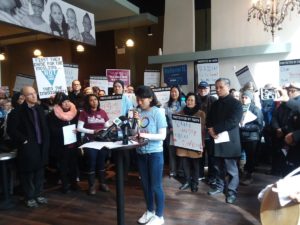
St. Joseph Parish in Seattle embarked on a journey almost a year ago that recently resulted in a prayer pilgrimage and Mass at the GEO run Northwest Detention Center in Tacoma Washington – a destination 30 minutes away by bus and light years away from where we come from as a faith community.

St. Joseph is a wealthy Jesuit parish in the Capitol Hill neighborhood of Seattle.  The houses that surround the parish sell for millions of dollars.  Very few of our members would be considered poor or marginalized and almost no one would be considered “illegal” or more correctly undocumented.  And yet a year ago, our parish, known for its commitment to social justice,  started a journey of education and  solidarity with  the immigrant, refugee, asylum seeker and those detained in Immigration Prison.

After some preliminary research and assessment, we discerned that the greatest need, our interest and gifts as a faith community lie with public witness and advocacy.  So beginning in March 2018 we published a Parish Letter, “A Church of Accompaniment,” that serves as our Mission Statement.  From there we organized 2 community forums on Immigration and detention attended by over 300 people.  In the second forum we were joined by our Congresswoman Pramila Jayapal, our representative who is a staunch advocate for immigrant justice.

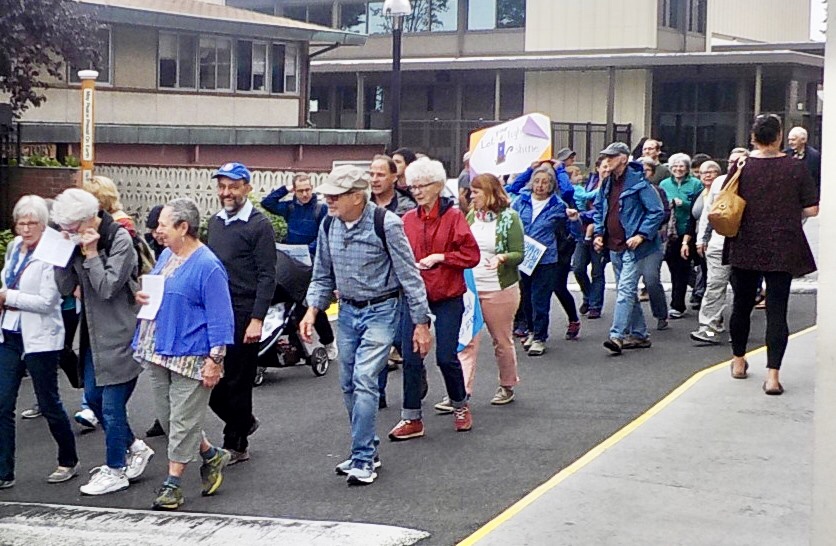
Now with growing parish support, we began planning with our Jesuit Sister Parish, St. Leo the Great, for a pilgrimage and Mass at the Northwest Detention Center in Tacoma.  On August 25th we gathered at St. Leo’s and began our prayerful 1.6 mile walk to the detention center in a bleak industrial area near the Port of Tacoma.  We were surprised and pleased that over 500 faithful people joined us.

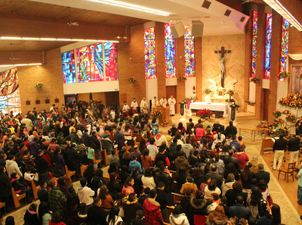
The Mass was co-presided by our two pastors, Frs. John Whitney SJ and Matt Holland SJ, and the homily was delivered by Fr. Scott Santarosa SJ, the provincial of the Jesuit West Province.  His words exhorted us to “bridge all divides, and foster understanding among diverse peoples and cultures, and make people feel in the most real way at home.”

At the conclusion of the Mass we blessed the detainees and their captors.  It was a hopeful day that renewed our energy for the continuing journey and cemented our relationship with immigrants and refugees.

To learn more about St. Joseph Parish, visit their website here

Progress from Congress on Appropriations

Progress from Congress on Appropriations

Tralonne Shorter
September 12, 2018

This summer, Congress made extraordinary progress toward completing the requisite 12 spending measures for upcoming fiscal year (FY) 2019. To date, the Senate has passed nine spending bills, while the House has passed six. Lawmakers have until September 30 to finalize spending bills or extend funding at current levels through a continuing resolution (CR).  Efforts are underway to bundle nine* out of 12 spending measures into three packages by September 30 and put the remaining three** bills into a CR, averting a government shutdown.

One reason for the Senate’s remarkable pace on appropriations is President Trump’s vow to not sign another omnibus spending bill.  To achieve this progress, the Senate uncharacteristically spent part of August in session.  Another reason is a bipartisan agreement between Appropriations committee Chairman Richard Shelby (R-AL) and Vice Chairman Patrick Leahy (D-VT) not to pack spending bills with controversial provisions that would weaken bipartisan support.

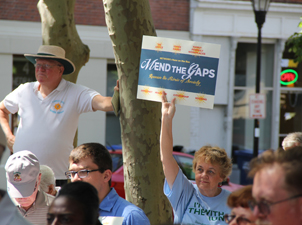
NETWORK continues to lead lobby efforts supporting our Mend the Gap priorities.  These include:  humane border enforcement that promotes family unity and funding increases for affordable housing, workforce development, job training, child welfare and health care.  In addition, NETWORK will continue to oppose efforts to defund the Affordable Care Act.

Immigration

Unsurprisingly, the Trump Administration’s “Zero Tolerance” immigration policy dominated the appropriations debate and faced strong opposition across party lines in both chambers.  NETWORK joined pro-immigration advocates in garnering support for more than 12 amendments to the Homeland Security bill that adds report language that clamps down on family separation with better oversight and accountability standards for ICE detention centers.  Additionally, we successfully lobbied for more funding to support alternatives to detention, family case management services, and mental health screening of unaccompanied minor children crossing the Southern border. However, a major disappointment by House Appropriators includes the reversal of the Flores Settlement, a 1997 agreement drafted by the ACLU which set a 20-day limit for family detention and governs the conditions of detention for children, including that facilities be safe, sanitary, and age appropriate.    If enacted this would allow immigrant families to be indefinitely detained in facilities with harsh conditions not supported by Flores.  Thankfully, the Senate approved LHHSED Appropriations bill leaves the Flores settlement agreement intact and the House language is not likely to be part of the final bill.

As for immigration enforcement spending contained in the Homeland Security Appropriations bill, the House Appropriations Committee approved $7 billion more than the Senate for Immigrations and Customs Enforcement (ICE), Customs and Border Patrol (CBP) and the Southwest Border Wall.  Other areas of concern include, a 10 percent increase in detention beds, as well as funding to hire almost 800 more border and customs agents/officers.

NETWORK will continue to push back on efforts to separate families or that would undermine humane border enforcement as negotiations gain momentum post the mid-term elections.

Supplemental Nutrition Assistance Program (SNAP)

The current Farm Bill is set to expire on September 30, unless Congress passes the next Farm Bill before then or extends the current reauthorization.  Regardless of when Congress finalizes the next Farm Bill, funding for SNAP will not lapse as the government is statutorily required to continue funding the program subject to participation demands.  Since 2015, SNAP enrollment has declined by more than 4.7 million people resulting in a $73 billion automatic appropriation for FY 2019.  This is $794 million less than FY 2018 and a 10 percent reduction since FY 2015.

Census

House appropriators gave a big boost to the Census Bureau in the FY 2019 Commerce, Justice, Science Appropriations (CJS) bill, approving nearly $1 billion more for the agency than the Senate. However, it is unclear how much of the $4.8 billion for the agency will be allocated for the 2020 Decennial.  Conversely, the Senate appropriators (under new leadership) appears to have taken a more conservative approach and adopted the President’s FY 2019 budget request to fund the 2020 Decennial at $3.015 billion.  This is drastically different from NETWORK’s request of $3.928 billion minimum baseline.

Besides census activities, the CJS bill also funds immigration related law enforcement and adjudication efforts within the Department of Justice.  Regrettably, the House Committee bill, fails to fully protect immigrant families and includes increased funding for immigrant-related law enforcement efforts.  Congress is not expected to finalize the CJS bill until sometime after the mid-term elections.  NETWORK will continue to call on our supporters to push for the higher number for the 2020 Census contained in the House bill.

Housing

Funding for housing programs fared better in the Senate.  The Senate approved a $12 billion increase above the President’s FY 2019 budget request−and is $1 billion above the House bill.  Housing programs help nearly 5 million vulnerable families and individuals.  This includes:  $22.8 billion for tenant-based Section 8 vouchers; $7.5 billion for public housing; $11.7 billion for project-based Section 8; $678 million for Housing for the Elderly; and $154 million for Housing for Persons with Disabilities.  Both committee bills reject the Administration’s rent reform proposal, and reinstate funding for the Community Development Block Grant (CDBG) and HOME Investment Partnerships programs, which were eliminated in the President’s FY 2019 budget request.  However, the House reduces spending for the HOME program by 12 percent.

NETWORK will continue to advocate for increased funding for affordable housing programs.

Children and Human Needs

The LHHSEd Appropriations bill funds popular safety net programs, like Medicare and Medicaid operations, home energy assistance, Head Start and the Child Care Development Block Grant.  It is the 2nd largest spending bill, after defense and comprises about 63 percent of total discretionary spending.  The House and Senate bills are slightly different—overall the Senate bill is better because it has a higher spending allocation and contains no poison pill riders unlike the House.

Unfortunately, the Affordable Care Act continues to be attacked by Republican lawmakers.  Both the House and Senate bills reduce access to affordable health care by cutting funding for the Centers for Medicare and Medicaid Services (CMS) operating budget by nearly half a billion dollars.  According to the House Committee report, Democrats view defunding CMS as “a misguided attempt to sabotage the Affordable Care Act’s health insurance marketplace.” If enacted this cut would significantly impact Medicare as it subject to mandatory 2 percent sequestration cut pursuant to the Balance Control Act of 2011 (P.L. 112-25).

NETWORK will continue to call on our supporters to push back against efforts to defund the Affordable Care Act.


* Agriculture; Defense; Energy and Water; Financial Services; Interior; Labor-Health and Human Services-Education; Legislative Branch; Military Construction and Veterans Affairs; Transportation and Housing and Urban Development.

**Commerce, Justice, Science; Foreign Operations; and Homeland Security.

Nuns on the Bus Getting Back on the Road

Nuns on the Bus Getting Back on the Road

August 20, 2018

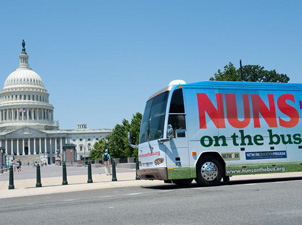
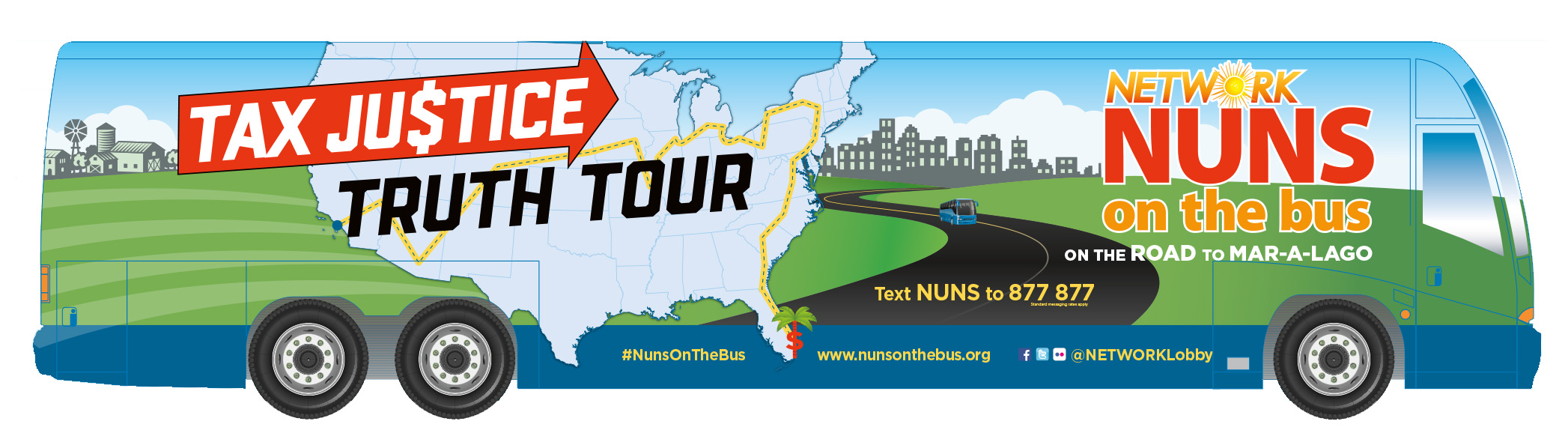
The Nuns on the Bus are going back on the road – this time driving across the country from California to Mar-a-Lago! We’ll be exposing the lies and telling the truth about the harmful effects of the 2017 tax law at every stop along the way.

We will hold members of Congress accountable for their votes in favor of this disastrous tax law. Those votes, as Sister Simone said, made it “crystal-clear who the Republican Members of Congress serve, and it is not the men, women, and children who Jesus championed.” Join us on the bus!

See our route and RSVP for events in your state: www.nunsonthebus.org/events

Guest Blog: Celebrating Our Dreams, Our Families in the Face of Threats to Family Reunification

Celebrating Our Dreams, Our Families in the Face of Threats to Family Reunification

Sam Yu
August 31, 2018

In February, the Senate voted on four different immigration bills for our undocumented young people. They all included plans to cut family-based immigration and they all failed to pass. Moreover, the Trump administration was doubling down on using harmful rhetoric around “chain migration” in order to further alienate and dehumanize communities whose families benefit from family-based sponsorship.

An overwhelming majority of Asian Americans come to the U.S. through the family-based sponsorship, meaning that any cuts directly impact our community. Forcing immigrant youth to choose between their futures and their families is pure blackmail and intolerable.

In order to spark dialogue and fight back against the harmful “chain migration” rhetoric, NAKASEC and affiliates launched the Our Dreams, Our Families” campaign. During February and March, we shared stories of impacted folks from our community whose families have benefited or will benefit from family-based sponsorship. All of the stories can be found at www.nakasec.org/ourdreamsourfamilies.

In one of our stories, Esther, our DACAmented young leader, explained how “it infuriated [her] that members of Congress, even our so called ‘allies,’ would think that [she] would ever want a pathway to citizenship that would prevent [her] from sponsoring [her] own parents… Our parents made us who we are today, our parents are the original Dreamers, and when you celebrate the achievements of Dreamers like [her], you are celebra

ting the achievements of not just our parents but our friends and our communities.”

Esther’s story and her declaration that her mother deserves to stay too captures the essence of the “Our Dreams, Our Families” campaign. We are asking Congress to value our families, protect family-based sponsorship, and fully understand that we cannot support undocumented young people without also supporting their families. Families are a cornerstone of American values and they deserve to stay together!

Sam Yu is the Communications Coordinator at NAKASEC. NAKASEC organizes Korean and Asian Americans to achieve social, economic, and racial justice. Learn more at www.nakasec.org

Originally published in Connection Magazine. Read the full issue here.

Getting to Know Younger Sisters in Their Own Words

Getting to Know Younger Sisters in Their Own Words

Sister Susan Francois, CSJP and Meg Olson
August, 28 2018

In Our Own Words: Religious Life in a Changing World is a collection of essays written by 13 younger women religious about the issues central to religious life today, ranging from vows and community life to ministries and leadership. The book was written over 4 months, with the authors meeting over video chat, forming a community, and writing on their own. Then, they came together for a week-long retreat where they work-shopped their essays.

I had the opportunity to attend a book reading and panel discussion moderated by one of the editors, Juliet Mousseau, RMCJ, and featuring four of the contributing authors, including a member of our 2016 Nuns on the Bus trip, Susan Rose Francois, CSJP. I was so moved and curious about the writing process that I needed to ask Susan a few more questions!

Meg: Why did you decide to say “yes” to the editors Juliet Mousseau and Sarah Kohles and participate in this writing project?

Susan: For years, I had been saying that it was up to us, the newer generation, to write the next chapter of religious life, literally write it.  So much of recent writing about religious life explores the life in relation to the changes after Vatican II, or as Juliet says, in relation to what it is not.  For those of us born years or even decades after Vatican II, it felt like we needed an updated take on the core issues of our life, such as vows, charism and mission, community, and leadership.  In the end, since I had been encouraging others to write, when Juliet and Sarah invited me to participate, I felt had to say yes.

Meg: Tell us about your chapter, “Religious Life in a Time of Fog.”

Susan: The title was inspired by Sister Nancy Farrell, OSF who spoke at the Leadership Conference of Women Religious (LCWR) assembly a few years ago about our time in history and in religious life.  She talked about this time as one where breakdown and breakthrough tussle with one another and the path forward is hidden in fog.  It certainly feels like that in the civic space these days, but also in religious life.  We keep saying that things will look different in the future, but I want to know how we get there. So, I look at the tremendous needs of the world at this time for things like peace, mercy, charity, and justice.  How are Catholic sisters being called to respond in this time of fog?  I believe that we are being called to de-commission the large-scale structures of religious life, both physical structures, but also how we organize our lives together, and recommission ourselves as critical yeast in a world yearning for our charism, witness, and presence.

Meg: What did you learn about women religious during this project? Did anything surprise you?

Susan: We had a lot of fun together. We shared deeply and found common ground so quickly, even though some of us had never even met.  We love our sisters in community and believe in the future of religious life. If anything surprised me, I guess it was the realization that what we hold in common as women of the Gospel is so much bigger than any differences, whether it be cultural or whether our community members wear a habit. No matter our congregation or leadership conference, we are sisters.

Meg: What is something that the NETWORK community should understand about this new generation of sisters under 50?

Susan: Collaboration and networking come natural to us.  Because there are fewer of us in individual congregations, we have been building peer relationships across congregational lines since the very beginning of our religious lives.  We also build networks outside of religious life, through our ministries, advocacy, and other connections. I think this experience will serve religious life, advocacy work, and the church well into the future.

Order the book at: https://litpress.org/Products/4520/In-Our-Own-Words

Susan Rose Francois is a member of the Congregation Leadership Team for the Sisters of St. Joseph of Peace.  She was a Bernardin scholar at Catholic Theological Union and a Nun on the Bus in 2016.  She has ministered as a justice educator and advocate. Follow her on Twitter at @susanfrancois.

Meg Olson is NETWORK’s Grassroots Mobilization Manager.

Originally published in Connection Magazine. Read the full issue here.

Guest Blog: Living out Our Hope That All May Be One

Living out Our Hope That All May Be One

Father Jim F. Callahan
August 24, 2018

Worthington, Minnesota is a community of 13,000 people, located in the Southwest corner of the state. It is a diverse community with 64 nationalities, living, working and worshipping together. The Latino population comprises the largest immigrant community. Seventy-five percent of our public school children speak Spanish as their first language. Most members of our immigrant communities come without documentation.

People often wonder how Worthington has the second largest immigrant community in the state. What draws immigrants here are the meat packing plants in the city and surrounding communities as well as the numerous farms throughout the region.

The challenges facing the immigrant communities in Worthington are racism, prejudice, and discrimination. Lack of affordable housing, medical, and dental care are also challenges that the community faces. As a result of the need for medical care, we established the Our Lady of Guadalupe Free Clinic, and later, the Our Lady of Guadalupe Free Dental Clinic. Anyone without insurance is welcome. We became a 501(c)(3) four years ago, and have seen over 1200 patients.

The Parish of St. Mary is a church of hospitality. Our primary objective is to make the parish a welcoming and safe haven for all people. After the election of Donald Trump, fear seized our community. We announced to the parish we would do everything possible to help and protect our people. The staff prayed and studied what would be the most Gospel-based response to this crisis. Already we were experiencing families being torn apart by deportation and mothers separated from their children. So we unanimously decided that we had to become a Sanctuary Church. Since our declaration of becoming a Sanctuary Church, we have received support from the diocese and individuals and faith communities around the state.

We believe Sanctuary has biblical roots and we have mandate to proclaim justice for all people, regardless of race, creed, or color.

We work closely with the Immigrant Law Center based in St. Paul. We established a steering committee made up of immigrants and community leaders and the church sponsors programs, workshops, and listening sessions related to topics which affect the community. As a Catholic Faith Community whose foundation is the Eucharist, we have an obligation to live out the pillars of Catholic Social Teaching, living out the Corporal and Spiritual Works of Mercy.

St. Mary’s Parish prays for comprehensive immigration reform and for the end of this reign of terror, where families will no longer hide in the shadows, where families will no longer be separated or children taken from their parents because of the color of their skin, the language they speak, or who they call God.

Our prayer is as a Nation, as a Church, as a People, that one day all may be one.


Father Jim F. Callahan is Pastor of St. Mary’s Parish in Worthington, MN.

Originally published in Connection Magazine. Read the full issue here.

Sister Kathy Flynn: Don’t Assume the Poor and Hungry Aren’t Working

Don’t Assume the Poor and Hungry Aren’t Working

Sister Kathy Flynn
August 19, 2018

I’m a native Iowan and a Catholic Dominican Sister. I minister at Opening Doors, a program in Dubuque that welcomes women who experience homelessness and who seek our help as they rebuild their lives.

We work with them to find employment, pursue educational goals, and develop other life skills.

The women I work with can’t become self-sufficient if access to food is taken away from them and their children. That is why I am urging U.S. Sen. Joni Ernst to reject the House version of the Farm Bill, which cuts access to nutritional food.

In September 2018, the Farm Bill, which funds Supplemental Nutrition Assistance Program (SNAP), expires and will need to be reauthorized. Both the House and Senate have created new versions of the Farm Bill, and now they have to reconcile them.

While the partisan House bill hurts families by cutting SNAP, the bipartisan Senate bill keeps SNAP safe and ensures that the women I work with will be able to eat and feed their children.

Sen. Ernst was appointed as one of a small number of Senate conferees on the bill, and she has the power and responsibility to make sure the Senate provisions in the nutrition title are upheld.

I see the “on-the-ground” ramifications of our food policies every day. I see women who desperately want to provide nourishing, healthy meals to their children but often can’t, due to limited resources or other barriers.

I see women without transportation or child care walking a mile to a grocery store and back, or taking an hour-long bus trip with children in tow. Being poor and without resources is simply exhausting!

It is a myth that people in poverty do not work. The vast majority of women who move through transitional housing live at or below the federal poverty threshold and are working — sometimes at two jobs while raising children — consistently trying to overcome barriers that are invisible to many of us.

Low unemployment rates mask the reality that most of the jobs available are low-wage and unpredictable. More than two in five Iowa households receiving SNAP include children. Options for child care and transportation are limited at best. Healing from trauma takes a lot of energy.

Sen. Ernst said the Senate Farm Bill lacked harsh work requirements and “missed an opportunity to help able-bodied SNAP recipients rise up out of poverty.”

Senator, you are wrong.

Most SNAP recipients who can work, already do work. In Iowa, 84 percent of SNAP families have at least one working member. If the 2018 Farm Bill makes it harder for people to eat, it certainly isn’t providing opportunities.

Expanding work requirements and adding unnecessary burdens to access nutrition assistance means more discouraging red tape for millions of Americans already struggling to get by. Insecurity and hardship takes a toll.

These are some of the most resilient people I have been blessed to know, but they deserve help to not go hungry.

The Dominicans are a mendicant order, meaning that for over 800 years we’ve begged — particularly when a just cause is at stake. And so I’m begging Sen. Ernst for a Farm Bill that does not make hunger and poverty worse in this country. Please look to the Senate’s version of the Farm Bill as the right path forward.

The author is a Dominican Sister of Sinsinawa, Wis., who is an education/employment case manager at Opening Doors in Dubuque, which ministers to women experiencing homelessness.


Sister Kathy Flynn’s Op-Ed was originally published in the Telegraph Herald. View the original here.

Faces of our Spirit-Filled Network: Jessica Pauly

Faces of our Spirit-Filled Network:
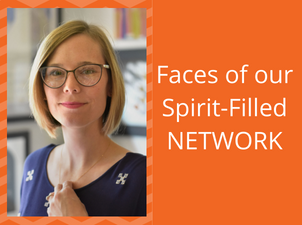
Dr. Jessica Pauly

August 22, 2018

How did you first learn about NETWORK?

I learned about NETWORK via Nuns on the Bus. In 2014, I was at a feminist organizational communication conference and Nuns on the Bus came up in conversation. It didn’t take long before I was reading anything and everything about NETWORK’s contributions.

You recently wrote a dissertation in which you recognized NETWORK as a “unique organizational site operating at the intersection of religion, politics, and authority.” Can you tell us a little more about this project and what inspired you to include NETWORK in your research?
My dissertation research on NETWORK considered how an organized group of (mostly) women deal with organizational tensions experienced with the all-male hierarchy of the Roman Catholic Church. I was particularly interested in the 2012 Vatican censure of U.S. women religious. It was a trying time for many women religious, and NETWORK, too. But NETWORK persevered, and continues to focus on shaping politics to better recognize and support the dignity and respect all people deserve. In the end, I see NETWORK representing a beautiful side of the Roman Catholic Church that ought to be seen, supported, and celebrated more often.

How has your combined research on women religious, the Catholic Church, and political action shaped your view of the world?

I have a sense of conviction that was previously lost on me. My research (i.e., reading about NETWORK’s history, interviewing staff and sisters, being Nuns on the Bus groupie) has opened my eyes to Christ’s calling for me, and us all, as Catholics. I am reminded that we are called to do more than pray; we are called to do all that we can to love one another, here and now. Engaging politics (e.g., being educated and informed about local and national politics, voting, supporting qualified individuals) is an excellent way to live out our faith.

How does your faith inspire you to work for justice?

I am inspired in reading about Jesus’s life and times from the Gospels. Jesus was with the people—he walked with those suffering and in need. He made himself uncomfortable so that other’s might be comforted. I am inspired to follow in His footsteps by recognizing my privileges, my comforts, my abilities, etc., and using them to support others—to love others.

Who is your role model?

Many people come to mind, but recently I have been especially inspired by two women who are active on social media as a means of inspiring other Catholic women: Clair Swinarski (of the Catholic Feminist podcast) and Kristin (of @onehailmaryatatime on Instagram). I look up to these women for their unwavering faith and bold commitment to live and share it so openly with others.

Is there any quote that motivates or nourishes you that you would like to share?

I recently came across a quote by the Venerable Fulton Sheen that nourishes my soul and reminds me that we, collectively, are truly the Church: “Who is going to save our Church? Do not look to the priests. Do not look to the bishops. It’s up to you, the laity, to remind our priests to be priests and our bishops to be bishops.” Jesus calls us, each and every one.

What social movement has inspired you?

I am inspired by many social movements, and relish opportunities to learn and read more about each and every one of them. That being said, most recently I am struck by the women’s movement, generally. A few news sites have suggested 2018 will be the year of the woman, and we are already seeing a record number of women running for office. Seeing women of all ages come together in the name of women and our social, economic, and spiritual power is astounding and makes me feel so proud to be a woman in this day and age.

What are you looking forward to working on in the coming year?

Inspired by my dissertation research, I am working on a book proposal with a colleague of mine focusing on the untold stories and lived realities of America’s Catholic nuns. In 1966, there were over 150,000 Catholic nuns in the United States, whereas today there are less than 50,000. We are interested in sharing and celebrating the unique and honorable lives our American Catholic nuns have lead, before it is too late.

We Cannot Allow This Cruelty in Our Country

We Cannot Allow This Cruelty in Our Country

Fighting Immoral Policies Tearing Families Apart at the Border

U.S. Representative Pramila Jayapal
August 17, 2018

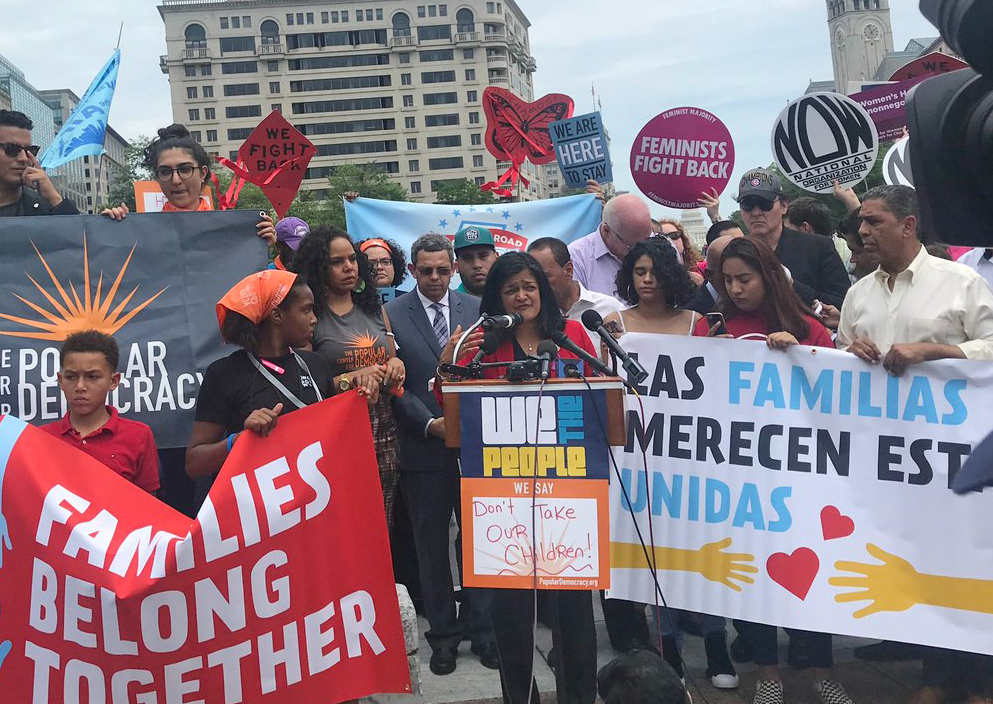
Our nation is in crisis. The words on the Statue of Liberty—”Give me your tired, your poor, your huddled masses yearning to breathe free”—seem far away as families on the border are separated as a result of President Donald Trump’s inhumane and cruel “zero tolerance” policy.  The policy has resulted in thousands of children being placed in tent cities, shelters, and foster homes across the nation, with no plan to reunite them with their parents.

Two weeks ago, I spoke with 174 women who were, at the administration’s orders, transferred thousands of miles from the southern border to a federal prison just outside Seattle. Most of these women were asylum-seekers, fleeing rape, violence, and persecution. The majority had been held in various facilities for over two weeks, many for over a month.

The mothers had been separated from their children at the border, and not a single one had spoken to their children since then. All but two of the mothers did not even know where their children were. They wept as they told me that they had been “deceived” by agents who told them to just leave the room for a minute to take a picture or see a judge, and when they returned, their children were gone. They didn’t even have a chance to say goodbye.

The women I spoke to had already made heartbreaking choices in deciding to come to the United States. One woman told me that her oldest child was shot killed by gangs, her second shot and paralyzed, and that she had to leave that paralyzed child in order to try and save her third child. She had been separated from that last child at the border and had not seen him in a month. Another woman traveled to the border with one child, leaving another child who was blind behind because she knew he could not make the difficult journey.

I am an immigrant and a mother, and what I heard breaks my heart.

We must demand that Trump fix the crisis he created, and reject his false claims that he has taken any action to do that. The executive order he signed does not reverse his zero-tolerance policy that created these abuses and violations; instead, it allows for the indefinite detention of children and their parents in family prison camps. His administration has challenged a previous court settlement that clearly states that children cannot be detained for more than 20 days. That means that, very soon, either he is going to separate families again or he is going to defy that court order and continue to detain children illegally. Does anyone seriously believe that incarcerating children is a solution to the crisis the president has created?

On top of that, the administration has no plans to reunite the thousands of children who have already been separated.

We cannot stand for this. As one of only a dozen members of Congress born outside of the United States, I began my organizing in the wake of 9-11, forming Washington’s largest immigrant advocacy organization to combat the abuses at the time against Sikhs, Muslims, Arabs, and immigrants. I saw then that strength emerges in times of crisis and that is what we must focus on building all over again today. That’s why I’m calling on Trump to overturn his zero-tolerance policy, reunite families, and release them from their prisons.

This isn’t about politics—it’s about right and wrong. We have to stand up for America.

Representative Pramila Jayapal represents the state of Washington’s seventh district. The first Indian-American woman in the House of Representatives, Representative Jayapal has spent the last twenty years working internationally and domestically as a leading national advocate for women’s, immigrant, civil, and human rights.

Originally published in Connection Magazine. Read the full issue here.

Humanizing the Immigration Debate: A Conversation with United We Dream

Humanizing the Immigration Debate: A Conversation with United We Dream

August 10, 2018

United We Dream, a youth-led organization with hundreds of thousands of members, is one of the strongest voices for immigrant rights in our nation. United We Dream has shaped the immigration debate on Capitol Hill and across the country since it was founded, advocating for Comprehensive Immigration Reform, Deferred Action for Childhood Arrivals (DACA) and Deferred Action for Parents of Americans and Lawful Permanent Residents (DAPA), and other legislation on the national, state, and local levels to improve the lives of immigrants and their families. 

Recently, NETWORK Government Relations Associate, Sana Rizvi, interviewed Juan Manuel Guzman, Community and Government Affairs Manager at United We Dream, to hear more about United We Dream’s history, current advocacy, and vision for a future of just immigration policy. This interview has been edited and condensed for clarity.

Sana: Hi Juan Manuel, thanks for talking with us. Could you give us a brief history of how United We Dream was created and how important it was, in that process, to be an immigrant-led organization?

Juan Manuel: Yes, absolutely. The co-founders of United We Dream, Cristina Jimenez and Julieta Garibay, always tell us how United We Dream  started. As you know in 2001, there was this Dream Act. It was a bill that was introduced by Senator Dick Durbin (D-IL), but it wasn’t up until 2006 or 2007 when immigrant youth, Dreamers, from different parts of the country had the opportunity to meet each other.

One of the catalysts of having United We Dream form is that idea of “Oh my gosh you are undocumented like me, but you live in another state and I didn’t know you existed.” So, United We Dream started as a network, a network of young immigrants who basically shared the same stories or similar stories and lived similar things here in the United States as undocumented immigrants. They decided to say, “Okay, you live in Texas, I live in New York, let’s keep in touch and see how we can move things forward.” So, that’s how it all started.

I think there was a point in the movement in which people, or at least the young people, their input was not as valid because young people making decision for themselves was not that mainstream. So, there was that need of people saying “No, I need to have a say about my life. Not only am I somebody who will tell his or her story, but I also want to be at that table where the decisions happen. I want to be able to influence that.” Because up until then it was other organizations doing the work and immigrant youth just being called to say their stories. More than the photo-op, immigrant youth wanted to have more influence on their own lives. So, they tell us that it all started with one desk. United We Dream only had a desk and a phone and people just trying to make the most out of it. As you know, it went from that desk and now it’s been 10 years.

Sana: We know that one of United We Dream’s guiding principles is “Our Stories are Power.” How do you use the power of stories in both mobilizing supporters and lobbying elected officials?

Juan Manuel: I think when politicians and the media and everyone talks about immigration in particular, it is a very hot issue. Sometimes when you don’t put a face to that, to those reports, when you don’t do that, you don’t humanize. What the stories do is basically put a face, a story, a human being, to what is being discussed. Politicians can talk a lot about policy but it is only when you understand the effect on people when it starts to make sense for you whether that policy is right or it’s wrong. So the stories are very powerful.

I did a lot of advocacy meetings with Republican offices for the DREAM Act campaign, for example. And you know, me, an undocumented immigrant, talking to Republican offices, that is not easy. But when I told them about the sacrifices of our families, for example, I remember telling this to one staffer: I told her, “Our families— our dads, or moms, our cousins— they worked hard for a better future. From dawn to sunset in backbreaking jobs, sometimes being abused, sometimes being treated unfairly, so we can have a better chance” and people would relate to that and say, “My mom worked a lot too and made a lot of sacrifices and you know what, I understand. It makes sense.” That is why our stories are so powerful.

Sana: What do you think is the most significant campaign that United We Dream has worked on in the past?

Juan Manuel: What a question. Probably the one that had the most impact is our DACA campaign. In 2010, right after the failure of the DREAM Act in Congress, United We Dream and other organizations decided to see how we could move into an executive branch strategy. Eventually, after a lot of work, activism, and organizing, immigrant youth were able to force the hand of the president of the United States into signing an executive order. It was the organizing, it was the strategizing, it was everything that made DACA happen. And that had, as you’ve probably seen, a huge impact on the lives of people, of families. It is not just about the DACA recipient who was able to get a work permit and be protected from deportation, but it was also an impact on the families, the economy, and the communities where we live. I think that is one of the most important results from our organizing.

Sana: So, moving onto the current situation which is, unfortunately, attacks on DACA and attacks on the immigrant community. With all of this, how is United We Dream balancing its priorities and what are some of your current campaigns?

Juan Manuel: I have to say the end of DACA [by President Trump] had a huge impact on United We Dream, because we are primarily led by undocumented young people. So the end of DACA took us to a 7-month [legislative] campaign for the Dream Act. That happened until March 5. We fought, we did everything that we could to find a legislative solution, but ultimately, politicians were not able to come up with a solution that provides a pathway to citizenship for immigrant youth but at the same time doesn’t hurt our families. So after March we decided to go back to the drawing board and see what is next.

I think at this moment what is important is that there have been a lot of leaders that emerged during the DREAM Act campaign. Even though there is that difficult reality that the future of the DACA program is in limbo, people have this energy, this willingness, to fight, to do something for their communities, to step up. There are many people in the country that we need to be involved at the local level. We have to see how we can protect immigrants at the local level. How do we work with the city council, how do we work with the school districts, how do we work with local organizations so we protect immigrants? Especially for people who are not protected or are losing protections, like TPS recipients or our own family who do not have any protection. How do we push for policies and people who are going to not only support us, but putting a stop to what has been coming from the federal government?

Sana: What keeps you all hopeful during this time? As an organization, I see United We Dream get up after we have a defeat and say, “Okay we are going to keep working, we are going to keep doing this.” What keeps that hope up?

Juan Manuel: I think we were able to see that in the DREAM Act campaign. We worked really long hours. We used to wake up really early, go to bed really late at night. Every day: working, going to Congressional offices, doing visits, doing actions, doing everything. We used all our energy and we were tired and it was difficult and it was cold, but at the same time you could see that people were still hopeful, were still energized and willing to fight. I think when you see that even though you might be tired, you might be burned out, you also have this sense of hope. In the worst times you can get the best out of people and I think that’s what gives me hope. When we didn’t have any certainty about our lives, it became the greatest leadership that we’ve seen. I think that’s what gives me hope that this is not over yet. We are going to keep fighting.

Sana: What is your long-term vision for just immigration policies in our country?

Juan Manuel: I think United We Dream has set it up clearly. It is not just about immigration. It goes beyond immigration. That was one thing we were able to see with President Trump coming to power. It is only not immigrants who are being attacked. It is also women. It is also our Muslim brothers and sisters. It is also the LGBTQ community that is being attacked, the environment. So I think the future for United We Dream and the vision is that we want to build this network of people, of people of conscience that want to work on behalf of these issues.

But most importantly, we want to seek racial justice because immigration is also a racial issue. You are seeing black and brown kids being separated from their families right now. They are not white kids. They are black and brown kids being separated from their families and black and brown people being incarcerated at such high levels. In the case of immigrants in detention centers, immigration detention centers, which are just jails— I can tell you that that is the future. Racial justice for issues that affect black and brown communities.

Sana: Are you hopeful that we will be victorious?

Juan Manuel: I think that sometimes we have to stumble and we have to fall a little bit so we can see the direction of our lives. I think that‘s true on a personal basis but also as a country. I think the country itself is waking up and people are saying, “I don’t agree with separating children, that’s not right. I don’t know what kind of political views you have but that is not a political issue, that’s a moral issue.” And I think people coming from that moral point of view will be able to say, “That is not the direction that we are going to go.” And I think progress, of course, is not linear, sometimes you have to take one step back to get two steps or three steps forward.

Sana: Can you give one word to describe how this movement makes you feel?

Juan Manuel: Wow, that’s a profound question. I think empowered. I joined the movement right around when Donald Trump was about to become the presidential nominee for the Republican Party. Before that, I was in the shadows and I felt very disempowered. That’s how you just feel. You don’t know your future here in the country. All these things being said about you and your community and your people. I had so much frustration and anger inside myself because of all the hateful things I was hearing. It was through the movement in United We Dream that I could feel empowered. I was able to say, “We can have an impact on the direction of our lives.”

Originally published in Connection Magazine. Read the full issue here.