

Category Archives: Front Page

Time for Moral Leadership on Medicaid from So-Called ‘Pro-Life’ Senate Republicans

Time for Moral Leadership on Medicaid from So-Called ‘Pro-Life’ Senate Republicans

Simone Campbell, SSS
June 26, 2017

Originally published at www.thehill.com.

When people hear that I, a Catholic Sister, work on healthcare in Washington, D.C., I’m met with mixed reactions. There is no doubt — many Americans have lots of feelings about the myriad issues under the healthcare umbrella. For me, it boils down to making sure that as many people as possible have access to life-saving healthcare coverage.

In 2010, I made sure that Congress knew that passing the Affordable Care Act was part of a pro-life stance, and now, over 20 million more Americans are covered because of this life-saving bill! But now, as Senate Republicans seek to rush through a plan to repeal the Affordable Care Act in the most secretive manner, I want to call their bluff on their proclaimed pro-life stance.

I am outraged to see allegedly pro-life Republicans put forward a healthcare bill that will strip millions of people of their healthcare. Not only that, but this bill preys on the most vulnerable! This is antithetical to any faith. The House and Senate healthcare proposals are the antithesis of a pro-life stance and needs to be named as such. People will lose their lives if this bill becomes law.

It used to be very difficult for women to find insurance coverage for pre-natal and maternity care. Under current law, maternal health (pregnancy and postpartum services) is an essential benefit, which insurers must offer without charging extra. This is a pro-life benefit — but the GOP is set to eliminate the essential health benefits, including maternity care, for millions of expecting mothers.

This bill that the Senate is days away from voting on would bring us back to a time when “maternity riders” forced women to pay more than many could afford just to bring a child into the world.” This is not pro-life.

Even worse, the Republicans plan to cut and cap Medicaid funding for people with disabilities and those living below the poverty level in our nation. But what many don’t know is that 45 percent of births in the United States are paid for by Medicaid!

The Senate bill ends Medicaid as we know it, and as a result these “pro-life” members of Congress are actually disregarding the needs of moms and their newborn children. Supporting Medicaid funding is a pro-life stance.

Further, Medicaid dollars benefit seniors residing in nursing homes, including many Catholic Sisters who have served their entire lives tending to the most vulnerable. It also affects people with disabilities, whose care can be too expensive for a family to manage. But, Republican efforts to cut Medicaid funding arbitrarily will jeopardize their lives and wellbeing. Taking money away from seniors, people in poverty and people with disabilities is wrong. Everyone has a right to live in dignity.

I fight for healthcare because I fight for the lives of our people. But, I am angry that by moving ahead with their American Health Care Act spin-off, Republican Senators are only concerned with lining the pockets of the wealthiest and are doing so at the expense of Medicaid and our most vulnerable people. If Republicans are truly pro-life, then they will place people, not corporate interests, at the center of their decision-making. And, when people are healthier, we all do better.

So my pro-life colleagues: Listen up. To be pro-life requires us to care about ALL of life, not just birth or death. Mothers and their infants need medical coverage. The disabled and the elderly need the promise that they can live in dignity for their entire natural life. This means that we must not cap individual or state expenditures for Medicaid or remove services from the defined benefits. It also means that we must not block grant Medicaid to the states or institute a per capita cap.

As the richest nation on earth, we can care for all of life if we choose. All other developed nations have accomplished it. Do we have the will to put our people over yet more tax cuts for the 1 percent? As a person of faith, I say that we must. It is a mandate of my faith and a call to the common good. So Senators, please, reject the so-called “Better Care Reconciliation Act,” and let’s have a real conversation that doesn’t include 23 million Americans losing their healthcare.

Affordable Housing is Needed for Neighbors to Help Neighbors

Affordable Housing is Needed for Neighbors to Help Neighbors

Steven M. Ziegler
June 15, 2017

With a degree from Chestnut Hill College in reach and a job in a research facility at the University of Pennsylvania, Kiara Wilson could not have a pictured herself living in a shelter nearly two years ago.

“Shelter life is something a child should never experience,” she says. Her children are always her priority and despite their circumstances, she is working to build a better life for them. Much of Kiara’s talk about the shelter focuses on the impact the situation is having on her son and daughter.  Just last month, a man was shot in the street outside the shelter and the shooter attempted to force his way inside. Scheduled meal times create an erratic schedule for her young children.  The attitudes of other parents and children do not mesh well with the way she has raised her own.

Kiara’s journey to success was offset by a combination of domestic abuse, a job layoff, and the attempted suicide of her children’s father. Now, she, her son, 5, and daughter, 4, are navigating the United States’ affordable housing system in order to get back on track.

That system faces serious cuts under the Trump budget.  The proposed $6 billion dollars in cuts to the department of Housing and Urban Development will intensify difficulties for those who already live in public housing, let alone someone like Kiara who is fighting to find a place of her own.

The conditions of the North Philly shelter where she is staying are disheartening at best. Kiara speaks of the lack of empathy displayed by those working in the system and the general sense of desperation among the shelter’s inhabitants.

“This feels like an eternity,” Kiara says of the life she has been living since December, 2015. “Domestic abuse is not taken seriously because, it is not seen as something as serious as mental illness or drug addiction.”

Through conversations, phone calls, and skips through the chain of command, Kiara is inching closer and closer to her goal of permanent housing with her children.

“Once I have my job, it’ll be much easier, but I keep hearing that it’s not too far off. And I’m thankful for everything Mercy has done to get me ready for the next stage.”

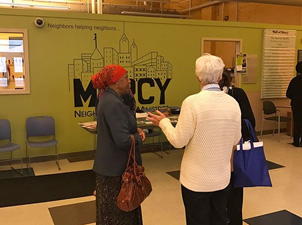
I met Kiara about eight months ago when she enrolled her children at Mercy Neighborhood Ministries of Philadelphia, Inc. Our curriculum gave her peace of mind about her children’s early education experience as her children are able to benefit from high quality Head Start and Pre-K Counts programming. The collaborative spirit of Mercy has assisted Kiara in preparing for her next steps in life.

“To get something you never had, you have to do something you’ve never done,” she says. “A short-term sacrifice leads to long-term comfort, and I’m going to be very comfortable when this is over.”

In Philadelphia today, 186,000 citizens, nearly 12% of the population, live in deep-poverty. Many of them are in situations like Kiara’s. Yet, these aren’t the stories you’ll hear from proponents of cutting public funding for “services” that should be considered human rights. Rather, you’ll hear about abuse of the system and a culture of dependence. Our motto at Mercy is “Neighbor helping neighbor, transforming lives, one person at a time.” We cannot build a community by cutting off resources from its members. Over the next four years, it is my sincere hope that the voices in power can quiet themselves long enough to hear stories like Kiara’s and not simply view them as numbers on a spreadsheet.

4 Mercy Neighborhood Ministries - steven headshot2
Steven Ziegler is the Director of Philanthropy for Mercy Neighborhood Ministries of Philadelphia, Inc. He is a Philadelphia native and has nearly a decade of experience as a nonprofit professional.

Jeff Sessions is Wrong On Crime – Again!

Jeff Sessions is Wrong On Crime – Again!

Joan Neal
May 26, 2017

When Attorney General Jeff Sessions ordered federal prosecutors to seek the harshest penalties possible under the law for all drug crimes, he signaled he wants to send us back in time.  We tried that strategy and research has shown that it didn’t work.  Under the ‘tough on crime’ approach, during the War on Drugs in the ‘80s and ‘90s, the U.S. prison population soared and the costs of incarceration increased dramatically.  Why, then, would we want to go back to a system that failed to lower crime levels or to make us safer?  Such a policy is clearly wrong on crime.

This order is a direct attempt to undo all of the progress the Obama Administration was attempting to make by focusing on rehabilitation of drug offenders, especially low level, non-violent offenders, and reducing the federal prison population, resulting in millions of dollars of savings in the federal budget.  In contrast, this ‘law and order’ policy will have exactly the opposite effect.  It will not stop – nor even slow down – the drug trade because it is not targeted and it will cost taxpayers more money.  ‘One-size fits all’ sentencing does not deter crime, save money, or make us safer.

But Jeff Sessions has been ‘wrong on crime’ for a long time.  As a Senator, he constantly opposed the growing congressional bi-partisan consensus on sentencing and prison reform, eventually, successfully blocking passage of any reform measure in the Senate.  Now, as Attorney General, he is seeking to institutionalize his outdated, ill-conceived policies that will only prolong the injustices already inherent in the criminal justice system.

History shows that mass incarceration, overcriminalization and prison warehousing have a disproportionately negative impact on communities of color and other marginalized groups.  Having a criminal record is a one-way ticket to intergenerational poverty.  It is an obstacle to employment, housing, education, healthcare and more.  It devastates families and is a drag on the American economy.  Jeff Sessions’ orders will insure that these conditions continue.

Thankfully, proponents of criminal justice reform across the board are still fighting for common sense reforms.  Both houses of Congress have bills pending.  Just this week, Senators Patrick Leahy and Rand Paul re-introduced the Justice Safety Valve Act which is aimed at restoring judicial discretion by giving federal judges the authority to impose sentences below the mandatory minimums when appropriate.  Reforms such as this will begin to restore fairness and equity.

The U.S. has the highest prison population of any country in the world.  This is not a distinction worthy of our values and identity as a proponent of freedom and liberty.  Our union is not yet perfect but we should always be working toward that goal.  Indiscriminately locking up people for long periods of time, no matter the severity of the crime, is unjust and immoral.  Our faith teaches us that there is always the possibility of rehabilitation.  The Attorney General’s approach to fighting crime denies the right of every person to be treated with dignity and respect.  It is inefficient, ineffective and un-American and we should do everything possible to turn it around.

Blog: Dialogue, Disagreement, or Both?

Dialogue, Disagreement, or Both?

Emma Tacke
May 24, 2017

“The new Pope is a humble man, very much like me, which probably explains why I like him so much!” Donald Trump crowed from his favorite podium, Twitter, in December of 2013. Although Trump appeared delighted to have found a kindred spirit in Pope Francis, I think most people would be hard-pressed to come up with any realistic similarities between our 45th president and Pope Francis. Our president, as we all know, is many things, but humble he is not. Even President Trump’s most ardent supporters probably wouldn’t list ‘modesty’ as one of his defining characteristics. The world was given its chance to compare the two men side-by-side as earlier this morning President Trump met with Pope Francis at the Vatican as part of his first foreign tour as president.

In fact, Pope Francis and Donald Trump seem like they could not be more opposite from one another. Besides the fact that they hold two of the world’s most influential titles, what could these two possibly have in common? They disagree on several important political and social issues, including but not limited to, immigration, healthcare, and climate change.

Did the president’s characteristic bravado and arrogance shine through this morning? Was the man who once said “If and when the Vatican is attacked by ISIS, which as everyone knows is ISIS’ ultimate trophy, I can promise you that the pope would have only wished and prayed that Donald Trump would have been president,” humbled at all in the presence of the pontiff?

As a Catholic and as someone who deeply admires Pope Francis, part of me wonders what could possibly be gained from this meeting. Will anything Pope Francis said to Donald Trump have any impact? We have seen time and time again that Trump dismisses anyone and anything that counters his warped ideologies. Maybe I’m coming across as too judgmental. Perhaps my resentment and anger towards the new president only contributes to the very divisiveness I seek to reject. My heart feels dried up and I am doubtful the meeting at the Vatican will have any true effect on Trump. However, maybe the lesson Pope Francis offers us is patience and a reminder to extend openness and respect to those with whom we have fundamental differences. This could be the Holy Spirit guiding us to call those neighbors we’ve come to verbal blows on Facebook with.  Maybe now is the time to reach out to those relatives we could barely speak to at Easter and say “I’m sorry. Can we start over?”

As we, the American people, watch our current president maneuver the weight and responsibility of the position for which he so mercilessly fought for, I am struck by this sentence from the Pope’s 2015 address to the United States Congress, “To imitate the hatred and violence of tyrants and murderers is the best way to take their place. That is something which you, as a people, reject.” Was this sentiment echoing in Pope Francis’ own mind this morning when he met with President Trump? Did he privately lament the kind of culture, seemingly lacking in empathy and compassion, our country has fostered in order for such a man to rise to power? I wonder if the Pope saw a tyrant sitting across from him this morning, or just a man desperately in need of redemption.

The McGrath Family’s Medicaid Story

Healthcare: The McGrath Family’s Story

NETWORK members Joe and Rita McGrath of Lafayette Hill, Pennsylvania know firsthand why Medicaid is important. It has been critical in keeping their daughter alive and the family from bankruptcy. When preparing for the arrival of their first child, Joe and Rita received the news their daughter would be born with Down syndrome. Some people asked Joe and Rita if they were going to terminate the pregnancy, but for the McGraths, it was never a question. The first few months of Maura’s life were difficult, but the McGraths pushed through the dark days with the support of friends and family.  A little more than a year later Joe and Rita welcomed their second daughter, Michelle.

Now 17 years old, Maura continues to be the blessing her parents have always known her to be. In addition to Down syndrome, Maura is also nonverbal and has been diagnosed with autism and behavioral issues. As a minor living with disabilities, Maura qualifies for Medicaid benefits. Even though Joe and Rita both work, the cost of Maura’s healthcare is too expensive for their family to afford on their own.

An integral part of Maura’s wellbeing is the care Maura receives from her home health aide, Williamina. Taking care of Maura is a full time job and looking after her became more difficult for her mother, Rita, after she fought cancer. Additionally, Joe has Parkinson’s disease. Medicaid provided the necessary funds for the McGraths to hire assistance, and in the past seven years Williamina has become like a family member.

In addition to a home health aide, Maura needs eight different medications, medical equipment and supplies, and frequent doctor appointments. Medicaid covers these costs. Without Medicaid the McGrath family would be in financial ruin. The cost of Maura’s medicine alone would be several hundred dollars every month. These are expenses the McGraths, and many families in similar situations, would be unable to afford without the help of Medicaid.

Joe and Rita have experienced the life-changing impact of affordable healthcare, and there are millions of families like the McGraths that need Medicaid. Each of these human lives is more valuable than cutting costs or turning a profit. We are one another’s keeper and the care Medicaid recipients are entitled to is our shared responsibility.

On March 24, 2017, during debate over the American Health Care Act (AHCA) in the House of Representatives, Rep. Brendan Boyle (PA-13) shared Maura McGrath’s story on the House floor and urged his fellow members to vote no on the AHCA.

Time for Moral Leadership on the Federal Budget

NETWORK Lobby’s Federal Budget Priorities

Download as a print-friendly PDF to share with your friends, or elected officials!

Download PDF.

NETWORK believes the federal budget is a moral document that reflects the priorities of our nation. Our budget must prioritize human needs programs, ensure funding to care for vulnerable members of our society, restore economic opportunity, and invest in community.  The challenges facing our nation and our world are serious and require a serious response from government.

The Budget Reality

Since 2010, powerful forces have converged to use the federal budget as a vehicle to lower the federal deficit by cutting social spending. These cuts are drastic and destructive, and they undermine programs that provide critical assistance to our nation’s most vulnerable. Meanwhile, tax breaks for wealthy corporations and outsized military spending, which cost billions of dollars, have been expanded.

From FY 2010 through 2016, funding declined for large numbers of human needs programs. FY 2017 funding was the seventh straight year of austerity for human needs programs, driven by the multi-year caps from the 2011 Budget Control Act and further reduced by additional budget cuts. In 2018, human needs funding is set to fall by $3 billion if Congress does not take action to stop the cuts.

Our Values:
  • The budget is a moral document.
  • Catholic Social Justice teaches us to uphold the dignity of each person as an equally valuable member of the human family.
  • As people of faith, we must be in solidarity with those who are living in poverty in the struggle against structures of injustice.

Federal Policies Must Mend Gaps, Not Widen Them

Elected officials must make budget decisions that promote the common good. This requires adequately funding programs benefiting vulnerable people while rejecting superfluous spending.  Investment in human needs programs will create stronger, safer, and healthier communities and promote the common good. Increasing funds for immigration enforcement and borders will not increase our security and must be rejected.

For FY 2018, NETWORK’s priorities are funding for the Census and Housing. We reject additional funding requests that would further militarize our border and harm immigrants in our communities.

Learn about funding in the Federal Budget for: Census, Housing, and Homeland Security.

We Come Alive Together

We Come Alive Together

Simone Campbell, SSS
April 27, 2017

As I write this, a few weeks ago Speaker Paul Ryan stated with righteous indignation that “well people shouldn’t have to pay for sick people.” This is one of his “principles” as he works to repeal the Affordable Care Act (ACA). I found this shocking because the whole principle of insurance is that you pay into it so that when you need to use it you can. Some have lower costs and some have higher costs, but all get the care they need when they need it. Costs average out over time. That is the whole theory of insurance and I thought Speaker Ryan would understand this “business model”. But apparently he does not.

The longer I pondered this misunderstanding of how insurance works, I came to see that there is even a deeper blindness. In the Republican commitment to individualism, they have lost sight of community and the common good. The biggest problem with the Republican effort at healthcare legislation is that it lacks the awareness that it is community which makes healthcare effective. It is not just about the individual. Healthcare is a communal good. This is why Pope Francis and his predecessors have clearly stated that healthcare is a human right.

Our nation’s hyper individualism is sucking the life out of our nation. Just focusing on myself is contrary to my Catholic faith and contrary to our Constitution. As I was pondering the Lenten readings, I was struck that all of the scriptures involve some aspect of community. No one is acting alone. This led me to an insight about Speaker Ryan’s flawed faith analysis.

The gospel reading on the second Sunday of Lent was the story of the Transfiguration of Jesus before the apostles. I love this story! Simon Peter both gets it wrong and gets it right. First, the truth of Jesus and the presence of Moses and Elijah are revealed to this small community. Peter and presumably the others are awed and surprised. Peter in his enthusiasm blurts out how good it is to be there and offers to “build a tent” as an altar for the three. But a bright cloud surrounds them and a voice says “This is my beloved…listen to him.” (Matthew 17:5) After a bit, Jesus helps the apostles stand up and tells them not to be afraid.

Reflecting on this scripture led me to know that we are called to see Jesus and the elders transfigured in our midst. In community we see the dazzling truth of the Divine’s presence and are urged to act. It made me think of our bus stop this past summer at Integrity House in Newark, New Jersey. It is a therapeutic community for people with substance use disorders. With guided interventions, staff and residents work together toward sobriety. We met with about 25 of their community members and heard about their struggles and hopes. Many residents previously had brushes with the law and had done jail time. They discovered that they could not do this work alone. Only in community could they be transformed. One woman said “It takes so much to fight addiction and depression! I can’t get rid of my demons by myself. I have to do my part, but alone I’m not enough.” She said by working in this community, however, she and others are being transformed.

While this was one woman’s story, I think it is also the story of our society that Speaker Ryan missed. It is not effective for us to be alone in our caring for our families, ourselves, or our communities. We are not made to be isolated. In fact, there is a lot of evidence that when I feel alone is when fear and division rise. We can only be “transfigured” in a group. Together we can be made new. This is the basis for sound, inclusive healthcare policy.

Let us remind our elected officials that we are our sisters’ and brothers’ keepers. If we embrace this truth and act in community, then we will have a healthcare system that works for all of us, not just the wealthy. Then we will be the people that we aspire to be—transformed and alive.

Originally published in Connection Magazine. Read the full issue here.
Michigan Advocates Lobby

NETWORK Advocates Lobby on Mending the Gaps in Michigan

Meg Olson
April 26, 2017

On Thursday, April 13, 2017, members of the East Lansing Catholic Network, one of NETWORK’s advocates teams, Ed Welch, Joe Garcia, Pat Hepp, and Sandy Maxim met with Representative Mike Bishop (MI-08) at his Brighton, Michigan office.

The focus of the meeting was immigration. Ed, Joe, Pat, and Sandy requested Representative Bishop’s support for a pathway to citizenship and his help in protecting Dreamers from deportation. During the meeting, Representative Bishop acknowledged to the NETWORK advocates that the immigration system is “upside-down,” but stated that immigration will probably not be addressed in the near future because of other pressing issues in Washington, D.C.. Next, the advocates asked Representative Bishop to refuse funding a border wall in upcoming budget legislation.

As a NETWORK advocates team, the East Lansing Catholic Network has met with Congressman Bishop and his staff several times about issues such as the EITC and Child Nutrition Reauthorization. While the Congressman doesn’t always share NETWORK’s vision on how to mend the gaps, the team members continue to build a relationship with him and hold him accountable for his actions in Washington D.C.

Blog: Secrecy Threatens Chance for Tax Justice

Secrecy Threatens Chance for Tax Justice

Colleen Ross
April 13, 2017

President Trump and Republican Congressional leadership have given themselves an August deadline to pass tax reform legislation. As that debate nears, it is unconscionable that President Trump continues to refuse to release his tax returns. We cannot have our elected officials passing laws that may personally enrich themselves or serve foreign interests without disclosing that information to the public.

We at NETWORK often say “the budget is a moral document” to advocate for funding federal programs that provide for the common good and work to mend the gaps. The reverse, however, is also true. The way we fund the budget, our tax code, is a moral declaration.

The tax code demonstrates what sources we decide to collect revenue from and their rates, as well as what escapes taxation. For an in-depth look at the individual, corporate, and other taxes used to raise revenue, read NETWORK’s guide “We the Taxpayers.” We cannot fund responsible programs – such as Social Security, Medicare and Medicaid, and SNAP (the Supplemental Nutrition Assistance Program) – without reasonable revenue, and equally important, that revenue must be raised through tax policies that are transparent, fair, and equitable. Ultimately, the tax code must not widen the income or wealth gap in our nation.

Much of our current tax code fails in that regard. Corporate tax loopholes and tax breaks for wealthy individuals have contributed to growing economic inequality in our nation over the years. Today, we are not mending the gaps with a progressive tax code, and signs of future tax reform do not look promising. House Speaker Paul Ryan’s “Better Way” plan proposed additional tax cuts that would disproportionally benefit the top 1%, while President Trump’s recently scrapped tax plan would also benefit our country’s highest-income households the most.

We understand that paying taxes supports our national interests and promotes the common good. As U.S. Supreme Court Justice Oliver Wendell Holmes, Jr. said “Taxes are what we pay for civilized society.” In the past, NETWORK members and friends have boldly proclaimed our Taxpayer Pride for government services ranging from student loans to public transportation.

This year, as we approach Tax Day, we call on President Donald Trump to have Taxpayer Pride and to release his tax returns. We also urge the president and members of Congress to support tax reforms that would ensure large multinational corporations pay their fair share and close loopholes that encourage corporations to shift jobs and profits overseas. It’s time for our nation to get closer, not farther away from Tax Justice!

Sister Simone Campbell will be at the Washington, DC Tax March on Saturday, April 15, 2017 to call on President Trump to release his tax returns. See more details about the DC march, or other local marches here: www.TaxMarch.org

Guest Blog: Hope From the Bottom Up

Guest Blog: Hope From the Bottom Up

Robert Beezat
April 11, 2017

For many of us, the last 12 months have been an unrelenting downer. What started as a quixotic run for the Presidency by Donald Trump turned into a victory. That victory has left many of us bewildered and afraid of what the next few years might bring domestically and internationally.

We have seen attacks on immigrants, attempts to take away health care from millions of people, and the removal of a number of environmental protections to name just a few serious threats to what many of us consider matters of social justice and equity.

What has happened to our country? What will happen to our country over the next few years?

These are important questions. Many of them cannot be answered yet. But amidst this pessimism, there are some signs of hope.

On a national basis, people around the country have become active again in our democratic processes. People showed up at airports to assist citizens and immigrants banned from re-entering or entering our country. A massive number of individuals and groups opposed the attempt to repeal the Affordable Care Act. In both of these matters, the fight for social justice is not over. But elected officials at the national level have taken note of this surge of citizen activism and are reconsidering the policies they propose and support.

Another positive sign of hope is the growing number of people and organizations who are making part of the world a better place from the bottom up.

An example of this is what is going on in the Greater Racine area. Two grassroots groups have sprung up in the last two years to mobilize the community to address a wide range of issues affecting our area. One group is called Visioning a Greater Racine (VGR). The other group is called Greening Greater Racine (GGR).

VGR is conducting community visioning sessions which involve a diverse group of over 1,000 people representing neighborhoods, schools, businesses, not for profits, churches, and local governments, as well as many individuals who want to make a positive difference. Community goals are being defined, priorities are being determined, and programs are being developed.

GGR is bringing together a broad range of organizations which impact the environment of our area. At these meetings, the organizations are learning from each other, coordinating their efforts, and celebrating their successes.

The GGR movement sprung from Racine Green Congregations, an ecumenical group which formed 8 years ago. Green Congregations’ initial purpose was to share ideas and successes in making their own places of worship more energy efficient. Much has been accomplished along those lines.

Then, based on the broader environmental concerns shared by all worship groups in the community, Green Congregations helped lead the formation of the larger Greening Greater Racine movement. The informal mantra of both groups is: Inform…Inspire…Celebrate!

From an information standpoint, we have all been amazed about how many good things are already happening in our community every day. Good people and good organizations are making a positive difference to quality of life from an economic and environmental perspective.

From an inspiration standpoint, it lifts all of our spirits to meet and work with so many people who are already making a positive difference. As we get to know each other better, build trust, and see new possibilities for future accomplishments, we are filled with hope.

From a celebration standpoint, we make it a point to not take for granted the good work that is already being done to make our community a better place to live, work, and raise a family.

One example of this spirit of celebration first happened in the Spring of 2016 and was repeated this Spring. Greening Greater Racine worked with our local community college, Gateway Technical College, to host EcoFest. 60 plus organizations set up informative and interactive displays of their environmental work at the community college. Close to 1,000 people visited EcoFest both years. People were simply amazed regarding the many positive programs that are already going on. Many have been inspired to join these efforts.

I look at the challenges ahead remembering these words from St. Paul’s letter to the Romans: “Let us…exult in tribulations also, knowing that tribulation works out endurance, and endurance tried virtue, and tried virtue hope. And hope does not disappoint, because the love of God is poured forth in our hearts by the Holy Spirit who has been given to us.”

I also think of the words of Margaret Mead: “Never doubt that a small group of committed people can change the world. Indeed, it is the only thing that ever has.” We all need to make this period of tribulation an opportunity for the Holy Spirit to pour forth God’s love into our hearts and into our world. And we need to remember that what starts from the bottom up can bring about positive and great change for our communities, our country, and our world.

Robert Beezat is a NETWORK Advocate based in Wisconsin. He can be reached at [email protected] or www.robertbeezat.com.