

Category Archives: Front Page

Comparing the Candidates on Immigration Policy

Comparing the Candidates on Immigration Policy

By Laura Muñoz
September 21, 2016

As an immigrant, the 2016 Presidential race has caused me to reflect on my migration to the United States. In 1997 when I was 4 years old, my dad moved our family from Manizales-Caldas, Colombia to Miami, Florida. I remember thinking that my life was going to be different. I wasn’t sure in what capacity, but I knew that Miami was our new home. I never thought that it would be close to 20 years before I would have the possibility of going back to my home country.

Unfortunately, the possibility for me and millions like me, to be able to go back to our home country even to simply visit our families is in the hands of two individuals who have extremely opposing views. NETWORK’s side by side comparison clearly show Hillary Clinton and Donald Trump’s stance on comprehensive immigration reform, among other issues.

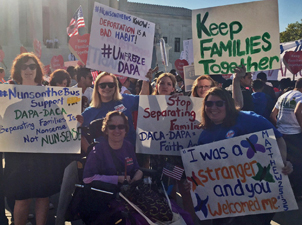
Hillary Clinton has made it a priority to pass comprehensive immigration reform that includes a pathway to citizenship within her first 100 days of office. She also supports President Obama’s administrative relief efforts such as Deferred Action for Childhood Arrivals and his Deferred Action for Parents of Americans initiative (that still unfortunately has not been passed). On the contrary, Donald Trump has pledged that within the first hour of his presidency he is going to begin the deportation of all undocumented people in the United States (yes, all 11 million). He is set on making Mexico pay for the wall at the southern border and of course, he will triple the amount of immigration officers, and make it harder for refugees and asylum seekers to come to the United States.

It isn’t hard for me to choose between the two candidates. Partly because this election directly affects me, but also because Catholic Social Justice shows us that we, as a people, need to address the inequality and suffering in our world and confront it as Christians by using the Gospel. When we use this mindset and think about immigration reform, the decision becomes clear. As Matthew 25:35 states, “I was a stranger and you took me in.”

In this critical presidential election, we must remind ourselves of our values and our principles, and keep in mind that if not us, many of our ancestors were once immigrants in search of a better life.

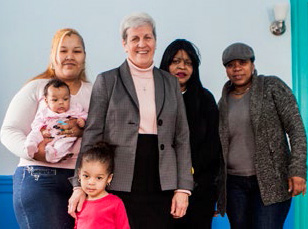
Sister Janet standing with residents of Providence House

Guest Blog: Sister Janet on Hateful Rhetoric in the Presidential Campaign

Sister Janet’s Remarks at Union Theological Seminary

Sister Janet Kinney, CSJ
September 1, 2016

On Thursday, September 1, 2016 Sister Janet Kinney, Executive Director of Providence House and a “Nun on the Bus,” joined Rev. William J. Barber, II and other national faith leaders to “speak out against hateful rhetoric and policies and the historical revisionism we are seeing in the Presidential campaign.” She said:

I am Sister Janet Kinney, a Sister of St. Joseph, and one of the 19 “Nuns on the Bus” who toured the country just a few short weeks ago. A project of NETWORK Lobby for Catholic Social Justice, I, together with my sisters, rode through 23 cities in 13 states, listening and engaging with others in various types of gatherings, comprised of diverse representations of our country.

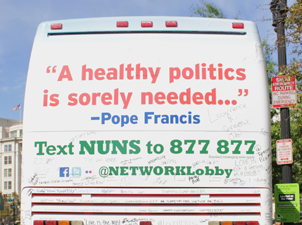
We went on the road in response to the divisive rhetoric of this 2016 election cycle, and as an answer to Pope Francis’ call that a ‘healthy politics is sorely needed to resolve the widening income gaps, especially the racial/ethnic and gender wealth gaps. To mend these gaps we must have a politics of inclusion where everyone’s voice is heard and given serious consideration.

Our tour included stops at both national party conventions, participating in multiple conversations and caucuses in every city we visited. We visited sites of social justice ministries and met with faith and community leaders alike. As I listened, encountered and spoke with our brothers and sisters,  I realized that it is so hard for people to find hope in the civil discourse of today.  I  heard heartbreaking stories of struggling families, of stark economic inequalities and blatant racism and discrimination.

People are hungry for hope and justice for communities that will stand together regardless of one’s race, ethnicity, or culture.  This cannot be done through the damaging and hateful speech making that is being heard in this political season. We need to promote the common good, engage in constructive dialogue and create inclusive policies reflective of an authentic democratic society.

That is what I heard traveling as a Nun on the Bus – morning, noon and night – in the voices and cries of “We the People”.

Immediately following on this experience, over 5,600 religious sisters across this country signed a letter asking our presidential candidates ‘to engage in political dialogue that reflects the principles and values upon which this nation was founded.’  We implored these candidates to refrain from language that stokes the fires of fear and disrespects, dehumanizes or demonizes another. We urged them to engage in careful listening and honest dialogue. They must respect and treat all with the reverence that is a sacred God given right.   It is then, only then, that we can together create an environment where everyone has a rightful place at the table and all are welcomed here in this, the United States of America.

What I Learned Touring America With Nuns on the Bus

What I Learned Touring America With Nuns on the Bus

By Sister Simone Campbell
August 10, 2016
How to sew the fabric of America back together.

In this age of the 24-hour news cycle, we must remind ourselves that America lives not at, but between, Republican and Democratic ideals. The “Nuns on the Bus,” as we are called, just returned from several weeks on the road (a lemonade stand in tow—it’s hot out there), traveling through the rust belt of the Midwest onto the industrial Northeast, looking for solutions to the gaps Americans face.

For Angie Whitman, the major gap is transportation. In Jefferson City, Missouri’s state capital, she told us that can’t get home from work because buses run from 8 a.m. to 5 p.m. Monday through Friday, and she works until 11 p.m. When she’s too tired to walk the four miles, she takes a taxi, which leaves her begging for overtime so she can pay for it. She relocated from Ferguson, Mo., to get away from violence there only to encounter another gap—housing. She now lives in public housing for the first time in her life because it’s all she can afford. The housing is in the city center, but the jobs are on the outskirts.

We heard about housing and transportation gaps a lot. Transportation between city centers where lower income people often live and the outer ring where they often need to work and shop is a problem in many places—from Terre Haute and Ft. Wayne, In., to Erie, Pa., and Buffalo, N.Y. In Buffalo the transit drivers say they haven’t had a raise in seven years. At $13.25/hour, they’re barely above minimum wage.

Missouri is also one of 19 states that has not expanded Medicaid to cover low-income workers under the Affordable Care Act. For Angie, who is in her early 40s and has high blood pressure, this healthcare gap forces a stressful choice between her medicine and rent. Last month she chose her medicine, hoping she can earn enough in time to pay her rent before the end of the month.

Caring for kids is another gap many people talked about. In Concord, N.H., I talked with Amy Shaw on the steps of the state’s capital. Even with a Master’s degree in social work, she can’t afford to work. She’s staying home to care for their three kids while her husband works two jobs; yet they still can’t make ends meet. Nor can the childcare worker I met there, Jennifer Cole, who barely makes minimum wage.

Racism is another gap that is tearing the fabric of America. While in Concord, I was so touched by a blessedly intelligent, biracial 20-year-old Jazmine Langley a Bill Gates Millennium Scholar who was awarded a full college scholarship. She should have so much hope for her future, yet she spoke with such anguish about friends facing racism, including one whose father was killed by police. Only off-handedly, at the end of our conversation, did she add: “I can’t tell you the number of times I’ve been stopped in my car for nothing—just because I’m black.” She keeps her student ID on top of her driver’s license and a college sticker on car. Not out of school pride, but for safety.

During our tour, we didn’t just ask about the gaps communities faced. We also asked about what would give them hope.

Something encouraging happened as Nuns on the Bus wandered its way through the streets of America, gathering each evening with folks to hear how they might mend the gaps across the American divide: tax injustice, living wage, family-friendly workplaces, and access to democracy, healthcare, citizenship and housing. The light bulb went on as people began to see how the gap they face is integrated with the gap faced by someone else.

In Toledo, Ohio, when the Farm Labor Organizing Committee (FLOC), was helping train Hispanic high school students in community organizing, the “FLOC Homies” reached out to the city’s African-American students to negotiate protocols with the Toledo Police Department to improve relations.

When two students, Billie and Genesis, discovered that ten of the young women in just their one high school class had been sexually harassed or assaulted, these “FLOC girls” found a private foundation to fund a counselor, and they met with the Toledo school board and persuaded them to post phone numbers in school restrooms to report molestations. They united and mended that gap.

In Fort Wayne, I visited a wonderful parish program called Vincent Village, which helps move families of all colors from shelters to transitional and permanent housing. Four women here—three black and one white—told me that the program helped them discover something important: their dignity. I was reminded that so often we focus on the task but neglect the dignity and value of the person.

In Erie, Pa., our evening roundtable was a bubbling with possibility. We’d heard too many stories that day about crime, poverty and lost jobs. But that evening, talking to their neighbors about mending their gaps replaced depression with hope, and by the end people were exchanging phone numbers and promises to stay connected.

It became clear that so many Americans living in between Republican and Democrat divides are tired of the divisions being sown. Many are ready to work together to help sew the fabric of our society back together.

And that’s what gives me hope for our nation. Reweaving fabric doesn’t just stitch it back together, it makes it stronger.

Originally published at Time.com.

Travel Log: Concord and Manchester

Travel Log: Concord & Manchester

Sister Janet Kinney, CSJ
July 22, 2016

Although this year’s Nuns on the Bus journey began last week in Wisconsin, I only became an official “NOTB” yesterday.   Travelling via Amtrak from my ministry as Executive Director at Providence House, a transitional and permanent housing organization in Brooklyn (founded by sisters of my congregation, the Sisters of St. Joseph of Brentwood),  I joined the sisters in Albany, New York and began my acquaintance with wonderful women – some of whom I had already met at other experiences as a “Nun on the Ferry” and through NETWORK affiliated events.

1concordThis morning as we prayed together and shared the scripture of the day, I was struck by this particular feast of Mary Magdalene, the woman who proclaimed to the disciples after the Resurrection “I have seen the Lord.” Thinking of the people I have met these two days, I too, “have seen the Lord” in the face of Christ in each of them.  I have been blessed by their trust in sharing their stories, their dreams, and yes, their passion for justice and equality for all their brothers and sisters.
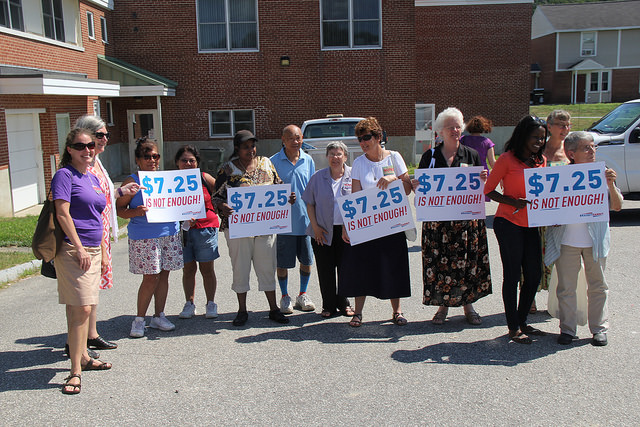
Our day began by travelling to the State Capital in Concord. Shortly before the event I was met with a big surprise – my very own cousin, Gail Kinney was the local coordinator of the rally! Gail is a New Hampshire resident, a minister affiliated with the Meriden Congregational Church, long time organizer for the United Auto Workers, and a member of both  the United Church of Christ Economic Justice Ministries and Interfaith Voices of Faith groups.  Who better than Gail to welcome us!

Like rallies held before this one, 4 local residents spoke on the gaps that have most intimately affected their personal lives. The rallies are a great illustration of the power of storytelling. Two mothers told stories of the challenges of raising young children and trying to support their families. The need for a living wage and the gap that currently exists is very real. Both women were well educated yet employment that paid a living wage eluded them. When Jazmin, a biracial college student got up and spoke and told us she carries her student ID in front of her driver’s license just in case she gets stopped by law enforcement, we knew that the racism gap is real. It was one of many humbling moments for me, a woman with white skin who has never had this worry.

1manchester1In the afternoon, the Granite State Organizing Project of New Hampshire invited us to visit a public housing development in Manchester composed of 250 units which are occupied by an extremely diverse community. The residents proudly described their newly organized Resident Council, whose motto is “togetherness is community.”  I thought of the tagline of my ministry at Providence House – “Creating Communities – Transforming Lives.”  I felt a synergy with the residents’ desire here and the strength that we all find when we are part of a caring community that supports one another!  We learned in our visit that in the past 2 years the council has developed a Homework club, English language classes, and other social activities for the whole community.   Dot who participated in their leadership training program spoke of how she learned to plan and prioritize her goals, and after 2 years was now on track to move to Georgia to reunite with family.  Dot was thrilled that we had come to visit and hear their stories.  Another humbling moment, as I thought of the women and children back home at Providence House – have I missed similar opportunities?
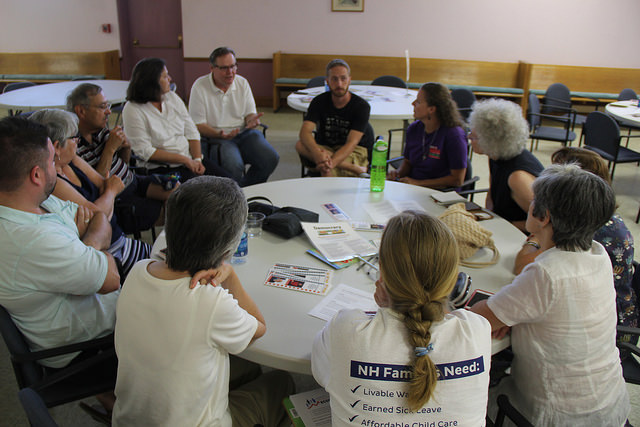
1manchester2The evening was a caucus event at Holy Cross Center Manor. Spirited conversations with men and women from the local community ensued on the seven gap issues, each sister being responsible for a different gap conversation to moderate. Mine was affordable housing -– a natural fit!

Attendees talked about the unique features of the New Hampshire “citizen legislature” that really only allows wealthier citizens to be elected, thus ensuring that the laws do not really benefit the 100%.

During the report out from the small groups, we had several refugees from Bhutan share about their gratitude for Social Security Insurance for the elderly, but at the same time say they were not able to earn a living wage. A lawyer from Ghana said she was not able to continue in her same profession here in the United States and that there were many refugees and immigrants who were highly educated, but who were forced to do menial, minimum wage jobs because their licensing or training didn’t transfer.

We also heard from people who called for a single-payer healthcare system, and for tax reform to create a more just, progressive tax policy. Before we left, all attending “signed on to the bus” signifying their commitment to working on the ‘Mend the Gap’ issues. I said a heartfelt good bye to cousin Gail, and put a close to a very full day. I felt enormously blessed!

See also:
Reflection: A Pivotal Moment in Time
Slideshow: Concord Rally
Slideshow: Elmwood Gardens (Manchester) Site Visit
Slideshow: Manchester Caucus

Reflection from Upstate New York: God Continues to Speak through Parables to Us Today

Reflection: God Continues to Speak through Parables to Us Today: Do You Hear It? Can You See It?

Sister Alison McCrary, SFCC
July 21, 2016

The disciples approached Jesus and said, “Why do you speak to the crowd in parables?” He said to them in reply, “. . . This is why I speak to them in parables, because they look but do not see and hear but do not listen or understand . . . “But blessed are your eyes, because they see, and your ears, because they hear. Amen, I say to you, many prophets and righteous people longed to see what you see but did not see it, and to hear what you hear but did not hear it.”

On this ninth day of the Nuns on the Bus Tour, we encountered more of the heartbreak and hope that we enter more deeply into each day on this journey throughout U.S. cities and towns.

Today, we departed early from our overnight stay at the motherhouse of the Sisters of St. Joseph of Rochester, New York and began our day as we always do with communal prayer. Followed by a long period of silent meditation and Mass scripture readings, many of our morning reflections were from our stops yesterday in Buffalo and Rochester, New York.

Some Sisters reflected on the radicalness of the healthcare provided at St. Joseph’s Neighborhood Center in Rochester, New York. Established in 1993 as a ministry of the Sisters of St. Joseph by a former community organizer Sister, the center provides treatment for more than 1,000 walk in clients a year.  The Center is run by a small staff and more than 150 volunteer medical professionals who are able to fulfill their original purpose for studying or practicing medicine by serving the working poor and others in need. We heard directly from one patient who shared her story as the center provides wrap-around services by providing food, hygiene bags, voter registration, housing referrals, and legal services referrals.

1rochester1Other Sisters shared about the stories heard from the more than 200 people gathered at the Colgate Rochester Crozer Divinity School for our daily caucus events in each city. Sisters reflected on the stories heard from those whose voices are intentionally silenced by institutions because of racism, the challenges of our current democracy that doesn’t allow everyone to participate fully in society, problems faced by those who cannot afford insurance, and the countless issues faced by the homeless in their communities.

These stories, like the stories Jesus told, stretch our imaginations to envision a new society so we can work to make it happen. The last question we ask participants at our caucuses is what would our country look like if there were no barriers to healthcare, housing, living wages, family-friendly workplaces, full participation in democracy by all, and citizenship.  The responses to these questions are pondered and discussed at small tables and then shared with the larger group help all of us to tap into our creativity to dream it so we can build it.

1albany2Following prayer this morning, we then made our way to the New York State Capital Building steps where again we heard parables from those on the margins so that more people may hear, see, and understand what is called forth from us to be disciples of Christ in the world today. We heard the story of one woman of the Working Family Coalition and part of the Fight for $15 and a Union movement and how she struggles daily to support her infant and five-year-old son as a loyal hardworking fast-food worker and how she had to choose again between giving birth to her son and losing her job that supports her family. We heard from the local Amalgamated Transit Union president Cory Bixby about the importance of workers’ rights and from Reverend Emily McNeil, Director of the Labor-Religion Coalition of New York about the need for a living wage, fair share taxation, and a stronger democratic process. Sister Simone Campbell, SSS, Executive Director of Network proclaimed that “policies made a lot of these problems and policies can fix these problems.” Congressman Paul Tonko declared that the Bus is powered by the people and indeed it is. It is powered by the parables, the stories of heartbreak and hope, of all those we meet and who sign their name to the bus to commit to doing their part to bring justice and joy into the world for everyone.

Reflection on Buffalo-Rochester: Tending the Body of Christ

Reflection: Tending the Body of Christ: Reweaving the fabric of society

Sister Jan Cebula, OSF
July 21, 2016

“…so we, though many, we are one body in Christ and individually parts of one another.” Rom 12:3-8

So began Day 9 of Nuns on the Bus: Mend the Gaps: Reweave the Fabric of Society.

As we prayed with this scripture at the start of our day, we could not foresee how immersed we would be in the experience of being One Body. How it would unfold all around us, embrace us and touch us so deeply.

Each night we reflect on the day’s experience and on the previous evening, we talked about how some people are invisible to others; particularly people of color and those who have been marginalized by society. Perhaps the key to reweaving the fabric is connecting people, particularly with people who are the most impacted, we speculated.

1buffaloOn our schedule was a stop at the Homeless Jesus statue outside of St. Paul’s Episcopal Cathedral in downtown Buffalo. Hmm, I thought. I had seen photos of it, but why stop here? By the time we stepped back on the bus, how grateful we would be for Rev. Will Mebane’s persistent invitation!

Buffalo is experiencing a type of rebirth, with lots of redevelopment, but not everyone was benefiting, Rev. Will told us. So he set about reconnecting the church with the homeless and others left out, left behind. It began simply by seeing and paying attention to those members of the Body of Christ. And it was apparent that the seeing and connecting keeps deepening, unfolding and expanding.

Rev. Bill invited us into a conversation with representatives of Concerned Clergy Coalition of Western New York, Gameliel of Western New York (a coalition of 85 congregations, labor unions and other organizations), the Coalition for Economic Justice, Catholic Charities and Friends of the Night People. And Congressman Brian Higgins joined in. They spoke of the abject poverty in the area—over 40%–and their efforts for racial and economic justice. “We are willing to lock arms with anyone and everyone,” Rev. Will explained. With tears at times, they told stories about how their relationships with “the least” had been transformative.

Details of what they said and even the words they spoke elude me now, but their passion and energy remain. And so do the lessons they taught about being members of the Body of Christ and about reweaving the fabric of society. It is about wholeness; of individuals and the entire body. Of reconnecting people, the personal with the systemic. Of seeing the whole and recognizing the connection to damaging policies and working to change them. Of ever expanding and inclusive relationships. Of being deliberate and intentional, grounded in deep faith and acting with courage.

We emerged from the conversation to the space outside the cathedral for a short public program and were greeted by a diverse crowd and buzz of activity. When I spotted the t-shirt “The church has left the building,” I thought “How true about what’s happening here, about Nuns on the Bus”. We hadn’t yet seen the Homeless Jesus a short distance away.

Then I saw it. Jesus sleeping on a bench, wounds in his feet exposed. Everything we had just heard and felt, depicted here. Calling us all to wholeness. Impelling us to go on.

Deeply moved, we boarded the bus and headed to Rochester to be surprised by another Body of Christ experience.

1rochesterSister of St. Joseph Chris Wagner invited us to tour and learn about St. Joseph’s Neighborhood Center, a primary integrated health care center. Fifty two percent of Rochester’s children live in poverty and 70% are trauma survivors and the center is located in the midst of a low-income neighborhood. Most of the people who come there are uninsured or unable to afford health care with the insurance they do have.

It was clear that the focus is the health and wholeness of both the people who are served and work there. Over time, they have developed an integrated system, with all under one roof: full primary care, specialties such as cardiology and oncology, mental health services, dental, x-ray and lab. There are even body rooms with chiropractic, massage and physical therapy services. The 18 staff and over 250 volunteers love working there; unconfined by time restraints, they are allowed to practice medicine in the way they were trained to and want to. Care is customized to the individual.

The broader issues of health care policy issues and structural racism are also being addressed, witnessing to the wholeness.

And we’re riding the Bus connecting what’s happening in local areas all across the country to advocate for just federal policies.

As we left, I noticed a sign on the wall that read “I pin my hopes to quiet processes and small circles, in which vital and transforming events take place.” (Rufus Jones).

A good reminder of day 9: living as a member of the Body of Christ; reconnecting, mending the gaps, reweaving the fabric of society and creating wholeness.

Reflection from the RNC: Sweetening a Sour Conversation

Reflection from the RNC: Sweetening a Sour Conversation

Sister Susan Rose Francois, CSJP
July 19, 2016

“Can I offer you a free cup of lemonade?”

1rnc-wagonpullThere were purveyors of all sorts Monday morning on the streets of Cleveland near Quicken Loans Arena as the Republican National Convention got underway. Most vendors displayed the standard assortment of red, white and blue political hats, buttons, and stickers promoting the Republican nominee. Others sold products designed to denigrate or ridicule the other party’s candidate.  Then there were the teams of folks dressed in pink t-shirts offering free hugs.

The Nuns on the Bus, wearing our own blue t-shirts, divided into two teams named “Holy Curiosity 1” and “Holy Curiosity 2” to spread across the downtown area. We were not selling anything or pushing a particular agenda or policy position. Rather, our mission was simply to offer free cups of lemonade to thirsty folks and engage RNC delegates and others in conversation.  Each team pulled a red wagon, designed to look like our bus, which transported our jugs of lemonade.

I must confess that I was more than a little bit nervous when I first heard that we would be engaging in street ministry at the RNC. How would we be received? It certainly felt different than visiting service organizations or holding caucus events with more friendly crowds.  My nervousness increased as the negative campaigning, hype, and possibility of violence at the convention filled the airwaves.  Yet as our bus rolled into Cleveland, there was a sense of purpose, unity and dare I say joy among us. We were on a mission to bring a politics of inclusion to divided places.

I think it also helped that we were offering something as non-threatening as lemonade. As Sister Simone Campbell said, lemonade is something you have on picnics and who doesn’t like a cup of lemonade on a hot day? Well, it turns out many people don’t. More than once I held out my little paper cup of lemonade and offered it up to passersby who were not interested.  But some did gratefully accept my offering, and each person who took me up on the offer of a cup of free lemonade was also more than willing to let me ask a few questions.

1rnc-simoneEach sister was equipped with a clipboard, pen, and three questions: 1) Who in your family is it difficult to discuss politics with, and why? 2) What worries you about this election? and 3) What gives you hope for our nation.  I talked to a mix of folks: RNC delegates, Cleveland natives observing the spectacle, vendors, and conservative activists.

I observed a general softening when I told my interviewee that we would be visiting the Democratic National Convention to ask the same questions. As Sister Simone says, the Nuns on the Bus enjoy being “equal opportunity annoyers.”

There was certainly a good amount of ideology and partisanship peppering the answers. We were there to listen, not to judge, and I found myself being stretched in a good way as I recorded responses which expressed frustration, fear, and in some cases parroted the hateful speech and generalizations which are expressed liberally on conservative talk shows.  Most of the answers to the second question about worries were of this variety.

When it comes to our families, there was a lot of commonality. A few people expressed that there is no one in their family or circle of friends that they disagree with, which perhaps helps explain the silo mentality and normalization of extreme views in our current political climate.  Most however named someone, often an in-law, sometimes a parent or child, who held an opposite view point. What I found most encouraging, however, was that more than one person expressed that they were still able to talk with each other about the issues, even if they disagreed.

It was the experience of asking the last question about hope that I found most interesting. More than one person was taken by surprise and unable to immediately answer the question.  One man, after a moment or two of quietly looking up, said, “It’s hard to answer isn’t it, because it’s so experiential.”

Everyone eventually was able to find some hope in the midst of our fear-filled political climate. Some answers were again ideological and focused on their preferred candidate’s stump speech. But there were other frequent answers of the genuinely hope-filled variety. More than one person pointed to young people committed to a better future. A number of answers expressed some faith in our nation’s values, principles, and foundations.  “Our diversity is our strength,” one man from Wisconsin told me, “it can be scary but over time our country will heal, based on our strong values.”  Another from Tennessee said, “We have overcome a lot before as a nation and can do it again.”

1rnc-huggingFor that to be possible, I think we need to bridge the growing political divide.  We need to sweeten the sour conversations in our body politic, in our families, and in our communities.  We need to talk with people with whom we do not normally engage. If we want to mend the gaps and reweave the fabric of society, then we need to move beyond trading barbs, attacks, and presumed facts and focus instead on our hearts, probe our fears, and dare to hope for our nation.

Reflection from Cleveland: Even the Sky Is Crying, but God Is Our Hope!

Reflection: Even the Sky Is Crying, but God Is Our Hope!

Sister Larretta Rivera-Williams, RSM
July 18, 2016

A severe thunderstorm blasted the morning sky over Cleveland as we boarded the bus for downtown.  Sister Simone Campbell described the streaks of lightening and cracks of thunder as “the sky crying that a National Convention is being held here.”

I am not sure the majority of Clevelanders are as excited about the Republican National Convention being here as they are about winning the 2016 National Basketball Association Championship.

1-ClevelandSome of the people we are advocating for are the people losing money this week. They are people in need of fair taxes, an increase in living wages, affordable housing and healthcare. Several  businesses in the vicinity of the Quicken Loans Arena, however, will be closed this week; people dependent will be negatively impacted. Businesses remaining open will difficult to reach if streets are closed. There will definitely be a crunch in some aspects of Cleveland’s economy.

Background checks, security screenings, and extra law enforcement is also building a healthy tab for the city.

We, the Nuns in the Bus, trust that all measures have been taken to assure safe passage in, around, and out of Cleveland.

We held our caucus last evening at St. Leo the Great School in Cleveland. As in prior cities the problems making gaps between the “haves and the have nots,” in Cleveland are a lack of public transportation, underemployment, low wages, unaffordable and poor housing, expensive or no health care, environmental injustice, etc.

Lisa Sharon Harper, Chief Church Engagement Officer for Sojourners, has joined us for a few days on the bus. She describes our presence among people as sacred encounters; providing sacred breathing space for the soul. What a powerful and humbling image!

The sun is beaming now. Another sign of God’s blessing upon our mission to “Mend the Gaps.”

Since vehicles cannot drive beyond a certain point we now travel by foot to our base camp at the headquarters of the United Church of Christ.

2clevelandWe call our street ministry today, Lemonade Ministry. Two Red Flyer wagons have been decorated to resemble our bus. As we meet people along the way and offer them a cup of cold Lemonade we are prepared to “listen to stories that need to be told and heard,” Sister Simone Campbell.

Three questions are being asked:
1) Who do you find it hard to discuss politics with in your family?
2) What worries you about this election?
3) What gives you hope for our nation?

These same questions will be asked at the Democratic National Convention next week in Philadelphia. We trust that what will be revealed is that all of us want the same thing. We want to heal our nation and solve our problems together! We the People making a difference

We have become signs of hope for a nation crying with fear, seething anger, and bleeding revenge. We are the hands, feet, and the voice of Christ in today’s wounded world.

With one another we stand strong in our faith knowing that God is in each step we take.  God is our peace, God is our hope, God is our tomorrow.

Reflection on Day Six (Toledo): Choosing Positive Change

Reflection: Choosing Positive Change

Sister Susan Rose Francois, CSJP
July 17, 2016

“It’s hard to make a good choice when there is not a good choice available.” – Peter Meinecke, youth program manager of the Farm Labor Organizing Committee in Toledo

One phrase that has been running through my head over the past week is that “actions have consequences.” Is it any wonder that we have a widening wealth and income inequality gap when our nation has chosen, for the past three decades, to prioritize tax breaks for the wealthiest individuals and corporations over using our resources to invest in the common good?

2-ToledoThe negative impacts that our nation’s policy choices have on people who are struggling are crystal clear in every state where the Nuns on the Bus have visited so far, and it’s not just in urban areas. Our route has taken us through small rural communities, mid-size towns, and larger cities. At each stop along the way we are blessed to mingle with the local community. During site visits we have heard first-hand stories from ordinary folks unable to make ends meet, no matter how many shifts they work. I have learned that too many Americans are unable to provide for their families or to access things most of the rest of us take for granted, such as transportation, health care, safe and affordable housing, or non-predatory lending.

During our caucus events in the evening, we talk with folks in the community who are concerned about the widening gaps. Many of the participants have chosen to volunteer in their local soup kitchen or shelter, visiting at the local prison or helping kids in after school tutoring programs. These experiences have helped them to understand that in 21st Century America it is very difficult, if not impossible, to “pull yourself up by your bootstraps.”

Our lack of investment in basic public infrastructure, such as public transportation systems, limits the choices available to low-wage workers in places like Jefferson City, Missouri where we learned that the public transit system stops running at 5pm, and does not operate on Saturday or Sunday. In Terre Haute, Indiana we learned that job seekers without their own transportation are unable to access new higher wage assembly jobs located in the outskirts of the city, because the transit system does not travel to these industrial areas. In Fort Wayne, Indiana we learned that even when a worker saves up to buy their own car, predatory lending practices mean that it is often impossible to keep up to date on car payments.

It has also become clear that structural racism limits the choices available to our nation’s children. Racism is not limited to individual acts of prejudice, although we certainly heard many stories of this variety. In every city and town, we also heard people making connections that point to structural racism directing the allocation of resources. Schools in communities of color have less resources available because of inequity in school funding, and students are more likely to face harsh disciplinary penalties such as suspension. Meanwhile the neighborhoods where they grow up are more likely to have broken street lights, boarded up houses, and empty lots instead of state of the art playgrounds and well-lit streets.

On the day before the Nuns on the Bus headed into Cleveland, we visited with the FLOC Homies Union in Toledo, a social movement that brings the skills of labor organizing to young Latinos aged 14 to 24 to empower them to make change in their community.

We heard about the program from Peter Meinecke, youth program manager for the Farm Labor Organizing Committee. FLOC has an employment readiness and youth empowerment program that places youth, called Homies, in work sites in their community to gain first-hand experience. They also learn the basics of leadership and community organizing which they put into practice.

Several of the Homies joined us for conversation around the table. Billie shared the story of how her Homies class, which was mostly made up of young women, realized that each had experienced sexual harassment at school. They organized a march in June to raise awareness about sexual harassment and domestic violence. Three members of the Homies Union then met with Toledo Public School officials where they successfully negotiated adding training on sexual harassment and assault to the health class curriculum, posting information about sexual harassment in schools and the student handbook, and funding a Prevention Specialist in collaboration with the YMCA to work full time on the issue district wide. They managed to make all of these positive changes in just one meeting with school officials!

Another Homie, Alejandro, shared a compelling story of when he was pulled over and harassed by police because the air freshener hanging from his rearview mirror was “distracting.” Many of the Homies have had similar experience with the police, which is why they are recordings their experiences to compile into a video to share with the chief of police. They are also actively negotiating a code of conduct between the police and the community.

The FLOC Homies are making choices to create positive change in their community. I wonder, as we the people face choices on the ballot in our local and national elections this fall, can we do the same?

Reflection on Day Four: Crafting Community

Reflection: Creating Community

Sister Susan Rose Francois, CSJP
July 15, 2016

The opportunity to be a Nun on the Bus is a multi-dimensional blessing. We are privileged to hear stories of pain and promise, challenge and opportunity, impasse and creative responses to systemic injustice.

Sister Simone Campbell keeps reminding us that, in effect, we are missionaries. We are on a mission to mend the gaps. To the observer the public advocacy side of being a nun on the bus is perhaps more apparent, but there is a profound pastoral side to our mission as well. We are listening to how the gaps are impacting folks across this country in real and immediate ways. We are also witnesses to the resilient efforts of communities to reweave the fabric of our society.

Community is key. The nine of us boarded the bus in Madison as relative strangers to one another. Most of us, in fact, had never even met before. Now that we have arrived in our fourth state and seventh city, it is hard to believe that I have not always known these sisters of mine. We certainly belong to and love our respective religious communities.  We know that our sisters are praying for and supporting us across the miles. But we are also now members of another community—we are, now and forever more, Nuns on the Bus.

Prayer has been key to crafting this sense of community among us so quickly. Most days, before we board the bus in the morning, we find a quiet spot for community prayer in the motherhouse where we have found gracious hospitality the night before. Other days we pray together on the bus at the beginning of our morning journey. Whatever the location, contemplation and sharing of the heart brings us together and focuses us on our mission.

Tears have also brought us together as we have met ordinary folks who are struggling to meet basic needs and provide for their families. I will never forget Julie who teared up as she shared her sadness at not being able to provide safe affordable housing for her three children because she could not find a job in her area that provided a living wage.   Or Anne who, because she lives in a state that has not expanded Medicaid benefits, almost died when she was taken to an emergency room for care that had reached a crisis level because she did not have health insurance and thus could not afford regular checkups. It is difficult, if not impossible, to avoid having your heart broken open, again and again, by such stories. Tears are a healing and human response to this sacred sharing.

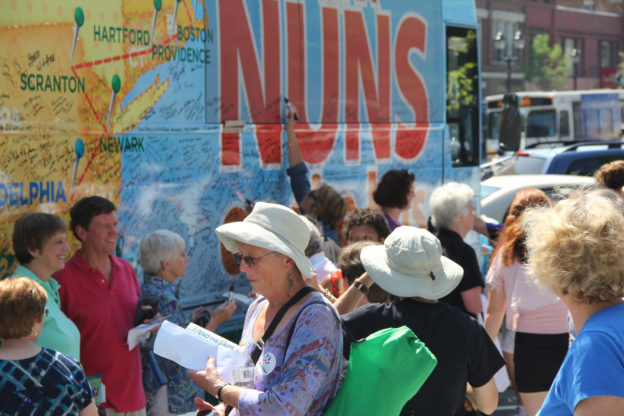
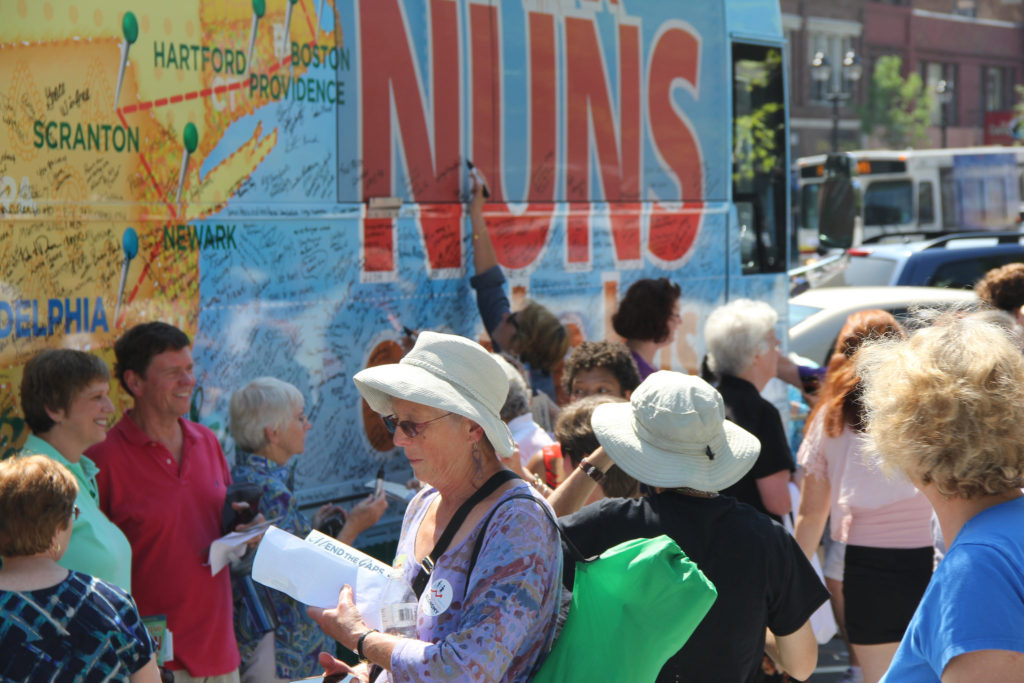
In our mission to reweave the fabric of society, we are weaving together the threads of our individual stories and experiences with those we meet along the way. It is no coincidence that the graphic on the side of our bus resembles the squares of a quilt.  Each state of our union is part of a whole and we have heard certain patterns emerging across our trip. During our caucus events and site visits, we have heard how problems like the lack of affordable mental health care, stable funding for K-12 and higher education, inadequate public transportation systems, and the prevalence of only low wage employment for job seekers are tearing at the fabric of our society.  While there are some variations in the ways these gaps color the lives of the communities we have visited, the overwhelming pattern that is emerging is one of widening gaps caused by policies that do not promote or serve the common good.

At our caucus event in Terre Haute, Sister Simone told the crowd: “I believe that in the 21st century it is necessary for us to work in community to make change.”

In St. Louis, we spent a few hours with one community of women working on the multi-dimensional problems facing their community. Voice of Women is a community development organization that unites women to address issues affecting their neighborhood, such as gentrification, lack of access to banking and affordable lending, and food insecurity. Their micro-lending and savings programs provide the economic engine that helps community members thrive. The community garden provides healthy vegetables and brings folks together to tend the garden and relationships.  During our tour of the neighborhood, I met a woman around my age who was raising her children in the same house in the neighborhood where her grandmother had raised her family. She was committed to the future of her community, and wanted to make sure that her 8-year-old daughter would have the same opportunity to stay connected to this resilient community, even as it changes and becomes more racially and economically diverse.

We are about half way through this leg of the trip. The community we are crafting informs our advocacy and gives us food for the journey. I cannot help but think of the words of the prophet Isaiah 25.

On this mountain (or on this Nuns on the Bus trip),
God will prepare a feast of rich food for all peoples,
a banquet of aged wine—the best of meats and the finest of wines.
On this mountain God will destroy
the shroud that enfolds all peoples,
the sheet that covers all nations;
God will swallow up death for ever.
Our God will wipe away the tears
from all faces.

As we get closer to Cleveland and the Republican Convention, there will no doubt be more tears and more stories. Yet another blessing of being a nun on the bus is the chance to carry these sacred stories in my heart and share them in order to inform new policies crafted to mend the gaps.