



What’s the Real Reason for High Grocery Prices?
Food prices are unaffordable! What’s going on, and what can we do?
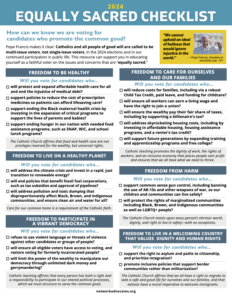
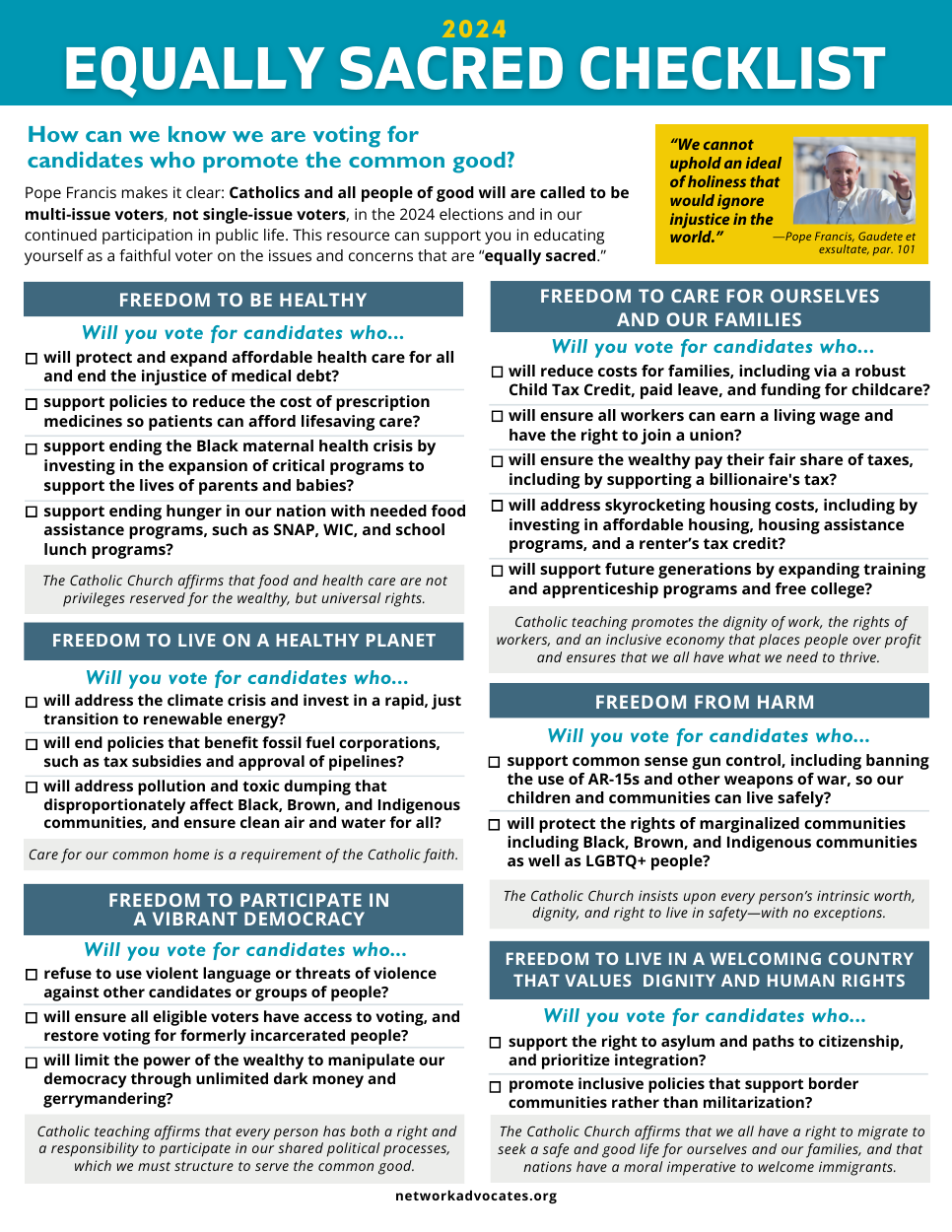
Check out our food prices one-pager here!
Sr. Emily TeKolste, SP
August 30, 2024

Sr. Emily TeKolste, SP, is NETWORK’s Grassroots Mobilization Coordinator.
No matter how old we are, where we live, or what’s in our wallets, every one of us has a right to be free from hunger. It’s a matter of our dignity. Grounded in the teaching and tradition of Catholic Social Justice, NETWORK believes that all of us—especially our children and elderly—have an essential right to good, basic nutrition.
As we all have noticed, grocery prices have skyrocketed since the COVID-19 pandemic. But even after the crisis of the pandemic has subsided, and even as inflation has dropped off in recent months, grocery prices remain high. With food prices up roughly 20% in the last two years, too many of us are struggling to feed ourselves and our families.
Why are our grocery prices so high?
We hear all sorts of explanations for food inflation, but none of them explain why big food corporations keep raising their prices.
So, what is actually behind the continuing rise in food prices? The simple fact is that a few big agribusiness executives are lining their pockets at our expense. Economists estimate that, by mid-2022, 53% of the increase in food prices was the direct result of corporate profiteering. Workers’ wage increases accounted for less than 8%.
While we’re struggling to feed our families…
-
-
 Big corporations made $2.5 trillion in profits in 2021 alone, their most profitable year since 1950—and corporate food executives still raised prices.
- Tyson Foods made profits of $11 billion, up 48% from 2021.
- Cargill, a huge commodities corporation, posted $5 billion in 2021 profits.
- General Mills posted profit increases of 97% in early 2022, as it increased its prices by 53%.
- PepsiCo raised prices for drinks and snacks by 17%, while its profits grew by 20%.
- Coca-Cola’s corporate profits grew by 14%.
-
-
-
- At the same time, food industry CEO salaries became even more bloated, averaging $22 million in 2022—almost 1,000 times the average food worker’s earnings.
-
-
-
- All this time, a few mega-corporations controlled the food industry, all but eliminating real competition, and driving out smaller businesses.
- Cargill and three other firms control 70% of the world’s food market.
- Just four supermarket chains control 65% of the nation’s food retailers.
- All this time, a few mega-corporations controlled the food industry, all but eliminating real competition, and driving out smaller businesses.
-
But you won’t hear big food executives and the politicians they buy mention these realities. Some Republican lawmakers like to blame inflation on the Biden-Harris administration’s economic policies — even though those policies help us afford our groceries. They blame the tax, unemployment, and rental assistance lifelines that got struggling families through the pandemic, and they blame new programs that build well-paying jobs, safely fix our roads and bridges, and give us clean air and energy. They blame these programs to distract us — because they would rather keep corporate profits high than fund the things that actually help us feed our families. They know it, and we know it!
What can we do?
The president alone cannot control inflation. President Biden has no authority to unilaterally issue orders to lower food prices, and a few lawmakers in Congress have blocked meaningful Congressional action.
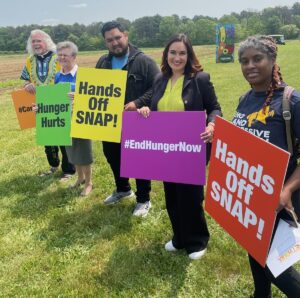
Advocates at NETWORK’s “Care Not Cuts” rally in Long Island last year. From left to right: Fr Frank Pizzarelli, Sr. Tesa Fitzgerald, Angel Reyes, Serena Martin-Liguori, Monique Fitzgerald
But we can demand better! Together, we will ensure that Congress supports affordable, nutritious food for us and our communities.
As a multi-issue voter, you can ask your elected officials and the candidates on your ballot:
1. Will they ensure that freedom from hunger is an essential right for all of us by fully funding food assistance programs, including:
- The Supplemental Nutrition Assistance Program (SNAP), including its Thrifty Food Plan that protects SNAP benefits from rising food inflation?
- School lunches, elderly meals, soup kitchens, and food banks?
- The Special Supplemental Nutrition Program for Women, Infants, and Children (WIC), which offers basic nutrition for pregnant people, new parents, and babies?
2. Will they stop rewarding the executives of mega-corporations and their wealthy shareholders at the expense of ordinary workers and their families by:
- Reversing excessive Trump administration’s 2017 tax bill benefits for big corporations?
- Imposing needed measures to curb excessive CEO and executive compensation packages for profiteering companies?
- Making the tax system fair for workers and their families, with stronger tax credits for children, childcare, and earned income?
3. Will they push the Federal Trade Commission to put the brakes on the monopolization in big agribusiness and protect small farmers and sellers?
 And then, of course, VOTE! Head to NETWORK’s Be a Voter page to check your voter registration status, find your voting information, make a voting plan, and tell your family and friends to vote, too!
Together, we will make Freedom from Hunger a reality for all of us, no exceptions! We will ensure that our nation’s food industry isn’t about feeding corporate profits, but about feeding our communities.
See NETWORK’s Food Prices One-Pager Here:
Sources
Head to these links to learn more about the real reasons for rising food costs:
https://www.stlouisfed.org/open-vault/2023/january/complex-supply-chains-bottlenecks-and-inflation
https://time.com/6139127/u-s-food-prices-monopoly/
https://www.nytimes.com/2023/03/23/us/politics/republicans-inflation-federal-reserve-powell.html
https://www.cnn.com/2021/08/06/politics/inflation-gop-fact-check/index.html