

Category Archives: Immigration

Comparing the Candidates on Immigration Policy

Comparing the Candidates on Immigration Policy

By Laura Muñoz
September 21, 2016

As an immigrant, the 2016 Presidential race has caused me to reflect on my migration to the United States. In 1997 when I was 4 years old, my dad moved our family from Manizales-Caldas, Colombia to Miami, Florida. I remember thinking that my life was going to be different. I wasn’t sure in what capacity, but I knew that Miami was our new home. I never thought that it would be close to 20 years before I would have the possibility of going back to my home country.

Unfortunately, the possibility for me and millions like me, to be able to go back to our home country even to simply visit our families is in the hands of two individuals who have extremely opposing views. NETWORK’s side by side comparison clearly show Hillary Clinton and Donald Trump’s stance on comprehensive immigration reform, among other issues.

Hillary Clinton has made it a priority to pass comprehensive immigration reform that includes a pathway to citizenship within her first 100 days of office. She also supports President Obama’s administrative relief efforts such as Deferred Action for Childhood Arrivals and his Deferred Action for Parents of Americans initiative (that still unfortunately has not been passed). On the contrary, Donald Trump has pledged that within the first hour of his presidency he is going to begin the deportation of all undocumented people in the United States (yes, all 11 million). He is set on making Mexico pay for the wall at the southern border and of course, he will triple the amount of immigration officers, and make it harder for refugees and asylum seekers to come to the United States.

It isn’t hard for me to choose between the two candidates. Partly because this election directly affects me, but also because Catholic Social Justice shows us that we, as a people, need to address the inequality and suffering in our world and confront it as Christians by using the Gospel. When we use this mindset and think about immigration reform, the decision becomes clear. As Matthew 25:35 states, “I was a stranger and you took me in.”

In this critical presidential election, we must remind ourselves of our values and our principles, and keep in mind that if not us, many of our ancestors were once immigrants in search of a better life.

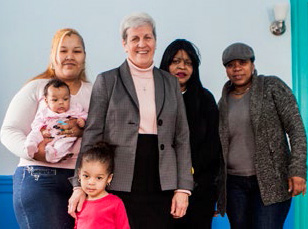
Sister Janet standing with residents of Providence House

Guest Blog: Sister Janet on Hateful Rhetoric in the Presidential Campaign

Sister Janet’s Remarks at Union Theological Seminary

Sister Janet Kinney, CSJ
September 1, 2016

On Thursday, September 1, 2016 Sister Janet Kinney, Executive Director of Providence House and a “Nun on the Bus,” joined Rev. William J. Barber, II and other national faith leaders to “speak out against hateful rhetoric and policies and the historical revisionism we are seeing in the Presidential campaign.” She said:

I am Sister Janet Kinney, a Sister of St. Joseph, and one of the 19 “Nuns on the Bus” who toured the country just a few short weeks ago. A project of NETWORK Lobby for Catholic Social Justice, I, together with my sisters, rode through 23 cities in 13 states, listening and engaging with others in various types of gatherings, comprised of diverse representations of our country.

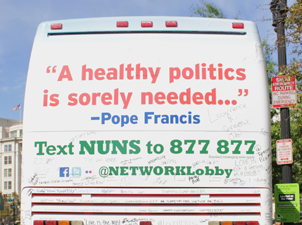
We went on the road in response to the divisive rhetoric of this 2016 election cycle, and as an answer to Pope Francis’ call that a ‘healthy politics is sorely needed to resolve the widening income gaps, especially the racial/ethnic and gender wealth gaps. To mend these gaps we must have a politics of inclusion where everyone’s voice is heard and given serious consideration.

Our tour included stops at both national party conventions, participating in multiple conversations and caucuses in every city we visited. We visited sites of social justice ministries and met with faith and community leaders alike. As I listened, encountered and spoke with our brothers and sisters,  I realized that it is so hard for people to find hope in the civil discourse of today.  I  heard heartbreaking stories of struggling families, of stark economic inequalities and blatant racism and discrimination.

People are hungry for hope and justice for communities that will stand together regardless of one’s race, ethnicity, or culture.  This cannot be done through the damaging and hateful speech making that is being heard in this political season. We need to promote the common good, engage in constructive dialogue and create inclusive policies reflective of an authentic democratic society.

That is what I heard traveling as a Nun on the Bus – morning, noon and night – in the voices and cries of “We the People”.

Immediately following on this experience, over 5,600 religious sisters across this country signed a letter asking our presidential candidates ‘to engage in political dialogue that reflects the principles and values upon which this nation was founded.’  We implored these candidates to refrain from language that stokes the fires of fear and disrespects, dehumanizes or demonizes another. We urged them to engage in careful listening and honest dialogue. They must respect and treat all with the reverence that is a sacred God given right.   It is then, only then, that we can together create an environment where everyone has a rightful place at the table and all are welcomed here in this, the United States of America.

Blog: 10 Things Speaker Ryan Could Do to Address Poverty Right Now

10 Things Speaker Ryan Could Do to Address Poverty Right Now

NETWORK Lobby
June 7, 2016

NETWORK Lobby for Catholic Social Justice welcomes anyone, any time, to the conversation about how to make sure no one in the United States lives in poverty. But we strongly dispute the claim that this is a deeply complicated problem requiring a brand new agenda, such as the one likely to be presented by Speaker Paul Ryan in the coming days. The fact is Congress knows, and has always known, how to end poverty. It is simply not that difficult, in the richest country the world has ever known, to create an inclusive economy where everyone has the resources to live with dignity.

In fact, we could do much of it as early as tomorrow.

Toward that end, we offer Speaker Ryan, the driving force behind the Republican “anti-poverty” agenda, 10 things he could bring to the House Floor tomorrow that would actually work. This is not everything that has to be done to mend the gaps in the fabric of our society, but it’s a darn good start.

  1. Raise the minimum wage to $15 an hour — Even as the economic recovery has brought lower unemployment, too many people working full-time jobs (or even two or three of them) don’t make enough to get by. A study by the National Employment Law Project found that $15/hour was the lowest wage that would still allow a single worker to meet the basic cost of living just about everywhere in the United States. Speaker Ryan could help lift thousands of workers out of poverty by passing H.R. 3164, the Pay Workers a Living Wage Act introduced in Congress last year.
  2. Guarantee paid sick leave — 49% of workers in America still lack paid sick leave and are forced to choose between losing the salary they desperately need and jeopardizing their health and the health of those around them. After passing a comprehensive paid sick leave policy New York City found not only that it improved the health and financial security of workers, but also that unemployment dropped and businesses grew.The Healthy Families Act (H.R. 932) was introduced in Congress more than a year ago. There’s no excuse not to pass this legislation today.
  3. Guarantee paid family leave — In addition to ensuring that everyone has the ability to take a sick day to care for themselves or their family, we must also guarantee paid leave for new parents and those who have to take extended time to care for a sick family member. Only 5% of workers in the lowest 25% wage category have access to paid family leave, compared to 22% of workers in the highest 10% wage category. The FAMILY Act (H.R. 1439), introduced in Congress last year, builds on successful legislation passed by cities and states around the country to create an insurance program that provides workers with the family leave they need.
  4. Expand and protect the Earned Income Tax Credit — The Earned Income Tax Credit (EITC) is one of our most effective anti-poverty programs. It provides tax relief to low-income workers to ensure that no one who labors to earn a basic wage is taxed back into poverty. According to the Center on Budget and Policy Priorities, the EITC helped lift 6.2 million people out of poverty in 2013. But the current law overlooks too many workers in need, including those low income workers without children and workers under 25 or over 65. Speaker Ryan himself discussed his support for addressing these gaps when he was Chairman of the House Budget Committee, now he has the means and the opportunity to make those changes today.
  5. Expand childcare subsidies — The high cost of quality childcare takes a dramatic toll on low-income families across the country. A report from theEconomic Policy Institute found that in every state, quality childcare cost more than 30% of a minimum-wage worker’s earnings. Access to high quality childcare allows parents to support their families and better prepares children to learn and grow into healthy adults. We shouldn’t ask people to choose between their kids and their paychecks — H.R. 4524, the Child CARE Act, is one way that Speaker Ryan could solve that problem.
  6. Ban the box — It’s no secret that admitting to having a criminal record is the kiss of death for job applicants. Conviction records are likely to reduce the prospect of a job offer or interview by almost 50%. There are currently 70 million people in America with arrest or conviction records, we are only just beginning to realize the massive economic implications of discriminating against the people who are reentering society and the workforce. Passing the Fair Chance Act (H.R. 3470) would allow people seeking to reenter the workforce the opportunity to apply based on merit, without facing discrimination.
  7. Pass immigration reform with a path to citizenship — For the millions of people who live in the U.S. without documentation or with only temporary permission to work, finding stable employment can be nearly impossible. Many more immigrants are barred from accessing the social programs they need because of decades of anti-immigrant legislation. By allowing immigrants to come out of the shadows and fully participate in society, immigration reform would benefit individual families and our community; the CBO estimated that immigration reform would reduce our federal budget deficit by $200 billion over ten years. H.R. 13, the Border Security, Economic Opportunity, and Immigration Modernization Act, had the votes to become law in 2014 and is a viable solution to fixing our broken immigration system. Speaker Ryan should work with his fellow members of Congress to pass real immigration reform now.
  8. Expand eligibility and opportunity for low-income housing units — There is a significant shortage of affordable housing units across the country. Bipartisan legislation in the Senate rumored to be introduced in the House of Representatives (The Affordable Housing Credit Improvement Act) would incentivize the building and preservation of almost 1.3 million homes. Speaker Ryan can move forward with his commitment to end poverty by developing a housing plan that focuses on ensuring that everyone has a home.
  9. Continue to make healthcare more affordable — The Affordable Care Act was a critical step toward making sure that all Americans can access the healthcare they need, but it stopped short of realizing the goal of universal healthcare. H.R.3241, the State-Based Universal Health Care Act of 2015, would allow states more flexibility and freedom to work toward universal healthcare. Speaker Ryan can move forward today to ensure that no one lives in the healthcare gap and take a powerful step toward alleviating the economic uncertainty and financial burden of families still left without health insurance.
  10. Reauthorize and improve the Child Nutrition and WIC Reauthorization Act — The landmark legislation that helps feed children in schools across the country has been under attack by congressional Republicans. Congress has sought to cut the number of schools eligible to feed all of their students and increase the amount of time and effort schools must put into qualifying for the program. Beyond these initial changes that will kick thousands of students out of the program, Republicans in Congress want to replace the entire program with ‘block grants’ that will seriously jeopardize our ability to feed children in need. Congress has an opportunity to improve child nutrition programs to feed more children who are hungry. If Speaker Ryan wants to lead on poverty, he can start by leading his party away from policies that take food from children.

As NETWORK’s Nuns on the Bus reminded Congressman Ryan in 2012, to implement programs that work to eliminate poverty, Congress must have the political will to raise reasonable revenue for these responsible programs. We can pay for these programs by closing tax loopholes and having the courage to fix our broken tax system. Right now, a loophole in tax law allows hedge fund managers to call a portion of their earnings a ‘capital gain’ instead of ‘income’ and that small difference costs the nation billions in tax revenue every year. The Carried Interest Fairness Act (H.R. 2889) is one such piece of legislation that promotes tax fairness in the United States.

Creative solutions to solving poverty are necessary, but we don’t need to look far to find the answers. What if — instead of giving the billionaires another break — we took that money and used it to expand Section 8, the federal program that helps low-income families find affordable housing? NETWORK Lobby judges all legislation by how it would affect people experiencing poverty. If Speaker Ryan is serious about this issue, we encourage him to use the same criteria.

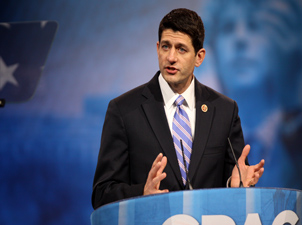
Photo courtesy of Gage Skidmore

Pope Francis’ Impact on the Catholic vote in 2016

Commentary: Pope Francis’ Impact on the Catholic vote in 2016

By Simone Campbell, SSS
May 5, 2016

When the Bernie Sanders campaign announced plans to visit the Vatican, more than one journalist asked me for comment on the oddity of a progressive candidate seeking to associate himself with an institution whose views are antithetical to much of what he espouses. This, I believe, is a fundamental misunderstanding of how the majority of Catholics in America view the role of their faith in their political and civic life. Call it the Pope Francis effect. It is real and, because Catholics are the preeminent swing voters, it will matter a great deal.

In this, the first presidential election in the era of Pope Francis, attempts to control the “Catholic vote” through issues of personal sexuality – often nothing more than a crass political calculation – will no longer work as well, if at all. Instead, those who seek to divide our nation will find themselves up against a spiritual leader who has taken the teachings of our faith that have resided for many in the dusty tomes of Catholic scholarship and philosophy and made them breathing realities in our daily lives. In doing so, he has energized Catholics to embody the center of our faith – active concern for the common good and attention to the needs of those around us.

And then he has taken this sacred work a step further. The pope has reminded our elected leaders and all of us that individuals, churches, and communities, while vital to the work of taking care of each other, cannot be expected to do it all alone. The work of ending the vast disparities of wealth and opportunity in America and around the world can only be accomplished by implementation of policies on a grand scale, a political scale – a tax policy under which everyone and every corporation pays its fair share and all employers pay their workers a living wage; policies that encourage a “family-friendly workplace,” recognizing that the economy is at the service of workers, not the other way around.

This call has not been the least bit coy or veiled. In his speech before Congress in 2015, Francis told our elected officials, “You are called to defend and preserve the dignity of your fellow citizens in the tireless and demanding pursuit of the common good, for this is the chief aim of all politics. A political society endures when it seeks, as a vocation, to satisfy common needs by stimulating the growth of all of its members, especially those in situations of greater vulnerability or risk.”

The pope’s words have clearly broken through to the professional political class, though whether it is through their hearts as well as their talking points, I leave to others to decide. For proof, look at House Speaker Paul Ryan’s public apology for his past rhetoric blaming the poor for their own poverty. Were Ryan to also publicly recognize, for example, that his mea culpa did not go far enough, and that the full implementation of the Affordable Care Act and the expansion of Medicaid to those who are most vulnerable is a pro-life position, perhaps the transformation would be more believable.

Ultimately, though, Francis recognizes that politicians are essentially stand-ins for the rest of us. It is the electorate who must heed the call to become politically active. It is up to us to recognize that in the wealthiest nation the world has ever known, the fact that there is still a vast difference in life expectancy between the rich and the poor is a collective wrong that we have a moral obligation to make right.

Hence the pope’s repeated calls for Catholics to “meddle in politics,” his repeated calls to, yes, feed and house and meet basic human needs from our parishes, but also to go out into the world and call for, vote for, big change – a reformed immigration policy that recognizes and embraces the dignity of our brothers and sisters, regardless of where they happened to be born; national spending priorities that recognize the need for safe, affordable housing as greater than the excitement over a newer, faster, deadlier weapon of war.

While Catholics do not vote as a single bloc, they are nonetheless a renowned bellwether in the political world, having voted for the winner of the popular vote, with one exception, in every presidential election since Roosevelt.

This year will not be different. When the chattering class analyzes the “Catholic vote,” as it will inevitably do – both before and after the primary and general elections – it will find that in this year of mercy, our votes stretched far beyond our self-interest and to the common good, that we turned out and voted for the needs of those who are most often left out of our care. We will be called the “Pope Francis voters.”

Originally published in The Philadelphia Inquirer.

Blog: An American Dream for All Americans

An American Dream for All Americans

By Monsieree De Castro
April 18, 2016

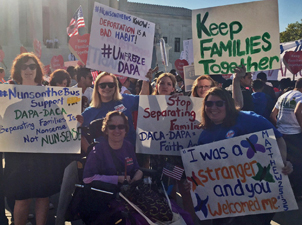
As a Filipino immigrant, I’ve always stood out. My dark hair, dark skin, foreign language, and Asian features have always distinguished me from the majority of those around me. Today I didn’t stand out for being foreign. Today I wasn’t just an immigrant. Today, 4,000 of us stood outside the Supreme Court in solidarity with one another. We come from different countries, we speak in different tongues and practice different religions, but today we came together as Americans to support our immigrant brothers and sisters. Together we’re asking the Supreme Court to support DACA+ and DAPA: giving undocumented immigrants the chance to live without fear, and fully pursue the American dream.

It was an honor to stand alongside those who continue speak up and use their voice, even as rhetoric around the country is attempting to crush their morale. I was in awe witnessing the unity and joy radiating from the crowd. Our African-American brothers and sisters from the Howard University Gospel Choir sang hymns reminiscent of the civil rights era. Mariachi bands nourished the Mexican spirit whirling in the air. Korean drums had all our hearts beating to the same rhythm and conviction.

The scene outside of the Supreme Court today was a testimony of how beautiful our country can be when we come together, cherish each other’s differences, and uphold each other’s dreams. Growing up as an immigrant, it was difficult be proud of my heritage when it’s what made me different. As I stood outside of the Supreme Court today, I proudly proclaimed my immigrant background, and embraced my Filipino heritage. Today demonstrated that we as a nation should be proud of our immigrant sisters and brothers, and the strength and beauty they’ve brought to our country.

We stand together as one nation, as one people, united by our convictions and strengthened by our differences. We’ve all come to this country pursuing our own American dreams. Now we pursue the dream of an America where everyone is celebrated because of where they come from. We are a greater and more harmonious country when everyone is allowed the opportunity to dream.

We remind the Supreme Court of the words of 6-year-old Sophie Cruz: “You too were children, you too had dreams like me.”

Blog: DACA and DAPA: More Than Just a Policy

DACA and DAPA: More Than Just a Policy

By Diana Pliego
March 15, 2016

To many, November 20, 2014 was just another day. To millions of others, it was a day long anticipated with hope for a drastic change in the way they lived their lives.

For them, a Presidential announcement that would be made that day could mean receiving the opportunity to work legally in the United States, obtain their driver’s license, and be safe from deportation proceedings that separate families and uproot lives. It could mean no longer living in fear.

For my family, that is exactly what that announcement for Deferred Action for Parents of Americans (DAPA) meant.

For too long, my family has lived in fear and in the shadows. My parents are afraid of the most mundane tasks due to the very real and ever-present fear of deportation that looms over us and millions of others each and every day. Every trip to the store is a calculated risk, every commute to work is taken with extreme caution, and every sighting of the police incites fear and unease. My parents do not celebrate holidays like most Americans. Celebrating the Fourth of July would require leaving our house on one of the most patrolled nights of the year. We understand that police are only trying to keep our communities safe by catching those who chose to drive under the influence, but a single stop at a check point could result in my parents being detained and potentially deported.  These same fears keep us indoors on New Year’s, Christmas, Memorial Day, Labor Day and any other highly patrolled day of the year.

DAPA would mean they could obtain a driver’s license and leave the house like any other American wishing to celebrate this great country on Independence Day, because, like many other immigrants, they have a different perspective and unique sense of gratitude for this land of opportunity.

My family, like many others, immigrated to the United States in search of a better life. In 1994, Mexico experienced its worst financial crisis since the Great Depression.  In 1996, my dad lost his job at a bank where he had worked for seven years. There were no jobs to be found. Church members with small businesses, barely making ends meet themselves, were hiring other church members for jobs not needed as a way to help our their fellow sisters and brothers. My father tried to start a small business selling fruits and vegetables, but he had no car and was barely breaking even with his business expenses. He had four mouths to feed, another on the way, and the way things were going he would not be able to afford my mother’s upcoming childbirth costs. So, he decided to come to the U.S. in search of job opportunities—a temporary solution while things got better at home. But, they never did.

A year later, after much prayer and internal struggle, my mother followed my father’s steps and came to the U.S. with my brothers and me at her sides and in her arms. My older brother was five, I was three, and my younger brother was seven months old. My youngest brother was later born in the U.S. in 1998. This happened despite surgical efforts to prevent my mother from having any more children. You could say he was meant to be born. It is because of him that my parents qualify for DAPA.

DAPA would provide for them what Deferred Action for Childhood Arrivals (DACA) provided for my brothers and me in 2012. Because we had arrived in the US before the age of 16 and met other requirements, we received work permits which allowed us to receive a social security number. That long-coveted nine-digit number allowed us to obtain a driver’s license—a common rite of passage that to us meant belonging and safety. But more importantly, we received a two year protection from deportation. We could finally get jobs, drive, and plan for our future knowing we now had one. We could now attend state colleges and could be employed upon graduation, a very real fear of many undocumented college students.

DACA changed my family’s life. It enabled my family to pay for my first three years of my college because, despite earning a scholarship, it took every member of my family working, including my two high school brothers and me, to cover the costs of room and board. Three years later, our financial circumstances have shifted 180 degrees. We still face financial challenges like many families, but we no longer worry about where our next meal is coming from. For us, that is a victory. I can only imagine the change my family would experience if my parents were afforded the same opportunities for advancement. What kind of job would my mother qualify for with her incredible spirit and talent for working with people? Would my father finally step back from the physically demanding job that is taking a toll on his body and pursue a different, higher paying career? Would my older brother finally be able continue his education?

If DAPA were implemented, how would the lives of immigrant families across the U.S. change? How would our nation be impacted? According to the Center for American Progress, every day that we do not implement DAPA and expanded DACA, the U.S. loses $8.4 million in GDP. See the cumulative total here.

In 2012, DACA could not have come soon enough. In 2014, DAPA did not come soon enough, but it came. Unfortunately, 13 days later Texas and other states filed a lawsuit against the President’s executive action. For almost a year, these actions kept DAPA tied up the courts. On November 9, 2015, the 5th Circuit Court ruled against the administrative actions.

One year after the original announcement, the Department of Justice filed an appeal asking the Supreme Court to take up this case. Three days later, Texas requested 30 more days to review the White House’s appeal. More delays. In the meantime, families continue to live in fear and with limited opportunities. Fortunately, in a rare move by the Supreme Court, the 5th Circuit Court was denied its request and instead granted an extension of only eight days. This move made it much more likely that the Supreme Court would take up the case during the current term and come to a decision by late June—a small, but significant victory for DACA/DAPA.  Finally, on January 19, the Supreme Court decided to take up the case.

Recently, NETWORK participated in a “Prayer for Justice” at the Supreme Court where people from different faith backgrounds and immigrants gathered to show support for DACA/DAPA. Religious leaders from different faiths said a prayer for justice for immigrants across the United States. Young children with undocumented parents, like my citizen brother, came forward and spoke bravely of their reality. Hearing my childhood story of fear and financial hardship being told by yet another generation broke my heart in ways that I cannot describe.  My heart broke a little more when I heard seven year-old Eddy ask for DAPA for his parents because he “doesn’t want to lose them.” Tears swelled up in my eyes as I heard my own fears expressed through the mouth of a young child, because losing your parents to deportation is a fear that does not diminish with age. If anything, I understand now better than ever the real implications of policy being debated and politicized. I understand the cruelty of playing politics with people’s lives. Eddy was born in Ohio, just like my youngest brother. His demeanor and bravery reminded me of my brother at that age. His story, and the story of all the others who testified, reminded me why I do what I do. We cannot give up this fight.

Our prayer is that the Supreme Court rules wisely by upholding the executive action of President Obama. By doing so, they will change the lives of millions of families and create further prosperity for our nation as DACA once did.

Guest Blog: The Power of Sisterhood

Guest Blog: The Power of Sisterhood

Sister Bernadine Karge OP
March 8, 2016

What a wonderful day and a half at the Sisters in Public Leadership  training in DC the first weekend in March 2016! I am most grateful for this experience learning about media and advocacy with the women and men of NETWORK and Faith in Public Life.

My name is Sister Bernadine Karge, and I am an immigration attorney. For most of my ministry I have worked in direct service with education and advocacy on the sideline. Having been a “Nun on the Bus” during the last three years brought opportunities to speak with reporters, to engage others in issues dear to their hearts and to be welcomed into diverse faith and ethnic communities and enabled me to experience and share my gifts and talents in new ways.

The most surprising part of our Sisters in Public Leadership training was the sense of sisterhood I felt and owning the title of “sister” to speak the truth about the lives, hopes, struggles and dreams of all the people who have blessed my life. Meeting the other sisters from across the country increased our sense of sisterhood. Our passion for justice and service for the poor connected us immediately. We could laugh and cry together at the mess of our world.

One valuable skill I developed was connecting the moral and religious aspect with the legal aspect of immigration, which has been my passion for decades. To come at the question as a Catholic sister, rather than as only a legal advocate was a helpful shift in perspective. I was encouraged not to be fearful of speaking out from a faith perspective.

The community of our sisterhood has been hidden under a bushel basket. Sisters are no longer immediately visible without traditional habits, but even more significantly, we have not seen ourselves as others see us, as powerful women with life and faith experience for which our world hungers. We are the ones who can take the risk to bring the faces of the poor to those who do not see them.

The feeling of trust and belonging that was shared during my Nuns on the Bus experience expanded my sense of community to those of other faiths. We are all one – not because we believe or act the same way, but because we all breathe the breath of God who calls us to the fullness of life in God’s image. It is our role to share our light, our life and our love with all.


Sr. Bernadine Karge OP
Chicago, IL
Dominican Sister of Sinsinawa, WI

NETWORK Stands with Refugees

NETWORK Stands with Refugees

By Meg Olson
November 23, 2015

NETWORK weeps with all who are suffering from violence all over the world. The principles of Catholic Social Teaching teach us to live in solidarity with our neighbors, with empathy for all who are suffering regardless of religion, race, or nationality. Together with the global community, we mourn the attacks in Paris. We pray for the lives that were lost and pray for healing for the injured as well as the families and friends of victims.

We also pray for all victims of violence in other countries including Beirut, Baghdad, and the ongoing violence in Syria. When hearing of these tragedies, we cannot forget the lesson taught in the parable of the Good Samaritan: our neighbor may not be someone who looks like us, speaks our language, or shares our customs. When Pope Francis came to the United States he encouraged Congress to heed the call to welcome the stranger saying:

Our world is facing a refugee crisis of a magnitude not seen since the Second World War. This presents us with great challenges and many hard decisions. … We must not be taken aback by their numbers, but rather view them as persons, seeing their faces and listening to their stories, trying to respond as best we can to their situation. To respond in a way which is always humane, just and fraternal.

For us, the faithful response is to welcome Syrian refugees of all faiths into our country and our communities. We must do this if we truly recognize the sacred call to protect and nourish all life. We must denounce Islamophobia that threatens our Muslim sisers and brothers from any source – from a neighbor in line at the grocery store to members of Congress, governors, and Presidential candidates. Fear cannot and must not be an excuse for inaction, or worse, a rejection of our faithful duty to respond to the urgent needs of our Syrian brothers and sisters. We must live up to the words of Jesus in the Gospel: “For I was hungry and you gave me something to eat, I was thirsty and you gave me something to drink, I was a stranger and you invited me in” (Matthew 25:35.)

I invite you to join me and NETWORK members across the country in calling on your senators to welcome refugees by following these steps:

Call 1-888-897-9753 to contact your senior Senator’s office.

When you call, here’s what you might say: 

“Hi, my name is [NAME], and I am a constituent from [CITY]. I’m calling today because I stand with Pope Francis and urge you to welcome refugees from Syria fleeing violence. Please oppose any legislation that attempts to limit access to refugees based on their religion or country of origin.” 

Call 1-888-496-3502 to contact your junior Senator’s office.

When you call, here’s what you might say: 

“Hi, my name is [NAME], and I am a constituent from [CITY]. I’m calling today because I stand with Pope Francis and urge you to welcome refugees from Syria fleeing violence. Please oppose any legislation that attempts to limit access to refugees based on their religion or country of origin.” 

Blog: Cities Take Steps to Protect Immigrant Communities

Cities Take Steps to Protect Immigrant Communities

Rachel Schmidt
Oct 30, 2015

Certain politicians are intent on categorizing all undocumented immigrants as “rapists and criminals” that need to be kept out of the United States with giant walls on the southern border.  This rhetoric creates fear, perpetuates racism, and is dehumanizing. The term immigrant has historically been used in our legal system to categorize people who migrated here from other countries and that has often been translated into “less-than” in our society. Thankfully, some cities in the U.S. are embracing policies that ­­­do not tip-off Immigration Customs Enforcement (ICE) about those who are undocumented. These municipalities have colloquially come to be known as “sanctuary cities” and are important to uplift, for they promote safer communities where trust exists between local law enforcement and community members.

There are many benefits sanctuary cities provide to all residents of the U.S. The obvious positive for people who are immigrants is that local authorities are not actively reporting their immigration status, which could lead to deportation back to their country of origin, if undocumented. This results in people, often undocumented parents and U.S. citizen children, being separated from family, friends, and communities. Individuals and families categorized as immigrants or refugees are often forced to return to dreadful violence or extreme poverty that prompted their migration to the U.S. in the first place. This practice is a violation of human rights and ongoing abuses are deeply feared by immigrant justice advocates across the U.S. as it leads to unsafety in our communities. People who are immigrants are less likely to trust local authorities and report crime or domestic violence if the threat of a deportation looms over them. This is not good for anyone in society.

Our hearts must be broken open to the anguish individuals and families are experiencing because of current immigration laws. This video from the 2015 Nuns on the Bus campaign shows the struggle families go through when members are deported. If this family was under sanctuary city protection, their story would not have been filled with such deep pain.

Last week, the Senate voted down S. 2146 that would punish the local governments that choose to exercise their discretion by not asking about an individual’s immigration status. We are grateful for this win. However, this is not the end of threats to sanctuary cities. The bill was labeled the “Donald Trump Act” after Trump’s proclivity to blaming immigrants for the problems of the nation. As long as anti-immigrant sentiment similar to Trump’s exists in Congress, there will be attempts to punish cities for acknowledging the humanity of people who are undocumented.

Individuals and families who are immigrants are already dealing with blatant racism and discrimination, and we must not encourage further discrimination by attacking sanctuary cities. As Pope Francis said while he was in the United States in September “”We, the people of this continent, are not fearful of foreigners, because most of us once were foreigners.” Eleven million people would not be undocumented in this country if we would pass comprehensive immigration reform that outlines a pathway to citizenship. We could also be doing more to invest in finding solutions to end the violence and poverty rampant in the countries of origin. Most of the money currently spent trying to resolve this humanitarian issue is being allocated toward the militarization of our borders where refugees are being turned away and back to the danger they are fleeing from. We need to support these individuals and families who are only trying to survive.

Blog: Immigration Update

Immigration Update

By Laura Peralta-Schulte
August 28, 2015

The Republican presidential contest is in full swing and one of the key issues that have been discussed thus far is the issue of immigration. Unfortunately for supporters of comprehensive immigration reform, the hysteria and demeaning rhetoric on the campaign trail has spilled over to the Halls of Congress with anti-immigrant Members of Congress once again pushing legislation to further militarize the U.S. border and to increase enforcement actions against immigrant communities around the country. The religious community, working with immigrant rights groups, is actively working to stop anti-immigrant legislation in Congress.

Pope Francis’s arrival in Washington, DC and his address to Congress on September24 present a challenge to anti-immigrant Members as well as the Republican leadership in Congress. It is widely expected that the pope will raise the issue of immigration during his trip and call on Members of Congress to pursue policies that welcome immigrants and refugees. It is hoped that his visit will have a positive impact on the Hill.

One of the most immediate threats this September is a bill that passed the House right before August recess and is set to be taken up in September. Sponsored by Senator Grassley and Senator Vitter, it is called the “Stop Sanctuary Cities Act” (S. 1814). The Grassley/Vitter amendment seeks to coerce law enforcement agencies (LEAs) to implement DHS’s immigration detainers, even though multiple federal courts have found that such detainers present constitutional problems. Under the amendment, law enforcement officials in over 300 cities and countries that refuse to honor the detainers risk losing federal justice department (“DOJ”) and housing department (“HUD”) funding. The amendment also creates new mandatory minimum sentences that would create unprecedented overcrowding in the federal prison system, even as other leaders and lawmakers including the senators’ own colleagues on both sides of the aisle have committed to reduce incarceration levels in our nation’s prisons and jails.

A second threat exists to immigrants in budget and tax debates. There are some human needs programs and tax credits, such as the Child Tax Credit, that benefit immigrant communities. There are already a number of proposals to cut back or eliminate these benefits to immigrant communities.

Finally, our community continues to demand that the Obama administration end the practice of placing young mothers with children fleeing violence in Central America in detention facilities. Family detention victimizes young mothers and children who are not a threat and have committed no crimes. Further, there are humane alternatives for detention for this vulnerable group.