

Category Archives: Immigration

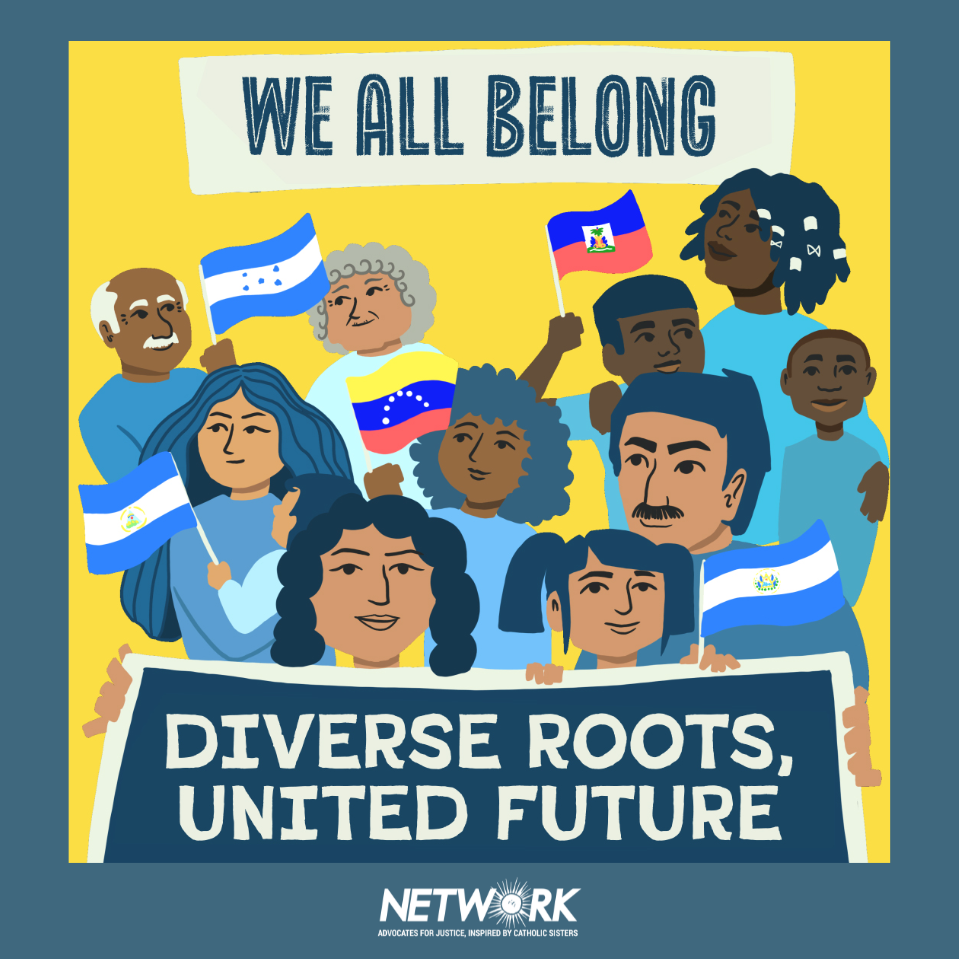
Honoring Black History Month: Immigration is a Civil Rights Issue

Honoring Black History Month

Immigration is a Civil Rights Issue

Black History Month isn’t just about the past—it’s about fighting for justice today. Immigration is often overlooked in these conversations, but the struggle against nativism and xenophobia is deeply tied to the Black freedom movement. From restrictive immigration policies to the mistreatment of Haitian migrants, we see how racism shapes who is welcomed and who is excluded.

In this powerful reflection, Adam Russell Taylor, President of Sojourners, reminds us that a just and humane immigration system is essential to the fight for civil rights. If we believe in justice for all, we must challenge the policies and attitudes that harm immigrant communities.

Watch the video below, and join us in action!☀️

Want to dive deeper into the systemic inequalities that keep racial and economic justice out of reach for so many? Sign up for our Racial Wealth and Income Gap workshops to learn how we can take action together! Sign up here.

Immigration Policy in the 2nd Trump Presidency

President Trump’s first days in office were filled with a flurry of executive orders targeted not only the safety of our immigrant siblings, but the time-honored U.S. asylum and legal immigration process. Content, which is available at the links below, is accurate as of January 22, 2025.

NETWORK has categorized the Executive orders into four categories:

  1. The entering of refugees and people seeking asylum
  2. Birthright citizenship
  3. Rescinding earlier executive orders
  4. Enforcement, detention, and deportation  (This is the executive order category that most concerns NETWORK).

Below are summaries of the Enforcement, detention, and deportation executive orders. You can see more complete analysis on our sister site, networkadvocates.org.

EO action NETWORK analysis Known legal challenge
Expands expedited removal Expands Homeland Security (DHS) application of expedited removal, or the government’s power to quickly “remove” someone from the U.S. without due process. Previously, ICE and CBP were authorized to arrest and remove people within 100 miles of the border, within 14 days of their arrival. This EO allows for the deportation of any noncitizen found anywhere in the United States who cannot prove to the satisfaction of a U.S. ICE agent that they have been in the country for more than two years, unless they can prove credible fear of persecution. Expedited removal is being enforced immediately, but there are no reports of arrests as of Jan. 23. ACLU filed suit. No hearing set.
Freezes funding for NGOs Paused federal funding to organizations that support immigrants in “any way.” The Administration directed an immediate review and audit of all contracts with such organizations and will terminate any contract if found guilty of “fraud.” This would impact faith-based organizations like Catholic Charities and Annunciation House. Effective immediately, many organization’s funds have been suspended. However, we have yet to hear of organizations being asked to provide documentation or dates for audit.
Criminalizes aid Organizations and individuals who support or shelter immigrants may be held criminally liable for supporting “invasion.” Not in effect immediately.
Increases funds for U.S. detention centers No impact immediately.
Designates cartels as terrorist groups This could impact churches and faith leaders who work with immigrants across the border and who cross the border to work with immigrants in Mexico. This is effective immediately but there is no impact as of Jan. 24.
Allows ICE and CBP officers into sensitive and sacred locations The Trump administration rescinded the Sensitive Locations Memo, which for many years protected churches, hospitals, and schools from invasion by ICE and CBP officers seeking to arrest undocumented people. This is effective immediately. We have not heard reports of any arrests or raids except for instances of ICE “visiting” churches–not for prayerful purposes, and making no arrests. NETWORK has Know Your Rights guidance for Immigrants to help you know what to do if ICE or CBP approach. Filed. No hearing set
Allows ICE and CPB in judicial areas The Judicial Locations memo was rescinded, ending the policy of keeping public spaces inside or outside courtrooms free of ICE and CBP. Now, all judicial areas, except judicial chambers, are subject to ICE or CBP activity. Effective immediately. No impact reports yet.
Ends sanctuary cities The federal government will now condition state and city funding on their cooperation with ICE and CBP. This is effective immediately, but the impact will be felt later when funding cycles come up or if there is a natural disaster. No litigation yet.

You can see  more at our sister site, Network Advocates

Everyone in the U.S. has Constitutional rights, including including immigrants, with or without a document status. It is important that all of understand your rights if you are approached by law enforcement. NETWORK has created Know Your Rights one-pagers for this purpose. Click to download:

Know Your Rights for Immigrants – Bilingual One-pager
Know Your Rights for Immigrants – One Pager English
Conozca Sus Derechos – Half page Espanol
Know Your Rights for Immigrants – Half-pager English

Dreams of Inclusion

Dreams of Inclusion

Inaction by Congress Costs DACA Recipients the Ability to Participate Fully in a Democracy They Help Make Flourish

Sydney Clark
June 11, 2024

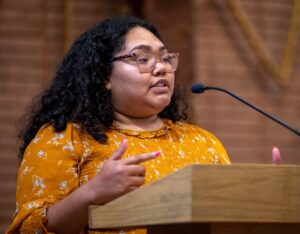
Ivonne Ramirez speaks about her experiences as a child immigrant and Deferred Action for Childhood Arrivals (DACA) program participant during Mass at Mary Mother of the Church Parish in St. Louis. Photo: Sid Hastings

Ivonne Ramirez was 8 when her family migrated to the U.S. from Mexico City. They arrived in St. Louis, Missouri, where her father and a sibling had been living for about a year.

“It took seven days to get to St. Louis,” Ramirez says. “I was mostly walking to cross the border. It took a lot out of me.” Her father, a police officer, left Mexico due to safety concerns after raiding a money-laundering operation inside a bar. He was only able to bring one of his children. Ramirez journeyed with her mother and three other siblings.

“I was sleep-deprived, and people kept telling me, ‘If you keep going, you’re gonna see your dad’,” she says. “Not seeing my father for a year felt like a lifetime.”

A few years after the family reunited, Ramirez became eligible for the DACA (Deferred Action for Childhood Arrivals) program, which began in 2012 as an executive action by President Barack Obama. This year marks a decade for Ramirez as a recipient.

She and her family still resides in St. Louis. She works full-time doing quality control for a medical equipment company. On weekends, she serves as a catechist at Our Lady of Guadalupe Parish in Ferguson, Missouri. “It feels like home. I’ve been here for most of my life,” Ramirez says.

Shut Out

While DACA has allowed Ramirez to attend school and get a driver’s license and a work permit, the realities of being a recipient remain at the forefront. She is one of roughly 580,000 active DACA recipients.

“Our permits and status allow us to be here for two years, and then we have to renew six months before,” she says. “This year, I’m OK, but next year, I have to start thinking about sending all the paperwork and the fee, which is $495. How will I get that extra income to pay for that?”

Recipients are ineligible to vote in federal elections, and Ramirez’s voting rights are nonexistent. Some states and municipalities allow noncitizens to vote in local elections like city councils, mayoral and school boards. Missouri is not one of them.

“If you pay your taxes, contribute to society, and show that you’re a model citizen, I don’t see why the efforts to put something permanent for [us] aren’t there,” Ramirez says.

In 2022, NETWORK honored Ramirez as one the organizations’ inaugural “Social Poets,” young justice-seekers whose lives and work define the challenges and possibilities of the coming decades. Unfortunately, permanent legal status for undocumented people in the U.S. remains an unaddressed challenge.

Juliana Macedo do Nascimento, deputy directory of federal advocacy at United We Dream and a DACA recipient. Photo: Diana Alvarez

At its height, DACA had around 840,000 recipients, says Juliana Macedo do Nascimento, deputy director of federal advocacy at United We Dream, the largest immigrant youth-led network in the country. A DACA recipient herself, she was 14 when her family migrated to the U.S. from Brazil. Macedo do Nascimento calls DACA the largest “victory of the immigration movement in decades.”

The program, however, has faced ongoing legal battles since its origin, leaving recipients in constant limbo.

“Many don’t know how much danger the policy is in,” Macedo do Nascimento says. The latest challenge happened on Sept. 13 of last year, when Texas federal judge Andrew Hanen ruled again that DACA is unlawful. Now, DACA will likely revisit the Supreme Court in 2025.

Although Hanen blocked new program applications, he left DACA unchanged for existing recipients during the anticipated appeals process. Recipients can continue to renew and apply for Advance Parole, which allows certain immigrants to leave the U.S. and return lawfully, said Macedo do Nascimento.

Bruna Bouhid, senior communications and political director at United We Dream, at a UWD Congress in Miami. Photo: United We Dream

“You feel like you’re on a roller coaster,” says Bruna Bouhid, senior communications and political director at United We Dream. “You never know if this will be your last chance to apply or if, in a year or six months, you will lose all those things you had planned for or worked hard to get.”

Bouhid, who became a recipient at 20, says the legal fights reveal that DACA will “not be our saving grace. We need something permanent. We need citizenship.”

Government Inaction

“It’s really up to Congress to find and support the solution,” says Christian Penichet-Paul, assistant vice president of policy and advocacy at the National Immigration Forum. “It’s the only branch of government that can ensure DACA recipients and other young DREAMers can stay in America long term and potentially become lawful permanent residents.”

Penichet-Paul says distrust among both parties and lack of courage helped derail legislative action and execution. He also predicts immigration reform talks in Congress will not advance during this election year.

“Democracy is such a precious thing, and it can take a long time to come up with a compromise,” Penichet-Paul says. “Sometimes, getting to the right place requires multiple little steps.”

As to when a policy window might open up, he notes, “It’s always said that Congress works best on a deadline. Unfortunately, that might be the next Supreme Court decision.”

Penichet-Paul stresses that there is bipartisan agreement and existing text that can serve as the bill that “finally provides permanence for young DREAMers who’ve been in America since they were little kids.”

One option could be a new version of the DREAM (Development, Relief and Education for Alien Minors) Act, first introduced in 2001. A version introduced last year by Senators Dick Durbin (D-Ill.) and Sen. Lindsey Graham (R-SC) would permit noncitizens brought to the U.S. as children to earn permanent residence aft¬er meeting specific education or work requirements. Durbin and Graham introduced similar legislation in the last three sessions of Congress.

Ivonne Ramirez speaks to parishioners at Mary Mother of the Church Parish in St. Louis. Ramirez, one of NETWORK’s “Social Poets,” has been a DACA recipient for the past decade. Photo: Sid Hastings

Additionally, Rep. Linda Sanchez (D-CA) introduced the U.S. Citizenship Act of 2023, which would tackle the sources of migration, reform the visa system, and “responsibly manage the southern border.”

“We can have a pragmatic system, looking at who needs and wants to migrate, but let’s create a system that is fair and humane for everyone,” Bouhid says.

Ramirez admits that she’s “a little scared” for the looming 2024 election but encourages those eligible in her community to vote.

“A lot of Americans know at least one, if not many, DACA recipients and immigrants,” she says. “If you get to know them and understand why they came to the U.S., you would happily vote in honor of them.”

Ramirez says her Catholic faith inspires her to be vocal about the challenges immigrants face.

“I never want to stop talking about us and why we need to become citizens,” she says.

Penichet-Paul says immigrants have grown up as “American as any U.S. citizen in many ways” and take civic participation and community service seriously.

“Immigrants are often some of our strongest allies in maintaining democracy and the institutions that allow our democracy to prosper,” Penichet-Paul adds. “Democracy can coexist with DACA and immigration. They’re about good governance and ensuring that people can reach their full potential, nothing more, nothing less.”

Sydney Clark is a New Orleans native and multimedia producer based in Washington, D.C.

This story was published in the Quarter 2 2024 issue of Connection.

NETWORK Reflects on the Do Not Be Afraid March and Vigil in El Paso

Tenemos Esperanza! Choosing Compassion in a Time of Scapegoating

Colin Martinez Longmore
April 4, 2024

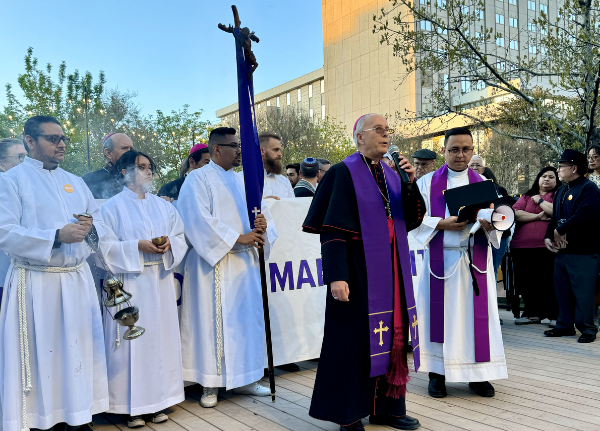
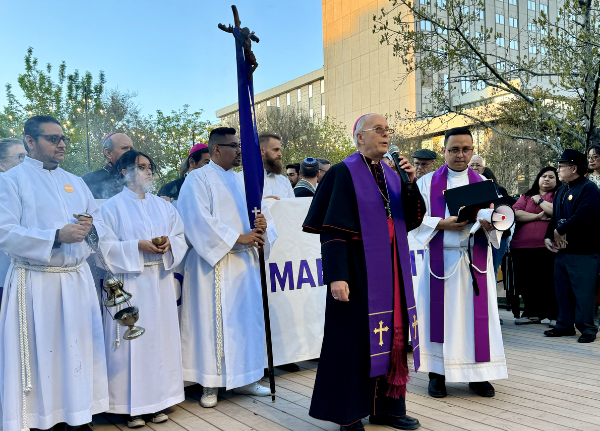
A beacon of hope shone brightly in EL Paso, Texas, the evening of March 21, 2024 as hundreds gathered for the “Do Not Be Afraid” March and Vigil for Human Dignity, hosted by the Diocese of El Paso and Hope Border Institute. The march and vigil, a show of solidarity with asylum seekers and migrants, powerfully displayed unity in the face of adversity.

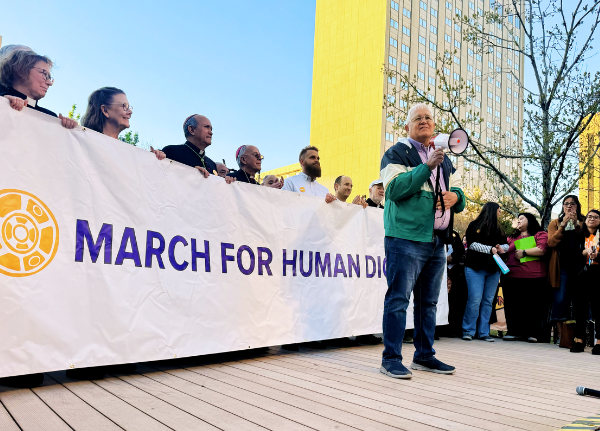
Ruben Garcia, Annunciation House, “Esta noche, todos somos Casa Anuncion (Tonight, we are all Annunciation House)”

Ruben Garcia speaks at the “Do not be afraid” march and vigil. Mary J. Novak is second from left holding the banner.

Over the past few months in the U.S., persistent hostility and scapegoating of migrants–and the direct service providers who aid them–has taken a sharper turn, particularly in Texas. Annunciation House, a network of shelters that receives and assists vulnerable asylum seekers, was targeted in unjust political probes.  Additionally, troubling state legislation like S.B. 4, which would allow local law enforcement to racially profile and arrest anyone suspected of being an undocumented migrant, was also signed into law (although it has not taken effect yet due to court challenges). Despite these actions, faith and borderland organizations showed they were unafraid. At the invitation of El Paso Bishop Mark Seitz, NETWORK Executive Director Mary J. Novak and I were proud to join them in offering support and prayer from the NETWORK community, and our help strategizing a way forward.

Bishop Mark Seitz, Diocese of El Paso said, “The work of God can never be made illegal”

Bishop Mark Seitz, Diocese of El Paso

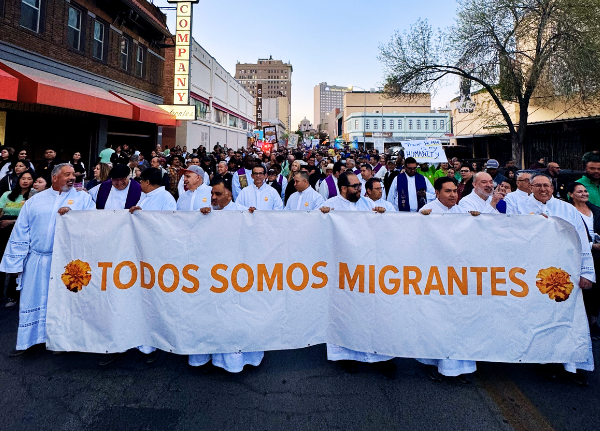
The rally began in San Jacinto Plaza and drew a diverse crowd, including many Catholic Sisters, religious and clergy, students, leaders from different faith traditions, as well as local and national organizations serving migrants.

NETWORK Reflects on the Do Not Be Afraid vigil and march in El Paso, Texas

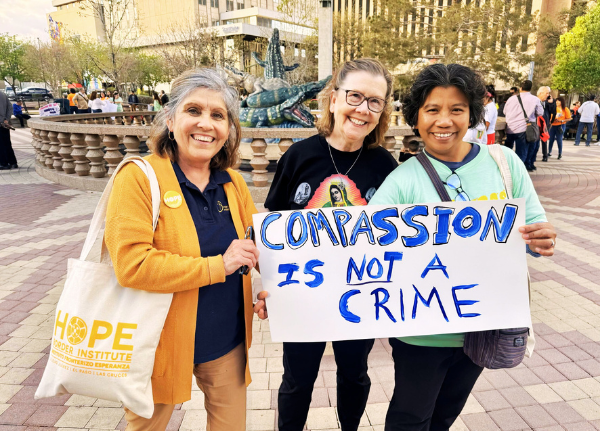
left to right, Elvira Ramirez (Executive Director, Maryknoll Lay Missioners), Mary Novak (Executive Director, NETWORK), and Sister Genie Natividad (Vice President Maryknoll Sisters)

Hope as a form of resistance against fearmongering was emphasized by the speakers who also held up the shameful criminalization of compassion; welcoming the stranger — a fundamental principle of faith — cannot be made illegal. We proclaimed in one voice, which rang out through the plaza: We have hope!Tenemos Esperanza! 

Marchers at the "Do Not Be Afraid" Vigil

Marchers at the “Do Not Be Afraid” Vigil

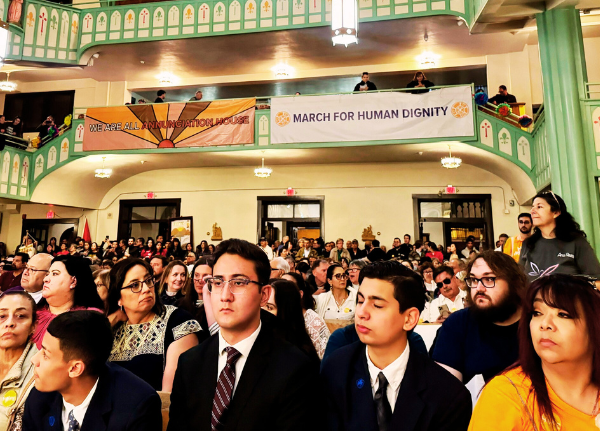
From the plaza, the crowd moved to Sacred Heart Church, where we filled every pew. The interfaith vigil, led by the Bishops of El Paso, testified to the city’s resilience and unity. Local leaders from across religious traditions, migrant organizations, and even asylum seekers spoke powerfully of solidarity and led the community in prayer.

The "Do Not Be Afraid" Vigil for Human Dignity at Sacred Heart Church

Attendees of the “Do Not Be Afraid” Vigil at Sacred Heart Church, El Paso, TX

The Holy Spirit’s presence was palpable throughout the evening, encouraging everyone to reject the fear and division often weaponized against communities like El Paso. As we enter this election season, we have clarity about the continued challenges that lie ahead for our migrant siblings and the communities that welcome them. However, our time in El Paso reminded us there is light and hope in the collective compassion and actions of communities standing together.


Move Past the Unserious

Move Past the Unserious

People Who Want Action on Immigration Should Look to These Proposals

Ronnate Asirwatham
April 2, 2024
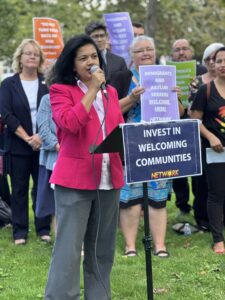
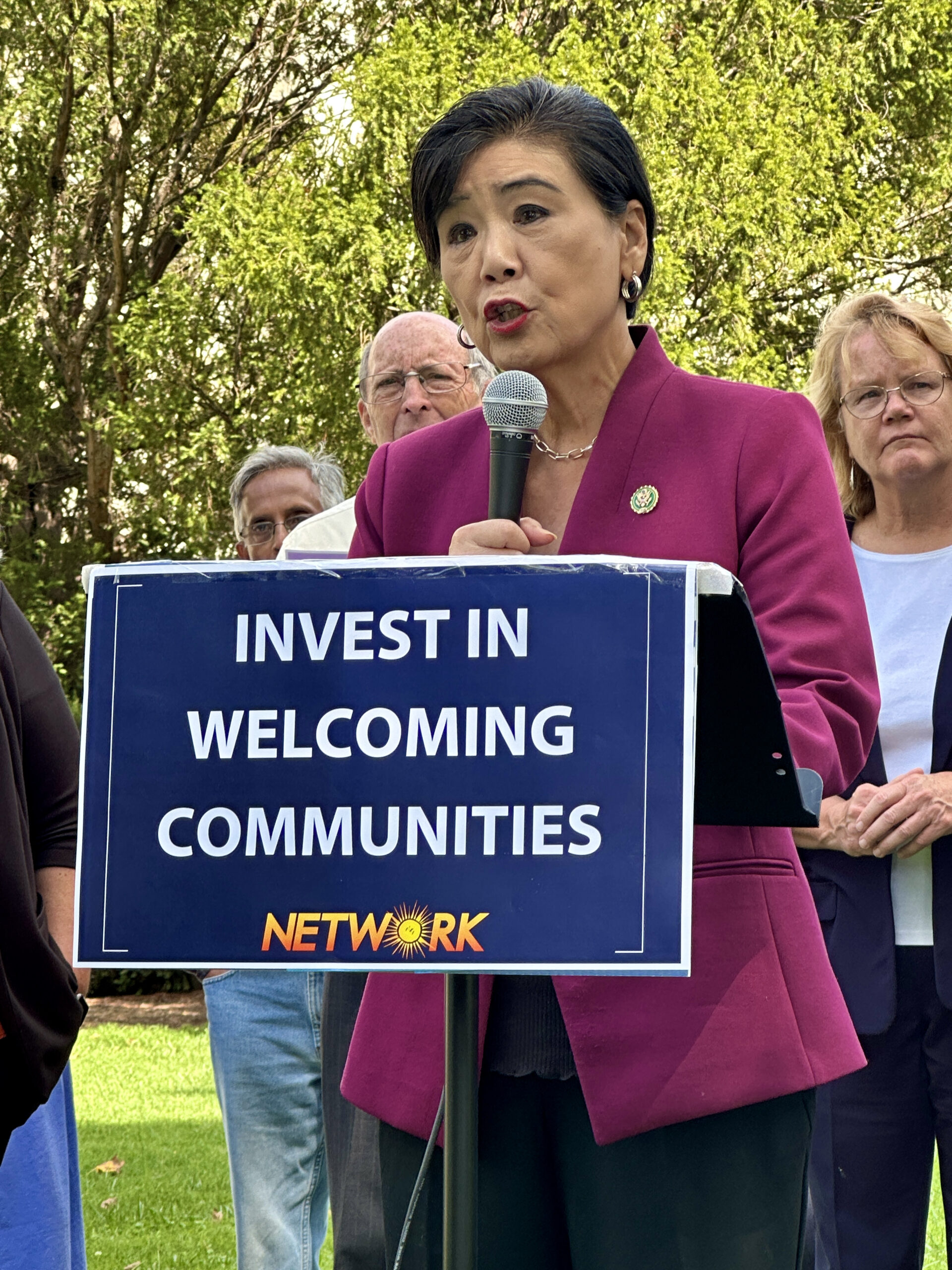
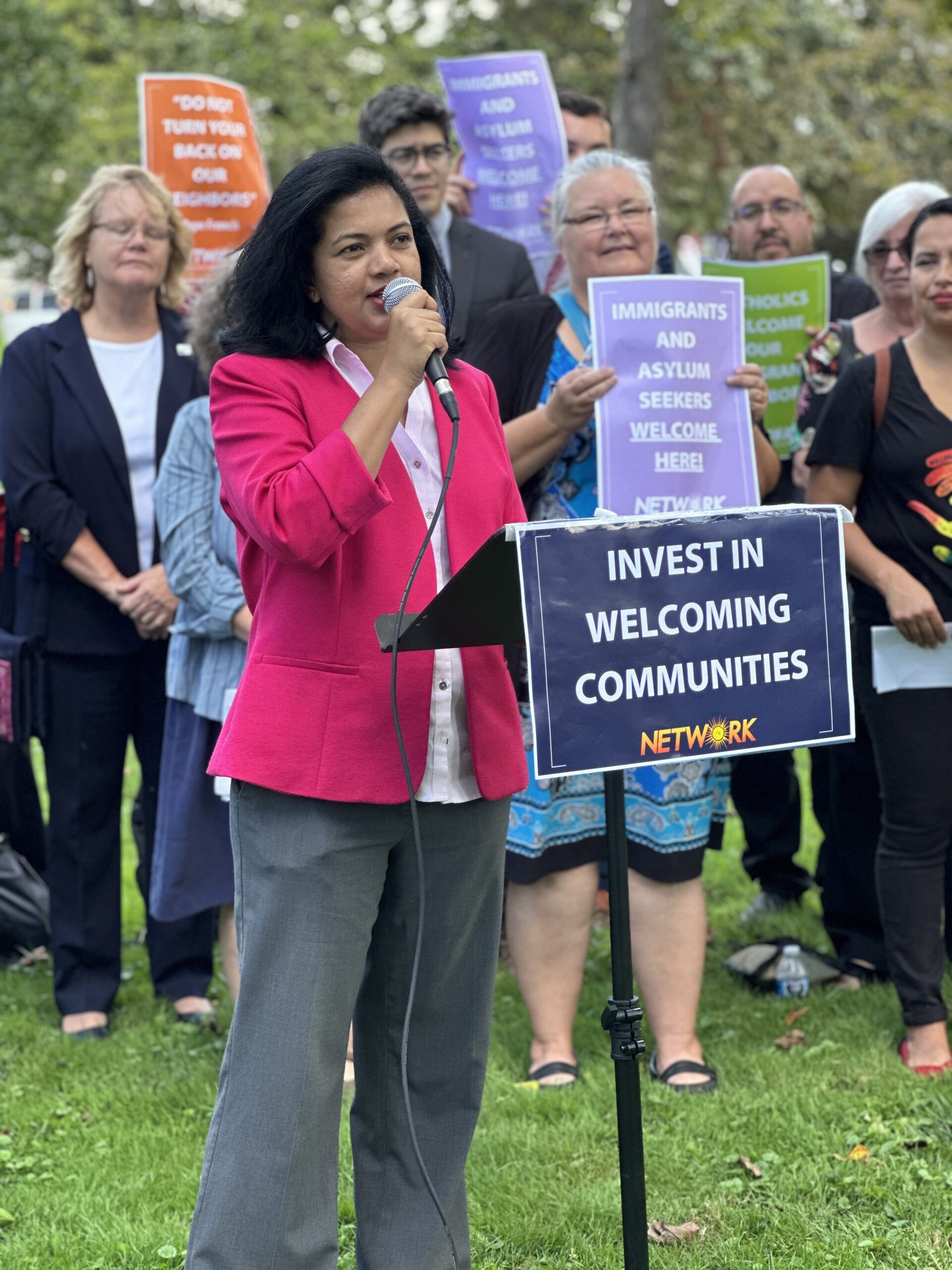
NETWORK Government Relations Director Ronnate Asirwatham, a woman in a pink jacket, holds a microphone and speaks from behind a podium with a sign, "Invest in Welcoming Communities." Many other advocates with similar signs stand behind her.

NETWORK Government Relations Director Ronnate Asirwatham at the September 2023 Welcoming Communities press conference on Capitol Hill

Words have consequences. And almost nowhere is that truer than when dealing with immigration.

People like to think they are true to their word when they say they want action on immigration and care about finding practical solutions. After all, immigration is a serious issue that touches millions of lives and practically every community. We should adopt serious proposals. But what does it mean to be serious?

Many people, especially elected officials, betray their unseriousness by how they talk about immigration. Unfounded claims of a “migrant crime” wave are dangerous and inaccurate. These claims feed into racist tropes by fueling fear and hatred towards immigrants and people of color, making our communities less safe.

Fearmongering gives cover to politicians wishing to pass or enact terrible policies. The recent legal attack by the Attorney General of Texas on Annunciation House—a series of shelters that serve migrant people across the Southwest—is one small example of right-wing extremists attacking people seeking safety, as well as the people of faith who serve them.

We have also seen this type of attack in extreme bills against immigrants and people who welcome them in the state legislatures of Arizona, Idaho, and Georgia and the U.S. Congress. Instead of putting forward workable solutions, Congressional extremists keep pushing for unworkable, failed proposals that the American public has rejected. They think this is a good way to pass unpopular policies, but providing a veneer of legality for attacking immigrants makes everyone less safe.

This xenophobic rhetoric is like that which brought gunmen to the Pittsburgh synagogue and the El Paso Walmart. Unserious people can still create serious threats, and the policies of deterrence and the rhetoric of racism these politicians are proposing will make all who live in the borderlands and people of racial and religious minorities everywhere unsafe.

We must focus on what constitutes a serious immigration policy proposal; luckily, we have plenty of examples. At the end of January, the Congressional Hispanic Caucus released its immigration principles for the second session of the 118th Congress. These principles, comprised of 18 policy proposals within a framework of four pillars—immigration reform, jobs and the economy, border safety, and regional migration concerns—are what serious immigration policy looks like and what people of faith and goodwill should push Congress and the Administration to adopt.

  • Increase funding for asylum processing and legal representation programs for adults and guarantee access to counsel for asylum seekers in federal custody.
  • Create family reunification programs for additional countries to assist with backlogs.
  • Facilitate access to work authorization for newly arrived immigrants.
  • Fund community-based case management programs that decrease immigration detention.
  • Protect Dreamers and DACA recipients.
  • Provide a pathway to citizenship for undocumented individuals.
  • Update the registry cutoff date through H.R. 1511, the Renewing Immigration Provisions of the Immigration Act of 1929.
  • Advance immigration protections through H.R. 3194, the U.S. Citizenship Act.
  • Establish a humanitarian visa for pre-screen asylum seekers.
  • Expand protections for minors seeking to be reunited with parents holding legal status in the U.S.
  • Protect undocumented spouses or parents of military members by providing a path of legal residency and eliminating the threat of deportation.
  • Advance protections for agricultural workers through the Farm Workforce Modernization Act of 2023.

These are serious proposals that can create real change by actually addressing the problems created by our broken immigration system. Any person, elected or otherwise, who claims to be serious about the border and immigration but isn’t embracing these proposals is not serious. In fact, they are very likely trying to use the plight of suffering people to get you to buy into a “solution” that will only cause more suffering and put more people in danger. And that’s serious.

This story was published in the Quarter 2 2024 issue of Connection.

The Need for Welcoming Communities

The Need for Welcoming Communities

Congress Can Invest in Welcoming Asylum Seekers Across the U.S.

Jenn Morson
December 5, 2023

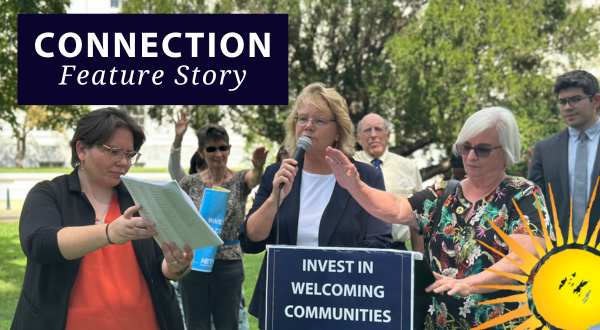
Sr. Susan Wilcox, CSJ, of Brooklyn, N.Y. shares her account of coordinating and serving meals to people seeking asylum who had been bused to New York. She noted how her efforts would benefit from Congress funding the Shelter and Services Program (SSP), which would shift the U.S. response to asylum seekers from militarization at the border to investment in communities across the country who offer a welcoming response to asylum seekers.

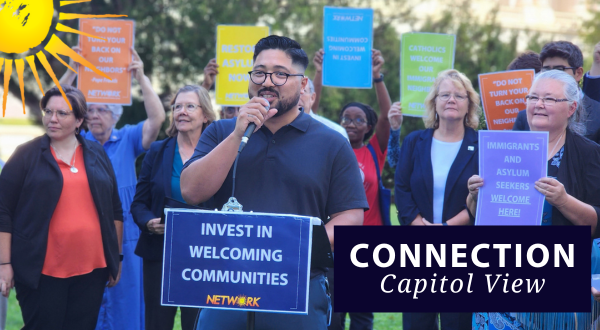
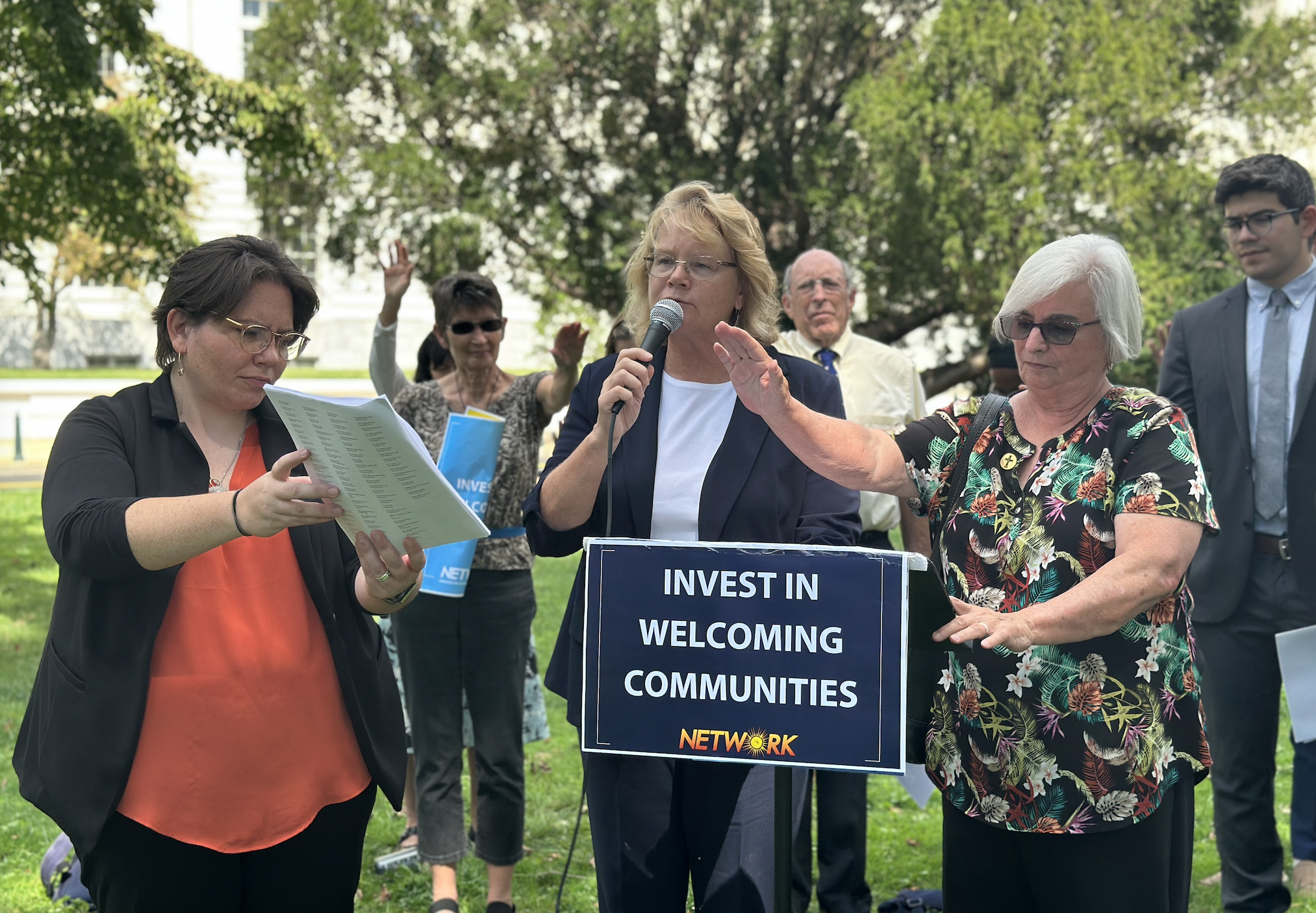
“Immigrants and Asylum Seekers Welcome Here!” read the signs held by a handful of supporters stationed behind the podium as several speakers, including three supportive members of Congress, gathered to deliver a letter to Congress signed by over 7,000 Catholics. Gathered September 13 on the U.S. Capitol grounds, members of NETWORK Lobby and other organizations including the International Mayan League, Church World Service, and Women’s Refugee Commission joyfully and emphatically laid out their hopes for a shift in how the U.S. government approaches its response to asylum seekers.

In her opening remarks, Ronnate Asirwatham, Government Relations Director of NETWORK, stated that the purpose of the gathering was to call on Congress to invest in welcoming communities. “Who are welcoming communities?” Asirwatham said, “To put it bluntly, welcoming communities are our community. People who welcome are all of us. It is very natural to welcome. We welcome each other, we welcome strangers, we welcome people seeking safety, and people passing through.”

“While it is most natural to welcome, it seems today that the voices against welcome, especially against welcoming people seeking asylum, [are] getting louder,” Asirwatham warned. “State and federal governments are moving to criminalize welcome. In Arizona, people are being arrested for leaving water out in the desert. In Florida, people are afraid to take their neighbors to the doctor because of pushback. And in Texas, people seeking safety are being pushed back, and Texans wanting to provide them water are not being allowed to.”

In spite of these obstacles, Asirwatham comforted those gathered, saying, “We are not going anywhere. Congress will hear us. Congress must act and enact laws and policies that support us, the American people, that allow us to thrive and reap the benefits that welcoming our fellow human beings allow. This is why our message is simple: we are asking Congress to invest in welcoming communities. We are simply asking Congress to invest in us.”

Gathered Together

Asirwatham introduced many compelling speakers who gave testimony of their own advocacy work as they also encouraged Congress to invest in welcoming communities. Speakers at the press conferences were optimistic despite the strongly worded letter calling for a renewed sense of justice.

Rep. Judy Chu (CA-28) speaking at the gathering

U.S. Congressman Joaquin Castro (TX-20) addressed the crowd, thanking NETWORK for being a voice of compassion, conscience, dignity, and reason for human beings. Castro’s own mother previously served on the board of NETWORK. “Your voice and your activism is needed more today than ever,” Castro said. “We need to remind politicians who use migrants as political scarecrows — because that’s what they do, they use them as scarecrows to engender fear and resentment among the American people — we should remind our fellow Americans and mostly politicians that America became the strongest nation on earth not in spite of immigrants but because of immigrants.”

“Instead of embracing our rich immigrant heritage, too many politicians have used our immigrant communities as political pawns by fearmongering and peddling harmful, dangerous, political rhetoric. And the human cost is immense,” said Rep. Judy Chu (CA-28) in her remarks.

Lifting up the leadership and vision of Pope Francis, Rep. Luis Correa (CA-46) said, “One human being suffering around the world is one human being too much.”

In her moving testimony that referenced her own plight as a refugee from Guatemala, Juanita Cabrera Lopez, Executive Director of International Mayan League, gave a message of hope: “I know firsthand what it looks like when a community invests in welcome and justice, and I know it is possible today because many communities are already doing this work.”

Regarding the immigration of Indigenous Peoples, Cabrera Lopez said, “Our ask remains the same. We need long-term investment to continue welcoming asylum seekers, particularly Indigenous asylum seekers.” Cabrera Lopez concluded her speech with a call for investing in shelter for newly arriving families and youth.

Sent Forth

Sr. Eilis McCulloh, HM, holds up a copy of the letter signed by over 7,000 Catholics from all 50 U.S. states calling on Congress to invest in communities who welcome asylum seekers, while Sr. Karen Burke, CSJ, and Sr. Alicia Zapata, RSM, pray a blessing over the letter at the conclusion of NETWORK’s Sept. 13 action on Capitol Hill.

Sister Eilis McCulloh, HM, encouraged those gathered to extend their hands in prayer over the letter to Congress, as Sister Alicia Zapata, RSM, and Sister Karen Burke, CSJ, prayed in gratitude for the signers of the letter while also offering prayers for immigrants, organizations that support immigrants, and for the openness of members of Congress to the message of the letter.

“May this letter, which carries the stories of our immigrant siblings and our hope for immigration reform, be one way that we share in Jesus’ mission to ‘welcome the stranger’ and advocate for immigration policies that invest in communities,” they prayed.

The letter, which was co-sponsored by Hope Border Institute, Kino Border Initiative, the Maryknoll Office for Global Concerns, and St. Columban Mission for Justice, Peace, and Ecology, was addressed to key House and Senate members. It begins with Pope Francis’ 2015 remarks to Congress, in which he urged those gathered to welcome the stranger. The signatories are asking Congress to appropriate funds for supporting immigrants and communities while divesting from programs which militarize the border and criminalize immigrants.

In order to accomplish these goals, the letter urges Congress to fully fund the existing Shelter and Services Program at $800 million in 2024, and to distribute the funding equitably.

Additionally, the letter requests that any funding made available is done so via grant or contract rather than as a reimbursement. Additionally, the letter urges Congress to take back all funding for the border wall construction that has not yet been spent and cut funding for Customs and Border Protection and all other militarized border enforcement agents and technologies, as these agencies are overstaffed and overfunded.

NETWORK and its partners remind Congress that seeking asylum is a human right that should not be restricted, and invite them to embrace the Catholic belief of the inherent dignity of every person and make this a guiding principle to immigration policies, moving away from militarization and towards care.

In the words of Sister Susan Wilcox, CSJ, “We are doing the work. We have the solutions. We just need a little help.”

This story was published in the Quarter 4 2023 issue of Connection. 
Advent 2023, Week One Be Vigilant

This Advent Calls for Vigilance 

NETWORK Lobby offers Advent reflections

This Advent Calls for Vigilance

Sr. Eilis McCulloh, HM
December 1, 2023

Advent 2023, Week One Reflection: A Call for Vigilance

Readings for the First Sunday of Advent, December 3

Is 63: 16B-17, 19B; 64:2-7
Ps 80: 2-3, 15-16, 18-19
1 Cor 1: 3-9
Mk 13:33-37

The readings on the First Sunday of Advent call for vigilance. In the Gospel, Jesus instructs his disciples to be alert and watchful, careful not to be found sleeping when the time is nigh.  

This year, the NETWORK community has had countless opportunities to stay awake and to practice the virtue of vigilance. At a moment’s notice, we have called on faith-filled justice-seekers to protect the rights of asylum seekers in the United States. From the racist and problematic U.S. Customs and Border Protection’s CBP1 App, to the threat to cut funding to programs that serve asylum seekers, some Members of Congress continually proposed drastic changes to the asylum process. And how did you respond? Nearly 10,000 of you signed on to our letter calling on Congress to invest in welcoming communities. You have also called your Members of Congress and visited them. 

To receive all of NETWORK’s Advent 2023 reflections in your email inbox, sign up here!

We cannot grow complacent; we must stay awake and vigilant. Just this week, some Members of Congress are trying to decimate the asylum system in order to pass a funding bill. We cannot ignore their attempt to re-institute an asylum ban.  

In this Sunday’s first reading, Isaiah tells us the story of the people who longed for God to come down from on high with a force that would shake the mountains, but, instead, we are reminded that “we are the clay and you are the potter: we are all the work of your hands.” To participate in the building up of Welcoming Communities, we, too, seek to do the work of God. With the Psalmist, we turn our face to God, eager to have God show us the way to the building up of the Kin-dom here on Earth.  

To do this, we must all participate in the work to bring more abundant life to all of God’s people, because the hope for abundant life does not end at our borders. It does not stop to decide if someone has the proper documents. Abundant life is God’s hope for all of us—and we will continue to be vigilant and respond to any threat to take away someone’s chance at abundant life. 

To receive all of NETWORK’s Advent 2023 reflections in your email inbox, sign up here!

Fortunately, we are not alone in this work. Fortunately, the NETWORK community lives out this mission together. Our Spirit-filled community of justice-seekers has significantly influenced elected officials this year to ensure the federal government makes room for the people most in need in our communities.   

We draw strength and encouragement from living this shared mission together, and we draw our hope from the God who, according to St. Paul, remains faithful and will keep us firm to the end. 

Advent 2023, Week One Be Vigilant

Call to Action:

Congress is now back in session, and their first order of business is passing a package to meet the President’s supplemental funding request for aid for Ukraine, Israel, and Taiwan. Unfortunately, some Members of Congress are pushing to decimate asylum in the U.S. as a condition of this deal.

Tell your Senators to protect asylum in the United States and not give into demands to change asylum law in order to get a funding deal passed. 

To receive all of NETWORK’s Advent 2023 reflections in your email inbox, sign up here!

The legislative priorities not passed before the end of the 117th Congress will continue to be priorities of NETWORK in 2024 and beyond!

Build Anew Series – Immigration

Build Anew Series — Part 2
Immigration

Virginia Schilder
September 28, 2023
Welcome back to our new Build Anew Series, with weekly posts covering the people, policies, and values at the heart of the issues we work on. Today, in our second installation of the series, we’re focusing on Immigration.
Our Present Realities
NETWORK Government Relations Director Ronnate Asirwatham, a woman in a pink jacket, holds a microphone and speaks from behind a podium with a sign, "Invest in Welcoming Communities." Many other advocates with similar signs stand behind her.

NETWORK Government Relations Director Ronnate Asirwatham at the September 2023 Welcoming Communities press conference on Capitol Hill

A lot has been happening in U.S. immigration policy, so NETWORK’s staff and faith-filled supporters have been hard at work. Over the summer, NETWORK opposed the Biden administration’s “asylum ban”  and condemned the horrific mistreatment of migrants at the southern border. On August 31, NETWORK and our partners released a report detailing the horrors of the implementation of the new CBP One app, which US Customs and Border Protection has made the almost sole avenue for the asylum process. Please read the full report here, which includes several first-hand stories from people impacted. Then, on September 13, Catholic Sisters from across the U.S. joined NETWORK, members of Congress, and partners from the #WelcomeWithDignity Campaign on Capitol Hill at a press conference, where we called on Congress to invest in welcoming communities and divest from the militarization of the border. We presented Congress with a letter signed by over 7,000 Catholics(!), urging Congress to continue to fund the Shelter and Services Program (SSP).  

We do this work because our broken immigration system fails to meet the needs of our siblings and make our communities truly safe. Right now, asylum seekers are forced to wait at the southern border in inhumane conditions, subject to assault, torture, kidnapping, and rape — violence to which Black, disabled, and LGBTQ+ migrants are particularly vulnerable. Many immigrants are detained in uninhabitable detention facilities, often torn from their families. 

On top of that, racism in immigration policy persists, as Black and Haitian asylum seekers in our country are still being expelled and deported without a hearing. For those who have been granted paperwork to remain in the U.S., racist policies and practices make it more difficult for immigrants of color to access care, transportation, and other basic needs than white immigrants. As The Center for Health Progress explains,  

“Until we clearly root out the inherent racism that is the foundation of our immigration policies, we will unlikely create an immigration system that is fair, just, and that creates a viable pathway for more immigrants to call the US home—something a vast majority of us, regardless of our political views, say we want.” 

These conditions, and the policies that create them, continue because of fear — what Pope Francis calls “alarmist propaganda.” Politicians in power scapegoat immigrant families and create a fabricated competition for jobs and resources — even though our economy relies on immigrant workers, who comprise 17.4% of the U.S. workforce. This xenophobia creates a culture of fear and scarcity that hurts all of us.  

The reality is, immigrants are already our families and our communities. A quarter of children in the U.S. have at least one immigrant parent. Yet, some people in power do not want to recognize immigrants as belonging to our communities, because that would mean acknowledging a responsibility for their wellbeing.  The refusal to welcome immigrants is a refusal to share power; a refusal to extend to others the same rights, powers, and privileges we enjoy; a refusal to open our hearts to another and accepting the possibility of being changed. 

Our Call to Welcome  

 As members of the human family, we are called to extend compassion interpersonally and structurally to people in need. In the same way that God’s love is not limited to country, our central commandment to love one another cannot stop at national lines. We cannot use borders to justify exclusion, to decide who “belongs” and who is an “alien.” Our faith invites us past the illusions of disconnection created by structures of oppression, and to instead recognize that we are of one global community, all children of God.   

Scripture explicitly calls us to welcome and love migrants and refugees: When a stranger sojourns with you in your land, you shall not do him wrong. You shall treat the stranger who sojourns with you as the native among you, and you shall love him as yourself, for you were strangers in the land of Egypt” (Lev 19:33-34). Borders should never be used as an excuse to turn away and ignore the real cries and suffering of our siblings.   

The Catholic view of the human person validates the strivings of each person to seek a safe and good life for themselves and their families. The Catholic tradition is clear that all people have a right to migrate, and that all nations have an imperative to welcome and accept them. Pope Francis, himself the child of an immigrant, told a joint meeting of the U.S. Congress:  

“On this continent, too, thousands of persons are led to travel north in search of a better life for themselves and for their loved ones, in search of greater opportunities. Is this not what we want for our own children? We must not be taken aback by their numbers, but rather view them as persons, seeing their faces and listening to their stories, trying to respond as best we can to their situation. To respond in a way which is always humane, just and fraternal.” 

Catholic Social Teaching affirms that each person belongs to a single, interconnected human family, irrespective of country of origin or immigration status. We are all neighbors, and our health and wellbeing depend on each others’. The unequal and unjust treatment of our immigrant siblings is a critical area to build anew if we hope to shape a more just and inclusive democracy for everyone.  

Ongoing Advocacy  

Gratefully, we have the work of justice-seekers like NETWORK Government Relations Director Ronnate Asirwatham, who continues to work to ensure that both immigrants and the communities who welcome them will not be divided by racism and xenophobia. Currently in D.C., the bipartisan Senate is desperately trying to keep the government open. Meanwhile, some Republicans in the House are threatening to shut down the government unless H.R. 2 becomes law. H.R. 2 is a bill that separates families at the border and will hold unaccompanied children in jail-like conditions. No Democrat voted for H.R. 2 in the House, and it has not even made it to the Senate. Asirwatham explains,

“Many of our Representatives today are telling us that unless we throw our neighbors into the fire, they will shut down the government, and cut programs that help our children eat or go to school. We will not be divided. We will continue to tell our Members of Congress that we are for policies that lift us all up, and they should be, too.” 

Join us again next week for our next installation of the Build Anew Series on a just economy. And, stay tuned for our upcoming Build Anew Series videos on Instagram (@network_lobby) and Facebook.  

WATCH: Click here to watch a recording of NETWORK’s Congress, Keep Your Promise webinar about our current campaign to ensure Congress funds critical human needs programs and to learn how you can get involved.
Manufactured Crises in Politics Hurt Vulnerable People.

The Smoke of Manufactured Crises

The Smoke of Manufactured Crises 

When Fearmongering Clouds Our View, We Risk Embracing Terrible Policy  

Ronnate Asirwatham
August 8, 2023
Ronnate speaks into a microphone at an outdoor event. She wears a coat and a red hat. Behind her is a board with heart-shaped sticky notes with writing on them.

Ronnate Asirwatham is NETWORK’s Director of Government Relations

When we see smoke where it shouldn’t be, for instance in a residence or other building, our survival mechanisms kick in, and we move as quickly as we can in the opposite direction. This is a natural, even understandable response. But in Washington, the old saying “Where there’s smoke, there’s fire” could be replaced with a new formulation, which goes something like, “Where there’s smoke, there’s somebody trying to goad you into doing the wrong thing.”  

A fire is an emergency. But a fake fire, a manufactured crisis, is more like a virus that has infected our politics. This year has seen several of them playing out, all of them set intentionally, all of them engineered to try to get someone else to do the wrong thing, whether out of fear or other questionable motives. When someone buys into the toxic narrative of a manufactured crisis, they hasten the harm they sought to avoid. Anthony De Mello, a Jesuit priest, once noted that reality cannot hurt us, but our reaction to it can. That wisdom applies here. 

Most recently, we witnessed the debt ceiling debacle, in which House Republicans demanded a budget that slashed vital human needs programs such as Medicaid, SNAP, and WIC in exchange for raising the debt ceiling and keeping the U.S. from defaulting on its debt. Never mind that the same Members of Congress voted to raise the debt ceiling without any conditions three times during the Trump administration. The threat of default was a purely manufactured crisis employed by these members to get President Biden and Democrats to do something that their constituents didn’t want them to do.  

While the deal struck between the President and House Speaker Kevin McCarthy could have been far, far worse, it will still impact millions of people who rely on SNAP for their basic food security. And placing the burden on people living in poverty is a morally abhorrent way to reduce deficits in the federal budget, especially when raising revenue through taxes on the ultra-wealthy and corporations would be far more effective.  

Sadly, making life more difficult for communities of people who need support is an element all of these fake crises have in common. At the state level, we have seen this year a record number of anti-LGBTQ+ bills (over 400 as of April!) introduced in legislatures across the country. These bills stoke a narrative of hysteria that presents drag queens and transgender people as the greatest threat to children. Not gun violence or Christian nationalism. It’s especially alarming because manufactured crises at the expense of marginalized groups of people is a well-documented tactic of authoritarian regimes in their efforts to grab and consolidate power against the will of the majority.  

Finally, we have the U.S.-Mexico border and the insistent bad faith chorus decrying the very conditions that they made possible by inconsistent and inhumane policies at the border. By not wishing to be portrayed as weak on the border, the Biden administration has perpetuated enforcement-only measures, such as the asylum ban, which exact a terrible human toll on people fleeing violence and other dangerous situations in their home countries. NETWORK and our immigration coalition partners opposed these rules by the Administration, as we also oppose bad bills in Congress, such as the Secure the Border Act (H.R.2) and a bipartisan Senate bill aimed at replacing Title 42.  

What then can we do? We must stay awake and vocally oppose the efforts of those trying to goad us into doing the wrong thing. The more we change our behavior out of fear of what bad actors might say or do, the more we ensnare ourselves in those webs. We owe the vulnerable people targeted by these manufactured narratives a response of true solidarity. That is the healthy defensive response that needs to be developed in our politics. Rather than the smoke of fake crises, we should be devoting our energy to kindling the fire of justice, renewing the face of the earth. 

Ronnate Asirwatham is NETWORK’s Director of Government Relations. In 2023, Washingtonian Magazine named her among the 500 most influential people in Washington for the second year in a row. 

This column was published in the Quarter 3 2023 issue of Connection. 
Sr. Eilis McCulloh, HM, speaks at a reparations vigil in Cleveland in June 2022.

The Welcoming Call

The Welcoming Call 

Solidarity with Migrant People is Intrinsic to the Vocation of Catholic Sisters

Sr. Eilis McCulloh, HM
August 1, 2023
Sr. Eilis McCulloh, HM, pictured with Eilis, amember of the Congolese community in Cleveland, Ohio.

Sr. Eilis McCulloh, HM, pictured with Eilis, a member of the Congolese community in Cleveland, Ohio.

For generations, Catholic Sisters in the U.S. have served alongside immigrant communities. Time and again, we have responded to the call to open our homes and hearts to meet the needs of families seeking asylum or newly arrived refugees. Our sisters and our communities have sponsored refugees, opened service agencies, taught English as a second language (ESL), served along the border, accompanied individuals and families, represented them in court, and advocated for just immigration policies. In so many ways, we have lived the call in Scripture to welcome the stranger and love our neighbor as ourselves.  

My own story of ministry is a part of this multi-generational call. In 2010, I began my own journey working with the Somali refugee community in St. Cloud, Minn. In subsequent years, I ministered alongside people from Bhutan, Iraq, Afghanistan, Burma (Myanmar), Sudan, the Democratic Republic of the Congo, Guatemala, and so many other countries. I learned about the asylum system in Immokalee, Fla. and witnessed the conditions that force a person to flee their homeland in Haiti or Guatemala. My own community, the Sisters of the Humility of Mary, remains connected through the sponsorship of Mary’s House in Cleveland. This work connects me with generations of sisters who have felt this call.  

Ministering alongside asylum seekers, refugees, DACA recipients, and other immigrants has shifted the way many of us Sisters understand immigration policy. We can no longer distance ourselves from the dangerous anti-immigrant rhetoric that has energized lawmakers to pass legislation to shut down and militarize the border, expand Title 42, deport asylum seekers from Haiti, or create an app that only recognizes white faces. 

These horrible policies impact the people who are a part of my extended community. They affect our neighbors. They affect members of our own family. We no longer have the luxury of waiting for Congress to fix the broken immigration system; we must do our part to ensure that a just and equitable immigration system remains at the forefront of our representatives’ minds.  

It was this sense of urgency that drove over 100 sisters and associates and their sponsored ministries to Washington DC in December 2021 to march for, pray for, and call for the end of Title 42. At that event, Sisters shared stories of ministering at the border, in Florida with the Haitian community, and in cities across the country. We shared a common understanding that our lives are forever changed by time spent ministering in El Salvador, Honduras, and many other countries. 

We shared with each other our own experiences of accompanying a family seeking asylum, only to watch helplessly as they were turned away by Border Patrol, or telling an individual that, according to current policy, they do not have a valid asylum claim even though a return to their home country would most certainly result in death. We also shared about moments of community — of shared meals of pupusas or beans and rice that made the Body of Christ a tangible offering that widened our understanding of community. All of these moments further strengthened our deeply held belief that the country’s immigration system needs an overhaul. 

As women religious, our individual community’s charism informs how we respond to the call to minister alongside our country’s diverse immigrant communities and advocate for justice. While our ministerial actions might vary, we all believe that all people, no matter their country of origin, economic status, family composition, gender or sexual orientation, or reason for migrating, deserve the opportunity to apply for asylum.  

This is the foundation of our belief as Christians: that all people reflect the Imago Dei — the image of the loving God who created them. Therefore, we will continue to call on our elected officials to stop playing politics with the lives of our immigrant siblings and create an immigration system that works for all people. 

Sr. Eilis McCulloh, HM is NETWORK’s Education and Organizing Specialist and a co-host of the podcast Just Politics, produced in collaboration between NETWORK and U.S. Catholic magazine.  

This column was published in the Quarter 3 2023 issue of Connection.