

Category Archives: Immigration

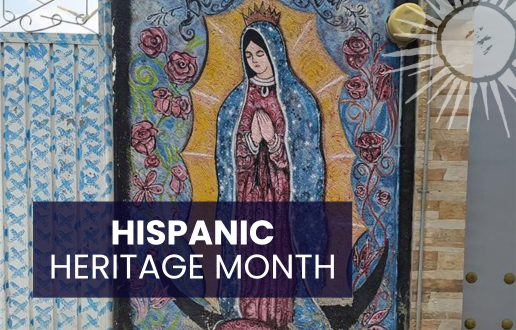
Hispanic Heritage Promotes Democracy and Dignity

Hispanic Heritage Promotes Democracy and Dignity


My Responsibility is to Help Build a Future Where We All Have a Share in the Decisions That Shape Our Destiny

Jonathan Alcantara
October 6, 2025


For Hispanic Heritage Month (September 15-October 15), NETWORK’s Sr. Carol Coston Fellows share their thoughts on the importance of this observance in the U.S. The following is Part 2 of a two-part reflection by Jonathan Alcantara of Marquette University. (Read Part 1.)

Jonathan Alcantara, a 2025 Sr. Carol Coston Fellow in NETWORK's Young Advocates Leadership Lab (Y.A.L.L.)

Jonathan Alcantara

In addition to undeniable economic and cultural contributions, the Latino community also participates powerfully in the democratic process. In particular, young Latinos are the fastest-growing demographic of voters, and our voices will shape the future elections. However, targeted voter suppression tactics like disinformation and misinformation, lack of access to absentee ballots, limited early voting, and bans on students using their school IDs at the polls continue to create barriers for young Latino voters.

So, over the past two years, I’ve served as a Sr. Carol Coston Fellow, working with other students and young adults in Wisconsin and across the country to foster a safe environment for civic engagement and support voter registration on our campuses. All of the meaningful conversations I’ve had with my peers on campus and with community leaders show and remind me that our democracy is stronger when we all participate and a lot weaker when we’re separated and pushed out.

Despite the inequalities, political tensions, and fearmongering, our lucha and resilience still define us. Across the nation this month, Latino communities are finding ways to gather and celebrate their heritage while navigating their fears. In cities like Chicago, Madison, and Appleton, Wisconsin, festivals celebrate with live music, dances, and traditional food. They also have workshops and representatives talking about healthcare, business inclusion, and professional leadership.

However, many events have scaled back and have even been postponed because of the possibility of immigration raids, but one thing’s for certain, seguimos unidos y en solidaridad, no matter the obstacles. Our culture is still alive not only in the happy moments but also in times when we must pivot, adapt, and continue showing up for one another through advocacy.

What ties all of this together is the set of values that go with the Latino community. We strongly believe in familia, dignidad, and oportunidad, which are values that anyone, regardless of their background and what they look like, can recognize as important. My Catholic faith reminds me that these are more than just cultural values; they are moral truths: that every person is made in the Imago Dei and deserves respect, freedom, and the chance to grow and thrive, no exceptions. In our faith, we say, cada persona es hijo de Dios, every person is a child of God. And that truth calls us to treat every person with the same dignity and respect.

Looking ahead, I see a hopeful future where our cultura is not only honored by others but fully integrated into the story of this country. A future where Latino students, like me, succeed in college without the barriers that are currently holding us back, where workers earn livable wages that match their contributions to our country, where families can live without the fear of leaving their house for five minutes, and where our voices are fully recognized in the public.

This vision is attainable, and this is why Hispanic Heritage Month matters. Is it about honoring culture? Yes. But it’s also about defending human dignity, expanding and growing economic opportunity, and strengthening our democracy. For me, Hispanic Heritage Month is both personal and shared. This month calls me to remember the resilience of those who came before me and to act with the knowledge of my responsibility for those who will come after me.

This month, I celebrate my heritage not only by remembering the past but by helping build a future where every family, Latino or not, can live, work, and thrive con fe, esperanza y orgullo, no exceptions.

Learn more about NETWORK’s Young Advocates Leadership Lab (Y.A.L.L).
Hispanic Heritage Gives New Life to Our Culture and Economy

Hispanic Heritage Gives New Life to Our Culture and Economy


This Month Reminds us of the Responsibility to Bring Culture, Faith, Community, and Resilience to Justice Work

Jonathan Alcantara
October 1, 2025


For Hispanic Heritage Month (September 15-October 15), NETWORK’s Sr. Carol Coston Fellows share their thoughts on the importance of this observance in the U.S. The following is Part 1 of two-part reflection by Jonathan Alcantara of Marquette University. (Read Part 2.)

Jonathan Alcantara, a 2025 Sr. Carol Coston Fellow in NETWORK's Young Advocates Leadership Lab (Y.A.L.L.)

Jonathan Alcantara

Hispanic Heritage Month is not just a time for us to honor our cultura with music, food, faith, and festivals. It is also a reminder of the responsibility to carry the values of our culture, our faith, our community, and our resilience into the work of justice especially in times like these. To me, this time of the year is a celebración of who we are, where we come from, and the challenges we face to help positively shape where we are going in the future.

Growing up in the metro Atlanta area, I saw my Latino heritage recognized not only during celebrations but in the everyday actions of our determination. Our family gatherings were filled with stories, delicious authentic comida mexicana, laughter that makes our stomach hurt, and the occasional chisme, but through all this there were also unmistakable examples of our families’ hard work and sacrifice.

Those experiences continue to guide and shape me as a first-generation Mexican American college student. As a student studying finance at Marquette University, a Jesuit community that emphasizes service, community, and justice, I remind myself every day that my Mexican and Latino heritage is more than just a set of traditions passed down to each generation but it’s the light, the source that pushes and strengthens us to lead with purpose, to advocate for justice, and to build stronger communities and a more just nation.

As I sit and reflect on this year’s Hispanic Heritage Month, I cannot ignore las injusticias that MY Latino community has and is currently facing in 2025. The federal government has intensified immigration enforcements to drastic measures. The recent Supreme Court ruling has opened the door to racial profiling and aggressive deportations.

As a result, the fear that Latino communities and neighborhoods that has existed for years has deepened even further. Since January, families have lived in constant anxiety and worry about raids, deportations, and having their families separated. These actions not only harm families and individuals but break trust in public institutions and weaken the connections that unite and make our community strong and resilient.

Despite this, the impact and strength of our economic contributions speak for themselves. The 2025 Latino GPD in the U.S. has recently surpassed $4 trillion, making our community one of the most powerful and largest economies in the world. Latinos have some of the highest labor participation rates, strong entrepreneurship, and growing levels of higher education. Still the inequalities continue through unfair wage gaps sometimes even with a college degree. Latina women, specifically, experience some of the most significant gaps, earning less than both white women and Latino men, while Latino men’s earnings fall short of his peers despite having equal qualifications.

Whether we are Latino, Black, Asian, or White, we all deserve to be paid fairly for our work. It matters just as much that many families, not just Latinos, rely on programs like SNAP and Head Start which are being threatened by recent federal legislature like the summer reconciliation bill, and political playbooks like Project 2025. In reality, Latinos contribute to face unfair barriers while significantly contributing to the U.S. economy. Now more than ever, there needs to be change.

Learn more about NETWORK’s Young Advocates Leadership Lab (Y.A.L.L). Read Part 2 of this reflection.

Immigrant Families: We Can All Afford to Live With Dignity

Immigrant Families: We Can All Afford to Live With Dignity

Cruel cuts to vital services come at a time of soaring costs for those who need it the most


Giovana Oaxaca
August 11, 2025

The recently passed budget reconciliation bill diverts resources from communities to mass deportation efforts and border militarization. In this third installment of a three-part series (Part 1, Part 2), Giovana Oaxaca, NETWORK Senior Government Relations Advocate for Immigration, explores how the bill cruelly cuts services to vital services, but also the road ahead that justice-seekers can pursue to defeat these measures.

In communities across the country, working families are already grappling with rising costs. Groceries, rent, childcare, and health care have all surged in price (and will continue to do so thanks to the recently passed budget bill), leaving many households struggling to make ends meet. Yet, Congress will deepen the hardship by stripping away vital support from those who need them most. 

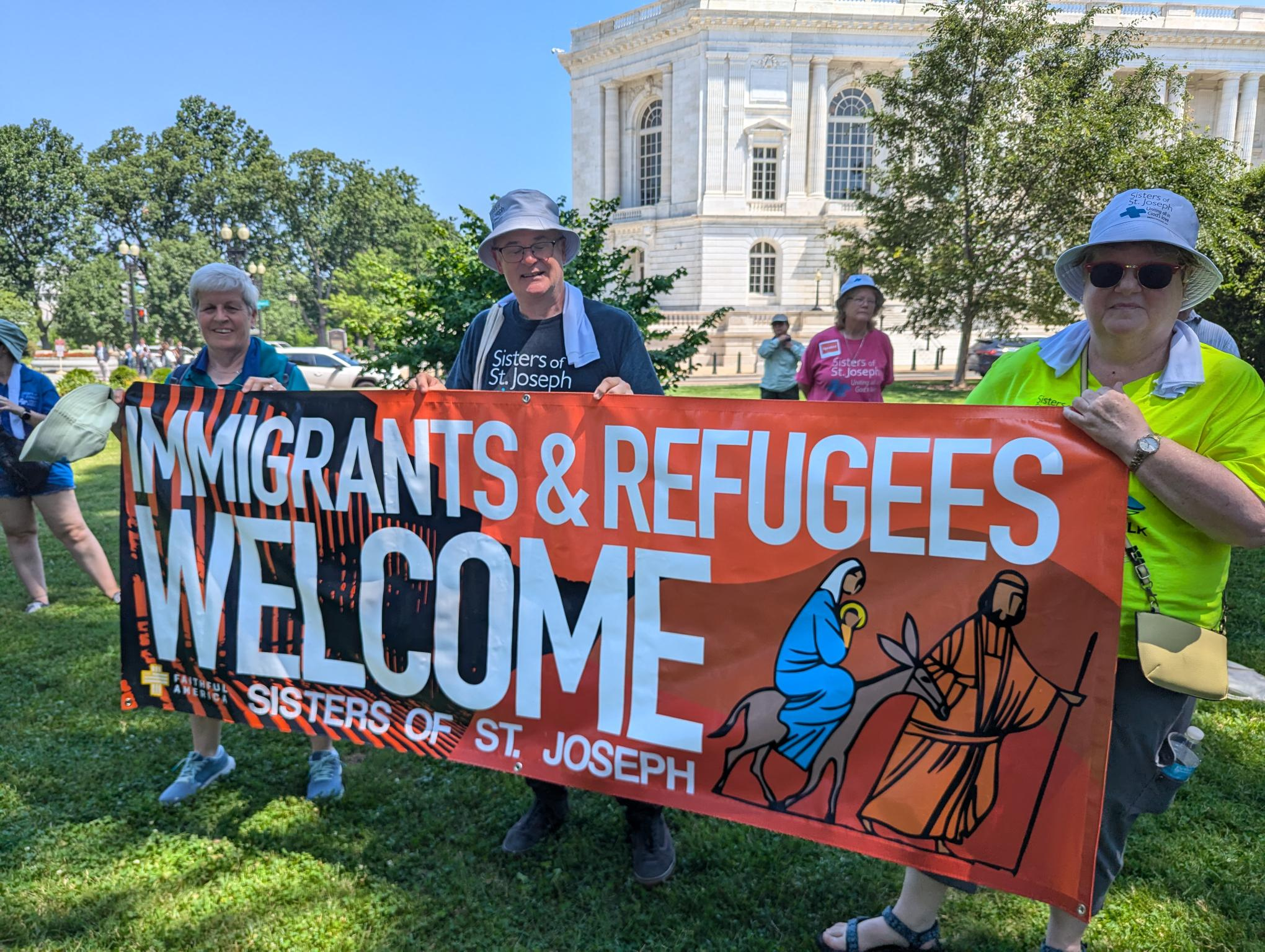
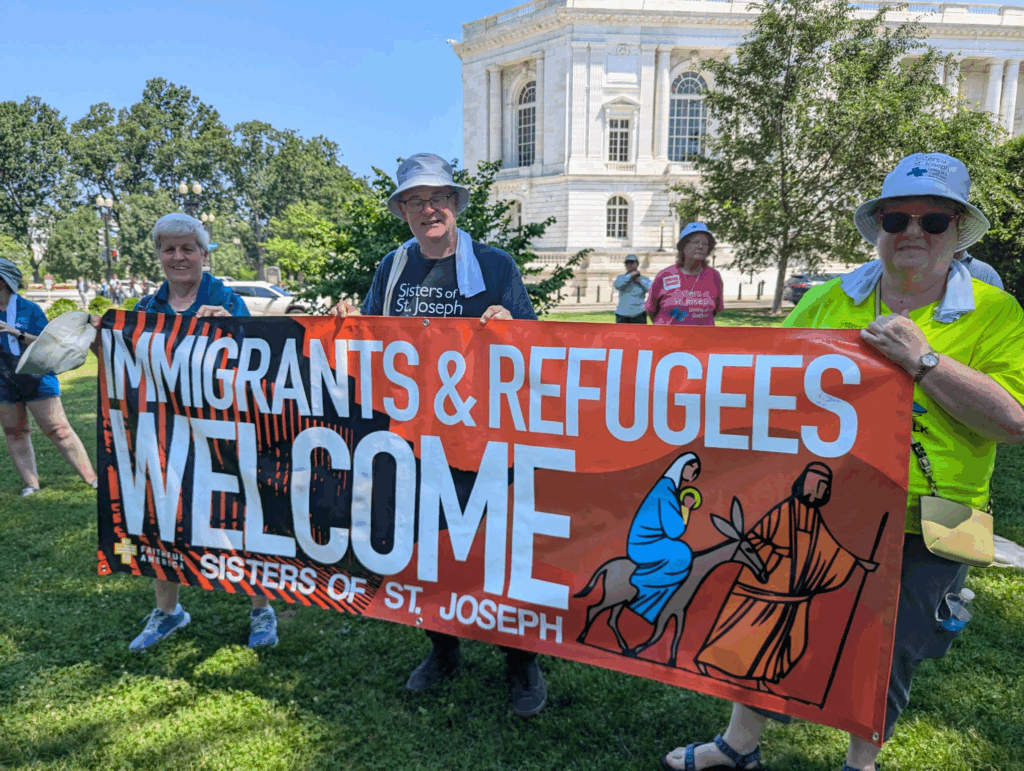
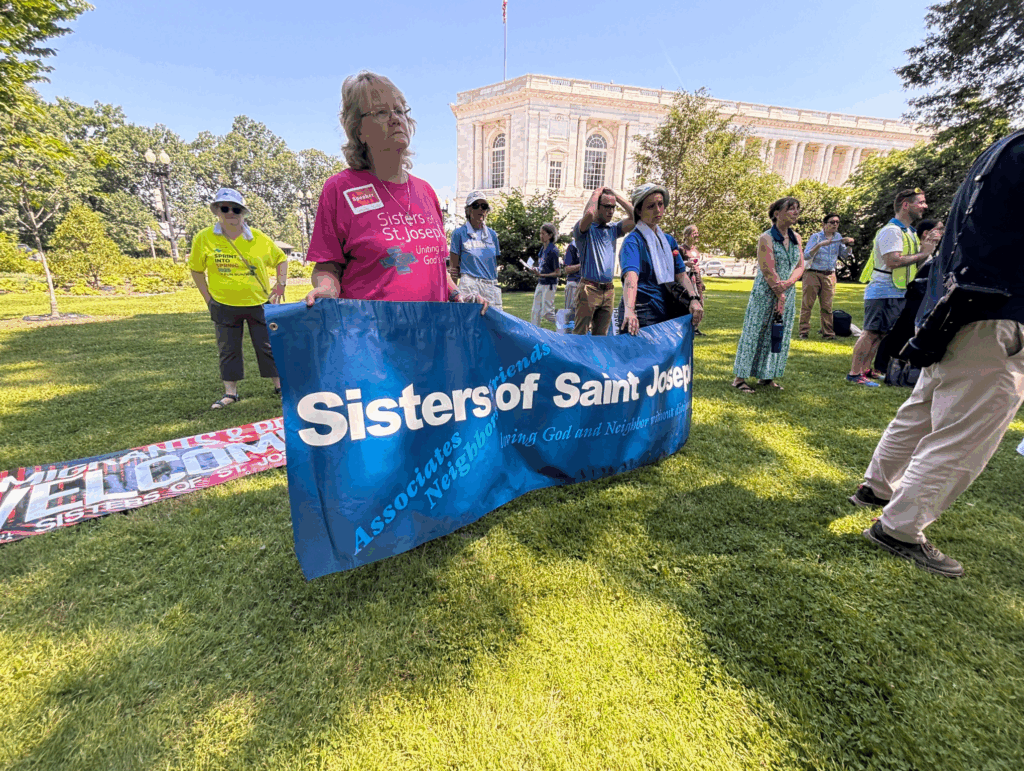
Sisters of St. Joseph of Brentwood, NY hold a sign at a June event on Capitol Hill at which Catholic Sisters strongly opposed the budget reconciliation bill.

This bill proposes to render many qualifying and lawfully present immigrants ineligible for vital programs while simultaneously slashing these programs by billions for U.S. citizens and lawful permanent residents. Except for green card holders, individuals residing in the U.S. according to a Compact of Free Association, and certain Cuban and Haitian entrants, the following programs will be severely restricted for non-citizens: 

  • Through passage of the budget reconciliation act, Congress ends Medicaid and Children’s Health Insurance Program (CHIP) for many of the most vulnerable including refugees, asylees, and several others. 
  • Congress also ends subsidized ACA Marketplace coverage for asylees, refugees, people with Temporary Protected Status, and Deferred Action for Childhood Arrivals (DACA) recipients beginning on January 1, 2027. Furthermore, all lawfully present immigrants with incomes under 100 percent of the FPL would be rendered ineligible for ACA marketplace coverage beginning on January 1, 2026
  • Despite promises to protect Medicare, the bill quietly strips access from many eligible immigrants. This means those who had coverage at the time of the bill will have their coverage end after January 4, 2027. This move leaves thousands of ageing individuals without the care they’ve relied on.
  • Food insecurity is also poised to worsen. The bill would end food assistance for eligible immigrants receiving Supplemental Nutrition Assistance Program (SNAP).
The Road Ahead

Harsh policies needlessly instill fear in communities and drive people deeper into the shadows. Common-sense immigration policies should uphold dignity, promote fairness and lawfulness, and prioritize meaningful reforms like a path to permanent legal status, not unnecessarily punish those who are in good standing in their communities as this administration has relentlessly done. Catholic Social Justice calls us to uphold the dignity of every human being. The real human costs of this immoral bill are undeniable. 

Legislation must bear in mind human dignity and the common good, the principle that every person should have the opportunity to live with dignity, contribute to society, and reach their God-given potential. The bills’ swift passage and lack of guidance create conditions ripe for abuse, including worsening overcrowding in detention facilities, fast-tracked deportations that bypass due process, and the hasty awarding of contracts without proper oversight.  

As Congress debates even more federal funding for ICE through the annual appropriations process, NETWORK is closely monitoring H.R. 4016, the Department of Defense Appropriations Act, 2026 and H.R.4213 – Department of Homeland Security Appropriations Act, 2026, which increase funds related to enforcement, detention, and border security. This alarming increase in interior enforcement in our communities is coming at the expense of taxpayers and family unity, and we must stand firm. 

Concerned people of faith can help support family unity and their communities by sharing know-your-rights materials and connecting with local community-based organizations, uphold dignity by supporting just policies like the restoration of sensitive locations policy guidance to ICE, and push for robust oversight and accountability from local and federal government officials and agencies.

Read Part 1 on immigration enforcement and detention.

Read Part 2 on how unfair government fees threaten family unity.

Immigrant Families: Unfair Fees Jeopardize Family Unity

Immigrant Families: Unfair Fees Jeopardize Family Unity

Congress is making it harder to get and maintain lawful status, raising the stakes for blended families trying to stay together


Giovana Oaxaca
August 8, 2025

The recently passed budget reconciliation bill diverts resources from communities to mass deportation efforts and border militarization. As Congress raises spending, it is also undermining the immigration system, deliberately raising barriers to lawful status. Most of these provisions take effect immediately. In this second installment of a three-part series, Giovana Oaxaca, NETWORK Senior Government Relations Advocate for Immigration explores how the bill threatens family unity with costly fees that, in conjunction with the Trump administration’s efforts to strip people of their status, create a legal minefield for many families.

Across the nation, blended families are navigating a huge immigration bureaucracy despite heightened enforcement targeting people following legal procedures at courthouses and check-ins. At the same time, through a series of fee hikes included in the bill, Congress is raising the cost of applying for and maintaining certain types of lawful status and work authorization, raising the stakes even more.  

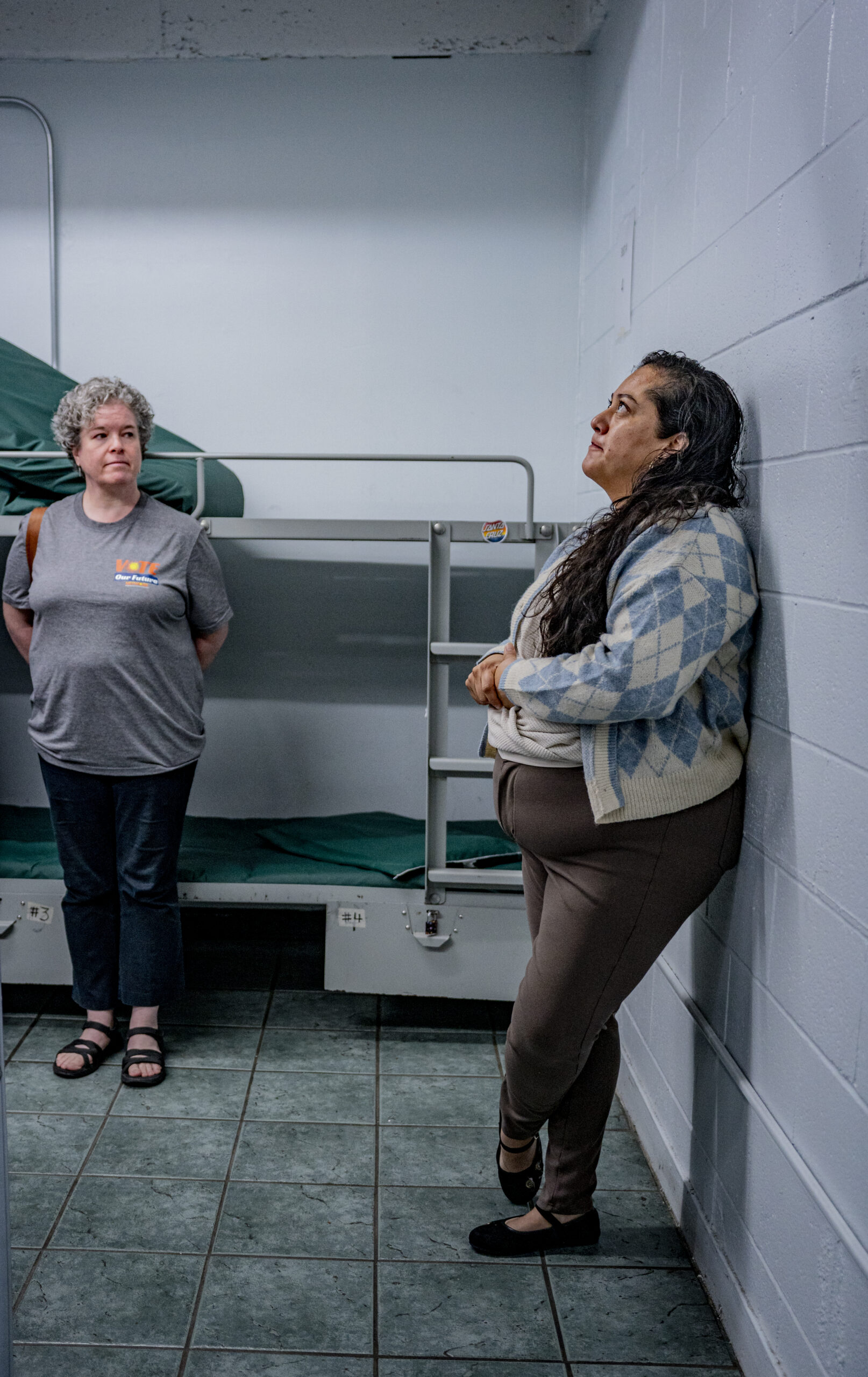
Sr. Deirdre Griffin, SSJ listens to Yesenia Lacayo of Mission Action in San Francisco during the 2024 Nuns on the Bus & Friends tour.

Sr. Deirdre Griffin, SSJ listens to Yesenia Lacayo of Mission Action in San Francisco during the 2024 Nuns on the Bus & Friends tour. The organization supports individuals and families with housing, immigration, health and wellness, and work resources. Photo: Jacob Schatz, CCR Studios

The fees in question will have a disproportionate impact on at-risk adults and families filing for humanitarian protection. These exorbitant fees mean that low- and moderateincome immigrant families will face new hurdles to securing stability and safety. Coupled with the Trump administration’s efforts to negate birthright citizenship and strip lawful status of numerous humanitarian migrants, family unity is under widespread attack.

  • The Trump administration has aggressively moved to take individuals with lawful status and valid work authorization and attempted to render them deportable.  
  • This has been attempted, with Supreme Court often intervening to permit the administration to carry out, with 500,000 CHNV humanitarian parole beneficiaries, Temporary Protected Status (TPS) holders from Haiti (348,000), Venezuela (350,000), Afghanistan (11,700), Cameroon, Nepal, Honduras, and Nicaragua (60,000).  
  • The Trump administration has also ratcheted up criminal charges for civil immigration violations, measures that increase vulnerability to deportation for immigrants. 

The bill would impose a minimum $100 fee for asylum and $550 for work permit applications—a first in U.S. history—posing a barrier for many, including trafficking survivors and those fleeing persecution. Asylum seekers, parole beneficiaries, and individuals seeking Temporary Protected Status would pay an initial fee and $275 annually to renew work permits sufficiency. To make matters worse, many of these fees are minimums, meaning the Administration could charge more than what is listed in the bill. And the bill removes various waivers. 

The proposed fees would be especially burdensome for immigrants seeking benefits adjudicated through the immigration court system, adding significant barriers to relief. This includes for example, applications for Green Cards, waivers of inadmissibility, appeals of immigration judge decisions, and other related proceedings. In all, it paints a picture that is grossly unfair, in addition to the already unjust and gut-wrenching toll that enforcement measures place on immigrant families and communities. 

The immense bureaucracy that families and individuals are facing is itself concerning but turning our backs on families and individuals trying to follow legal processes is unjust and counterproductive.

Part 3 of this series will address the needs of families to live with dignity.

Read Part 1 on immigration enforcement and detention.

Immigrant Families: What’s at Stake and How We Respond

Immigrant Families: What’s at Stake and How We Respond

Congress has allocated hundreds of billions of dollars to ramp up raids and detain thousands of our neighbors and loved ones at a massive taxpayer and moral cost


Giovana Oaxaca
August 5, 2025

The recently passed budget reconciliation bill diverts resources from communities to mass deportation efforts and border militarization. As Congress raises spending, it is also reinforcing state and federal cooperation. Most of these funds will be spent before September 30, 2029. In this first of a three-part series, Giovana Oaxaca, NETWORK Senior Government Relations Advocate for Immigration, will address immigration in the bill. 

In cities across the country, ICE raids have become all too common, leaving families shattered and communities living in fear. But we don’t have to accept terror as the status quo. Immigrants, their families, neighbors, employers, and advocates are united in demanding respect for human dignity, protection of basic rights, and a government that serves the common good. NETWORK staff and advocates have been on the frontline of defending immigrant rights—turning the passage of recent legislation into a moral awakening.  

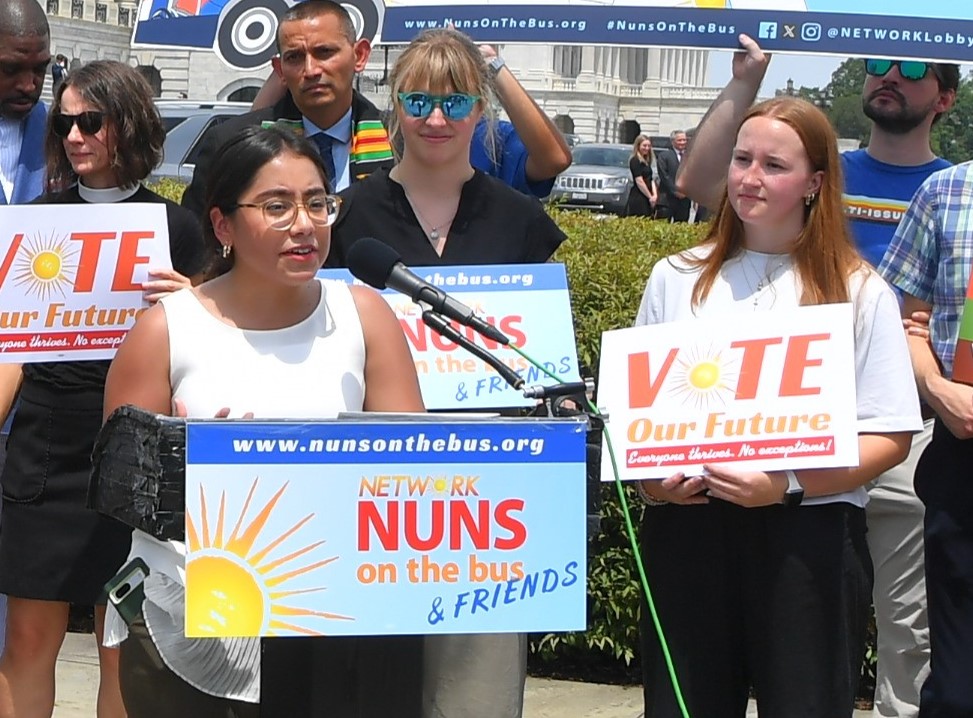
Giovana Oaxaca speaks at 2024 Nuns on the Bus & Friends launch.

Giovana Oaxaca, who now serves as NETWORK Senior Government Relations Advocate for Immigration, speaks at the 2024 Nuns on the Bus & Friends announcement. Photo: Larry French/AP Content Services for NETWORK Nuns on the Bus and Friends

To understand the most aggressive immigration crackdown in recent U.S. history, let’s unpack how the budget reconciliation will drive mass deportations that tear families apart; impose higher immigration fees on already burdened families; and cut health and food assistance, denying children and families the necessary resources they need to thrive.

Diverting Community Resources to Fund Mass Deportation Efforts

The rapid growth of the detention system is poised to continue. Congress provided $45 billion to expand adult and family immigration detention, enough to maintain 100,000 detention beds per day. The bill includes a $29.9 billion lump sum that can be used to hire 10,000 new ICE agents, upgrade facilities, detain families together, and expand the use of 287(g) agreements, among other uses. Another $5 billion for the Bureau of Prisons (BOP) could allow for continued repurposing of prisons for immigration detention. 

  • In the text of the bill, Congress failed to create guardrails to prevent the prolonged detention of children and their families, in potential contravention of the Flores Settlement Agreement. This puts the protection of children at even greater risk. 
  • On May 10, the Trump administration moved to terminate Flores, the landmark court order establishing the standards of treatment, care, and release of children in federal immigration custody. 

Another significant amount of funding ($3.32 billion) is allocated to the Department of Justice (DOJ) for hiring immigration judges, combatting drug trafficking, investigating and prosecuting immigration matters, supporting state and localities’ immigration enforcement efforts through community policing grants, and compensating states and localities for jailing immigrants. Congress effectively guarantees that the deportation infrastructure will be primed to deport one million people annually, ramping up kidnappings, accelerating the removal process, and raising barriers to relief. 

Entrenching State-Federal Cooperation

New programs created by Congress cement further state and local law enforcement collaboration on immigration enforcement, eroding trust in local law enforcement. 

The bill provides $3.5 billion for establishing a new grant program under the DOJ called the Bridging Immigration-related Deficits Experienced Nationwide (BIDEN) Reimbursement Fund, which states and localities can use for a range of purposes, including apprehending unlawfully present non-citizens who have committed crimes and for the criminal detention of non-citizens. State and local cooperation is emphasized with a further $2.055 billion lump sum created to fund hiring new Customs and Border Protection (CBP) agents, deportations, enhanced screenings of immigrants, and the deportation of unaccompanied children from contiguous countries. It will also reimburse states and localities for various immigration and security efforts, providing for the deportation of unaccompanied children, expedited removal of non-citizens who have committed crimes, and screening unaccompanied children for possible gang affiliations. 

This spending allows deeper entanglement between state and local law enforcement and federal authorities. An additional $13.5 billion is allocated to states for border-related immigration enforcement, $10 billion for a “State Border Security Reinforcement Fund,” and $450 million for Operation Stonegarten, which bolsters state and local law enforcement at the border. This further embeds state and local law enforcement into both administrative and criminal enforcement of immigration laws, blurring lines. 

This may contribute to the erosion of trust between local police and immigrant communities due to fear. In one survey, 35 percent of Latino parents said they planned to avoid talking to police or reporting crimes because of fear.

Ramping Up Deadly Border Enforcement

Under this legislation, $46.5 billion is provided for new and replacement border walls and barriers. Congress also makes $4.1 billion available to hire new Border Patrol agents, $2 billion to award bonuses, and $5 billion to make facility and checkpoint upgrades. Aside from the already provided amounts, $10 billion is provided to DHS for unspecified homeland security measures. Our tradition teaches that truth must precede reconciliation, and that repair is a spiritual discipline. As Pope Francis reminds us, “Every human being is precious.” That sacredness demands a public reckoning with the truth and a commitment to systemic transformation, so that all of us can thrive.

Part 2 of this series explores fairness for immigrant families.


Sisters Speak Out-Dominican Sisters of Sinsinawa

Catholic Sisters Called for Justice at Sisters Speak Out, NETWORK was there

Catholic Sisters Called for Justice at Sisters Speak Out

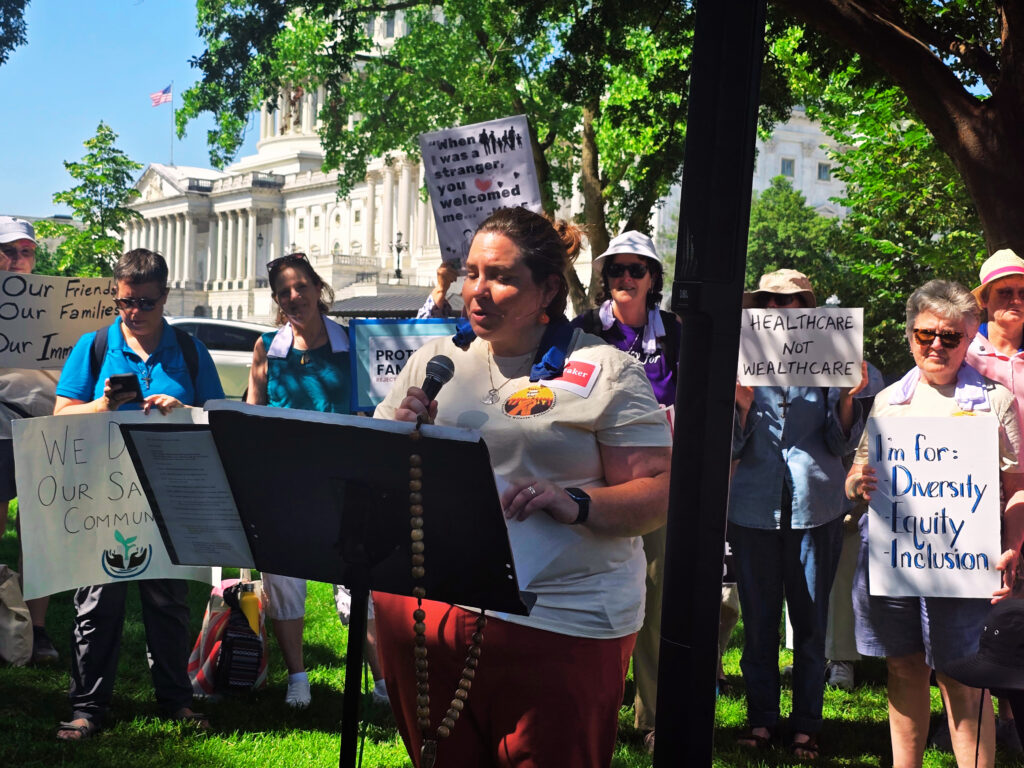
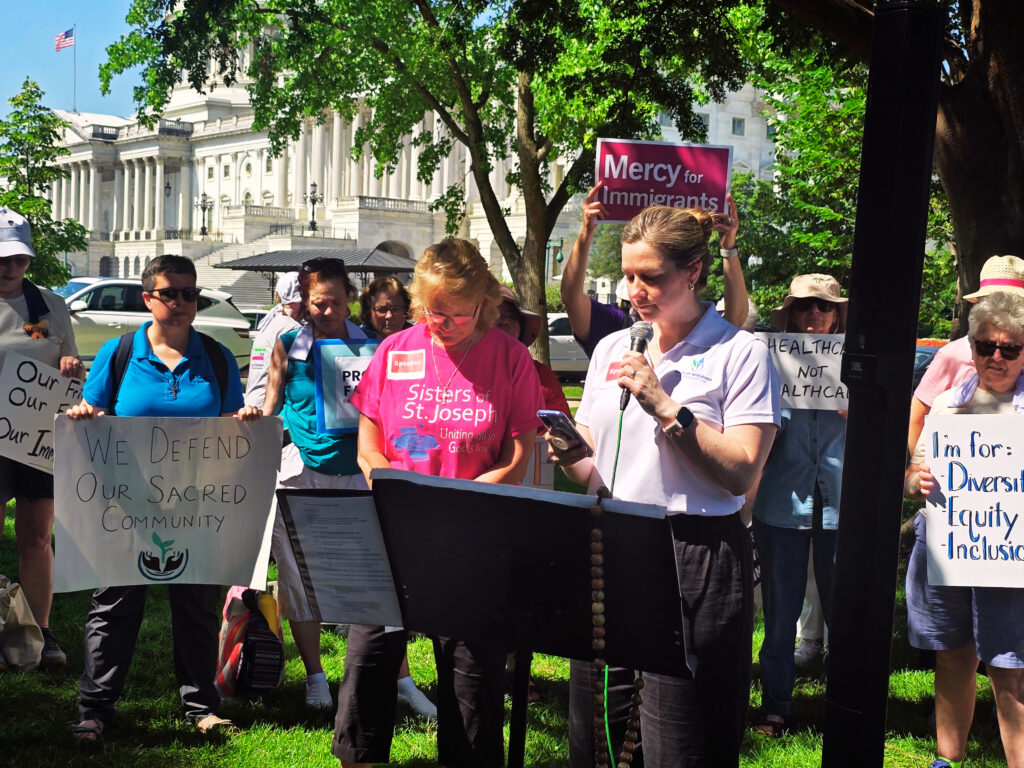
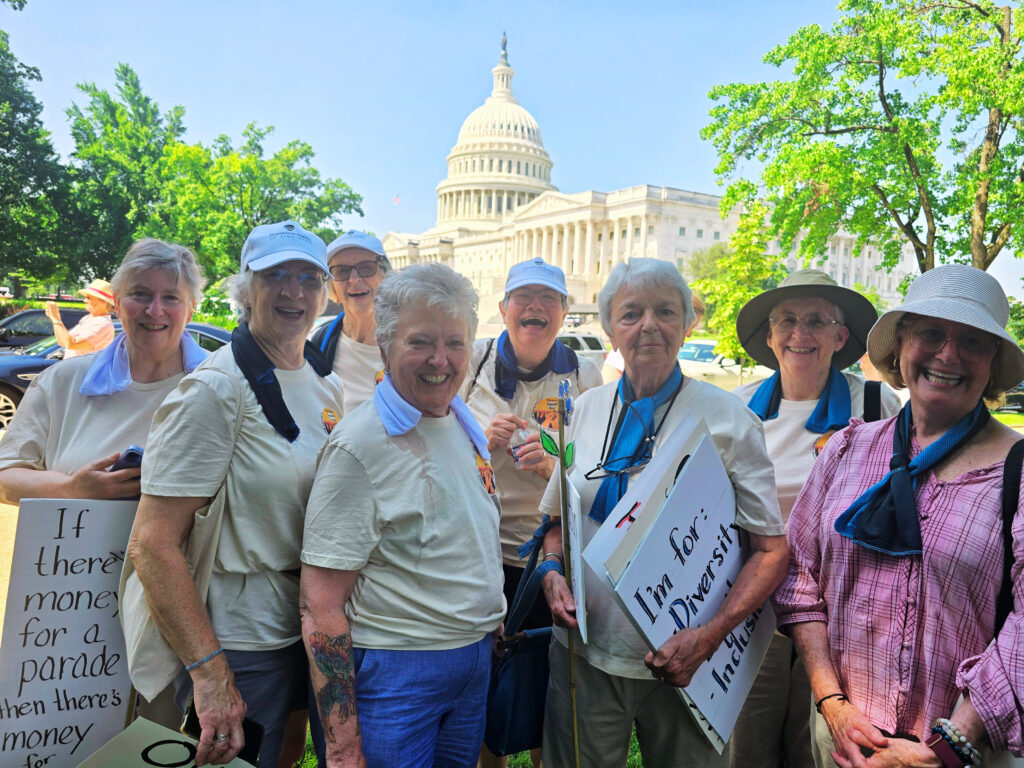
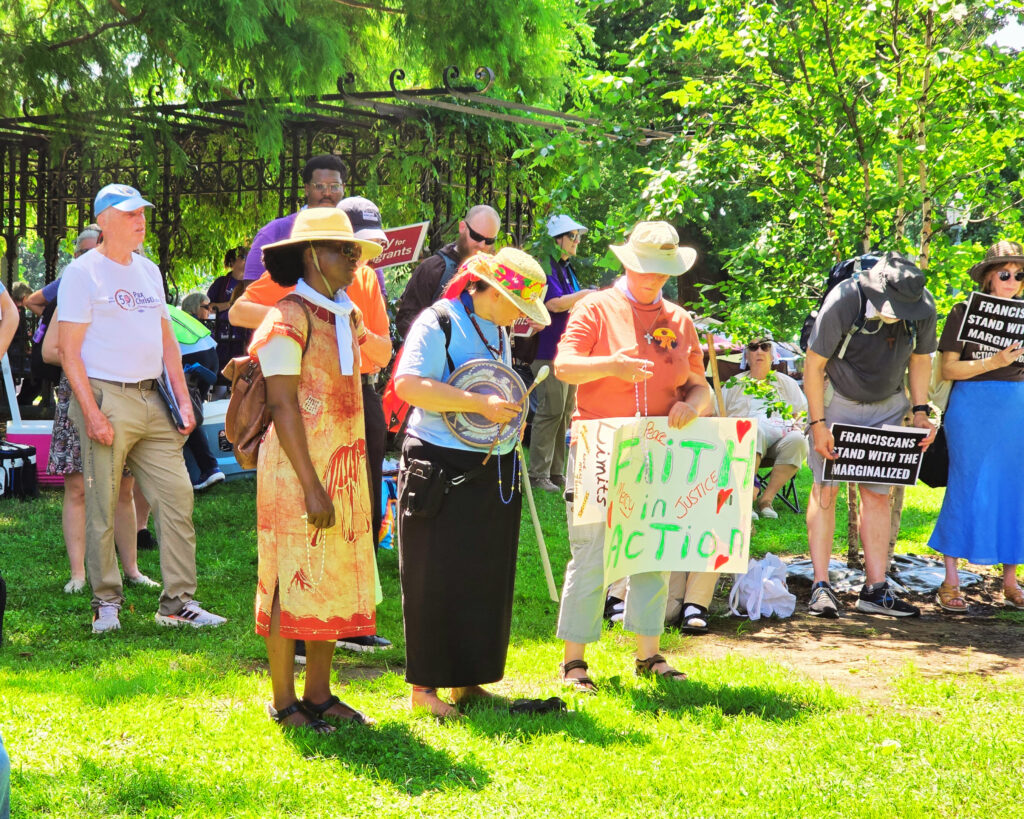
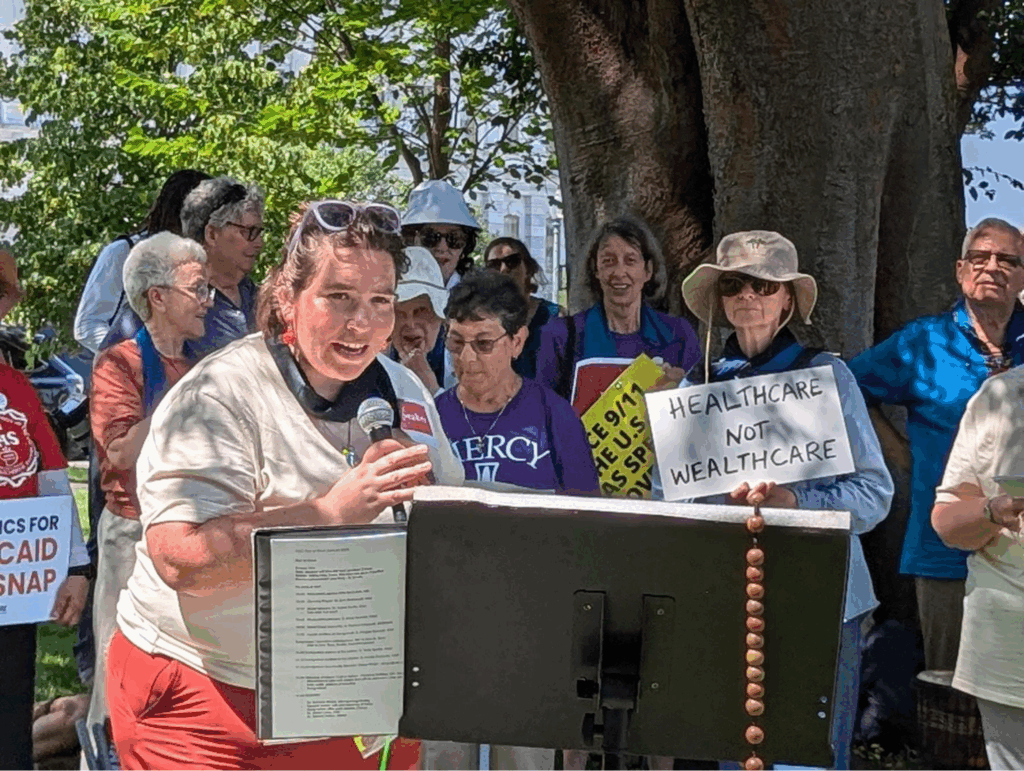
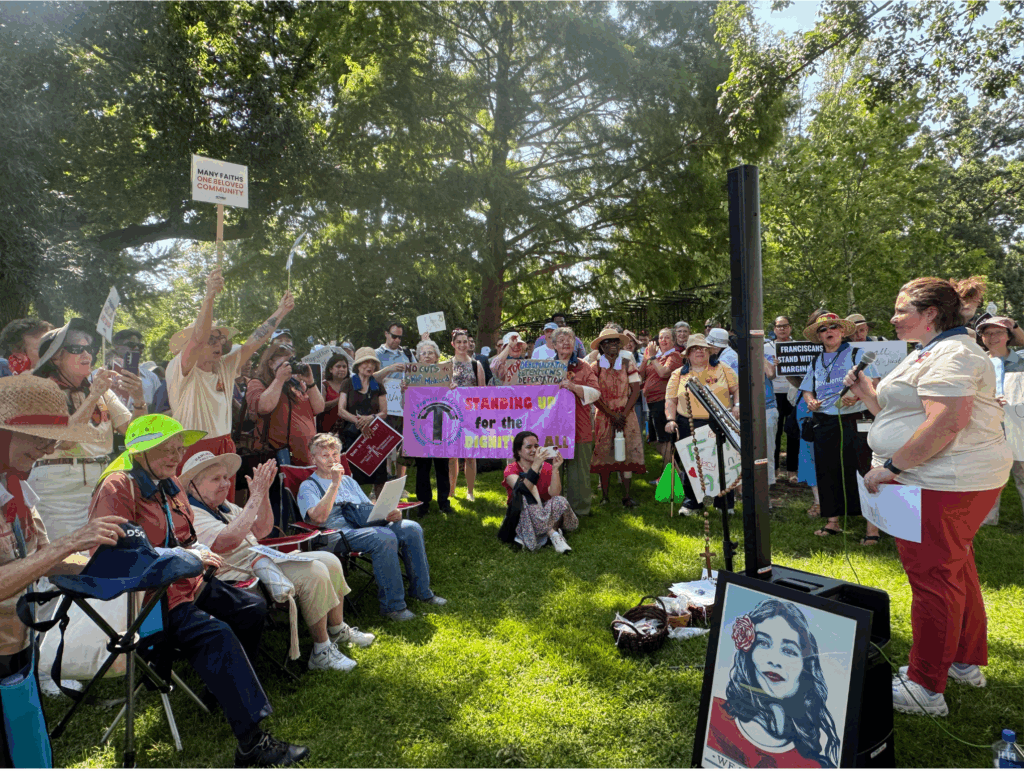
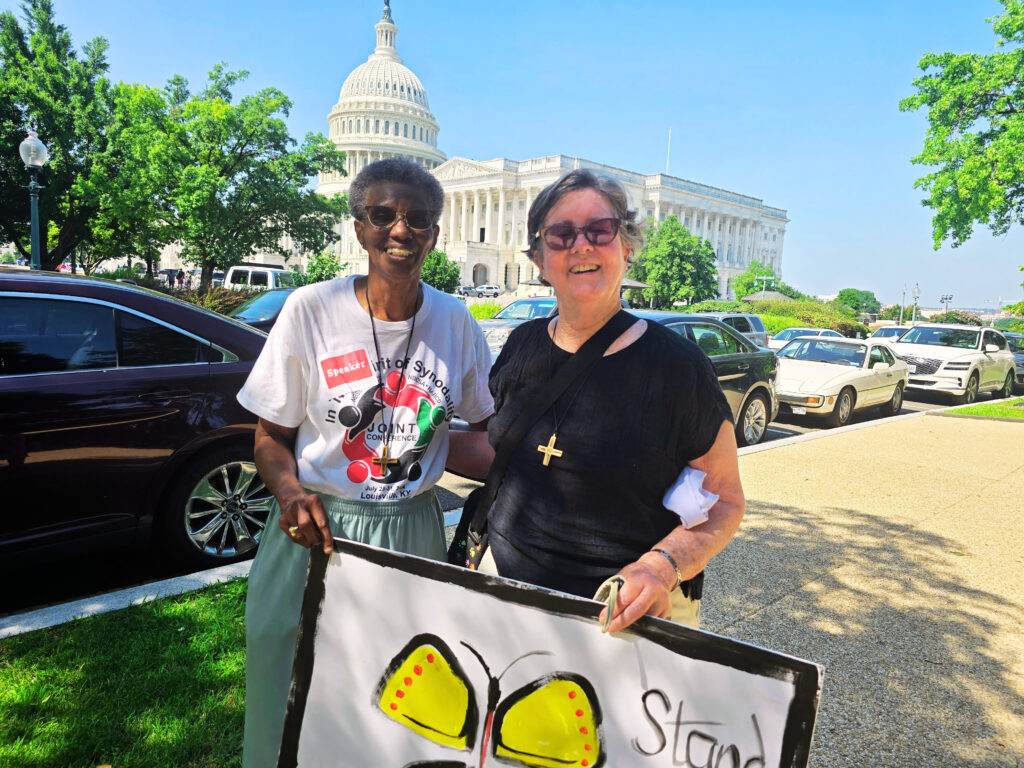
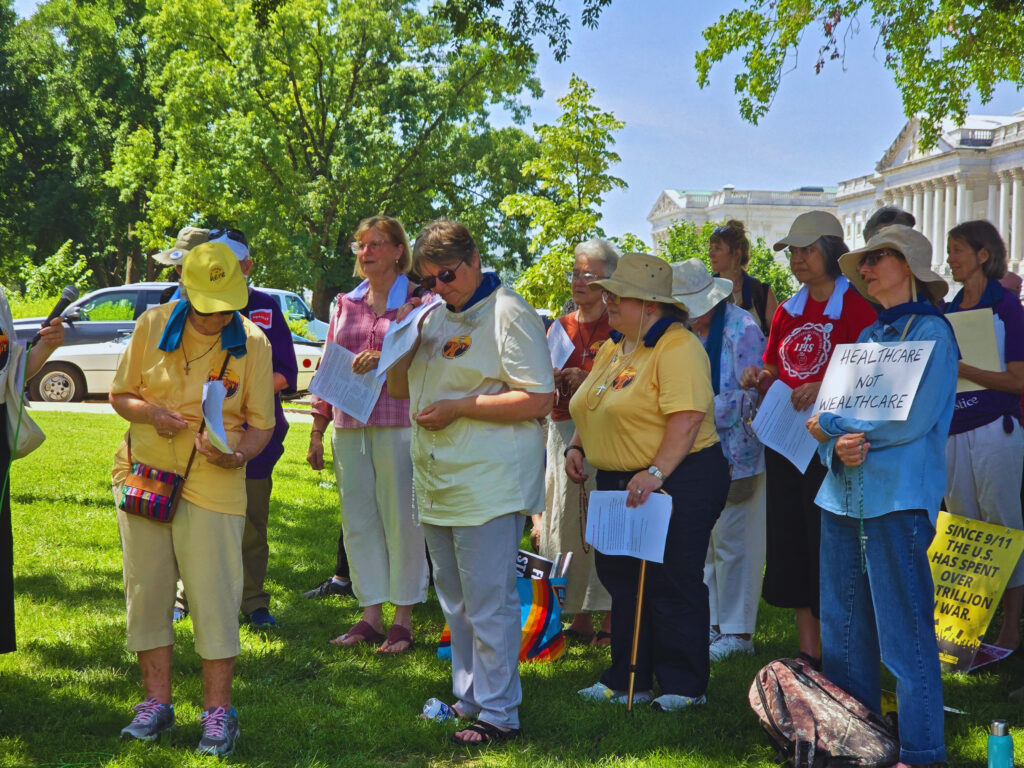
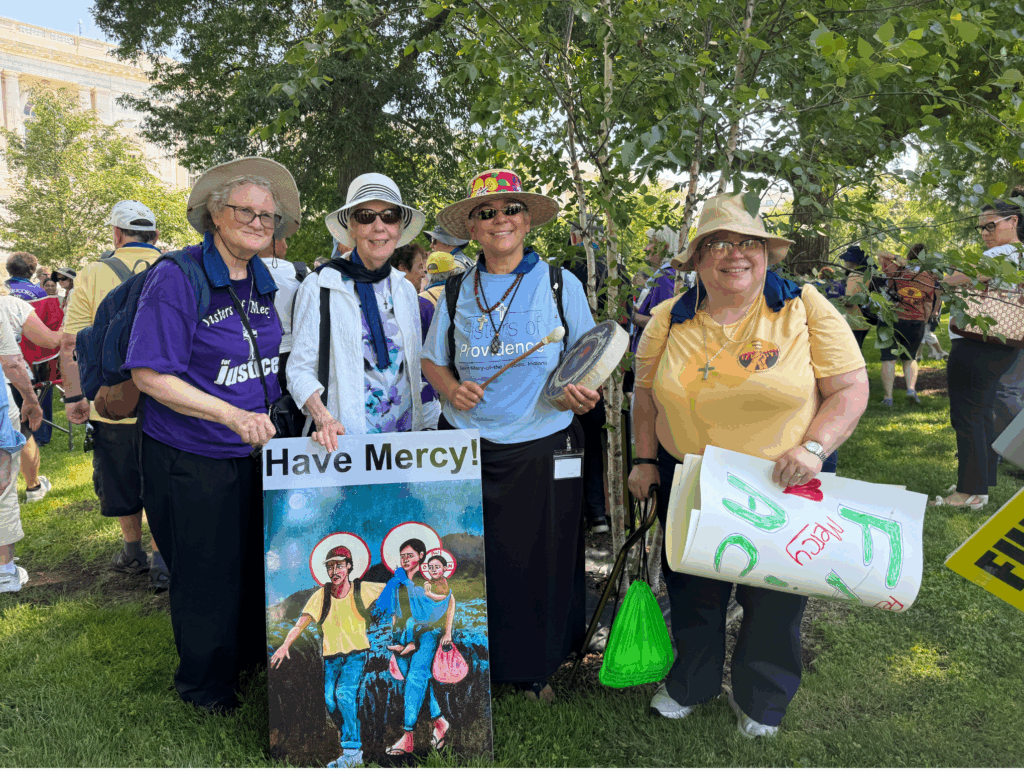
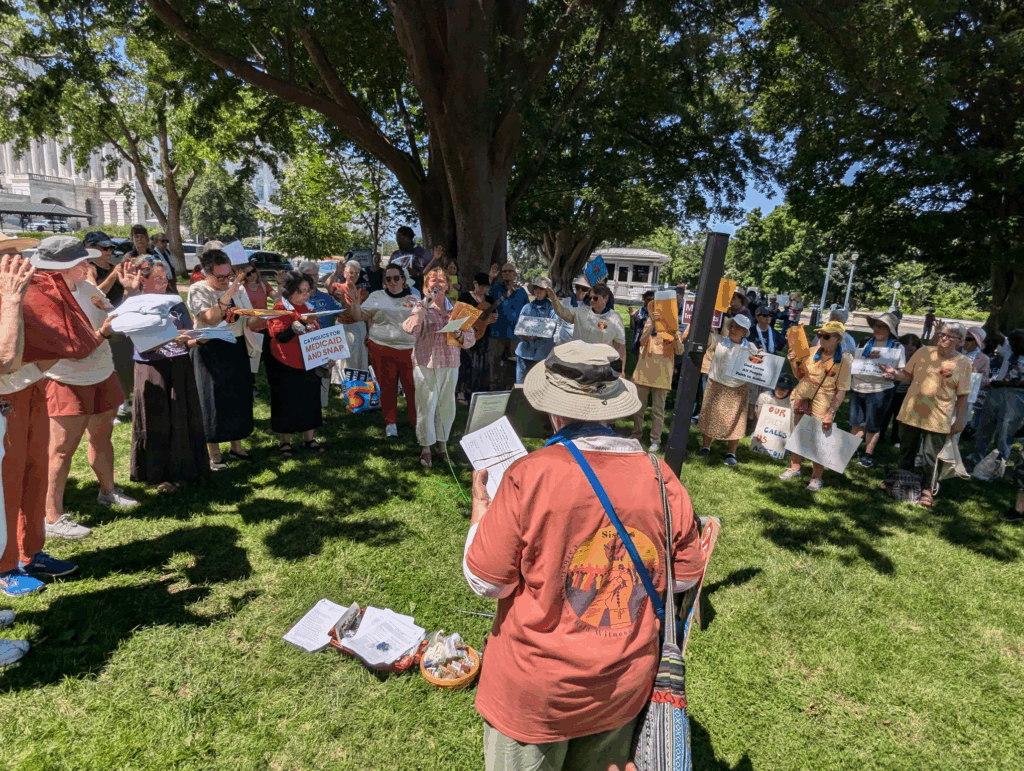
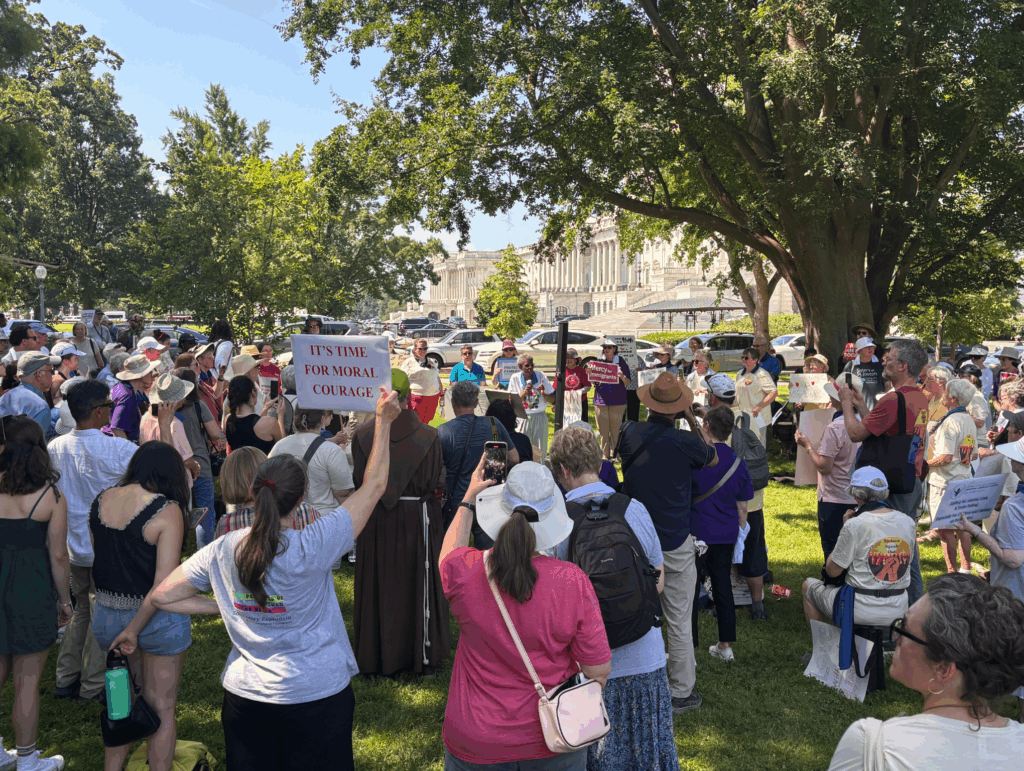
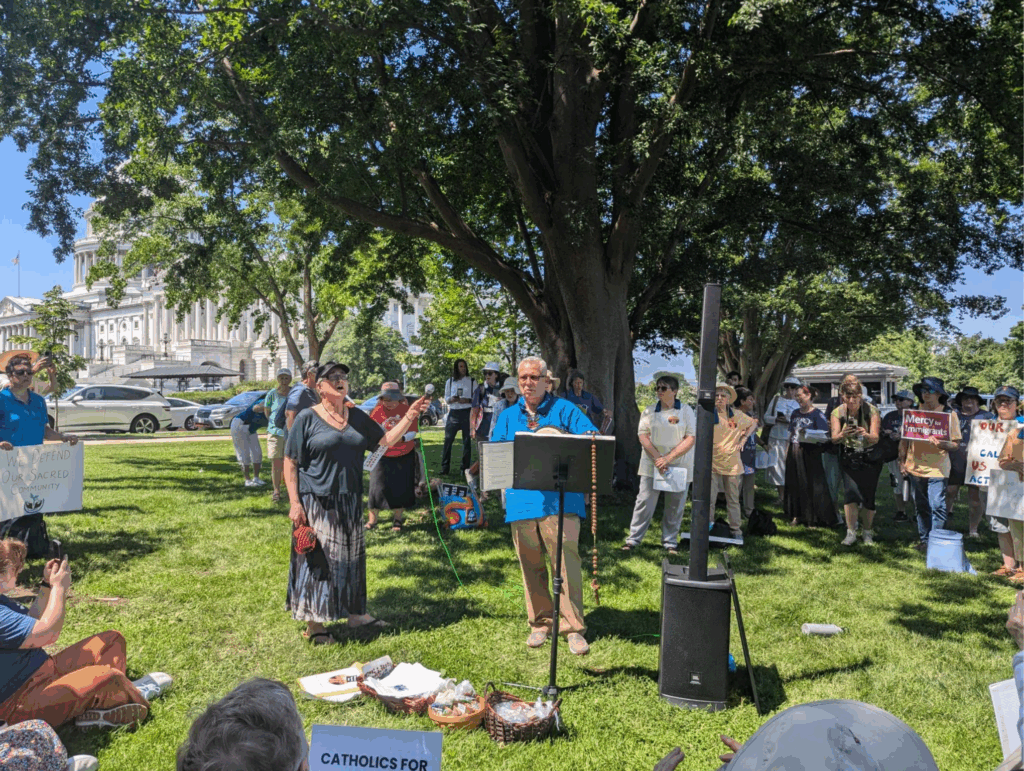
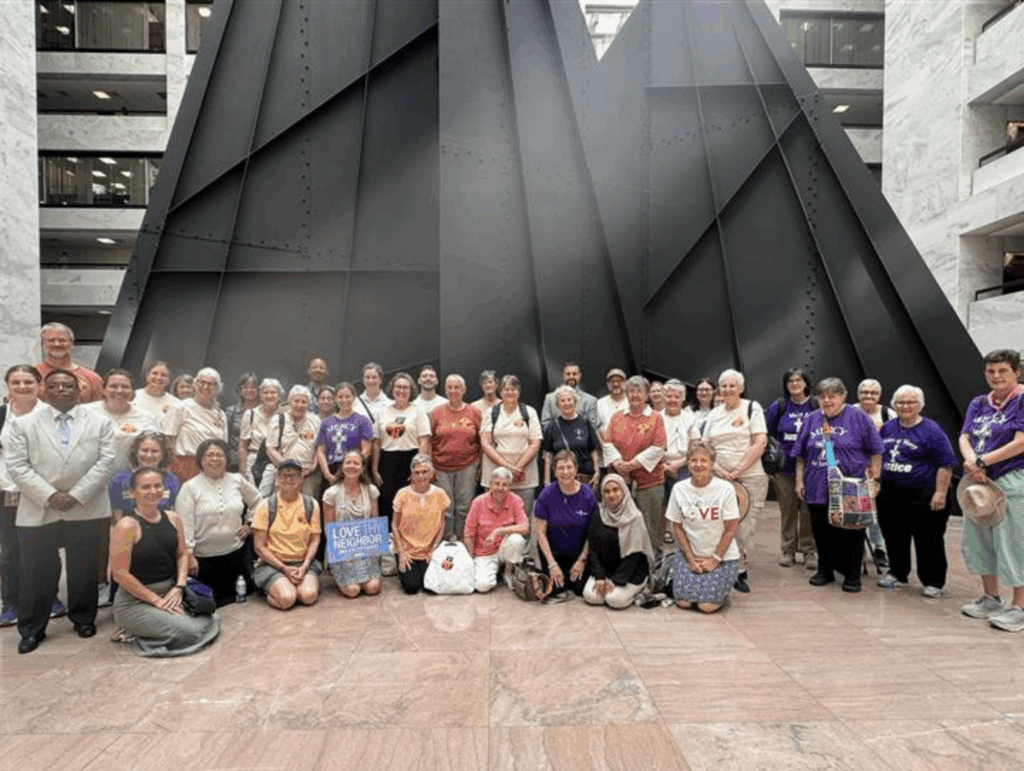
Catholic Sisters from more than 50 congregations around the country gathered in 100 degree heat for prayer and public witness on Capitol Hill on June 24, 2025 for Sisters Speak Out. Joined by social justice organizations and Spirit-filled advocates, they urged the Senate to reject steep budget cuts that will gut Medicaid, the Supplemental Nutrition Assistance Program (SNAP) and more programs vital to the well-being of people in every state in our country.

The group of over 300 people also heard Sisters Speak Out in opposition to the massive increase in spending for the inhumane roundup of our immigrant neighbors, their deportation without due process, and the cruelty of family separation.

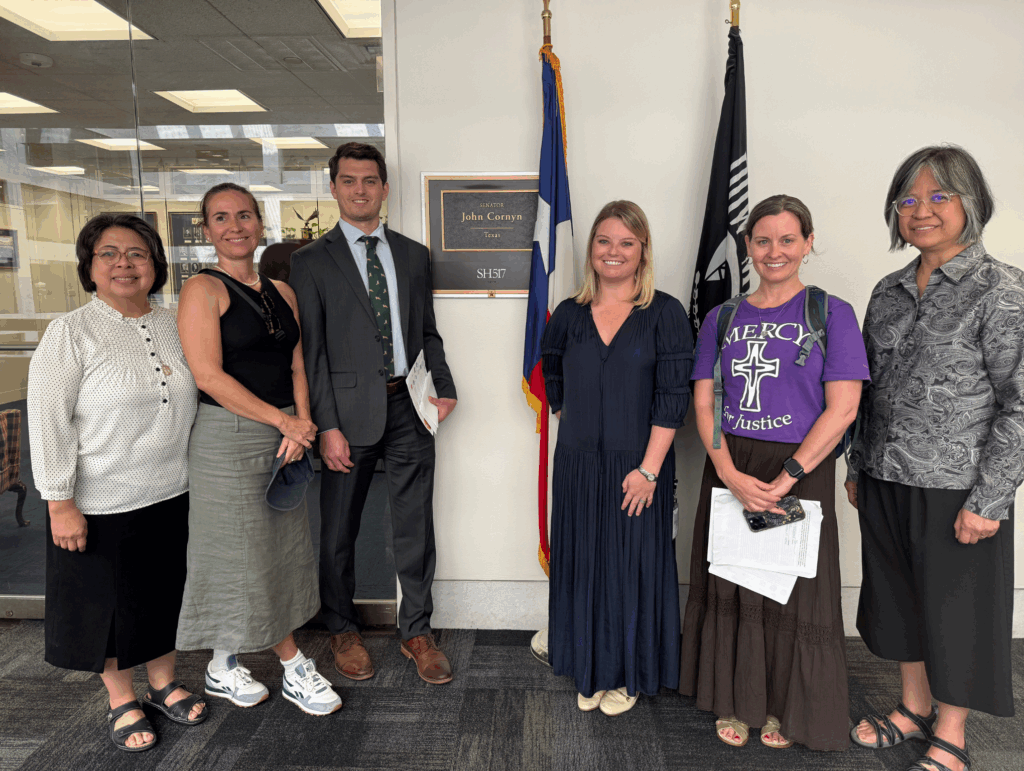
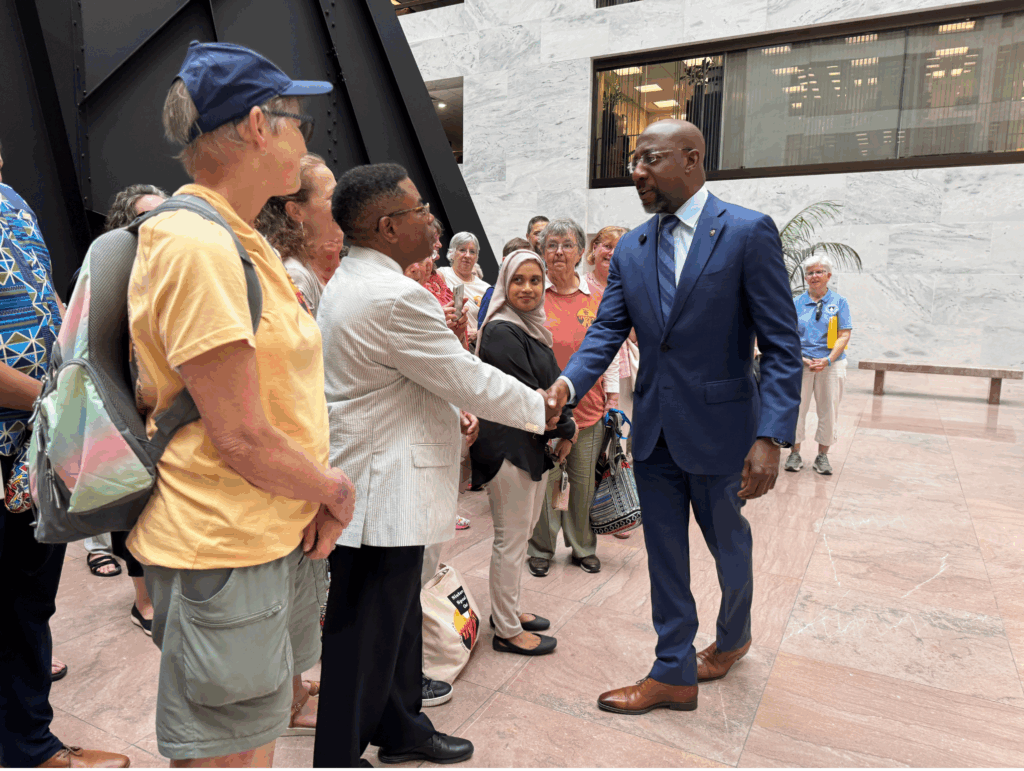
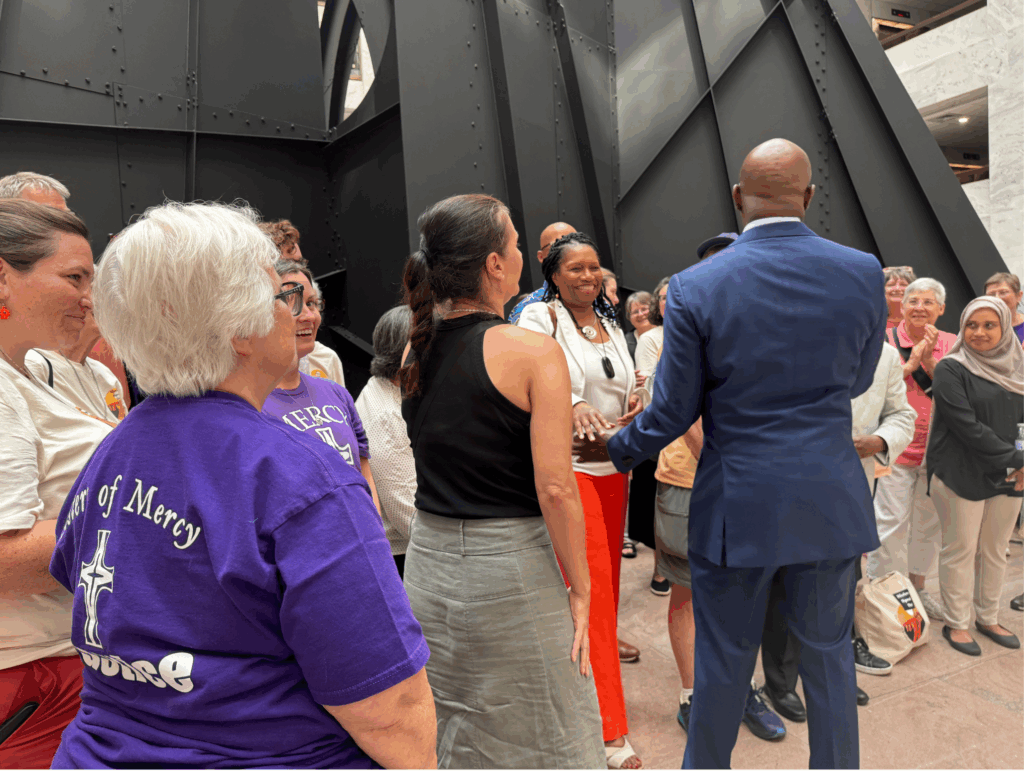
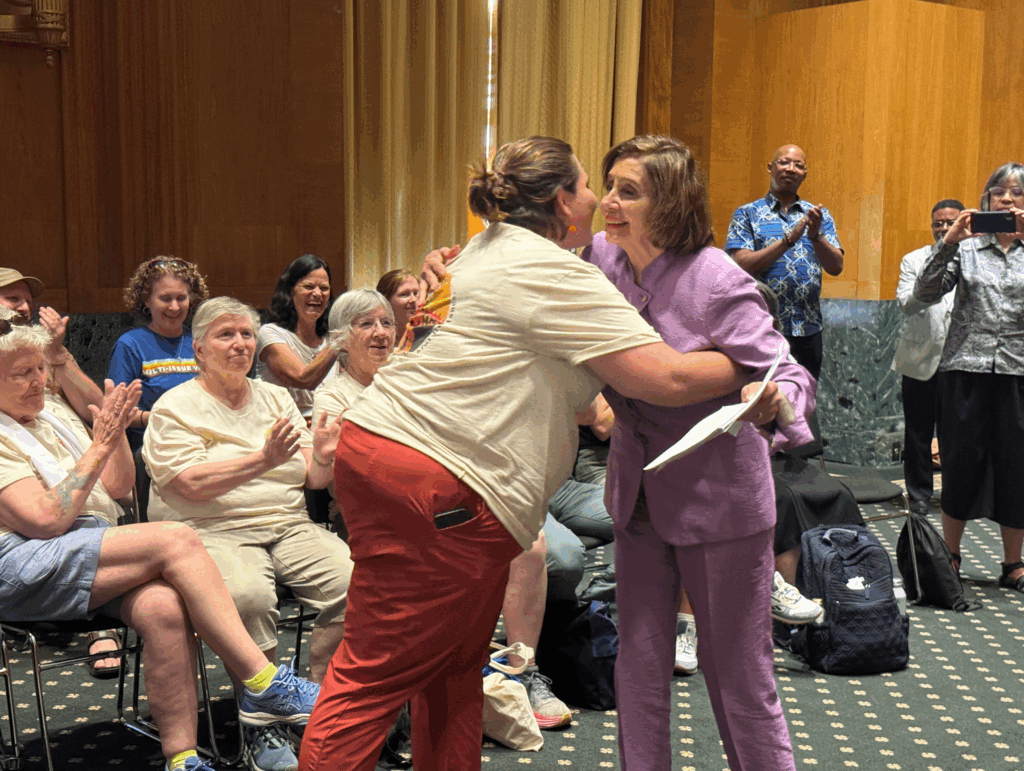
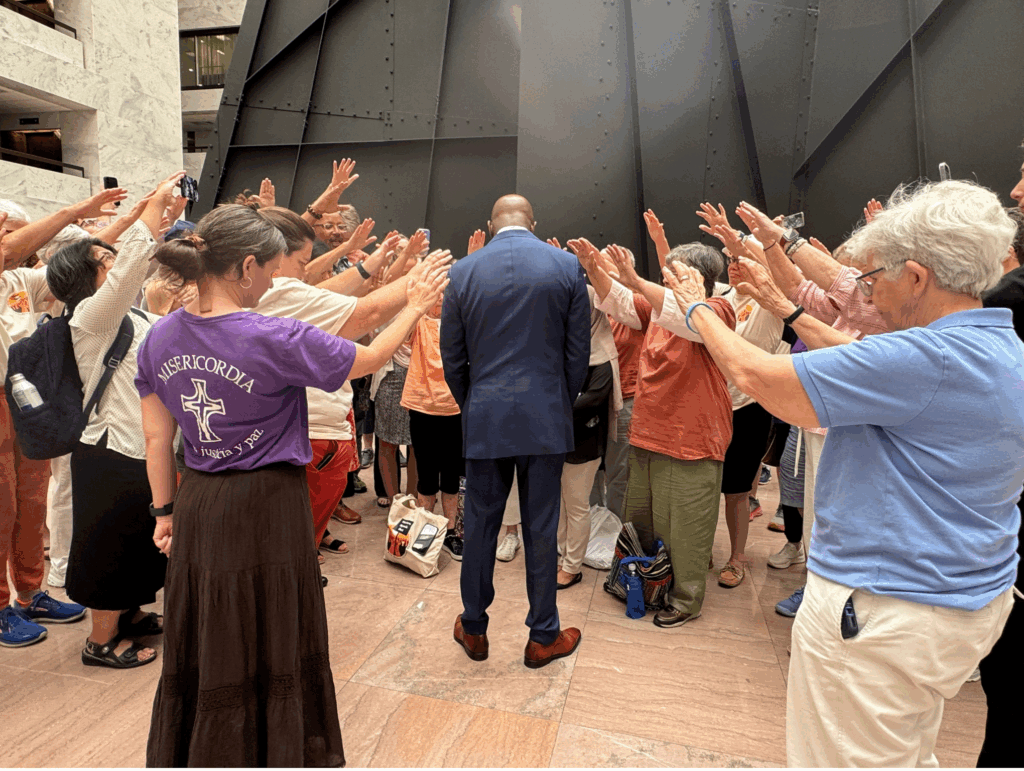
Through excessively high temperatures, spirits and hopes remained high through passionate Sister stories and reflections, soul-stirring spirituals, and powerful prayers (including a lovely rosary to end the gathering). The Sisters did not end the day on a grassy patch on the Hill. Dozens were accompanied by NETWORK staff for lobby visits to Senate offices. Their day ended with time spent with Speaker Emerita Nancy Pelosi (CA-11) and Senator Raphael Warnock (GA) for conversation and prayer.

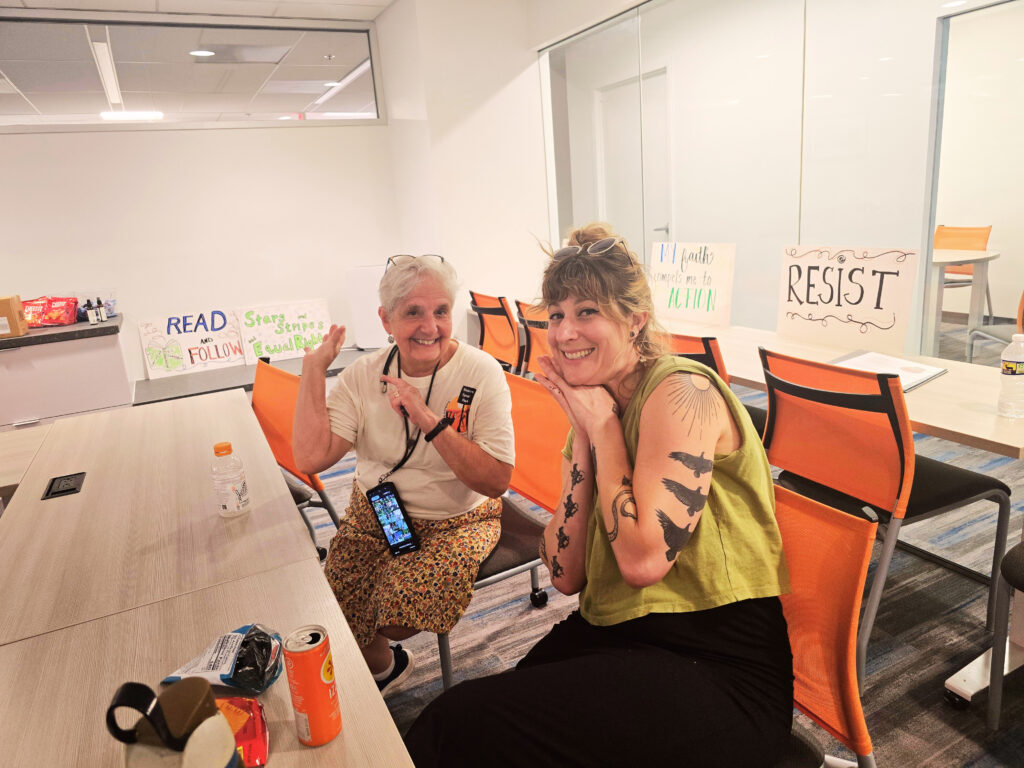
Selected images from the beautiful day are on this page. You can find more photos and images on the NETWORK Flickr account.

——-
For more than a century, Catholic Sisters (also known as nuns) have been at the forefront of serving with vulnerable communities in the United States through ministries of health care, education, and social services. They sponsor many of the country’s largest Catholic hospital systems, universities, and social services agencies.

For inquiries about Sisters Speak Out, please contact Sister, Eilis McCulloh, HM, NETWORK’s Grassroots Education and Organizing Coordinator at [email protected]

Present Day Trauma and Old Wounds

Present Day Trauma and Old Wounds

We Need Solidarity Across Communities to Counter the Horrors of the Budget Bill’s Immigration Provisions

Joan F. Neal
June 26, 2025

In responding to the budget reconciliation bill now expected to pass the U.S. Senate this week, NETWORK and Sisters around the country have focused much attention on the calamitous cuts to health care and food programs in the bill, especially as they would go to tax cuts for the wealthiest individuals in the country. This is a worthy focus, given the millions of people whose lives are threatened by this disastrous bill.

Sadly, this is only part of the story. NETWORK has also called attention to the $150 billion this bill allots to terrorizing our communities through scaled up immigrant detention and deportation efforts. The horrific policies and actions under this Administration have drawn much attention in the media.

One recent example is the viral video of Narciso Barranco, a California gardener, being beaten by agents as they arrest him. One of his sons, a Marine who put his life on the line for our country, says he is heartbroken and betrayed. While this violence is happening to specific families, the shockwaves it sends through our communities are palpable. It is also intergenerational. Clearly, we need to realize that no individual, family or community is safe when this level of unchecked militarization descends upon us at such an expanded scale.

For Black people in the U.S., images of masked and armed men snatching people off the streets and disappearing them evoke another horrific chapter in U.S. history, one that is still discernable in the rear-view mirror. Neighbor turned on neighbor along racial lines. There was vigilante justice against the Black community, and, just like today, people were afraid to live their daily lives. The impacts on our communities are comparable in terms of the terror and trauma they spread.

Across the U.S., we should feel real pain watching neighbors, coworkers, friends, and families—including those with legal residency in the U.S.—being hauled away from their homes, workplaces, and loved ones. We need to lean into this empathy and let it draw us into action. Solidarity is our salvation.

We have mustered this widespread solidarity before, the most recent and far-reaching example being the Civil Rights movement, which saw white people—including many Catholic Sisters and clergy—joining protests and marches to decry racial segregation and the denial of civil rights, voting rights, fair housing and more, to Black people – U.S. citizens. The Civil Rights movement is an example of how solidarity across communities can work to counter systemic injustice and lead to societal transformation. This is a lesson we should all remember at this time of turmoil.

So as we act together in resistance to the current push to pass the ‘big, bad’ budget reconciliation bill, we cannot lose sight of the human cost of this terrible, unjust piece of legislation that will provide billions of dollars to continue the violent assaults on immigrants while slashing essential programs for all people across the country who need assistance. Rather, we must once again come together in solidarity so that none of us, no matter who we are, react to the harm of another person without empathy. We must acknowledge that we are all one, human family without exception—as residents of this country, as members of communities, as children of God—and act accordingly.

We shouldn’t need horrors such as these ICE raids or devastating cuts to essential programs to remind us of this oneness, but here we are. Thankfully, protests and other actions in recent weeks have shown encouraging signs that we are still capable of recognizing our shared humanity. Let us pray and act so that these acts of solidarity continue.

Use NETWORK’s Budget Reconciliation Toolkit to take part in our advocacy against this bill.

Lent Week 6: We Aren’t Falling for Division

Lent 2025: Giving Up Billionaires


Welcome to week 6 of our Lenten series, “Giving Up Billionaires,” as we call on Congress to give up billionaires so our communities can have what we need to thrive. Click here for the rest of our Lenten reflections and actions.

We Aren’t Falling for Division


Sr. Emily TeKolste, SP
April 9, 2025


In the U.S., only one percent of the population earns a million dollars or more per year, and there are just 800 billionaires. Yet this small group of the wealthiest individuals has spent millions to persuade everyday Americans to vote in favor of their interests instead of our own. How have they done that? One answer: by stoking racial fear.

In the 1950s and ’60s, some politicians and their ultra-wealthy backers seized on the discomfort of the Civil Rights Movement to stoke racist resentment. They tried to weaken support for a government that works for the people, so they could instead build a government that works only for the ultra-wealthy.

Some lawmakers and their ultra-wealthy backers today still stoke racial fears by scapegoating our neighbors. The ultra-wealthy try to distract us from the economic problems that their wealth-hoarding creates by pointing the finger at immigrants, transgender people, or working people.

We see this in the Trump administration as they spin lies about diversity, equity, and inclusion (DEI) initiatives to pit white, Black, and Brown workers against each other. And, we see it this week as Republicans in Congress seek $350 billion in the budget reconciliation bill to detain and deport our immigrant neighbors.

Take action
  • Call your House Member at 1-888-897-9753 to ensure that Congress does not pay for more tax breaks for the ultra-wealthy and more funding to detain and deport our immigrant neighbors by cutting Medicaid and SNAP in the budget reconciliation bill.
  • Spread the word. Save the image that I’ve placed below to your computer or phone, then share it on social media or email it to friends and family.
  • Write a letter to the editor (LTE) calling Congress to reject the budget proposal. LTEs are one of the most effective advocacy tactics. Please join us TOMORROW, Thursday, April 10 at 7:00 PM Eastern / 4:00 PM Pacific at our LTE training at our LTE workshop to learn some LTE best practices.

Find more LTE and social media guidance in our Lent toolkit.

The result of these divide-and-conquer tactics has been devastating for most of us, no matter our race or gender. As the ultra-wealthy have amassed power, they have weakened regulations that protect us and our communities and let billionaires off the hook from paying their fair share and contributing to the common good.

These lawmakers and their ultra-wealthy backers hope that we will become too divided and distracted to recognize the real culprits. But we aren’t falling for it! We refuse to fear our neighbors or to fall for attempts to divide us. We know the way through this: to come together across our differences and work to build a world that truly works for all of us–not just the ultra-wealthy. We must demand that our elected officials make the ultra-wealthy pay their fair share instead of giving them tax breaks and taking away our health care, food, and even our immigrant neighbors, to do it.

TAKE ACTION: Call your House member today at 1-888-897-9753 and tell them to protect SNAP and Medicaid and reject funding for detention and deportation and tax cuts for billionaires in the budget proposal! Then, use our Lent toolkit to write an LTE calling Congress to reject the budget proposal.

NETWORK has more shareable content, sample social media posts, and LTE guidance for you in our Lent Toolkit.

Emily TeKolste, SP, NETWORK bio

Sr. Emily TeKolste, SP is NETWORK’s Grassroots Mobilization Coordinator. To read more, check out her column in Global Sisters Report, “The existence of billionaires is immoral.”

Lent Week 5: Congress: Keep Families Together, End Private Prison Profits

Lent 2025: Giving Up Billionaires


Welcome to week 5 of our Lenten series, “Giving Up Billionaires,” as we call on Congress to give up billionaires so our communities can have what we need to thrive. Click here for the rest of our Lenten reflections and actions.

Congress: Keep Families Together, End Private Prison Profits


Sr. Emily TeKolste, SP
April 2, 2025


On a recent call with investors, Damon Hininger, CEO of private detention company CoreCivic, called this “one of the most exciting periods in my career.” He was referring to President Trump’s executive orders targeting immigrants–and Congress’s passage of a bill that would force the detention of some of our immigrant neighbors without due process.

It is reprehensible that President Trump’s actions to militarize our neighborhoods, tear families apart, and devastate our communities is an “exciting” career moment for an ultra-wealthy CEO.

The budget reconciliation bill that is moving through Congress includes more than $300 billion in funding for the Trump administration to detain and deport our immigrant neighbors, and to fund tax breaks for the ultra-wealthy. Republicans in Congress plan to pay for all of that by cutting our Medicaid and SNAP.

Take action
  • Call your House Member at 1-888-897-9753 to ensure that Congress does not pay for more tax breaks for the ultra-wealthy and more funding to detain and deport our immigrant neighbors by cutting Medicaid and SNAP in the budget reconciliation bill.
  • Spread the word. Save the image that I’ve placed below to your computer or phone, then share it on social media or email it to friends and family.
  • Write a letter to the editor (LTE) calling Congress to reject the budget proposal. LTEs are one of the most effective advocacy tactics. If you’d like to receive LTE training, join us on Thursday, April 10 at 7:00 PM Eastern / 4:00 PM Pacific at our LTE training at our upcoming LTE workshop to learn some LTE best practices.

Find more LTE and social media guidance in our Lent toolkit.

Nearly all people in U.S. Immigration and Customs Enforcement (ICE) detention are held in private prisons operated by companies like CoreCivic and GEO Group. In 2022, GEO Group made $1.05 billion from ICE contracts, or 43% of its total revenue. And following Trump’s electoral victory in November, stock prices for private prison companies soared.

That’s why these private corporations are funding politicians who drum up anti-immigrant narratives.

In total, the American Immigration Council estimates that the mass deportations promised by the Trump campaign would cost $1 trillion and take ten years to carry out. With a significant portion of that money going to private contractors who celebrate this as “wins,” it’s no wonder the ultra-wealthy want us to think that immigrants are the problem. They simply deflect blame from where it belongs – among some lawmakers and their ultra-wealthy backers who hoard wealth and power, making life worse for all of us.

While some lawmakers and their ultra-wealthy backers try to divide us with hate and fear, we aren’t falling for it. Immigrants are our family members, neighbors, coworkers, and friends. No matter where we come from, we all work hard and dream of a good life for ourselves and our families. Together, we can reject scapegoating and demand that our elected officials stop caging families and invest in our communities in ways that benefit all of us.

TAKE ACTION: Call your House member today at 1-888-897-9753 and tell them to protect SNAP and Medicaid and reject funding for detention and deportation and tax cuts for billionaires in the budget proposal! Then, use our Lent toolkit to write an LTE calling Congress to reject the budget proposal.

NETWORK has more shareable content, sample social media posts, and LTE guidance for you in our Lent Toolkit.

Emily TeKolste, SP, NETWORK bio

Sr. Emily TeKolste, SP is NETWORK’s Grassroots Mobilization Coordinator. To read more, check out her column in Global Sisters Report, “The existence of billionaires is immoral.”

Holding onto Hope

Holding onto Hope

Grounding Ourselves in Encounter and Community is the Way Forward

Sr. Eilis McCulloh, HM

Nuns on the Bus & Friends riders stand around the graves of Cesar and Helen Chavez as their grandson, Andres Chavez, leads the Prayer of the Farm Worker’s Struggle.

On a warm, sunny morning in Keene, California, Nuns on the Bus & Friends riders stood around the graves of Cesar and Helen Chavez while Andres Chavez (their grandson) led us in the Prayer of the Farm Worker’s Struggle.

“Show me the suffering of the most miserable. Thus, I will know my people’s plight,” Andres prayed, and we repeated.

As we begin 2025 and gear up for a new administration and a new Congress, I find myself returning to this prayer as a source of encouragement amid the struggle that we will be up against with the new Trump administration. I also find myself searching for hope and encouragement to hold onto as we fight for the rights of so many people.

Nuns on the Bus & Friends was a boost of energy and belief in the power of people who come together in search of the common good. From coast to coast, we were welcomed into neighborhoods and communities. We witnessed the resurrection of a community when meeting with the Resurrected Community Development Foundation in Allentown, PA; celebrated liturgy and broke bread with the community in Cleveland at Blessed Trinity Parish; learned from NETWORK’s Coston Fellows at the Town Hall in Milwaukee, WI; and walked along the Border with Kino Border Initiative in Nogales, AZ.

No matter where we were, we heard about the struggle to ensure that all people—no matter their country of origin, faith tradition, economic status, age, or gender—have what they need to thrive. We learned about people who saw a need and did all they could to meet that need in their communities.

Sometimes it included feeding people out of the trunk of their car; other times it involved launching an internet service provider to ensure that neighbors had access to the internet.

Everywhere we went, we heard stories about people seeing a need and meeting a need. This was the gift of the Bus – to give us enough hope, joy, and courage to hold onto as we head into this upcoming year.

As we all know, less than a month after the Bus ended, a stark reality descended upon us. Our fight for thriving communities, for an Economy for All, will be much more difficult.

Make no mistake: the next four years will be difficult and filled with challenges. But we cannot let ourselves lose focus.

We cannot let ourselves be swayed by angry rhetoric that attempts to divide us by demonizing so many members of our communities: immigrants, people of color, members of the LGBTQ+ community, and those who depend on life-saving programs like SNAP, WIC, and Medicaid.

Nuns on the Bus & Friends riders visit the National Chavez Center.

These are times that will require us to dig deep, to root ourselves in our communities across the country, to hold onto hope and joy, and to continue the fight for equality and justice.

We must work together to create a country where all people are welcomed; where all people are seen as created in the image of God; and where all people have what they need to thrive.

As we begin 2025, we may find it easy to think about giving up hope and to throw in the proverbial towel. We must reflect on the words of the Prayer of the Farm Workers’ Struggle, so that we can “let the spirit flourish and grow so that we will never tire of the struggle.”

For some of us, that means we cannot allow our privileges of being safe from deportation or discrimination of any kind to lead us into complacency. With a renewed commitment, we must be led into authentic solidarity with our neighbors, our communities, our cities, and our country.

This story was published in the Quarter 1 2025 issue of Connection.