

Category Archives: Spirit Filled Network

Sister Anita Baird Shares History of Black Sisters in the United States

Sister Anita Baird Shares History of Black Sisters in the United States

Honoring the Legacy of Black Sisters during Catholic Sisters Week
May 12, 2021

“In this moment of dual life-threatening epidemics: COVID-19 and racism, the voice of the Church in America is eerily silent when it comes to the racial unrest in this country.”
– Sister Anita Baird, DHM


In honor of this year’s Catholic Sisters Week, Sister Anita Baird, DHM spoke to the NETWORK community about the history of Black sisters in the United States and their work today. Sister Anita, a recognized religious leader, community leader, and racial justice activist in Chicago, presented, “This Is Our Story…This Is Our Song: Black Catholic Women Religious Standing in the Breach.” While the hour-long talk was only enough time to brush the surface of the rich and complex legacy and the often painful history of Black women religious, Sister Anita told the stories of several sisters and the 53-year history of the National Black Sisters’ Conference, as well as her personal journey of becoming Catholic and a member of the Religious Congregation of the Society of the Daughters of the Heart of Mary.

As Sister Anita remarked, “Over 500 years of Black Catholic faith and presence in what is now the United States… is a history that was not just erased, but rather, it was often never documented or recognized by the larger Church, even to this day.” Sister Anita went on to share a wealth of insights into both this history and the Church today. While Black Catholics are sometimes seen as “recent newcomers” to the faith, that is an inaccurate and uninformed assumption.

Sister Anita explained that Black Catholics had an active presence in the United States and in the U.S. Catholic Church for more than two centuries before Declaration of Independence was even written. This began in 1526, when the first enslaved African peoples (who were themselves Spanish-speaking Catholics) were brought by force to what is now the U.S. by Spanish colonists, all with the blessing of the Catholic Church.

As Sister Anita’s description of the history of early U.S. Black Catholics continued, including instances where religious conversion was held as a price for freedom from enslavement, I was reminded of Cardinal Gregory’s February 2021 reflection on Black Catholics in the Archdiocese of Washington, D.C. He named the often-unspoken truth that many Black Catholics’ ancestors did not come to their faithfulness by choice, but by cruelty. Sister Anita and Cardinal Gregory’s truth telling led me to reflect on how often white people are encouraged to not name racism in our history or the current reality of race in the Catholic Church and in the U.S.
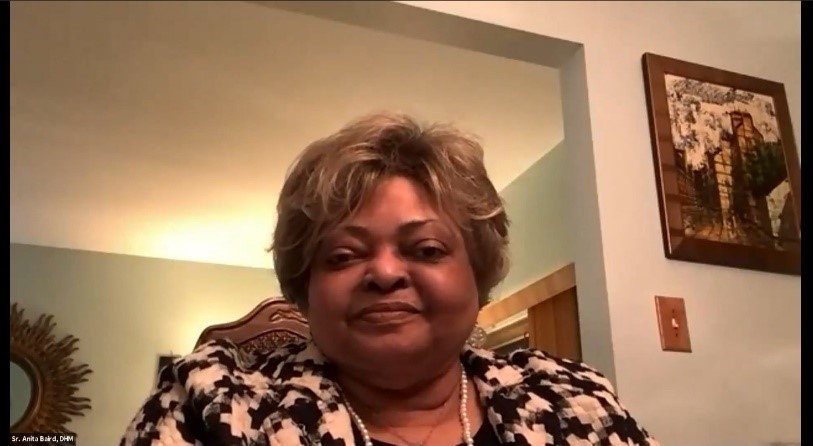
Sister Anita named the three Black Catholic Women included in the group of six Black American Catholic candidates for sainthood, including Mother Mary Lange, O.S.P. She noted that in 1829 when Mother Lange founded the first African-American religious congregation, the Oblate Sisters of Providence, in Baltimore, Maryland, it was still legal to enslave people in parts of the United States and named some of the challenges and tragedies the Oblates faced. White religious orders in the U.S. did not accept African-American women until the 1940s, and Sister Anita told how Eliza Healy (sister of the first African-American bishop, Bishop James Augustine Healy) joined the Congregation of Notre Dame in Canada and served as a superior and Mother Superior decades before then. Even Sister Antona Ebo’s story, shared by Sister Anita, illustrated the racism present in the Church for Sister Antona and the two other Black sisters who joined the Sisters of Mary in 1946. When Sister Antona Ebo marched alongside Congressman John Lewis in Selma following “Bloody Sunday” and spoke out for racial justice in the years following the Civil Rights movement, she was bearing witness to racism that infected even her religious life.

For herself, Sister Anita knew she wanted to be sister since she was young, but as a Black woman was discouraged from considering religious life. Sister Anita spoke about the day when she saw two Black nuns at a department store and followed them around, in awe. After that, Sister Anita says, “I knew I could be a Black woman religious. I had seen them with my own eyes.”

Today, Sister Anita and the sisters and associates who comprise the National Black Sisters Conference continue to grapple with what it means to be Black Catholics, and continue to take their place at the table. Faithful and prophetic, they expose the racism of the Catholic Church and hold the hope that it can change.

Watch Sister Anita Baird’s talk: www.networklobby.org/sistersweek2021.

Learn about the National Black Sisters’ Conference: www.nbsc68.com.

This article was originally published in Connection. Read the full issue here.
Locating the COVID-19 Vaccine in Your Community

Locating the COVID-19 Vaccine in Your Community

Caraline Feairheller
May 7, 2021

Nearly 200 million people in the United States have at least one vaccine shot in and that number is growing daily. Vaccinations are one of the best tools to slow the spread of COVID-19 and prevent future severe outbreaks. As of April 19 2021, the COVID-19 vaccine is available to all persons 16 and older in the United States. The vaccine is free regardless of access to medical insurance and regardless of immigration status.

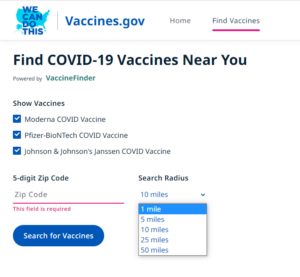
Access to the vaccine should be not a barrier to care, which is why the Center for Disease Control and Prevention (CDC) has created the Vaccine Finder Tool. Vaccines.gov helps you find locations that carry COVID-19 vaccines and their contact information. By entering your zip code into the finder, the website connects you with a number of nearby appoints. Most providers require and appointment and the Vaccine Finder links you directly to the page to sign up.

Vaccines.govCurrently, there are three available vaccines: Pfizer, Moderna, and the Johnson & Johnson vaccine. All three have undergone the FDA’s rigorous standards for safety and effectiveness. Each works by training the immune system to recognize the virus and trains the cells to hold the virus off. As a result, many people experience side effects like soreness of the arm injected, fever, or headache – all of which will go away in a few days. The vaccines have been shown to be highly effective in preventing severe cases of COVID-19 that lead to hospitalization and help to reduce the likelihood of its spread.

Following the appointment, you get the vaccine, you should still wear a mask and maintain social distancing. At the vaccine appointment you will receive a vaccination card that tells you what COVID-19 vaccine you received and the date you received it as well as a paper or electronic fact that that tells you more about the specific vaccine you are receiving. The COVID-19 vaccine is critical for the safety and health of our communities. As Pope Francis said, “I believe that morally everyone must take the vaccine. It is the moral choice because it is about your life but also the lives of others.”

For more information:

Frequently Asked Questions About COVID-19.

What to Expect After Getting a COVID-19 Vaccine.

After You’re Fully Vaccinated.

NETWORK’s Blog on Talking with Friends and Family About the Vaccine.

Talking with Your Community About the Vaccine

Talking with Your Community About the Vaccine

Caraline Feairheller
May 7, 2021

The COVID-19 vaccines are the safest way to build protection and minimize the severe effects of COVID-19 for you and your community. As the COVID-19 vaccines are new, it is normal for people to have questions. The sheer volume of information, and misinformation, on the vaccines can be overwhelming. According to experts, the best approach to vaccine hesitancy is having trust figures, like family members and peers, address the root cause of the hesitancy. When community members are able to see others in their circle embracing the vaccine and all its benefits, they are more likely to be willing to get the vaccine themselves. It is important we each do our part to limit misinformation by listening to our communities concerns without judgement. As Pope Francis says, “Whenever people listen to one another humbly and openly, their shared values and aspirations become all the more apparent. Diversity is no longer seen as a threat, but as a source of enrichment.”

When talking with friends and families about the COVID-19 vaccines, the U.S. Department of Health and Human Services (HHS) and Center for Disease Control and Prevention (CDC) recommends five key steps:

Listen to their questions with empathy

By listening without judgement, you can identify the root of their concerns. It is important to listen fully and attentively, without interrupting. You can read more on strategies for active listening through the article “Effective Communication: Barrier and Strategies” by the Centre for Teaching Excellence at the University of Waterloo.

Ask open-ended questions to explore their concerns

By asking open-ended questions, you can help to understand what your community is worried about and what sources they are getting their information from. It is important to respectfully ask questions and avoid dismissive language like “That’s a silly concern” or “Why would you be worried about that?”

Ask permission to share information

Once you understand your community’s questions and concerns, ask if you can share information from trusted sources. It is important to not push information on them too quickly and when you do not know the answer consider offering to help look for the information.

Help find their own reason to get vaccinated

Everyone who chooses to get vaccinated does it for a different reason – to protect their community, to visit their family, to return to school. The reasons that someone chooses to get vaccinated will always be those that are most compelling to them personally. It is important to not only focus the conversation on the “why not” of the vaccine but to steer it towards the “why” of the vaccine.

Help make their vaccination happen

Offering to help a community member make a vaccine appointment can help make the path to vaccination easier and less stressful.

#BuildAnew BINGO

#BuildAnew Bingo

Audrey Carroll
April 28, 2021

In February 2021, NETWORK introduced Build Anew: A Justice Agenda for All of Us.
This policy agenda is inspired by the principles of Catholic Social Justice and comes from encounter with individuals and families across the United States. 

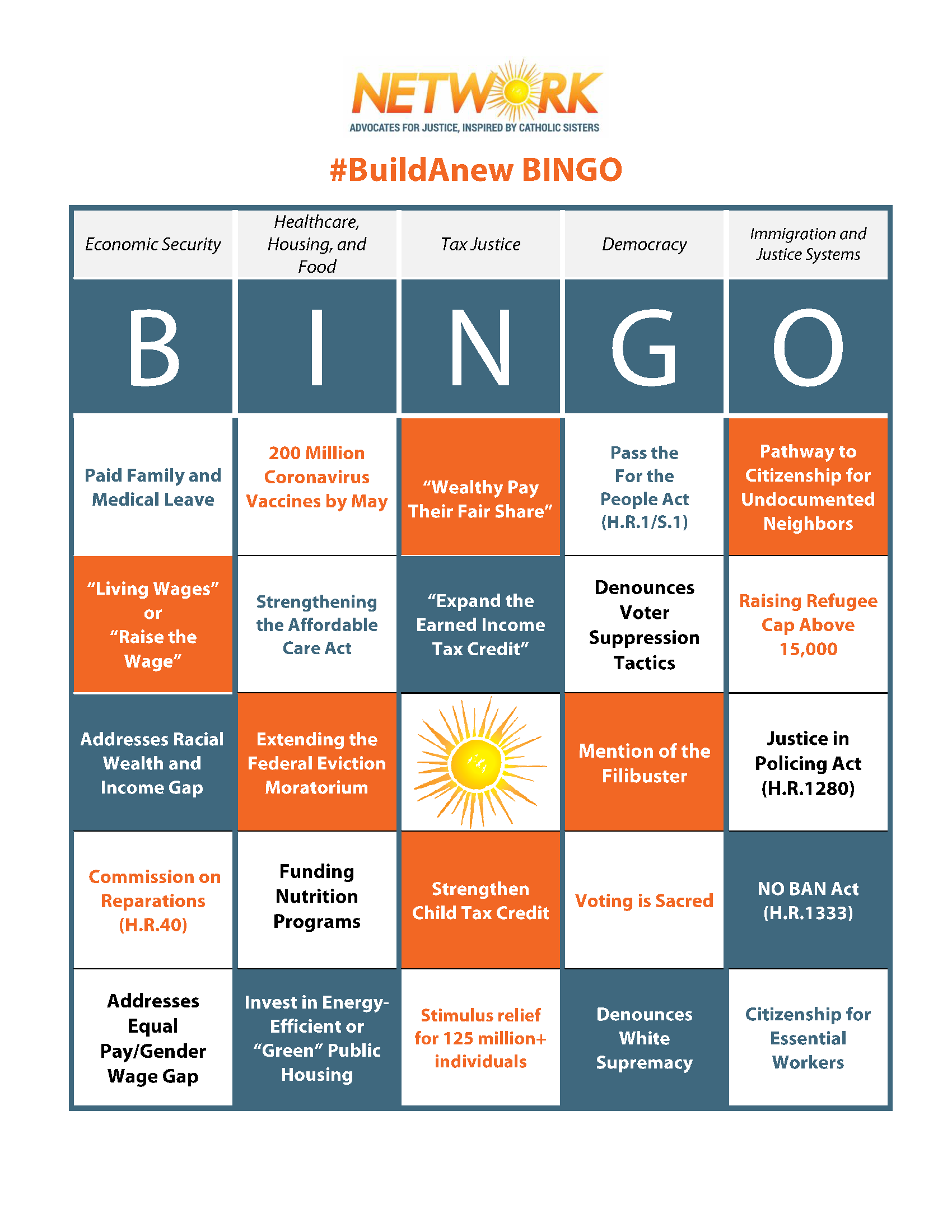
Based on our Build Anew Policy Agenda, we’ve created this #BuildAnew Bingo card to use during President Biden’s address to Congress to see how well the administration is doing at supporting our Build Anew policy areas.

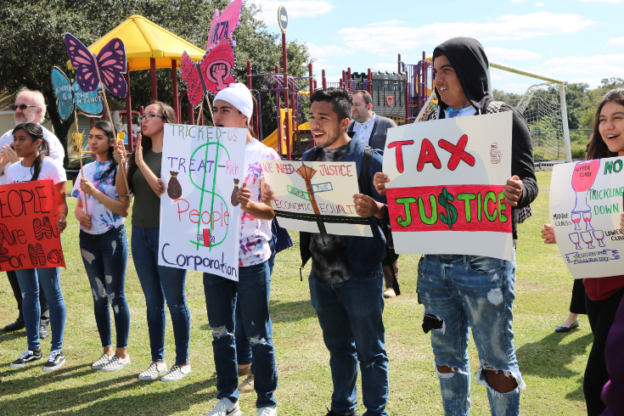
Certain policies and systems seek to widen the income gap, encourage racism, and exclude people based on their identity. At NETWORK, we believe there is no way to achieve justice without intentionally building our political system, economy, and society to be just and inclusive. The Build Anew Agenda includes five policy areas: Economic Security; Healthcare, Housing, and Food; Tax Justice; Our Democracy; and Our Immigration and Justice Systems.

We hope to see President Biden address these important policy areas to work towards Dismantling Systemic Racism, Cultivating Inclusive Community, Rooting Our Economy in Solidarity, and Transforming Our Politics.

Download Your Bingo Card with Instructions Here. 

Tax The Rich: NETWORK Hosts Instagram Live Conversation with Patriotic Millionaires

Tax The Rich: NETWORK Hosts Instagram Live Conversation with Patriotic Millionaires

Audrey Carroll
April 19, 2021

On Friday, April 16 NETWORK Grassroots Mobilization Coordinator Sister Emily TeKolste, SP joined Patriotic Millionaires Chairperson Morris Pearl for a conversation on Instagram Live about his new book, Tax the Rich. Emily and Morris discussed the importance of everyone in our nation paying their fair share to work towards eliminating the racial wealth and income gap. Watch the whole conversation here:

I Am Excited to Educate, Organize, and Lobby with the NETWORK Community

I Am Excited to Educate, Organize, and Lobby with the NETWORK Community

Mary Novak
April 7, 2021
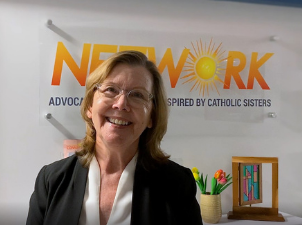
Meet Mary Novak, NETWORK’s new Executive Director
Thursday, April 15 at 4:00 PM Eastern/1:00 PM Pacific.
Register here.

I am honored to be here with all of you as the new Executive Director of NETWORK Lobby for Catholic Social Justice. As I begin this new adventure, I ask — if you are a praying person — for your prayers as I transition into this Spirit-filled community. The NETWORK community is full of committed justice-seekers and has been for 50 years. I am grateful to join you in building our country anew.

Today, we are facing unprecedented challenges pushed to the crisis point by the COVID-19 pandemic. This crisis has also brought us together in a shared experience out of which so many are calling for federal approaches to root out injustice.

We need federal policies that name and dismantle systemic racism, eliminate the wealth and income gap, and allow all people to thrive so that we truly are a “more perfect union.” I’m excited to educate, organize, and lobby with you, the NETWORK community.

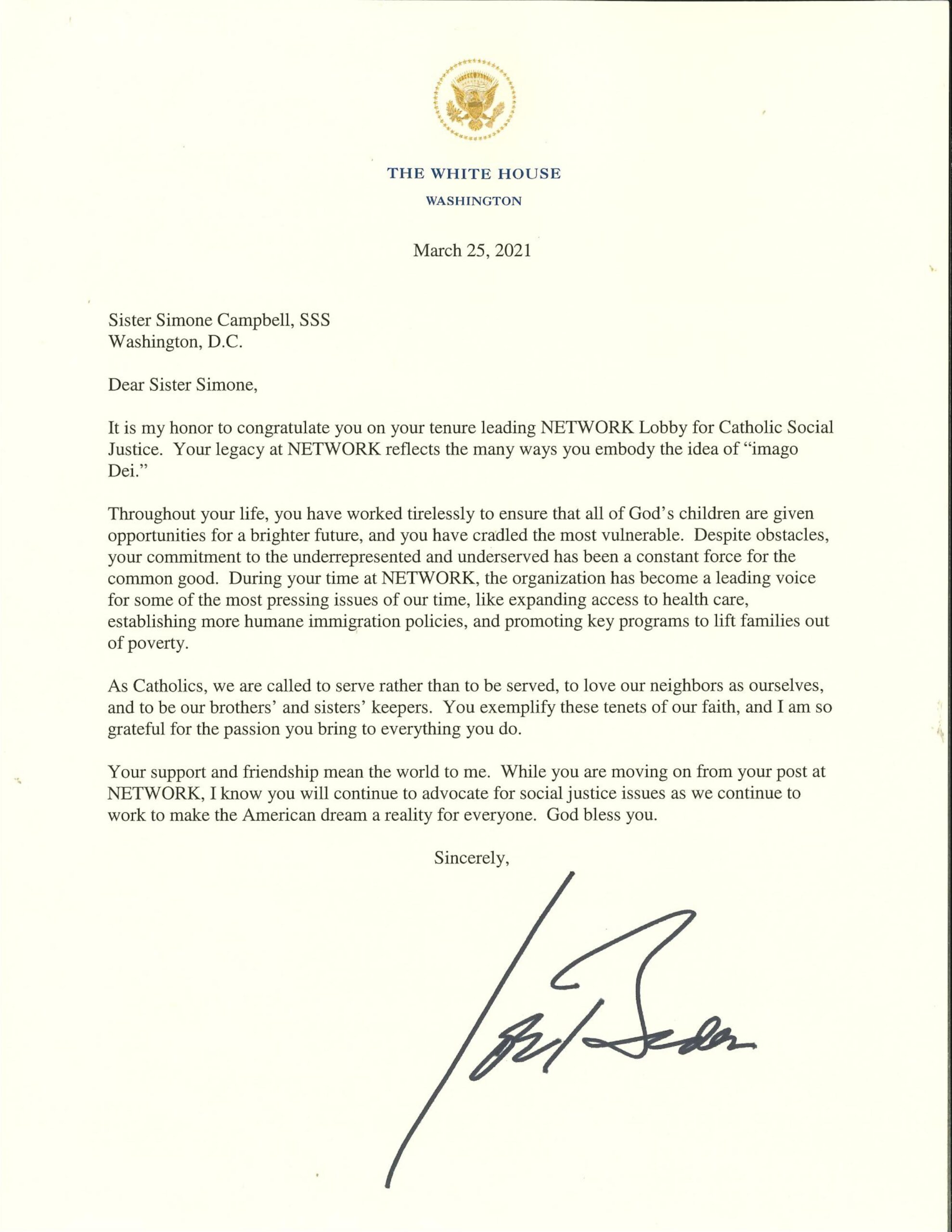
Read President Biden’s Letter to Sister Simone

Read President Biden’s Letter to Sister Simone

March 31, 2021

Last week, President Joe Biden, our country’s second Catholic president, sent the letter below to Sister Simone Campbell as she prepared to step down as Executive Director of NETWORK Lobby.

In it he wrote, “As Catholics we are called to serve rather than be served, to love our neighbors as ourselves, and to be our brothers’ and sisters’ keepers. You exemplify these tenets of our faith and I am so grateful for the passion you bring to everything you do. Your support and friendship mean the world. God bless you.”

Read more:

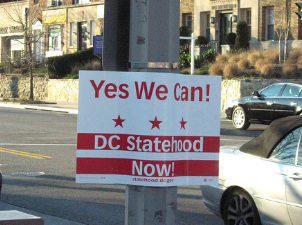
Statehood and Self-Determination for Washington, D.C.

Statehood and Self-Determination for Washington, D.C.

Ms. Andrea Renee Reed
March 22, 2021

Ahead of the House Oversight Committee hearing on H.R.51 the Washington, D.C. Admissions Act, I sent the following message to all committee members in a letter asking them to support D.C. statehood.

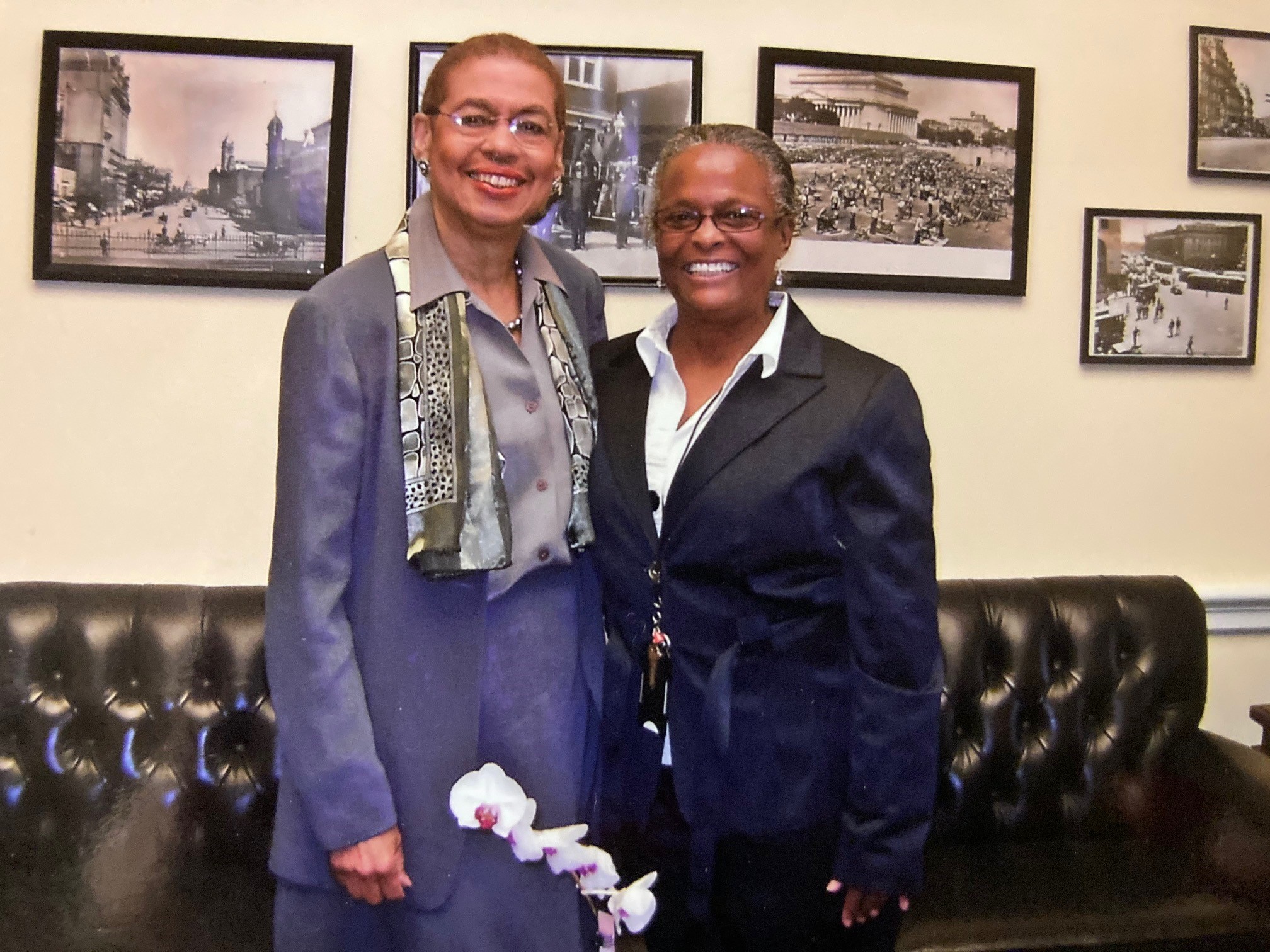
Rep. Eleanor Holmes-Norton and Ms. Andrea Renee Reed, 2010

My name is Ms. Andrea Renee Reed.  I’m a resident and native of DC, a 62 year-old, grateful African-American woman. Growing up in Washington, D.C. was hard. In the 60s there were several assassinations of civil rights leaders such as President John F. Kennedy, then Malcom X, then Martin Luther King Jr., and then Robert Kennedy—all in the prime of their lives. They led with strength, character and faith.  I can remember overhearing adult conversations about events that were filled with disillusionment, hopelessness, and disempowerment.

In the following years, I have witnessed a downward spiral of disenfranchisement and an economic free fall in the District. It felt like our communities were suffering and the politicians were indifferent. Like they were only interested in using the resources of our city without reinvesting them to meet the needs of the community. Which is why I am writing in support of the Washington, D.C. Admission Act (H.R.51/S.51). This legislation guarantees right of voters to participate fully in federal elections. The more than 700,000 D.C. residents, the plurality of which are Black and Brown citizens, deserve full congressional representation and the self-determination that comes with statehood.

I moved around a lot within the District during my younger years but wherever I lived, nobody in the surrounding community owned their own homes. We all lacked ownership in the places we lived.  Every place I stayed, it was a constant struggle for me and for others in these neighborhoods. My entire experience was an attempt to escape.

It was by God’s grace that I met Ms. Carolyn Byrd who supported destitute young Black people by showing curiosity about their dreams and offering encouragement. Ms. Byrd trusted me with the great responsibility of caring for her disabled daughter, LaShonya.  She showed me that I could make choices about the direction of my life and didn’t have to live in a state of reactivity.  I still believe she could have been an effective, powerful community leader or even city council member had she had the resources available to her.  She held a vision for the District and felt ownership of it as a place to grow and to thrive, and she tried to make it better in her own way.

With her encouragement, I realized I could follow my path, so I left the District and lived many places trying to find somewhere that felt like home.  It was also during that time that I slowly and steadily gained independence and confidence.  An awareness of my contributions and capabilities became more clear to me and I also learned that unaddressed, undiagnosed mental illness had contributed to some of my struggles. With a newfound freedom I slowly began to thrive and feel like a whole person with agency. Mental health issues stagnate the abilities of citizens to meet their highest potential for growth and economic development.

Now, many years later, I chose to return to Washington, D.C. looking for healing and to reclaim my roots.  I reside in a safe environment, with a supportive community in the Petworth neighborhood.  It finally feels like home. This community has inspired me to work for change and I can see now where Ms. Byrd found her inspiration to help others. I feel the same call and that’s why I’m writing today.

I can see with new eyes how the District, as a broader community, suffers like I did growing up: discouraged, disempowered, and held down with little control of its path forward.  In addition to many of the same problems I saw growing up, now with gentrification happening, it compounds the lack of ownership for the native population.  Again, a community left out in our own home.

It is 2021, we are tired of being marginalized and having others dictate our path and our goals. Those of us who call the District home refuse to have our choices undermined or overruled by politicians from other states, some with fewer residents than Washington, D.C. We deserve to have statehood status, with proper representation and agency over our own affairs. I believe DC statehood would improve all aspects of residents’ lives including addressing homelessness and the psychological condition of the broader community, generally uplifting our spirits.

We are ready to claim our home—to TRULY take ownership—and be properly represented in Congress. We are capable of managing our own affairs just like other states. It is time to give us our agency and give the power of the vote to courageous heroes like Rep. Eleanor Holmes-Norton who has been speaking truth to power for 30 years.

Ms. Andrea Renee Reed is a member of the Assisi Community, an intentional community in Washington, D.C. committed to living simply and working for social justice.

The Black Church: This is Our Story, This Is Our Song

The Black Church: This is Our Story, This Is Our Song

Taylor Miller
March 9, 2021

In celebration of Black History Month, NETWORK staff took the time to watch and reflect on the 2-part PBS Documentary Series: The Black Church: This is Our Story, This Is Our Song. Below are some of the staff’s responses to the documentary.

What did you think of the documentary?

“The Black Church was interesting and informative; not only did it tell the the history of Black Christian churches in the U.S., but it also told the story of segregation, terror, and economic oppression experienced by Black people throughout history and the Black-led freedom movements that pushed back against white supremacy.” –Colleen Ross, Communications Director

“I think it was powerful, educational and pushed you to learn more about the Black church. What really struck me was that there is a black church quite separate to that of denomination –Black saints, and a Black form of worship which is overarching identity of Blackness/African American Culture regardless of denomination and this has not been celebrated or nurtured enough.” –Ronnate Asirwatham, Government Relations Director

Did any quotes in the film stand out to you? What were the quotes and why?

“In our experience there is no separation between Church and state.” – This stood out to me because the documentary explains that “politics” was at the heart of the Black Church since its inception. That can still be seen today and is a powerful force for justice. –Lee Morrow, Press Secretary/Elections Manager

“[Rev. Dr. Martin Luther King] used the genius of the Gospel not to make this a Christian nation, but to use his Christianity to make this a just nation” -Michael Eric Dyson
I think this quote instructs us still today about how to use faith to work for justice in diverse coalitions.” –Colleen Ross, Communications Director

Would you recommend our members watch this film? Why or Why not?

“Yes. It was great learning and very important for my personal growth.” –Laura Peralta-Schulte, Chief Lobbyist

“Absolutely. I think it provides important historical understanding for how Christian Nationalism became so embedded in white churches and also how spirituality and resistance and music/art all developed side-by-side in the Black church.” –Sister Emily TeKolste, SP, Grassroots Mobilization

“Yes. I believe our members are hungry for more information on racial justice.” –June Martin, Annual Giving Manager

“Yes, because it is a celebration of the Black Church. It informs our white membership without asking our Black membership to endure something unnecessary, like reading White Fragility. From what I’ve seen, I think everyone can learn from and enjoy this program.” –Lee Morrow, Press Secretary/Elections Manager

What questions should have been asked?

“More focus on the Black Catholic story and key issues.” –Laura Peralta-Schulte, Chief Lobbyist

“Why did the slave owners allow praise houses? There was a part of the film which shows slave owners didn’t allow any praise houses or organizing in any manner and then it shows praise houses. So I would like to know how this came about. B) I think there was a misconception in the film that Arabic is only connected to Islam. In the five minutes that they say they discovered Arabic in the church they talk about Islam in the church. But Arabic is a language not a religion and there are many Christians who worship in Arabic (I myself have attended Catholic mass said in Arabic in South Sudan) so the writings in the church could be from a Christian who wrote something in his native tongue.” –Ronnate Asirwatham, Government Relations Director

Have you watched the Black Church yet? Let us know what you thought, or visit www.pbs.org/show/black-church to watch.