

Category Archives: Spirit Filled Network

The Moment is Now: Pass H.R.40

The Moment is Now: Pass H.R.40

Mary Novak
July 16, 2021

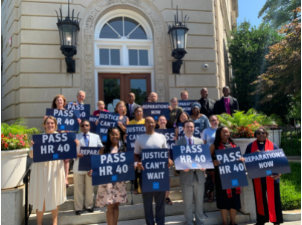
On July 13 2021, I joined faith leaders to call on Congress to pass H.R.40, the Commission to Study and Develop Reparation Proposals for African Americans Act, before the August recess. What a Spirit-Filled gathering with the incomparable Nkechi Taifa, Founder of The Taifa Group; Laura James, Program Coordinator for Grassroots Organizing; Yolanda Savage-Narva Racial Equity, Diversity, and Inclusion Director, Union for Reform Judaism; Diane Randall, General Secretary of Friends Committee on National Legislation; Jarrett Smith, Government Relations Fellow, NETWORK Lobby; Bishop Eugene Sutton, Episcopal Church, Maryland Diocese; Victoria Strang, Policy Advocate with Faith Communities, Human Rights Watch; Reverend Timothy Tutt, Senior Minister, Westmoreland Congregational UCC; and Jim Winker President and General Secretary, National Council of Churches.

What is not named cannot be healed. It is time to name our country’s sickness. Using the frame of the  Catholic tradition — it is time to name our original sin of slavery and move towards repair, reparations. That moment is now.

For the first time, we are talking about reparations in the national conversation. States, local authorities, and religious orders are all moving on reparations. We have been waiting 32 years for this moment. We cannot wait another day or another week. We are  calling on House leadership to bring H.R.40 to the floor. The moment is now.

It is no coincidence the momentum for movement on reparations follows that terrifying day of January 6th. We not only survived that shameful day, but are seeing for what it was: evidence of our need for collective salvation. The moment is now.

We know there is resistance to move towards healing from our collective soul sickness. Resistance comes because healing can be hard and oftentimes painful. We must overcome that resistance because the freedom on the other side is calling us. The moment is now.

My friends:

There is a balm in Gilead
To make the wounded whole
There is a balm in Gilead
To heal the sin-sick soul

That balm can begin now, so let’s do this; let us get this Commission going and pass H.R.40. If not, my friends, we must call on President Biden to make it happen by any means necessary. The moment is now.

Watch the Faith for H.R.40 Press Conference to learn more. Watch on Facebook or YouTube.

Stay engaged and find more ways to take action to advance policies that build our systems and structures anew at www.networklobby.org/ActNow.

Honoring Pride Month by Ending LGBTQ+ Housing Disparities

Honoring Pride Month by Ending LGBTQ+ Housing Disparities

Caraline Feairheller
June 14, 2021

The month of June marks the beginning of Pride Month. First celebrated in 1970 as a commemoration of the 1969 Stonewall Uprising, the month is both a celebration of LGBTQ+ individuals and the LGBTQ+ community and a recognition of the violence faced by LGBTQ+ communities throughout history – violence that continues to this day. This Pride Month, we call on the Biden administration and Congress to pass federal policies that bring justice and equality for the LGBTQ+ community in the United States.

LGBTQ+ people face multi-faceted and intersecting forms of stigma and discrimination across their lifetime. The inequities faced by LGBTQ+ communities do not only take the form of physical violence but often also stem from discriminatory policies, including our country’s unjust lack of affordable housing. Access to safe, stable, affordable housing is a human right. However, the rising costs of housing paired with the legacy of anti-LGBTQ+ discrimination in housing continues to threaten the physical and mental health of LGBTQ+ people in the United States. Today, LGBTQ+ people experience higher rates of poverty and lower raters of homeownership compared to non-LGBTQ+ people. The lack of explicit legal protections has led to one in five transgender and non-binary people facing housing discrimination and nearly one in ten having been evicted.

It is critical that the Biden administration and Congress support housing policies that honor the dignity of each person and ensure all have access to safe and affordable housing. In order to build anew and cultivate an inclusive community, anti-LGBTQ+ housing discrimination policies and practices must end. In particular, these federal policies must extend protections for Black trans women who face an epidemic of violence and immoral rates of discrimination because at the intersection of racism, transphobia, and sexism. While there is still much work to do, President Biden’s American Jobs Plan is a necessary start to reshape our country’s housing.

The American Jobs Plan would allocate $213 billion to build, preserve, and retrofit 2 million homes by:

  • Creating public housing and addressing capital needs following years of disinvestment in our public housing ($40 billion)
  • Instituting Neighborhood Homes Investment Act tax credits for low- and middle-income homebuyers to build or rehabilitate 500,000 homes in underserved communities ($20 billion)
  • Developing 1 million affordable, resilient, accessible, energy-efficient, and electrified housing units in underserved communities nationwide, including rural and tribal areas ($126 billion)

In addition to the programs and funding included in the American Jobs Plan, NETWORK calls on Congress to increase funding for public housing in order to adequately meet the needs of our country’s families and provide housing vouchers to all who qualify by creating a universal housing voucher program.

Along with increased investments in housing, the Senate should pass the Equality Act (H.R.5), which would amend the 1964 Civil Rights Act to explicitly prohibit discrimination on the basis of sexual orientation and gender identity in housing as well as other areas.

Housing is a basic human right and the foundation for a person’s ability to meet their needs and achieve their God-given purpose. Justice demands that every member of our human family is protected from discrimination; Congress must allocate funding and pass policies that protect the rights of all LGBTQ+ individuals.

Stay engaged and find more ways to take action to advance policies that build our systems and structures anew at www.networklobby.org/ActNow.

Virtual Lobby Day: Dismantling Racism in Our Criminal Legal System

Virtual Lobby Day: Dismantling Racism in Our Criminal Legal System

Caraline Feairheller
June 1, 2021

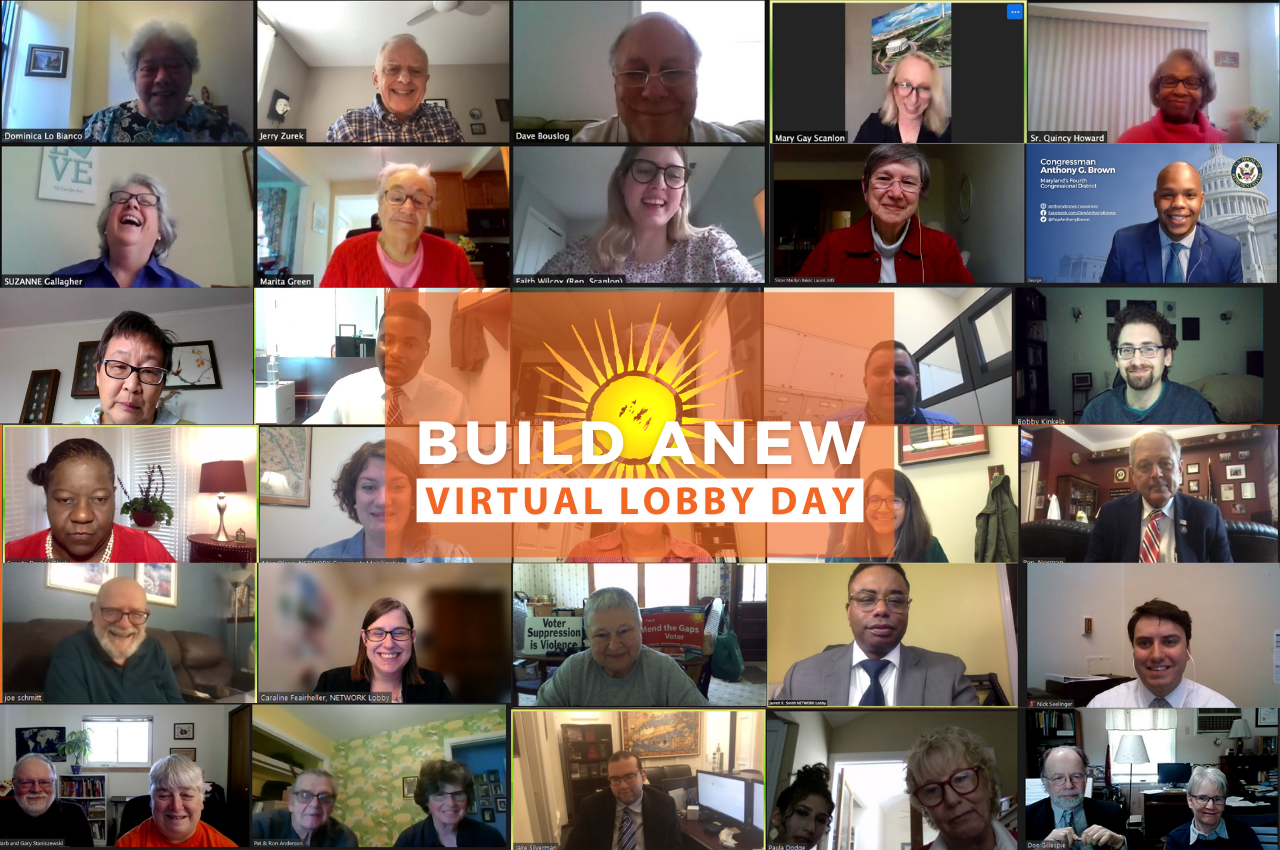
On May 12, 2021, more than 120 justice-seekers from across the country went on 50 lobby visits to urge their Representatives to co-sponsor and vote YES on the EQUAL Act (H.R.1693). Thanks to you, our community of activists, the EQUAL Act now has ten new cosponsors – moving us closer to a criminal legal system that provides fair and equal justice under law!

For decades, the sentencing disparity between crack and powder cocaine offenses has contributed to our country’s shameful legacy of systemic racism and mass incarceration despite being two forms of the same substance. As Executive Director of New Hour for Women and Children Serena Ligouri said at the Lobby Day Kick-Off Rally, “It is by no mistake, in fact it is intentional that racism has continue to perpetuate disproportionate sentencing in the carceral system. It is no longer okay to let our legislators stand back and perpetuate this in our communities.” As we celebrate our advocates for educating our elected officials on the importance of the EQUAL Act, we know there is much more work to do.Mary J. Novak emphasizes how “being sentenced in today’s U.S. criminal legal system is essentially a life sentence if you consider the severe consequences economically, the disruptions in family life, the limited future access to employment, housing, voting, the stigma, the trauma to both the person incarcerated and that person’s family.” In order to build anew, Congress must pass legislation that lifts bans on housing assistance and other social safety net programs for those who have been released from incarceration.

Every person is made in the image and likeness of God and deserves respect, dignity, and equal justice under law. We must support each other in these challenging times and continue working to pass policies like the EQUAL Act and George Floyd Justice in Policing Act. This will help dismantle systemic racism, eliminate the wealth and income gap, improve the wellbeing of our communities, and allow all people to thrive.

Stay engaged and find more ways to take action to advance policies that build our systems and structures anew at www.networklobby.org/ActNow.


Mary Novak Named in “2021’s Faith Leaders to Watch”

Mary Novak Named in “2021’s Faith Leaders to Watch”

Audrey Carroll
May 28, 2020

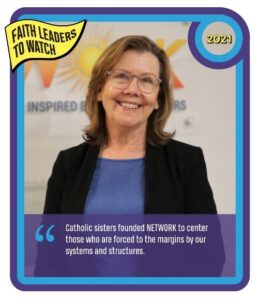
Recently, the Faith and Progressive Policy Initiative at Center for American Progress (CAP) released a list of “21 Faith Leaders to Watch in 2021.”

The list highlights the important work of faith leaders in leading our communities towards progressive, equitable change. NETWORK’s Mary Novak was included on CAP’s list alongside Anthea Butler (@AntheaButler), an associate professor of religious studies and Africana studies and interim chair of religious studies at the University of Pennsylvania and Shantha Ready Alonso, a former NETWORK staff member who led Creation Justice Ministries (@CreationJustice) before becoming Director of Intergovernmental and External Affairs at the Department of the @Interior.

When asked how her faith inspires her, Mary told CAP:

“My grounding in the Catholic intellectual and social tradition, lived through my Ignatian spirituality, motivates my work to transform federal policies and shapes me as a restorative justice practitioner. This prophetic, living tradition compels me to act out of a faith doing justice that is inclusive, centered on race and human dignity, and trauma-informed. Catholic sisters founded NETWORK to center those who are forced to the margins by our systems and structures. For me, this praxis is an essential place of connection, solidarity, and inspiration. Society has prioritized the powerful for too long.”

We are thrilled Mary’s leadership at NETWORK and commitment to advancing the Build Anew Agenda has been recognized amongst many other instrumental faith leaders. See the full list of CAP’s “2021’s Faith Leaders to Watch” here.

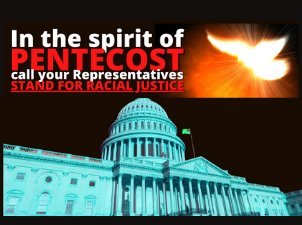
Pentecost and the Call for Reparations

Pentecost and the Call for Reparations

Jarrett K. Smith, NETWORK Lobby and Minister Christian S. Watkins, National Council of Churches
May 21, 2021

As we continue commemorate Pentecost this year, we are reminded of the strange and new power that came and rested upon the Apostles and other followers of Christ. The gift of the Holy Spirit was God’s way of showing and sharing His power so that the disciples could do great and extraordinary things.

We are heirs and spiritual descendants of those who were present for that event. That same power and spirit that was upon them is also upon us to do immeasurable tasks and feats as well! Today, we see the ways that systemic racism is holding back the true potential of our country and doing grave harm to our communities. In the spirit of Pentecost, we must take action to stake a moral claim against racism on our country.

Due to past and present systemic racism, Black people are pushed to the margins of our society; with lower rates of homeownership, greater difficulty securing reliable transportation, higher rates of food insecurity, and all the things that contribute to a person’s wellbeing. These conditions are manmade. Systemic racism is built into every historical and contemporary system and institution of U.S. society, placing Black people at a constant disadvantage.

The results of this widespread, systemic racism are perceived by the rest of society as normal.  Soaring rates of mass incarceration serve as a way to destroy the Black family unit. Street executions by law enforcement, painfully reminiscent of the violent slave patrols, threaten Black men and women every day. Given our country’s history (and our lack of reckoning with it), it is no wonder that those who commit these atrocities often garner no punishment.

Inspired by the feast of Pentecost and the nation-wide movement for racial justice, we call on Congress to pass H.R.40 (The Commission to Study and Develop Reparation Proposals for African-Americans Act). We need legislation to examine the impact of chattel slavery, Black Codes, convict leasing, Jim Crow, redlining, access to fair housing, education, employment opportunities, and the list goes on. H.R.40 is the first step to understanding and quantifying the continued impact the legacy of U.S. slavery has had on the Black people.

We can see the devastating effect of white supremacy on Black people throughout the United States with our own eyes. It is time for Congress to support a start to end institutional racism. Passing H.R.40 to establish this commission on reparations would be a start.  As our scriptures affirm, God hears the cry of those considered “least” in our society. Now, we ask, will Congress hear those cries as well and act?


Call Your Representative NOW: 888-422-4555
Tell them to pass a H.R.40 and establish a Reparations Commission!


Jarrett K. Smith is a Government Relations Fellow at NETWORK Lobby for Catholic Social Justice and Councilmember for Ward 5 in Takoma Park, Maryland.

Minister Christian S. Watkins is the Justice Advocacy and Outreach Manager for the National Council of Churches.

NETWORK Virginia Advocates Team Lobbies for COVID-19 Relief

NETWORK Virginia Advocates Team Lobbies for COVID-19 Relief

May 17, 2021

I am a longtime supporter of NETWORK with financial contributions, prayer support, and occasionally (pre-pandemic) attending in-person witnesses in Washington, D.C. I am also a longtime admirer of the women religious and the lay leaders at NETWORK.

For many years, I have been immersed in advocacy for justice, especially in state and local organizations in my home state of Virginia. Like so many other justice-seekers, the dawn of 2021 and the inauguration of our newly elected president brought rays of sunshine and hope that We the People were embarking on a new journey replete with reform and improvement for all, but especially for people struggling on the margins of our great country.

I was invited to join NETWORK advocates in northern Virginia to advocate for President Biden’s legislative initiatives to rescue the American people from the devastation of the COVID-19 pandemic and to restore many of the basics of our country’s democratic systems fractured under the previous administration. NETWORK provided me with a unique opportunity to learn about proposed legislation and why it was critical to persuade Congress to pass it. As a NETWORK Advocate, I received resources that explained the problem, proposed solutions and gave me tips for how to present it to my Members of Congress. NETWORK also provided materials (“leave behinds”) to share with our legislators and their staff.

Our small group of enthusiastic advocates for justice met in advance (virtually) to discuss the legislation we planned to raise with the Senators, choose the specific issue on which each of us wanted to focus and outlined a strategy for our meet-up. We took a couple of days to study our focus-areas in the legislation and then had a final brief meeting (virtual) for a practice lobby meeting. By the time we met with our Senators’ staff, I felt like I was sufficiently knowledgeable to share my concerns for struggling people and why the proposed legislation would help solve the problems we wanted addressed.

Now, I am more attentive to what is happening on the federal stage and am looking forward to further collaboration and participation with NETWORK Advocates.

Anne Murphy
New Member of the Virginia NETWORK Advocates Team

This article was originally published in Connection. Read the full issue here.

New Workshop: Tax Justice for All

New Workshop: Tax Justice for All

Colin Longmore
May 20, 2021

Today, 719 billionaires in the United States hold four times more wealth than the 165 million people in the bottom half of our economic spectrum.* At the same time, the racial wealth gap continues expanding.** How did we get here and what does it mean for our communities? Join me for NETWORK’s newest workshop: Tax Justice for All: Unveiling the Racial Inequity of the U.S. Tax Code

This 90-minute workshop looks at the U.S. tax code and economic inequality in two parts. First, we’ll explore how the tax code currently disadvantages women and people of color together. Second, you’ll work with fellow justice-seekers to reimagine a new tax code to build a just and inclusive society.

Sign up for one of NETWORK’s upcoming virtual workshops today!

Tax Justice for All
Wednesday, May 26 from 12:00-1:30 PM Eastern: Register here
Tuesday, June 1 from 3:00-4:30 PM Eastern: Register here
Thursday, June 3 from 12:00-1:30 PM Eastern: Register here
*Please note, this is a standalone
workshop, not a series, so the same workshop will be presented each time.

Virtual Conversations Keep the NETWORK Community Connected

Virtual Conversations Keep the NETWORK Community Connected

While traveling on the virtual “Bus” last year, our biggest learnings were first, that our Spirit-filled network is hungry for community and second, that technology offers a powerful opportunity to bridge geographic divides. On Election Night 2020, as we awaited to hear results, NETWORK members and supporters gathered for a time of conversation, reflection, and prayer. As people responded with great enthusiasm, we decided to continue these virtual conversations on a monthly basis. While each monthly conversation has had a different theme (ranging from reflecting on racism in our faith communities to advocacy in a new administration), the basic premise remains the same: to bring people together for reflection, community, and conversation.

For upcoming community conversations, check out www.networklobby.org/communityconvo.

This article was originally published in Connection. Read the full issue here.

“We Want Change and We Don’t Mean Pennies.”

“We Want Change and We Don’t Mean Pennies.”

Meg Olson
May 18, 2021

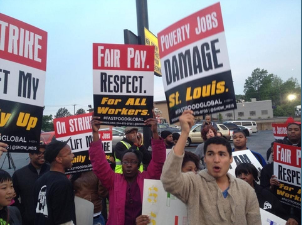
On Wednesday, May 19, McDonald’s workers in the Fight for $15 are going on strike in 15 cities across the country. Their demand? That “every worker who wears the McDonald’s uniform” makes at least $15/hr.

If that seems shocking or radical, consider this: last year, McDonald’s earned nearly $5 billion in profits, and paid shareholders nearly $4 billion in dividends. Meanwhile, thousands of their workers—essential workers—received an average of $10/hour, just over $20,000 a year for a full-time employee, without health or dental benefits or access to paid sick leave.

McDonald’s worker and Fight for $15 Organizer Ieshia Townsend said, “Some workers ask me why I do what I do and I tell them, ‘The reason I do what I do is so I can make a better life for my kids and your children, and our next generation. You should be able to go on family vacations and spend time with our kids if they get sick. We should not have to keep living in poverty.”

Fast food workers, who have been essential workers during the COVID-19 pandemic, are struggling to survive. Every day, these workers are forced to make decisions between basic needs such as food, medicine, and transportation. Many of them work two and even three jobs and are still unable to make ends meet, especially when it comes to housing. The National Low Income Housing Coalition’s 2020 Out of Reach Report, finds that in Illinois, where the minimum wage is $10/hour, one would have to work 72 hours a week to be able to rent a 1-bedroom apartment at fair market rent without spending more than 30% of income on housing. In Mississippi, where the minimum wage is the federal rate of $7.25/hour, a worker would have to work 68 hours a week.

The good news is that the Fight for $15 is working! Since Fight for $15 started in November 2012, workers in the fast food industry and other minimum-wage jobs have led the movement for the passage of $15 minimum wage laws in states such as California, New York, and Massachusetts, as well as the District of Columbia, and cities as diverse as Flagstaff, Arizona, St. Paul, Minnesota, and Seattle, Washington. In 2018, the National Employment Law Project reported that “22 million workers [had] won $68 billion in raises” thanks to the movement. Unfortunately, legislatures in states such as Florida, Missouri, and Kentucky fought back against the workers’ efforts and passed preemption laws that kept cities from raising their wages. This is why Fight for $15 is now focusing its efforts on McDonald’s.

I first got involved with the Fight for $15 in 2013, when I was the diocesan director of the Catholic Campaign for Human Development in St. Louis and a member of Missouri Jobs with Justice Faith and Labor Coalition. While it was thrilling to strike and shut down a McDonald’s or Wendy’s at 5:00AM, my participation in the movement was also a steep lesson in the principle of Subsidiarity. Catholic Social Tradition teaches us that Subsidiarity means that the people who are most injured by the injustice should have the dominant voice in creating a solution. Fight for $15 is a worker-led movement that truly embodies Subsidiarity. The workers are, to quote Pope Francis, “social poets” and “protagonists of their own destiny.” We faith leaders, an interfaith coalition of clergy, vowed religious, and laypeople, learned to listen, step back, and support the workers. This meant driving around the city the day before the strike delivering notices to surly store managers, letting them know that their employees had the legal right to strike. It meant babysitting children and serving snacks and cold water on hot days. It also meant accompanying workers when they returned to their first shift after the strike.

Faith leaders also had the responsibility of holding the fast food restaurants accountable if they retaliated against the workers. Once, one of SEIU’s lawyers called and told me that an Arby’s near my workplace was threatening to fire one of the workers, a young woman and mother of two. “Would you be willing to make a bunch of noise with other people of faith tomorrow? Are you willing to be arrested?” I told him yes. When we arrived at the Arby’s the next day, we were greeted by an H.R. Director from corporate headquarters who assured us that the managers now understood the labor laws.

Every time we gathered on a strike day, the workers asked to pray. Workers I talked to explained how working multiple jobs and second and third shifts made it nearly impossible to go to church. “So this is our church!” This was my ultimate lesson: for people of faith, the call to be in solidarity with workers means not just avoiding certain stores or companies, or hitting the streets, but also figuring out how to make Church fully inclusive to the low-wage workers, even if that means holding a service at 2:00 AM. Until then, “this is our church.”

To participate in a Fight for $15 day of action in your city, please visit https://actionnetwork.org/event_campaigns/15hr-day-of-action.

Email your Members of Congress to pass the Raise the Wage Act
www.networklobby.org/actnow.

Join a NETWORK Advocates Team in Your State

Join a NETWORK Advocates Team in Your State

May 13, 2021

NETWORK has or is building Advocates Teams in 12 states. Teams gather monthly to build community, dream together, and do the work of advocacy, including preparing for lobby visits, writing letters to the editor, planning public events, and more. If you want to learn more about a NETWORK Advocates Team and you live in…

  • Ohio
  • Michigan
  • Virginia
  • California
  • New York
  • Texas

Contact Catherine Gillette.

  • New Jersey
  • Pennsylvania
  • Indiana
  • Kentucky
  • Illinois
  • Missouri

Contact Emily TeKolste.

This article was originally published in Connection. Read the full issue here.