
Tag Archives: Sr. Thea Bowman

We Should All Be Like Nuns

We Should All Be Like Nuns

How Their Example of Justice, Courage, and Joy Keeps Shaping Movements 

Franceska Bruny
June 10, 2026


One evening after my Anglican Missions class, I shared with a friend how much I’d been learning about the history of the Anglican Church, the connections between the Catholic Church and missionaries, and, most importantly, how excited I was to be learning directly from a nun. Not that it was new to me. I grew up in Catholic school and spent most of my education around nuns. 

I found myself questioning, “Should I become a nun? Is this the call? What is it exactly that makes me fascinated with our sisters?” I concluded that I do want to be like nuns, and everyone else should, too. I don’t necessarily mean you should sell all your belongings and join the local order. I mean that nuns have been and continue to be a vital part of social movements, and we need their inspiration now more than ever to shape a better world.  

They’re not usually at the forefront making it a point to be seen, but they’re always present with ideas, devotion, discipline, and a willingness to serve. They operate without needing applause. We should strive to be like these sisters who support movements that improve people’s lives because their faith compels them to show up.
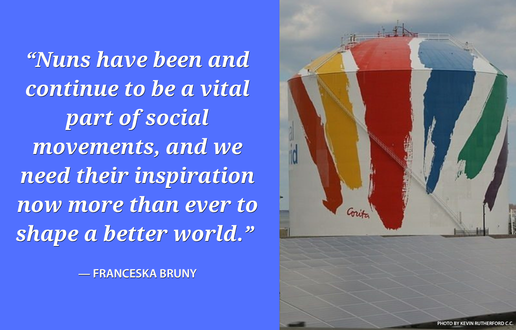
Outside of the orders that shaped much of my upbringing in Boston, the Sisters of Charity of Halifax and the Sisters of St. Joseph, I later learned about Sister Corita Kent, who as Chair of the Art Department at Immaculate Heart College in Los Angeles, turned pop art into theology and protest. 

Sr. Corita used advertising slogans, scripture, and bold color to critique capitalism, racism, and the Vietnam War. In the 1960s, her classroom became a hub of creative dissent. She believed art should disturb the comfortable and comfort the disturbed, and she embodied that belief through printmaking that was unapologetically political and joyful. 

One of her most notable pieces is one I’m familiar with as a native Bostonian: the Rainbow Swash, a design painted on a large gas tank. Commissioned in 1971, the sweeping bands of color are often interpreted as a subtle commentary on the Vietnam War and are widely recognized as the world’s largest copyrighted work of art. What most people drive past without a second thought is actually a massive piece of public art rooted in faith, resistance, and imagination. Sister Corita shows us that being like a nun can look like creative defiance, disciplined enough to master craft and bold enough to color a skyline.  

Then there’s Sister Mary Antona Ebo of the Franciscan Sisters of Mary in St. Louis, one of the first Black women to enter her order. She marched in Selma after Bloody Sunday in 1965 and explained her presence by saying, “I am a Negro, a nun, a Catholic, and I want to bear witness.” Holding theology, politics, and identity together, she refused to separate her race from her vocation or her faith from her fight for justice. 

After Selma, Ebo served as a hospital administrator and spoke openly about racism within the church. She models embodied witness at the intersection of race and faith. Being like a nun, in her case, meant public moral clarity and reform from within, even when the institution was slow to change. 

Most recently, I learned about Sister Thea Bowman, a Franciscan Sister of Perpetual Adoration who became one of the most influential Black Catholic voices of the 20th century. In 1989, while terminally ill, she addressed the U.S. bishops and challenged them to confront racism within the Church. She did so with clarity, humor, and song, even inviting them to sing “We Shall Overcome.” 

Sister Thea brought Black spirituals and call and response traditions into Catholic liturgy and advocated for inculturation, faith expressed through Black cultural forms. It gave me joy to see her affirm experiences and music I grew up with in Haitian Catholic services. She shows that being like a nun can look like prophetic joy and telling the truth while still singing. 

There are many more examples, but I want to be like the sisters who came before us and who are still working among us. They choose community, purpose, and conviction over comfort, ego and popularity. If what it means to be a sister is creative resistance, visible justice, and joyful reform, then we should all strive to be like nuns. The world needs it. 
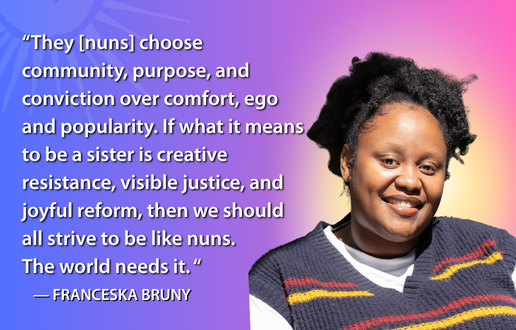
Franceska Bruny is a Master of Arts in Social Justice student at Union Theological Seminary and a multidisciplinary artist and storyteller. She served as an Advocacy Intern with NETWORK, supporting policy research and advocacy on immigration and economic justice. Franceska’s work explores how storytelling, theology, and creative practice can foster community dialogue and collective liberation This column originally appeared in the Quarter 2 2026 issue of Connection magazine.
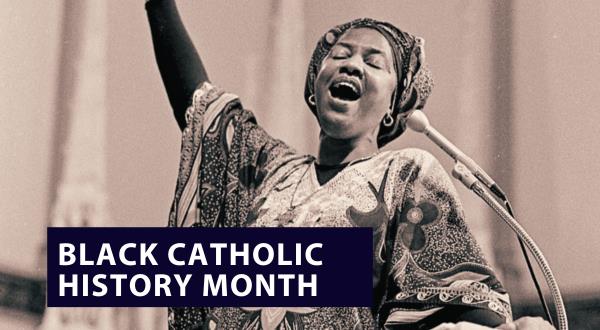
Sr. Thea Bowman in a featured image for Black Catholic History Month

Love With Action: Black Catholic History Month

Love With Action

Black Catholic History Offers Strength and Hope in Our Quest for Justice

Ralph McCloud
November 4, 2025


I met Sr. Thea Bowman a couple of times. What is there to say about meeting a living saint? It was an honor? A joy? It strengthened my faith? 

Absolutely! 

Meeting Sr. Thea challenged me in my mission as a baptized believer. Her 1989 address to the U.S. bishops is a landmark event in Black Catholic History in the United States, and I try to revisit it every November, if not more often. 

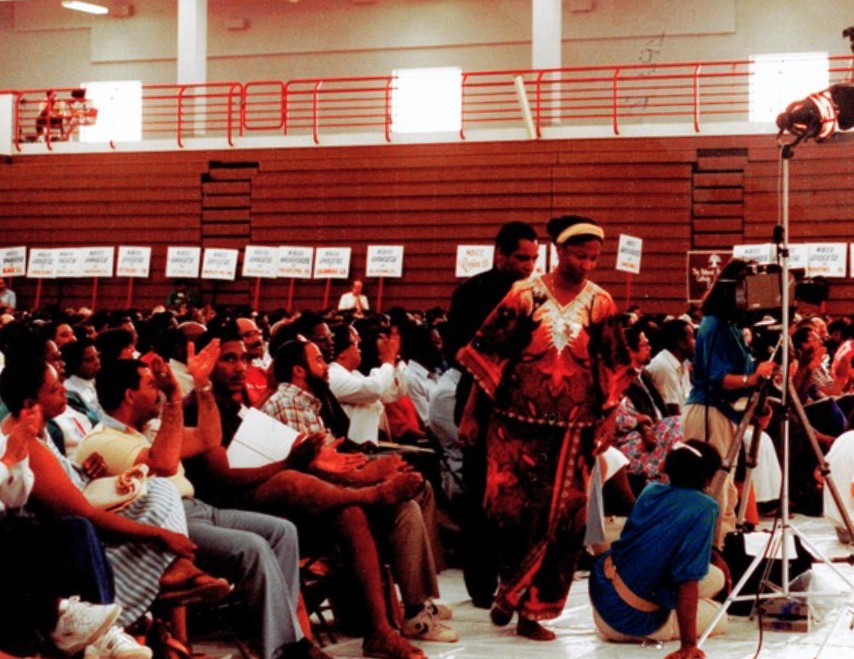
Sr. Thea Bowman walks past future NETWORK Fellow Ralph McCloud at a gathering of Black Catholics in the 1980s.

I had no idea I was four feet from a future saint. (I’m seated cross-legged in the front row.)

November is Black Catholic History Month, an observance that coincides with the feast of St. Martin de Porres (November 3), and the birthday of St. Augustine (November 13). It begins with All Saints and All Souls Days, which evoke the reverence for ancestors in African history. For us, this cloud of witnesses isn’t merely watching. They inspire us, help us, and hold us accountable. 

Sr. Thea still encourages me with the awareness that, in her words, a Black Catholic brings “my whole history, my traditions, my experience, my culture, my African-American song and dance and gesture and movement and teaching and preaching and healing and responsibility – as gifts to the church.” 

But gifts are not always appreciated or received with grace. She also noted: 

“I see it: Black people within the church—Black priests, sometimes even Black bishops—who are invisible. And when I say that I mean they’re not consulted. They are not included. Sometimes decisions are made that affect the Black community for generations and they’re made in rooms by white people behind closed doors.” 

Today some of the challenges we face go beyond being ignored, to blatant racism brazenly spewed by both political leaders and influencers; the gutting of voting rights and approval of racial profiling by the Supreme Court; the erasure of slavery and Civil Rights from school textbooks; and the Trump administration’s fervent, almost gleeful rush to destroy any program intended to help promote equity and inclusion. 

While the Catholic Church is among those groups that have decried the sin of racism and espoused a belief in dignity and equity for all (documented in a succession of pastoral letters by the bishops through the decades), the practical reality is often different. Racism still has a hold in the church – whether through the actions of individuals and communities or in the words, actions, or omissions of its leaders.  

When Black history and the pain of Black people get buried and watered down, it is to the detriment of all believers. Gloria Purvis expressed this brilliantly in a recent essay: 

“Our Catholic witness in America hangs in the balance. Church leaders can either acknowledge their grave error and work toward genuine reconciliation, or they can continue tacitly sanctifying racist speech and injustice. The choice will help determine whether American Catholicism finally confronts white supremacy or remains captured by the same moral blindness that has corrupted Christian witness in our country since its colonial origins.” 

Living out our faith in the context of an imperfect church—where even the best pastoral letter tend to gather dust on shelves—might require going back to the basics, to something like the Bible, to show the way. Jesus, in his radical example, acclaimed the Good Samaritan and dined with the tax collectors and sex workers. Jesus—God incarnate—didn’t hesitate to cross lines to include those who had long been excluded from full participation in society. 

Today, we have a pope who gets it. With his background that includes Black ancestors in the Caribbean, life among poor people in Peru, and the promotion of women into leadership roles, we could call Leo XIV the “DEI pope.” In his letter, Dilexi Te, Pope Leo calls us to love our marginalized neighbors with action. 

“God has a special place in his heart for those who are discriminated against and oppressed, and he asks us, his Church, to make a decisive and radical choice,” the pope proclaims. 

Applying our mission to our troubled world is a radical choice. And we can all work together to make justice, equity, and the fullness of human dignity come alive in our society. 

Growing up Black and Catholic, my siblings and I took pride in the causes of African-American men and women advancing toward sainthood. But over time, we also wondered: when will they ever move forward on that journey? These causes are now known as “the Holy Seven,” and they include Sister Thea Bowman. 

I believe we can move forward and will make progress in ways both great and small. And it is this progress, guided and cared for by the Holy Spirit, we can find the hope to persist on this long, often difficult journey toward justice. 


Ralph McCloudRalph McCloud is NETWORK’s Senior Fellow. He previously served for 16 years as Director of the Catholic Campaign for Human Development, the domestic anti-poverty program of the U.S. Conference of Catholic Bishops.