
Tag Archives: nuns

We Should All Be Like Nuns

We Should All Be Like Nuns

How Their Example of Justice, Courage, and Joy Keeps Shaping Movements 

Franceska Bruny
June 10, 2026


One evening after my Anglican Missions class, I shared with a friend how much I’d been learning about the history of the Anglican Church, the connections between the Catholic Church and missionaries, and, most importantly, how excited I was to be learning directly from a nun. Not that it was new to me. I grew up in Catholic school and spent most of my education around nuns. 

I found myself questioning, “Should I become a nun? Is this the call? What is it exactly that makes me fascinated with our sisters?” I concluded that I do want to be like nuns, and everyone else should, too. I don’t necessarily mean you should sell all your belongings and join the local order. I mean that nuns have been and continue to be a vital part of social movements, and we need their inspiration now more than ever to shape a better world.  

They’re not usually at the forefront making it a point to be seen, but they’re always present with ideas, devotion, discipline, and a willingness to serve. They operate without needing applause. We should strive to be like these sisters who support movements that improve people’s lives because their faith compels them to show up.
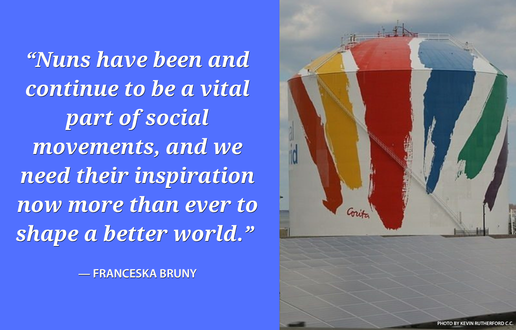
Outside of the orders that shaped much of my upbringing in Boston, the Sisters of Charity of Halifax and the Sisters of St. Joseph, I later learned about Sister Corita Kent, who as Chair of the Art Department at Immaculate Heart College in Los Angeles, turned pop art into theology and protest. 

Sr. Corita used advertising slogans, scripture, and bold color to critique capitalism, racism, and the Vietnam War. In the 1960s, her classroom became a hub of creative dissent. She believed art should disturb the comfortable and comfort the disturbed, and she embodied that belief through printmaking that was unapologetically political and joyful. 

One of her most notable pieces is one I’m familiar with as a native Bostonian: the Rainbow Swash, a design painted on a large gas tank. Commissioned in 1971, the sweeping bands of color are often interpreted as a subtle commentary on the Vietnam War and are widely recognized as the world’s largest copyrighted work of art. What most people drive past without a second thought is actually a massive piece of public art rooted in faith, resistance, and imagination. Sister Corita shows us that being like a nun can look like creative defiance, disciplined enough to master craft and bold enough to color a skyline.  

Then there’s Sister Mary Antona Ebo of the Franciscan Sisters of Mary in St. Louis, one of the first Black women to enter her order. She marched in Selma after Bloody Sunday in 1965 and explained her presence by saying, “I am a Negro, a nun, a Catholic, and I want to bear witness.” Holding theology, politics, and identity together, she refused to separate her race from her vocation or her faith from her fight for justice. 

After Selma, Ebo served as a hospital administrator and spoke openly about racism within the church. She models embodied witness at the intersection of race and faith. Being like a nun, in her case, meant public moral clarity and reform from within, even when the institution was slow to change. 

Most recently, I learned about Sister Thea Bowman, a Franciscan Sister of Perpetual Adoration who became one of the most influential Black Catholic voices of the 20th century. In 1989, while terminally ill, she addressed the U.S. bishops and challenged them to confront racism within the Church. She did so with clarity, humor, and song, even inviting them to sing “We Shall Overcome.” 

Sister Thea brought Black spirituals and call and response traditions into Catholic liturgy and advocated for inculturation, faith expressed through Black cultural forms. It gave me joy to see her affirm experiences and music I grew up with in Haitian Catholic services. She shows that being like a nun can look like prophetic joy and telling the truth while still singing. 

There are many more examples, but I want to be like the sisters who came before us and who are still working among us. They choose community, purpose, and conviction over comfort, ego and popularity. If what it means to be a sister is creative resistance, visible justice, and joyful reform, then we should all strive to be like nuns. The world needs it. 
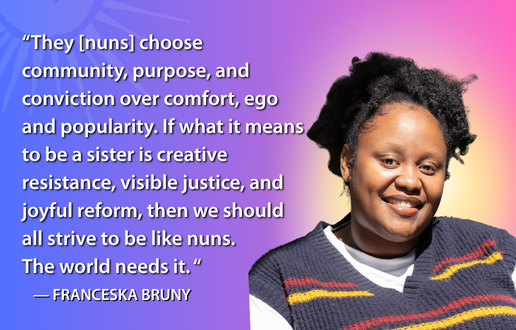
Franceska Bruny is a Master of Arts in Social Justice student at Union Theological Seminary and a multidisciplinary artist and storyteller. She served as an Advocacy Intern with NETWORK, supporting policy research and advocacy on immigration and economic justice. Franceska’s work explores how storytelling, theology, and creative practice can foster community dialogue and collective liberation This column originally appeared in the Quarter 2 2026 issue of Connection magazine.
We are rising to the moment

Not on Our Watch, Not in Our Name

Not on Our Watch, Not in Our Name

Resistance and Persistence Build Community as We Search for Hope

Sr. Eilis McCulloh, HM
November 13, 2025


The horrors of this current administration feel like they are coming at us rapid fire. As we at NETWORK have said for months, this is by design — with the hope that we, people united for the common good, lose focus in all of the chaos. They hope that we become burned out by everything that is happening at warp speed and lose steam. And, truth be told, we are tired, but we are not slowing down.

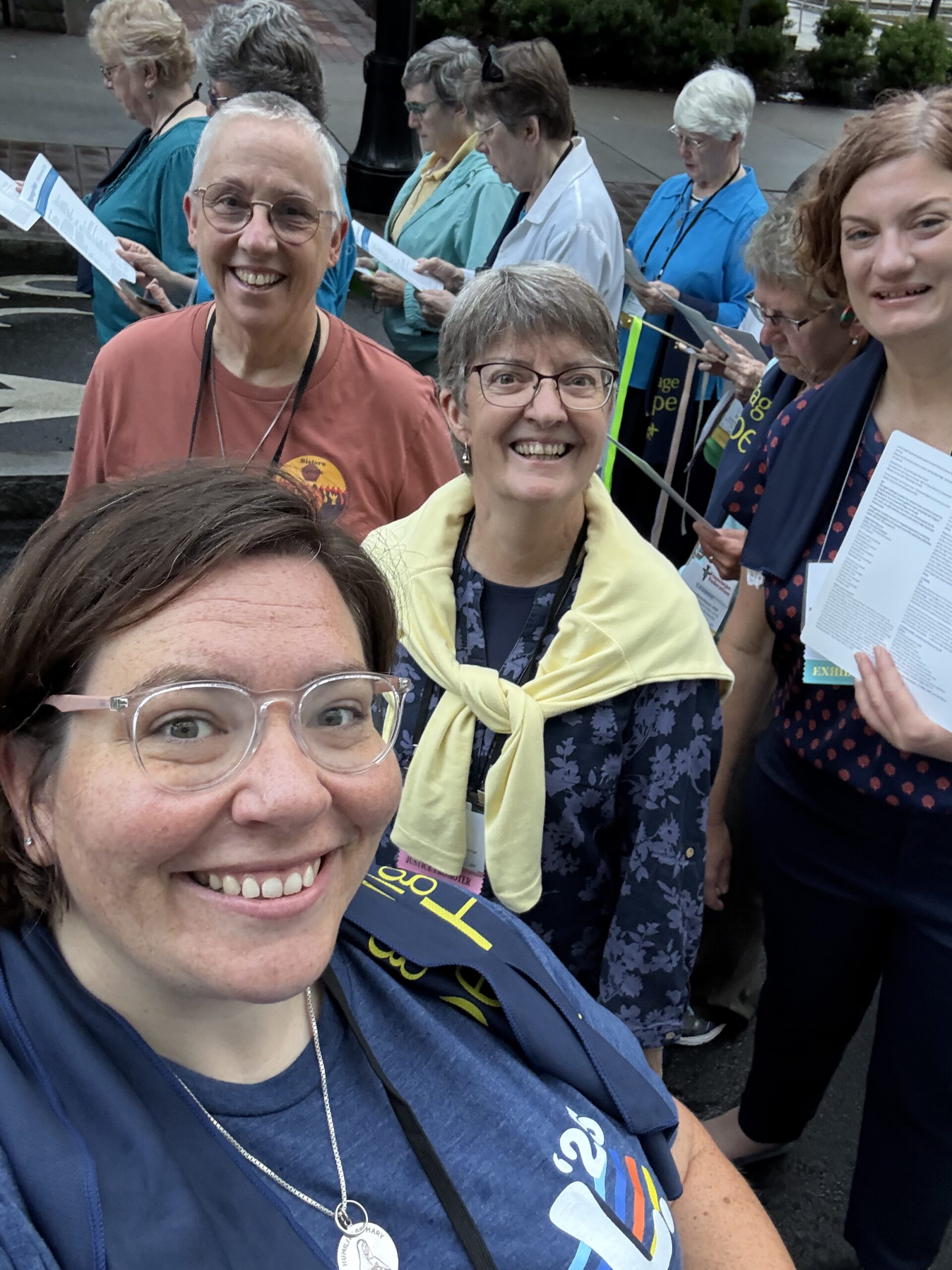
Sr. Eilis McCulloh, HM joined by Sr. Barbara Batista, SP, Sr. Dani Braught, ASC, and Meg Olson, NETWORK Director of Grassroots Mobilization at the annual August gathering of the Leadership Conference of Women Religious in Atlanta.

Sr. Eilis McCulloh, HM joined by Sr. Barbara Batista, SP, Sr. Dani Braught, ASC, and Meg Olson, NETWORK Director of Grassroots Mobilization during the Pilgrimage of Hope at the annual August gathering of the Leadership Conference of Women Religious in Atlanta. The Pilgrimage of Hope was a one-mile walk through downtown Atlanta prayerfully dedicated to addressing systemic injustice in the areas of racism, migration, and the climate crisis.

Years ago, I heard the phrase that we are called to touch the pain of the world. It felt heavy when I could not respond to all the pain in the world. Now this has taken many different forms, but I truly believe that touching the pain of this country and responding to it is a way that we all can practice accountability in 2025.

We need to know where our community is hurting—be it by an increased military presence patrolling our streets, immigration raids terrifying our neighbors, hospitals closing, or a lack of available food. As we become aware of the pain and devastation in our communities, we must be moved to act. This is our current form of contemplation in action and courageously speaking truth to power.

We are called not only to stand in the chasms—in the wake of raids, slashed funding, and fear—but to respond to it. We are called to be the tangible opposition to these horrors and advocates for a better tomorrow. No matter where we live, our walk of life, or whether we’re college students or senior citizens, we are called to be an active form of resistance against the degradation of our democracy and our communities.

As Bishop Marianne Budde recently wrote: “We can rise to this moment, to do our part to stop those who are determined to dismantle the institutions, destroy the guardrails of our democracy, and accelerate the very trends we need to reverse for the human species to survive.”

We are rising to the moment.

We call our Members of Congress. We send emails. We write letters to the editor. We put up billboards, pass out zines, attend workshops and webinars. We talk to our friends and family. Why? To hold our elected officials accountable and maybe, in some ways, to hold ourselves accountable to planting seeds for the greater good of our country.

Across the country, our Sisters and friends have been holding vigil at immigration detention centers, offering prayers and solidarity to those unjustly detained and their family members. In song and prayer, we line local streets with signs that say things like “Protect Families, Reject Deportation.”

This witness says to the wider community: This cannot happen in our name. We are hosting
letter writing campaigns and call-in days, continually widening the circle by inviting friends, neighbors, family, and community members to participate.
Through these invitations, we’ve heard from so many who made their first phone call. And it wasn’t so scary after all!

Through it all, we are rooted in community. Each time we join a vigil, protest, or webinar, we meet new people who share our passion. We build bridges. We resist together. We learn together. We celebrate together.

As Bishop Budde said in the same reflection: “We are the ones who must dare to believe that seeds of new possibilities, invisible to us now, have already been planted in the soil of our lives, and they are slowly taking root. New life will emerge from the ashes of what is lost.”

It might not feel like there is a lot of new life emerging in the here and now. But I see it springing forth from every person crowded around tables folding zines, every street lined with people, every chapel filled with people praying, and every meeting room where people are gathered.

We are part of the movement to create An Economy for All, where all people, no matter their economic status, citizenship status, orientation, or ZIP code, have what they need to thrive.

Sr. Eilis McCulloh, HM is a Sister of the Humility of Mary and NETWORK’s Grassroots Education and Organizing Coordinator. This “Spirited Sisters” column originally appeared in the Quarter 4 2025 issue of NETWORK’s Connection magazine.

NETWORK’s 2025 Labor Day Statement

NETWORK’s 2025 Labor Day Statement

Showing Up for Workers’ Rights


August 27, 2025

When we serve others, when we create, when we work to contribute to the world around us, we as human beings become more fully alive. Work holds a sense of purpose and dignity that feeds the human soul. That, ultimately, is the purpose of work—to build up, not to reduce human beings to mere producers or commodities.  

The Catholic Church continues to show up to advocate for the rights of workers, most visibly in the 20th century tradition by helping unions to come together, organize, and obtain just wages, benefits, and safe working conditions — all benefits that would allow workers to adequately support their families and be contributors to the community.   

Catholic Sisters continue to show up as part of this faithful solidarity, and with the formation of NETWORK over 50 years ago, Sisters took the work to the next level by directly lobbying for pro-labor federal policies, a practice that continues to this day.  

Sadly, in the decades since then, workers have suffered from the methodical and malicious dismantling of labor unions and ruthless attacks on organized labor. There continues to be a coordinated effort to curtail workers’ rights and put profits over people. Wages have stagnated since the 1970s.   

In many ways, the weakening of unions was an early warning sign of the destruction of government we see today. The second Trump administration is on a mission to destroy any function of government that contributes to human dignity: foreign aid, health care, due process, and yes, workers’ rights.  

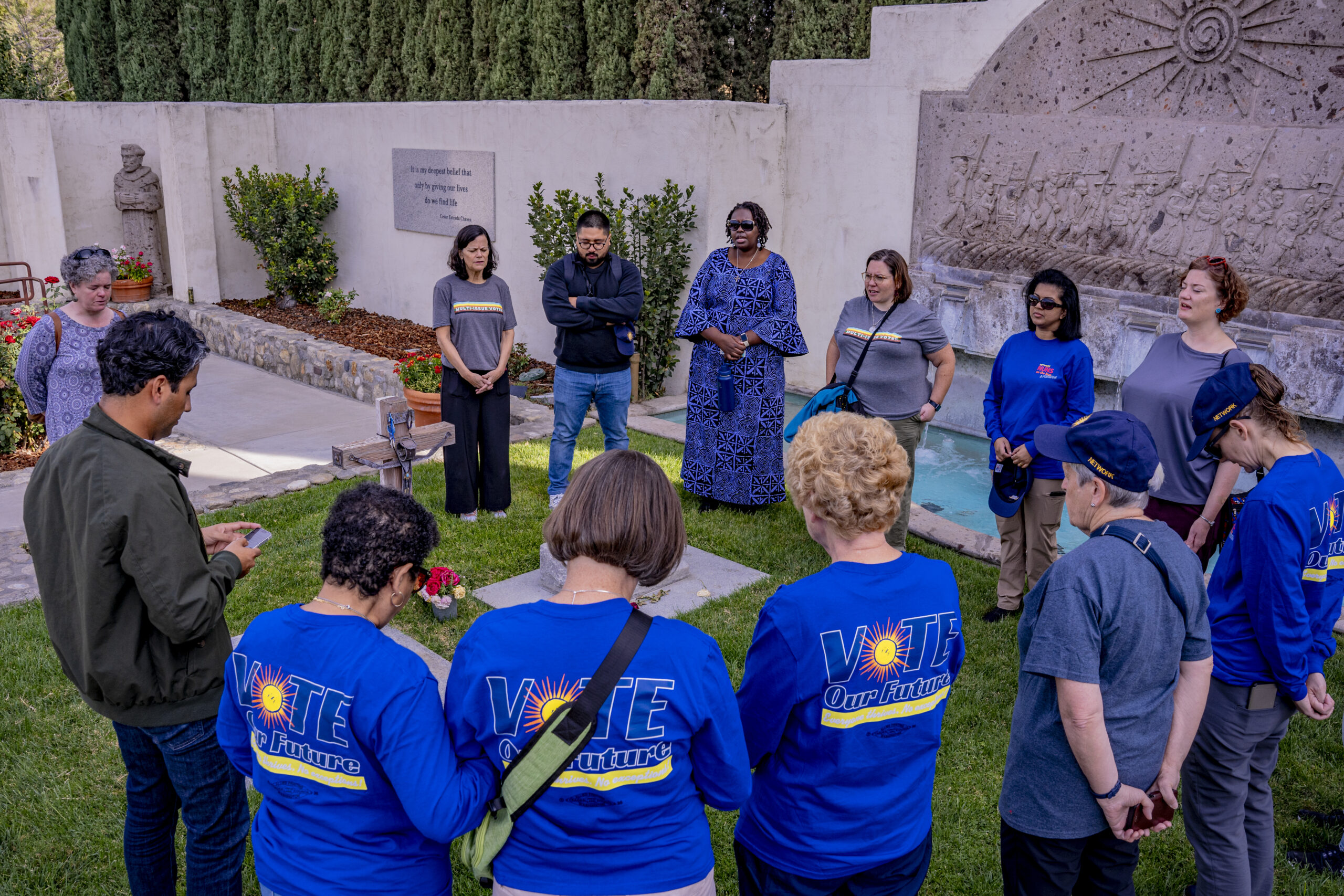
Nuns on the Bus & Friends pray at Cesar Chavez grave.

Andres Chavez, Bus Riders, and NETWORK staff pray at the grave of labor leader and civil rights activist Cesar Chavez in Keene, California on an Oct. 16 stop of the Nuns on the Bus & Friends 2024 “Vote Our Future” tour. Photo: Jacob Schatz, CCR Studios

Those who advocate for the dignity of work in the Catholic Social Justice tradition harken back to Pope Leo XIII, as he addressed the radical changes to the world brought by the Industrial Revolution, condemning unjust wages, unsafe working conditions, unbridled capitalism, and anything that risked reducing workers to less than their full dignified humanity. The document in which he addressed these issues—and championed the right of workers to organize—was called Rerum Novarum, Latin for “New Things.”  

Now in the 21st century, another pope, this one aptly named Leo XIV, has taken up the thread and is applying his predecessor’s moral lens to the emergence of artificial intelligence (AI). In this space too, Sisters are showing up to help lead the way. NETWORK’s engagement with AI policy is truly a “new thing” in the church’s support for labor rights. We recognize the risks: cogs and boilers have been replaced by artificial neural networks, data centers, and algorithms. More than 130 years since the warning of Pope Leo XIII, technological innovation again threatens to make humans grist for the machines.  

The emergence of AI is yet another reason why it is urgent that workers organize.   

We cannot shy from these challenges. Rather we must lean into hope. We must hope as the generations before us did with the hope of dignified workers’ rights so that all who toil might be able to share in the richness that God intends for all of us. We must join in solidarity with many unorganized and organized workers today who are beginning to realize their power to come together and bravely demand what is rightfully theirs.

# # #