

Category Archives: Advocates in the Field

Why I Celebrate the Pregnant Workers Fairness Act

Why I Celebrate the Pregnant Worker’s Fairness Act

Abby Kays
Guest contributor story of truth
October 24, 2023
I have always been an advocate for things I believe in and part of my advocacy journey includes sharing my personal story to show why change is necessary. My account reveals the workplace harm I faced during my pregnancy and is a perfect example for why it was important for the Pregnant Workers Fairness Act to become law. I would love to say that my story is a happy one, that it is joyful and exciting–but it is far from it. 

I was working at a meat processing plant when I became pregnant. I was trained in almost every position and area of the factory. My supervisors put me on fast-paced jobs that required attention to quality control, lifting, packing, and bagging. There was constant movement, twisting, bending, and lifting boxes that weighed up to 100 pounds. Because I worked the second shift, my workday started at 3:00 PM. It was typically scheduled to end at 11 PM, but that rarely happened. Most of the time, I was given notice that I would have to stay for mandatory overtime about an hour before my shift ended.

I actually found out I was pregnant when a fork truck driver hit me at work. The onsite nurse sent me to the hospital to have my injuries checked out. Months before this incident, I’d suffered a miscarriage. It just so happens that around the time I was hit at work, my husband and I had begun to try again to conceive. We even discussed taking a pregnancy test after work that very day. Even so, when preliminary tests at the hospital revealed that I was pregnant, I was stunned.  The doctor told me that he couldn’t administer a CT scan because I was pregnant. I had to have him repeat himself to make sure I heard him clearly.  Under his order, I was off of work until an OB/GYN examination. A few days later, the OB/GYN shared what I’d already suspected — mine would be a high risk pregnancy.  I knew because I had already had four miscarriages. But at about eight weeks along, everything looked good. I was cleared to work with a few restrictions:  no lifting boxes over 30 pounds, access to the restroom as often as possible, and light-duty jobs. Of course I turned that note into work upon my return.

Problems on the job

There were plenty of light duty jobs at the factory available to me that would have protected my pregnancy, such as moving small pallets to different areas, making boxes, packing smaller meat products, quality control inspections, and office work. They honored the OB/GYN’s restrictions  at first, starting me on light duty jobs until they put me back onto my pre-pregnancy duties. If someone was fired, quit, or didn’t show up to work, and they didn’t have anyone else trained on the heavy-duty jobs I did before my pregnancy, they put me into their position. If I needed to go to the bathroom, I would have to relay messages to co-workers around me so they could spread the word to try to find a supervisor to give me permission to go to the restroom. If I was lucky, I could go a half an hour after I got the urge, but most of the time it would be hours later, when it was break time, before I could go. I ended up with urinary tract infections that required repeated doctor visits. There were several times I was given warnings for taking too long to go to the bathroom, or for not being back from lunch on time because I was getting sick in the bathroom due to morning sickness.

My Reminders Fell on Deaf Ears

I continued to remind the supervisors about my pregnancy-related restrictions but was ignored. When I suggested that they train other workers (who weren’t pregnant) for the heavy-duty tasks, I was ignored. I offered to train other people, and was told that management would get someone else trained. This didn’t happen. All I received were excuses–we were too busy or so and so called out sick–either way, there wasn’t anyone else to do the job.

Five and a half months into my pregnancy, I was operating the strapper at the end of the packing line. It is usually a two-person job, but I was assigned to work alone. As my supervisor stood next to me, a fork truck driver ran into the machine and the machine hit my stomach and my supervisor’s hip. My supervisor, who knew what I had already been through with my previous pregnancies, sent me to the nurse immediately.

I stopped in the bathroom on the way to the nurse and noticed bleeding. I recited the details of the accident to the nurse, and the supervisor confirmed the story. I told them both that them I was bleeding. Instead of showing concern for the baby, they told me I was fine and sent me back to work. I was told to return to the strapper–the same job I was working when I was hit.

About 20 minutes after I reported back to work, I was still in a lot of pain and the bleeding continued. I was concerned about a possible miscarriage so I went back to the nurse. I was sent back to work. 30 minutes later, I began to feel contractions every 10 minutes. My supervisor sent me back to the nurse who informed me that, once again, I was fine and sent me back to work.

When my contractions were about two minutes apart, and I was bleeding through my pants, I informed my supervisor that I had to leave. I also told the nurse who informed me that there would be negative consequences if I left. I left. At the hospital, I was rushed to labor and delivery where my contractions were confirmed to be real. They gave me multiple injections to stop the contractions. I almost lost my pregnancy because of the people in charge at my job.

When I returned to work, I had more pregnancy-related restrictions. This time, I discussed them with the human resources department prior to my return. HR agreed to the doctor’s updated recommendations: a 10 pound weight limit on lifting items, limited bending, no kneeling or squatting,  restroom breaks as needed, and light duty work with the ability to sit if needed.

There were plenty of jobs in the factory that I could have done with a stool to accommodate the doctor’s orders like, prepping bags for the lines, making boxes, making labels, and sorting. The day I went back to work I was informed that they were unable to work with my restrictions and informed that I was required to use all of my personal time off and start my FMLA leave immediately. I was also reprimanded (pointed) for leaving work and ignoring the nurse’s order to return to work when I knew I needed to get to the hospital.

More Workplace Challenges After Baby’s Arrival   

I was induced a month before my son’s due date because of complications, but there were even more challenges after he was born. I was scheduled for a standard check-up at six weeks post-partum, but I was too sick with a high fever to go to the doctor. Unfortunately, this appointment fell during the Christmas season and rescheduling near the original appointment date was impossible. It would be a month before I could see the doctor. This impacted the day I was set to get back to the factory.

I contacted HR and let them know about my new post-partum check-up date and they informed me they would take care of it. I returned to work after being cleared by my doctor, I even had a  note from him. I worked for another month and a half before being called into HR for a reprimand.

I was informed that I was to be punished for leaving work after being hit with the strapper–the day I went to the ER with contractions and bleeding. I was also reprimanded for rescheduling my six-week post-partum appointment, which pushed my return to work date beyond the date that was documented when I left to have the baby. I was too sick to go to the doctor, and I couldn’t go back to work until I visited the doctor–and to them, I was a bad worker who missed the documented return to work date.

Today, because of the new federal law, most pregnant people won’t have to experience the challenges and struggles I experienced. The Pregnant Workers Fairness Act requires businesses to provide reasonable accommodations, like frequent bathroom breaks, time off for doctor’s visits,  the use of a stool, and honoring doctor-recommended weight restrictions. To me, this is a huge, and very necessary, win for healthy pregnancies and healthy people.

Abby Kay (a pseudonym for the author who wished to remain anonymous while sharing her story) lives in Camden, Indiana and has graciously shared her story with NETWORK advocates. We are grateful that our faith-filled justice-seekers, who were persistent supporters of the PWFA, can read her story of truth. The PWFA took effect on June 27, 2023. To read the accommodations and limitations of the PWFA, visit the U.S. Equal Employment Opportunity Commission.

Louisville, KY Rally for a Better Federal Government

Get Beyond ‘Bandage’ Work in the Federal Budget

David J. Dutschke,
Guest Contributor from the Kentucky NETWORK Advocates Team
October 13, 2023
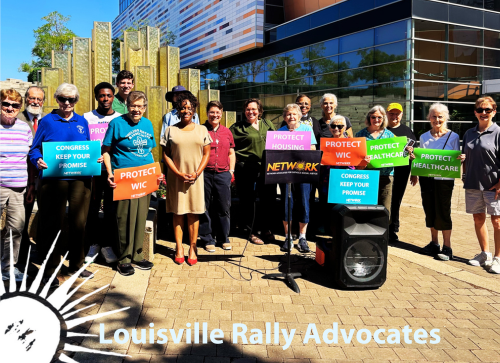
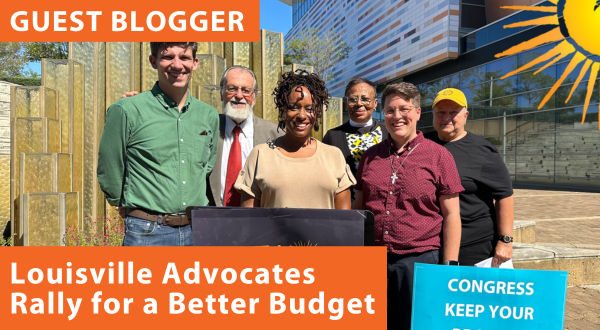
Oct 2, 2023, Louisville Rally Speakers Speak Out for a Better Federal Budget at the Ali Plaza in Louisville, KY

Louisville, KY advocates spoke out for a better federal budget at the Ali Center Plaza

We often talk about a “living wage.” Now it’s time to talk about a “living budget.” A

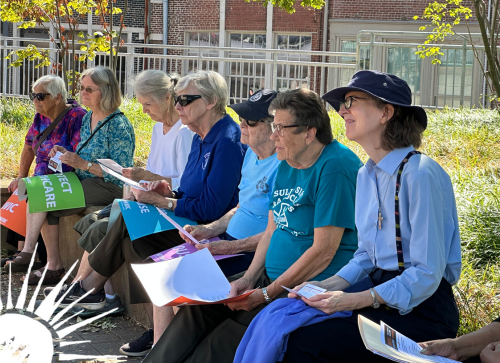
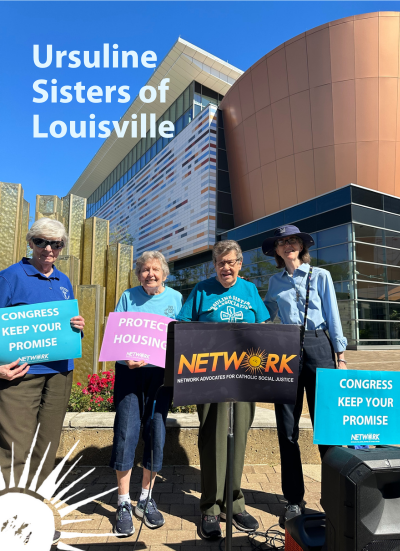
On Monday, October 2, 2023, a group of about 15 persons of faith and action gathered under the NETWORK umbrella at the Mohammed Ali Center Plaza in Louisville, Kentucky to challenge our elected officials to pass a budget that includes those on the margins struggling to afford housing, meals, health care, and more.

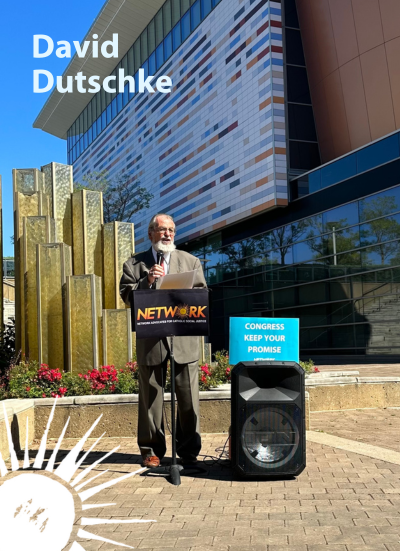
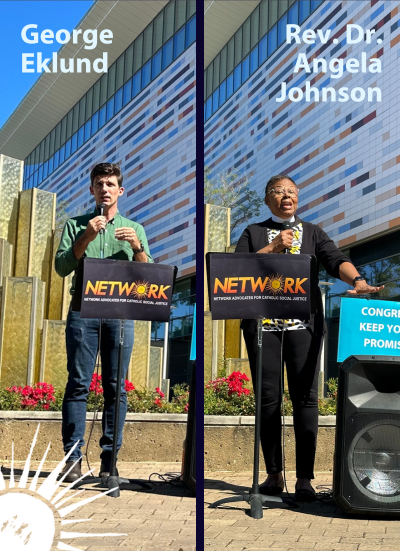
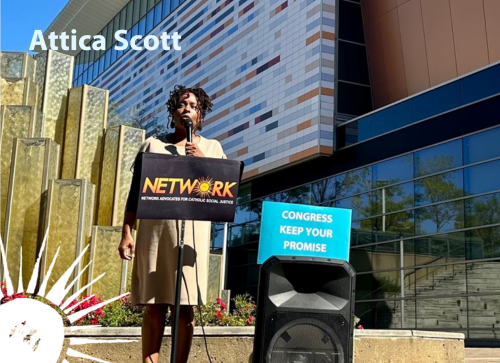
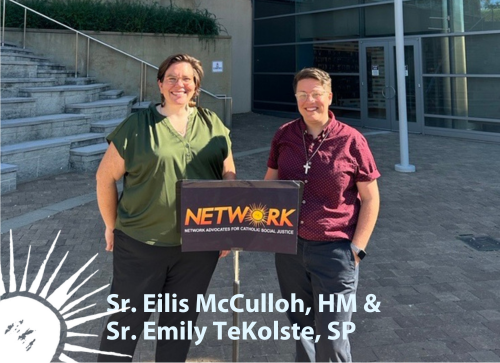
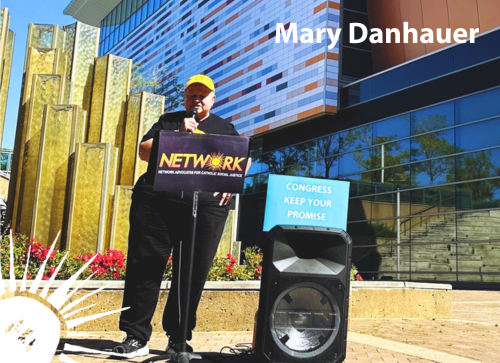
David Dutschke was the Oct. 2 Louisville Rally emceeSpeakers at our gathering included George Eklund, Director of Education and Advocacy, Coalition for the Homeless; Mary Danhauer, a retired nurse practitioner from Owensboro working in low-income clinics; the Honorable Attica Scott, former state Representative and Director of Special Projects at the Forward Justice Action Network; and the Rev. Dr. Angela Johnson, pastor of Grace Hope Presbyterian Church. They all spoke from different perspectives, but highlighted the fundamental role that you, me, and our government must take to provide for people in the margins. All of the speakers shared stories of the “bandage” work, or what I’d call charity or direct service work, that they do–myself included at St. Vincent DePaul. But all of us also emphasized the need for work to transform structures. The systemic change work that I do is with NETWORK and Clout (Citizens of Louisville Organized and United Together). And to start that systemic change work, Sr. Emily TeKolste, SP, an organizer with NETWORK, and leader of the Kentucky Team, provided very specific actionable items.

So here are some of my takeaways from our gathering: first, the largest provider of assistance to those on the margins is the U.S. people, at the direction of the federal government, in the form of rent assistance, housing programs like Section 8, SNAP, and Medicare assistance. We have to support these programs and ensure that Congress bolsters them, not slashes them.

George Eckland, Coalition for the Homeless and Rev. Angela Johnson, Grace Hope Presbyterian Church

George Eckland, Coalition for the Homeless and Rev. Angela Johnson, Grace Hope Presbyterian Church

Second, we don’t have a living wage mandate. In Louisville, a family of 3 needs at least $66,893 per year of income. Translated to wages, they need one job that pays at least $32.16 per hour. We can talk about food pantries, shelters, assisted living spaces, assisting our neighbors with paying rent and utilities, but eventually one comes down to the question: how many jobs do you have to have to raise a family today? Third, we have to reject the myth of scarcity.
There are 5,671,005 Americans with a net worth of over $3 million. There is $381 billion in unpaid taxes. And there are 37.9 million persons in the U.S. who live in poverty.
Finally, we need to do both charity work and system change work. All together, we the people of the U.S., have the resources to pay our bills and to shrink the margins. Our federal budget is a moral document to help us move forward. Solutions require the change of the system. And to do that, we have to organize. In organizing work, we say that there are only 2 sources of power—organized money and organized people. We have the people.

David Dutschke, a member of the Kentucky NETWORK Advocates Team, is former director of Parish Social Ministry and Housing Development at Catholic Charities of Louisville.

Watch Video from Louisville, KY Rally for a Better Federal Government

We must act, always with others, to make the Good News of our communal action THE news. We are all challenged to make our policies, including our budget, a beacon of moving forward on this great shared cosmic journey on which the Cosmic God leads us. Peace be with you all.
                                                               ~David Dutschke

Working the polls strengthens my faith in democracy.

Working the Polls Strengthens My Faith in Democracy

Working the Polls Strengthens My Faith in Democracy

Bob Kloos
September 19, 2023
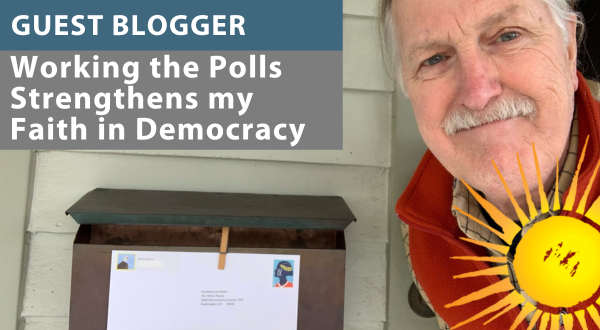
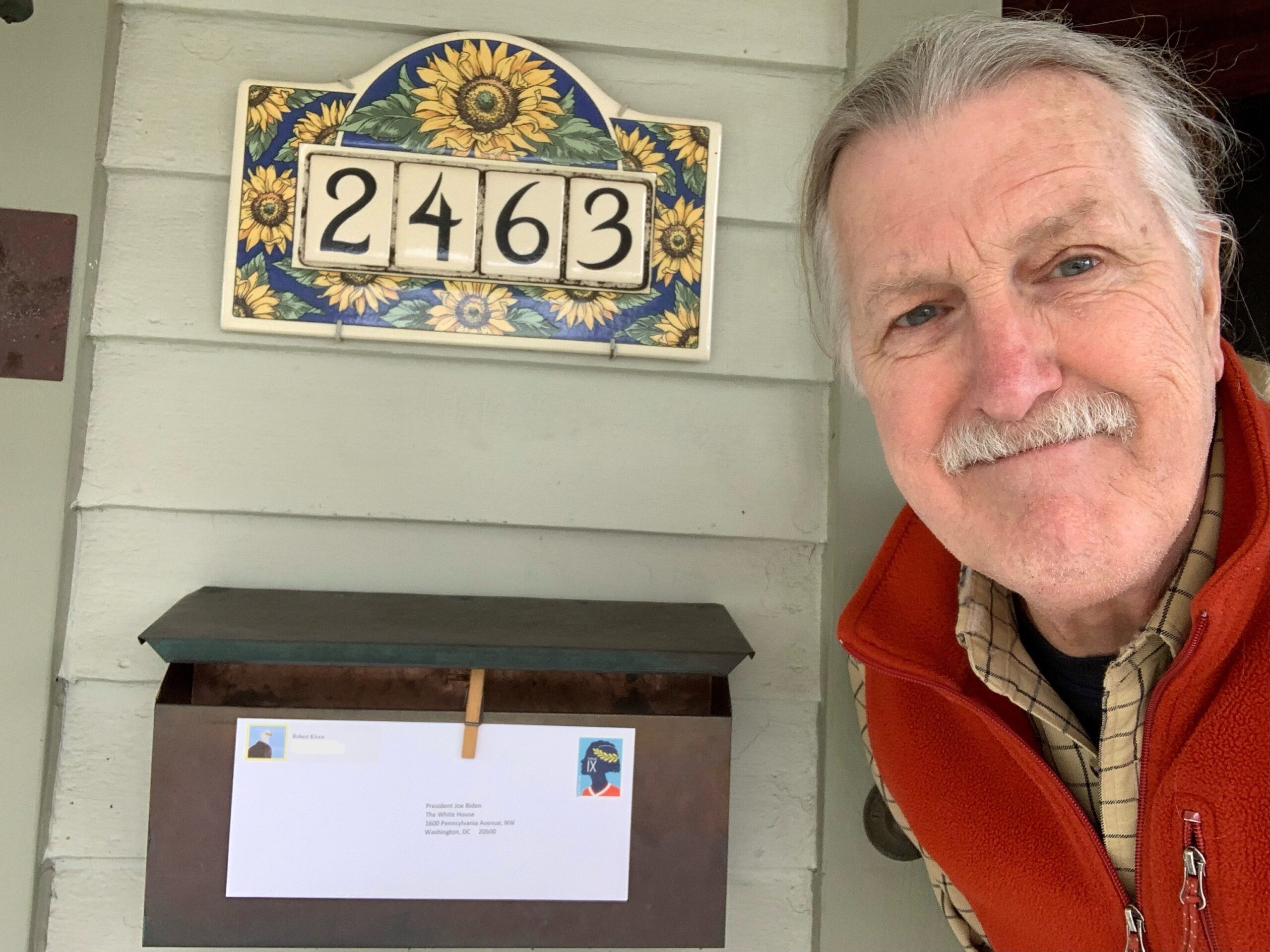
Bob Kloos at his mailbox with a letter addressed to the White House

Bob Kloos participated in NETWORK’s President’s Day 2023 letter-writing campaign for reparations.

I’m a pastor. I can’t campaign door-to-door. So, I volunteer to work the voting polls. I have done this a few times now, and it’s absolutely a chore with a purpose. Voters deserve to arrive at the polls and be welcomed, assisted, directed, and thanked. I can do that, but it’s not exactly a volunteer gig. The county offers a stipend that works out to about $14 per hour and Election Day is long. Working the polls strengthens my faith in democracy. It’s all about hospitality, teamwork, and respect. It’s about being a neighbor in somebody else’s neighborhood.

Preparations for Election Day

Where I live in Greater Cleveland, the county Board of Elections (BOE) tries to mix it up by balancing the number of Republicans and Democrats working at each polling place–with a few Independents here and there. I live in an area thick with Democrats, so I am often assigned to neighborhoods where staffing is a challenge. The last few times, I have been located in Black precincts, and often, I’ve been the only white person working at the site.

We set up the night before, assembling and lining up voting booths according to the diagram supplied by the BOE. We make certain that electronic voting machines are fully charged and show “0” votes cast, and we check to make sure all ballots and scanners are secured and sealed. At 5:30 AM on Election Day, everything is ready, assignments are given, and the countdown begins.

What Election Day Looks Like

The first wave includes voters on their way to work. They have done this before. Voting is as routine and vital as clocking in for work on time, paying the rent, and spending time with their children. Steady streams of locals arrive with photo IDs in hand. They are informed, prepared, and determined. It is refreshing to see students from a local university arrive as well. They spend three or more years in Ohio, and by voting, they share their convictions even if it means extra effort to secure required documentation for registration. Democracy has a universal attraction, and the satisfaction of exercising this “obligation” is visible on the faces of everyone I see on Election Day, from the first arrivals at 6:30 AM to the last voters who arrive just in time to cast their vote at 7:29 PM.

As a pastor, I know my voice matters. And if voice matters, voting does too. People have died trying to protect their vote and the votes of their people. Many voters are still laboring under oppressive structures and systems that have been in place for decades, even centuries, to try to keep them from voting. Gerrymandered legislative districts continue to propose “unpopular” laws that are against the will and good of the public. This is no time to remain silent or to stay home.

Ohio’s August 2023 Special Election

The most recent election day in Ohio was an unusual August polling day. It was a special election about a proposal to raise the threshold for changing the Constitution in Ohio, to require 60% of the vote +1 (as opposed to 50% +1), and signatures from all 88 counties. Many voters in the predominately Black precincts where I worked came in “hot.” They perceived this initiative to be just another effort to diminish their vote, silence their voice. It was the only item on the ballot, so they were in and out in less than five minutes. Their effort demonstrated to me that they believe this was time well-spent. They weren’t just protecting their own freedom, they were protecting mine as well.

Faith in Democracy

Working the polls strengthens my faith in democracy, which is especially inspiring in our current political landscape. Many elected officials are not public servants, but rather, they are beholden to private interests, corporations, or the for-profit sector. Money drives decisions. And as much as some on the Hill protest that we are a Christian nation, they are loathe to fully consider the gospel narrative that reminds us of the plight of those in the margins (Matthew 25,31-46). Ironically, both the sheep and the goats ask the question: “When did we see you?” Unless we make time in our day to walk with the homeless, families dealing with food scarcity, and political or environmental refugees, numbers and statistics will have no faces, no names, no traction in our everyday decisions.

That’s why I appreciate those with the expertise to remind me of the facts, align them with sound gospel principles, and then lead by example–that is, begin to work for change. I need all the help I can get. I would be at a loss without NETWORK.

I have known of NETWORK for ages. One of the original leaders, Catherine Pinkerton, CSJ, was from these parts. Anecdotally, it has been said that whenever Teddy Kennedy looked up and saw her entering his office, he simply threw up his hands and said, “Whatever you want, Sister Catherine, I will work for it.” And former Executive Director, Sister Simone Campbell, SSS, has spoken in our worship space and NETWORK staff have come to town many times–even on a bus! I am informed by NETWORK. I am inspired by NETWORK.

Bob Kloos lives in Cleveland, Ohio and is a member of the Ohio NETWORK Advocates Team. September 19 is National Voter Registration Day, and the month of September has been designated as voter registration month by the National Association of Secretaries of State. Please register to vote, check to be sure your existing registration is accurate, set voting alerts, and find out how to help others do the same.

Rochester Reparations Vigil | NETWORK Lobby for Catholic Social Justice

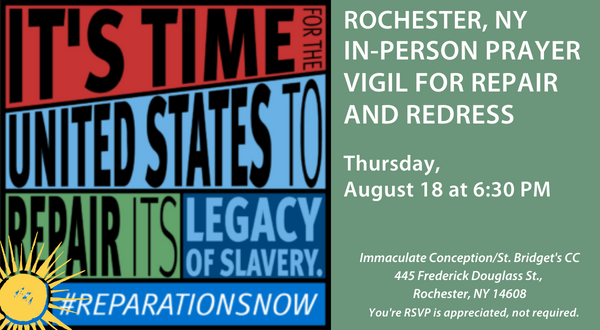
Register for the Rochester, NY In-Person Prayer Vigil for Repair and Redress

[ninja_form id=”9″]

Racism has been a well-preserved traveler across generations in large part because of government behavior, like: blocked access to the wealth-building opportunities of homeownership, racial bias throughout the criminal legal system, and segregation from “good” schools. Our communities suffer because redress has been denied. We’re glad you can join us!

Want to learn more about New York’s NETWORK Advocates Team, who are volunteer justice-seekers rooted in the community, or about future reparations events and actions? Contact Catherine Gillette, Senior NETWORK Grassroots Mobilization Organizer.