

Category Archives: Front Page

After Shelby: The Need to Reinstate Crucial Voting Rights Protections

After Shelby: The Need to Reinstate Crucial Voting Rights Protections

Sister Quincy Howard, OP
Updated: June 27, 2019

We at NETWORK, with many of our partners, are naming this week “Shelby Week” in recognition of the six years that have passed since the Supreme Court’s decision in Shelby County v. Holder. 

In the aftermath of the June 25, 2013 Shelby decision – which gutted key protections of the Voting Rights Act (VRA) – states and localities across the country jumped to enact restrictive voting laws, disenfranchising millions of American voters. For six years, civil rights organizations have been fighting back against these discriminatory laws. We need Congress to restore the VRA to its full strength to ensure that all eligible voters have equal access to the ballot and that every vote counts.


The ideal of “one person, one vote” is central to our understanding of democracy in the United States, but the reality in our country falls short. While the legal discrimination that prevented people of color from voting for hundreds of years is no longer in place, today a new combination of restrictive standards and requirements keep voters from exercising their right to vote. Whether implementing voter ID requirements, purging voter rolls, restricting early voting, or closing polling locations, state-level election laws can make it considerably harder, if not impossible for many eligible citizens to vote. Furthermore, these requirements have a disproportionate impact, often by design, on low-income and voters of color who are less likely to have flexible schedules, access to transportation, or a government photo ID.

Many of these tactics are familiar to communities of color, but ever since the passage of the Voting Rights Act in 1965 there had been an effective mechanism in place to apply federal oversight of potential voting rights violations. Specifically, Sections 4 and 5 of the Voting Rights Act (VRA) used a formula determined by the VRA in 1965 to identify jurisdictions with histories of racial discrimination and subject them to federal preclearance requirements prior to implementing any changes in voter registration or casting of ballots. In 2013, however, the Shelby County v. Holder Supreme Court decision stripped the VRA of this preclearance mechanism—deeming the formula outdated—and opened the door for states to pass more restrictive voting standards with impunity.

Since the Shelby ruling, 23 states have freely implemented more restrictive voting laws and conducted elections accordingly. The only recourse left is under Section 2 of the VRA—to challenge these laws after the fact. Meanwhile, the resulting voter disenfranchisement has already taken place and the results of potentially rigged elections stand. Accordingly, unfair elections around the nation have begun to resemble a discriminatory game of wack-a-mole: lawsuits of voter discrimination have quadrupled in the five years since the Shelby decision. Expensive and slow-moving litigation is an untenable approach to reinstating fair elections; and Section 2 offers no remedy for the impacts of disenfranchisement.

In contrast, under the Section 5 process the Justice Department provided quick, inexpensive reviews and decisions on proposed changes to voting requirements or procedures. The vast majority of proposed changes to elections were cleared and there was space to appeal decisions when they were not.  It was a system that worked; the VRA without this preclearance mechanism is not working.

This Wednesday, the House Oversight and Reform Committee will be conducting a hearing on “Protecting the Right to Vote: Best and Worst Practices.” Chairman Jamie Raskin (MD-08), who is also a professor of Constitutional Law, the First Amendment, and Legislative Process, will lead the Civil Rights and Civil Liberties Subcommittee in this effort to get to the bottom of voter suppression today.

For six years, Congress has made multiple unsuccessful legislative attempts to update the preclearance formula and restore this crucial provision of the VRA. Part of the process to adopt a preclearance formula that the courts will uphold is gathering and documenting evidence of efforts to disenfranchise voters. Congress is currently building this record to demonstrate ways in which jurisdictions have changed laws to disenfranchise voters, particularly voters of color. Most recently, we can look to states like Georgia, Texas, North Carolina, North Dakota, Florida, and Alabama for flagrant examples of manipulated election procedures that effectively suppress the vote of communities of color.

Throughout April and May, the House Administration Committee’s Subcommittee on Elections is holding a series of field hearings on voting rights and election administration. Hearings have taken place in Standing Rock, ND; Halifax, NC; and in Cleveland, OH. Still to come are field hearings in Alabama and Florida to review and hear testimony about the impacts of new voting and registration laws on communities of color. These hearings are the opportunity to examine what voter disenfranchisement in the 21st Century looks like—so we can prevent it from happening.

In late February, Representative Teri Sewell (AL-07) and Senator Patrick Leahy (VT) introduced the 116th Congress’ high-priority legislative fix to restore and extend these key provisions of the VRA. It’s not the first time that a “Shelby-fix” bill has been introduced since 2013, but this year it’s coming on the heels of an historic election in which rampant and flagrant voter suppression was apparent. H.R. 1 (the For the People Act) has also already passed in the House and specifically named this as a crucial component for democracy reform.

The Voting Rights Advancement Act of 2019 (VRAA), H.R. 4, represents the most robust and inclusive proposal to revise the criteria for determining which States and political jurisdictions should be subject to preclearance requirements. Specifically, the formula proposed in VRAA subjects any jurisdiction with 15 or more voting-rights violations over the past 25 years to 10 years of federal preclearance. The threshold would be lowered to just 10 violations if any of them were committed by the state itself. VRAA is not solely a defensive measure. It’s intended to be punitive, to deter people who take advantage of the fact that there are few real consequences for officials found in violation of the Constitution. The VRAA would add teeth that the Voting Rights Act didn’t have even at full strength. While alternate bills are already emerging with less-expansive formulas, NETWORK strongly supports H.R.4 as the way to quickly address and end voting rights abuses that have become commonplace across our country.

Faces of our Spirit Filled Network: Beth Ford McNamee

Faces of our Spirit Filled Network: Beth Ford McNamee

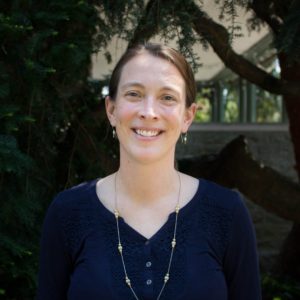
Beth Ford McNamee
June 26, 2019

Tell us a little about yourself and the work you do.

I am a Campus Minister at Saint Joseph’s University (SJU). I coordinate a weekly community service program of about 300 students who commit to serve weekly with local community partners in Philadelphia and Camden. The program involves relationship-based service and peer-led, faith-based social justice reflection and discussion. I also coordinate a Campus Ministry Associate program at SJU. This program gives recent college graduates a one year paid experience working full-time on our staff to discern ministry as a full-time career. I am also currently a student in the Interdisciplinary Doctor of Education Leadership Ed.D. program at SJU. My spouse Jeremy and I have a four year old son Aaron.

How did you first learn about NETWORK and what inspired you to get involved?

I first learned about NETWORK when I was a graduate student at Washington Theological Union in Washington, DC. I was studying theology there and seeking to live out a faith that does justice as I had encountered in my Jesuit education at Saint Joseph’s University and as a Jesuit Volunteer. I was inspired by all those at NETWORK who were challenging us to examine public policies and their impact on people on the margins. I worked with a few folks at NETWORK in a committee to help plan the annual Ecumenical Advocacy Days conference. In addition, quite a few of our Saint Joseph’s University graduates have worked as NETWORK associates. My imagination was captured by the Nuns on the Bus tours. SJU was proud to host the Nuns on the Bus tour this past October 2018.

What issue area are you most passionate about?

This is such a difficult question to answer! Immigration justice, racial justice, and care of God’s creation are often among my top issues. However, because education has been such a gift in my life, I also focus on education equity and access to higher education.

How are you engaging your community on important social justice issues?

I help coordinate campus participation in several local, national, and international justice efforts. Our department coordinates the following student groups: Hawks for Just Employment (campus workers’ rights issues), Hawks for Life (focuses on human dignity and a consistent ethic of life), POWER University (local community organizing around various justice issues), a delegation to the Ignatian Family Teach-In for Justice, and Catholic Relief Services, SJU’s Refugee and Immigrant Working Group, and others!

How has your advocacy for social justice shaped your view of the world?

Advocacy for social justice issues has expanded my awareness of human need and systemic justice issues. I believe that it is a duty as part of my faith.

How does your faith inspire you to work for justice? (if applicable)

I’ve been formed in Ignatian spirituality which is grounded in gratitude, finding God in all things, a relationship with Christ, discernment, co-laboring empowered by the Holy Spirit, and a call to live a faith that does justice (and much more!). My faith is grounded in relationships; all people are members of one human family created in the image and likeness of God; when members of the human family suffer, all suffer, and all are called to work for the full realization of God’s reigning in justice, love, and peace.

Who is your role model?

Dorothy Day.

Is there a quote that motivates or nourishes you that you would like to share?

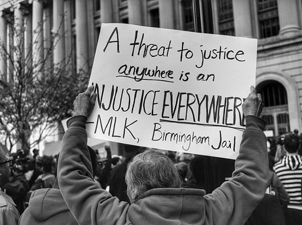
“Injustice anywhere is a threat to justice everywhere. We are caught in an inescapable network of mutuality, tied in a single garment of destiny. Whatever affects one directly, affects all indirectly.” Martin Luther King, Jr.

“We cannot love God unless we love each other, and to love we must know each other. We know him in the breaking of bread, and we are not alone any more. Heaven is a banquet and life is a banquet, too, even with a crust, where there is companionship. We have all known the long loneliness and we have learned that the only solution is love and that love comes with community.” – Dorothy Day

What social movement has inspired you?

Does Nuns on the Bus count? 🙂

What was your biggest accomplishment as an activist in the past year?

In all honesty, it has been balancing commitments as a spouse, mother, minister, and doctoral student while making time for prayer, health, and showing up for prayer, protests, and advocacy opportunities when I am able. I’m also proud of my associates and student leaders who deepened our social justice and advocacy efforts in our programs this year.

What are you looking forward to working on in the coming months?

I am looking forward to working with a mentor to develop a course in faith-based community organizing. I’m also looking forward to this summer for much-needed time for justice-related strategic planning and for sabbath rest.

President Trump Calls for Mass Raids This Weekend: What is Your Faithful Response?

President Trump Calls for Mass Raids This Weekend: What is Your Faithful Response?

Laura Peralta-Schulte
June 21, 2019

President Trump began his 2020 campaign this week with the same anti-immigrant platform he ran on in 2016. In his opening speech, he promised to begin a set of raids intended to “remove millions of illegal aliens beginning this weekend.”  Thus begins the likely ramping up increased domestic terror against our immigrant sisters and brothers.  Following the announcement, there have been leaks from ICE, the agency in charge of conducting raids, confirming they may begin actions as early as this weekend. While raids are not new – the Administration has already conducted massive raids in places like Ohio, Wisconsin, and Tennessee – this racketing up is intended to remind President Trump’s supporters that this is still his number one campaign objective.

Our best understanding is that individuals and family units with final orders of removal are anticipated to be targeted. Such targeting would likely result in collateral arrests, meaning: persons who are undocumented but do not have a final order of deportation will likely be detained also.

What does this mean for us, as people of faith?

For some of us, this means our families will sit in fear between now and the election waiting for a knock on the door. We will fill out the appropriate legal documents full of personal information so that if the worse happens, we know our kids will be safe in the custody of a family member or a friend. We will review what we learned at Know Your Rights trainings so that if and when the knock comes, we know what to do. We will live in a continued state of fear.

We learn more and more everyday about the impact of toxic stress on the bodies and health of people under duress. It takes a tremendous toll on a person’s physical, mental and emotional health. We are reminded by our partners at the Center for Law and Social Policy about what happens when children witness the arrest of a parent – particularly in their own home. The children are now ‘at greater risk of suffering mental health and behavioral problems with have long-term implications for their overall development and future success.’

What does it mean for those of us who are not directly impacted?  This is the key faithful question of our time. As people grounded in sacred texts that call for welcome and love, how do we respond? Do we look away because it all seems overwhelming? Do we chose to sit in our comfortable homes, go to our pools, enjoy a barbeque with family and friends completely detached from this terror? Or, do we engage in acts of resistance and love?
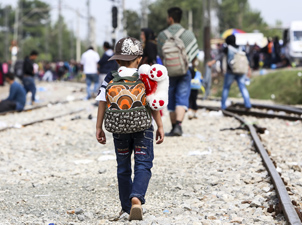
NETWORK is continuously engaging in discernment to discover how we as an organization can live a more authentic life, one grounded in the work of racial justice. This year, our Lenten reflections aimed to strengthen our commitment to be and work in solidarity with communities of color, so we can live out our call to justice for all people in the public square.

We must shake off the choice of inaction. To fail to speak out against injustice is to be complicit.  We can and we must live into our call to be a people of love and justice.

A child wearing a cap walks with a backpack and a stuffed animal at the US-Mexico border

Congress Holds Hearing on Situation at the Border

Congress Holds Hearing on Situation at the Border

Laura Peralta-Schulte
June 11, 2019

Today, the Senate Judiciary Committee is holding a hearing to examine the refugee crisis at U.S. – Mexico border. The key witness will be Acting Director of the Department of Homeland Security Kevin McAleenan. During the hearing, McAleenan is expected to call for: increasing border militarization; stripping away the rights of children from Central America to seek asylum; making it more difficult for families to assert a claim to asylum; and dramatically expanding family detention.

This Administration has already taken unpresented steps to dismantle our asylum system, going as far as separating children from their parents with full knowledge of the harm this inflicts on children and families. Tragically, at least six children have died in federal custody in the past year due to lack of access to healthcare. It was recently revealed that 37 children were locked in vans for up to 39 hours in a parking lot of a detention center outside Port Isabel, Texas.  Further, the private prisons this Administration desperately seeks to expand to house immigrant families have come under continued criticism for their dangerous conditions. Just last week the Inspector General Department of Homeland Security found “egregious” health and safety violations at four major ICE (Immigration and Customs Enforcement) facilities.

None of this is surprising given immigration was President Trump’s signature issue in the 2016 presidential campaign. His racist attack on immigrants, symbolized by the call to “build the wall”, set the stage for the policies his Administration is currently pursuing.  The scapegoating of immigrants and asylum seekers will only increase as we head into the 2020 campaign.

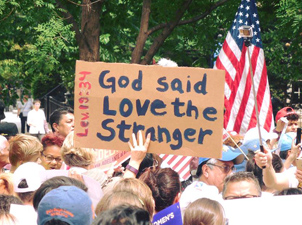
Sacred scripture instructs people of faith about how we should treat migrants.  We are called to “release those bound unjustly, untying the thongs of the yoke; Setting free the oppressed, breaking off every yoke.” (Isaiah 58) We must “Bring good news to the poor…release to the captives…sight to the blind…let the oppressed go free.” (Luke 4:16-21) This is not a political issue for the faith community, it is a matter of justice.

Acting Secretary McAleenan, let us be clear:  NETWORK and our interfaith partners reject your false choice between chaos and compassion. It is wrong to use a humanitarian crisis to shred laws protecting vulnerable families seeking asylum. It is wrong to cage children and families in indefinite detention. It is wrong to strip protections for children that keep them safe and healthy.

These actions are cruel and unjust. We will continue to call for justice for our immigrant family.

Mending the Gaps Experienced by the LGBTQ+ Community

Mending the Gaps Experienced by the LGBTQ+ Community

Siena Ruggeri
June 7, 2019

NETWORK is proud to have supported the recent passage of the Equality Act in the House, and we urge the Senate to also pass this important legislation. While the Equality Act would extend critical anti-discrimination protections to the LGBTQ+ community in both the workplace and housing, many of NETWORK’s Mend the Gaps other issues have a direct impact on the LGBTQ+ community. As we work to mend the gaps in our nation, it is important to consider the challenges facing the LGBTQ+ community and ways federal policies can reduce those challenges.

Paid family leave, for example, is a significant issue for LGBTQ+ families. Even in areas and workplaces that do offer paid leave, LGBTQ+ families face an extra hurdle to taking the necessary time they need to be with their families. According to a survey by the Human Rights Campaign, 27% of LGBTQ+ people of color and 16% of LGBTQ+ white people say they are afraid to request time off to care for a loved one because it might disclose their LGBTQ identity. 44% of LGBTQ+ people of color are afraid of losing their job if they took paid leave, compared to 37% of their white counterparts.

Paid family leave is already challenging to access for countless families. LGBTQ+ workers have to disclose their gender identity or sexual orientation in order to access paid leave, putting them in a highly vulnerable spot. In our efforts to expand access to paid leave, we must intentionally include all types of families. This is why legislation like the FAMILY Act (H.R.1185) is so important to advance — this policy has a broad definition of family, allowing for all types of families, biological and chosen, to take equal advantage of paid leave.

LGBTQ+ people may also face barriers to healthcare because of discrimination against their gender identity and/or sexual orientation. Just last week, the Trump administration proposed rolling back an Obama-era HHS rule called the Health Care Rights Law, which ensures healthcare providers cannot discriminate on the basis of sex. The rollback of this rule will strip away the protections established by the ACA, which were critical for LGBTQ+ healthcare access.

According to a 2015 report by the Center for American Progress, 23.5% of transgender respondents and 10.3% of LGBT people of color avoided doctors’ offices in the past year due to fear of discrimination. Ensuring affordable, accessible healthcare is an LGBTQ+ issue, and we must consider the unique challenges the community faces as we advocate for greater access to quality, affordable health care.

LGBTQ+ issues also intersect with immigration. Those who identify as lesbian, gay, and bisexual are three times more likely to be incarcerated. As a result, LGBTQ+ migrants are uniquely vulnerable to overpolicing, discrimination, and violence. There has also been an increase in violence towards undocumented LGBTQ+ people. According to the Center for American Progress, 6% of survivors of hate violence were LGBTQ in in 2014, compared to 17% in 2015. While immigrants already face discrimination, those who also identify as LGBTQ+ face even more danger.

The threat of deportation is also a life or death issue for countless LGBTQ+ migrants. 76 countries allow the criminalization of sexual orientation and gender identity. This means many of our nation’s refugees seeking asylum are fleeing their home countries based on the threat of violence due to their LGBTQ+ identities. By denying asylum claims and deporting undocumented LGBTQ+ immigrants, our nation is putting their lives at risk. The Trump administration’s attacks on immigrants puts already vulnerable LGBTQ+ immigrants in dangerous, often life-threatening situations.

The experiences of the LGBTQ+ community intersect with each of NETWORK’s Mend the Gaps issues. This Pride Month, we continue to work toward federal policies that bring justice and equality for the LGBTQ+ community in the United States.

House Dream and Promise Act Vote Approaches

House Dream and Promise Act Vote Approaches

Laura Peralta-Schulte
June 4, 2019

Today, the House of Representatives is expected to vote on The American Dream and Promise Act of 2019. This legislation would provide permanent protections and offer a pathway to citizenship for more than two million immigrants who are Dreamers and TPS (Temporary Protected Status) or DED (Deferred Enforced Departure) holders.

We at NETWORK strongly support this legislation and encourage all members of the House to vote for the American Dream and Promise Act (H.R. 6). You can still call your Representative’s office and ask them to vote YES on H.R. 6 before the vote today by dialing 888-738-3058.

Read the vote recommendation that NETWORK sent to all House offices below :

NETWORK Calls on Congress to Immediately Pass the American Dream Act and Promise Act of 2019 (H.R. 6) to Provide a Pathway to Citizenship for Dreamers, TPS, and DED Recipients

NETWORK Lobby for Catholic Social Justice educates, organizes, and lobbies for economic and social justice. We have a 46-year track record of lobbying for critical federal programs that support people at the margins of our society and prioritize the common good. Inspired by our founding Catholic Sisters and the leadership of the women who followed, we faithfully embody Gospel justice as we work for change. We are rooted in Catholic Social Justice and open to all who share our passion. NETWORK Lobby has over 100,000 members in every congressional district across the country.

Catholic Social Justice teaches that all people are made in the image and likeness of God and possess an equal and inalienable worth. Because of this essential dignity, each person has a right to what is necessary to reach their full potential as intended by God. NETWORK believes it is long past time for Congress to provide Dreamers, TPS, and DED holders with a pathway to citizenship. This has been a cornerstone goal of numerous legislative efforts to reform our broken, outdated immigration system. The American Dream Act and the Promise Act will create a pathway to citizenship for Dreamers, TPS, and DED holders.

NETWORK strongly urges you to support and pass this legislation. Failing to create a pathway to citizenship for Dreamers, TPS and DED holders would mean that we fail to recognize their contributions to our society and their inalienable worth.  We also request all Members to oppose any changes to the bill on the floor including a Motion to Recommit.  Adoption of any amendment would risk final passage of this important bill.

Every day that a real solution is delayed, countless members of our community have to live in anxiety and fear, unsure if they will be allowed to stay in the country they call home. For far too long, our immigrant sisters and brothers have waited for Congress to pass legislation that affirms their dignity by providing them access to citizenship. Congress must pass the American Dream Act and Promise Act immediately.

Faces of Our Spirit-Filled Network: Leslye Colvin

Faces of Our Spirit-Filled Network: Leslye Colvin

Leslye Colvin
May 3, 2019

Tell us a little about yourself and the work you do.

Leslye Colvin with Sr. Simone Campbell at Good Shepherd Services during a 2013 Nuns on the Bus stop in Chamblee, GA.

I am a native and resident of Dothan, AL. In addition to serving on the Boards of NETWORK, I work as the communications coordinator for Gathering for Mission, a project of Catholic Committee of the South. Founded in the 1930s, CCS is a regional network of clergy and laity addressing issues of racial and social injustice. Inspired by Pope Francis, Gathering for Mission provides practicums in dialogue for dioceses across the United States.

How did you first learn about NETWORK and what inspired you to get involved?

After years of social justice ministry in my parish, I was aware of NETWORK when I began working in Justice and Peace Ministries for the Archdiocese of Atlanta in 2011. It was during this period that I had my first opportunity to meet Sr. Simone Campbell and other women religious as part of NETWORK’s Nun on the Bus tour in 2013. More than a decade earlier, I completed JustFaith through which I gained the vocabulary to speak of what I consider to be the transcendent heart of the Gospel – the Church’s social justice tradition. It was apparent to me that NETWORK was upholding this tradition by acknowledging the dignity of those marginalized by society. Unfortunately, some of my colleagues did not share this perspective. The pushback that I received underscored the urgency of the organization’s work and strengthened my resolve to do more to support it.

What issue area are you most passionate about?

Our communities and our lives are diminished by the absence of those exiled to the margins; both are enriched by their presence and voices. Understanding that our nation was established on the flawed and exclusionary concept of white privilege, I am very passionate about the resulting systemic denial of dignity and justice. My experiences as an African-American woman lead me to be an ally for and in solidarity with other people of color, the economically disadvantaged, immigrants and refugees, religious minorities, and members of the LGBTQ community.

How are you engaging your community on important social justice issues?

When living in Atlanta, some of my friends rented a small house to begin the ministry of El Refugio, a house providing hospitality and lodging for those visiting men detained at Stewart Detention Center in Lumpkin, GA. El Refugio also coordinates visits with the men who are detained because of their immigration status.  After moving home to care for my mother, I realized that Lumpkin is now only an hour and a half drive as opposed to the two hours plus drive from Atlanta. I am sharing information on the ministry and recruiting volunteers while engaging them on the need for comprehensive immigration reform. Journeying to a detention center and visiting a detained man are transformative experiences.

How has your advocacy for social justice shaped your view of the world?

My world view influences my advocacy. Universally, regardless of culture or faith, there is a desire for dignity. My view was enhanced when, as a graduate student, I resided in a dormitory where more than sixty percent of the residents were from other countries, and many were of other great faith traditions.

How does your faith inspire you to work for justice? 

Faith and working for justice are deeply and strongly interwoven. As a Christian embracing the Incarnation, I pause in considering that Jesus lived as a marginalized and economically disadvantaged person in an occupied land. This compels me to question the standards of the society in which I live.

Who is your role model?

As a child – African-American and Catholic – in a majority Christian, yet racially segregated society, I knew early that my race and my faith tradition were obstacles for many. Sister Thea Bowman continues to inspire me to live as God’s child in a complex world.

Is there a quote that motivates or nourishes you that you would like to share?

“You have been told, O mortal, what is good, and what the LORD requires of you: Only to do justice and to love goodness, and to walk humbly with your God.”  – Micah 6:8

What social movement has inspired you?

I am inspired by the long struggle of resistance to the indignities born of the concept of white supremacy. I am mindful of the people of the First Nations, the Africans who resisted kidnapping, and those of various ethnic backgrounds who survived dehumanizing conditions while in a land that espoused “liberty and justice for all.” Although I was born in Alabama in 1958, I know that the Civil Rights Movement of the 1960s was part of a much larger struggle for liberation and citizenship that continues today.

What was your biggest accomplishment as an activist in the past year?

I have had a few monumental accomplishments within the past nine months. The first was to collaborate with six other students from the Living School of the Center for Action and Contemplation to respond to our times by writing Barmen Today: A Contemporary Contemplative Declaration. As of this moment, we have 12,000 signatories including the Living School faculty – Rev. Richard Rohr, Dr. James Finley and Rev. Cynthia Bourgeault.

Another accomplishment was traveling to Rome for the book launch of The Catholic Women Speak Network’s Visions and Vocations to which I submitted “Life, Freedom and Dignity: Reflections of A Black American Catholic.” While in Rome, I had a 40-minute interview on the concept of race with Vatican Radio.

What are you looking forward to working on in the coming months?

I look forward to gathering with 40 other Living School students in a few months for an intensive program guided by Father Richard Rohr.

Valuing and Promoting Participation in Every Aspect of Our Democracy

Valuing and Promoting Participation in Every Aspect of Our Democracy

April 2019

The right and responsibility to participate in our government motivates NETWORK’s mission to educate, organize, and lobby for justice. We believe that every person is called to work to promote the common good through our political system. This sacred right must not be violated.

The influence of money in politics, gerrymandering, varied methods of voter suppression, felon disenfranchisement, and other anti-democracy tactics limit the impact of individuals’ participation on our policies. The variety of ways that voting rights and fair representation are undermined at the local, state, and federal levels makes it difficult to see the total effect on our democracy. As a result, our political reality moves further from a system of fair representation and elected officials who are accountable to their constituents.

Together with faith and secular partners, NETWORK is working to restore the influence of individuals in our representative democracy. Recently, the For the People Act (H.R. 1) passed in the House of Representatives, signifying a groundbreaking shift of power in favor of participation. While H.R. 1 has little chance of a vote in the Senate, its strong passage in the House and the building momentum around the country are clear indications of pro-democracy support. It may ultimately fall to the next Congress to take action, but H.R.1 is clearing a path to strengthen and protect our democracy.

Until then, NETWORK, along with our partners, will continue to oppose threats to participation and promote the right to vote, advocate, and have fair representation in our democracy.


Working for Fair Participation in the Public Sphere

By Patrick Carolan, Executive Director of Franciscan Action Network

The Gospel of Matthew tells us we cannot not serve God and money. After hearing God’s call to “rebuild My Church,” a young St. Francis famously renounced his wealthy merchant father and all his worldly possessions. And, as Pope Francis calls us to “meddle in politics,” we are reminded that that means everyone must have an equal say in the public square.

Following the Gospel example of Jesus and taking our cues from both St. Francis and Pope Francis, the Franciscan Action Network (FAN) leads an interfaith coalition, “Faithful Democracy” working on the issue of money in politics. The coalition looks at this issue from both a faith and legislative perspective. It is imperative that we institute reforms in the areas of campaign finance, voting rights, and good governance for a fully functioning and representative government. FAN has called for those reforms since the Citizens United decision nearly a decade ago.

Now, there is a newfound energy on Capitol Hill for these good governance reforms. Join us as we bring about the Kingdom of God here on earth and implement vital reforms that are necessary to have a fully functioning and healthy democracy.

Patrick Carolan has been the Executive Director of the Franciscan Action Network (FAN) since 2010. FAN is an advocacy voice for the entire Franciscan family in the United States representing over 50 different institutions nationwide. FAN is inspired by both the Gospel of Jesus, and by the example of Saints Francis and Clare, to transform U.S. public policy related to our core issues: peace making, care for creation, poverty, and human rights.


State-Level Barriers to Voting

By Colleen Ross, NETWORK Communications Coordinator

The ideal of “one person, one vote” is central to our conception of democracy in the United States, but the reality in our country falls short. While the legal discrimination that prevented people of color from voting for hundreds of years is no longer in place, today a new combination of restrictive standards and requirements keep voters from exercising their right to vote. Whether implementing voter ID requirements, purging voter rolls, restricting early voting, or closing polling locations, state-level election laws are making it harder, if not impossible for many eligible citizens to vote. Furthermore, these requirements have a disproportionate impact, often by design, on voters of color and low-income voters who are less likely to have flexible schedules, access to transportation, or a government photo ID.

Many of these tactics were implemented after 2013, when the Shelby County v. Holder Supreme Court decision opened the door for states to pass more restrictive voting standards. Up until this decision, Sections 4 and 5 of the Voting Rights Act (VRA) used a formula set by the VRA in 1965 to identify jurisdictions with histories of racial discrimination and subject them to federal preclearance requirements for any changes in voter registration or casting of ballots that they wanted to implement. In Shelby County v. Holder, Chief Justice Roberts wrote that the formula was no longer accurate, dissolving the preclearance requirement for areas it had previously applied to: Alabama, Alaska, Arizona, Georgia, Louisiana, Mississippi, South Carolina, Texas, and Virginia, as well as parts of California, Florida, Michigan, New York, North Carolina, and South Dakota. Since then, states have been able to freely implement restrictive voting requirements and 23 states have chosen to do so.  Now, these discriminatory laws must be challenged after the fact—essentially setting up an unjust competition to reinstate fair elections through expensive litigation. Meanwhile, the resulting election outcomes and disenfranchisement cannot be undone. Cases of voter discrimination have quadrupled in the five years since the Shelby decision. While excessive money in politics and gerrymandering distort the results of elections across the country, it is important not to lose sight of the ways states prevent eligible citizens from even casting their vote.


Incarceration does not Negate Citizenship Rights

By Joan Neal, NETWORK Senior Fellow Government Relations and Strategy

In the United States, there is both an expectation and an assumption that every citizen has the right to vote. The Constitution fails to explicitly state that all citizens have the right to vote, but future amendments have made it very clear when the vote cannot be denied: on the basis of race, color, previous condition of servitude, sex, failure to pay poll tax or any other taxes, and age (for anyone at least 18 years old). Yet, at the federal and state level, formerly incarcerated citizens are routinely denied their right to vote despite the fact that they have served their time and paid their debt to society. In fact, the U.S. is one of the only countries in the world that strips returning citizens of their right to vote.

As of 2016, The Sentencing Project found that more than 6 million formerly incarcerated people have been denied their right to vote due to felony disenfranchisement. This number has grown exponentially since the 1970s, largely due to the War on Drugs and the resulting increase in incarceration. Currently, approximately 2.5% of the total U.S. voting population – 1 of every 40 people – is disenfranchised due to a felony conviction. Communities of color are disproportionately impacted by this policy of disenfranchisement; as of 2016, one in every 13 Black adults could not vote as the result of a felony conviction.

Clearly, the denial of the right to vote for so many citizens produces unequal representation in the political system. It effectively silences the voices of people who have not lost their citizenship but who are prevented from exercising their full range of rights. Research shows that the results of several close national and state elections would have been decidedly different if formerly incarcerated citizens had been allowed to vote. Voting restoration will not only give returning citizens a say in their own governance, but will help them to feel a connection to society again. For the millions of formerly incarcerated people living, working, and paying taxes in their communities, it will be a deterrent to recidivism, will restore their dignity as human beings, and, most importantly, will make our democracy more truly representative.


Resisting the Influence of Money in Politics to Restore Our Power

By Karen Hobert Flynn, President of Common Cause

Our democracy faces a crisis not seen since the 1970s. Some elected officials and states continue to suppress the votes and voices of Americans; self-interested politicians cherry-pick their voters; the Trump administration continues to undermine our Constitution and the rule of law; and special interests, big-monied lobbyists, and multi-national corporations have a megaphone in deciding policies that our government makes while our children and our communities often suffer the consequences of those rigged policies.

H.R. 1, the For the People Act, is the biggest, boldest democracy reform package introduced since the Watergate era. It would restore the rule of law, stop hyper-partisan gerrymandering, strengthen the right to vote for all citizens and empower the voices of all our nation’s people. It contains many bold reforms, such as: small-donor citizen-funded elections, disclosure of secret money in politics, and closing loopholes to prevent foreign money from being spent in U.S. elections.

Citizen-funded elections are an especially important part of H.R. 1 because they allow individuals from traditionally underrepresented communities, who may not always be connected to sources of money, to run for and win elected office. In my home state of Connecticut where I helped lead the successful fight for the Citizens’ Election Program, the program is making a difference in the types of policies that are debated and passed in the state legislature, and it is shifting power from lobbyists and big-money corporations back to the people.

Nearly all the reforms contained in H.R. 1 have been tested and proven at the state and/or local level, often with Common Cause state chapters leading those efforts. Last November, Common Cause supported more than two-dozen pro-democracy reform ballot initiatives, more than 90% of which passed in red, blue, and purple states and localities, often with strong bipartisan support. We detail those initiatives, including six successful state initiatives to reduce the influence of money in politics, in our “Democracy on the Ballot” report. Additionally, with the beginning of many states’ legislative sessions this year, we have already secured several key voting reform victories in 2019.

We, and all the incredible allies in the faith community and other organizations, must continue fighting to “hold power accountable” to make sure that the voices of all people, regardless of the size of their wallets, can be heard in our democracy.

Karen Hobert Flynn is the president of Common Cause, which since 1970, has been working to hold power accountable through lobbying, litigation, and grassroots organizing. Our non-partisan, pro-democracy work has helped pass hundreds of reforms at the federal, state, and local levels. We now have 30 state chapters and more than 1.2 million members around the country who are working to strengthen our democracy. Read the “Democracy on the Ballot” report at www.commoncause.org/resource/democracy-on-the-ballot


The Impact of Gerrymandering on Voters, Elections, and Lawmakers

By Celina Stewart, Director of Advocacy and Litigation, League of Women Voters

Gerrymandering comes in two forms—racial or partisan—and has been happening since before the Constitutional Convention of 1787; no party is innocent in using their political power to influence what they want. But what is gerrymandering? Where did it even come from?

In1812, Massachusetts Gov. Elbridge Gerry signed a redistricting bill, creating a new voting district designed to favor his party. In the end, the district was curvy and long—much like a salamander. So foreign was this shape that a Boston Gazettecartoonist added claws, wings, and fangs, naming it “The Gerry-Mander”. Just like that, the term “gerrymander” was born.

Since then, very little has changed. Legislators have simply found new and innovative ways to accomplish the task. Some of this “innovation” stems from the evolution of technology. For example, as the United States entered the Digital Age, the development of computers and their ability to store, sort, and hold an enormous amount of information allowed political parties to gerrymander faster and methodically. So, why does this matter? Because voting data can now be exploited, in a way like never before, to distort our democracy; and politicians can pick their voters instead of voters electing their politicians. It’s a game politicians win before it even starts, and voters are the pawns.

Many of the gerrymandered maps created in 2011 during the last redistricting cycle ensured that no matter who voted, the outcome was already determined. This was achieved, with mathematical precision, by either “packing” or “cracking” minority voters into various districts. Gerrymandering tactics employed in battleground states like Pennsylvania, Michigan, Georgia, and North Carolina, coupled with the gutting of Section 4 and 5 of the Voting Rights Act (VRA) in Shelby County v. Holder (2013), created the perfect storm for rampant voter suppression across the country.

Fast forward to 2019 – We now have 20/20 vision of the impact rampant gerrymandering and the Shelbydecision have made: Lawmakers choose their electorate without any checks in place to stop, discourage, or limit the practice without court intervention. For more than two decades, voters have existed in a system that favors the powerful and well-connected, enabling self-serving politicians to game the political system in ways that undermine the very essence of the U.S. Constitution. In a system like this, voters simply are disempowered.

Principles of fair governance are not hard to understand or articulate. If we want our government to truly represent all the people, then all our votes must count, and that’s what makes gerrymandering so dangerous. It’s why we must all be determined to fight for redistricting reform and relentlessly defend our democracy’s promise of “one person, one vote.”

Celina Stewart joined the League of Women Voters as Director of Advocacy and Litigation in April 2018.The League of Women Voters of the United States encourages informed and active participation in government, works to increase understanding of major public policy issues, and influences public policy through education and advocacy.League m77embers in all 50 states and in more than 700 communities register new voters, host community forums and debates, and provide voters with election information they need.


Census: The Foundation for Fair Representation

By Sister Quincy Howard, OP, NETWORK Government Relations Specialist

For the more than a year, the NETWORK community has advocated and lobbied Congress for adequate funding to support an accurate 2020 Census count. The Census’s potential future impact on billions of dollars of federal funds allocated to local communities for infrastructure, schools, and other vital services is deeply concerning to us. The census is a crucial tool for maintaining our safety net programs and providing for the needs of communities. The decennial census count also lays the foundation for our democratic systems. Census data is used to apportion Congressional representatives; determine the votes of each state in the Electoral College; and draw state, local, and congressional districts. Therefore, failing to accurately count all persons in the United States would be enormously damaging for, and potentially undermine, our democracy.

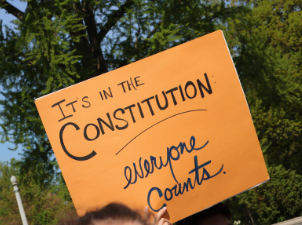
The federal government is constitutionally obligated to count all persons in the United States, both citizens and non-citizens alike, in the decennial census. After the 13th Amendment ended slavery, the 14th Amendment to the Constitution established a democracy premised on the idea that all persons—no matter where they are from, regardless of whether they can vote—deserve equal representation in our government. This precept aligns with our own Catholic Social Justice principles which promote the dignity of every person and the right and responsibility to participate in politics and society. Ensuring a proper count of the nation’s population to apportion representatives requires an “actual enumeration” of the people. This “actual enumeration,” specified by the Constitution imposes a clear duty on the federal government: to count all people living in the United States, whether they are citizens or not and whether they were born in the U.S. or elsewhere.

The Trump administration, however, is once again threatening to undermine the fairness and accuracy of the 2020 Censuscount by including a citizenship question. Under the current climate of fear, mandating such a question would have a chilling effect on response rates in immigrant communities. The ill-conceived addition of the question circumvents the Constitution’s requirement to obtain an accurate count of all persons living in the United States, regardless of immigration status.

The Census occurs only once every ten years, and there are no do-overs. These numbers could lock our nation into an unfair count and inaccurate representation for at least a decade and possibly longer. The repercussions of an unfair, inaccurate count are immense, so we must do whatever we can to ensure that every person counts in the 2020 Census.

To Repair Democracy

To Repair Democracy

Stacey Abrams
May 28, 2019

Within the corridors of government – from the highest levels of federal and state leadership to county and city municipal bodies – public servants and community advocates, carrying deeply-held motivations like faith, family, and service, fight relentlessly. Their mission: to ensure that decision-makers enact policies to enrich and protect the lives of those they govern. In my home state of Georgia, advocates continue to wage an impassioned battle for Medicaid expansion, which will cover more than 500,000 Georgians who need healthcare access. They demand a world-class public education from cradle to career to empower Georgia’s children regardless of zip code.  Refusing to accept economic insecurity as a given, they push for economic opportunity to reach every corner of our state’s 159 counties.

But dreams of expanded economic and social prosperity, of policy outcomes that truly lift up people, are built on a foundation of hearing every voice from the people, through free and fair elections in a thriving democracy. Yet, as the 2018 midterm elections proved, particularly in Georgia, from voter registration to ballot access to full confidence that votes cast are counted, our elections are in dire need of repair.

Fixing our broken democracy stands as a foundational prerequisite to progress. Our work to achieve healthcare access, education parity, social and economic justice and more, they each depend the fundamental obligation that undergirds them all—eradicating voter suppression and ensuring that our elections are fair fights.

After acknowledging the result of widespread election irregularities following my race for governor last year, I redoubled my commitment to voting rights and founded Fair Fight Action, calling on my fellow Georgians of all stripes to join me in pursuing a fair and equitable elections system that operates effectively, efficiently and equally.

In this pursuit, our strategy recognizes that the path to progress is both political and legal. Therefore, we filed a voting rights lawsuit in federal court that details how the seamless integration of incompetence and malfeasance through arcane or manipulated laws deprive citizens of their constitutional right to vote. Likewise, we have engaged in local efforts to thwart legislation that would deepen disenfranchisement, and we have participated in a national conversation about the restoration of the Voting Right Act. Our motives are simple: we cannot allow an immoral and unacceptable system of voter suppression to tarnish our elections, as we have unfortunately witnessed in full force after the Voting Rights Act was effectively neutered in 2013.

Voter suppression has ravaged voter registration, ballot access, and ballot counting processes alike. Attacks on third-party registration submissions and databases rife with errors and security concerns, the discriminatory ‘exact match’ policy blocking many registrations from voters of color, and wildly reckless voter roll purges (which once circumscribed the right to vote for a woman who had lived in the same house and voted at the same precinct continuously for over thirty years), serve as infamous examples of suppression executed by top elections officials in Georgia.

Ballot access has fared no better, with our most recent cycle producing myriad instances of absentee ballots that never arrived, regular voters forced to cast provisional ballots, unacceptably long lines, precinct closures, vulnerable or inadequate equipment, disparate treatment based on county lines, and ill-equipped elections staff. And ballot counting processes include absentee ballots never found, provisional ballots never accounted for, and insecure voting machines producing inaccurate, unverifiable tallies, all within districts surgically gerrymandered to drown out the voices of marginalized voters.

Make no mistake, while our fight has taken root in Georgia’s tarnished elections, our nation’s democracy is imperiled. While Georgia has uniquely linked together a dizzying array of voter suppression tactics, examples of voices silenced can be found across the country. Luckily, we can also hear the clarion call of faith from organizations like Nuns on the Bus, who have been warriors against discrimination and disenfranchisement for decades. From the movement in the 1960s that produced the Voting Rights Act, led by faith leaders like the Southern Christian Leadership Conference and Reverend Dr. Martin Luther King, Jr., to the Georgia churches that have directly joined our ongoing lawsuit as co-plaintiffs, voices of faith are indispensable to framing the moral imperative of free and fair elections that affirm the inherent worth and dignity of every person and every voice in our democracy.

Faith undergirds my every step in this work. My parents, retired ministers and civil rights workers, instilled in me and my siblings a deep respect for the right to vote. As we continue to demand full, unfettered voting rights for citizens in Georgia, the cradle of the civil rights movement, I call on NETWORK and its members to join us in our call for the end to voter suppression wherever it may be found. Whether through supporting the Voting Rights Advancement Act in Congress, or advocating for ballot security on the local level, or holding every presidential candidate accountable for putting forth a plan to end this abominable practice, together we can finally establish an electoral system that operates under the consent of the governed, where policies of, by, and for the people, truly flourish. And, in the process, repair democracy itself.


After running for governor of Georgia, Stacey Abrams joined Fair Fight Action in 2018. Fair Fight’s mission is to advocate for election reform and engage in voter education and turnout to secure the voting rights of Georgians. Fair Fight brings awareness to the public on election reform, lobbies the state legislature for election reform and engages in targeted voter registration and other voter outreach programs and communications.

***

This story originally appeared in the April 2019 issue of Connection Magazine. Read the full issue here.

Renewing the Promise of ‘By the People, For the People’

Renewing the Promise of ‘By the People, For the People’

During our Nuns on the Bus trip in the fall of 2018, just before the Midterm elections, we heard many stories about efforts to limit access to our democracy:

  • For every Republican office that we lobbied (or attempted to lobby) we heard constituents’ stories about their representative’s refusal to meet with them. One Republican member’s district chief of staff even went so far to say that the problem was that her boss “was incredibly shy…he was an introvert.” As if that justified it when he met regularly with donors.
  • We heard of some state legislation that would require a street address in order to vote. However, on the Native American reservations there were no street addresses so Native American people would be “purged” from the voter rolls.
  • Gerrymandering was mentioned at many stops where the Congressional district maps were drawn to benefit the majority party. In fact, it was so bad in Pennsylvania that the court had stepped in and redrawn the state’s map for Congressional representation. This was the first election under the very new map, but even that was confusing to some of the voters we met, as their districts and their representatives were now different.

I ended the bus trip worried about our democracy and how it is being undermined. The political “game” of winning has taken precedence over the commitment to let every voice be heard.

This isn’t just a “Republican thing.” In Maryland, where Democrats are in the majority, districts were drawn to benefit Democrats and reduce the number of Republicans in Congress and the state legislature.

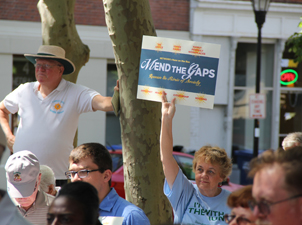
This bipartisan desire to win at the expense of democracy underscored for us why we need to heal our democracy if we are going to “Mend the Gaps” in our nation. For this reason, access to democracy is one of the key provisions in our policy agenda.

But this work is multilayered. We initially started by thinking that it was only about the Voting Rights Act that the Supreme Court undermined a few years ago in the 2013 Shelby County v. Holderdecision. But as we went deeper, we realized that if the census is flawed then the data from which districts are determined is also flawed. Article I Section 2 of the Constitution mandates that there be an “enumeration…every subsequent term of ten years.” This is a mandate to count everyone without regard for citizenship or even immigration status. The Constitution requires the census to count everyone in the country.

Therefore, we are engaged in making sure that there is adequate funding for the 2020 Census count and that it is carried out in a way that encourages participation. We have been fighting against including a “citizenship question” to the census questionnaire or any other actions that would push people away from responding to the census.

Whether our work is about the census, efforts to restore the Voting Rights Act, or ending gerrymandering, we do this work because every voice matters in our democracy. This is the difference between the economy and government. In the capitalist economy there are those who are “winners” and those who are left out. But in a functioning democracy everyone needs to be afforded equal dignity and opportunity to be heard. It is this dignity of the individual that is at the heart of our work…and the heart of our faith.

Pope Francis says in his encyclical Laudato Si’: “Love for society and commitment to the common good are outstanding expressions of a charity which affects not only relationships between individuals but also ‘macro-relationships, social, economic and political ones.’ That is why the Church set before the world the ideal of a ‘civilization of love’.” (Paragraph 231)

Let us labor in love in our society to ensure that everyone in our nation can fully participate in our democracy. This is the doorway to realizing the common good.

***

This story originally appeared in the April 2019 issue of Connection Magazine. Read the full issue here.