

Category Archives: Front Page

Two Shutdowns Over Immigration Policies

Two Shutdowns Over Immigration Policies

José Arnulfo Cabrera
January 17, 2019

In our current government shutdown—this time over $5.7 billion dollars President Trump is demanding as a down payment to build a wall—I was thinking about last year’s much shorter shutdown (only 3 days) over a DACA fix and the many other numerous times politicians have used the security of undocumented people and families as a bargaining chip in political debates. This blog post is a reflection of my feeling and thoughts of the last year’s DACA fix during the appropriation process. This ISN’T what other DACA recipients or undocumented youth felt during this time.

My two younger sisters and I grew up in the rallies our mom would drag us to. My mom was an organizer and I hated it. My weekends and weeknights were always filled with meetings, rallies, protest, and vigils. But after being tricked to share my immigration story and then organize a rally at the age of 15, I fell in love with it. A few years later I got my first community organizing job while I was a student at Xavier University. I organized a group called YES, Youth Educating Society, a group for high school and college students who wanted to fight for immigrant rights, empower immigrant youth, and put pressure to elected officials to adopt pro-immigrant policies.

After the 2016 election, our membership grew and the following year we had 100 members across the greater Cincinnati area with 50 of them considered “active members.” On September 5, 2017, every DACA recipient and their loved ones’ nightmare happened. The Trump administration decided to end the DACA program. That night I went to bed with a 105 degree fever, exhausted from rapidly organizing a protest outside of Senator Portman’s Cincinnati office, and having to comfort my fellow YES members. I spent the rest of that night re-planning how to achieve my life goals as an undocumented citizen. I spent the rest of 2017 trying to pass all my classes so I could stay on track to graduate in May 2018, organizing rallies in support of the 2017 DREAM Act, coming to D.C. to lobby Ohio Senators and Representatives to support the DREAM Act, and participating in a sit-in at Senator Portman’s DC office. But the most challenging and stressful month was December when immigration advocates made their strongest push for a DREAM Act.

The current government shutdown reminds me of the one that happened in January 2018, and how they both resulted from immigration-related issues: DACA last year and building a border wall this year. In December 2017, Congress had to pass multiple short-term continuing resolution bills that would fund the government for the following year. Democratic leadership saw that moment as an opportunity to secure a Republican commitment to hold a vote on legislation that would protect   the 800,000 DACA recipients who felt the weight of deportation again after the Trump administration rescinded DACA. After several negotiation meetings between President Trump and Democratic leaders, a deal was made. Republicans would include a DACA fix to last few appropriations bills, and Democrats would agree to give President Trump the money to build the Wall. Activists made it clear to Leader Pelosi that they didn’t want that deal. We wanted a clean DREAM Act.

I was scared. I was freaking out. I kept a close eye on leading groups in DC who were organizing actions for a DACA solution, aiming to make this the last time we had to pass a bill that will give DACA recipients citizenship, instead of the threat of deportation.

I was thankful that those demonstrators were doing what needed to be done to put pressure on the Senate to pass a clean DREAM Act. I was angry at myself that my exams were on the same week all of this was happening, and I couldn’t go to DC to do my part. Then I realized that if the DREAM Act didn’t pass, in 2019 my DACA would expire and I would lose the job I got after graduating from college. Since September 5, 2017, I still didn’t know how I could accomplish my life goals without my DACA. Watching all of the action in DC kept reminding me that I still didn’t have a plan figured out.

This standoff resulted in a government shutdown from January 20-22, 2018. The shutdown ended when the House and the Senate passed a short-term continuing resolution funding the government until February 9. Part of the agreement was that the House and Senate would use that time to pass legislation that would protect DACA recipients. Instead, federal court orders in January and February extended DACA renewals for previously-approved DACA recipients. By the time Congress needed to pay additional funding for the federal government, there was no mention of a legislative solution for DACA. Since then, Congress has not considered the DREAM Act bill again.

This past December, we found Congress in a similar position they were in the previous year. They needed to pass seven appropriations bills to fund the government, including one for the Department of Homeland Security which would have given President Trump money for the wall. This time, no one wanted to put a DACA solution in the debate. In some weird way, I’m kind of glad. I don’t think I could take another emotional month like the one in December 2017. But this time, the fight for wall funding is still relevant and is the reason why  we’ve been in a government shutdown for 27 days. Before everyone at NETWORK left for the holiday break, we saw President Trump refuse to sign the funding deal that didn’t give him the $5 billion to build a wall on the US southern border. Coming back to the office this month I was disappointed by the lack of leadership President Trump has to re-open the government. President Trump has failed to get the funding for the wall but has succeeded in further dividing our country.

I know passing a clean DREAM Act, or even a comprehensive immigration reform bill, won’t be easy. It would most likely get worse before it gets good and we’ll definitely get scuffed-up, but we’ll get it. I have faith.

For the People Act Introduced in Congress

For the People Act Introduced in Congress

Bold Democracy Reforms in the Making
Sister Quincy Howard, OP
January 15, 2019

This week, as the new Democratic House leadership began implementing their agenda, democracy reform emerged as the #1 priority. Speaker Pelosi, with Representative Sarbanes’ leadership, introduced the For the People Act (H.R.1), broad legislation designed to put the people back in charge of our government. When this bill was introduced earlier this month, it immediately garnered 220 co-sponsors.

The timing and importance of this bill cannot be overstated. Today we see how the manipulation of big data and key SCOTUS rulings (Shelby and Citizens United) have resulted in an impaired democratic system. Last year’s midterm elections revealed a system that allows suppression of votes, distortion of representation and the prominence of moneyed interests to sway election outcomes. Fortunately, the 2018 election also demonstrated a growing momentum across the nation to strengthen our democracy. Local and state ballot initiatives emerged—and many passed—which sought to reinstate the influence of voters in an increasingly rigged system. 

We know that now is the time to act: there is a groundswell of urgency and deep concern for our democracy. There is a growing movement for reforms explicitly committed to ensuring that all voices are heard equally and to advancing the rights of those who have been cut out of the current system. People want to believe in a successful and functional government that truly represents the values of their community. 

Voting rights and fair representation in our democracy are foundational to NETWORK’s Mend the Gaps policy vision for 2020. Just and equal representation for all is a necessary condition for making progress in our advocacy efforts. It takes full representation to pass policies that benefit the common good. At NETWORK, we also believe the right and responsibility to participate in the political process. No individual or community should be disenfranchised by federal policy.

NETWORK is part of a diverse advocacy coalition building momentum by advancing policies that promote just election reforms at the federal level. The For the People Act is a comprehensive package of policy fixes which, combined, are far-reaching in scope. These provisions run the gamut from ethics rules for elected and appointed officials to automatic voter registration, publicly financed election campaigns, and everything in-between.  

H.R. 1 is generally described as having three broad policy objectives:

  1. Ending the dominance of big money in our politics
  2. Ensuring public servants work for the public interest
  3. Making voting easier and improving elections

Within this legislative framework, NETWORK Lobby is focused on policies related to voting and elections. Our faith teaches that we have a responsibility to participate in politics out of a concern for, and commitment to, the common good. This responsibility to participate means each person also has a fundamental right to participate.  

H.R.1 has a bold and comprehensive platform of provisions intended to ensure that all votes count. For the People would begin the process to restore the Voting Rights Act with a series of hearings to investigate modern-day tools used to suppress the vote. [Spoiler alert: many of them are the same tactics banned under the original Voting Rights Act!]  

NETWORK supports additional provisions that improve election integrity by: 

  • Making registration and voting more accessible for eligible voters
  • Improving polling and election operations
  • Restoring voting rights as criminal justice reform

Finally, in line with NETWORK’s advocacy for an accurate Census 2020 count, we support provisions to end gerrymandering.  A democracy that accurately reflects the body politic requires a fair, accurate Census count for fair apportionment and then a non-partisan redistricting process. H.R.1 includes reforms that would separate the redistricting process from politics through independent state redistricting committees.  

A functional and fair democracy undergirds all of the policy goals and objectives that we at NETWORK advocate for. 


Learn more about the broader Declaration for American Democracy coalition and advocacy efforts around H.R.1 on their webpage.

Reflecting on Roots Camp: Activism in Motion

Reflecting on Roots Camp: Activism in Motion

Marshele Bryant and Ibby Han
January 7, 2019

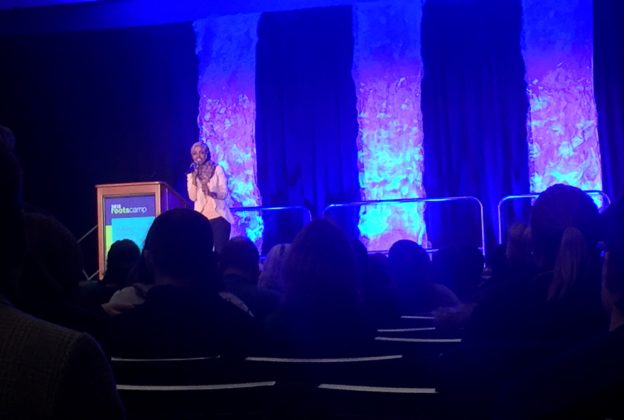
Members of NETWORK’s Grassroots Mobilization and Communications teams recently attended RootsCamp, an “un-conference” for organizers, political campaign workers, and progressive activists.

NETWORK wanted to highlight the work of other emerging justice-seekers in activist spheres, and asked a few community members to reflect on their Roots Camp experiences.

Marshele Bryant, Statewide Campus Organizer at Virginia Student Power Network:

This was my first time attending Roots Camp and it was unlike any conference I’ve attended before. It is billed as an “un-conference,” allowing attendees to shape and guide the agenda from start to finish. There were more structured trainings that focused on lobbying and preparing to run for office but there were many more that pitched and picked up by other folks attending the conference. The toughest part of Roots Camp was deciding which sessions to attend! It was exciting to be surrounded by so many folks doing similar work but it was also a relief. There were sessions that catered to specific issues organizers face within the progressive sphere as well as strategy sessions for battling some of the biggest external challenges we as progressive organizers face.

One of the first sessions I attended was a frank discussion about how white supremacy and racism is a problem even in the most progressive spaces. A friend from Michigan Student Power attended a session dedicated to self-care, an important but often neglected aspect of our work. One session I attended had a few folks who worked on the Stacey Abrams campaign. Another session was led by folks from Alexandria Ocasio-Cortez’s digital team for her campaign. It’s one thing to watch inspiring candidates build progressive, grassroots campaigns that eventually capture national attention. It’s another to meet and engage with the folks who built and sustained those campaigns. Whether the campaigns they joined were successful or not, there was a hopeful energy that enveloped the conference.

I left Baltimore and returned to Chesapeake, Virginia with a renewed passion and pride for the work the Virginia Student Power Network has done and continues to do. Meeting with people who worked on some of the biggest campaigns of the election cycle caused me to reflect on what VSPN has achieved. With a staff of two people, we managed a cohort of 25 Vote Fellows who registered over 780 Virginians to vote and engaged thousands more in GOTV efforts. We realized the importance of integrating electoral work with the issue-based organizing that has driven our organization since its inception. And I can only look forward to the opportunities and challenges that lie ahead in 2019.

Ibby Han, Statewide Campus Organizer at Virginia Student Power Network:

This was my first time attending RootsCamp! Everywhere I went, I ran into a friend from a different corner of the movement world. It was a mingling of over 1,000 folks from political campaigns, grassroots organizing, and the tech world. The first session I attended was an open conversation on how white progressives tend to replicate systems of oppression in their organizations and campaigns. We had a great discussion centered on lived experiences and frustration felt by people of color working in majority white progressive spaces. The weekend offered many other opportunities: I hosted my own workshop, attended talks by Congresswoman-elect Ilhan Omar and Deepa Iyer, and built relationships with other AAPI organizers from across the country.

As a part of the Student Power Networks crew, we came with a unique perspective. Not only were we some of the youngest people there, we also shared our experimental model of youth-led year-round organizing that integrates electoral work, issue-based grassroots organizing, and policy work, all on a statewide level. RootsCamp was a great place to connect and reconnect across many movements and strategies.

As the 116th Congress kicks off, Roots Camp was the perfect place to channel progressives’ excitement and plan out strategies for the future, especially with regard to dismantling systemic racism and white supremacy in political and organizing spheres. We have hope for this new session of Congress, especially with so many Roots Camp activists leading the charge nationwide.

NETWORK’s New Year’s Resolutions

NETWORK’s New Year’s Resolutions

Alannah Boyle
January 1, 2019

We asked NETWORK staff to share their social justice goals and resolutions for the New Year. As we enter 2019, here’s what staff members are planning to incorporate into their lives:

My New Year’s Resolution Is To…


“Be a better food consumer.  I want to only buy food that I will consume and making more of an effort to use up food before it goes bad.  Additionally I want to cut out plastic bags in my shopping.”

-Erin Sutherland, Grassroots Mobilization Associate


“Live more simply so I can give more generously.”

-Catherine Gillette, Grassroots Mobilization Coordinator


“Follow more women and femmes of color on social media and read their blogs.”

-Meg Olson, Grassroots Mobilization Manager


“Cut down on my wasteful consumerism. In 2019 I will buy a maximum of 10 new articles of clothing all year”

-Alannah Boyle, Grassroots Mobilization Associate


“Try to greet each day with joy and welcome.”

-Laura Peralta-Schulte, Senior Government Relations Advocate


“Welcome the new Representative from my hometown (Chrissy Houlahan, PA-06) and introduce her to NETWORK! I’d also like to get more involved in local social justice issues, particularly concerning homelessness, affordable housing, and gentrification.”

– Lindsay Hueston, Communications Associate


“My New Year’s resolution is to read more books about domestic and international social justice issues so that I can have a deeper understanding of them, especially how issues are intersectional.”

-Colleen Ross, Communications Coordinator


Wishing all in our NETWORK community a happy and healthy 2019. May our work for justice continue!

Keeping the Momentum for Affordable Housing

Keeping the Momentum for Affordable Housing

Siena Ruggeri
December 28, 2018

During NETWORK’s journey across the country , we were energized by the many community organizations we encountered that are doing fantastic work reducing homelessness and housing instability. In Detroit, we met Cass Community Social Services, an organization that bought three blocks of land in their neighborhood to build tiny homes for low-income community members. In Miami Beach, we saw how the Elderly Housing Development and Operations Corporation develops and manages housing for seniors. These apartments provide vital spaces for seniors; the average wait time for seniors in need of affordable housing is four to eight years. The Women’s Community Revitalization Project develops affordable housing for women and families in Philadelphia, a city coping with opioid addiction and housing instability, and we were able to see their tangible impacts in their community.

Direct service providers across the country are implementing creative solutions to housing instability, but their efforts are not adequately supported in Washington. These communities rely on federal funding and tax credits. We must connect the work being done at a community-level to our federal housing policies. The federal government’s approach to housing has barely budged for decades—solutions that were prescribed in the 1960s are insufficient to meet the complex challenges of housing in the 21st century.

Only 1 in 4 people who qualify for federal housing assistance receive it. Once they obtain a Section 8 voucher, it’s another battle to find a landlord who will accept the voucher. This is an antiquated system and an affordable housing supply that is dwarfed by the magnitude of the housing crisis. A minimum wage worker can afford a one-bedroom at a fair market rate in only 22 out of more than 3,000 counties nationwide. It’s not a small minority that’s struggling to find an affordable place to rent. Teachers, college graduates, and white collar workers alike are struggling to find housing. With the middle-class feeling the pinch, low-income families who have always struggled with secure housing are pushed out even farther. With wages stagnant, someone can have a full-time job and still not be able to keep up with rapidly rising rent prices.

Our nation’s lack of investment in housing exacerbates social inequalities and widens the racial wealth gap—housing is a key means to acquiring generational wealth. It is unfortunate the housing crisis has only recently been emphasized in the media because it now impacts people outside of traditionally housing insecure groups. It does present an opportunity to demand our legislators give the housing struggle their attention.

There is legislative momentum building on the idea of affordable housing. The 115th Congress included the Rent Relief Act, a bill introduced by Senator Kamala Harris that would assist renters who spend more than 30% of their income on rent. Senator Elizabeth Warren introduced the American Housing and Economic Mobility Act, which would invest $445 billion dollars in the national Housing Trust Fund over 10 years, providing resources to build housing for the lowest-income households. The bill also expands protections against housing discrimination, provides down payment assistance to first-time homebuyers living in formerly redlined or officially segregated areas, and includes local incentives to reduce the cost of middle-class housing. Senators Maria Cantwell and Orrin Hatch introduced the Affordable Housing Credit Improvement Act, which expands the low income housing tax credit (LIHTC) by 50%, enabling the construction of more homes for people with extremely low incomes.

While there are innovative ideas being introduced, those ideas are not making it to the finish line of being passed into law and actually impacting real lives. With the shadow of the 2020 elections looming over Congress, affordable housing could easily be seen as simply a messaging tool to strengthen congressional resumes before the primaries. Housing demands urgency and action in order to advance meaningful legislation in the next Congress. While our new Congress looks hopeful, it is only as good as the legislation it produces on issues that directly impact families and communities in our country.

There is also an opportunity to advocate for affordable housing via the budget process. Congress has yet to pass a spending bill for 2019. The Department of Housing and Urban Development budget proposed by the Senate ensures that HUD does not have its funding cut further. If Congress does not pass an updated HUD budget, housing will be funded by a continuing resolution. Since a continuing resolution does not reflect market-rate rents, housing programs would face deep cuts. Any cut to HUD funding decreases the government’s ability to serve people who depend on assistance for affordable housing, including seniors, people with disabilities, families with young children, and people experiencing homelessness or people on the verge of homelessness. Congress needs to pass a budget for the 2019 fiscal year that adequately funds key programs that protect vulnerable groups from homelessness.

Recognizing the Holiness of Bethlehem

Recognizing the Holiness of Bethlehem

Alannah Boyle
December 24, 2018

As I reflect on the story of Jesus’s birth, I am struck each time about the openness and generosity this story is contingent upon. An innkeeper opening the doors to his stable and allowing a stranger to stay allowed for the circumstances of Jesus’s birth. Ten months ago, I had the opportunity to visit Bethlehem, the birthplace of Jesus. When in Bethlehem, I was able to focus on this same openness and experience it in the people I met, sharing stories, and breaking bread. We shared this deep human connection and recognition of the holiness of where we were standing.

As the season of Advent draws to a close and Christmas quickly approaches, I find myself reflecting on my time in the birthplace of Jesus. Preparing to spend Christmas with my family, I saved many gifts made of olive wood native to the area. The holiness of the land, and bringing something tangible back from Bethlehem for my family was important to me.

One of my favorite videos from my trip is in Manger Square where I filmed the bustle of businesses and tourists in the square, capturing the Church of the Nativity. The Muslim Call to Prayer is playing loudly throughout the city and the square. This moment, like many during my trip, reminded me of the ways in which we are all interconnected and how deeply the roots of multiple religions stem from this region of the world. In such a divisive time in our country and world, the interconnection I witnessed during my trip to Bethlehem is important to keep at the front of our minds as we at NETWORK continue our work for justice.

NETWORK Celebrates First Step Act Becoming Law

NETWORK Celebrates First Step Act Becoming Law

Joan Neal
December 21, 2018

NETWORK congratulates Congress for passing the FIRST STEP ACT with strong bi-partisan support and becoming law.  It is rare to see any legislation pass with such backing from both sides and we commend all those who worked so hard to achieve this victory.

While the law offers only modest changes, it begins at long last, the process of making some much-needed improvements to the federal criminal justice system.  Among its more laudable provisions, the legislation reduces the mandatory minimum sentences for certain drug offenses, gives judges more leeway in sentencing, revises the ‘good time’ credit calculation, improves conditions in federal prisons, including prohibiting the use of restraints on pregnant incarcerated women, and provides additional resources for rehabilitation, job training, and recidivism reduction programs that increase the chances for success for those who will eventually re-enter society.

At the same time, some of the provisions fail to go far enough.  Many of the sentencing reductions are prospective–forward looking only.  This potentially leaves thousands of people in prison, continuing to serve time under the very outdated laws this bill revises.  Additionally, it allows private prison companies to profit, fails to address parole for juvenile offenders, and exposes inmates of color to the possibility or disparate treatment due to racial bias in the risk assessment tool.  As its name implies, the FIRST STEP ACT is a beginning, a place to start to make our federal criminal justice system more just and humane.

Nevertheless, we commend lawmakers for taking this ‘first step’ at reform.  Clearly, there is more work to be done to reduce the number of people entering the system, to eliminate racial disparities and to create second chances for all those impacted.  Our faith teaches us that redemption and rehabilitation are possible even for people who have committed crimes against society and our criminal justice system should reflect that value.  This can be the beginning of such transformational change.

Our System of Mass Incarceration: Seeing the Parallels between Black Americans and Immigrants

Our System of Mass Incarceration: Seeing the Parallels between Black Americans and Immigrants

José Arnulfo Cabrera
December 19, 2018

In the last 40 years, the incarcerated population in the United States has increased 500%. There are currently 2.2 million people in U.S. prisons and jail. We incarcerate more people than any other country in the world thanks to drug and sentencing policies that disproportionately affects people of color. According to the NAACP, the effect of this callous approach to policing is riveting: Black people are incarcerated more than five times the rate than whites, the Black women prison population is twice that of white women, and Black children represent 32% of children who are arrested.  Then upon release, returning citizens face a myriad of obstacles that impede reintegration: employment background checks, low wages, and lack of affordable housing, coupled with banishment from government-sponsored safety net programs. For people of color, an encounter with the penal system could be its own death sentence. This is not how we as a country ought to be leading.

Yet, it doesn’t look like the U.S. will lose its standing as the world leader in mass incarceration with the presidency of Donald Trump, who campaigned as the “Law and Order” candidate.  Since Trump took office, a new Jim Crow 3.0 has emerged: the criminalization of undocumented immigrants. Undocumented Immigrants are considered criminals because they committed a misdemeanor crime, the equivalent to running a red light, for staying, or entering the U.S. without documentation. Under President’s Trump’s administration 448,000 undocumented immigrants have been returned or removed and includes those with and without prior convictions. Because President Obama’s DACA policy gave prosecutorial discretion to immigration judges, there are no records available for undocumented immigrants without prior convictions.

As a Government Relations associate responsible for managing a legislative portfolio that includes both immigration and criminal justice reform policy, I find it dangerously easy to spot the similar tactics used to criminalize immigrants and Black Americans. During Trump’s presidential campaign he said Mexican immigrants are rapists, and that they bring drugs and crime to the U.S. This past mid-term election cycle President Trump retweeted a fear-mongering campaign ad that portrayed immigrants as dangerous criminals who we must keep out of the U.S. The video bore a notable resemblance to the 1988 Republican “Willie Horton” presidential campaign ad now infamous for the “dog-whistle” racism it employed. While I’d like to believe these fear-mongering tactics don’t work, 34,000 of the 2.2 million people incarcerated in the U.S. are immigrants held in ICE facilities, and 60% of those incarcerated are people of color.

When we begin to look at how immigrants and Black Americans are incarcerated, we find another scary similarity. Since 2000, the amount of people incarcerated in private prisons has increased by 47% and the amount of immigrants held in private facilities has increased 442% since 2002. The corporations that manage these prisons and detention facilities are GEO Group, Core Civic, and Management and Training Corporation, which require the states in which they are located to arrest and imprison a center amount of people in their prison to make a profit. Because of this practice, it is in their best interests that the U.S. incarceration and detention rate does not decline. Additionally, the prisons owned by these corporations are almost always located in the middle of nowhere, making it difficult for the families and lawyers of incarcerated people to visit them. These tactics are used to make it harder for people of color to seek the justice they deserve.

The United States has created a system that values incarcerating individuals more than helping them return to their communities to be self-sufficient and contribute to society as we all do. Our country views a criminal as people who have always been bad, and will continue to be bad. But the only true evil in this system is mass incarceration.


(feature image courtesy of the California Innocence Project)

Congress Takes First Step to Lower Maternal Mortality and Improve Health Equity

Congress Takes First Step to Lower Maternal Mortality and Improve Health Equity

Siena Ruggeri
December 17, 2018

There’s a silent but deadly epidemic occurring across the United States: women are dying during childbirth at an alarming rate. The United States is the only developed country where the maternal mortality rate is rising. Pregnancy-related deaths increased from 7.2 deaths per 100,000 live births in 1987 to a high of 17.8 deaths per 100,000 in 2009 and 2011. On top of that, 50,000 mothers a year experience dangerous complications that have the potential to kill them. U.S. women had a better chance of surviving their pregnancy thirty years ago than they do today. The fact women are worse off than thirty years ago is an embarrassment and a terrifying reality for women who are choosing to start families. If we truly care for one another, we must put a special focus on this critical issue impacting women across the country.

The rising maternal mortality rate is a public health crisis that is receiving a woefully low amount of coverage and legislative responses. California is the only U.S. state that has successfully lowered their maternal mortality rate. From 2006 to 2013, the state cut its maternal death rate in half. This was accomplished by a thorough investigation of the care process, and an implementation of better practices. California hospitals work in a collaborative that shares information and best practices specifically about maternal care. In order for other states to replicate California’s success, Congress must act.

Recently the House and the Senate passed the Preventing Maternal Deaths Act, which was introduced by Rep. Jaime Herrera-Beutler, with bipartisan support and a companion bill in the Senate introduced by Senator Heidi Heitkamp.  It creates maternal mortality review committees in every state that gather data and report their findings back to the Department of Health and Human Services.

(image courtesy of the Southern Coalition for Social Justice)

The U.S. healthcare system denies far too many women the care they need before, during, and after giving birth, a fact that needs to be remedied through legislation. Due to the medical racism that permeates the healthcare system, women of color are frequently ignored by providers when they advocate for their medical needs.

Black women are almost four times more likely to die of pregnancy-related causes, pointing to a shocking racial disparity. This is intensified in maternal health care deserts, where women lack access to critical healthcare. In rural and urban areas with limited OB-GYN services, women of color suffer greatly. In her congressional testimony, Stacey Stewart, the president of the women’s health nonprofit March of Dimes, emphasized that women of color often feel less trusted and feel less listened to in the medical system. She pointed to the fact that there are no obstetrical services east of the river in Washington, D.C.’s predominantly Black neighborhoods—women must cross the river to receive any sort of prenatal care. She also observed that in New York City, women of color are 12 times more likely to die as a result of pregnancy than white women. Women of color are disproportionately vulnerable to deadly pregnancy complications, making the maternal mortality crisis a horrifying manifestation of racial injustice.

In his testimony to the House Energy and Commerce health subcommittee in September, maternal healthcare advocate Charles Johnson told how he lost his wife Kira after she gave birth to their second child. Kira and Charles, a young Black couple, made sure that hospital staff were aware that Kira was bleeding heavily after her C-section. Yet the hospital waited ten hours to address her medical crisis. By the time hospital staff acted, it was too late. Kira died of massive internal bleeding, leaving behind an 11-hour-old child, her husband, and her other young child. Kira did everything right; she advocated for herself and her child throughout her time in the hospital. Despite Kira and her husband’s persistence, her symptoms were ignored until it was too late.

The CDC Foundation estimates that 60 percent of American pregnancy- and childbirth-related deaths could be prevented. The U.S. healthcare system is focused on infant health while ignoring the holistic needs of women.  As a result, healthcare providers are not equipped to protect pregnant women and prevent complications that can be easily addressed under the right care. We know many of these deaths can be avoided, but we must take action to examine how our healthcare system fails women and create policies that will prevent this.

Congress has taken the first step passing the Preventing Maternal Deaths Act, which was only possible because of the continued advocacy of the public. Using this as a first step, it’s important to keep the momentum going to fight for even bigger reforms to make health care safer and more equitable.  Health advocates need to make it clear to legislators that maternal health needs to be a key priority, both as we come to the end of the 115th Congress and in the new Congress. Far too many women, especially women of color, have needlessly died in this public health crisis. The only way to begin working toward a solution to this crisis is providing resources to gather more data on this epidemic so healthcare providers have the tools to prevent more tragic losses.

A Faithful Reflection on the Universal Declaration of Human Rights

A Faithful Reflection on the Universal Declaration of Human Rights

Colleen Ross
December 11, 2018

On December 10, 1948, the Universal Declaration of Human Rights (UDHR) was adopted by the UN General Assembly. To mark the 70th anniversary of this event, the Carter Center, founded by U.S. President Jimmy Carter, published a new compilation of Biblical texts that support the human rights proclaimed in the groundbreaking United Nations document. Sister Simone Campbell contributed, along with 14 other faith leaders, to the final document titled, “Scripturally Annotated Universal Declaration of Human Rights.”

Religious texts have been used against marginalized communities for too long. To counter this, we must declare the truth of religious teachings that liberate all of God’s creation. At an event launching this document, President Jimmy Carter said: “One of the main reasons for inequality and oppression of women is that the primary translators of religious scriptures were men.”

When the Universal Declaration of Human Rights was published in 1948, it was a direct response to the horrors and sins of the Holocaust and the Second World War. Now, this new pairing of scripture and human rights is important in our current time, when both religious texts and legal particulars are used to avoid fulfilling the responsibilities we have to our sisters and brothers who are suffering and vulnerable in our nation and around the world.

About the connection between Article 25 of the UDHR and the parable of the Good Samaritan, Sister Simone writes:

This story of the Good Samaritan outlines the basic call to care for our neighbors. Jesus says that the Samaritan (an outcast in Judaism at the time) took the man who had been attacked by the side of the road and took extravagant effort to ensure that he was housed, fed, and received healthcare.

UDHR Article 25, in a sense, extends the compassion evidenced by the Good Samaritan and posits a set of basic rights around human well-being: food, clothes, housing, health care, social security. The special needs of mothers and children (note the specific concern for children born out of wedlock) receive special focus here, as also in the Bible. Each person and family is entitled to the basics of life, with special attention to times and cases of special vulnerability, so that each can live in dignity.

Many more parallels can be drawn between Christian religious teachings and these universally declared human rights. May all of us, and especially our political leaders, be inspired by faith or civic responsibilities to ensure that all people can fully claim these inalienable human rights.

Read the full document on the Carter Center’s website.