

Category Archives: Front Page

Reflection: Encounters of a Recurrent Pilgrim

Reflection: Encounters of a Recurrent Pilgrim

Sister Jan Cebula, OSF
October 23, 2018

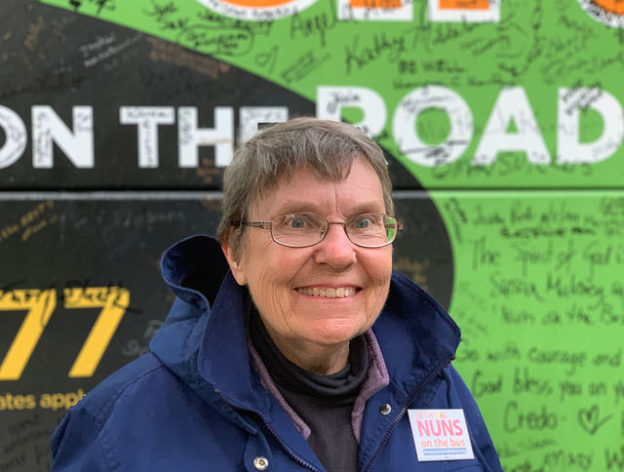
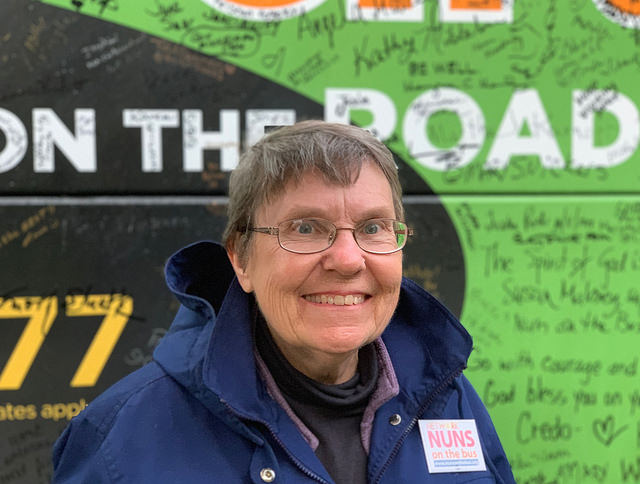
The following is a reflection by Sister Jan on her experience during Week Two of Nuns on the Bus

During our morning prayer before we first boarded the Bus for the second leg, we talked about Nuns on the Bus being a pilgrimage. Having ridden the Bus before, I had a sense of what that meant. I knew I was going to enter into a sacred experience. I was ready to become a pilgrim; being on a journey, open to discovering sacred places.

Pope Francis has repeatedly called us all to foster a culture of encounter– reaching out, engaging in dialogue and friendship outside our usual circles. Stepping out. I’m not sure he imagined riding on a Bus, shining a light on economic disparities, calling for tax justice.

As I stepped off the Bus in Cleveland at the end of the week, I realized that the encounters we experienced had been the sacred places of our pilgrimage. Images of people we met cycled through my mind and will continue to do so. Diondai, Faith, Trisha, Maria, Cassie, Gladys, Cheryl and . . . Even more so, their spirit of dedication, serenity, creativity and focused dedication continues to reverberate. I can sense a presence, a change within. Sacred people.

But I also realized there was another dimension of encounter we experienced, a communal one. We met people at every stop who understand that we’re all sisters and brothers AND also ACT like it. What a blessing to be on a pilgrimage to these sacred communal spaces.

We encountered the dogged persistence of constituents on behalf of others and our democracy in the face of indifferent elected representatives; the persistent widows of the Gospel.

We encountered the resilience of St. Sabina’s, Sr. Maria, and the women of “Chopping for Change” in Cleveland. Their voices and strength glowed, blessing us and everyone with their courage.

We encountered the creative, innovative and collaborative service programs focused on the whole person at YESS in Des Moines, Heartland Health Services in Des Moines, Cass Community Center in Detroit and Lutheran Metropolitan Ministries in Cleveland. They understand both sides of the coin: It takes community/collaboration for healing and that wholeness is communal.

We encountered the openness at every location to learn through our visual town hall human graph experience, releasing more creativity and energy for advocacy.

By witnessing the risk-taking of both staff and the people being served at site visits and of advocates at rallies, we encountered communal courage and hope.

We were blessed by the joy of the solidarity among all of us “nuns” from all different communities who rode on the Bus and who offered us hospitality.

Sacred people, sacred places of encounter.

Coming Out—and Catholic

Coming Out—and Catholic

Lindsay Hueston
October 11, 2018

Today, October 11, is National Coming Out Day, which celebrates LGBTQ+ people and the right to live their lives openly. The day commemorates the National March on Washington for Gay and Lesbian Rights and acknowledges the struggles that LGBTQ+ people face when coming out, and instead transforms them into reasons for celebration.

I’ve been more confident in owning my identity since working at NETWORK, where one of our four values of inclusion is to welcome and affirm the LGBTQ+ community. It can be daunting to be associated with a Catholic organization and simultaneously be a member of a group the church often actively discriminates against.

But I hadn’t always felt so unquestioningly welcomed in Catholic spheres: National Coming Out Day was a trepid joy entirely unfamiliar to me until a few years ago. I had tip-toed my way out of the closet during my entire senior year of college, painstakingly and anxiously. I finally reconciled the fact that I was gay that same April.

I was afraid, lonely, and liberated. At age 21, I had absolutely no idea that being gay was a possibility for my life, much less being able to recognize it in myself. In part, I blame it on Catholicism and the not-so-welcoming attitudes towards the LGBTQ+ community that still permeate today’s church.

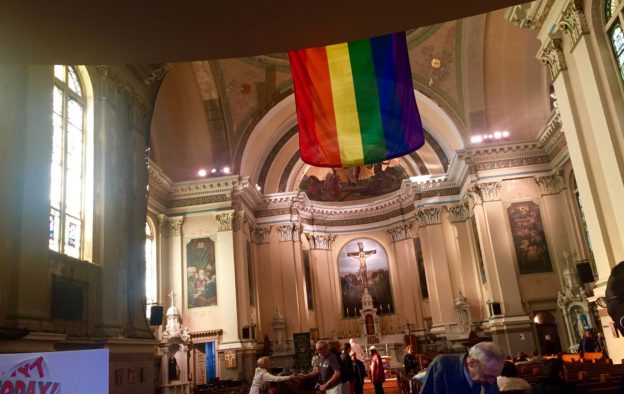
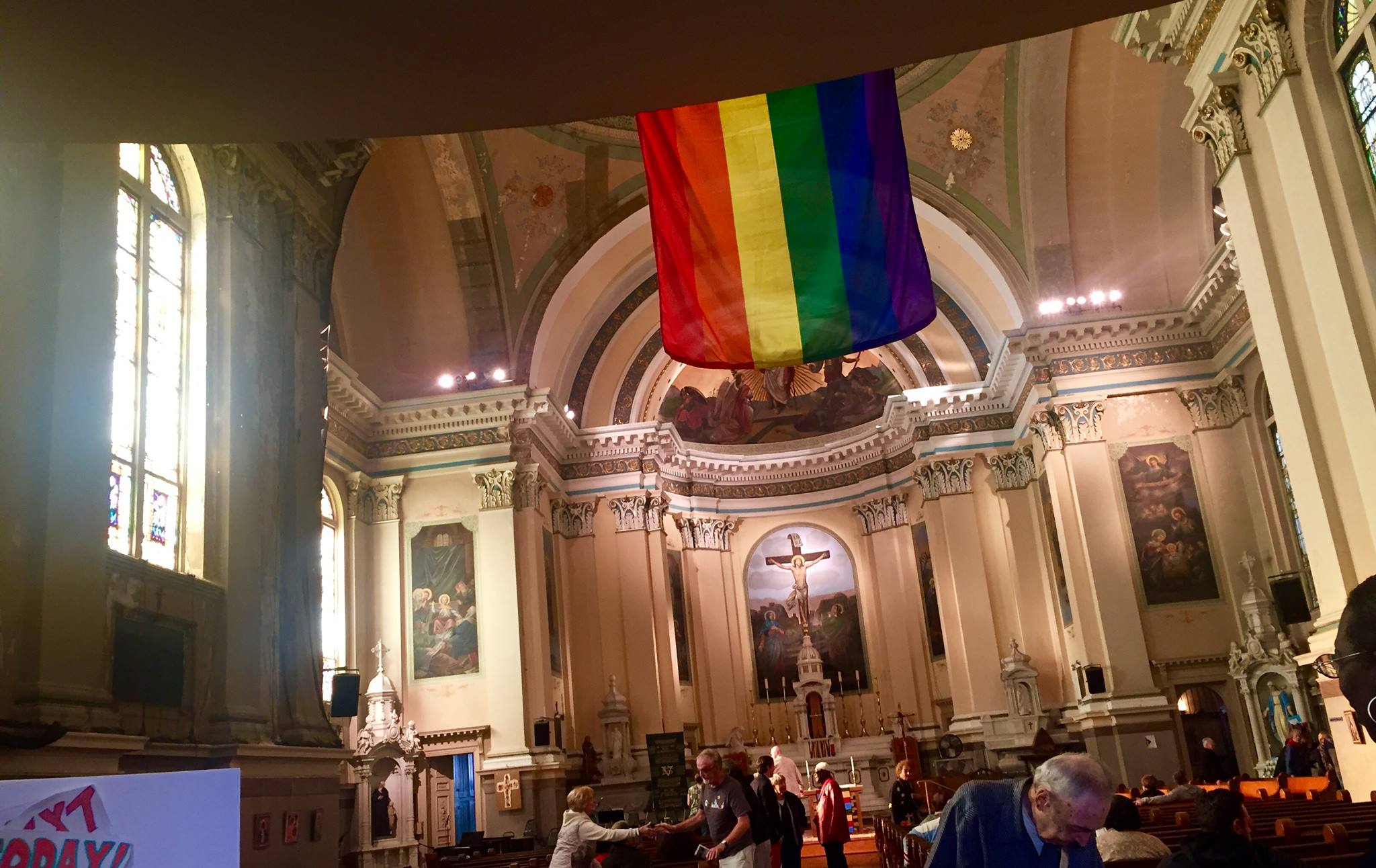
Overarching homophobia is still present in the church and our greater society. I had only been out for a few months before the Pulse nightclub shooting in Orlando, when I realized the tense societal climate into which I’d stepped. Hate crimes still happen. There have been more than 20 trans women of color killed in the U.S. so far this year. A nine-year-old boy died by suicide when he was bullied after coming out as gay to his classmates, and they told him to kill himself. Recently, a Catholic parish in Chicago burned a rainbow flag, even after the archdiocese told them not to. Discrimination and hatred of the LGBTQ+ community is still alive and well, and much of that ugliness is rooted in warped religious beliefs.

In the few years that I’ve been out, I’ve come to view coming out as a kind of resurrection and a cathartic (and utterly Christian) practice. When I was most anguished about coming out, something tiny inside me whispered, “And Jesus wept.”

I wept, too, when I let go of the idea that I had to be straight. I had always been gay; what had died was my own self-expectation, and the presumably-straight self I had constructed. It was painful to grieve the self I was losing, and instead lean into this new life. Coming out felt like dying, but it also felt like rising again – like resurrection.

The process of reconciling my church, my faith, and my sexuality was an enormous hurdle, and I still struggle with it. No Catholic I knew growing up was out, and the few LGBTQ+ adults I encountered later on were always cautious about sharing their sexuality in Catholic spaces. I devoutly attended CCD classes as a child, and later paid rapt attention in high school theology. I have been in too many rooms where the words “Catholic teaching” and “unnatural” and “not God’s plan” had been thrown around. Morality automatically meant heterosexuality; at least, that’s what I absorbed. These words made me uncomfortable and defensive, but I never knew why.

A few months into my year as a Jesuit Volunteer, I came out to my spiritual director amidst shallow breaths and a racing heartbeat. I knew she’d be accepting of me, but as with many LGBTQ+ Catholics, I am perpetually on the defensive when it comes to not knowing if people will truly accept me in a religious setting.

To my utter relief, she congratulated me and said maternally, “Oh, honey. This is where your spirituality lies.”

And it is. I don’t remember when I became a part of the church, or how I knew I was gay. Both of these things have simply always been a part of me and have shaped my worldview. My sexuality is inextricable from my spirituality; I can’t dissect the ways in which I experience God without including my queerness.

My spirituality has shown brighter in places like El Paso and Ecuador and Philadelphia and Seattle—and yes, too, in attending a church service with a woman I dated briefly, our hands intertwined as we acknowledged the God among and within us.

Yet coming out has also meant living amidst fear, and deciding to rise above it. When I came out, a spiritual dam broke within me; I was no longer holding myself back.

I celebrate National Coming Out Day, now, as a recognition of my desire for changes in our society and in the Catholic Church: a sharing of vulnerability in the hopes that it will spur something new. Each time I come out to someone (especially in a Catholic setting), I put aside my fears and feel another small part of myself owning my identity. I understood, more concretely, that I too was made in the image of God – that we are all made in the image of God.

The shame still exists, but it’s dwindled. What takes its place, now, is the understanding that I am whole as I am created, and my sexuality is inextricable from who as I am as a person. In coming out, my relationship with God has strengthened, and I feel more full: at home in my skin, in myself. In the same way, I feel that I am able to be at home at NETWORK. I don’t have to fear that I will be judged or fired or scorned for my sexuality; many others don’t have that luxury and that freedom. To be in such a place is a gift, a sigh of relief.

Coming out, for me, was a personal challenge, but a spiritual one as well. It still is; I’ve questioned my place in the Church, if I still wanted to be part of an institution with a tenuous relationship to its LGBTQ members. Yet painful as it can be, I couldn’t imagine my life without my deep-ingrained Catholic faith, or the fact that I’m gay.

I’ve decided that coming out is better than staying hidden, and embracing myself as both gay and Catholic is often difficult, but life-giving. I shouldn’t have to compromise myself, nor should any Catholic in a similar situation.

Happy National Coming Out Day, all. You are exactly wonderful as you are.

Bus Blessing 2018 – Rabbi Sharon Brous

Bus Blessing 2018 – Rabbi Sharon Brous

Rabbi Sharon Brous
October 8, 2018

Dr. King famously said that the Kingdom of God as a universal reality remains “not yet.”

We’re gathered here today because we persist in believing in the Kingdom of God. For me, as a Jew, that looks like a world in which human dignity is real. In which every single person is treated as an image of God, with infinite worth, absolutely unique and precious in the eyes of God and humanity.

And the pain point of this moment in time, of this era we’re living through, is that every day we are reminded of how far we are from the realization of that vision.

We are, to say the least, not there yet.

We are not there yet, when a Supreme Court Justice is confirmed amid multiple credible accusations of sexual assault, messaging to women, trans and nonbinary folks, to men and boys who are victims of sexual violence that they, and their trauma, are a liability, an exaggeration, a hassle and a distraction, and can’t we just quiet down and let them get back to the business of securing partisan advantage?

No, the Kingdom of God is not at hand, when young mother who flees violence in El Salvador arrives at the US border and is given 5 minutes to say goodbye to her two small boys, who are then ripped from her arms in a policy of wanton cruelty. We’re not there yet, when we realize how little those with power in our country care that even those children who are reunited with their parents—the lucky ones—will be traumatized for many years to come.

We’re not there yet when the justice department actively works to roll back civil rights achievements and 23 of 50 states have adopted harsh voter suppression laws in the last eight years alone. When Mexicans and Muslims and all People of Color are monsterized and criminalized, when the President fuels antisemitism and then shrugs when a JCC in Virginia is spray-painted with swastikas.

No, the Kingdom of God is not yet at hand, when Callie Greer from Alabama—whom I marched with in DC at the Poor People’s Campaign—wails in agony as she describes her daughter, Venus, dying in her arms from a cancer that could have been treated had Alabama not refused to expand Medicaid under the Affordable Care Act. We’re not there yet when a quarter of a million Americans to die from poverty related issues in the US each year.

We’re not there yet when kids are afraid they might get shot in school. When the prison population has grown from 200,000 to 2.2 million in the last 40 years, and Puerto Rico is abandoned. When our planet aches under the weight of fossil fuels and even still, our government obsessively and furiously prioritizes deregulation.

We’re not there yet, because today our country is driven by fear, mired in a failed moral narrative, contaminated by corruption, hypocrisy and indecency. Our nation—the richest in the world, boasts 140 million who are poor or live in poverty (with women, children and those with disabilities disproportionately affected).

It’s almost too much to bear. Dr. King was right, the Kingdom of God is “not yet.”

But he didn’t leave it there. Dr. King also quoted the historian Charles Beard in saying, “when it is dark enough you can see the stars.”

We’re out here today to train our eyes to see the stars.

And here’s what they look like: they look like Sister Simone Campbell, and these holy sisters, who are “On the Road to Mar-a-Lago.” Who will engage thousands and thousands of Americans at 54 events in 21 states over the course of the next 27 days, and then will land at Mar-a-Lago, where they will speak truth to power.

These sisters and their supporters of all races and ethnicities and religious traditions, are calling us to seek out the stars in the night sky. Stand up, they’re saying, and fight for the America you know is waiting to be born. A new America, fierce, gorgeous and fair. An America built on justice, fairness, and mercy. An America that lifts up the widow, the orphan and the stranger, that stands not ON, but WITH the most vulnerable.

This message matters more now than ever before, because today it is supremely clear: either we work to dismantle oppressive systems, or our inaction becomes the mortar that sustains them.

The Kingdom of God has not yet arrived. We’re painfully far from our collective vision of a world redeemed. But each of us is called לְתַקֵּן עוֹלָם בְּמַלְכוּת שַׁדַּי – to do whatever we can to heal the world and bring about the Kingdom of God.

That’s why we need this movement; that’s why we bless this moment.

Sisters, we send you off on your journey with blessings.

Go, and help free us from a politics that invisibilizes, marginalizes and steals from those who need most, a politics in which hatred, intolerance and heartlessness poison the water of our nation.

Go, and proclaim liberty throughout the land.

Go, and remind our nation, aching under the weight of oppression and injustice, that it is precisely in the dark of night that we can see the stars.

צֵאתְכֶם לְשָׁלוֹם—Go, go in peace.

Twin Cities Town Hall: Talking About Tax Justice

Twin Cities Town Hall: Talking About Tax Justice

Hanna Potter and Ceara Curry, St. Joseph Workers
October 2, 2018

Editor’s note: before embarking on NETWORK’s 2018 Nuns on the Bus trip, the “Tax Justice Truth Tour,” Sister Simone and Sister Mary Ellen traveled to bring one of the main programs – our Town Hall for Tax Justice – to the Twin Cities. This reflection is from those participants.

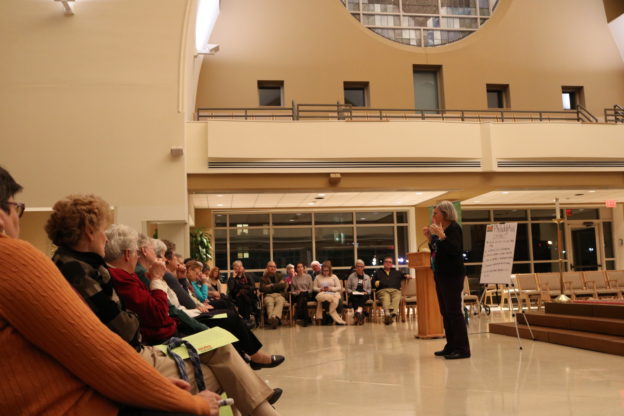
We attended a “Town Hall for Tax Justice” with Sister Simone Campbell and Sister Mary Ellen Lacy on Thursday, September 27th in St. Paul, MN at the Carondelet Center, hosted by the Sisters of St. Joseph of Carondelet (CSJs). The room was filled with religious sisters, consociates of CSJs, and community members.  And, of course, we as Saint Joseph Workers were present as well.

This event gave us a unique opportunity to see – both visually and through personal narrative – how much the 2017 Tax Bill affects people from a variety of economic backgrounds. We volunteered to help with an activity to demonstrate how the disparity between different economic levels has widened from 1979 to the present, and how the current 2017 Tax Law only widens that gap in inequality.

Seven volunteers from the crowd represented a different economic perspective – one for each quintile and one for the top 1%. Each volunteer had a name and a story. We represented the two lowest quintiles, the next quintile was the “middle” middle class, then the higher middle class, followed by the top 1%, and then a corporation. We started in the year 1979, with participants standing together. As “time” passed, participants were asked to walk farther away from each other – showcasing the gap widening between economic levels. Once the 2017 Tax Law was put into effect in the activity, the 1% and the corporation not only widened the gap by walking away from the lower economic quintiles, but the lower quintiles also walked away from the middle and more towards the poorer end of the spectrum. There wasn’t even enough room in the hall to show how far the gap would really be. The rich becoming richer and the poor becoming poorer is clearly an understatement.

After the demonstration, Sr. Simone and Sr. Mary Ellen had the room break into small groups to discuss the following 3 questions:

  1. What surprises you?
  2. How is your community impacted?
  3. What would the common good look like?

Reactions around the room were unanimous in their disgust of the effects that the 2017 Tax Law has. What surprised many was just how badly it will impact people. Many were not pleased with the fact that 4% of corporations were projected to raise wages for workers, but in reality only 2.2% have actually raised wages. Companies are not raising wages “out of the goodness of their own heart,” as trickle-down economics would suggest. With fewer taxes being collected, this also impacts public assistance programs that the lower quintiles will need to utilize in order to continue their current quality of living. Programs will accept fewer people or will be shut down completely, because money will be floating around in the pockets of the rich and not in public funding. This will impact communities negatively – people will struggle to upkeep their housing, lose housing, or could face not having enough food on the table.

But how would Catholic Social Teaching of the common good address this situation? Sister Simone says, first, there is a need to depoliticize the situation and to spread the message of radical acceptance: “I care for you, even though I disagree with you…” We must create a shared vision of an alternative to the tax bill and stop bipartisanship. We can all be better by helping one another. The unpatriotic lie of individualism needs to stop; it is “WE the people,” not “I’m looking out for my own people only.”

This Town Hall was so important because not only did it shed light on the negative impacts of the 2017 Tax Law, it invited us – in light of the realities of the law – to reflect on what the common good would look like for all.

So, what is a tax policy that honors and respects the common good? What does tax justice really look like?  Many people present at this event offered suggestions, and Sr. Simone and Sr. Mary Ellen also offered suggestions. An answer rooted in Catholic Social Teaching of caring for one another and of the Earth is a good direction, yet how we accomplish this goal through public tax policy is a difficult question to answer. What we do know is that the 2017 Tax Law does not accomplish the common good, and laws do not have to be permanent.  We can work together towards creating a tax policy that takes care of everyone.

An important take-away for us was that this kind of dialogue needs to continue to happen and people need to take action through exercising their political rights.  We are inspired by this experience, knowing that in order to continue moving towards the common good, we must continue to educate ourselves on tax policy and its effects on all economic classes. In order to work towards the common good, we must come to the middle ground.  We must not only consider how taxes affect the lower, middle and upper classes: we must get to know all sides of the story.


Hanna Potter and Ceara Curry are current members of the St. Joseph Worker Program, a year-long service opportunity through the Sisters of St. Joseph of Carondelet. Hanna and Ceara are St. Joseph Workers in the Twin Cities, and recently attended NETWORK’s Town Hall event at the Carondelet Center in St. Paul, MN.

Thousands of Medicaid Recipients in Arkansas Lose Access to Care

Thousands of Medicaid Recipients in Arkansas Lose Access to Care

Siena Ruggeri
October 2, 2018

In September 2018, the state of Arkansas revoked coverage for more than 4,300 Medicaid users. The state recently implemented a stringent work requirement on Medicaid recipients under the Arkansas Works program, stipulating that they must perform 80 hours of work, service, job training, or education a month. The state unceremoniously dropped recipients who did not properly log their hours into an online portal for three months. These dropped Medicaid users have no possibility of reapplying for the entirety of 2018.

This news came as a shock to the many low-income Arkansans who previously qualified for Medicaid. Due to the low profile implementation of the program, many were not aware of the new requirements. Some will not even realize they have lost their healthcare coverage until they go to the doctor or try to fill a prescription.

This is not an isolated phenomenon. Across the country, the Trump administration and its allies are encouraging burdensome work requirements for programs like Medicaid and SNAP (the Supplemental Nutritional Assistance Program). Indiana, New Hampshire, and Kentucky already received federal approval to implement their own Medicaid work requirements, while at least nine other states are considering them.

Even if Medicaid recipients in Arkansas are aware of the recent changes, they might not be able to access the Arkansas Works website to log their hours. According to the Federal Elections Commission, about a fourth of Arkansas’s population lives in areas without Internet service. The online portal has also been fraught with problems, preventing many from logging their work hours. Curiously, the website is down for 10 hours every night for maintenance, leaving it out of commission for 70 hours a week. These barriers make compliance difficult for a population already stretched thin.

It’s not as if Medicaid recipients aren’t working. At best, only 15% of enrollees not exempt from existing work requirements are not employed (Urban Institute); the vast majority are already working. The reason they are utilizing Medicaid is not due a lack of work—it is due to the deep poverty they are experiencing. Recipients do not have access to quality jobs that pay a living wage and provide health benefits.

Let’s not be mistaken—programs like Medicaid already have strict work requirements. These additional work requirements are an attempt to burden vulnerable populations with administrative barriers to affordable, quality healthcare. By dropping more than four thousand people from Medicaid coverage, the state of Arkansas stands to save 30 million a year. States like Arkansas that choose to implement these cumbersome some work requirements are choosing savings over care for their people.

Burdensome work requirements don’t address the realities of the low-income populations Medicaid serves. Work requirements don’t create stable jobs that pay a living wage, nor do they do anything to alleviate the racial income gap. Black Arkansans are twice as likely to live below poverty level than their white counterparts. These work requirements are complex in nature—they are designed to quietly dismantle social safety nets while stigmatizing low-income people as the problem. If Arkansas is serious about getting its residents off Medicaid, it needs to address economic inequality and reinvest in the working class.

The data from Arkansas gives us a look at the true human cost of burdensome work requirements. As other states roll out similar programs, thousands of people will unknowingly lose their coverage. There is no human benefit to burdensome work requirements. They only serve to harm people who utilize programs like Medicaid and SNAP to survive. NETWORK opposes implementing work requirements on our most effective human needs programs, and urges lawmakers to craft these programs to uphold human dignity, not diminish it.

Walking and Praying for an End to Immigrant Detention

Walking and Praying for an End to Immigrant Detention

Vince Herberholt
September 13, 2018

St. Joseph Parish in Seattle embarked on a journey almost a year ago that recently resulted in a prayer pilgrimage and Mass at the GEO run Northwest Detention Center in Tacoma Washington – a destination 30 minutes away by bus and light years away from where we come from as a faith community.

St. Joseph is a wealthy Jesuit parish in the Capitol Hill neighborhood of Seattle.  The houses that surround the parish sell for millions of dollars.  Very few of our members would be considered poor or marginalized and almost no one would be considered “illegal” or more correctly undocumented.  And yet a year ago, our parish, known for its commitment to social justice,  started a journey of education and  solidarity with  the immigrant, refugee, asylum seeker and those detained in Immigration Prison.

After some preliminary research and assessment, we discerned that the greatest need, our interest and gifts as a faith community lie with public witness and advocacy.  So beginning in March 2018 we published a Parish Letter, “A Church of Accompaniment,” that serves as our Mission Statement.  From there we organized 2 community forums on Immigration and detention attended by over 300 people.  In the second forum we were joined by our Congresswoman Pramila Jayapal, our representative who is a staunch advocate for immigrant justice.

Now with growing parish support, we began planning with our Jesuit Sister Parish, St. Leo the Great, for a pilgrimage and Mass at the Northwest Detention Center in Tacoma.  On August 25th we gathered at St. Leo’s and began our prayerful 1.6 mile walk to the detention center in a bleak industrial area near the Port of Tacoma.  We were surprised and pleased that over 500 faithful people joined us.

The Mass was co-presided by our two pastors, Frs. John Whitney SJ and Matt Holland SJ, and the homily was delivered by Fr. Scott Santarosa SJ, the provincial of the Jesuit West Province.  His words exhorted us to “bridge all divides, and foster understanding among diverse peoples and cultures, and make people feel in the most real way at home.”

At the conclusion of the Mass we blessed the detainees and their captors.  It was a hopeful day that renewed our energy for the continuing journey and cemented our relationship with immigrants and refugees.

To learn more about St. Joseph Parish, visit their website here

Progress from Congress on Appropriations

Progress from Congress on Appropriations

Tralonne Shorter
September 12, 2018

This summer, Congress made extraordinary progress toward completing the requisite 12 spending measures for upcoming fiscal year (FY) 2019. To date, the Senate has passed nine spending bills, while the House has passed six. Lawmakers have until September 30 to finalize spending bills or extend funding at current levels through a continuing resolution (CR).  Efforts are underway to bundle nine* out of 12 spending measures into three packages by September 30 and put the remaining three** bills into a CR, averting a government shutdown.

One reason for the Senate’s remarkable pace on appropriations is President Trump’s vow to not sign another omnibus spending bill.  To achieve this progress, the Senate uncharacteristically spent part of August in session.  Another reason is a bipartisan agreement between Appropriations committee Chairman Richard Shelby (R-AL) and Vice Chairman Patrick Leahy (D-VT) not to pack spending bills with controversial provisions that would weaken bipartisan support.

NETWORK continues to lead lobby efforts supporting our Mend the Gap priorities.  These include:  humane border enforcement that promotes family unity and funding increases for affordable housing, workforce development, job training, child welfare and health care.  In addition, NETWORK will continue to oppose efforts to defund the Affordable Care Act.

Immigration

Unsurprisingly, the Trump Administration’s “Zero Tolerance” immigration policy dominated the appropriations debate and faced strong opposition across party lines in both chambers.  NETWORK joined pro-immigration advocates in garnering support for more than 12 amendments to the Homeland Security bill that adds report language that clamps down on family separation with better oversight and accountability standards for ICE detention centers.  Additionally, we successfully lobbied for more funding to support alternatives to detention, family case management services, and mental health screening of unaccompanied minor children crossing the Southern border. However, a major disappointment by House Appropriators includes the reversal of the Flores Settlement, a 1997 agreement drafted by the ACLU which set a 20-day limit for family detention and governs the conditions of detention for children, including that facilities be safe, sanitary, and age appropriate.    If enacted this would allow immigrant families to be indefinitely detained in facilities with harsh conditions not supported by Flores.  Thankfully, the Senate approved LHHSED Appropriations bill leaves the Flores settlement agreement intact and the House language is not likely to be part of the final bill.

As for immigration enforcement spending contained in the Homeland Security Appropriations bill, the House Appropriations Committee approved $7 billion more than the Senate for Immigrations and Customs Enforcement (ICE), Customs and Border Patrol (CBP) and the Southwest Border Wall.  Other areas of concern include, a 10 percent increase in detention beds, as well as funding to hire almost 800 more border and customs agents/officers.

NETWORK will continue to push back on efforts to separate families or that would undermine humane border enforcement as negotiations gain momentum post the mid-term elections.

Supplemental Nutrition Assistance Program (SNAP)

The current Farm Bill is set to expire on September 30, unless Congress passes the next Farm Bill before then or extends the current reauthorization.  Regardless of when Congress finalizes the next Farm Bill, funding for SNAP will not lapse as the government is statutorily required to continue funding the program subject to participation demands.  Since 2015, SNAP enrollment has declined by more than 4.7 million people resulting in a $73 billion automatic appropriation for FY 2019.  This is $794 million less than FY 2018 and a 10 percent reduction since FY 2015.

Census

House appropriators gave a big boost to the Census Bureau in the FY 2019 Commerce, Justice, Science Appropriations (CJS) bill, approving nearly $1 billion more for the agency than the Senate. However, it is unclear how much of the $4.8 billion for the agency will be allocated for the 2020 Decennial.  Conversely, the Senate appropriators (under new leadership) appears to have taken a more conservative approach and adopted the President’s FY 2019 budget request to fund the 2020 Decennial at $3.015 billion.  This is drastically different from NETWORK’s request of $3.928 billion minimum baseline.

Besides census activities, the CJS bill also funds immigration related law enforcement and adjudication efforts within the Department of Justice.  Regrettably, the House Committee bill, fails to fully protect immigrant families and includes increased funding for immigrant-related law enforcement efforts.  Congress is not expected to finalize the CJS bill until sometime after the mid-term elections.  NETWORK will continue to call on our supporters to push for the higher number for the 2020 Census contained in the House bill.

Housing

Funding for housing programs fared better in the Senate.  The Senate approved a $12 billion increase above the President’s FY 2019 budget request−and is $1 billion above the House bill.  Housing programs help nearly 5 million vulnerable families and individuals.  This includes:  $22.8 billion for tenant-based Section 8 vouchers; $7.5 billion for public housing; $11.7 billion for project-based Section 8; $678 million for Housing for the Elderly; and $154 million for Housing for Persons with Disabilities.  Both committee bills reject the Administration’s rent reform proposal, and reinstate funding for the Community Development Block Grant (CDBG) and HOME Investment Partnerships programs, which were eliminated in the President’s FY 2019 budget request.  However, the House reduces spending for the HOME program by 12 percent.

NETWORK will continue to advocate for increased funding for affordable housing programs.

Children and Human Needs

The LHHSEd Appropriations bill funds popular safety net programs, like Medicare and Medicaid operations, home energy assistance, Head Start and the Child Care Development Block Grant.  It is the 2nd largest spending bill, after defense and comprises about 63 percent of total discretionary spending.  The House and Senate bills are slightly different—overall the Senate bill is better because it has a higher spending allocation and contains no poison pill riders unlike the House.

Unfortunately, the Affordable Care Act continues to be attacked by Republican lawmakers.  Both the House and Senate bills reduce access to affordable health care by cutting funding for the Centers for Medicare and Medicaid Services (CMS) operating budget by nearly half a billion dollars.  According to the House Committee report, Democrats view defunding CMS as “a misguided attempt to sabotage the Affordable Care Act’s health insurance marketplace.” If enacted this cut would significantly impact Medicare as it subject to mandatory 2 percent sequestration cut pursuant to the Balance Control Act of 2011 (P.L. 112-25).

NETWORK will continue to call on our supporters to push back against efforts to defund the Affordable Care Act.


* Agriculture; Defense; Energy and Water; Financial Services; Interior; Labor-Health and Human Services-Education; Legislative Branch; Military Construction and Veterans Affairs; Transportation and Housing and Urban Development.

**Commerce, Justice, Science; Foreign Operations; and Homeland Security.

Nuns on the Bus Getting Back on the Road

Nuns on the Bus Getting Back on the Road

August 20, 2018

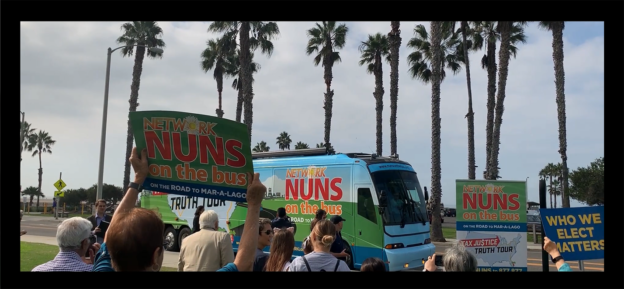
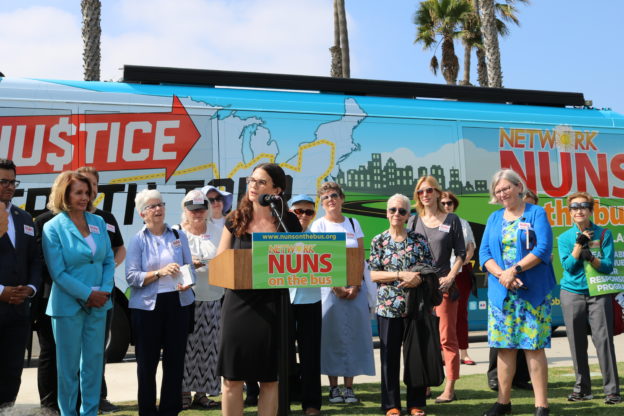
The Nuns on the Bus are going back on the road – this time driving across the country from California to Mar-a-Lago! We’ll be exposing the lies and telling the truth about the harmful effects of the 2017 tax law at every stop along the way.

We will hold members of Congress accountable for their votes in favor of this disastrous tax law. Those votes, as Sister Simone said, made it “crystal-clear who the Republican Members of Congress serve, and it is not the men, women, and children who Jesus championed.” Join us on the bus!

See our route and RSVP for events in your state: www.nunsonthebus.org/events

Guest Blog: Celebrating Our Dreams, Our Families in the Face of Threats to Family Reunification

Celebrating Our Dreams, Our Families in the Face of Threats to Family Reunification

Sam Yu
August 31, 2018

In February, the Senate voted on four different immigration bills for our undocumented young people. They all included plans to cut family-based immigration and they all failed to pass. Moreover, the Trump administration was doubling down on using harmful rhetoric around “chain migration” in order to further alienate and dehumanize communities whose families benefit from family-based sponsorship.

An overwhelming majority of Asian Americans come to the U.S. through the family-based sponsorship, meaning that any cuts directly impact our community. Forcing immigrant youth to choose between their futures and their families is pure blackmail and intolerable.

In order to spark dialogue and fight back against the harmful “chain migration” rhetoric, NAKASEC and affiliates launched the Our Dreams, Our Families” campaign. During February and March, we shared stories of impacted folks from our community whose families have benefited or will benefit from family-based sponsorship. All of the stories can be found at www.nakasec.org/ourdreamsourfamilies.

In one of our stories, Esther, our DACAmented young leader, explained how “it infuriated [her] that members of Congress, even our so called ‘allies,’ would think that [she] would ever want a pathway to citizenship that would prevent [her] from sponsoring [her] own parents… Our parents made us who we are today, our parents are the original Dreamers, and when you celebrate the achievements of Dreamers like [her], you are celebra

ting the achievements of not just our parents but our friends and our communities.”

Esther’s story and her declaration that her mother deserves to stay too captures the essence of the “Our Dreams, Our Families” campaign. We are asking Congress to value our families, protect family-based sponsorship, and fully understand that we cannot support undocumented young people without also supporting their families. Families are a cornerstone of American values and they deserve to stay together!

Sam Yu is the Communications Coordinator at NAKASEC. NAKASEC organizes Korean and Asian Americans to achieve social, economic, and racial justice. Learn more at www.nakasec.org

Originally published in Connection Magazine. Read the full issue here.