
Tag Archives: democracy

What’s the Real Reason for High Grocery Prices?

What’s the Real Reason for High Grocery Prices? 

Food prices are unaffordable! What’s going on, and what can we do?

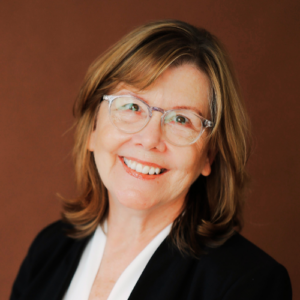
Sr. Emily TeKolste, SP, is NETWORK’s Grassroots Mobilization Coordinator.

No matter how old we are, where we live, or what’s in our wallets, every one of us has a right to be free from hunger. It’s a matter of our dignity. Grounded in the teaching and tradition of Catholic Social Justice, NETWORK believes that all of us—especially our children and elderly—have an essential right to good, basic nutrition.

As we all have noticed, grocery prices have skyrocketed since the COVID-19 pandemic. But even after the crisis of the pandemic has subsided, and even as inflation has dropped off in recent months, grocery prices remain high. With food prices up roughly 20% in the last two years, too many of us are struggling to feed ourselves and our families.

Why are our grocery prices so high?

We hear all sorts of explanations for food inflation, but none of them explain why big food corporations keep raising their prices.

So, what is actually behind the continuing rise in food prices? The simple fact is that a few big agribusiness executives are lining their pockets at our expense. Economists estimate that, by mid-2022, 53% of the increase in food prices was the direct result of corporate profiteering. Workers’ wage increases accounted for less than 8%.

While we’re struggling to feed our families…

      • Big corporations made $2.5 trillion in profits in 2021 alone, their most profitable year since 1950and corporate food executives still raised prices.
        • Tyson Foods made profits of $11 billion, up 48% from 2021.
        • Cargill, a huge commodities corporation, posted $5 billion in 2021 profits.
        • General Mills posted profit increases of 97% in early 2022, as it increased its prices by 53%.
        • PepsiCo raised prices for drinks and snacks by 17%, while its profits grew by 20%.
        • Coca-Cola’s corporate profits grew by 14%.
      • At the same time, food industry CEO salaries became even more bloated, averaging $22 million in 2022—almost 1,000 times the average food worker’s earnings.
      • All this time, a few mega-corporations controlled the food industry, all but eliminating real competition, and driving out smaller businesses.
        • Cargill and three other firms control 70% of the world’s food market.
        • Just four supermarket chains control 65% of the nation’s food retailers.

But you won’t hear big food executives and the politicians they buy mention these realities. Some Republican lawmakers like to blame inflation on the Biden-Harris administration’s economic policies — even though those policies help us afford our groceries. They blame the tax, unemployment, and rental assistance lifelines that got struggling families through the pandemic, and they blame new programs that build well-paying jobs, safely fix our roads and bridges, and give us clean air and energy. They blame these programs to distract us — because they would rather keep corporate profits high than fund the things that actually help us feed our families. They know it, and we know it!

What can we do?

The president alone cannot control inflation. President Biden has no authority to unilaterally issue orders to lower food prices, and a few lawmakers in Congress have blocked meaningful Congressional action.

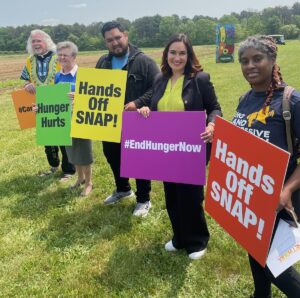
Advocates at NETWORK’s “Care Not Cuts” rally in Long Island last year. From left to right: Fr Frank Pizzarelli, Sr. Tesa Fitzgerald, Angel Reyes, Serena Martin-Liguori, Monique Fitzgerald

But we can demand better! Together, we will ensure that Congress supports affordable, nutritious food for us and our communities.

As a multi-issue voter, you can ask your elected officials and the candidates on your ballot:

1. Will they ensure that freedom from hunger is an essential right for all of us by fully funding food assistance programs, including:

  • The Supplemental Nutrition Assistance Program (SNAP), including its Thrifty Food Plan that protects SNAP benefits from rising food inflation? 
  • School lunches, elderly meals, soup kitchens, and food banks? 
  • The Special Supplemental Nutrition Program for Women, Infants, and Children (WIC), which offers basic nutrition for pregnant people, new parents, and babies?

2. Will they stop rewarding the executives of mega-corporations and their wealthy shareholders at the expense of ordinary workers and their families by:

  • Reversing excessive Trump administration’s 2017 tax bill benefits for big corporations?
  • Imposing needed measures to curb excessive CEO and executive compensation packages for profiteering companies?
  • Making the tax system fair for workers and their families, with stronger tax credits for children, childcare, and earned income?

3. Will they push the Federal Trade Commission to put the brakes on the monopolization in big agribusiness and protect small farmers and sellers?

Vote Our Future logoAnd then, of course, VOTE! Head to NETWORK’s Be a Voter page to check your voter registration status, find your voting information, make a voting plan, and tell your family and friends to vote, too!

Together, we will make Freedom from Hunger a reality for all of us, no exceptions! We will ensure that our nation’s food industry isn’t about feeding corporate profits, but about feeding our communities.

See NETWORK’s Food Prices One-Pager Here:
YALL Food Prices One-Pager FINAL
Sources

Head to these links to learn more about the real reasons for rising food costs:

https://www.stlouisfed.org/open-vault/2023/january/complex-supply-chains-bottlenecks-and-inflation

https://time.com/6139127/u-s-food-prices-monopoly/

https://finance.yahoo.com/news/inflation-is-cooling-the-gop-wants-you-to-remember-its-up-179-since-biden-took-office-152408852.html?fr=yhssrp_catchall

https://www.nytimes.com/2023/03/23/us/politics/republicans-inflation-federal-reserve-powell.html

https://www.cnn.com/2021/08/06/politics/inflation-gop-fact-check/index.html

https://www.forbes.com/sites/errolschweizer/2022/05/10/how-windfall-profits-have-supercharged-food-inflation/


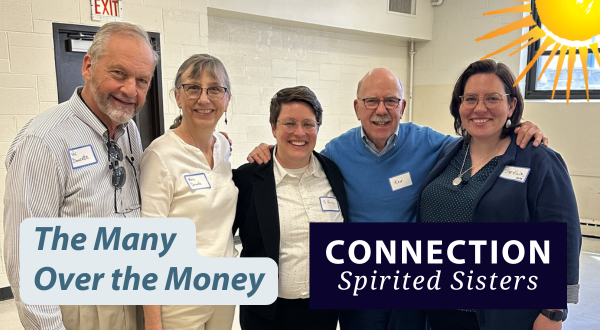
The Many Over the Money

The Many Over the Money

NETWORK’s Non-Partisan Voter Education Series Shows the Power of People Uniting

Sr. Emily TeKolste, SP
August 15, 2024

Sr. Emily TeKolste, SP, center, visits St. Gertrude Catholic Church in Chicago for a NETWORK election year training on April 14. Also pictured, left to right, are Vic and Mary Doucette from NETWORK’s Chicago team, Ken Brucks, and Sr. Eilis McCulloh, HM. Sr. Emily is NETWORK’s Grassroots Mobilization Coordinator.

From Indiana to California, from New Jersey to Texas, NETWORK Advocates across the nation want to build a world where everyone thrives, no exceptions. And they’re showing up. My colleagues and I have been privileged to work with wonderful advocates — NETWORK mainstays and new faces alike — who have attended online and in-person trainings to build skills and explore a variety of ways they can talk about the issues that matter to them and help their neighbors participate in our democracy this election.

We know we’re facing some big obstacles: a few ultrawealthy people are pouring big money into organizations trying to divide us over issues like immigration and rights for people in the LGBTQ+ community. They know that when we’re working against each other, we can’t see the ways they’re working to get big tax breaks for themselves and their ultra-wealthy friends — leaving the rest of us with few resources and struggling communities.

This election year, we’re coming together from across the country and across our many differences of race, age, and gender to build the skills we need to unite our nation around our shared values.

In April and May, the NETWORK team hosted two rounds of a four-week online training series. We talked about the many issues that matter to us when we consider candidates. We explored ways to talk about our issues that can help others see them as important — both in interpersonal conversations and in the ways that we contribute to the public narratives in our nation. Lastly, we explored other ways to get involved — everything from serving as poll workers to hosting ballot research parties.

We’ve also been hosting in-person trainings. These three-hour interactive workshops cover some of the content from the online trainings and give participants opportunities to practice and strengthen their skills even further.

Attendees have been thrilled by the skill-building opportunities and energized by the hope of being in community. Alice from California said, “Your sessions give direct, usable, doable actions for anyone who wants it. When we apply the information, results happen.” Sr. Mary Jo from Wisconsin said, “I wanted more hope in regards to this election. You provided it. Thank you.”

Vote Our Future logo

The Vote Our Future logo of NETWORK’s 2024 voter education campaign

Participants practiced talking about our visions for a future in which everyone thrives and learned about the policies that are helping us get there — recent victories like the largest investment in climate change prevention in U.S. history through the Inflation Reduction Act and the largest cut in child poverty in over 50 years through the American Rescue Plan.

They learned skills like deep listening and storytelling that help reshape people’s perspectives in one-on-one conversations and transformative narrative-building through the Race Class Narrative framework. Finally, they explored ways to get going on the ground, and many have signed up to be poll workers, committed to hosting voter registration drives, and much more.

As NETWORK has always done, we approach this election year with hope and welcome. From Nuns on the Bus to the 2022 Pope Francis Voter Tour to everyday conversations with policymakers in Congress, NETWORK staff and NETWORK advocates are transforming our politics by boldly declaring that all people deserve to have what they need to thrive. And we can get there when we go together — when we overcome the attempts to divide us by race, gender, and creed — and declare that all people are made in the image and likeness of God, who came that we “may have life and have it more abundantly.”

Like Alice and Sr. Mary Jo, we know that hope is an active virtue, and when we take action together, the many can defeat the money.

This is how we show up for each other, creating a world where nobody goes hungry, where people have access to safe and reliable shelter, good-paying jobs, and the ability to contribute to their communities. Together, we will vote our future so that everyone thrives — no exceptions!

This story was published in the Quarter 3 2024 issue of Connection.


Want to join in the action? Are you in the Louisville, KY area?  Register today for “Informed, Engaged, and Committed: NETWORK’s 2024 Election Year Training,” happening Saturday, Aug. 24, 8:30 am – 12 pm EDT, at Epiphany Catholic Church in Louisville. See you there!


Embracing the Great ‘Y’ALL’

Embracing the Great ‘Y’ALL’

Justice Demands a Future—and a Politics—That Includes Everyone

Mary J. Novak
August 8, 2024

Mary J. Novak is NETWORK’s Executive Director.

James Joyce famously described the Catholic Church as “Here comes everybody!” It’s a joyfully loud and messy image for a universal people of faith making their way through history toward the kin-dom of God. At World Youth Day in Portugal last year, Pope Francis echoed this sentiment when he described the church as being for “¡todos todos todos!” — “everyone, everyone, everyone!”

At NETWORK, we embrace this inclusive vision, not only for the church but for all of society. In our voter education efforts, for instance, we call on people to “Vote our Future” to embrace a vision of a future for everyone, where all people — no matter their race, country of origin, or socioeconomic background — have what they need to flourish and participate in our society.

While the beauty of Catholic Social Teaching provides a helpful light as we navigate toward a more just and equitable tomorrow, unfortunately, not all faith leaders devote their witness to promoting these values. The message many people receive in the pews is that they need to defend themselves against cultural “threats,” usually posed by greater acceptance of the LGBTQ+ community in our society.

Sadly, some politicians stand to gain from people of faith, believing they have to defend an exclusionary worldview, whether against the LGBTQ+ community or immigrants and other marginalized people, in order to be faithful. It amounts to a brazen bet that people will do the wrong thing if it benefits them.

But not all faith leaders allow themselves to be cynically co-opted. Pope Francis, for instance, made a powerful statement about the role of faith in a complex, changing world when, on December 18 of last year, he approved a blessing for same-sex couples. While many noted that this did not change Catholic teaching on marriage and sexuality, the point is that the pope modeled how to engage in affirmative acceptance and inclusion, rooted in human dignity, rather than treating human beings as threats.

This is especially urgent in the U.S., where the dominant position of the church has been to rebuff every legal protection for LGBTQ+ people as a threat to religious freedom. So much action on behalf of solidarity and the common good could be unleashed in the world if people of faith no longer feared for their identity or saw themselves as culturally under siege.

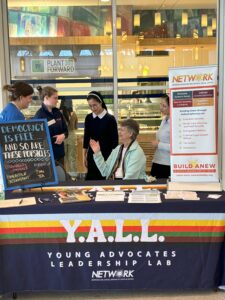
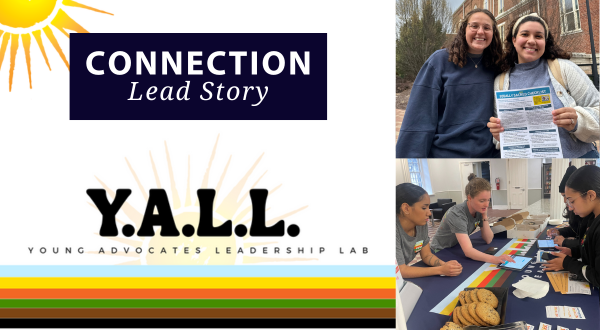
A group that understands this on a very deep level is young adults. While many have given up on the church because they see its teachings as endorsing intolerance, others have stayed and connected the dots of care for creation, care for immigrants, care for the whole human family, and the witness of faith. And so NETWORK, seeking to support and grow this energy, has engaged a cohort of college students this year to participate in our new Young Advocates Leadership Lab — or Y.A.L.L.

Like “Here comes everybody” and “¡todos todos todos!” Y.A.L.L. promotes an inclusive vision of faith at work in the public square. Y.A.L.L. leaders will engage in peer civic education on their campuses through activities such as voter registration drives and deep canvassing. These young leaders will also collaborate on NETWORK’s social media outreach to young Catholics. In an election year that has already proven so volatile, these young leaders are rays of hope for the future of U.S. democracy — and for the role of faith in preserving it.

Whether we worship in San Francisco, Detroit, or the Rio Grande Valley, Catholics have everything to lose if we silence our moral witness and buy into appeals to fear and scapegoating at the expense of solidarity and democracy.  The foundation of a multi-racial, multi-ethnic, multi-cultural, pluralistic democratic society should be an appreciation for how all people are interconnected, with our well-being and fates intertwined. In this challenging moment in history, people of faith have an opportunity to draw on these values and build our society anew.

This story was published in the Quarter 3 2024 issue of Connection.

Living Out of Our Shared Humanity

Living Out of Our Shared Humanity

We Lose Ourselves When We Disown Our Neighbor

Sr. Eilis McCulloh, HM
June 26, 2024

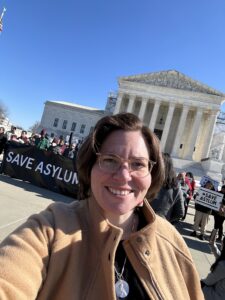
Sr. Eilis McCulloh, HM, pictured here at a Jan. 9 rally to save asylum, is NETWORK’s Grassroots Education and Organizing Specialist.

It should be simple. Our faith propels us towards caring for one another. Scripture commands us to love our neighbor as ourselves. More specifically, Exodus instructs us: “You shall not oppress or afflict a resident alien, for you were once aliens residing in the land of Egypt. You shall not wrong any widow or orphan. If you ever wrong them and they cry out to me, I will surely listen to them.”

These passages read as if they could guide our country. However, somewhere along the way, our politics took a turn. Instead of centering our commitment to welcome the stranger or care for our neighbors, we began pitting ourselves against one another. Instead of striving for unity and the common good, we began using one another as step stools to reach the next highest rung of the ladder.

As certain groups tried to attain a higher status, the divide in our country grew. How did this happen? Perhaps, it was when the notion of the achieving “American dream” took us out of living in community and into a large house with a white picket fence that divided us from our neighbors. As we move into our own insulated neighborhoods, we risk losing the recognition that we depend on one another. When we allow borders and fences, ZIP codes, and railroad tracks to physically, socially, and spiritually divide us, it becomes easy to pit one person against another.

And yet, we know that this is not how democracy or the common good flourishes. We know that division only serves as a kindling for hatred and fear of “the other.” When we lose sight of the people around us, it becomes far too easy to categorize the “other’s” struggles as a problem not worth fixing. We forget that what affects one of us, affects all of us.

Last year, in NETWORK’s Thriving Communities campaign, we named this. A thriving community is not possible unless every person has what they need to thrive. Every person is integral to our community. When one of us—or a group of us—falters, we all falter. Like the often-repeated phrase during COVID, “We are stronger together.”

At NETWORK, we also talk about building an inclusive world where we all work together to transform our politics and structures of racial, economic, and social injustice. We must recognize the dignity in every person, no matter their political party, religious tradition, nationality, race, gender, etc. As a Sister, I know that it is easy to claim that I work to ensure that we all have the opportunity to live abundant lives, but in practice this is more difficult. We run the risk disowning or dehumanizing our neighbor or, worse yet, picking and choosing who we want to identify as neighbor.

In his message to the World Meetings of Popular Movements in 2017, Pope Francis said,

“The grave danger is to disown our neighbors. When we do so, we deny their humanity and our own humanity without realizing it; we deny ourselves, and we deny the most important Commandments of Jesus. […] But here we also find an opportunity: that the light of the love of neighbor may illuminate the Earth with its stunning brightness like a lightning bolt in the dark; that it may wake us up and let true humanity burst through with authentic resistance, resilience, and persistence.”

What does this mean for us? In both big and small ways, we might be called move outside of our routines and comforts to begin to build authentic relationships with one another. If we do not build these authentic relationships, we will not see ourselves as members of one community. This is not a ”one and done” performance, but a lifelong commitment to being neighbor to one another. It is a commitment to border and boundary crossing so that we can begin to understand someone else’s self-interest, to understand worlds and viewpoints different than our own, and to witness to a future full of hope.

This story was published in the Quarter 2 2024 issue of Connection.

A Future for Freedom

A Future for Freedom

We Must Never Stop Dreaming of a Better World

Joan F. Neal
June 17, 2024
Joan F. Neal, Deputy Executive Director and Chief Equity Officer at NETWORK

Joan F. Neal, Deputy Executive Director and Chief Equity Officer at NETWORK

It’s usually dangerous to look back on previous eras of history as somehow better. Nostalgia too often masks racism and other egregious injustices more widely accepted in times past. However, one positive hallmark of some recent past decades is people’s capacity to dream.

Past generations had a lot to say about the American dream; they embraced the concept of all people having the ability within their grasp to make the life they wanted for themselves. In the fight against slavery, Jim Crow, and second-class citizenship, most Black Americans embraced Dr. King’s dream of the Beloved Community where all are free and equal. Dreams push us toward action, because they imbue the lives of those who have them with hope.

We all want to live lives of hope, lives oriented toward having what we need to flourish and find fulfillment. The word for that is freedom, true freedom.

Unfortunately, due to circumstances beyond their control, today’s younger generations do not feel the hope to dream. Millennials and Gen Zers have had their adulthoods defined by financial crises, spiraling economic inequality, and an unrelenting experience of being priced out of American success and the freedoms that only democracy conveys, ones that their parents and grandparents took for granted. This is no accident. This is the result of 40 years of deliberate public policy choices that divested from families and communities and directed greater and greater wealth into the hands of fewer and fewer extremely rich individuals.

Pope Francis has described this phenomenon as young people feeling “crushed by the present,” unable to dream of a better future. Young people without hope should be a warning to us all that our ability to experience or exercise freedom is in danger. When people lose faith in a system’s ability to deliver for them, the system is in jeopardy. Is it any surprise then that the world has witnessed a global decline in democracy for the past 17 years?

We cannot afford for freedom to be relegated to the history books as a curious anomaly of the late second millennium. No, it is in the best interest of all people on the planet for there to be a future for freedom. For a picture of what the alternative offers, we can look to a country like Russia where the corrupt rule of a few oligarchs violently suppresses its opposition, leaves its own people without hope, and brutally attacks the freedom of its neighbor, Ukraine. But we can also look to the oppressive structures we permit in our own politics — such as inaction on immigration reform or refusing to make the tax code more equitable — that also robs people of freedom and their future.

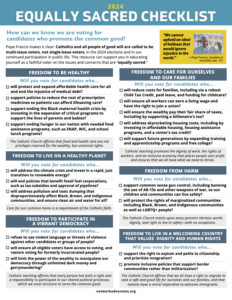
See NETWORK’s 2024 Equally Sacred Checklist, to support you in educating yourself as a faithful voter on the “equally sacred” freedoms at stake in this election and beyond.

Catholic Social Teaching talks a great deal about freedom. It really matters. If a person lacks freedom, then they do not have what they need to make a true moral choice, including the choice to live into the potential and the dream that God has for every one of us to thrive, no exceptions!

At NETWORK, we see the brokenness of our public policies as structures of sin, that destroy people’s freedom and the common good. That is why, this year, NETWORK is focusing our election priorities on six freedoms:

  • Freedom to be Healthy
  • Freedom to Care for Ourselves and Our Families
  • Freedom to Live on a Healthy Planet
  • Freedom from Harm
  • Freedom to Participate in a Vibrant Democracy
  • and Freedom to Live in a Welcoming Country that Values Dignity and Human Rights.

You can read more about these later in this issue of Connection. Whether it’s health care, immigration, climate change, or one’s economic situation, we see this year in terms of the human freedoms at stake. We must ensure that these freedoms are reverenced and more deeply enshrined in our politics and our public policies, so that future generations experience the freedom to dream.

This story was published in the Quarter 2 2024 issue of Connection.

Dreams of Inclusion

Dreams of Inclusion

Inaction by Congress Costs DACA Recipients the Ability to Participate Fully in a Democracy They Help Make Flourish

Sydney Clark
June 11, 2024

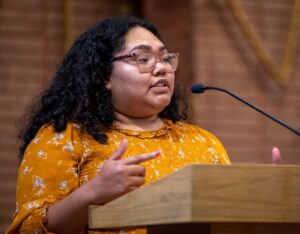
Ivonne Ramirez speaks about her experiences as a child immigrant and Deferred Action for Childhood Arrivals (DACA) program participant during Mass at Mary Mother of the Church Parish in St. Louis. Photo: Sid Hastings

Ivonne Ramirez was 8 when her family migrated to the U.S. from Mexico City. They arrived in St. Louis, Missouri, where her father and a sibling had been living for about a year.

“It took seven days to get to St. Louis,” Ramirez says. “I was mostly walking to cross the border. It took a lot out of me.” Her father, a police officer, left Mexico due to safety concerns after raiding a money-laundering operation inside a bar. He was only able to bring one of his children. Ramirez journeyed with her mother and three other siblings.

“I was sleep-deprived, and people kept telling me, ‘If you keep going, you’re gonna see your dad’,” she says. “Not seeing my father for a year felt like a lifetime.”

A few years after the family reunited, Ramirez became eligible for the DACA (Deferred Action for Childhood Arrivals) program, which began in 2012 as an executive action by President Barack Obama. This year marks a decade for Ramirez as a recipient.

She and her family still resides in St. Louis. She works full-time doing quality control for a medical equipment company. On weekends, she serves as a catechist at Our Lady of Guadalupe Parish in Ferguson, Missouri. “It feels like home. I’ve been here for most of my life,” Ramirez says.

Shut Out

While DACA has allowed Ramirez to attend school and get a driver’s license and a work permit, the realities of being a recipient remain at the forefront. She is one of roughly 580,000 active DACA recipients.

“Our permits and status allow us to be here for two years, and then we have to renew six months before,” she says. “This year, I’m OK, but next year, I have to start thinking about sending all the paperwork and the fee, which is $495. How will I get that extra income to pay for that?”

Recipients are ineligible to vote in federal elections, and Ramirez’s voting rights are nonexistent. Some states and municipalities allow noncitizens to vote in local elections like city councils, mayoral and school boards. Missouri is not one of them.

“If you pay your taxes, contribute to society, and show that you’re a model citizen, I don’t see why the efforts to put something permanent for [us] aren’t there,” Ramirez says.

In 2022, NETWORK honored Ramirez as one the organizations’ inaugural “Social Poets,” young justice-seekers whose lives and work define the challenges and possibilities of the coming decades. Unfortunately, permanent legal status for undocumented people in the U.S. remains an unaddressed challenge.

Juliana Macedo do Nascimento, deputy directory of federal advocacy at United We Dream and a DACA recipient. Photo: Diana Alvarez

At its height, DACA had around 840,000 recipients, says Juliana Macedo do Nascimento, deputy director of federal advocacy at United We Dream, the largest immigrant youth-led network in the country. A DACA recipient herself, she was 14 when her family migrated to the U.S. from Brazil. Macedo do Nascimento calls DACA the largest “victory of the immigration movement in decades.”

The program, however, has faced ongoing legal battles since its origin, leaving recipients in constant limbo.

“Many don’t know how much danger the policy is in,” Macedo do Nascimento says. The latest challenge happened on Sept. 13 of last year, when Texas federal judge Andrew Hanen ruled again that DACA is unlawful. Now, DACA will likely revisit the Supreme Court in 2025.

Although Hanen blocked new program applications, he left DACA unchanged for existing recipients during the anticipated appeals process. Recipients can continue to renew and apply for Advance Parole, which allows certain immigrants to leave the U.S. and return lawfully, said Macedo do Nascimento.

Bruna Bouhid, senior communications and political director at United We Dream, at a UWD Congress in Miami. Photo: United We Dream

“You feel like you’re on a roller coaster,” says Bruna Bouhid, senior communications and political director at United We Dream. “You never know if this will be your last chance to apply or if, in a year or six months, you will lose all those things you had planned for or worked hard to get.”

Bouhid, who became a recipient at 20, says the legal fights reveal that DACA will “not be our saving grace. We need something permanent. We need citizenship.”

Government Inaction

“It’s really up to Congress to find and support the solution,” says Christian Penichet-Paul, assistant vice president of policy and advocacy at the National Immigration Forum. “It’s the only branch of government that can ensure DACA recipients and other young DREAMers can stay in America long term and potentially become lawful permanent residents.”

Penichet-Paul says distrust among both parties and lack of courage helped derail legislative action and execution. He also predicts immigration reform talks in Congress will not advance during this election year.

“Democracy is such a precious thing, and it can take a long time to come up with a compromise,” Penichet-Paul says. “Sometimes, getting to the right place requires multiple little steps.”

As to when a policy window might open up, he notes, “It’s always said that Congress works best on a deadline. Unfortunately, that might be the next Supreme Court decision.”

Penichet-Paul stresses that there is bipartisan agreement and existing text that can serve as the bill that “finally provides permanence for young DREAMers who’ve been in America since they were little kids.”

One option could be a new version of the DREAM (Development, Relief and Education for Alien Minors) Act, first introduced in 2001. A version introduced last year by Senators Dick Durbin (D-Ill.) and Sen. Lindsey Graham (R-SC) would permit noncitizens brought to the U.S. as children to earn permanent residence aft¬er meeting specific education or work requirements. Durbin and Graham introduced similar legislation in the last three sessions of Congress.

Ivonne Ramirez speaks to parishioners at Mary Mother of the Church Parish in St. Louis. Ramirez, one of NETWORK’s “Social Poets,” has been a DACA recipient for the past decade. Photo: Sid Hastings

Additionally, Rep. Linda Sanchez (D-CA) introduced the U.S. Citizenship Act of 2023, which would tackle the sources of migration, reform the visa system, and “responsibly manage the southern border.”

“We can have a pragmatic system, looking at who needs and wants to migrate, but let’s create a system that is fair and humane for everyone,” Bouhid says.

Ramirez admits that she’s “a little scared” for the looming 2024 election but encourages those eligible in her community to vote.

“A lot of Americans know at least one, if not many, DACA recipients and immigrants,” she says. “If you get to know them and understand why they came to the U.S., you would happily vote in honor of them.”

Ramirez says her Catholic faith inspires her to be vocal about the challenges immigrants face.

“I never want to stop talking about us and why we need to become citizens,” she says.

Penichet-Paul says immigrants have grown up as “American as any U.S. citizen in many ways” and take civic participation and community service seriously.

“Immigrants are often some of our strongest allies in maintaining democracy and the institutions that allow our democracy to prosper,” Penichet-Paul adds. “Democracy can coexist with DACA and immigration. They’re about good governance and ensuring that people can reach their full potential, nothing more, nothing less.”

Sydney Clark is a New Orleans native and multimedia producer based in Washington, D.C.

This story was published in the Quarter 2 2024 issue of Connection.

Move Past the Unserious

Move Past the Unserious

People Who Want Action on Immigration Should Look to These Proposals

Ronnate Asirwatham
April 2, 2024
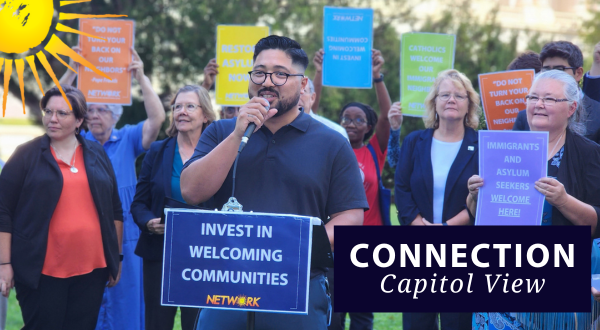
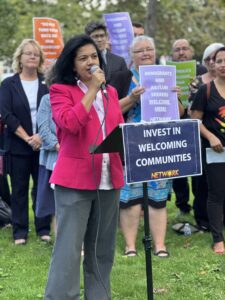
NETWORK Government Relations Director Ronnate Asirwatham, a woman in a pink jacket, holds a microphone and speaks from behind a podium with a sign, "Invest in Welcoming Communities." Many other advocates with similar signs stand behind her.

NETWORK Government Relations Director Ronnate Asirwatham at the September 2023 Welcoming Communities press conference on Capitol Hill

Words have consequences. And almost nowhere is that truer than when dealing with immigration.

People like to think they are true to their word when they say they want action on immigration and care about finding practical solutions. After all, immigration is a serious issue that touches millions of lives and practically every community. We should adopt serious proposals. But what does it mean to be serious?

Many people, especially elected officials, betray their unseriousness by how they talk about immigration. Unfounded claims of a “migrant crime” wave are dangerous and inaccurate. These claims feed into racist tropes by fueling fear and hatred towards immigrants and people of color, making our communities less safe.

Fearmongering gives cover to politicians wishing to pass or enact terrible policies. The recent legal attack by the Attorney General of Texas on Annunciation House—a series of shelters that serve migrant people across the Southwest—is one small example of right-wing extremists attacking people seeking safety, as well as the people of faith who serve them.

We have also seen this type of attack in extreme bills against immigrants and people who welcome them in the state legislatures of Arizona, Idaho, and Georgia and the U.S. Congress. Instead of putting forward workable solutions, Congressional extremists keep pushing for unworkable, failed proposals that the American public has rejected. They think this is a good way to pass unpopular policies, but providing a veneer of legality for attacking immigrants makes everyone less safe.

This xenophobic rhetoric is like that which brought gunmen to the Pittsburgh synagogue and the El Paso Walmart. Unserious people can still create serious threats, and the policies of deterrence and the rhetoric of racism these politicians are proposing will make all who live in the borderlands and people of racial and religious minorities everywhere unsafe.

We must focus on what constitutes a serious immigration policy proposal; luckily, we have plenty of examples. At the end of January, the Congressional Hispanic Caucus released its immigration principles for the second session of the 118th Congress. These principles, comprised of 18 policy proposals within a framework of four pillars—immigration reform, jobs and the economy, border safety, and regional migration concerns—are what serious immigration policy looks like and what people of faith and goodwill should push Congress and the Administration to adopt.

  • Increase funding for asylum processing and legal representation programs for adults and guarantee access to counsel for asylum seekers in federal custody.
  • Create family reunification programs for additional countries to assist with backlogs.
  • Facilitate access to work authorization for newly arrived immigrants.
  • Fund community-based case management programs that decrease immigration detention.
  • Protect Dreamers and DACA recipients.
  • Provide a pathway to citizenship for undocumented individuals.
  • Update the registry cutoff date through H.R. 1511, the Renewing Immigration Provisions of the Immigration Act of 1929.
  • Advance immigration protections through H.R. 3194, the U.S. Citizenship Act.
  • Establish a humanitarian visa for pre-screen asylum seekers.
  • Expand protections for minors seeking to be reunited with parents holding legal status in the U.S.
  • Protect undocumented spouses or parents of military members by providing a path of legal residency and eliminating the threat of deportation.
  • Advance protections for agricultural workers through the Farm Workforce Modernization Act of 2023.

These are serious proposals that can create real change by actually addressing the problems created by our broken immigration system. Any person, elected or otherwise, who claims to be serious about the border and immigration but isn’t embracing these proposals is not serious. In fact, they are very likely trying to use the plight of suffering people to get you to buy into a “solution” that will only cause more suffering and put more people in danger. And that’s serious.

This story was published in the Quarter 2 2024 issue of Connection.
Network condemns voting righs EO and SAVE Act bill

NETWORK Lobby Condemns Trump’s Voting Rights Executive Order and the SAVE Act (H.R.22)

NETWORK Lobby Condemns Trump’s Illegal and Blatantly Authoritarian Voting Rights Executive Order

Min. Christian S. Watkins
March 28, 2025

President Trump issued an extreme executive order Tuesday, March 25, 2025 that threatens our freedom to vote with unconstitutional mandates, public and election administration confusion, and draconian restrictions for election officials and voters.

According to the White House, the Trump administration desires to require “government-issued proof of U.S. citizenship on its voter registration forms.” to ensure no non-citizens are voting in U.S. elections. Additionally, the Administration’s move preempts House Republicans’ attempts to pass H.R.22—the Safeguarding American Voter Eligibility (SAVE) Act, a bill that seeks to codify extreme voter suppression tactics into law.We know that these non-citizen voting claims are a false flag, as there is no evidence that noncitizen voter registration and voting is occurring at any meaningful scale. Not only is it practically infeasible for an undocumented immigrant to have the documents required to register to vote in the first place, it’s also difficult to imagine an undocumented immigrant would risk government scrutiny, arrest, and deportation — all to cast just one vote. President Trump and his enablers in Congress peddle the lie of noncitizen voting to try to justify their attempts to take away our freedom to vote. They know that their policies are unpopular, so they want to make it harder for our communities to vote and have a say in the decisions that affect us. This is yet another move in their effort to consolidate power for themselves.

The SAVE Act would mandate American citizens provide proof-of-citizenship documents that many can’t access – like a passport or certified birth certificate – to register to vote or update their registration, such as after a move. Federal courts have found it an impermissible violation of the Constitution. State Department data shows 43-49% of Americans, or 104-118M voting-age citizens, do not have current passports.

Moreover, research from the Center for American Progress finds that approximately 69 million women do not have a birth certificate with their legal married name on it. Nearly 80% of married women–more than 69 million American women–have adopted their partner’s surname, and they would be unable to register to vote if the name on their ID does not directly match their proof of citizenship.

In effect, millions of people would have to get a passport that has lists their current name. But obtaining a passport takes time (in recent years, it has taken 10-13 weeks to process a passport applications) and is costly. Current rates are a $130 application fee plus a $35 execution fee. The fees are the same for passport renewal. This is seemingly a reiteration of poll taxes levied against African Americans and other impoverished citizens that were commonplace before the 24th Amendment to the Constitution ratified on January 23, 1964.

Consumer research shows that citizens in rural, working class, farming, and evangelical communities are least likely to hold passports. The data show:
• 76% of citizens who have not attended college do NOT have a valid passport
• 70% of citizens with family income less than $50K do NOT have a valid passport
• 62% of “evangelical hub” citizens do NOT have a valid passport
• 58% of citizens in working-class communities do NOT have a valid passport
• 53% of rural and farmland citizens do NOT have a valid passport

The freedom to vote is a foundational American value. And it’s one that states deliver on in every election cycle. States have strong checks and balances in place to ensure their elections are secure and accurate, with layers of safeguards in place set by state and federal law. States do not need Elon Musk’s DOGE accessing our personal information or disrupting electoral systems that effectively delivered results just a few months ago. Additionally, withholding federal funds from states that do not cooperate with the order’s provisions is egregious and will be a detriment to the unity and stability of our nation and elections. President Trump’s order, the SAVE Act, and bills like it are meant to divide Americans at a time when we are united in what we want from our government leaders: solutions to fix our broken economy.

Read NETWORK’s March 28 statement condemning the Trump administration’s illegal effort to steal the voting rights of millions.

Additional resources

The Ripple of One Person’s Vote

The Ripple of One Person’s Vote

Contribute to the Love That Saves the World

Sr. Erin Zubal, OSU
March 5, 2024

Sr. Erin Zubal, OSU, NETWORK Chief of Staff

Waiting in line outside a school gymnasium in the early morning hours. Feeling the chill of November in the air. Greeting the poll workers. Making selections on an electronic menu screen. The experience of voting is many things, but not many people would probably think of it as helping us grow holiness. But listening closely to Pope Francis, it’s clear that this election year offers yet another opportunity for many people to journey closer to the God who loves and saves the world.

In his 2018 letter on the call to holiness, Gaudate Et Exsultate (“Rejoice and Be Glad”), Pope Francis waded into explicitly political waters when he cautioned against limiting one’s political concern and advocacy to just one or two issues, as so many Catholics tend to do in the U.S. “Equally sacred,” he affirmed, are the lives of people in poverty and all who are rejected and discarded by society. “We cannot uphold an ideal of holiness that would ignore injustice in the world,” he wrote.

That same year, the Vatican’s doctrine office also published a document on “certain aspects of Christian salvation.” This document rejects “individualistic and merely interior visions of salvation” as being against the “economy through which God willed to save the human person.” People must journey beyond themselves, out into the world, to participate in the grace of the salvation story that culminates when “each person will be judged on the concreteness of his or her love.” (Placuit Deo #13)

This, too, is political.

See NETWORK’s 2024 Equally Sacred Checklist to support you in educating yourself as a faithful voter on the issues and concerns that are “equally sacred.”

Voting is concrete. It is an act. It is a choice. It’s an imperfect choice because voters are often not faced with specific policy proposals but with individual office-seekers who may be better on particular issues than others and whose performance, once elected, can be unpredictable. Will they advocate for people on the margins? Are they able to be bought by wealthy corporate interests? Do they take the weight of responsibility of their office seriously? The answers to these questions can and do produce wildly different outcomes.

But what remains is this: In the act of voting, a person creates a small ripple in the social fabric, a ripple that may end up part of a more significant current or movement that impacts the lives of millions of other people– for good or ill.

Using one’s vote for ill often means voting as a means of lashing out against people or groups of people whom voters have been told to fear, such as migrants and other people struggling to survive on the peripheries of society.

Voting may take only an instant, but the harm inflicted by bad immigration policy compounds over the years. It is felt in the lives of families and children who might never recover from the devastation they experience.

Even more could be said about the pain intentionally inflicted on Black and Brown communities by the stoking of Christian nationalist and white supremacist narratives. What does it mean for this country that so many neighbors voted this way?

But the opposite is also possible. A person can use their vote to build up rather than tear down, show welcome rather than hostility, and contribute to love rather than hate. And in an election year that looks to be decided by a small number of people in a few states and localities, the choice of one person to choose solidarity, to make their vote an act of love, is as consequential as it’s ever been. It might just play a part in saving the world.

This story was published in the Quarter 1 2024 issue of Connection.

Lessons for Democracy in 2024

Lessons for Democracy in 2024

Advocates Agree That Voting Remains a Powerful Tool and Act of Engagement

Don Clemmer
March 1, 2024

One of the reasons politics seemed so broken in 2023 might have been because so many people separated the exercise of power from service:

  • A faction of the U.S. House of Representatives kept trying — and failing — to make the very functioning of the government contingent on deep cuts to human needs programs.
  • A former president on the campaign trail promised that a return to power would mean annihilation of his opponents.
  • And at the state level, restrictive voting laws continued to threaten the participation of all people in a system that shapes their lives.

It all raises the question of the overall health of democracy in the U.S. and its prospects for weathering the 2024 elections — in the presidential race, Senate, House, and state-level contests. Advocates, academics, and leaders in the areas of faith and politics agree — and shared with NETWORK’s Just Politics podcast last year — that current threats to democracy require vigilance and action. Action includes rooting out Christian nationalism, opposing voter suppression, forging broader political alliances to work common problems, and showing up to vote.

The Place of Faith in Politics

Dr. Rachel Kleinfeld

“This is much bigger than just elections,” says Dr. Rachel Kleinfeld, senior fellow in Carnegie Endowment for International Peace’s Democracy, Conflict, and Governance Program, who notes that the world has witnessed a global decline in democracy for the past 17 years. In consolidated democracies like the U.S. and Brazil, this has occurred because people elect populist, authoritarian leaders. “Just beating those leaders doesn’t mean that democracy is restored.”

Celina Stewart

“The threat has always persisted. The tools that are used each election cycle sometimes change, or sometimes they just get scaled in some way or another,” says Celina Stewart, chief counsel and senior director of advocacy and litigation for the League of Women Voters, of the particular threat of voter suppression. “Voting rights is really about empowering people to engage in their community, to have a voice in selecting the person or the group of people who will represent their interests.”

“When we start suppressing votes, and we start suppressing knowledge, we’re heading down a very dark road,” says Sr. Anita Baird, DHM, a member of NETWORK’s board. “As a church, we have failed to speak out on many of these issues.”

Sr. Anita Baird, DHM

As the threat of Christian nationalism has grown more visible in U.S. politics in recent years, NETWORK has vocally denounced the movement, as have other religious groups. The Baptist Joint Committee for Religious Liberty (BJC) is one of them.

“Christian nationalism takes that Gospel of love and perverts it into this false idol of power,” says Amanda Tyler, BJC’s executive director. She says it’s incumbent on Christians to call out where public assertions of Christian identity stray from the teachings of Jesus.

She adds, “When we look around at all the injustice in the world today, we desperately need, I think, that authentic Christian witness to try to call us to live in a more just and equitable place.”

Rep. Jim Clyburn

Rep. Jim Clyburn of South Carolina, assistant leader of the House Democratic Caucus, has a similar response to colleagues who separate their Christian identity from concrete service.

“I ask them: Show me what you mean. Don’t tell me what you mean. Show me,” he says, citing from James 2:16 that one cannot say “Go in peace; keep warm and well fed” and do nothing to help someone. “You have to feed them. You have to clothe them. Because faith without works is dead.”

In the face of chaos spurred by Christian nationalism in the body he has served for over 30 years, Clyburn says he has begun reaching out to members of different factions within his own party, recognizing that they “need to demonstrate some leadership in the very near future to make sure this country doesn’t to go over the edge.”

Inaction Is Not an Option

“We need democracy to deliver more for people who have been left out,” says Kleinfeld. And in bridging that connection, she sees Catholics as having a special role. “Almost every other religious group is on one side of the aisle or the other. It’s really quite stunning. Catholics are the only group that are pretty evenly divided in Republicans and Democrats.”

Sr. Eilis McCulloh, HM, Joan F. Neal, and Colin Martinez Longmore interviewed a range of democracy advocates and experts for Season 3 of the Just Politics podcast, produced in collaboration between NETWORK and U.S. Catholic magazine.
To hear more from the conversations encapsulated in this article, visit uscatholic.org/justpolitics
or networklobby.org/just-politics-podcast/

Kleinfeld advises, “What you need to start doing is both talking to people on the other side but then working with people on the other side on things you find you agree on. And this is really important, because finding those instances of agreement requires some deep conversation. It also requires constructive engagement with the system. … It can show people that the government can work. It can show people the humanity of the other side. And ideally it eventually moves into more political change.”

Rep. Clyburn says that fixing its own faults is something that makes America great.

“COVID-19 exposed some faults in our system that needed to be repaired,” he notes. And that inspired him to bring together Members of Congress from rural districts to get access to broadband included in the Bipartisan Infrastructure Law. The result was a $65 billion investment to make high-speed internet available to all people in the U.S.

Baird agrees that promoting policy that affords people what they need to participate more fully in society amounts to “strengthening the foundation of our democracy,” which gives future generations a better chance to realize the dream Dr. King talked about.

“We’re called to be in the political marketplace and to speak truth to power and to do it within the context of the Gospel and the social teachings,” she says. One failing Baird laments is how the racial divide in the U.S. makes it much harder for people to find solidarity with one another.

“If I’m white and poor in America, I don’t see what I have in common with poor people of color in America,” she notes. “But you have more in common with poor people of color than you have with the wealthy — that you have nothing in common except the color of your skin!”

Baird recalls that, when Dr. King called for a poor people’s campaign, that’s when people got upset. “When he started talking about bringing people together from every different background,” she says, “that became a threat to the power structure.”

Rep. Ayanna Pressley of Massachusetts speaks outside the U.S. Capitol on Dec. 6 as she and Senator Peter Welch of Vermont introduced the Inclusive Democracy Act. The bill seeks to end felony disenfranchisement, a measure that disproportionately keeps Black and Brown people in the U.S. from voting.

Stewart of the League of Women Voters affirms the value of getting engaged: “So often in my interactions with people, they don’t always recognize how important their perspective is. They think everyone may feel that way, they don’t know the value that it brings. And every voice, collectively, has so much power.” Baird says that — especially as a Black woman — she struggles with people who say they are so demoralized by U.S. politics that they aren’t going to.

“Things do change. It may not change as quickly as we want or in the exact way that we want,” she says, but, “people died for the simple right to vote.”

Stewart asserts that who we elect matters: “Those are now people who make decisions on behalf of your family, on behalf of your life, your access, your ability to move and have potential services around the country,” she says. “And so it’s a really big deal, not only election day, but the impact of who’s elected.”

Kleinfeld says some people are resistant to holding onto a system that seems to be broken, but she cautions, “There’s not been a better system for peacefully changing power, peacefully choosing leaders who represent you. And that’s a lot to throw out.”

“Perhaps we have to go through this to realize how fragile democracy is, but what a gift it is,” says Baird. “I think we have to understand the power of the vote, the power of people coming together.”

This story was published in the Quarter 1 2024 issue of Connection.