

Category Archives: Front Page

Advent 2021: The Struggle for Racial Justice

Advent 2021: The Struggle for Racial Justice

Joan Neal
November 27, 2021

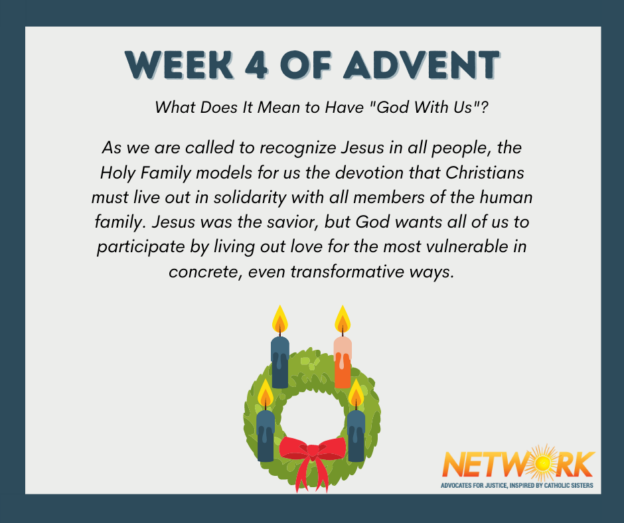
The 1st Sunday of Advent symbolizes Hope with the “Prophet’s Candle” reminding us of the prophetic ministries, especially Isaiah, that foretold of Jesus’ birth. In this year’s Advent reflection series from NETWORK, Joan Neal, our Deputy Executive Director and Chief Equity Officer, reflects on the implications that the coming of Jesus at Christmas has for racial justice in our world today:

God is with Us in the Struggle for Racial Justice

Advent is a time when so many Christians prepare to welcome Jesus at Christmas. But what does that mean lived out in the U.S. today? And what demands does it make of us who believe? Remember, Jesus was a person of color and member of a religious and ethnic group that lived in the shadow of the most powerful empire in the history of the world up to that time.

“He knew what it was to be oppressed in this system,” says writer, activist, and NETWORK board member Leslye Colvin. “He knew the history of his people and how his people had been in bondage, and all the ups and down of their journey.”

From the moment he is born, Jesus is a target of state powers that seek his violent and unjust death. They ultimately succeeded, abetted by religious leaders of the time, in publicly putting him to death in his 30s. There are still people who are unjustly targeted today. Despite making up only 13% of the population, Black people comprise 38% of the U.S. prison population and over a third of defendants executed in the U.S. in the last 45 years. Among unarmed victims, police kill three times as many Black people as white people. Also, Black and other people of color face persistent and pernicious efforts to exclude our voices from the political process through restrictive new voting laws that 17 states have enacted in just the past year. Unjust racial targeting is alive and well today.

In the Gospel this weekend, Jesus urges us, “Be vigilant at all times and pray that you have the strength to escape the tribulations that are imminent.” These words resonate, not just with Black people and other people of color, but with the struggle of all who hunger and thirst for racial justice. None of us can afford to turn a blind eye or to ignore the growing racism and racial violence in our country. We have seen the cost of falling asleep will be catastrophic for the entire country.

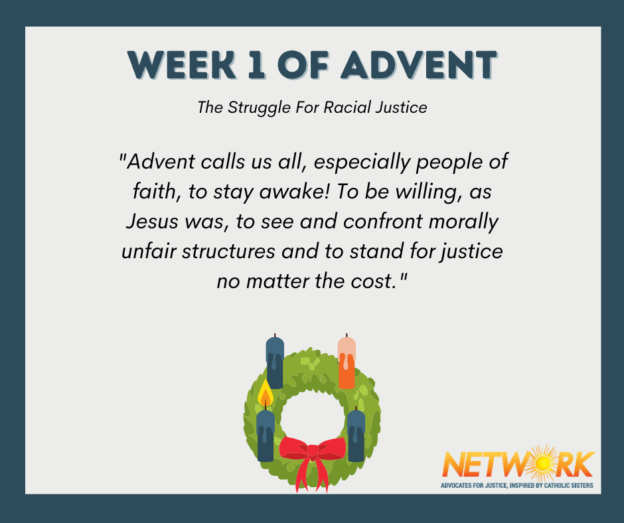
Advent calls us all, especially people of faith, to stay awake! To be willing, as Jesus was, to see and confront morally unfair structures and to stand for justice no matter the cost. To truly make a place for Jesus in our hearts and our country, we must realize and embrace our common humanity and God-given dignity. We must summon the strength to live in solidarity rather than in separation. Trusting that God is always with us, we must be prophets and practitioners of this change today.

Take Action

Confronting the Inflation Scare

Confronting the Inflation Scare

Jarrett Smith
November 24, 2021

There is a new scare tactic corporations and their lobbyists are using to maintain the status quo of hoarding their profits for themselves. They are manufacturing a false and misleading panic about inflation to scare elected officials away from supporting policies that require corporations and the ultra-wealthy to pay their fair share.

We cannot let a disingenuous panic over inflation get in the way of passing our common-good agenda.

Here are the facts about our economy:

1.) COVID-19 is the driver of recent inflation, not public investments. Resolving supply-chain problems and making progress on COVID-19 will reduce inflation.
-Consumers shifted their buying patterns during the pandemic, spending more on goods than on services. This is temporarily squeezing capacity and driving up prices.
-On the supply side, supply-chain bottlenecks are the result of initial shutdown of production and ongoing disruptions from the pandemic around the globe.

2.) The Build Back Better plan will help reduce inflationary pressures in the long term.
-Build Back Better (and the Infrastructure Investment and Jobs Act) will create jobs and make it easier for workers to keep them, expand our capacity to produce goods and services in the medium- to long-term, and reduce the risk of inflation.

3.) In the short-term, the Build Back Better plan will help families deal with rising costs by:
-Providing families with children up to $300 per month per child to help afford the basics and get ahead
– Helping families cover the rising cost of childcare – one of families’ biggest costs
– Lowering the cost of prescription drugs and making health insurance more affordable
– Helping people with low incomes afford housing and avoid evictions and homelessness

It is deceptive to look only at rising prices, without taking into account recent wage gains and income boosts from the American Rescue Plan. Seventeen Nobel Prize-winning economists refuted inflation panic and supported President Biden’s economic agenda in a joint letter, saying,

“Because this agenda invests in long-term economic capacity and will enhance the ability of more Americans to participate productively in the economy, it will ease longer-term inflationary pressures.”

Build Back Better will help our communities recover from the COVID-19 pandemic equitably. The Build Back Better Act just passed the House; now we must urge the Senate to pass the bill and send it to President Biden’s desk.

Thank you for your help confronting inflation-panic scare tactics and advocating for Build Back Better!

Running from the past is no way to dismantle racism

Running from the past is no way to dismantle racism

Julia Morris
November 23, 2021

Did you know that the Catholic Church was one of the largest slave holders in North America? Me neither.

I have spent over a decade in the church and in countless hours of schooling, Mass, and service projects no one mentioned this to me once. I went to Catholic school for 12 years, 5th grade through college, but it was not until my post-grad Catholic year of service that I learned that the Catholic Church played a role in American slavery.

The private Catholic education system did not just forget to teach me and countless other, predominantly white students about this history. The Catholic Church is and was, running from an uncomfortable past.

The church’s history runs parallel, overlapping, and intertwined with white supremacy United States. The Catholic Church was a major player in the transatlantic slave trade, and the effects of white supremacy are still felt today, as researcher Robert P. Jones reports that white Christians who regularly attend church on Sundays are more likely to hold racial bias.

While the church did not teach me about racism, it did teach me about sins of omission, or leaving out parts of the truth to manipulate your listener. Leaving out parts of our history is lying. If the public education system in the United States was to do the same, it would not only be immoral but contribute to the increasing distrust our citizens have towards our own institutions.

What kind of effects could excluding teaching students about racism have on the American public? Take a look at Catholic politicians.

President Biden was Catholic educated yet he upholds Title 42. A Trump era immigration policy instated under the guise of containing the spread of COVID, which former CDC officials reveal they found no evidence that it would have any control to slow the spread of COVID were “forced to do it”, by the Trump administration. Biden’s choice to uphold Title 42 shows his either lack of care for or his inability to see the policy’s xenophobia.

Senator Joe Manchin is Catholic, in spite of foundational Catholic teachings that uphold the family and caring for children, he still pushed for work requirements for the Child Tax Credit that would benefit 400,000 children in West Virginia. Work requirements are a well-known dog whistle aimed at demonizing Black and Brown folks living in poverty.

Lets face it: This is a lose, lose, lose situation. Pandering to racists doesn’t help advance good policy. Refusing to reconcile is hurting the church’s numbers. People of color, as usual, are paying the price with food insecurity, facing bigotry, and their lives.

If the Catholic Church is actually serious when it says that racism is an intrinsic evil, then Catholic educators, politicians, and voters are going to need to start acting like it. So take it from me and the 87% of Americans who want this to be taught in schools -– not teaching about racism helps no one.

Recommended Reading for Black Catholic History Month

Recommended Reading for Black Catholic History Month

Colleen Ross
November 18, 2021
In honor of Black Catholic History Month, consider reading one or more of the books below!

Thea Bowman – Faithful and Free by Fr. Maurice J. Nutt, CSsR 

With every passing year since her death in 1990, more people are recognizing Sister Thea Bowman as one of the most inspiring figures in American Catholic history. This granddaughter of slaves became Catholic on her own initiative at the age of nine. As a Franciscan sister, she lived a wide-ranging ministry of joy, music, and justice.

Father Maurice Nutt offers a new biography of Sister Thea that introduces her and sheds new light on who she was. Drawing on careful research and the insights of people who were close to her, Nutt explores her personality, her passion, her mission, and her prayer. He captures Thea Bowman as she was: an unapologetically African American woman, a religious sister who deeply loved God and the people to whom she ministered through teaching, preaching, and singing, and who embraced the blessing of her ancestry, the wisdom of the “old folks,” and a passion for justice and equality for all God’s children. Published in 2019.

 Birth of a Movement: Black Lives Matter and the Catholic Church by Olga Segura

Birth of a Movement presents a radical call to dignity and equality for all people. It examines the founders of the Black Lives Matter movement, the church’s involvement with slavery, including the decision by Georgetown University to make amends for its past actions, and the Catholic Church’s response to the recent deaths of Trayvon Martin, George Floyd, and Breonna Taylor.

In relating the story of the Black Lives Matter movement through a Christian lens, readers—Catholic and others—will gain insights and a deeper understanding of the movement and why it can help the church, and the country, move closer to racial equality. Published in 2021.

Racial Justice and the Catholic Church by Fr. Bryan Massingale 

“We all are wounded by the sin of racism… How can we struggle together against an evil that harms us all?”  

Racial Justice and the Catholic Church examines the presence of racism in America from its early history through the Civil Rights Movement and the election of President Barack Obama. It also explores how Catholic social teaching has been used–and not used–to promote reconciliation and justice. Published in 2010. 

The History of Black Catholics in the United States by Fr. Cyprian Davis, OSB 

This book makes an extremely valuable contribution to our understanding of African-American religious life by presenting the first full-length treatment of the Black Catholic experience. It should be read by all interested in the history and culture of Black Americans. Published in 1995. 

No Crystal Stair: Womanist Spirituality by Diana L. Hayes 

In this collection of essays, prayers, and meditations, Diana Hayes lays the foundation for womanist spirituality in the lived faith and struggles of African American women. This spirituality, as she observes, “flows from their lived encounters with God, nurtured and sustained with sweat, tears, and blood as they worked the fields, worked in the homes of white families, worked in factories and wherever else they could to support their families and build their communities.…It is a spirituality which arises from a deep and abiding faith in a God of love, a wonder-working God who walked and talked with them, giving them the strength to persevere.” Published in 2016. 

Uncommon Faithfulness: The Black Catholic Experience edited by M. Shawn Copeland with LaReine-Marie Mosely & Albert J. Raboteau 

These essays describe the experience of Black Catholics in the United States since their arrival in North America in the sixteenth century until the present day. The essays highlight the difficulties black Catholics faced in their early attempts to join churches and enter religious communities, their participation in the civil rights struggle, and the challenges they face today as they seek full inclusion in the church, whether in terms of liturgical practice or pastoral ministry. 

The five parts–history, theology, ethics, pastoral ministry, and pan-African concerns–include essays by Albert J. Raboteau, Diane Batts Morrow, Cyprian Davis, Cecilia A. Moore, Katrina M. Sanders, LaReine-Marie Moseley, Jamie T. Phelps, Diana L. Hayes, Bryan N. Massingale, Wilton D. Gregory, Kevin P. Johnson, Paulinus I. Odozor, Clarence Williams, and M. Shawn Copeland. Published in 2009.  

John Lewis Voting Rights Advancement Act

Passing the John Lewis Voting Rights Advancement Act Cannot Wait

Julia Morris
November 17, 2021

Rep. John Lewis died over a year ago, in the midst of his passing senators and representatives from both sides of the aisle shared kind words about him and honoring his legacy. However, sentiment does not seem to align with congressional action.

On three occasions in the past month, Senate Republicans have blocked discussing the John Lewis Voting Rights Advancement Act (H.R.4).

What’s in the John Lewis Voting Rights Advancement Act?

  • The John Lewis Voting Rights Act (VRAA) would restore the full power and protections of the 1965 Voting Rights Act.
  • In 2013, in the disastrous Shelby County v. Holder decision, the Supreme Court struck down the pre-clearance provision of the Voting Rights Act. This provision required states with a history of enacting racist anti-voter laws to get pre-clearance from the Department of Justice before their state’s election laws could be changed.
  • This bill would restore the pre-clearance provision of the Voting Rights Act and hopefully expand the list of covered states.
  • This would prevent future discriminatory laws from being allowed on the books — like we are seeing proliferate across the country now.

Suppression tactics to hamper voter participation have become campaign strategy. Gerrymandered districts reflect the needs of the party in power, not the constituents. It is often impossible to know the sources of campaign attacks and fear-mongering half-truths. While these weaknesses were on full display, a coordinated misinformation campaign by the loser’s party is dangerously undermining voters’ trust in elections.

In a faithful democracy, elections, campaigns, and voting are all mechanisms for a collective wisdom to break through which shapes truly representative leadership and empowers accountable decision-makers. This is the open-loop system that, at its best, brings about a more perfect union. Transformational reforms are needed to get us there, and they cannot wait another election cycle.

What’s In the Latest Build Back Better Framework?

What’s In the Latest Build Back Better Framework?

Audrey Carroll
November 10, 2021

On October 28, President Biden unveiled the framework for his Build Back Better Plan. The $1.75 trillion package includes key provisions such as permanent refundability of the Child Tax Credit, closing the Medicaid coverage gap in the 12 non-expansion states, a $150 billion investment in affordable housing and vouchers, $100 billion for immigration system reforms, four weeks of paid family leave, and more.


Source: https://www.whitehouse.gov/briefing-room/statements-releases/2021/10/28/build-back-better-framework/

Here’s a breakdown of the NETWORK priorities included in the Build Back Better framework:

Health Care

*Expand Medicaid coverage in 12 non-expansion states
*Address the Black maternal health crisis

The $130 billion health care investments in the Build Back Better framework will expand Medicaid coverage to 4 million uninsured people in 12 non-expansion states. Medicaid expansion will help elders, rural communities, low-income communities, and other folks with health care accessibility issues receive care. Also included in the package are historic maternal health equity investments to address the Black maternal health crisis.

Tax Credits

*Permanent refundability of the Child Tax Credit
*One-year extension of the expanded Child Tax Credit and Earned Income Tax Credit

The proposed Build Back Better framework includes permanent refundability of the Child Tax Credit, and will provide more than 35 million households with the expanded Child Tax Credit of up to $3,600 per child for one year. Full refundability of the Child Tax Credit means that low-income families who do not typically file a tax return will still qualify for the credit and get the support they need.

The framework also extends the expanded Earned Income Tax Credit for about 17 million low-wage workers. The American Rescue Plan tripled the credit for childless workers, many who  are essential workers, and the Build Back Better framework will extend this provision to work towards alleviating poverty.

Housing

*$150 billion for housing investments including: $25 billion in new rental assistance; $65 billion to preserve public housing infrastructure; and $15 billion for the national Housing Trust Fund 

President Biden’s plan would invest $150 billion in housing affordability, especially for rural communities. These investments will fund more than 1 million new affordable homes, rental assistance, public housing, and expand housing vouchers to hundreds of thousands of families in the U.S. This is one of the biggest affordable housing investments in history and will help eliminate the racial wealth and income gap by allowing first-generation homebuyers to build wealth.

Paid Leave

*Four weeks of paid family and medical leave

After initially being gutted from the original Build Back Better framework, four weeks of paid family and medical leave is now included thanks to the tireless advocacy of workers and families across the country. The U.S. is one of the only countries in the world without a national paid family and medical leave program. A federal paid leave program will allow low-income workers and workers of color to access paid leave for the first time. Workers will no longer have to choose between a paycheck and caring for themselves or their family members.

Immigration

*Reforms to our immigration systems
*Work permits and deportation protection for undocumented people in the U.S. 10 years or longer

The Build Back Better framework includes a $100 billion investment for immigration systems reforms, contingent on a Senate parliamentarian ruling. While the current framework includes access to work permits and deportation protections for nearly 7 million undocumented people living in the U.S. for a decade or longer, it disappointingly does not include a pathway to citizenship Dreamers, TPS holders, farm workers, and other essential workers despite strong bipartisan support.

Additional Investments in Children, Families, and Our Communities

In addition to these NETWORK priorities, additional investments the Build Back Better plan will establish universal and free preschool for more than 6 million 3- and 4-year-olds, expand access to high-quality, affordable child care, improve Medicaid coverage for home care services for seniors and people with disabilities while improving the quality of caregiving jobs, and provide $550 billion of investments in clean energy and other climate change initiatives.

How will the Build Back Better plan be paid for?

The Build Back Better plan will be paid for by requiring ultra-wealthy millionaires and billionaires and corporations to pay their fair share. The framework reverses some of the 2017 Trump-era tax cuts for the wealthy to raise revenue for families and workers in the U.S. The tax justice provisions include:

  • A surtax of 5% on personal income above $10 million, and 3% on income above $25 million.
  • A 15% minimum tax on corporate profits of large corporations with over $1 billion in profits.
  • A 1% tax on stock buybacks.
  • A 50% minimum tax on foreign profits of U.S. corporations.
  • Closing loopholes that allow wealthy taxpayers to avoid Medicare taxes, and more.

Unfortunately, the Billionaires Income Tax was left out of the framework. With the tax changes in the Build Back Better framework, we will raise more than enough revenue to pay for the $1.75 trillion plan.

It’s time to pass Build Back Better!

The Build Back Better framework outlines transformational investments in workers and families that will work towards eliminating the racial wealth and income gap and building a new, equitable society. The framework falls short by not including a pathway to citizenship, but is overall a significant step towards dismantling systemic racism in our federal systems. House Democrats are currently working on moving the Build Back Better plan across the finish line before the end of the year. Email your Representative today or dial 888-738-3058 to call your Representative and tell them you support the Build Back Better framework!

Legislative Update: Build Back Better

Our Work to Pass Build Back Better Continues

Julia Morris
November 9, 2021

While we have been talking about the Bipartisan Infrastructure bill (H.R.3684) and Build Back Better Act for months, last Friday, the Bipartisan Infrastructure package passed the House and became law and a deal was struck between moderates and progressives on Build Back Better. While the Bipartisan Infrastructure plan includes important investments in affordable housing, safe drinking water, and broadband access, we need Congress to also pass the social investments in the Build Back Better plan to support families and communities. You can read more about the Bipartisan Infrastructure Deal on the White House website. 

Together, both bills will make a spectacular investment to improve lives, create good union jobs, add a more sustainable environment, and more! Last week’s vote, agreeing on the rule for Build Back Better, will pave the way for investment in the care economy, a clean environment, and having the wealthiest pay more of their fair share for it all. 

Five Democrats: Representatives Ed Case (HI-1), Josh Gottheimer (NJ-5), Stephanie Murphy (FL-7), Kathleen Rice (NY-4) and Kurt Schrader (OR-5); offered their tentative support for Build Back Better. If the cost estimate from the nonpartisan Congressional Budget Office is “consistent with the toplines for revenues and investments” outlined in the White House estimate, they will vote in support. With this commitment, the House went forward and passed the Bipartisan Infrastructure bill. This is in large part thanks to the Congressional Black Caucus’s two-step solution: passing the Bipartisan Infrastructure bill along with the rule governing floor debate for Build Back Better (H.Res.774). 

NETWORK applauds President Biden, Speaker Pelosi, the Progressive Caucus and Moderates who are moving the whole package, both bills, forward.  Now, we urge Congress to vote before Thanksgiving to begin making transformational investments that prioritize vulnerable communities.  As the Build Back Better plan continues advancing in the House, we have to keep pressure on Senators Joe Manchin and Krysten Sinema of Arizona, neither of whom have yet to support the plan publicly. 

Make your voice heard! Join us in emailing the Senate and House to show your support for Build Back Better. 

Or write a letter to the editor supporting the Build Back Better plan here! 

As Pope Francis said at the beginning of the pandemic, “it is necessary to build tomorrow, look to the future, and for this we need the commitment, strength and dedication of all.”