


Category Archives: Front Page

Our Advent Prayer: Let Us Support Children and Families in our Tax Policy

Our Advent Prayer: Let Us Support Children and Families in our Tax Policy

December 4, 2017

As we begin the season of Advent, we recall the time Mary and Joseph spent preparing for the birth of Jesus – time spent in joyful anticipation. Now, we wait in hopeful anticipation for Christ and strive to shape a world where all children are welcomed and cared for.

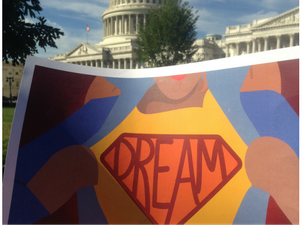
As we prepare for the coming of Jesus, we are reminded of children across the country whose lives are affected by federal policies. Throughout the weeks of Advent, NETWORK will explore the current policy situation of: the Dream Act, the Child Tax Credit, the Children’s Health Insurance Program, and child care for working families. We will share a combination of reflections, prayers, and current news that will help us gain insight into how these policies impact children and their families. We hope you will join us on this journey during Advent while we prepare for the coming of the child Jesus!

“The Word became flesh and made his dwelling among us. We have seen his glory, the glory of the one and only son, who came from the Father, full of grace and truth.”   -John 1:14, NIV

Policy Basics: The Child Tax Credit

  1. The Child Tax Credit is one of the most effective anti-poverty programs in our nation. In 2016, it lifted approximately 2.7 million people out of poverty, including about 1.5 million children, and lessened poverty for another 12.3 million people, including 6.1 million children.
  2. The Child Tax Credit was created in 1997, and historically has had bipartisan support in Congress and from the White House.
  3. The Child Tax Credit includes a refundable component; if the value of the credit exceeds the amount of federal income tax a family owes, the family may receive part or all of the difference in the form of a refund check.  Therefore, many working families can benefit from the credit even if their incomes are so low that they owe little or no federal income tax in a given year.
  4. Research has found that boosting working families’ incomes, as the Child Tax Credit does, can expand opportunities for children, leading to better health, improved school performance, and eventually higher earnings in adulthood.

Source: The Center on Budget and Policy Priorities

A Prayer to Support Children and Families

Dear Jesus,

Advent calls us to be alert to signs of a pending encounter with You.  When that glorious encounter occurs, may we be prepared to respond rightly.

Working together, we encountered You in vulnerable parents and children, and we provided for them.  Would that you might always meet us doing right, being mindful of You in our ways. (Isaiah 64:4)

It is not right for our policies to reward the wealthy while failing to extend the same support to struggling families. We cry out to You from the wilderness of disparate opportunity and pray that political leaders encounter You as they allocate hope to mothers and children. And would that You meet them doing right, being mindful of You in their ways. 

Clearly, proposals to prioritize some families over others based on immigration status affronts Your ways and must be opposed.  Encounter us, dear Jesus, as we struggle to hold leaders accountable to justice for all persons in our country. And would that You meet us doing right, being mindful of You in our ways.

Encounter us, oh Lord, encounter us!  And would that You meet us doing right, being mindful of You in our ways!

In Jesus’ name we pray.

Amen.

Written by Sr. Mary Ellen Lacy, D.C.

Our Challenging National Reality: Facing Our Failure to House Everybody

Our Challenging National Reality

Facing Our Failure to House Everybody
Simone Campbell, SSS
November 24, 2017

I live in Southwest Washington which 13 years ago when I moved in was an undiscovered portion of the District. Rents were affordable. There are housing projects across the street. It was a great multiracial, economically diverse part of town. Then development started with the Nationals’ baseball park and high rise luxury condominiums. When I moved in I had a clear view of the palisades on the other side of the Anacostia River. Now we are being hemmed in with construction of unaffordable condos. This has me worried. Where are low wage working families going to live?

This is not only a DC phenomenon. All of the cities I have visited have the same story. In Indianapolis at the Immigrant Welcome Center’s GED class, I heard of low wage working families being evicted from houses so the owners can sell them to developers. It was impossible for these families to find housing in their old neighborhood and they had to move out of the city.

In Cincinnati’s Over-the-Rhine neighborhood, I was shocked when I visited last year for the first time since 2012. The neighborhood is completely changed. New construction and restored historic buildings line the street. When we met with trainees at Venice on Vine restaurant in the old neighborhood, they spoke of how their community had changed. They were no longer able to live in the area. Services for low income families had moved to other areas. It was difficult to commute because public transit is so spotty and set up for the “old city” not the new reality.

In Milwaukee I met Billy and his wife who, after trying to live with their two sons in their car, decided to pool their salaries for rent and use food stamps and the free dining room at St. Benedict the Moor parish to feed their family. In San Jose, CA, the heart of Silicon Valley, I met parishioners who open their church parking lot/school playground every evening so that homeless families can park their car in a safe place for the night. Almost all of these “car families” have working parents.

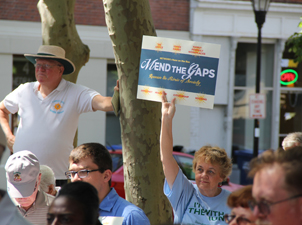
In short, our neighborhoods are transforming before our eyes, and our housing policy cannot handle the current reality. We at NETWORK realized that if we are going to Mend the Gaps in income and wealth disparity, we must address housing policy. There needs to be a new burst of creativity to impact this twenty-first century reality.

Housing is one of those critical issues that has so many ripple effects. The value of housing stock affects property taxes and the amount of money available for local schools. Housing also affects the need for public transit and the ability to be near work. Urban housing policy affects the amount of “green space” and the sense of safety and serenity in a city. Housing affects the ability of families to live free from the fear of being homeless. In short, housing is at the heart of the health of our nation.

In the United States we pride ourselves on being problem solvers. However we are failing our communities on this housing dilemma. First we must begin to pay attention to what is actually happening in our cities, towns, and neighborhoods. Watch for both creative ideas and continuing problems. Talk to your neighbors and asked your local and federal representatives what they are doing to address our lack of safe, affordable housing.

And hold this issue in your reflective prayer. Let us ask the Spirit the question: “Where are you calling us to act in addressing the housing crisis?” Then share with us what you hear. I believe it will be like Elijah who waited for the word in the loud bluster, thunder and lightning and heard nothing. It wasn’t until the gentle breeze that the word of the Spirit came. Let us as a community be attuned to that “wee small voice” so we might find the way forward for the sake of our struggling family.

Originally published in Connection Magazine. Read the full issue here.

Powerful Young Voices for Justice

Powerful Young Voices for Justice

Emma Tacke
November 21, 2017

In early November I had the pleasure and honor of emceeing the 20th annual Ignatian Family Teach-In for Justice (IFTJ).  This was a weekend where over 2,000 students from Jesuit affiliated high schools and colleges gathered in Washington D.C. to learn, celebrate, pray, and challenge one another to “row into the deep,” the theme for the conference. At a time when those in power continue to espouse prejudice, violence, and hate, the need for weekends such as these feel all the more necessary. It was restorative to spend time with such an energetic group of people who shared a common desire to build a more just world with fairer policies and a more empathetic and inclusive culture.

Let me be clear: this weekend was not reduced to a self-congratulatory party where we affirmed each other for being good socially and politically conscious people. This annual gathering was a chance for all who attended to put faith into action. It was a reminder that our commitment to God requires us to be resilient and dogged in the face of injustice.  The call of this year’s Ignatian Family Teach-In beckoned us to “Wake ourselves and others from dormancy” and to not “accept the status quo in either ourselves or our surrounding world . . . we will row into unfamiliar waters that will stretch and challenge us, but ultimately move us to magis, a greater, stronger, and more enduring love of justice.”

This theme of challenging ourselves to be courageous and work for justice was threaded throughout the conference’s breakout sessions. The narrative that we are powerless in the face of systemic injustices such as racism, classism, and institutionalized violence was rejected and tossed aside by dynamic and influential keynote speakers such as Father Bryan Massingale, Sister Patricia Chappell, and Dr. Maria Stephan. The weekend ended with a day of advocacy on Monday when over 1,400 IFTJ participants went to Capitol Hill to advocate for bills promoting criminal justice and immigration reform.

The students I met were engaged, smart, empathetic, and ready to talk about what they could do to be better advocates for justice. They queued up for a chance to speak with Jesuit priest Father James Martin, a celebrity in the Ignatian community. They packed crowded conference rooms to learn about the racial wealth gap, ending the death penalty, changing the civil discourse on immigration, and dozens of other topics. Hundreds of students made their way through the hall to visit the myriad of faith-based organizations that passed out information and advocacy tools.

Millennials are often dismissed as a self-absorbed, politically disengaged generation. As a millennial myself, it’s difficult for me to be objective, but what I witnessed at IFTJ and what I often see from my peers is anything but self-absorption and political apathy.  The momentum and energy generated by the 2,000 students at IFTJ wouldn’t have been possible if this group of young people were not aching to change the world. This desire to make a difference is not limited to IFTJ participants, nor should it be reduced to naiveté or foolish optimism. I am inspired by my peers to seek the truth and confront systemic and social injustice.  When working for justice, progress is often slow and pushing back against oppressive institutions is exhausting. It is not work that can be done alone. This year’s Ignatian Family Teach-In was a call to action many responded to wholeheartedly.

I want to bottle the collective energy I experienced throughout the IFTJ weekend and take a swig any time I feel lacking in courage to continue challenging myself to advocate for justice. There is strength in numbers and the Igantian Family Teach-In is an example of the power collective faith in action can have in the march towards a better future.

Emma Tacke is a former NETWORK Grassroots Mobilization Associate. She currently works as the Associate Director of Community Engagement at Catholic Mobilizing Network (CMN) in Washington D.C.

Anyone Can Lobby

Anyone Can Lobby

Claudia Brock 
November 18, 2017

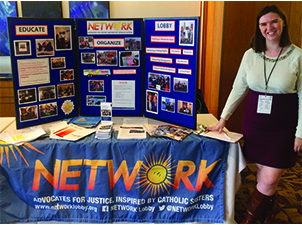
In early November, NETWORK Lobby headed to the Ignatian Family Teach-In for Justice (IFTJ) for a few days of presenting, learning, and networking. As a graduate of a Jesuit university, it was heartening to see so many young people excited about social justice and willing to consider how their values influence politics. To begin the weekend, my colleague, Jeremiah, and I gave a “How to Lobby” presentation to prepare the students for their day advocating on Capitol Hill — the culmination of the IFTJ weekend.

One of my favorite parts of the presentation was when Jeremiah asked who had lobbied before and only a few students in a room of over one hundred people raised their hands. After a few moments, Jeremiah asked again and this time noted that signing on online petition, calling a Member of Congress or tweeting with a political hashtag were forms of lobbying; suddenly every hand in the room was up. At times it can feel like the political process is hard to navigate or so abstract it’s impossible to engage in it, especially as a young person who is not able to vote yet. But it is important to remember that every constituent has personal power in their own voice. It was enlivening to demystify what it means to be politically active through our presentation.

A few of us on the Grassroots Mobilization team at NETWORK had the chance to meet the renowned organizer Heather Booth. When she was asked what it took to be an organizer or make any kind of political change she said, “You just have to love people and hate injustice.” Using Heather Booth’s qualifications, every student at IFTJ and each member of NETWORK’s spirit-filled network has what it takes to enact real change.

As Jeremiah told the students at IFTJ, there are many ways to lobby for justice. If you’re busy working full time or have other responsibilities, it may be most convenient for you to lobby your elected officials by making phone calls. When you call, we recommend mentioning a brief personal reason for why you support or oppose a bill (see more tips here for using email, social media, or for an in-person lobby visit ). Find out how contacting your Member of Congress, using social media and writing letters to the editor are great ways to advocate for social change.  Email [email protected] with any questions, comments, or to report back on how your lobbying goes!

Interreligious Coalition Opposes H.R. 1

Interreligious Coalition Opposes House Republican Tax Bill

Laura Peralta-Schulte
November 16, 2017

Yesterday, the Interreligious Working Group on Domestic Human Needs, a coalition of faith-based organizations, sent a letter to the House of Representatives urging members to vote no on H.R. 1, the House Republican tax bill.

This immoral tax bill prioritize the wealthy at the expense of struggling communities and vulnerable families. It violates our call to care for the most marginalized and to work for the common good. We call on Congress to pass a just tax bill that asks everyone to pay their fair share to invest in our nation.

Read the text of the letter below, or download as a PDF.


November 14, 2017

Dear Speaker Ryan and Leader Pelosi:

As members of the faith community, we know that tax decisions are moral decisions. Taxation choices show who we preference as a nation and who pays the price.  These choices show who and what we care about as a nation. All of our faiths teach us that the center of our concern should be those at the economic margins of our society. Therefore, we, the interfaith community, are speaking with one voice.

We must oppose H.R. 1, the Tax Cut and Jobs Act, because the bill violates our faith values as well as the fundamental issues of tax fairness and fiscal discipline.

First, the Tax Cut and Jobs Act is fiscally irresponsible. It grows the deficit by $1.5 trillion dollars over ten years. Growing deficits and debt threatens not only the fiscal health of our country, but it also threatens future funding for the programs that help countless families put food on the table and provide for their children. This additional $1.5 trillion in lost revenues will lead directly to future cuts in critical anti-poverty programs and low-income services including Medicaid, SNAP, low-income housing assistance, and other critical services for families struggling to make ends meet. The tax system should be structured to support investments in programs that create economic opportunity and dignity for all, especially families struggling to make ends meet. This bill violates the moral responsibility to care for the vulnerable.

The Tax Cut and Jobs Act makes the tax code more regressive. The tax breaks included in the legislation are not targeted to low- and moderate-income individuals. Provisions such as repeal of the estate tax, lower rates for pass-through income, and lower tax rates for income between $480,000 and $1 million will give enormous benefit to those at the top. This proposal is the exact opposite of a moral mandate to focus on those who struggle the most.

At the same time low-income families are left out of the benefits of H.R. 1. The bill increases the Child Tax Credit, but without making the additional credit refundable or making any improvements for low-income households, 10 million children are completely left out of any benefit increase. We have grave concerns about the cuts to the Child Tax Credit and the American Opportunity Tax Credit for immigrant families. We also strongly oppose the way in which H.R. 1 inhibits low-income working families from accessing the EITC, arguably the most effective anti-poverty, pro-mobility program in the country. Yet again this bill fails a basic moral test.

Rather than cutting these key anti-poverty investments for working families, a morally faithful way forward would have Congress

  1. Expanding the Earned Income Tax Credit so that no worker is taxed into poverty,
  2. Expanding the Child Tax Credit for low income workers so that those who need the credit most benefit
  3. Expanding the American Opportunity Credit so that students can more easily afford higher education which is critical for success.

These are faithfully moral choices that Congress can make.

We call on Congress to put the needs of working families and struggling communities first in creating a just tax system.  All our faith traditions call us to prioritize struggling families and vulnerable communities in our laws and policies.  We respectfully ask you to ensure that any tax changes taken as part of our tax debate be based on principles of fairness and shared commitment to the common good.

Sincerely,

Alliance of Baptists

American Baptist Home Mission Societies

Bread for the World

Congregation of Our Lady of Charity of the Good Shepherd, US

Dominican Sisters ~ Grand Rapids

Franciscan Action Network

Friends Committee on National Legislation

Interfaith Worker Justice

Islamic Relief USA

Jesuit Conference, Office of Justice and Ecology

Leadership Conference of Women Religious

MAZON: A Jewish Response to Hunger

National Advocacy Center of the Sisters of the Good Shepherd

National Council of Churches

NETWORK Lobby for Catholic Social Justice

The Poligon Education Fund

Faith Action Network – Washington State

Union of Reform Judaism

United Church of Christ, Justice & Witness Ministries

‘The United Methodist Church- General Board of Church and Society

The Importance of Intentionality

The Importance of Intentionality

Jeremiah Pennebaker
November 15, 2017

What do I owe to the generations coming after me?

I was always taught to “reach back as I forge ahead” in my life and that nobody gets to where they’re going without some help and guidance from those who came before them. So I try and take that to heart, especially when I’m in a position where I can speak about my experiences and expertise.

I had an opportunity to do just that this past weekend at the Ignatian Family Teach-In for Justice (IFTJ),  a conference for members of the Ignatian network  to come together to reflect and advocate for justice. Overall, it was a rewarding weekend of teaching, reflecting and discerning. My fellow NETWORK Associate Claudia Brock and I were tasked with educating various high school and college groups. We had the chance to talk to a multitude of young people who are motivated by their faith and values to engage in the political process throughout the weekend. Seeing their passion to learn about and do justice was very inspiring. At times I really felt that I was living up to that idea of helping those after me to move forward. I shared my knowledge and experience, provided them with insight on my position at NETWORK and told them how they can become NETWORK Associates one day.

What I failed to realize is that I would learn more from them than they would learn from me. The students at IFTJ taught me valuable lessons and inspired me to be a better pioneer for justice. I was particularly inspired at a session on what it means to be a feminist. I saw a big group of Black boys walk in, something I would have thought to be impossible, as it took me until my senior year of college to grasp the importance of feminism. So often I had heard and witnessed the lack of respect that men have for women — specifically in my friend circles– but to see a group of Black high school boys interested in feminism gave me some hope. I listened to a panel on immigration and heard one of the most heartbreaking stories of my life about a woman who lost her family to insidious immigration policies and procedures. I watched as the woman regained her resolve and spoke about how she continues to push forward even in the most daunting of situations.

I learned not only from hearing the experiences of others, but also by presenting at the conference. After my session on the Racial Wealth and Income Gap, I was critiqued by a young group of Black and brown students. Their feedback made me realize that I need to do better job of being intentional when I am attempting to “reach back as I forge ahead.” While presenting on the Racial Wealth and Income Gap, I made the mistake of only thinking about how my message impacts the white students in the audience. In my mind, I had only considered how the white students needed to learn about the horrific sins of the past and how the subject of racism is woven into our federal policies. I failed to account for the experiences of those who are too often the only person of color in the room.

I forgot about the times when I wished I wasn’t in history class surrounded by pale faces talking about how their ancestors didn’t think mine were people. I forgot what it felt like to feel singled out because slavery this and redlining that. I forgot that for the select few in the audience this was their daily experience and not just some educational exercise. I forgot maybe because I had become numb to being the token, a position I was placed so often. I realized that does not mean that I should irresponsibly place others in that position. I owed it to these students. They shouldn’t be forced to deal with both the reality of their situations and the potential condescension and or guilt of their white counterparts. I realized that it was my burden to bear as a facilitator to try and alleviate them from that difficult position in whatever way that I can. I realized that I need to hold myself more accountable to the people who look like me because I know they already have it hard enough.

I learned a lot from IFTJ. I learned what I could do to be a better example for the generations after me. I learned that as hopeless as the media may make the world look, there are too many people of all ages working for justice that I refuse to believe it.

Congress Must Prioritize Affordable Child Care for Families

Congress Must Prioritize Affordable Child Care for Families

Tralonne Shorter
November 9, 2017

On September 14, two leading Congressional champions for children —Senator Patty Murray (D-WA) and Representative Bobby Scott (D-VA)—introduced the Child Care for Working Families Act (S. 1806/H.R. 3773). The bill would make high-quality child care affordable and accessible to lower- and middle-class families under 150 percent of the state median income level by capping costs at 7 percent of a family’s budget. The bill would focus on preparing 3- and 4-year-old children for kindergarten and make new investments in training child care professionals.

NETWORK supports this bill because our faith teaches us that children are a gift and blessing from God. Working families are stretched beyond their means and struggle to meet day-to-day expenses like housing and utility expenses. In 33 states child care costs rival college tuition.  Between 2007 and 2014 the median worker’s wages and compensation declined, respectively, by 4.0 and 1.9 percent. High-quality child care is simply unattainable for most families.  That is unacceptable. The Child Care for Working Families Act would help alleviate this burden on working families and help more children enter Pre-Kindergarten and Kindergarten on track and prepared to meet core competencies in reading and math.

There is growing support for the Child Care for Working Families Act including from: 28 Senators, 98 Representatives, and more than 20 national advocacy organizations.  Despite this strong support, the bill faces an uphill battle for passage since there is no support from Congressional Republicans. Additionally, the GOP-majority under the leadership of President Donald Trump, Speaker Paul Ryan, and Senate Majority Leader Mitch McConnell has prioritized passing tax cuts for the super wealthy, raising the deficit by $1.5 trillion on the backs of our children and working families. The GOP tax reform legislation does very little to help working families who are desperately in need  of tax relief such as refundable tax credits for child care and housing.  The Child Care for Working Families is a better alternative to tax proposals that would widen the wealth and income gap, and we encourage Congress to pass S.1806/H.R. 3773. The joy of raising a family should not be overshadowed by the rising costs of child care.

Here are three ways for you to act:

  • Explore NETWORK’s position on Women and Families (Mend the Gaps)
  • Sign the Moms Rising Child Care for Working Families petition
  • Read Senator Patty Murray’s blog on why she introduced the Child Care for Working Families Act

Being a Woman of Color in the Trump Era

Being a Woman of Color in the Trump Era

LaTreviette Matthews
November 8, 2017

Historically our country has viewed women and people of color –especially those on the low end of the socio-economic scale– as second-class citizens.  Never before, however, had I experienced so many emotions for just being me than I did after the 2016 election. The first thing I felt was a tremendous amount of fear. After the election, there seemed to be a rise in hate crimes and attacks on unarmed men and women of color. I did not want to leave my house. Subsequently the fear left me and I turned to anger. I felt angry that after having an African American president for two terms, now in the year 2017, people of color were still being treated like they are less deserving of being in this country than everyone else. I felt the pain of my ancestors and was ready for war against white supremacy and white privilege.

When fighting for the right to self-determination, people of color have endured pain and resistance. I did not want to do things the old fashion way by engaging in non-violent protests, boycotts, demonstrations, and marches. I vacillated between fight and flight, all the while determined to protect myself and my family at all costs. My emotions were beginning to change again. I was in limbo. I was still angry but now angry with a purpose. I wanted to do something. For centuries people of color have tried many forms of fighting back against racism and injustice. I wanted to do something that was going to make a difference. This presidential election was the catalyst for my ferocity. Uncertain of my future and armed with a fierce determination, I sought community support.

Before last year, I did not consider myself a political person. I did vote in the last five presidential elections; I felt it was important for my vote to be counted. However, for presidential elections held before then, I was uninterested in social political activism and did not understand the importance of having my voice heard through voting. Although I was aware that people fought very hard in this country for African Americans to vote, it did not dawn on me that my voice would make a difference today. Growing up as a young woman of color, I did not have someone like Sister Simone at my high school or college to discuss my political views, encourage me to go to a protest, or show me how joining a political group could make a difference. I thought the political stuff was best left up to the adults.

I believe everything happens for a reason. I am convinced that this backlash against Obama’s presidency happened in order to shake things up and to awaken people to the injustices happening in this country; injustices that have gone on for far too long. Aside from racism, sexual harassment and assault, just to name a few, are issues that have impacted me the most following the 2016 election. Over the past five years working at NETWORK, I have become more political in my views, more involved, and more “WOKE.”  As a woman of faith, I know that life and death are in the power of the tongue. As a woman of color, I know the double standard that comes with freedom of speech.

Today, social media and “fake news” seem to have surpassed the reach of traditional media. In spite of its limitations, social media has become a platform for getting voices heard. To that end, I commit to using my platforms to hold people accountable for their actions. I have joined racial justice groups and forums in hopes to educate myself and others about racism and the challenges that people of color face in the United States. Today I am more hopeful and more connected. Women of all races are rising up and raising their voices. This makes me proud to be a woman of color in the fight for racial justice and social justice.

Legislative Update: House Passes Partisan CHIP Bill

House Passes Partisan CHIP Bill

Lucas Allen
November 6, 2017

Last week, on Friday, November 3, the House passed H.R. 3922, the CHAMPIONING HEALTHY KIDS Act, by a vote of 242 – 174. The legislation includes much-needed funding for the Children’s Health Insurance Program (CHIP), Community Health Centers, and other healthcare programs. Unfortunately, it also included deep cuts to public health funding, risky changes to Medicaid and Medicare financing, and new barriers for families to access affordable health care coverage in the private marketplace. It is unacceptable to pay for children’s coverage with cuts that will hurt the health of others.

Tara Straw from the Center on Budget and Policy Priorities analyzed one harmful aspect of the bill:

“The legislation’s shortened grace periods would hurt low- and moderate-income individuals and families who miss even part of a payment for any reason, such as a costly home or car repair. It would leave well-intentioned consumers with too little time to catch up on premiums when they fall behind and would lock people out of coverage for the rest of the year, raising the number of uninsured.

We shouldn’t take coverage away from other low-income people to pay for essential health priorities like extending CHIP, which provides health coverage for children in low- and moderate-income families, and funding for community health centers, which provide health care for more than 27 million people.”

Read more: Up to 688,000 Would Lose Insurance Under House Bill from the Center on Budget and Policy Priorities

Now, it is up to the Senate to pass a bipartisan bill to extend funding for CHIP without the harmful offsets in the House bill. We urge them to pass the Keep Kids’ Insurance Dependable and Secure (KIDS) Act of 2017 in a bipartisan way. For health policy to serve the common good, we must not cut funding from one group to preserve coverage for another.

Finding Beauty in Difference

Finding Beauty in Difference

Caitlin Wright
November 3, 2017

Everything is so…white, I couldn’t help but think as I emerged from the 72nd Street Broadway metro station on the Upper West Side. Not only were the people strikingly white, but the buildings, the sidewalks, everything was gleamingly ivory. The streets of Brooklyn that I had grown accustomed to were far away, both in distance and memory, as I converged with the other white women of one of the wealthiest areas of Manhattan. Though I was not sporting Givenchy or Prada, it was odd to think that superficially, I had much more in common with these people than with residents of the other boroughs. Yet I felt the most uncomfortable I had since moving to Bedford-Stuyvescent, a neighborhood of Brooklyn, as a Jesuit Volunteer a month and a half prior. I pounded the pavement — my attempts to look like a native New Yorker typically consist of me walking quickly in a distinct direction — toward the Church of the Blessed Sacrament to see a talk with a Jesuit priest that others and I admire very much: Father James Martin.

In his talk, Father Martin spoke about his most recent publication, Building a Bridge, a monumental piece of literature for the Catholic Church. In Building a Bridge, Father Martin reflects on the essential bond the Church must nurture between members of the Catholic faith and the LGBT community. After the lecture, I could not stop thinking about the discussion surrounding the concept of “the other”. Jesus calls us toward the marginalized, toward the oppressed, and toward those in need. He calls us not toward ignorance, nor denial, nor pity for those who are different, but toward solidarity; toward true empathy that we are unified as children of God. Your neighbor, whoever he/she/they may be, is inextricably bound to you through God’s love. As Father Martin said that night, “There is no ‘other’ for Jesus. There is no ‘us’ and ‘them’. There is only us.”

In no way am I disregarding the essential recognition of those who are different from you or me, but we must see the beauty in these differences rather than allowing them to become divisive. It is far too easy to allow ourselves to see each person superficially, especially in this political climate. Even Jesuit juggernauts like Father Martin are facing massive backlash for efforts toward unification that are manipulated into cruelty and spite. Class consciousness only prevails in the greatest efforts toward understanding, when we ask a question and sincerely listen to the answer without malice. And it is only with this class consciousness that we can achieve a faith that does justice.

I thought about this as I exited the church back into the Upper East Side, questioning the judgements I had held about the diverse neighborhoods of the largest city in the world. On my train back to Brooklyn, I asked myself, had I been too self-righteous in thinking that I already knew it all? Was I inserting myself into a community with preconceived assumptions, allowing existence of the “other” to remain? When I arrived in Bed-Stuy, I promised myself that I would ask more of these questions, and challenge myself to see beyond. I am called to act with justice, not only as a Jesuit Volunteer, but as a child of God, and this call asks me to love and serve by being with others, side by side, in solidarity. Whether I am with my clients, my housemates, my neighbors, the people in my subway car, or even the Upper East Siders, the matter remains: there is no “us” and “them”. There is only us.

Caitlin Wright is a Jesuit Volunteer serving at Catholic Migration Services in Brooklyn. She is originally from Prior Lake, MN and graduated from Creighton University in May of 2017.