


Not Our Parents’ Economy
The Basics of Good Jobs and Affordable Housing are Luxuries We Can’t Afford
Lydia Nelson
June 24, 2026
I know four postgrads. One of them works at Menards after one year of job hunting. One gave up on the United States and moved back home to Colombia. The other two aren’t faring much better.
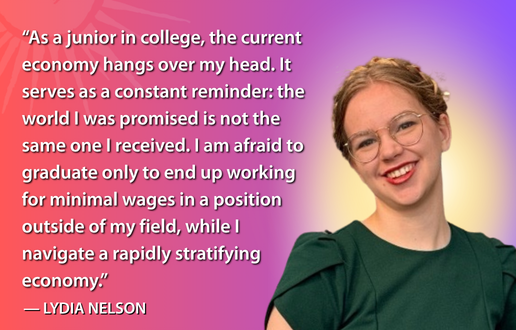
None found a career in their field of study. As a junior in college, the current economy hangs over my head. It serves as a constant reminder: the world I was promised is not the same one I received. I am afraid to graduate only to end up working for minimal wages in a position outside of my field, while I navigate a rapidly stratifying economy.
Affordability is one of the most popular political platforms right now, and it isn’t difficult to see why. Working progressives and conservatives alike all feel stress. Our “low hire, low fire” economy makes it quite difficult for those who are not already employed to find new work.
The unemployment rate sits at 4.4%, slightly above the FED’s target of 4%. More worryingly, the United States lost an astonishing 90,000 jobs in February of 2026. Job cuts impacted a wide range of sectors, from construction, to service, to administration and support services.
For the employed, the likelihood of holding their position is promising. The likelihood of being fairly compensated is not. The U.S. Bureau of Labor Statistics reported real average hourly earnings increased only 0.3% from March 2025 to March 2026. While any amount of increase is better than the alternative, hourly earnings increasing less than a full percent is a far cry from the increases before the 2008 financial crisis.
The current political climate is unlikely to offer a good solution. But that doesn’t mean we’re without solutions. The minimum wage has not increased since 2009. The average living wage in the United States is $32.50 an hour. A minimum wage increase to $15 (or more) would still be an improvement on the current $7.25 federal standard.
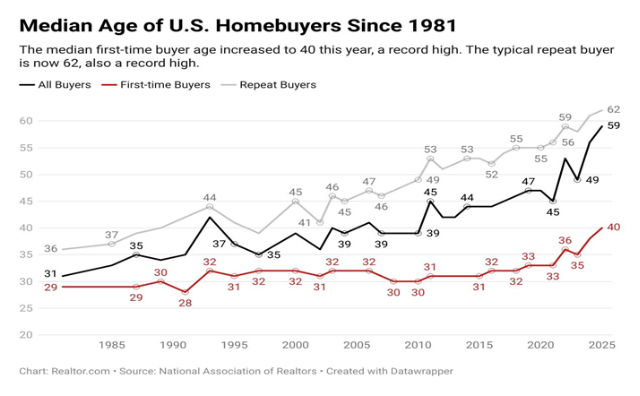
Meanwhile, housing inflation is through the roof, leading non-homeowners, even those with stable employment, to doubt if they will ever own homes. Policies incentivizing construction and repair, offering affordable mortgage programs, and increasing public housing options all increase housing supply. This in turn lowers demand and inflation. The 21st Century ROAD to Housing Act—the most comprehensive housing legislation the U.S. has seen in a century—aims to do just this. It focuses on supply, aiming to increase the amount of property on the market.
As the ruling class gets smaller while the percentage of wealth they possess grows, so does our imperative to keep our eyes on affordability policies. Billionaire tax cuts, rampant privatization, and other trickle-down neoliberal economic policies are traps that take advantage of vulnerable and scared voters. The One Big Beautiful Bill Act, passed in 2025, is only one example of predatory policy. The bill’s policies mean middle-income households will face a likely net income loss of “1.2 percent, or $1,300, in 2027.” Meanwhile, the top 1 percent will enjoy “a net income increase of nearly $5,000.”
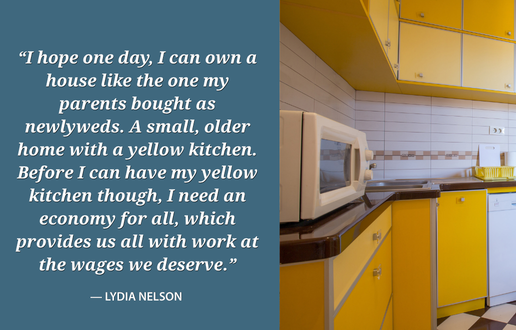
Policy solutions to mitigate our economic straits do exist. They are not perfect, nor are they guaranteed to come to fruition, but they are out there. They offer hope to unemployed new grads, struggling workers, the shrinking middle class, and everyone in between. I hope one day, I can own a house like the one my parents bought as newlyweds. A small, older home with a yellow kitchen. Before I can have my yellow kitchen though, I need an economy for all, which provides us all with work at the wages we deserve.
Lydia Nelson is a student at Loras College in Dubuque, Iowa and a Sr. Carol Coston, OP Fellow in NETWORK’s Young Advocates Leadership Lab (Y.A.L.L.).