

Category Archives: Front Page

Texas v. Azar: One Court Ruling Could Affect the Lives of More Than 20 Million People

Texas v. Azar: One Court Ruling Could Affect the Lives of More Than 20 Million People

Anne Marie Bonds
October 9, 2019

Passed in 2010, the Affordable Care Act (ACA) was meant to decrease the number of uninsured people in the United States. Too many people simply hoped to stay healthy every day, avoiding hospitals and ambulances because they couldn’t afford thousands of dollars in medical bills. The ACA has made insurance accessible for over 20 million people since 2010 and has helped even more by making preventative care, such as annual physicals, free. It also prohibits all insurance companies from discriminating against people with pre-existing conditions, meaning people who are already sick cannot be rejected because of their illness.

For the last seven years, Republicans attempted to repeal the ACA numerous times through the legislative, executive, and judicial branches. In 2017, the repeal of the ACA came down to one vote in the Senate. Senator John McCain’s historic thumbs down vote effectively ended the Republican movement to repeal the ACA through legislation.

Now, the ACA is at risk again. This time, it is back in the courts. In February 2018, twenty Republican-led states filed a lawsuit, Texas v. Azar, to invalidate the ACA. Now, the lawsuit has made its way up to the 5th Circuit Court of Appeals, which is only one step down from the Supreme Court. The 5th Circuit is expected to make a ruling sometime this week, a decision that could potentially shake the nation’s entire health system.

If you know me you would probably ask: Anne Marie, why do you care so much about the Affordable Care Act? You’re an upper-middle class, 22-year-old white girl from Alabama. How has the ACA affected your life in any way? Well, the short answer is that it hasn’t. Not directly. I’ve been covered under my parents’ employer health insurance since I was young, and I’ve had the privilege of never needing to worry about how my medical bills were going to be paid. In fact, I never really cared about Obamacare until November of 2013, when I realized how the ACA impacts every single person in our nation.

In November of 2013, my father was diagnosed with ALS, or Lou Gehrig’s disease. It’s a terminal, degenerative disease that slowly atrophies muscle over time. Those with an ALS diagnosis have 3-5 years left to live, but for many, those years are not pleasant. Before my Dad got sick, he worked in an aluminum plant, and when he was diagnosed, he had to quit his job because he couldn’t lift anything anymore. Because of this, he lost his employer’s health insurance coverage, as many with ALS do.

Without the ACA, my father would not have been able to find private insurance, as insurance companies could have easily denied him due to his pre-existing condition. Thousands of ALS patients are dependent on this non-discrimination clause within the ACA to receive care that can prolong their lives for months. Without the ACA, ALS patients are left without a safety net and no way to pay for their care. Other people with chronic conditions, such as multiple sclerosis, fibromyalgia, and heart disease, depend on the ACA to protect them from private insurance discrimination. Although 20 million people directly depend on the ACA to provide them with quality, affordable health insurance, an innumerable amount of people in the U.S. depend on the ACA indirectly by prohibiting pre-existing condition discrimination and making preventative care services free.

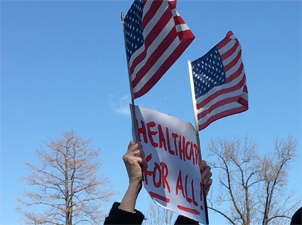
Depending on how the 5th Circuit rules, there’s a good chance we’ll see this case in the Supreme Court next year. Although conservatives would have you believe the ACA only helps the uninsured, in reality, the positive effects of the ACA extend to almost every person in the nation. The ACA has faced a bevy of criticism for nine years, even though it is a vital aspect of our nation’s health care system. It is time to stop our partisan arguing over the ACA. It is time to stop making the health of our people an ideological argument. It is time to support the ACA and work to stop those who continue attempting to repeal and destroy it.
Affirmation in the Workplace

Affirmation in the Workplace

Ness Perry
September 27, 2019

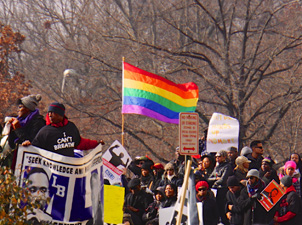
As a young adult working at a YMCA in a Southern California suburb, I never thought that being out in the workplace was safe. I had come out to my friends, my family and most importantly myself. But, I wondered all the time whether my coworkers knew, and if they did, would say anything to my boss? More seriously, would the clientele think differently of me because I worked with children? Conservative parents are notorious for having perverse thoughts about queer-identified people in the childcare industry. Needless to say, I lived in fear of being fired and ousted by my community for being queer and proud at work. So, I vowed never to talk about my identity at work.

As a new staff member at NETWORK, I found that being out at work is not just accepted, it’s celebrated. I don’t know how I lived in the shadows (or in the closet) for so long because of how comfortable I am now. This organization proudly affirms me, my identity, and who I love. As I write, however, I realize how big of a privilege it is to even be able to write this. In little under a month, the Supreme Court will hear a case to decide the constitutionality of employment discrimination on the basis of sexual orientation.

Bostock v. Clayton County, Georgia will be heard on October 8, 2019. This case is not a question of whether the law permits discrimination, it is a question about respecting human dignity. As individuals, we have the right to be ourselves one hundred percent of the time — this includes identifying as LGBTQ+ all the time. I am scared, though. What if our human dignity is not protected under the law? What if my queer siblings and I cannot live in peace without the fear of discrimination? We cannot let the courts, nor any administration revoke the rights that we have been working to gain for so long. I began identifying myself as queer in the workplace because I realized that Marsha P. Johnson did not sacrifice her life for me to be scared.

A verdict will be announced soon, and we cannot and will not be afraid of a negative outcome. Queer is invincible; it is resilient, and we will overcome just as we have many times before. Perry v. Hollingsworth was the first time the Supreme Court overturned a state decision to put a ban on marriage equality. This case proved that we can make progress, but we must unite as a coalition of citizens loving and affirming those affected while being dedicated to social justice efforts.

Honestly, I never thought a faith-based organization would be the place I can present myself in such an authentic way. NETWORK proudly affirms the dignity of all people and the reality that LGBTQ+ people like myself are in need of protection under the law and within the social sphere. When I walk into my workplace, I am queer. When I am working, I am queer. When I am advocating for the rights of others, I am queer. There is no political force nor law that will bar me from being myself, unapologetically.

Advocating for Policy Change on Capitol Hill

Advocating for Policy Change on Capitol Hill

Sr. Emily TeKolste, SP
September 26, 2019

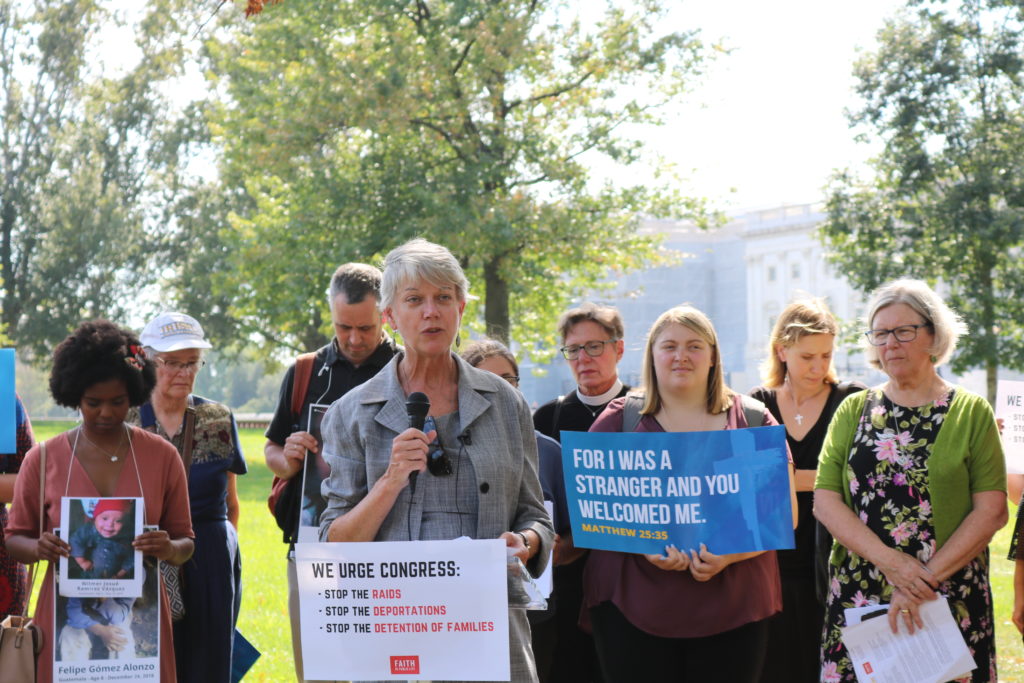
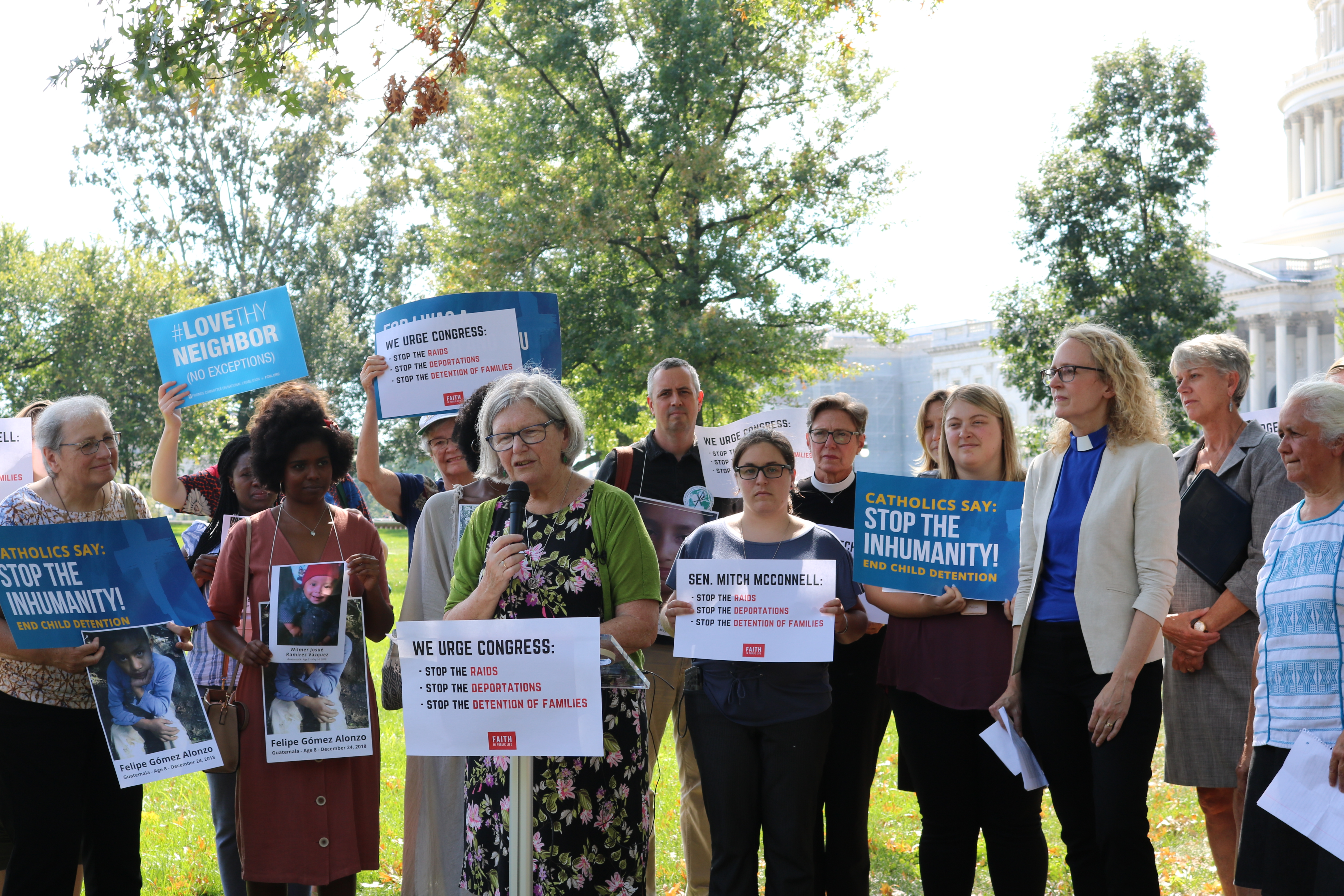
As climate leader Greta Thunberg scolded international leaders at the United Nations and protesters shut down the streets in D.C., NETWORK and our partners hosted a rally and press conference on Capitol Hill. Following the rally, we delivered a letter to several key Senators challenging them to address the injustice in our current immigration system through the ongoing appropriations process. It’s not quite as exciting as shutting down streets or risking arrest (as Catholics and others have previously done in both D.C. and Newark), but distinct policy proposals – actionable requests of our elected officials – are also important.

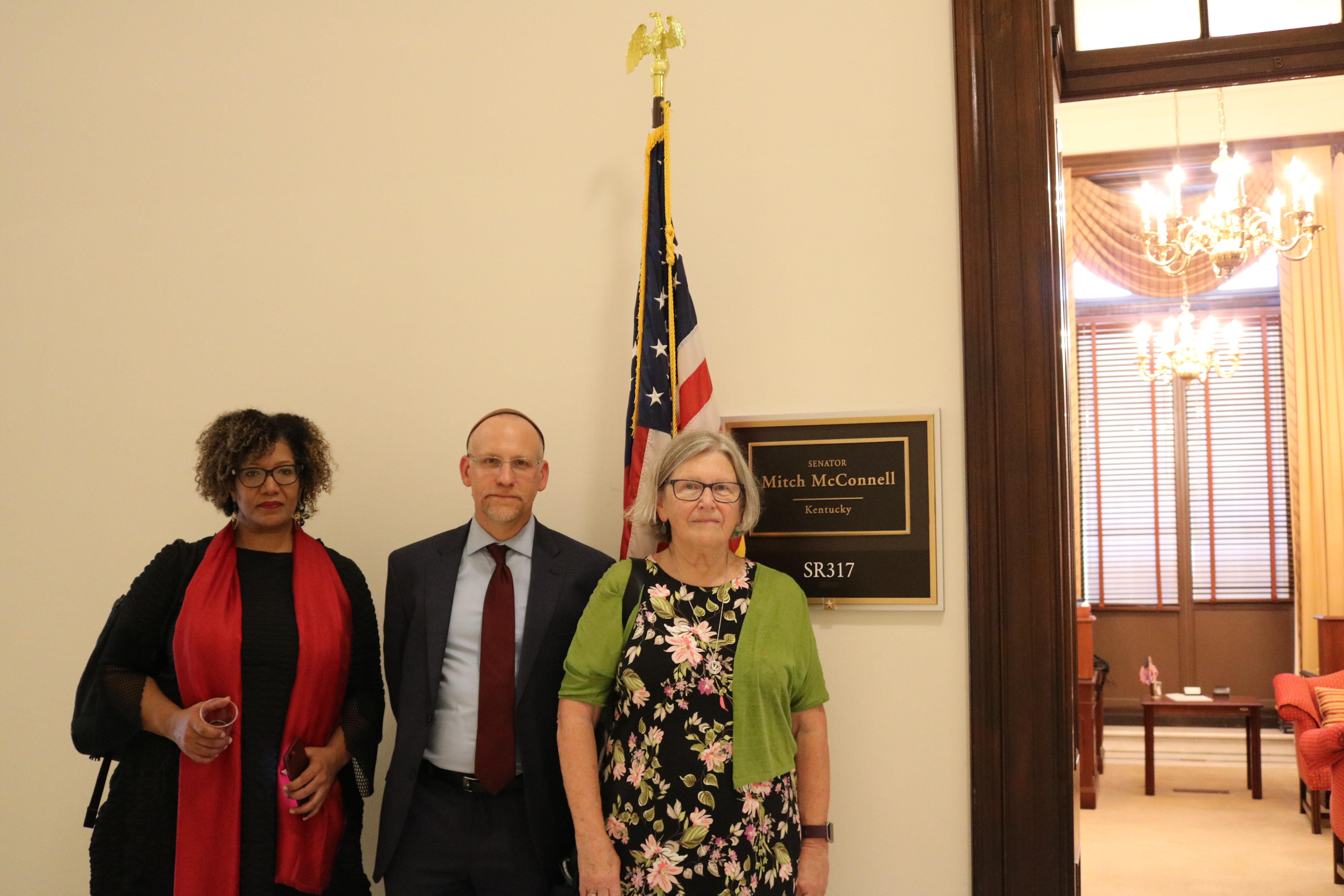
For my first experience advocating on Capitol Hill, I joined Charlotte Hakikson, a Grassroots Mobilization Associate, and Kathleen and Dan from the Maryknoll Office for Global Concerns to deliver letters to Senators Collins (ME) and Manchin (WV). We called on the Senators to use the appropriations process to shift funding away from detention, deportation, and border militarization to refugees, asylum, and alternatives to detention, and to exert robust oversight over the use of appropriated funds. Shifting the public conversation around immigration lays the groundwork for change, but specific legislative asks will shift the reality of our policies. We do this work of justice-seeking together as we demand more of our nation and our leaders.

As climate change drives refugees and asylum seekers from their homes, we must continue to stand and say, in the words of Greta Thunberg, “We will not let you get away with this!”

Sister Quincy Talks Faithful Democracy on Capitol Hill

Sister Quincy Talks Faithful Democracy on Capitol Hill

Colleen Ross
September 25, 2019

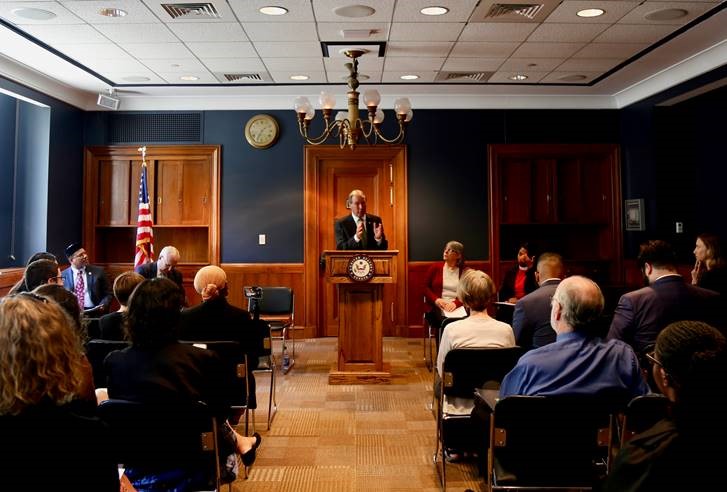
Last Friday, Sister Quincy Howard, OP joined New Mexico Senator Tom Udall and interfaith partners on Capitol Hill to discuss democracy reform efforts. Video of the discussion can be found here.

From Senator Udall’s website:

“There is a direct link between our broken campaign finance system and our voting rights system that puts up barriers to the ballot box, and the issues of concern to the faith community,” Udall said. “Issues like gun violence, food security, economic justice, and climate change. The American people, in overwhelming numbers, want Congress to address these issues. But we are not because the representatives in Congress are not representing the American people…We need to put an end to the idea that money equals free speech.  And that corporations are people.  And reign in an out of control campaign finance system.”

The Faithful Democracy Coalition is an inter-denominational campaign that began in the wake of the Citizens United decision.  The Coalition advocates for ending the dominance of big money out of politics, examining the issue from both a faith-based and legislative perspective, and focuses their campaign on the issues of climate change, gun violence prevention, immigration, and private prisons.

“The faith community recognizes how our democratic processes are corrupted at every level: from gerrymandering to voter suppression to campaign finance to foreign intrusion,” said Sr. Quincy Howard, of the NETWORK Lobby for Catholic Social Justice. “In a secular democracy, elections are the closest thing we have to a sacrament.  NETWORK Lobby and our faith partners call on our government to restore the people’s faith in our democratic systems by securing our elections, ensuring fair representation of the people, and rooting out the corrupting influence of money in politics.”

Read more:

https://www.tomudall.senate.gov/news/press-releases/_photo-and-video-udall-leads-discussion-with-interfaith-leaders-on-democracy-reform

The Loretto Community Works to Mend the Gaps

The Loretto Community Works to Mend the Gaps

Alice Kitchen, Loretto Co-member
August 29, 2019

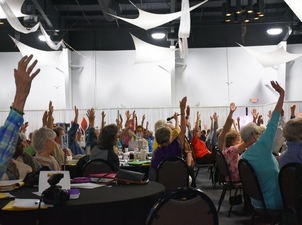
Recently, the Loretto Community went through a period of dialogue and discernment about how we can mend the gaps within our sphere of influence. Our considerations were guided by NETWORK’s 21st Century Poverty guide. Sisters and Co-members of the Loretto Community gathered in 19 community groups from California to New York. The groups discussed raising the hourly pay of low-wage workers to a livable wage. Each group’s job was to explore the issues facing low-wage workers in the communities where they live.

We already knew that low-wage workers undergird daily life in our communities. Low-wage workers care for children, staff nursing homes, and keep our airports functioning. Often these women and men have no steady schedule and have little control over their hours. Many work more than one job to get by. Their employers often have no regard for the multiple jobs they are juggling or their childcare needs. In our study, we learned that the cost of housing, transportation, childcare, and utilities far exceed the hourly incomes of most low-wage workers.

The need for these discussion groups emerged from our Loretto Assembly in August 2018. There, the community group in Kansas City put forth a proposal for the whole Loretto Community to hear, consider and vote on. The proposal advocated for Loretto administrators to “review the compensation of all our employees, working toward the goal of providing a living compensation package as nearly as is sustainable with our financial resources.”

Attendees from all over the U.S. and two overseas countries participated in the bi-annual Loretto Assembly. Participants were vowed members, Co-members, and Loretto employees, all of whom had previously affirmed the goal of a pay structure for all Loretto employees based on justice as a mission priority.

Last summer’s proposal was a spur to move forward on this goal. As a follow-up in January 2019, Loretto leadership approved an $1.50 an hour pay increase for Loretto Motherhouse and Infirmary employees and a 2 percent increase for those same employees who had worked 1,000 hours or more in 2018.

The next step in this ongoing process is collecting the thoughts and ideas of all 19 community groups and determining how to take this commitment to the next level. Much of Loretto’s social justice work lies in persuading decision-makers to make needed changes in both our living rooms and in the halls of power. We hope, therefore, that we can find ways to change our own community and beyond.

Some Loretto groups have natural allies in their communities where they can team up to support raising wages at either the local or state level. We are following the Raise the Wage Act (H.R. 582) in Congress and sending out alerts to call our Representatives in support of the bill.

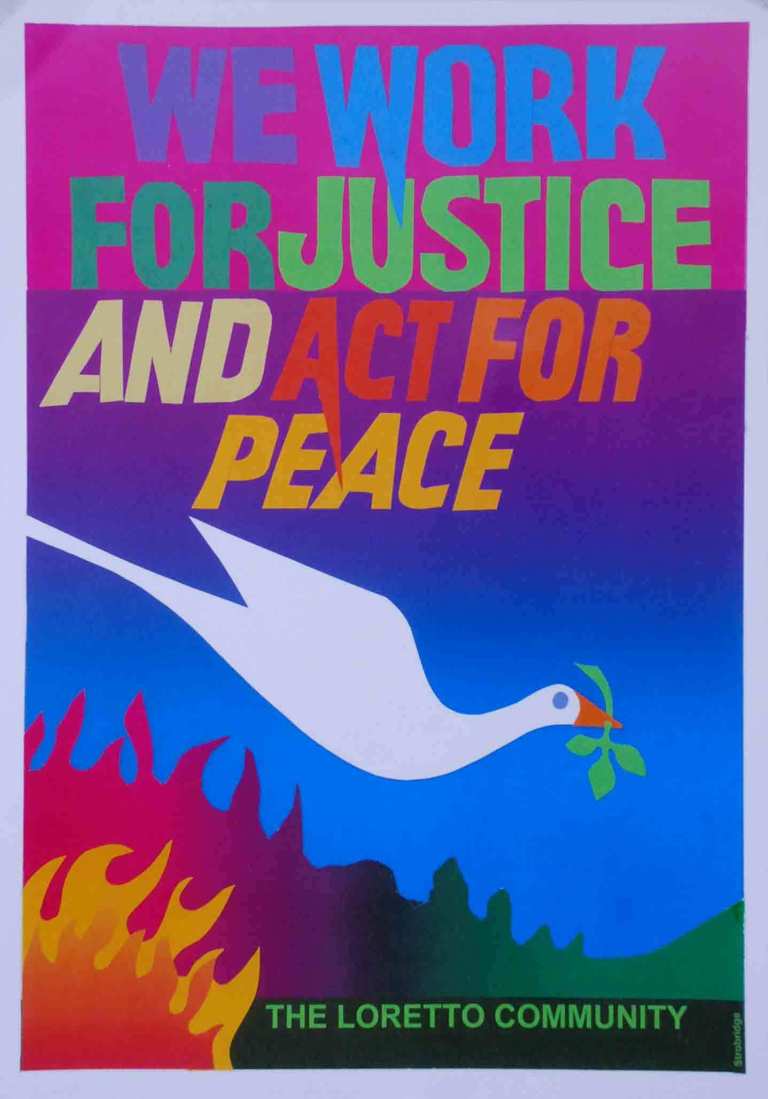
This is all about living our Loretto mantra: We work for justice and act for peace.

______________________________________

Alice Kitchen is a Loretto Co-member as well as a NETWORK Board member. She is based in Kansas City, Missouri.

This story was originally published in the July 2019 issue of Connection magazine. Read the full issue.

HUD Housing Rule Hurts Families

HUD Housing Rule Hurts Families

Elisa McCartin
August 27, 2019

This blog continues explaining the various rules changes proposed by the Trump administration which would hurt our country and make it harder to mend the gaps. Read blogs about additional proposed rules here:

Redefine the Poverty Line
Joint Employer Rule

President Trump’s Mixed-Status Family Housing Rule

The Department of Housing and Urban Development (HUD) released a proposed rule change that would prohibit families with one or more member who is ineligible from receiving HUD public housing or housing subsidies from accessing both these services—essentially barring mixed-status immigrant families from public housing. The NETWORK community submitted over 600 comments to HUD during the submission period which closed on July 8, 2019, strongly opposing the measure on behalf of our members and the immigrant community.

If implemented, the rule change would impact the 25,000 families with one or more ineligible member residing in HUD public housing. These families would be forced from their homes, displacing 108,000 people even though 70 percent are eligible to receive HUD services. Among the 108,000 to be evicted, 55,000 are children. Since these families already rely on subsidized housing, it is extremely unlikely they will be able to find replacement homes that they can afford. As a result, homelessness across the country will increase, dramatically harming the physical, economic, and psychological wellbeing of immigrant families. Such a policy reflects absolute neglect of the immigrant community. As one of the richest nations around the world, America ought to extend compassion and kindness to our neighbors. The Department of Housing and Urban Development has demonstrated a complete lack of grace and humanity with this proposed change.

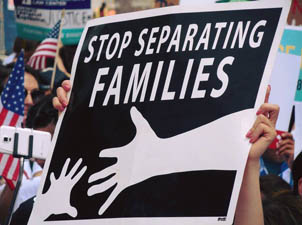
Since thousands of families will face acute homelessness, this rule would force families to have to choose between their housing and staying together as a family—a truly inconceivable decision. To force families into this situation is immeasurably evil and cruel.

To defend their position, HUD’s leadership has presented this rule change with the argument that removing mixed-status immigrant families from public housing will open up more housing for U.S. citizens. This position is extremely misguided. Implementing this rule change would cost HUD millions of unnecessary funds, eliminating even existing affordable housing options. Under the current system, HUD pro-rates the housing subsidy per family based on the number of eligible members in each family. Families with more eligible members receive higher subsidies than those with fewer eligible members. With the proposed rule change, HUD would no longer be able to pro-rate any of its subsidies since every resident would be fully eligible to receive HUD benefits. A HUD report itself concluded that this would cost HUD $227 million. The same report noted that in order to cover these added costs, HUD would either have to reduce the quantity and quality of the public housing it offers or turn to taxpayers to foot the bill. The likelier scenario of reducing public housing availability would directly harm all residents of HUD housing and eliminate any chance of expanding public housing. The alternative of forcing taxpayers to pay off HUD’s debt is no better—hardworking individuals and families should not carry the burden of a sloppy, unnecessary, and underhanded HUD rule change.

NETWORK is committed to seeking solutions to the public housing crisis in the United States. There is an undeniable need to expand public housing options and reduce prices in order to substantially mend the gaps in our society. Instead of proposing measures that will limit public housing options and evict immigrant families, NETWORK urges HUD to find solutions that meaningfully address root causes and affirm their commitment to expanding affordable housing to every person in our country who needs it. We will continue to oppose HUD’s brutal proposal and defend immigrant families. Housing is a human right.

___________________________________________________________________________________ 

Elisa McCartin is a NETWORK volunteer and student at Georgetown University. 

Understanding VAWA’s Importance for Native Communities

Understanding VAWA’s Importance for Native Communities

Laurel J. Robertson, Odawa Tribal Member
August 26, 2019

For a long time, I was really unaware of the severity of Indigenous missing, murdered, and abused women and girls in the USA and Canada until it hit close to home.

I was aware and appalled, as most are, by the large number of women and girls of all races who are affected by this tragedy. Then, my husband and I were invited to a walk in support of these women and girls on a nearby reservation. Under a canopy, pictures and stories were displayed of a few of the victims, both survivors and murdered. But most disturbing was the fact that most of these cases were unresolved. A short time after that, a friend of ours’ granddaughter was raped, beaten, and killed. Because our friend is a well-known and famous person, the killers were finally apprehended. But for average Indigenous families, the prospect of finalization and justice for their loved ones is not as certain.

So I started to study and read what I could find on the subject. As it stands, almost every Native woman will experience violence: 8 in 10 Native women will be raped, stalked, or abused in the course of a lifetime. Prosecuting these crimes is difficult. The vast majority (96%) of crimes against Native victims are committed by non-Natives. Due to a complex web of federal laws and statutes, tribes have long been unable to prosecute non-Natives who commit their crimes on tribal land.

The 2013 Violence Against Women Act reauthorization changed that — to some extent — by restoring tribal jurisdiction over non-Native perpetrators of domestic violence and dating violence. However, the 2013 bill excluded tribes in Alaska and Maine from this expanded jurisdiction and excludes non-domestic violence related crimes from tribal jurisdiction including child abuse, sex trafficking, rape, or murder.

I can go on with the statistics and numbers, but my emotions start to get involved. Tribal nations must also have the ability to advocate for their citizens living in urban areas. This courtesy is extended to all other sovereign nations. When a citizen is killed while living or traveling outside their nation, the nation is notified of their death and can advocate for their citizen’s case. This basic respect must be afforded to tribal nations. Currently, this is not extended, and rarely is a tribe notified or given access to the data regarding their tribal citizens.

All of these facts and numbers are accessible online from the National Congress of American Indians. The emotion is from the real life stories that have been lived and shared with me over the years.

I hope that drawing attention to the violence will help bring change.

Legislative Update

In April 2019, the House of Representatives passed an expanded Violence Against Women Act (VAWA). This VAWA reauthorization legislation would strengthen protections and expand access to justice to even more victims of abuse.

Key provisions of the 2019 House VAWA bill include: increased protections for unmarried victims from dating violence, expanded access to justice for Native victims of all crimes committed by non-Native perpetrators, and finally closing the “boyfriend loophole.” This legal glitch fails to extend for dating partners or former partners the prohibition on the purchase or possession of guns that is enforced for domestic abusers who are (or were) married, living with, or co-parents with the victim of abuse.

Unfortunately, partisan politics in the Senate has stalled further legislative action for this expanded VAWA reauthorization, placing victims in undue danger.


Mrs. Laurel J. Robertson is Secretary of the All Nations Veterans Council of Detroit, Treasurer of Turtle Island Dream Keepers of Monroe, Michigan, and a member of the Monroe County Community College Diversity Committee. Her tribal affiliation is Odawa.


This story was originally published in the July 2019 issue of Connection magazine. Read the full issue.

Joint Employer Rule Moves DOL Backwards

Joint Employer Rule Moves DOL Backwards

Elisa McCartin
August 23, 2019

The Trump administration has announced many harmful rules changes in the last several months, including Joint Employer rule change explained below. This blog follows our previous blog about the Trump administration’s proposal to re-define the poverty line. Read that blog here.

Proposed Joint Employer Rule Change

On June 25, 2019, the Department of Labor (DOL) closed its commenting period on a proposed rule that would alter Section 791 of the Fair Labor Standards Act (FLSA), which governs joint employer liability. The proposed rule would create a four question standard to determine if one is legally considered a joint employer and is liable for their employees, making it dramatically more difficult to hold putative employers accountable.

In its current form, the FSLA stipulates that employers must be “not completely disassociated” in order to be considered joint employers who share liability of an employee. The DOL’s plan is to update this criteria based on a Court of Appeals case Bonnette vs. California Health and Welfare Agency (1982), to include a higher standard that requires employers to share direct control over an employee in order to be considered liable. Under this standard, to be considered a joint employer, one must have the power to 1) hire or fire the employee 2) supervise and control the works schedule of conditions of employment 3) determine the employee’s rate and method of payment and 4) maintain the worker’s employment record. In 2015, the D.C. Circuit Court ruled in the case Browning-Ferris Industries of California vs. National Labor Relations Board (NLRB) that indirect control of an employee is sufficient to qualify someone as a joint employer. Despite this more recent precedent, the Trump Administration is trying to revert back to this outdated legal framework from the 1982 Bonnette case.

By adopting this higher standard, the DOL would make it nearly impossible to prove that a putative employer should be considered a joint employer and thus held accountable for their employee’s treatment. American workers in contract labor positions often work under the jurisdiction of someone who does not directly control the terms of their employment, but oversees their daily activities and work environment. Holding people in these positions accountable for workplace conditions, treatment and environment of the people working under them would become extremely difficult to litigate against if the DOL goes through with the proposed change. Unjust conditions such as organizing restrictions, discrimination, and harassment would all essentially become state-sanctioned. Moreover, collective bargaining would become obsolete, as only employers are legally required to allow workers to bargain. As a result, this rule change has the potential to radically shift work-place power dynamics more heavily in favor of employers at the expense of employees’ rights and protections.

Every person has the right to work in a safe and nurturing work environment. By making harder to prove that putative employers should be considered joint employers, it will be increasingly difficult to ensure employees work in fair conditions. Pope Francis reminds us that we must create moral and ethical economies which protect workers and our environment. The DOL’s proposal only further elevates the managerial class at the expense of workers, who deserve equal protections and enforcement by the government. We cannot operate businesses in good faith without ensuring there are strong mechanisms in place to protect employees.

This proposed rule change represents the Trump administration’s continued efforts to chip away at worker protections and undermine the working class. At NETWORK, we recognize the dignity of all workers. We acknowledge the gross injustices at hand in the American workforce. We will continue to stand in solidarity with workers and organized labor to put an end to the rampant injustice that further weakens the most vulnerable and powerless in our society.

___________________________________________________________________________________ 

Elisa McCartin is a NETWORK volunteer and student at Georgetown University. 

We Are Truly One Body

We Are Truly One Body

Economic Interdependence Shows the Depth of Our Connection to One Another
Sister Simone Campbell
August 22, 2019

One of my favorite spiritual realities is that we are the body of God. All of us together make up the image of the Divine. We have different parts to play in the body, but we all serve in order to allow the other parts to function fully.

This image came to mind as I was at one of our rural roundtable listening sessions. Folks were talking about the challenge of being a farmer and only getting income once or twice a year when you sell your crops. This means that (unless you have other income) you have to stretch that money across the whole year. Dairy farmers around the table spoke up and said that in the dairy business they are paid more regularly because they sell their milk every day. For them, however, the challenge is that milk prices are so low that it is almost impossible to stay in business. The way the dairy farmers talked, it was faithfulness to their cattle that kept them going.

These farmers told us one of the big deterrents to family farms is the fact that many bills, like healthcare premiums, come on a monthly basis. This system is designed to work for salaried employees but not farmers.

I began to see that other businesses in farming communities then have different business models depending on how well the crops do on the market or the price of milk. Farming communities live, by necessity, in an interdependent economy of which I as a life-long “city person” was unaware.

As the conversation continued, I realized the Earned Income Tax Credit (EITC) is an essential boost to rural economies. When families receive their tax returns, they can make purchases at local businesses that they would not otherwise be able to afford. This boosts the local economy and supports families.

It is this interrelationship that makes me know the living, breathing reality that we are one body. We are profoundly connected both economically and socially. The Earned Income Tax Credit, and the ways we organize our tax code, are one specific instance where we can see this interdependence.

This same reality of community interdependence exists in our nation’s urban areas, but it is more difficult to see because of the size of the economy. In areas with larger economies, the EITC’s impact for the families that receive it is significant, but businesses are less likely to notice a distinct impact. Still, the impact is there.

However, while the Earned Income Tax Credit aims to supplement low-wage earners’ income and succeeds on many counts, there are some gaping holes in the system. The EITC as it is currently designed leaves out childless adults as well as people who earn less than $3,000 in a year from salaried employment. Those who fall into these categories and are left out are struggling mightily to thrive and flourish in our nation. AND small businesses in their communities are struggling too. This is how we are “one body” in our nation. We are interconnected.

For this reason, we at NETWORK believe we must expand the Earned Income Tax Credit. Doing so will benefit families and entire communities. The benefit is felt most directly in rural communities, but it is also true in cities and suburban neighborhoods. We are connected in this one body.

Therefore, we are working with partner organizations, Members of Congress, our NETWORK members, and advocates across the country to expand the Earned Income Tax Credit and other tax credits to benefit families who are working but still not getting by in our nation. We are advocating for a tax policy that does a better job of helping the households and communities most in need. The one, interconnected body of our nation requires everyone to flourish for our nation to succeed. Federal policy should ensure that all of our families can live in dignity. Expanding the EITC would be one more step towards meeting our communal duty to our neighbors.

This communal duty is at the heart of the Gospel call to love one another. Oh one body, let us respond to the needs of our sisters and brothers and make this change for the common good.


This story was originally published in the July 2019 issue of Connection magazine. Read the full issue.

Putting More Money in the Pockets of Working Families

Putting More Money in the Pockets of Working Families

U.S. Senator Sherrod Brown
August 21, 2019

People in the United States are working harder than ever before to make ends meet. But the cost of everything – from childcare to prescription drugs to a college education – is up, while wages are largely flat.

That’s why I led my colleagues to introduce the Working Families Tax Relief Act. This plan will cut taxes for workers and families by expanding the Earned Income Tax Credit (EITC) and Child Tax Credit (CTC).

Research has shown that these credits are two of the most effective tools we have to put money in the pockets of working people, pull children out of poverty, and help families with the cost of living. EITC and Child Tax Credit are simple to administer, and they give families in the United States what they need most – extra dollars. We worked to expand the EITC and make it permanent in 2015, and the following year, it lifted nearly six million people out of poverty.

As Americans filed their taxes this spring, more and more people saw President Trump and Congressional Republicans’ tax scam for what it really is – a handout to millionaires and billionaires at the expense of working families. Many families didn’t get the large refunds they were expecting, and some even owed money. Our plan is targeted directly to working families, and would boost the incomes for more than 114 million Americans.

And while the president’s tax scam left out 26 million children, our bill would fix that by making the Child Tax Credit fully refundable for the first time, helping to lift three million children out of poverty. The plan would also create a new Young Child Tax Credit, to provide families of very young children extra help when they need it most. Families would receive an extra $1,000 for each child under age five, up to $3,000 per family, because research shows investing in children in these formative years can set children up for success later in life.

The Working Families Tax Relief Act would also make sure workers can no longer be taxed into poverty. Right now, five million young workers without children are taxed into or taxed deeper into poverty. These are young people working hard at jobs that don’t pay high wages – they’re too young to qualify for the EITC under current law, but they still get hit by state and local taxes, and those taxes can push them below the poverty line. Our plan raises the maximum credit for these workers, and expands the age range to cover all workers from age 19 to 67.

Our plan would also stop families from having to turn to predatory payday lenders in an emergency, by allowing people to draw a $500 advance on their EITC. Right now, 4 in 10 Americans say they couldn’t afford an emergency expense of $400 without borrowing money. And we know what so often happens to those families – they’re forced to turn to payday lenders or car title lenders, and become trapped in a cycle of debt. A one-time, interest-free advance on people’s EITC payment would give families a real alternative. The plan would also establish minimum competency standards for paid tax preparers, to give families better peace of mind that they won’t get ripped off during tax season.

Right now, Democrats are united around this plan, and we want Republicans to join us.

Many of my colleagues on both sides of the aisle have said over and over that they want to cut taxes for working Americans and support families. We have a plan to do it, and put more money in the pockets of millions of families.

_________________________________________

Senator Sherrod Brown is represents the state of Ohio and is a champion of middle-class families. Senator Brown supports workers and just trade policies and is proud of his work to help pass the historic health care law that made health insurance more affordable and accessible for American families. Informed by his faith as a member of the Evangelical Lutheran Church in America (ELCA), Senator Brown is committed to social and economic justice.

This story was originally published in the July 2019 issue of Connection magazine. Read the full issue.