

Category Archives: Front Page

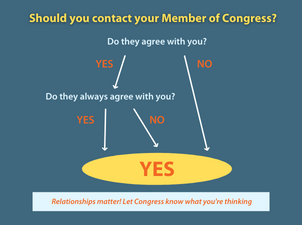
Yes, Please Contact Your Member of Congress “Even If”

Yes, Please Contact Your Member of Congress “Even If”

Catherine Gillette
February 16, 2022

As a NETWORK organizer, I spend a lot of time talking with our field about how they can most strategically engage to advance our policy priorities.  We discuss tactics like making phone calls, sending emails, writing letters to the editor, attending town halls, hosting rallies, canvassing in their communities, and so much more.  In these conversations, folks often have questions about how to choose a tactic or implement it successfully. However, more than anything else, folks ask me…

“Should I still contact my Member of Congress even if they ALWAYS agree with me?”

or

“Should I still contact my Member of Congress even if they NEVER agree with me?”

My response is always the same, “YES! Absolutely! Please, please, please! Call them! Email them! Let them know what you are thinking!” And here is why…

If your Member of Congress “always” agrees with you, contact them! Here’s why…

  • Every point of contact is an opportunity to be in relationship with your Member of Congress and their staff, and we know that relationships are POWERFUL. You want them to know exactly who you are and what you believe in. You want them to pick up the phone when you call and help you to get the lobby visit that you need.  You want to be viewed as a both resource and trusted messenger.  Relationships are power.
  • There’s always the opportunity to address an angle or perspective that they might have not considered before. Several years ago, one of my NETWORK Advocates Teams met with a Democratic Senator’s staff about the importance of fully funding the U.S. Census.  The staff indicated it was the first time anyone had addressed the issue with them but promised to investigate it further. That same Senator ended up being a HUGE advocate for making sure the U.S. Census had the funding it needed to be successful. Members of Congress and their staff work hard and are very knowledgeable about many things.  However, it is a mistake to assume they know everything: you could be the one to bring an issue or piece of legislation to their attention!
  • Members of Congress have to make hard choices about what gets included in legislation. Even if they generally agree with you, it is important for them to hear what YOUR policy priorities are. If they are picking from a list of 25 generally good priorities, you want them to pick the 5 that matter most to you. Similarly, it can be an opportunity to tell them where you’d like to see them provide leadership.
  • Stories are powerful, and Members of Congress want to hear them! I am convinced that one of the major strengths of NETWORK’s field is how connected our members and supporters are to their communities. You all know and love your neighbors so well.  You know, in a very real way, how different policies might help or harm your community.  Members of Congress need to hear that. They need to hear about the lived experiences of their constituents.  Furthermore, it’s not uncommon for them to then take those same stories to the Floor to share them with their colleagues.  Again, stories are powerful!
  • Share your faith perspective! It is important to let Members of Congress know that people of faith care about an issue and are holding them accountable on it. This can be particularly important if another group from your faith perspective is advocating on the other side of an issue.  Help them to understand that your faith does not take a singular position.  You can be the one to provide them with cover! Beyond all that, it is particularly powerful if you can get a group of folks from diverse religious traditions advocating together on an issue.
  • You better believe they’re getting calls and emails from folks with perspectives different than your own. Members and their staff need to hear your perspective too!
  • Working for a Member of Congress is a tough job. Supportive calls mean a lot to staff morale!

If your Member of Congress “never” agrees with you, contact them! Here’s why…

  • Even if you don’t always agree with one another, relationships are POWERFUL. Many of our advocates have found that a relationship with the local state or district level staff is both possible and meaningful (as long as they are respectful in sharing their views).  In the past, these relationships have helped our advocates both to more easily schedule lobby visits with staff and to better understand a Member of Congress’ policy position (which often helps the NETWORK staff). Plus, you never know, you may agree on something! That leads me to my next point…
  • It is possible to find common ground! In 2021, NETWORK hosted a Virtual Lobby Day focused on the EQUAL Act (legislation addressing racial sentencing disparities in the criminal legal system).  As part of this event, over 120 NETWORK advocates went on 50 lobby visits with both Democratic and Republican Members of Congress.  In the days following the event, the EQUAL Act gained 10 new co-sponsors (3 Republicans and 7 Democrats). Don’t give up—your Member of Congress might surprise you!
  • You can help gather intel for NETWORK. If your Member of Congress opposes a piece of legislation, find out why! Do they have a specific concern? Is it something we can fix? As constituents, you sometimes have more information available to you than the NETWORK staff.  Your report-backs can help us tremendously!
  • Stories are powerful! Share your stories, and share your community’s stories! Remind them of the impact of their actions. You never know what seeds you will plant or what the impact will be.
  • Share your faith perspective! It is important to let Members of Congress know that people of faith care about an issue and are holding them accountable on it. This can be particularly important if another group from your faith perspective is advocating on the other side of an issue.
  • Changing policy positions is possible! My favorite example is related to health care. As it turns out, Americans like having their pre-existing conditions protected and aren’t shy about saying so.  They called their Members of Congress en masse, wrote letters to the editor, rallied, and marched in the streets! A 2018 Kaiser Family Foundation poll even found that 75% of respondents supported the Affordable Care Act’s protections for pre-existing conditions.  In response, a number of GOP candidates suddenly came out in loud support of same the protections they had once fought to end. It was all due to public opinion and pressure!
  • As people of faith, we are people of hope. The work of advocacy is often long and difficult, but we can take comfort in knowing that we don’t journey alone. We are accompanied in our efforts by NETWORK advocates from across the nation and are guided by the many saints who have come before us.  Most importantly, the Holy Spirit is present with us each time we pick up the phone, write an email, or attend a rally. With that in mind, I believe it is possible to change hearts, minds, and votes!

Finally, in our increasingly polarized society, it seems like everyone puts their Members of Congress into one of these two categories.  If we write our elected officials off that easily, they will never hear from us! So, YES, please contact your Members of Congress even if they “always” agree with you or “never” agree with you. Your advocacy matters!

Mom Taught Me: To Love Your Neighbor Is To Suffer For Them

Mom Taught Me: To Love Your Neighbor Is To Suffer For Them

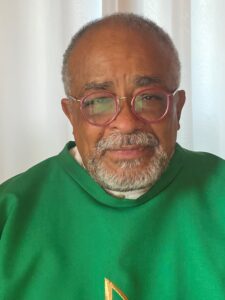
Deacon Art Miller
February 14, 2022

“I wanted to talk to you over dinner tonight. There’s something very important that your dad and I are going to require of you.”

This was not the normal dinner banter my family and I had at the dinner table back in 1957. My brothers and I – aged 9, 11, and 13 – normally fought over who would get the best piece of whatever we were having that night, playfully teasing one another as our 18-year-old sister Carol dismissed us with sisterly disdain.

Deacon Art Miller is a permanent deacon of the Archdiocese of Hartford, Connecticut.

After a glowering look from our father, Mom continued: “There’s a country in Africa, called South Africa that has a system of governing the people that is horrible and evil. It’s called apartheid. It means to separate. They require that their Negro citizens carry passes with them at all times. These passes are so they can make sure the Negro people don’t go anywhere they are not supposed to go. The Black people have no rights. They can’t vote. They are put in jail and are treated very poorly.”

My older brother Pete, whose friend and classmate at McCosh Elementary School was Emmett Till, was suddenly quiet.

He found his voice and whispered; “That sounds a lot like Mississippi.”

Mom responded; “Yes, it does. That’s one of the reasons we in this family, are going to protest, like they are doing in the South. There’s a company here in America that’s helping the South African government create these passes. The name of the company is Polaroid. They make a camera that makes a picture instantly. So the government of South Africa is buying these cameras to make it easier to create those dreadful passes. So we are not going to allow anyone to bring a Polaroid camera into our home. We will not buy one, and we don’t want anyone to take your picture with one. Do you understand?”

We all quickly agreed with the family mandate.

Mom was rarely so severe. She was an elegant woman, profoundly intelligent and deliberate, but always gentle in her approach to our learning. We knew she was very, very serious. Even Dad was quiet, almost bowing his head in deference to her passion.

I looked up to see a most remarkable thing, rare for a man who was as impassionate as she was passionate. He reached out and touched her hand, very gently. Almost startled by the gesture, Mom smiled at him. He returned the smile and removed his hand from hers. With that it was done. Polaroid Corporation had lost a customer.

That company would never know that a Black family in a little third floor apartment on the south side of Chicago had taken a stand against a horrid injustice. The South African government, more than 8,000 miles away, had no idea nor could it care that this little family had stood up against its ungodly tyranny. But we did. We knew.

That night I learned what social justice truly meant. We learned there was a new and important way to love your neighbor, even if you didn’t know them. Even if you had never met them, they were still your neighbor. We learned on that long ago night that to love your neighbor was to suffer for them.

This idea of deep love was embodied by our mother. She was a friend to Mamie Till-Mobley, Emmett’s mother. We prayed for her and Emmett when all the terrible things happened. The women in the neighborhood had brought food and comfort to Ms. Mobley during those days of torment.

Mom particularly embraced our Catholic faith as a safe harbor during that time, where she found the comfort only God can provide. In every difficult moment we faced, her faith got us through. We, that small family from the south side of Chicago, learned well the tenets of our faith, that faith is never restricted to the Sunday morning Mass.

Our faith is not static but transportable. We are to apply our faith to the moments we live outside the building we call church. For we are the church, we are where the deposit of faith is to be made manifest. We are the church that lives in the world which breaks down anger and injects love, which enables generosity to overcome selfishness, which causes humility to be more important than pride.

The church lives as long as our faith lives.

Deacon Art Miller is a permanent deacon of the Archdiocese of Hartford and former head of the archdiocese’s Office for Black Catholic Ministries, which has since closed.

Learn About the Three Sentencing Reform Bills Moving Through the Senate

Learn About the Three Sentencing Reform Bills Moving Through the Senate

Min. Christian S. Watkins
February 11, 2022

Members of the US Senate are currently considering a package of three sentencing reform bills already approved on a bipartisan basis by the Senate Judiciary Committee. Senate passage of The First Step Implementation Act (S. 1014), the Prohibiting Punishment of Acquitted Conduct Act (S. 601), and the Covid-19 Safer Detention Act (S. 312) would make meaningful if incremental, progress toward a more just criminal legal system. Sentencing of those who have been found guilty of wrong-doing must be based on values that honor human dignity, sanctity, and the allowance for redemption. However, our system for sentencing those convicted of crimes has for too long borne no relation to these values, resulting in prisons that are heavily populated by Black, Indigenous, and other people of color.

Over the last 30 years, the United States has come to rely on its criminal justice system and lengthy prison terms more than any other nation.  With just 5% of the world’s population, the U.S. holds nearly a quarter of the world’s prisoners, including one-third of all women incarcerated worldwide.

The ACLU has reported [1] that the United States has the highest incarceration rate in the world. In 2019, approximately 2.1 million people were in adult correctional jails and prisons around the United States. Many thousands of people, disproportionately people of color, are cycled in and out of state jails or prisons every day.

Extreme sentencing laws and practices are keeping people in prisons for far longer than ever before. The result is that more people are spending more of their lives in prison than at any point in U.S. history. Over-reliance on incarceration is fiscally unsustainable and has imposed a burdensome human toll and a disparate impact on African American and Latino persons and communities.

The federal prison population has increased nearly 800% since 1980 and more than doubled since 1994, with spending up 1700% during that time, and federal prisons are currently operating at 131% of capacity. This is due to a significant degree to the proliferation of mandatory minimum sentences.  Nearly half of all federal prisoners are serving sentences for nonviolent drug crimes. [2]

There is consensus across the political spectrum that our criminal justice system is out of balance and in need of significant reform. Many states have enacted bipartisan “smart-on-crime” reforms that achieve significant cost savings and reduce crime. Now, it is time for these reforms to be made at the federal level.


Eliminating a Quantifiably Unjust Application of the Law (EQUAL) Act of 2021 (S.79)

Introduced by Sen. Corey Booker (D-NJ) on January 28, 2021, this bipartisan legislation that seeks to eliminate the disparity in sentencing for cocaine offenses, established in 1986 when Congress passed the Anti-Drug Abuse Act–a major contributor to mass incarceration–and apply retroactively to those already convicted or sentenced. Congress set a 100:1 disparity, sentencing crack cocaine offenses at a higher level even though the drugs are nearly identical chemically and comparable in physiological and psychoactive effects. Although it did not address the disparity fully, Congress passed the bipartisan Fair Sentencing Act of 2010, which reduced the disparity to 18:1 for pending and future cases only. The change was not made retroactive until the bipartisan First Step Act of 2018.

Prospective Impact: The Sentencing Commission [3] estimates that approximately 827 offenders each year would benefit from this section of the bill.2 The current average sentence for those offenders is 74 months. The estimated new sentence for those offenders would be 43 months.

Retroactive Impact: Approximately 7,787 offenders in BOP custody would be eligible to seek a modification of their sentence based on this section of the bill. The Commission estimates that up to 7,644 offenders would receive a reduction in their sentence. [3] The current average sentence for these offenders is 173 months. The estimated new sentence for these offenders would be 100 months


First Step Implementation Act of 2021 (S. 1014)

Introduced by Sen. Richard Durbin (D-IL) on March 25, 2021, this bill would further the goals of the First Step Act of 2018 (FSA) by correcting unfairness that has resulted in implementation and interpretation errors that contravene the spirit of the FSA by:

  • Allowing courts to apply the FSA’s sentencing reform provisions to reduce sentences imposed prior to the enactment of the FSA;
  • Broadening the safety valve provision to allow courts to sentence below a mandatory minimum for nonviolent controlled substance offenses if the court finds the defendant’s criminal history over-represents the seriousness of the defendant’s criminal record and the likelihood of recidivism;
  • Allowing courts to reduce sentences imposed on juvenile offenders who have served more than 20 years;
  • Providing for the sealing or expungement of records of nonviolent juvenile offenses; and,
  • Requiring the Attorney General to establish procedures ensuring that only accurate criminal records are shared for employment-related purposes.


Prohibiting Punishment of Acquitted Conduct Act of 2021 (S. 601)

Introduced by Sen. Richard Durbin (D-IL) on March 4, 2021, this bill would end the perverse practice under which federal courts consider acquitted or dismissed charges as aggravating factors when imposing sentences for convictions. It would do so by:

  • Amending 18 U.S.C. § 3661 to preclude a court of the United States from considering, except for purposes of mitigating a sentence, acquitted conduct at sentencing, and
  • Defining “acquitted conduct” to include acts for which a person was criminally charged and adjudicated not guilty after trial in a Federal, State, Tribal, or Juvenile court, or acts underlying a criminal charge or juvenile information dismissed upon a motion for acquittal.


Covid-19 Safer Detention Act of 2021 (S. 312)

Introduced by Sen. Richard Durbin (D-IL) on February 12, 2021, this bill would clarify and expand the eligibility for the Elderly Home Detention Pilot Program (introduced by the FSA), including explicitly naming COVID-19 vulnerability as a basis for compassionate release under this program. It would do so by:

  • Clarifying that the percentage of time served required for the Elderly Home Detention Pilot Program should be calculated based on an inmate’s sentence, including reductions for good time credits (H.R. 4018, which passed the House by voice vote last Congress);
  • Expanding the eligibility criteria for the Elderly Home Detention Pilot Program to include nonviolent offenders who have served at least two-thirds of their term of imprisonment;
  • Clarifying that elderly nonviolent D.C. Code offenders in BOP custody are eligible for the Elderly Home Detention Pilot Program and that federal prisoners sentenced before November 1, 1987 are eligible for compassionate release;
  • Subjecting elderly home detention eligibility decisions to judicial review (based on the First Step Act’s compassionate release provision); and
  • Providing that, during the period of the pandemic, COVID-19 vulnerability is a basis for compassionate release and shortening the period prisoners must wait for judicial review for elderly home detention and compassionate release from 30 to 10 days.

There are too many people in prison serving unnecessarily long sentences.  These people are not a threat to the public and serving inhumanely long sentences actually reduces their chances of becoming productive law-abiding citizens.  We must support shorter sentences when appropriate.  These bills are not only appropriate, but also imperative.

Events of the past few years have illuminated the systemic inequalities in our country’s criminal legal system. At NETWORK, we cannot continue to tolerate racial profiling, police brutality, the loss of another generation to mass incarceration, or the perpetuation of poverty. As we Build Anew, we affirm the truth that every person is entitled to dignity and equal justice under law. It is time for Congress to act and take a firm stance against institutional racism embedded within the criminal legal system bypassing the First Step Implementation Act, the Prohibiting Punishment of Acquitted Conduct Act, and the Covid-19 Safer Detention Act.

[1] Sentencing Reform | American Civil Liberties Union (aclu.org)

[2] Federal Sentencing Reform (americanbar.org)

[3] Prison and Sentencing Impact Assessment for the EQUAL Act of 2021 (ussc.gov)

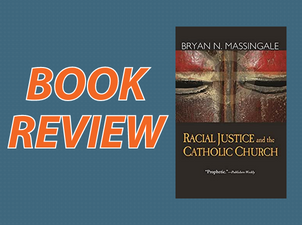
Book Review: “Racial Justice and the Catholic Church”

Book Review: “Racial Justice and the Catholic Church”

Sister Emily TeKolste, SP
February 11, 2022

Since the 2010 publication of Racial Justice and the Catholic Church, Fr. Bryan Massingale has made a name for himself as the premiere voice on racial justice in the Catholic Church. Twelve years after its publication, Racial Justice and the Catholic Church holds up to its original review from Publishers Weekly as “Prophetic.”

Massingale’s prescient perspective even predicts the overwhelming white backlash that led just over a year ago to an insurrection against the U.S. Capitol. His most important contributions, though, are that racial justice needs to be an essential identifying mark of Catholic faith; about the deep work that needs to be done to ensure Catholic spaces are truly catholic; and why this matters for each of us – not just for Black Catholics.

With a thoroughness of an academic ethicist, Massingale defines his terms and goals. The assumption that he is writing an introductory text, though, does not take away from his willingness to drive straight to the heart – and the challenge – of the topic. Racial Justice and the Catholic Church is neither an endorsement of past (inadequate) efforts nor a wholesale repudiation of what the tradition has to offer.

With an authenticity that comes from his ability to be a voice that offers so much to the whole Church (People of God), Massingale highlights “the valuable and essential contributions of the black experience – the experience of creating meaning and possibility in the midst of the crushing ordinariness of American racism – can make to Catholic faith and theology.”

This last point is critical: the perspectives of Black Catholic theologians matter not just to Black Catholics or to theologies around racial justice; they have so much to teach all of us about theology in all areas. Yet the practical challenge is that there are relatively few Black Catholic theologians (mostly because of systemic exclusion). Thus, as Massingale explores in the fifth chapter, too often Black Catholic theologians are invited almost exclusively to speak on issues of racial justice – with an ignoring of their expertise on all areas of theology. We are all worse off for this.

Also critical is Massingale’s emphasis on action. The statements from the USCCB, he points out, too often lacked power because they never entered into catechesis and no resources were invested in creating offices to implement the charges.

“We cannot offer what we do not ourselves genuinely believe,” he says. “Too often, the Catholic faith community is ‘catholic’ in rhetoric and aspiration alone. Becoming genuinely ‘universal’ in our welcome will entail dying to the ‘empty promises’ of racial and social privilege” (178). So what practical things can we challenge ourselves to do? He gives us some ideas: Sing in another language. Pray in another idiom. Welcome darker faces into church leadership. Imagine new configurations and possibilities of being ‘church’ that are not dependent on our racialized values and idolatrous identities.

There is so much else Massingale has to offer for conversation in Racial Justice in the Catholic Church. It is worth reading – and inviting others to join you in a book discussion. And maybe you can start to find ways to engage in a truly universal faith tradition, embracing the Paschal Mystery that life comes after death – in this case, death to white supremacy.

Hear more from Fr. Bryan Massingale at NETWORK’s upcoming event, “White Supremacy and American Christianity” April 9 at 12:30 PM Eastern. Register for the event here. 

Let Us Dream: January Community Conversation

Let Us Dream: January Community Conversation

Virginia Schilder
February 9, 2022

On Thursday, January 27, members of the NETWORK community joined together for our first Community Conversation of 2022. The theme was: “Let us Dream — Reflecting on 2021; Dreaming about 2022 and Beyond.”

The evening’s topic was inspired by Pope Francis’ book, Let Us Dream: The Path to a Better Future. NETWORK Executive Director Mary Novak welcomed community members, saying, “This is the time of year to remember and dream. And it is a sacred gift to do it in community.”

The facilitator for our conversation, Colin Longmore, NETWORK Grassroots Outreach and Education Specialist, spoke with excitement about the possibilities for the upcoming year of advocacy. He described the intention of this conversation as a space to look back on the year behind us and to dream together about the year ahead — to connect what we’ve learned to our hopes and our goals.

Colin explained that while NETWORK community conversations usually feature a guest speaker or a presentation from a NETWORK staff member, for this conversation, the community was the “featured speaker.”

The reflective element of this community conversation aligned with the emphasis on learning and deep listening that characterizes the synod on synodality launched by Pope Francis last year. It also parallels the reflection that NETWORK is undertaking as we celebrate our 50th anniversary, thinking intentionally about who we are and where we came from so that we can work toward our future with clarity. As Mary Novak said, “Our quest to the future must begin with remembering.” And this remembering, in particular, entails examining the consequences of being founded as a predominantly white organization, and how NETWORK lives out its commitment to racial justice in our political ministry today.

The instructions for discussion were simple yet bold: “Dream big and dream detailed!” We broke into small groups to discuss the questions: What were your top three learnings of 2021, and what are your top three hopes for 2022? Together we responded to these questions across personal, local, and societal levels.

In our discussion, a major “learning of 2021” was a realization of the fragility of our democracy, and the grave effects and injustice of voter suppression. Another common learning was a more acute understanding that our pandemic response must not be an attempt to “go back to normal” — because “normal,” in the United States, means inequality. Several community members expressed finding Catholic Sisters and the work of groups like NETWORK to be a source of courage and fortitude throughout the tumult of 2021.

As we turned to our dreams for 2022, community members shared hopes of ending voter suppression, advancing racial justice, combating polarization, and promoting environmental justice. We voiced hopes for the passage of legislation like Build Back Better, and that more people in our country will join in working to create a truly just, multiracial society. Many expressed a hopefulness found in the engagement of younger generations and the example of Catholic Sisters.

This community conversation was rooted in a belief in the transformative political power of dreaming and of articulating visions in community. As Fr. Brian Massingale writes in his book Racial Justice and the Catholic Church,

“Visions illumine possibilities that are overlooked, paths not taken, potentials that lie dormant, and capacities not yet developed. Visions spring from and fuel the nonrational centers of the human person from which come the courage, fortitude, and determination needed to engage and persevere in protracted struggles against injustice. … We will never get our theorizing about justice right, nor truly understand African American praxis for justice, without some account of the power of vision, in particular, the visions of the welcome table and the Beloved Community.”

In sharing our learnings as well as our dreams and visions at our “welcome table,” we named and offered one another our vulnerability and laments as well as our resilience and hopes. Sharing our dreams in community is not only the ground of justice work; it also serves as an important and refreshing time of connection and relationship-building. (Some members of my small discussion group delighted as they learned that they have a mutual friend!)

Our first Community Conversation of 2022 grounded us in a reflection of the past year and sent us into the year ahead with renewed resolve. This resolve emerged from an uplifting community of solidarity, shared vision, and collective discernment. The community member who spoke last in our conversation captured the spirit of the evening when she expressed a commitment to becoming more involved with NETWORK — because, as she said, working to change our hearts and enact a vision of justice is up to all of us. “The invitation is to do this together… to let go of those boxes we put people in. There is a role for all of us!”

Witness of John Lewis Rallies People of Faith on Voting Rights

Witness of John Lewis Rallies People of Faith on Voting Rights

Congresswoman Barbara Lee
February 1, 2022

This summer will mark two years since the death of Congressman John Lewis. But as we in the House watch the Senate’s failure to advance the voting rights measure that bears his name, the truth is that we are on the brink of losing so much more than Lewis himself: the monumental legacy and instructions to each of us that he left behind.

Congresswoman Barbara Lee has served in the U.S. House of Representatives since 1998 and represents California’s 13th district.

John Lewis was a person of deep faith. From being drawn into the Civil Rights movement as a young man by the witness of the Rev. Dr. Martin Luther King to his leading annual pilgrimages to the Deep South for members of Congress, he saw Civil Rights through the lens of the values of his deeply-held Baptist faith and as a natural outgrowth of it.

When Lewis – then 25 – was beaten by Alabama state troopers while taking part in the March 7, 1965 march across the Edmund Pettus Bridge in Selma, he had two books in his knapsack. One of them was the autobiography of Thomas Merton, the influential Trappist monk and author. In his 2015 address to Congress, Pope Francis named Merton, along with Dorothy Day, Abraham Lincoln, and Dr. Martin Luther King Jr., as “Great Americans” to emulate.

The implications are clear. The struggle for racial justice, and especially the struggle for voting rights, is one that people from all backgrounds, whether Catholic or Protestant, religious or secular, regard as integral to human life and dignity. There is a sacred quality to such a right, as John Lewis often reminded us, and people of goodwill have a moral responsibility to ensure that public policy enshrines these rights and builds up the common good.

That is why it was a blow to the legacy of John Lewis, Dr. King, and civil rights overall when the U.S. Supreme Court gutted the 1965 Voting Rights Act in their 2013 Shelby County v. Holder decision. In her scathing dissent, Justice Ruth Bader Ginsburg – another giant we sorely miss today – noted that eliminating the effective voting rights protections of that law was “like throwing away your umbrella in a rainstorm because you are not getting wet.”

That storm has intensified into a gale that has wrought destruction on democracy in 19 states, as GOP-controlled legislatures have enacted brazen new restrictions on voting. These measures have already been shown to disproportionately disenfranchise Black and Brown voters and, unless rectified by federal law, will silence the voices of countless people in future elections. John Lewis would not be surprised, but he would also be resolved.

The time during which I had the honor to serve with John Lewis in the House remain a treasured gift. His legacy and his wisdom guided me then, and we should heed his witness now and draw on it for courage and strength. He reminds us of the importance of the rule of law and the essential participatory nature of democracy. I’ve gone on several civil rights pilgrimages to Selma, Montgomery, and Birmingham with young people from the Martin Luther King Freedom Center in my district in Oakland, California. Congressman Lewis spent time with them and encouraged and inspired them to participate in civic engagement and make “good trouble.”

We are free not to get involved, should we so choose. But that decision carries a heavy cost. John Lewis got involved, courageously pursued justice, and paid the price with his blood and his freedom. His struggle for voting rights was bruising, one that left a mark. John Lewis bore those marks on his body and his ensuing 34 years of service in Congress were a witness to his values. Now, we are all called to honor his legacy and protect voting rights to ensure his struggle was not in vain.

Barbara Lee has served in the U.S. House of Representatives since 1998 and represents California’s 13th district.

2021 NETWORK Voting Record Released – See How your Members Scored!

NETWORK Lobby Voting Record 2021
117th Congress – 1st Session

A violent, anti-democratic insurrection, restrictive voting laws passed in 19 states, and a Supreme Court decision further weakening the 1965 Voting Rights Act, our democracy faced serious threats in 2021. In the first session of the 117th Congress, NETWORK recommended ‘Yes’ votes on bills that provide COVID-19 relief, protect workers’ rights and voting rights, create a pathway to citizenship, and reform racist sentencing disparities, as well as the transformational Build Back Better Act. Unfortunately, most bills never advanced past the House due to the willingness of Republican Senators to utilize the racist, Jim Crow-era filibuster.

Members’ scores are a reflection of their commitment to protecting our democracy and to advancing the common good. These votes have consequences for our nation and for our people. Download the 2021 Congressional Voting Record.

Email your Members of Congress

Let your Senators and Representative know how they scored! Send NETWORK’s 2021 Congressional Voting Record to them now at networklobby.org/2021votingrecordemail.

Deliver the Voting Record to your Members of Congress

Sign up to deliver NETWORK’s 2021 Congressional Voting Record to your Senators and Representative at networklobby.org/2021votingrecorddelivery.

After you deliver NETWORK’s 2021 Congressional Voting Record, tell us how it went at networklobby.org/2021votingrecorddelivery/report.

Become a NETWORK Member and Receive the Voting Record in the Mail

Make a Donation to NETWORK Lobby

Make a Donation to NETWORK Advocates

A Catholic President at One Year

A Catholic President at One Year

Mary J. Novak
January 20, 2022

In January 2021, NETWORK celebrated the historic inauguration of the United States’ second Catholic President and first female Vice President “heartened by the administration’s focus on racial equity and economic justice.” Let us take a closer look at how their leadership has lived up to our values of Catholic Social Justice.

The first year of the Biden administration has largely been a series of responses to the crises that surfaced during the previous administration. These included the COVID-19 pandemic and subsequent economic downturn, racist policies enacted at the U.S.-Mexico border, and growing distrust in our elections, which has led to the passage of restrictive voting legislation across the country.

In March 2021, President Biden signed the American Rescue Plan – a $1.9 trillion COVID relief package – into law. It provided relief to families in the form of healthcare, rental assistance, housing vouchers, access to food programs, and other benefits. It also expanded Child Tax Credit payments and made the credit fully refundable, meaning that families most struggling from poverty had access to monthly payments of cash through December of last year.

The expansion of the Child Tax Credit in the American Rescue Plan was an incredible achievement, providing millions of families funds that they used for necessities including housing, food, clothing, utilities, and education, and living up to NETWORK’s values of supporting families’ economic security. However, if the credit’s refundability is allowed to expire this March, 65 million kids will pay the price.

The passage of the Infrastructure Investment and Jobs Act last November – with its investments in broadband internet, climate-friendly public transit, and clean water –  was an important step toward building our country anew. Unfortunately, the Build Back Better Act – the administration’s landmark proposal to invest our nation’s families and communities – has stalled in the Senate. So have efforts to protect voting rights, which President Biden said should be passed even if it required a Senate rules change in the form of altering or eliminating the filibuster. Given the filibuster’s racist history, NETWORK fully supports this call.

A major disappointment for the NETWORK community has been President Biden’s failure to roll back the previous administration’s cruel and xenophobic border policies: the Migrant Protection Protocols and the misuse of Title 42. Under these measures and in violation of international law, asylum seekers are either expelled from the U.S. without being allowed to claim asylum or being turned away and told to wait in Mexico while they await their pending court dates. Both of these policies are resulting in assaults and significant harm against our siblings seeking asylum.

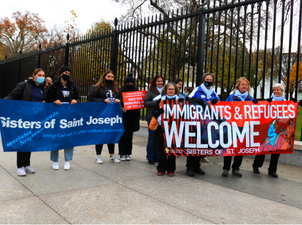
In solidarity with migrant-led organizations, President Biden’s continuation of these unjust border policies brought over 80 Catholic Sisters to Washington in early December to process prayerfully past the White House to protest these policies. In 2022, President Biden must significantly shift his administration’s border policies to align with our faith teaching to “love our neighbor.”

Every year of our 50-year existence, NETWORK has analyzed the voting records of Members of Congress, but we have never reflected on one year of a Catholic president’s administration. This is certainly a significant milestone for Catholic justice-seekers, even as the lived reality has included both progress and setbacks for our justice agenda.

President Biden has credited Jesuits and Catholic Sisters with keeping him Catholic, and he has taken office at a time when the vision of a Jesuit – Pope Francis – and the witness of Catholic Sisters offer him a roadmap to rebuilding solidarity, based in encounter. NETWORK advocates for policies that center people who have been pushed to the margins by our systems and structures. And Pope Francis calls us, individually and at the structural level, to seek out, encounter, and integrate those living on the periphery.

Joe Biden is the son of a working class Catholic family who prides himself on remembering his roots. The clear moral measure for his administration going forward is whether it has prioritized the struggles of individuals and families over powerful interests, whether at the border, the ballot box, or simply their day-to-day efforts to stay safe and healthy.

Transforming our politics from a system that upholds the status quo to one that honors the dignity of every person requires dismantling systemic racism, cultivating inclusive communities, and rooting our economy in solidarity. One year into the Biden administration, we can see with greater clarity than ever just how daunting these challenges are and how much work we have to do. We call on President Biden to join us in this necessary transformation.

Our Voting Rights Encounter: Sisters’ Prophetic Role in Ensuring the Health of Democracy

Our Voting Rights Encounter: Sisters’ Prophetic Role in Ensuring the Health of Democracy

Sr. Karen Berry, OSF
January 19, 2022

I have never felt that being a member of a Franciscan community and being a citizen of the U.S. were separate things. For instance, I have been working at polling places on election days for the past 21 years. But it was only in November of 2020 that I have ever experienced anger and hostility and mistrust of the voting procedures. I have very real fears for the future of our democracy.

My activism in seeking the passage of a voting rights bill is one more way I am trying to take a stand for equality, dignity, and fairness, and I am so proud that thousands of women religious around the country are in solidarity with this issue.

Being an introvert by nature, it isn’t comfortable for me to engage in the public square. However, I have learned that when values I hold deeply are being threatened, or when my country or my church are being less that I know they can be, I am willing to stand up, to speak, to write, to commit to whatever it takes to nudge civic and religious institutions in the direction of values Jesus and other religious leaders taught and lived.

Last summer, NETWORK reached out to Sisters around the country, asking them to sign a letter addressed to President Biden and Senate Majority Leader Chuck Schumer. The letter requested swift passage of the For the People Act to secure voting rights for all Americans. Over 3,600 Sisters signed it, and it was delivered in Washington on July 26. At that time, NETWORK also asked if I would be able to gather a representative group of Sisters in Tucson to present a copy of this letter, with all of its signatures, to our U.S. Senators’ offices in Tucson.

The Tucson Sisters who accompanied me were Franciscan Sisters Joneen Keuler (Wisconsin) and Carolyn Nicolai (New York), and Sr. Eileen Mahoney of the Congregation of St. Agnes from Wisconsin. All are longtime residents of Tucson, ministering in a variety of roles.

Sr. Joneen Kueler, OSF, Sr. Karen Berry, OSF, Sr. Carolyn Nicolai, OSF, and Sr. Eileen
Mahoney, CSA, meet with Ron Barber of Senator Mark Kelly’s office on August 6, 2021, to voice their support for voting rights legislation. Courtesy photo

We chose Friday, August 6, as our delivery date, not only because it was the 56th anniversary of the signing of the Voting Rights Act, which has been weakened through the federal courts and still faces attacks today, but also because it is the feast of the Transfiguration. We also knew that on that Friday morning we would be in solidarity with Sisters from West Virginia who were delivering the letter to the office of Senator Joe Manchin.

We were able to secure a time with the staff of Senator Mark Kelly, but Senator Sinema’s staff was unable to meet with us. Ron Barber, former Congressman and now a staff member for Senator Kelly, agreed to represent the Senator to receive the letter from us. Ron, a Catholic, had been seriously wounded along with Congresswoman Gabby Giffords — Senator Kelly’s wife — when they were shot in Tucson during a “meet your Congresswoman” event in 2011.

When we presented the letter, we offered a blessing prayer, and all in attendance joined in. I remember the warm welcome and the enthusiastic response when we asked the staff to join us in prayer. I felt profoundly moved by the sense of being unified with members of religious communities all across our country and also moved by the dedicated political staff praying with us.

We were deeply motivated to encourage the passing of a bill so greatly needed.

The letter stated: “Every voice and every vote is sacred.” It affirmed the need for the reforms written into the bill, stating, “The ‘For the People Act’ protects the vote from attacks and from those who seek to suppress it.” It has been disappointing that the For the People Act didn’t pass. We still have hope that its successor, the Freedom to Vote Act, will pass soon.

Religious communities have an important prophetic role in our world today. Just as the prophets of the past challenged religious leaders and kings, so members of religious communities today are called to awaken the consciences of the people in our church and in our nation.

Sr. Karen Berry, OSF is a Sister of St. Francis of Mary Immaculate. She lives in Tucson, Arizona.

Christians Should Honor Dr. King With United Witness on Voting Rights

Christians Should Honor Dr. King With United Witness on Voting Rights

Minister Christian Watkins
January 17, 2022

With Rev. Dr. Martin Luther King Jr.’s son calling for “No celebration without legislation,” the milestone of Dr. Martin Luther King Jr. Day resonates differently this year. Never in recent memory have voting rights been so hotly at the center of our country’s policy debate. The Senate has a historic opportunity to restore our democracy and protect our right to vote by passing the Freedom to Vote Act, and the John Lewis Voting Rights Advancement Act, which have now been combined into one bill, H.R.5746. We need immediate action to protect our democracy.

In his 1957 speech “Give Us the Ballot,” Rev. Dr. Martin Luther King, Jr. called the denial of the sacred right to vote “a tragic betrayal of the highest mandates of our democratic tradition.” With the passage of 34 laws restricting access to voting in 19 states across the country last year, this tragic betrayal is becoming a reality.

In the Senate, the filibuster has been used to block popular bills to stop lynching, end poll taxes, and fight workplace discrimination. The weaponization of the filibuster is racism cloaked in procedure. Now, this Jim Crow-relic is being used to block crucial voting rights protections. Today, Dr. King’s family is joining with faith leaders, civil rights leaders, and voting rights advocates to call on the Senate to end the filibuster and deliver on legislation that protects the right to vote.

This is a crucial moment for people of faith to come together around this issue, and it couldn’t be more apt. January 18-25 is the Week of Prayer for Christian Unity, an annual observance among Christians who want to see their collective witness in the world live up to the prayer of Jesus in John’s Gospel, “that they all may be one” (John 17:21). For over a century, this has primarily taken the form of theologians gathering to dialogue about issues that divide one church denomination from another — and in many cases finding commonalities and ways to bridge these divides.

But equally important is the pursuit Christian unity through what some call a “dialogue of service,” a shared witness to build up the common good. The commitment to upholding human dignity through the right to vote – and, , the election of leaders who will enact policies that build up the common good as Dr. King rightly pointed out – is something that should draw Christians across denominational lines very close together. Indeed, simply collaborating with my coworkers at NETWORK finds me, a United Methodist, working alongside a Catholic Sister and Presbyterian organizer to push Congress to protect the right to vote.

Now is the time to pass the H.R. 5746, the Freedom to Vote: John R. Lewis Act, a transformative piece of legislation that sets national standards to increase access to the ballot box, neutralizes partisan and racial gerrymandering, protects our elections from interference, increases transparency in campaign finance to prevent dark money from buying our politicians, and more. Unfortunately, this bill is at risk of being blocked by the filibuster. These anti-democratic efforts cannot be allowed to sabotage passage of robust voting rights legislation.